- Biogeography is the study of the distribution of species and ecosystems across geographic space and through time. It explains the patterns of life on Earth through the processes that shape them: past climates, plate tectonics and evolutionary history.
- Classical biogeography assumed stable environmental conditions: each region’s climate stayed roughly constant, so species ranges settled into a long-term equilibrium with their surroundings.
- Climate change has overturned this assumption. The environment now changes fast and often unpredictably, so species must respond in decades rather than over evolutionary time. The biogeography of climate change studies how past and present climate shifts redistribute life.
Climate and the Distribution of Life

Climate as the master control
- For most species, climate is not incidental but the critical determinant of distribution:
- temperature and precipitation decide which vegetation can grow in an area;
- vegetation, in turn, decides the animal life the area can support.
- Climate is thus the foundational control on a region’s whole biogeographic structure; vegetation and fauna are, in effect, downstream of climate.
- The world’s biomes follow the climatic regions, and Alexander von Humboldt (1807) showed that vegetation belts on a tropical mountain repeat the sequence from Equator to pole.
- Each species occupies a climatic envelope, the range of temperature and moisture it tolerates; other factors of distribution (soil, relief, competitors, history) set the finer limits.
From a stable to a moving baseline
- Two views of ecosystems frame the subject:
- the equilibrium model: a disturbed community soon returns to its original state, so ranges are fixed reference points;
- the non-equilibrium model: frequent external change keeps communities from ever settling, so ranges are moving targets.
- Resilience is the ability of an ecosystem to absorb change and still function. When change outruns resilience, the ecosystem becomes unstable; climatic change is the chief natural cause of such instability.
- The decisive variable is rate: if the environment changes faster than species can adapt or move, species decline and go extinct. This principle links the ice ages and present warming in one framework.
- Ranges were never truly fixed: they expanded and contracted with every past climatic swing. What is unusual now is the speed of change and the fragmented landscape in which species must respond.
Past Climate Changes and Biogeography
Climate and life through geological time
- Past climatic changes, often driven by the drift of continents, have repeatedly rebuilt the world’s flora and fauna.
| Period | Climatic event | Biogeographic outcome |
|---|---|---|
| Carboniferous–Permian (about 340–260 million years ago) | Ice sheets over much of Gondwana; cold, humid climates after deglaciation | The Glossopteris flora spread across Gondwana; its fossils occur in South America, Africa, India, Australia and Antarctica |
| End-Permian (252 million years ago) | Massive Siberian volcanism, extreme warming, ocean oxygen loss | The largest mass extinction: the great majority of marine species died |
| Triassic | Dry interior of the supercontinent Pangaea | Carboniferous swamp forests gave way to sparse desert vegetation; cycads, conifers and ferns survived |
| Cretaceous | Mountain building, sea-level change and shifting climates created new habitats | Flowering plants spread rapidly and came to dominate |
| End-Cretaceous (66 million years ago) | Asteroid impact (Chicxulub), with Deccan Traps volcanism; sudden “impact winter” | About three-quarters of species, including the non-avian dinosaurs, died |
| Neogene (about 8–6 million years ago) | Cooling, drying and a stronger monsoon contrast | Grasslands spread; soils of the Siwaliks record forest giving way to grassland |
| Quaternary (from 2.58 million years ago) | Repeated glacial–interglacial cycles | Ranges repeatedly contracted into refugia and re-expanded |
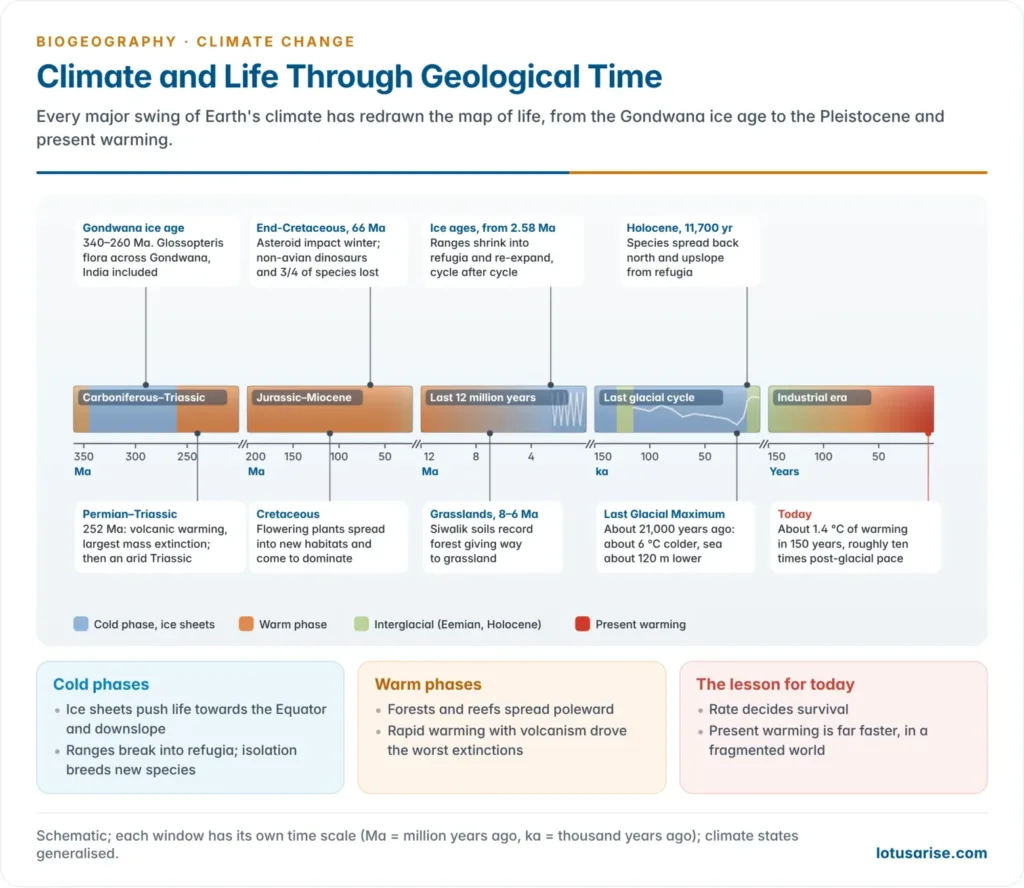
- Gondwanan India carries this record: the Gondwana coal of the Damodar, Son and Godavari valleys holds Glossopteris fossils shared with the southern continents.
- Tertiary mountain building (the Rockies, Andes, Alps and Himalaya) created new climates and new barriers, and so new centres of speciation.
Pleistocene glaciations and refugia
- The Pleistocene glaciations brought dozens of glacial–interglacial cycles, each lasting about 100,000 years in the last million years.
- At the Last Glacial Maximum (LGM), about 21,000 years ago:
- ice sheets covered Canada, Scandinavia, the Baltic and northern Britain;
- the world was about 6 °C colder, and sea level about 120 m lower, which exposed land bridges such as Beringia and the Sunda Shelf;
- the tropics were cooler and drier, and the Indian monsoon was weaker.
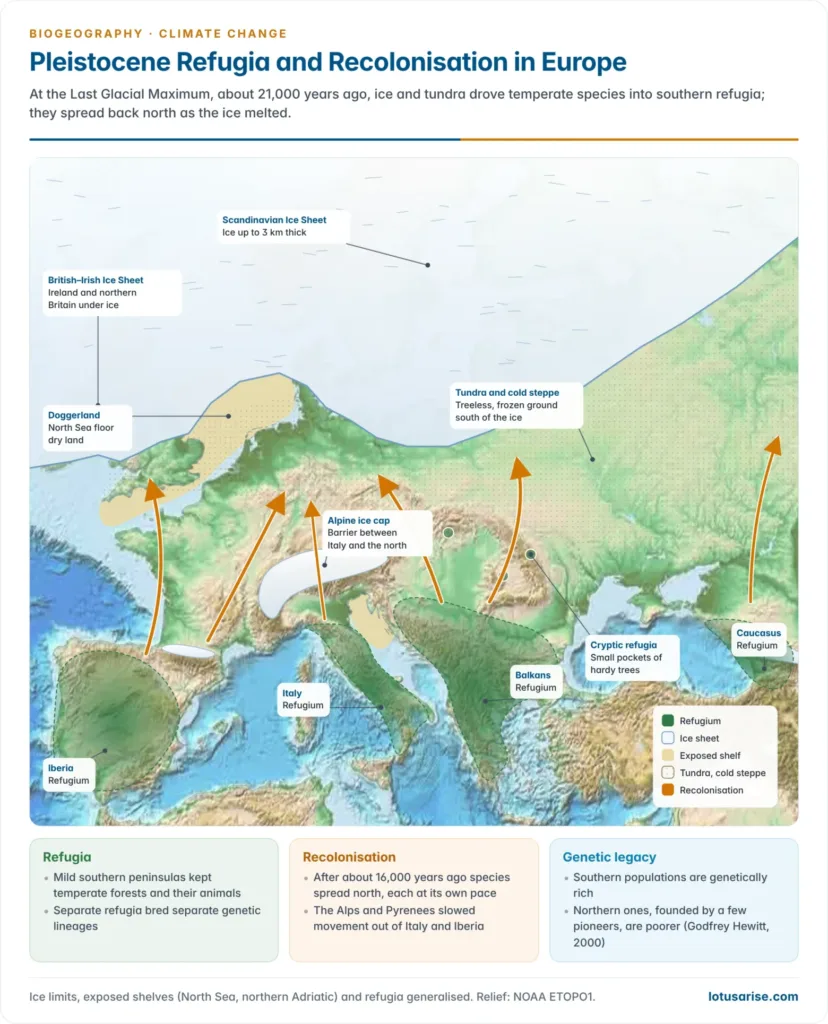
- Species moved towards the Equator and downslope, or survived in refugia: areas where a favourable climate persisted while the surrounding region became hostile.
- Main refugia:
- Europe: the three southern peninsulas, Iberia, Italy and the Balkans, with the Caucasus; small “cryptic” northern pockets also sheltered hardy trees.
- North America: south of the Laurentide ice sheet, and ice-free Beringia.
- Tropics: Jürgen Haffer (1969) proposed that Amazonian forest broke into islands during dry glacial phases and that isolation drove bird speciation. Pollen cores later showed much of the forest persisting, so the refugia hypothesis is now only partly accepted.
- India: wet evergreen forest shrank to the moist southern Western Ghats and the north-east. A wetter, cooler past climate across central India explains the species shared by these two regions.
- Low sea level joined India and Sri Lanka across the Palk Strait, which is why the two share so many species.
- Glacial cycles were creative as well as destructive: isolation in separate refugia split populations and drove the formation of new species and subspecies.
- At the end of the last glacial, mammoths, giant ground sloths and other megafauna died out. Paul S. Martin (1967) blamed human overkill; others stressed climatic change, which sharpened competition for food and shelter. Most researchers now see both acting, with their weight varying by continent.
Post-glacial recolonisation
- Warming after the LGM, and the Holocene from 11,700 years ago, let species spread back from refugia towards the poles and upslope.
- Each species moved at its own pace. Trees whose seeds jays and other birds carried spread fastest; slow dispersers still lag behind the climate.
- Communities therefore reassembled species by species, not as whole biomes moving together.
- Godfrey Hewitt (2000) showed the genetic legacy of these journeys: southern refugial populations are genetically rich, while recolonised northern populations, founded by a few pioneers, are genetically poorer.
- In the Himalaya, the treeline and alpine meadows climbed as glaciers retreated.
Present Warming as a Driver
Climate change as a driver of biogeographic change
- Climate change is now one of the most significant drivers of biogeographic change. Global warming is redrawing the thermal landscapes, the patterns of temperature and moisture within which species evolved.
- Current warming: 2024 was the warmest year on record, and the WMO placed 2025 at about 1.43 °C above the pre-industrial level. The eleven years 2015–2025 were the eleven warmest on record.
- The pace is what is new. Global temperature has risen faster since 1970 than in any 50-year period of at least the last 2,000 years, roughly ten times faster than the warming after the last glacial.
- IPCC AR6 Working Group II (2022):
- about half of the species assessed have shifted polewards or, on land, to higher elevations;
- seasonal timing has shifted;
- climate change has caused local losses, mass mortality events and the first climate-driven extinctions.
Shrinking and shifting habitats
- As temperatures rise, the optimal habitats of many species are shifting. Species of polar regions and mountains find their habitats shrinking.
- Such species are typically forced to migrate in search of suitable conditions:
- towards higher latitudes, or
- towards higher altitudes.
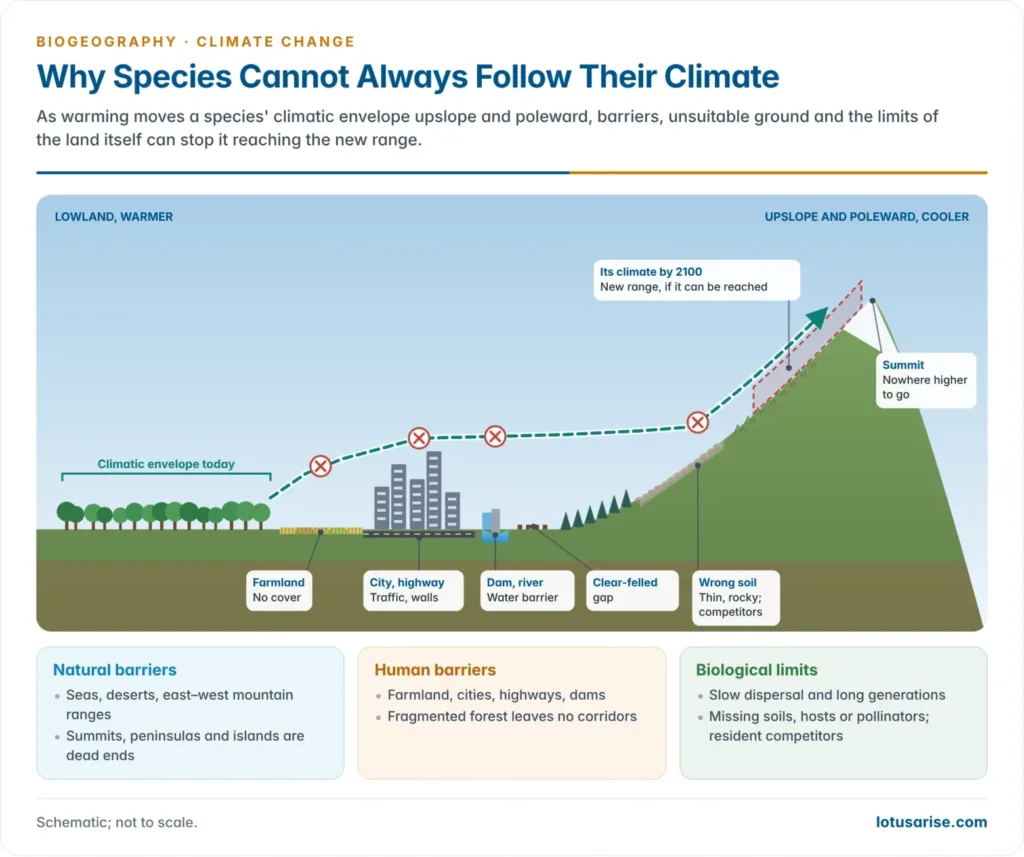
- Migration is not always possible:
- geographic barriers block the way: oceans, mountain ranges, urbanised land and fragmented habitats;
- no suitable habitat may exist further on: a species near a mountain summit or a polar coast has nowhere left to retreat.
- Where migration is blocked or too slow, the result is population decline and, in extreme cases, local or complete extinction.
Three responses: move, adapt or die
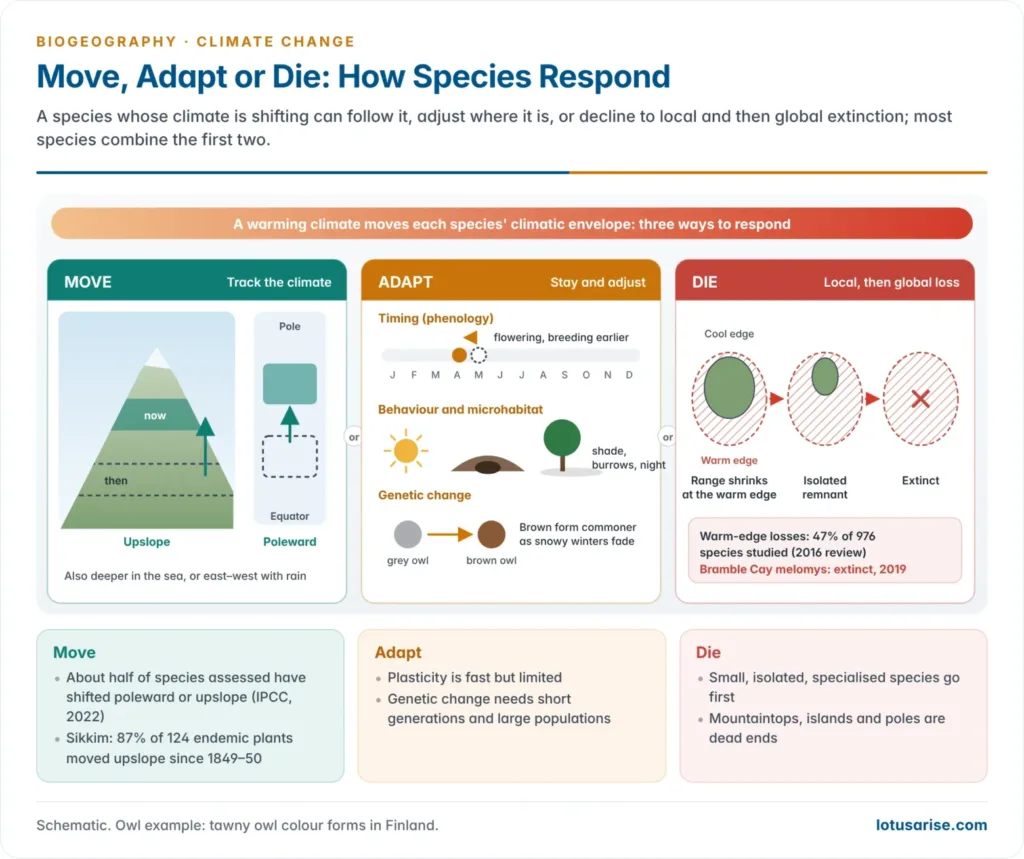
- A species facing a changing climate has only three options, and real species usually combine them.
- Move: track its climatic envelope by shifting its range; this is the commonest observed response.
- Adapt in place:
- plasticity: shifting the timing of flowering, breeding or migration, which is phenology;
- behaviour and microhabitat: using shade, burrows, cooler slopes or night-time activity;
- genetic adaptation: possible mainly in species with short generations and large populations. In Finland, the brown colour form of the tawny owl has become commoner as snowy winters have declined.
- Die: local extinction at the warm edge of the range comes first, then global extinction once no population survives.
- A 2016 review found climate-related local extinctions in 47% of 976 species studied.
- The Bramble Cay melomys, a rodent of a low Torres Strait cay, was declared extinct by Australia in 2019, the first mammal lost to climate change.
Range shifts and species migration
- Range shifts, the movement of a species’ distribution as it tracks its preferred conditions, are the most direct and best-documented effect of climate change on biogeography.
- Latitudinal shifts: species move poleward, following isotherms that are themselves moving to higher latitudes. Many land and sea species are expanding their ranges northward in the Northern Hemisphere.
- Altitudinal shifts: in mountains, species climb to higher elevations to stay within their thermal comfort zone.
- Sikkim Himalaya: 87% of 124 endemic plants studied have shifted upslope since Joseph Dalton Hooker’s records of 1849–50.
- Longitudinal shifts: some species move east or west, tracking rainfall or suitable microclimates. Moisture, not only temperature, steers range shifts.
- Depth shifts: marine fish move into deeper, cooler water where they cannot move poleward.
Biome boundaries on the move
- Whole biome edges are shifting as well as single species:
- Arctic greening: shrubs and trees are spreading into the tundra, which darkens the surface and adds to warming;
- treelines are rising on many mountains, though more slowly than the isotherms, because trees need decades to establish;
- tropicalisation: warm-water fish, corals and seaweeds are moving into temperate seas off Japan, Australia and the Mediterranean, while coral reefs bleach at their warm limits.
- In India, the Himalayan treeline and alpine meadows are the clearest land case, and the coral reefs of Lakshadweep and the Gulf of Mannar the clearest marine one.
Constraints on Range Shifts: Why Migration Is Not Uniform
What limits a species’ movement
- Range shifts are not uniform across species. Success in relocating depends on several factors:
- Dispersal ability: how far and how fast a species can move, as a flying bird can and a rooted plant cannot;
- Life-history traits: reproductive rate, generation time and ecological flexibility, which decide how fast a species can establish in new areas;
- Ecological corridors: continuous habitat linking the present range to new habitat, without which even a mobile species may be unable to relocate.
- Further constraints:
- Velocity of climate change: isotherms are moving at a global average of about 0.42 km a year (Scott Loarie and colleagues, 2009), faster still on flat lowlands. Many plants spread far more slowly.
- Barriers: natural (seas, deserts, mountain ranges running east–west) and human (farmland, cities, roads, dams).
- Non-climatic needs: a suitable soil, host plant or nesting site may be missing in the climatically suitable area.
- Biotic interactions: pollinators, prey or symbionts may not move with the species, and established competitors may block the newcomer.
- Geometry: land area shrinks towards mountain summits, and peninsulas and islands end at the sea.
- Indian examples: endemics of the Nilgiri and Anamalai “sky islands” have no higher peaks to climb, and the Western Ghats chain ends at the sea in the south. In the Sundarbans, rising seas squeeze mangrove species against farmland and embankments.
Climate-induced extinctions
- Species with limited dispersal, such as many plants that spread only by seed, and flightless animals, often cannot keep pace with present warming.
- This mismatch between the pace of climate and the pace of species movement underlies concern over climate-induced extinctions. Species die not from climatic stress alone but from failing to reach suitable habitat in time.
- Extinctions often lag behind the change: small, isolated populations may persist for decades in a doomed range, an extinction debt.
- IPCC AR6 projects that 3–14% of land species assessed face a very high risk of extinction at 1.5 °C of warming, rising to 3–18% at 2 °C and 3–29% at 3 °C. Endemics of biodiversity hotspots are the most exposed.
| Likely winners | Likely losers |
|---|---|
| Generalists with broad climatic tolerance | Specialists tied to one habitat, host or food |
| Strong dispersers (many birds, flying insects, wind-dispersed plants) | Poor dispersers (many plants, amphibians, flightless animals) |
| Short generations, fast reproduction | Long-lived, slow-breeding species |
| Lowland and widespread species | Mountaintop, island, polar and coastal endemics |
| Many invasive weeds and pests | Species in fragmented landscapes |
Climate change as a filter
- The biogeography of climate change replaces the old assumption of stability with a picture of dynamic, continuing redistribution of life.
- Warming reshapes thermal landscapes and drives latitudinal, altitudinal and longitudinal shifts. Because the ability to shift is uneven, climate change does not merely relocate biodiversity but actively filters it.
- Species with poor mobility or fragmented habitats face disproportionate risk of decline and extinction.
- The past offers both hope and warning. Species survived the ice ages by moving and finding refugia, but they did so through unbroken landscapes and at a slower pace of change.
- This makes the subject a key lens for conservation strategies: keeping corridors open, protecting climate refugia and planning for moving ranges.
Previous Year Questions
- No direct PYQ has been asked on this sub-topic yet.