

Proofs for the Existence of God and their Critique (Indian and Western).
Official Syllabus: Paper II, Section B, Unit 2
The proofs for God were developed in two great traditions that hardly knew each other. In Europe, Anselm, Aquinas, Leibniz, Paley and Kant built and attacked the ontological, cosmological, teleological and moral arguments (Articles 2–6). In India, Udayana and the Naiyāyikas built a rival edifice of inference, Yoga argued from the degrees of knowledge, the Vedāntins rested God on scripture, and the Cārvāka, Mīmāṃsā, Jaina, Buddhist and Sāṃkhya critics attacked every proof (Articles 7–9). This article puts the two traditions side by side: Aquinas’s Five Ways and Udayana’s proofs point by point, the kāryāt argument and the design argument, why India has no ontological argument, how Kant and the Vedāntins both set limits to reason, how Hume and the Indian sceptics make the same objections, and finally the larger question — do the proofs succeed? — with the modern cumulative-case approach and the place of proof in religious life.
In simple words
Two engineers in different countries, who never met, try to build a bridge across the same river. One uses steel, the other bamboo. When you compare their designs you find the same problems — where to anchor, how to bear weight, how to cross the deepest part — and some different solutions. The proofs for God are like that. Aquinas and Udayana never met, yet both try to cross from the world we see to a God we cannot see — and both run into the same gap at the deepest point.
Context & Problem
Two Traditions, One Question
- The shared question. Can the existence of a supreme, intelligent cause of the world be known by reason, and if so, how?
- The Western frame. Proofs are classified as a priori (from the concept of God alone — the ontological argument) and a posteriori (from features of the world — cosmological, teleological, moral). Natural theology (proof by reason) is distinguished from revealed theology (truth by revelation).
- The Indian frame. Proofs are classified by the pramāṇa used: perception (pratyakṣa), inference (anumāna), testimony (śabda). Nyāya proves God mainly by inference; the Vedāntins mainly by śabda; the critics deny that any pramāṇa reaches God.
- Why compare? To see which arguments are universal responses of reason to the world and which depend on a particular metaphysics — Aristotle’s physics in one case, Vaiśeṣika atomism and karma in the other.
A Priori and A Posteriori: The Basic Distinction
- A priori arguments start from the idea of God and reason deductively to his existence. Example: Anselm’s “that than which nothing greater can be conceived” (Article 2).
- Strengths — if valid and sound, they give a necessary, certain conclusion; they do not depend on disputable facts about the world.
- Weaknesses — they seem to define God into existence; Kant objects that existence is not a property added to a concept, and that from the idea of God follows only the idea of his existence; empiricists find them abstract and unpersuasive.
- A posteriori arguments start from experienced facts — motion, causation, contingency, order, conscience — and argue inductively or as an inference to the best explanation to God (Articles 3–6).
- Strengths — rooted in observable reality; intuitive; they engage science and cosmology (the beginning of the universe, fine-tuning).
- Weaknesses — their conclusions are at best probable; they move from finite effects to an infinite cause; they are open to scientific reinterpretation (Darwin, the multiverse) and to the problem of evil.
| Point | A priori (ontological) | A posteriori (cosmological, teleological, moral, Nyāya) |
|---|---|---|
| Starting point | The concept of God | Facts about the world |
| Method | Deduction; analysis of meaning | Induction, analogy, best explanation |
| Kind of certainty | Claims necessity | At most probability |
| Main danger | Turning a definition into a fact | Leaping from finite data to an infinite God |
| Classic critic | Kant: existence is not a real predicate | Hume: weak analogy, no experience of world-making |
| Indian presence | Almost absent | Central (Nyāya’s anumāna) |
- Which is to be preferred? The question has no single answer, and the reasons on each side are instructive.
- For the a posteriori. Most philosophers find them more persuasive, because they begin from what everyone accepts and connect with scientific reasoning; Indian theism is entirely of this type.
- For the a priori. Only an a priori argument could show that God exists necessarily — and a God who merely happens to exist would not be the God of religion. Kant himself argued that the a posteriori arguments depend on the a priori one: the cosmological argument needs the idea of a necessary being, and the design argument needs the cosmological.
- A balanced view. The a posteriori arguments show that the world raises the question of God; the a priori argument shows what kind of answer God would be. Neither, taken alone, compels belief; together with experience and faith they make belief reasonable for many and unproved for others.
In simple words
Ask two detectives whether a guest stole the necklace. The first says, “By definition the thief is the person who had the key, and only the butler had the key” — neat, certain, but only as good as the definition. The second says, “The window was forced, mud on the carpet matches the butler’s shoes” — messier, never certain, but tied to real evidence. The a priori proof is the first detective; the a posteriori proofs are the second.
Core Doctrine
1. Aquinas and Udayana: The Five Ways and the Nyāya Proofs
(a) The two thinkers
- Thomas Aquinas (13th century, Summa Theologiae) gives five ways to God, all a posteriori, built on Aristotle‘s physics of motion, causes and purposes. The conclusion of each: “and this everyone understands to be God” (Article 3).
- Udayana (10th–11th century, Nyāyakusumāñjali, “a handful of flowers of reasoning”) gives nine proofs, built on Vaiśeṣika atomism, the theory of number, the authority of the Veda and the law of karma (Article 7).
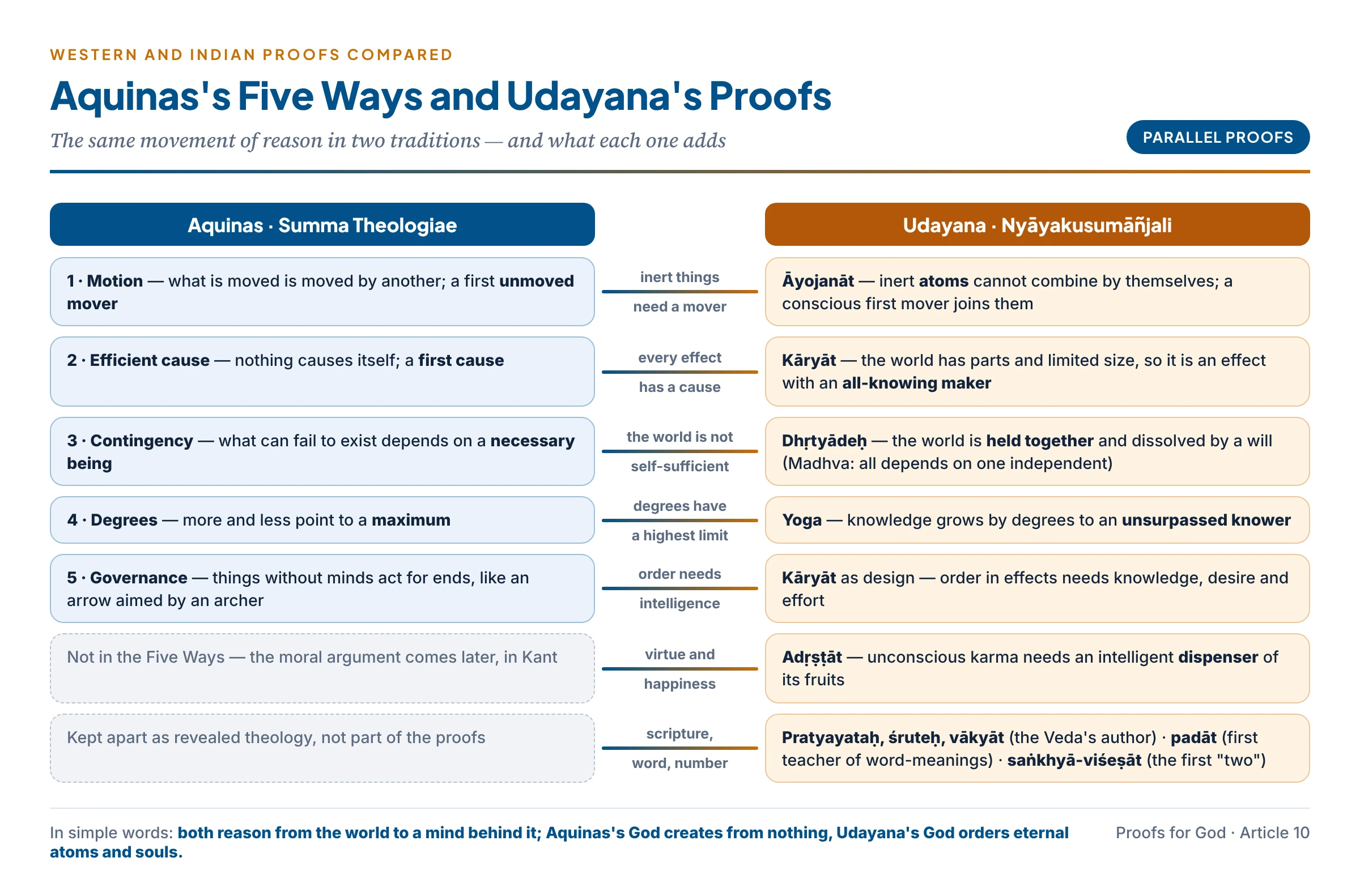
(b) Point-by-point comparison
| Aquinas | Udayana / Indian parallel | What is the same | What differs |
|---|---|---|---|
| First way — motion (an unmoved first mover) | Āyojanāt — inert atoms need a first mover to combine | Inert things do not start moving by themselves | Aristotle’s potency and act vs Vaiśeṣika atoms and adṛṣṭa |
| Second way — efficient causes (a first cause) | Kāryāt — the world is an effect, so it has an intelligent maker | Every effect needs a cause | Aquinas: a first cause of a chain; Udayana: an intelligent maker of each whole effect |
| Third way — contingency (a necessary being) | Dhṛtyādeḥ (the world is held together and dissolved by a will); Madhva’s argument from dependence | The world is not self-sufficient | No exact Nyāya parallel: atoms and souls are themselves eternal and necessary |
| Fourth way — degrees of perfection (a maximum) | Yoga‘s argument from degrees of knowledge to an omniscient being; the Jaina omniscient | What has degrees has a highest limit | Aquinas’s maximum is the source of being; Yoga’s is a special self, not a creator |
| Fifth way — governance (things act for ends) | Kāryāt in its design form; Śaṅkara’s argument against an unconscious pradhāna | Order towards ends needs intelligence | — |
| Not in the Five Ways | Adṛṣṭāt — karma needs an intelligent dispenser | Close to Kant’s moral argument: happiness must match virtue | Moral governance is a proof in Nyāya, a postulate in Kant |
| Not in natural theology | Pratyayataḥ, śruteḥ, vākyāt — the Veda needs an omniscient author | Aquinas too accepts revelation, but as revealed theology, not proof | Nyāya puts scripture inside the proof |
| No parallel | Padāt (word-meanings first taught) and saṅkhyā-viśeṣāt (the first number “two”) | — | Distinctively Indian, rooted in Nyāya theories of language and number |
(c) Deeper similarities
- Both are a posteriori — they start from the world, not from the idea of God; both reject or ignore the ontological argument (Aquinas explicitly rejects it).
- Both use causal reasoning and both deny an infinite regress of dependent causes.
- Both conclude to a personal God — intelligent, willing, all-knowing, one.
- Both defend God against critics — Aquinas states objections and replies in his articles; Udayana writes the whole Kusumāñjali as replies to atheists.
- Both face the same objections — Hume and the Cārvāka both ask for the experience of a world being made; Kant and the Buddhists both question applying causation beyond experience.
(d) Deeper differences
- Creation vs ordering. Aquinas’s God creates the world from nothing and is the cause of its very being. Udayana’s God orders eternal atoms, souls, space and time; he is the efficient cause only — an architect, not the source of being.
- Necessity. For Aquinas only God is necessary; everything else is contingent. For Nyāya, atoms and souls are eternal too — so the argument from contingency has nothing to grip.
- Karma. The Nyāya God works with karma; much of his role is moral administration. Aquinas’s God is governor by providence, but there is no karmic law that he executes.
- Scripture. Aquinas separates natural theology (the Five Ways) from revealed theology; Nyāya places the Veda inside the proofs.
- Metaphysical base. Aquinas depends on Aristotelian physics (motion as potency becoming act); Udayana on Vaiśeṣika physics (atoms, dyads, number, adṛṣṭa). When the physics is doubted, each argument must be restated.
- The God reached. Aquinas’s God is the Christian Trinity only through revelation; the Five Ways prove a first cause “everyone calls God”. Udayana’s God is Śiva or Maheśvara in devotion, but philosophically a supreme self among selves.
Indian Connect — Which is stronger?
- Aquinas is more formal and more independent of scripture; his third way raises the deepest question — why anything exists at all.
- Udayana is more comprehensive — he adds a moral argument and arguments from language and number — and more tightly logical within Nyāya’s rules of inference.
- Both fall short of a demonstration for the same reason: the step from familiar causes to an all-knowing, unique cause is not secured by experience.
2. Kāryāt and the Design Argument
- The shared core. Both argue that order needs a mind: as a pot has a potter and a watch has a watchmaker, the world has a maker (Articles 5 and 7).
- Differences of form.
- Paley argues by analogy and probability: the eye is like a watch, only more intricate; so its maker is like a watchmaker, only greater.
- Udayana argues by inference with a stated universal rule — “whatever is an effect has an intelligent maker” — and a strict list of what counts as an effect (things with parts and limited size).
- Udayana adds that the maker must know the atoms directly — so he must be omniscient; Paley moves to omniscience only by suggestion.
- Shared objections.
| Objection | Western form | Indian form |
|---|---|---|
| No experience of world-making | Hume: we have seen houses built, never worlds | Cārvāka, Kumārila: no one saw creation; no vyāpti for mountains |
| Many makers | Hume: a ship is built by many workmen | Jaina: bees build one hive, ants one anthill |
| A limited maker | Kant: design proves an architect, not a creator | Internal Nyāya critique: God limited by co-eternal atoms |
| Embodied makers | Hume: makers we know have bodies and brains | Jaina and Mīmāṃsaka: a bodiless maker is unknown |
| Order without mind | Darwin: natural selection | Svabhāva (Cārvāka), unconscious Prakṛti (Sāṃkhya), karma (Buddhist) |
| Evil | Hume, Mill: a flawed or limited designer | Kumārila, Jainas: why create a painful world? |
3. Why India Has No Ontological Argument
- The fact. Classical Indian philosophy has no close equivalent of Anselm’s argument — no school tries to prove God’s existence from the concept of God alone.
- Reasons.
- Pramāṇa epistemology. Indian thinkers ask by which means of knowledge something is known. A concept is not a pramāṇa; knowledge of existence must come from perception, inference or testimony. An argument that moves from an idea to a fact would look like a confusion of thought with reality.
- Inference needs an example. Nyāya inference requires a known instance where the rule holds (the kitchen for smoke and fire). There is no instance where a concept’s content guarantees the existence of its object.
- Existence is not a quality. In Vaiśeṣika, existence (sattā) is the highest universal shared by substances, qualities and actions — not a perfection that some things lack and God has more of. This is close to Kant‘s point that existence is not a real predicate.
- The Buddhist logicians held that names and concepts are constructions (vikalpa) that never reach the real particular; a conceptual argument could never prove a real thing.
- Theistic Vedānta turns to scripture for God’s nature, so it has no need of a purely conceptual proof.
- Near-parallels.
- Yoga‘s argument — knowledge has degrees, so there must be an unsurpassed knower — is sometimes called “ontological”; it is really an argument from gradation, like Aquinas’s fourth way.
- Advaita‘s self-evidence of the self: no one can doubt “I am”, since the doubter exists. Śaṅkara says no one thinks “I am not”. This resembles Descartes’s cogito and the idea of a being whose non-existence is inconceivable — but it concerns the self (which Advaita identifies with Brahman), not an inference from the concept of a perfect being.
- Madhva‘s and Rāmānuja’s God has infinite auspicious qualities — but his existence is known from the Veda, not deduced from his perfection.
Common confusion
Is there an “ontological argument” in Patañjali’s Yoga Sūtra? Some notes say so, because Yoga argues for a being of unsurpassed knowledge. But the Yoga argument does not deduce God’s existence from the concept of a perfect being. It starts from an observed fact — knowledge exists in degrees in different people — and argues that what has degrees has a highest limit. That is an argument from gradation, like Aquinas’s fourth way, not an ontological argument like Anselm’s.
4. Kant and the Vedāntins: The Limits of Reason
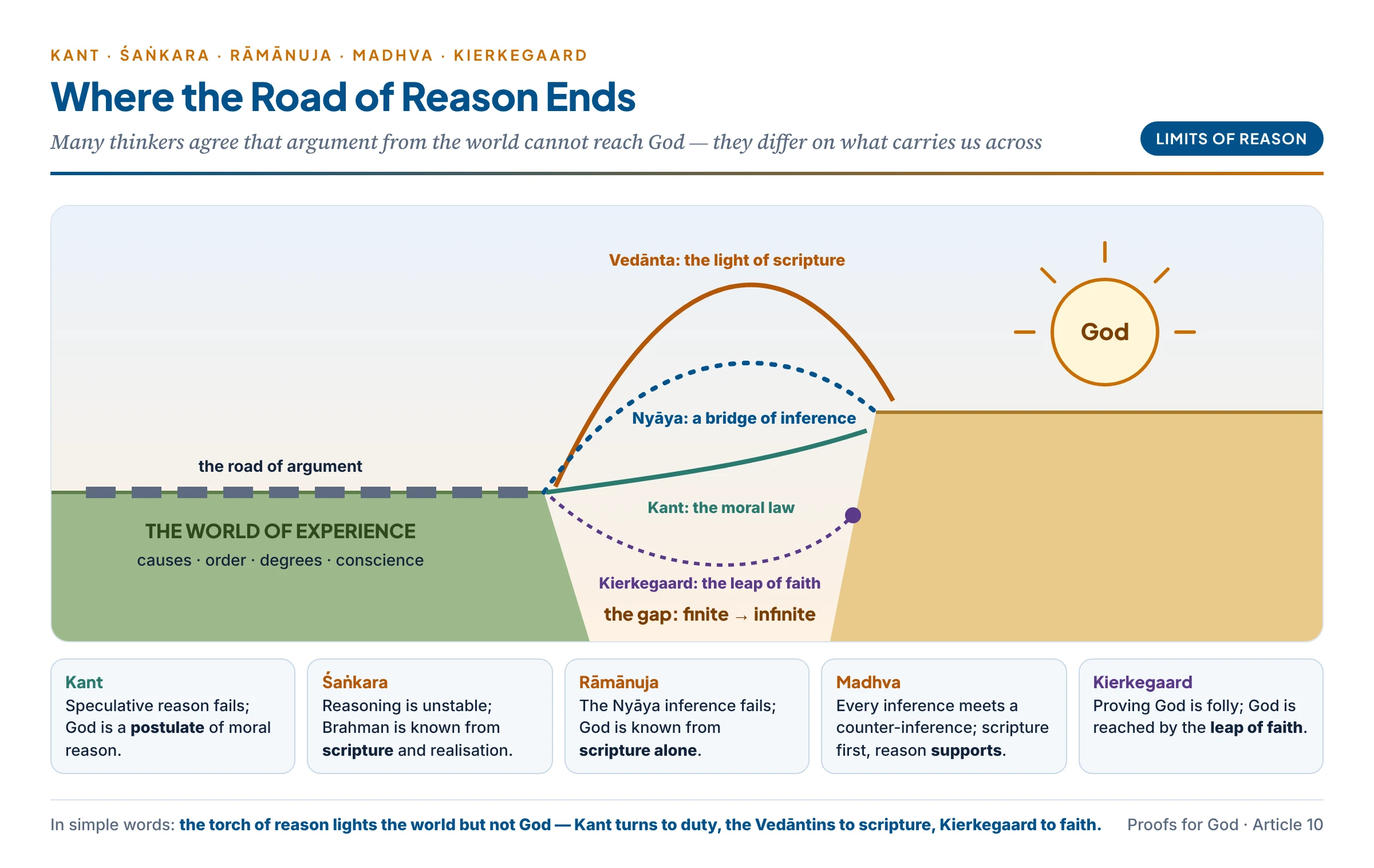
- Kant. Theoretical reason cannot prove God: the ontological argument confuses concepts with existence; the cosmological argument needs the ontological; the design argument needs the cosmological. Causality applies only within experience. God is not known but postulated by practical (moral) reason — “I had to deny knowledge in order to make room for faith” (Article 6).
- Śaṅkara. Brahman is known from scripture (śāstrayonitvāt, “because scripture is the source”). Mere reasoning is unstable — a clever arguer can always be refuted by a cleverer one (tarkāpratiṣṭhānāt). Reason has a place only in support of scripture. Yet Śaṅkara uses a design-type argument against Sāṃkhya: unconscious Prakṛti cannot produce an ordered world (Article 8).
- Rāmānuja. Neither perception (ordinary or yogic) nor inference reaches God. The Nyāya inference fails: the world was not produced at one time or as one whole; its things are not uniform like pots; souls of great merit could make it; makers we know are embodied and limited; and the argument would prove many makers rather than one. So God is known only from scripture (śāstraika-pramāṇa).
- Madhva. Every inference for God can be met by a counter-inference; reason can show God’s possibility and support scripture with arguments from dependence and order, but the Veda is the primary proof (Article 8).
- Kierkegaard. “If God does not exist, it would be impossible to prove it; and if he does exist, it would be folly to attempt it.” God is reached by the leap of faith (Article 1).
| Thinker | Can reason prove God? | What reaches God instead? | Role left for reason |
|---|---|---|---|
| Kant | No — speculative reason overreaches | Moral faith: God as postulate of practical reason | Criticises proofs; regulates enquiry |
| Śaṅkara | No — reasoning is unstable | Śruti and realisation (anubhava) | Supports scripture; refutes rivals |
| Rāmānuja | No — the Nyāya inference fails | Śruti alone | Clarifies scripture |
| Madhva | Not alone — counter-inference always possible | Śruti, supported by reason | Shows possibility; supports |
| Kierkegaard | No — proof is folly | Faith, the leap | None in the decisive step |
| Nyāya (contrast) | Yes — by inference | Inference and Veda together | Primary |
In simple words
Think of reason as a torch. It lights up the room you stand in — the world of experience. Point it out of the window into the night sky and the beam fades long before it reaches the stars. Kant and the Vedāntins agree that the torch of reason cannot reach God. They disagree about what does: Kant says the moral law within us; Śaṅkara, Rāmānuja and Madhva say the revealed Word; Kierkegaard says the leap of faith.
5. Hume and the Indian Sceptics
- One pattern of criticism. Hume’s Dialogues and the Indian critics independently reach almost the same objections:
- No experience of the cause → Hume: we never saw a world made; Cārvāka: no vyāpti for mountains.
- Many makers → Hume: a ship built by many; Jaina: bees and ants.
- Who made the maker? → Hume: the designer’s mind also needs explaining; Jaina and Buddhist: if every effect needs a cause, so does God; Dharmakīrti: if atoms need a controller because they start after a rest, so does God.
- Nature may be enough → Hume: matter may order itself (the Epicurean hypothesis); Cārvāka svabhāva; Sāṃkhya Prakṛti.
- Evil → Hume and Mill; Kumārila, the Jainas, the Jātaka.
- Differences. Hume ends in suspended judgement — the cause of order “probably bears some remote analogy to human intelligence”. The Indian critics usually end with a positive alternative: karma, svabhāva, Prakṛti, dependent origination, or an uncreated cosmos of eternal substances.
6. The Cosmological Argument East and West
- Western forms. Aquinas’s first three ways; the Kalām argument of al-Ghazālī and Craig (the universe began, so it has a cause); Leibniz‘s principle of sufficient reason; Clarke‘s dependent and self-existent being (Articles 3–4).
- Indian forms.
- Nyāya — the world as an effect needs an intelligent efficient cause (God is only the efficient cause; atoms are the material cause).
- Advaita — Brahman is both the material and efficient cause, but the world is an appearance (vivarta) of Brahman, not a real product.
- Viśiṣṭādvaita — Brahman is both causes, and the world is his real transformation, as his body.
- Dvaita — the world is real and dependent; Viṣṇu is its efficient cause only; matter (Prakṛti) is the material cause.
- What both traditions share. The world is not self-explanatory; a regress of dependent causes cannot end in nothing; the first cause must be intelligent.
- What differs. The West often argues to a beginning of the universe (Kalām) or a ground of being (Aquinas, Leibniz). India, holding the world-process to be beginningless, argues to an ever-present controller of cycles of creation and dissolution.
Common confusion
Is God both the material and the efficient cause of the world in all Indian theism? No. Some notes state that “in Nyāya and Vedānta, God is both the material cause and the efficient cause of the world”. This is true of Advaita (Brahman as the ground of the world-appearance) and Viśiṣṭādvaita (Brahman transforming as his body). It is false for Nyāya, where God is only the efficient cause and eternal atoms are the material cause, and for Madhva, where Viṣṇu is only the efficient cause and Prakṛti is the material cause — Madhva explicitly denies that God changes into the world.
7. Do the Proofs Succeed?
(a) The verdict of the critics
- Hume — the proofs overreach experience; at most a vague cause of order.
- Kant — speculative proofs fail; God is a matter of moral faith.
- Russell (in the 1948 radio debate with Copleston) — “the universe is just there, and that’s all“; demanding a cause of the whole is a mistake.
- J.L. Mackie — every argument fails, and the problem of evil counts against theism.
- The Indian critics — no pramāṇa reaches God (Article 9).
(b) The defenders’ replies
- Copleston — the question “why is there something rather than nothing?” is a real question; to refuse it is to stop thinking.
- The new versions — modal ontological arguments (Plantinga), the Kalām argument with Big Bang cosmology, fine-tuning arguments (Articles 2, 4, 5) — show that the debate is alive, not closed.
- Udayana’s spirit — reason can at least remove objections and show that belief in God is not irrational.
(c) The cumulative case (Swinburne)
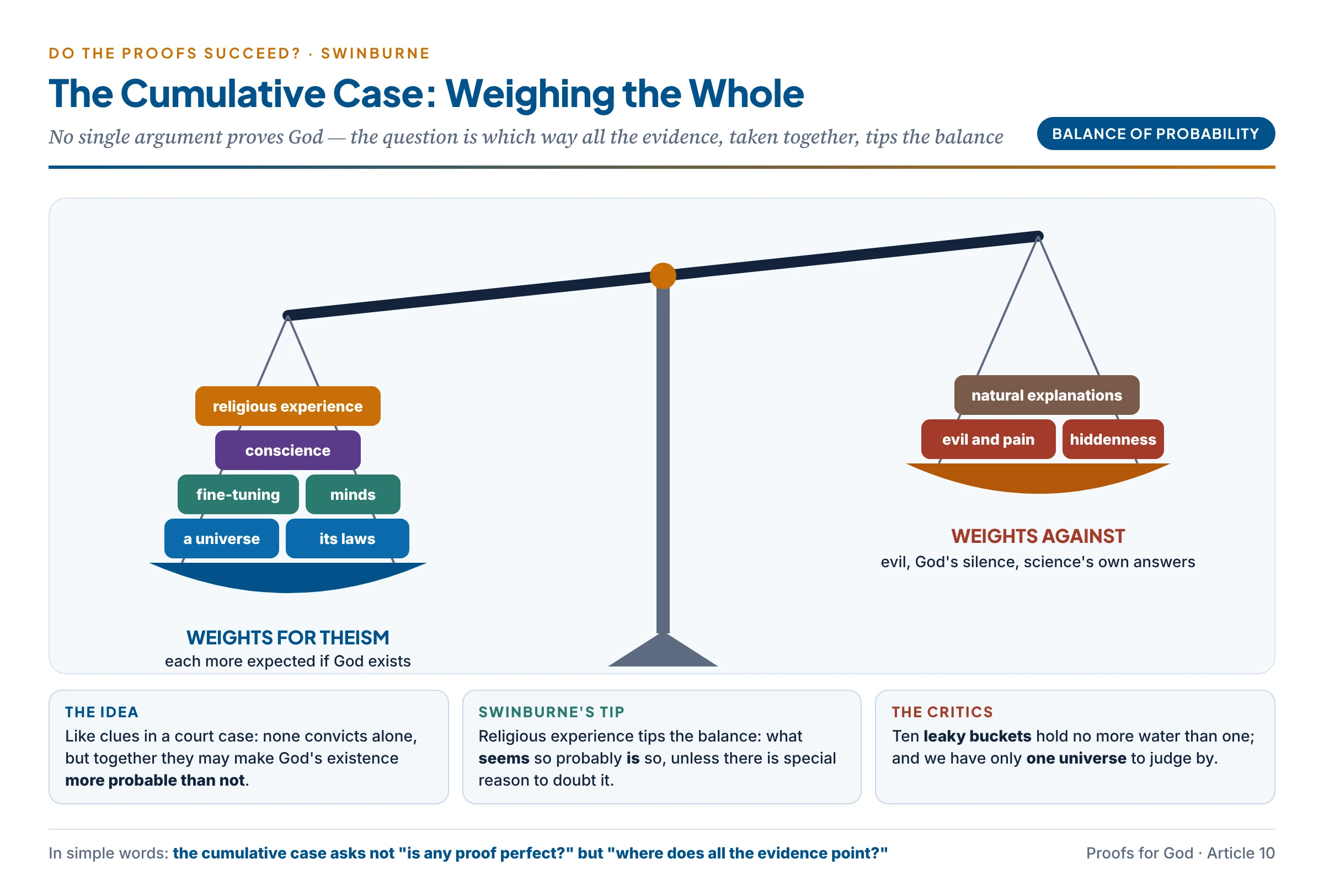
- The idea. No single argument may prove God, but several weak arguments together may make God’s existence more probable than not — as in a court case, where no single clue convicts but many clues together do.
- Swinburne’s procedure. Start from the existence of a universe, its orderly laws, its fine-tuning for life, the existence of conscious, moral beings, providence and religious experience. Each fact is more to be expected if God exists than if he does not. Put together, they tilt the balance towards theism. The problem of evil weighs on the other side. Religious experience then tips the balance, by the principle of credulity: what seems to be so probably is so, unless there are special reasons for doubt.
- Criticisms.
- Ten leaky buckets do not hold water better than one — if each argument is unsound, adding them gives nothing.
- Probabilities about the whole universe have no comparison class — we have only one universe.
- Evil may weigh more than Swinburne allows.
- The God made probable may be less than the God of worship.
In simple words
A rope is made of many thin threads. No single thread could hold a climber, but twisted together they hold far more than any one of them. Swinburne thinks the arguments for God work like the threads of a rope. His critics reply that the arguments may be more like leaky buckets: if each one leaks, stacking ten of them inside one another still will not hold water. Whether the proofs are threads or buckets is exactly what the debate is about.
- An Indian analogue. Udayana’s nine proofs, offered together, function like a cumulative case; and the Yoga, Nyāya and Vedānta arguments together with experience (anubhava) and scripture form a combined case in Indian theism.
(d) A balanced conclusion
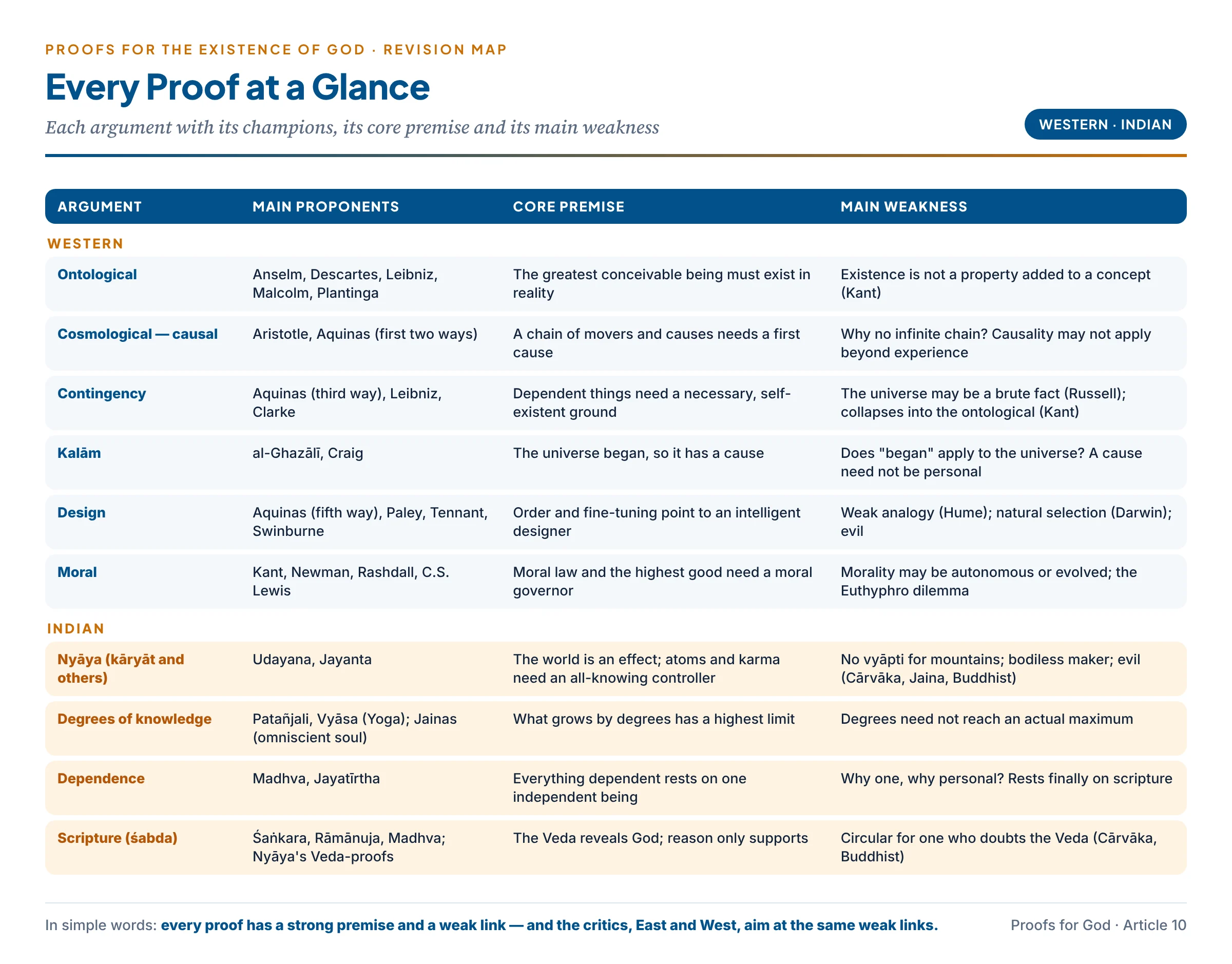
- No proof is a demonstration. No argument compels assent from every rational person; the ontological argument is disputed at its premise, the a posteriori arguments are at best probable, and the critics’ objections have never been fully answered.
- But the proofs are not worthless.
- They show that belief in God is not irrational and can be held for reasons.
- They clarify the concept of God — necessary, uncaused, intelligent, good.
- They raise real questions — why anything exists, why the world is orderly and intelligible, why we are bound by duty — which every worldview must answer.
- They serve the believer’s understanding (“faith seeking understanding”) more than the unbeliever’s conversion.
- John Hick’s view of religious ambiguity. The universe is ambiguous: it can be consistently seen with God or without him. Proofs neither prove nor disprove; the decision is made by faith and experience, which reason can examine but not replace.
- The Indian view. For the theistic Vedāntins, God is known from scripture and finally by realisation; for Nyāya, by inference and scripture together; for the critics, not at all. Even Nyāya ends its proofs with devotion — Udayana offers his reasoning as “a handful of flowers” at God’s feet.
8. The Place of Proof in Religious Life
- For most believers, proof is not the root of faith. Faith grows from tradition, community, worship and experience; proofs come later, as defence and understanding.
- Proofs serve several functions.
- Apologetic — answering objections from atheists and rival schools (Udayana against the Buddhists; Aquinas against the Averroists).
- Clarifying — making the idea of God precise (necessity, simplicity, omniscience).
- Bridge-building — giving believers and unbelievers common ground in reason; and making inter-religious dialogue possible.
- Devotional — Anselm’s argument is written as a prayer; Udayana’s proofs are an offering.
- The fideist warning. Pascal: “The heart has its reasons which reason does not know.” The God of the proofs — a first cause, a necessary being — may not be the “God of Abraham, Isaac and Jacob“, the God one prays to.
- The reformed epistemologist’s reply. Belief in God may be properly basic — rational without argument, like belief in other minds or the past (Plantinga; Article 1). Proofs are then a support, not a foundation.
- Religion without proof. The non-theistic religions of India — Jainism, Buddhism, Sāṃkhya — show that a deep religious life can exist with no proof of God at all (Article 9).
Critical Evaluation
Is the Comparison Itself Fair?
- Different questions. Western proofs often ask “why is there anything at all?“; Nyāya asks “who arranges and governs the eternal reals?”. Comparing them as rival answers to one question can hide this difference.
- Different gods. The creator from nothing and the architect of eternal atoms are different concepts; agreement in form of argument may hide disagreement in content.
- Different standards of proof. Nyāya inference has strict formal rules (five members, a valid reason, an example); Western natural theology moved from demonstration (Aquinas) to probability (Paley, Swinburne).
- Shared fate. Yet both traditions show the same limits: the step from familiar effects to an infinite, unique, personal cause, the regress question, and the problem of evil.
Objections to the Conclusion “the Proofs Fail”
- Too strict a standard. If “proof” means what compels every rational mind, almost nothing in philosophy is proved — not the existence of other minds or the external world. By ordinary standards of reasonable belief, the arguments may succeed.
- The question of existence remains. Even critics admit that “why is there something rather than nothing?” is not answered by science.
- Converging traditions. That thinkers in Greece, Arabia, Europe and India, independently, reached causal and design arguments suggests that these arguments express a natural movement of reason.
Critics and Defenders
Criticism — Critics of the proofs
- Hume and the Cārvāka: no experience of world-making; analogy too weak.
- Kant and the Vedāntins: reason cannot reach God; only faith or scripture can.
- Russell: the universe may be a brute fact.
- Buddhists and Jainas: a changeless or bodiless maker is incoherent.
- Everyone who presses evil: a good, almighty maker would not make this world.
Defence — Defenders and the value of the proofs
- Copleston: “why is there anything?” is a real question that demands an answer.
- Swinburne: together the arguments make God more probable than not.
- Udayana and Aquinas: reason can remove objections and show belief is reasonable.
- Plantinga: belief in God can be rational even without proof.
- All traditions: the proofs clarify the idea of God and serve faith seeking understanding.
Cross-Tradition Comparison
The Grand Comparison
| Feature | Western proofs | Indian proofs |
|---|---|---|
| Main proponents | Anselm, Aquinas, Leibniz, Clarke, Paley, Kant (moral), Swinburne | Udayana and Nyāya, Patañjali (Yoga), Madhva (dependence), Vedāntins (śruti) |
| Dominant method | A priori and a posteriori; later probability | Inference (anumāna) and testimony (śabda) |
| God reached | Creator from nothing; necessary being; designer; moral governor | Efficient cause ordering eternal reals; dispenser of karma; author of the Veda |
| Ontological argument | Central and much debated | Absent |
| Moral argument | Kant (postulate), Newman, Rashdall | Nyāya’s adṛṣṭa argument (a proof) |
| Role of scripture | Outside the proofs (revealed theology) | Inside the proofs (Nyāya); the main source (Vedānta) |
| Chief critics | Hume, Kant, Darwin, Russell, Mackie | Cārvāka, Kumārila, Jainas, Dharmakīrti, Sāṃkhya |
| Typical alternative to God | Brute fact, natural selection, multiverse | Svabhāva, karma, Prakṛti, dependent origination, uncreated cosmos |
Indian Connect — Key takeaways
- Aquinas and Udayana argue in parallel from motion, causation, dependence, degrees and order; Udayana adds karma, scripture, word-meaning and number.
- India has no ontological argument, because its epistemology asks for a pramāṇa for every existence-claim.
- Kant and the Vedāntins both deny that speculative reason proves God; Kant turns to moral faith, the Vedāntins to scripture.
- Hume and the Indian sceptics raise the same objections independently — a sign that these objections are serious.
- The proofs make belief reasonable for many but do not compel it; faith, experience and scripture carry the rest.
Synthesis (Siddhānta)
- Placed side by side, the Western and Indian proofs show a striking convergence: both traditions argue from the world as caused, from its order, from the gradation of perfections, and from the moral order to an intelligent supreme cause. Aquinas’s Five Ways and Udayana’s proofs match closely, while each tradition adds its own — the Western ontological argument and contingency of all finite being; the Indian arguments from karma, the Veda, language and number.
- They show an equally striking convergence in criticism: Hume and the Cārvāka, Kant and the Buddhist logicians, the problem of evil pressed by Mill and Kumārila alike.
- India’s lack of an ontological argument reflects its pramāṇa-based epistemology; the Vedāntins’ turn to scripture parallels Kant’s turn to moral faith — both admit that speculative reason cannot reach God.
- Do the proofs succeed? Not as demonstrations that compel every rational mind. But as arguments they show that belief in God is reasonable, they keep alive the question “why is there something rather than nothing?“, and, taken together as a cumulative case, they can make theism a serious rational option. Their deepest role is within religious life itself — faith seeking understanding, or in Udayana’s image, reasoning offered as flowers to the God it seeks.
- Contemporary relevance.
- Cosmology (the beginning of the universe, fine-tuning) has revived the cosmological and design arguments in both scientific and interfaith discussion.
- Comparative philosophy of religion uses the Aquinas–Udayana parallel as a model of cross-cultural dialogue.
- Pluralist societies like India need a public reason in which believers and non-believers can argue about God without contempt — the very space that the proof tradition, and its critics, created.
“The heart has its reasons which reason does not know.” — Blaise Pascal
Previous Year Questions
- 2022Discuss the main points of distinction between a-priori and a-posteriori arguments for the existence of God. Which one according to you should be preferred over the other? Give reasons and justifications for your answer.
- 2018Compare St. Thomas Aquinas’ five ways of knowing God with the arguments of the Nyāya School of Indian Philosophy for the existence of God.
- 2013State and elucidate cosmological argument for the existence of God in Western and Indian Philosophy.
- 2012Can God’s existence be proved with cogent and convincing rational arguments?