

Proofs for the Existence of God and their Critique (Indian and Western).
Official Syllabus: Paper II, Section B, Unit 2
Nyāya tried to reach God mainly by inference (Article 7). The other great theistic schools of India took different roads. Yoga argues from the degrees of knowledge to an unsurpassed knower, and values God above all as the object of devotion that steadies the mind. Vedānta — the schools built on the Upaniṣads — holds that the Supreme Being is known first and decisively through scripture (śruti), with reason as its servant. Within Vedānta, Śaṅkara says reason cannot establish Brahman, yet uses a powerful design argument against Sāṃkhya; Rāmānuja gives the sharpest Indian critique of inferring God from the world; and Madhva combines scripture with an argument from dependence that resembles the Western argument from contingency. This article sets out each position, asks which source of knowledge (pramāṇa) each school trusts for God, and compares their verdict with Kant‘s.
In simple words
Imagine three people trying to find out whether a famous but rarely seen musician is really in town. The first looks at the posters, the stage being built and the crowds, and infers that the musician must be here (Nyāya). The second notices that every local singer is better than the last and concludes there must be a best singer somewhere (Yoga). The third says: “Clues can mislead. I trust the musician’s own announcement, and the clues only help me understand it” (Vedānta). All three reach the musician, but by different roads — and they argue about which road is safe.
Context & Problem
Three Attitudes to Proving God
- Reason first (Nyāya). God is proved by inference from the world, supported by scripture.
- Practice first (Yoga). God is a special self whose existence is argued from the gradation of knowledge, but whose real importance is practical — devotion to God helps concentration and liberation.
- Scripture first (Vedānta). The Supreme is beyond the senses and beyond any inference about the world; it is known from the Upaniṣads. Reasoning (tarka) supports scripture, removes doubts and refutes rivals, but cannot stand alone.
The Vedānta Starting Point
- The definition. The Brahmasūtra defines Brahman as “that from which the origin, maintenance and dissolution of this world proceed“. This sounds like a cosmological argument — from the world to its cause.
- The very next step. The next sūtra says “because scripture is the source” (śāstra-yonitvāt). Commentators read it in two ways:
- Brahman is the source of the vast scripture, so Brahman is omniscient.
- Scripture is the source (the means of knowing) of Brahman — Brahman cannot be known by any other pramāṇa.
- The problem for all Vedāntins. If the world points to Brahman as its cause, why not prove Brahman by inference, as Nyāya does? Each school answers differently, and this article follows their answers.
Core Doctrine
1. Yoga: Īśvara and the Argument from Degrees of Knowledge
Who is Īśvara?
- A special puruṣa (puruṣa-viśeṣa). Patañjali defines God as “a special self, untouched by afflictions, actions, their fruits and their latent impressions“.
- Not the creator. Yoga accepts the Sāṃkhya world-picture: Prakṛti evolves by itself for the sake of the selves. Īśvara is not the material or efficient cause of the world in the Nyāya sense.
- Eternally free. Other selves become free; Īśvara was never bound.
- His name. God is expressed by the sacred syllable Om (praṇava); repeating it while meditating on its meaning steadies the mind.
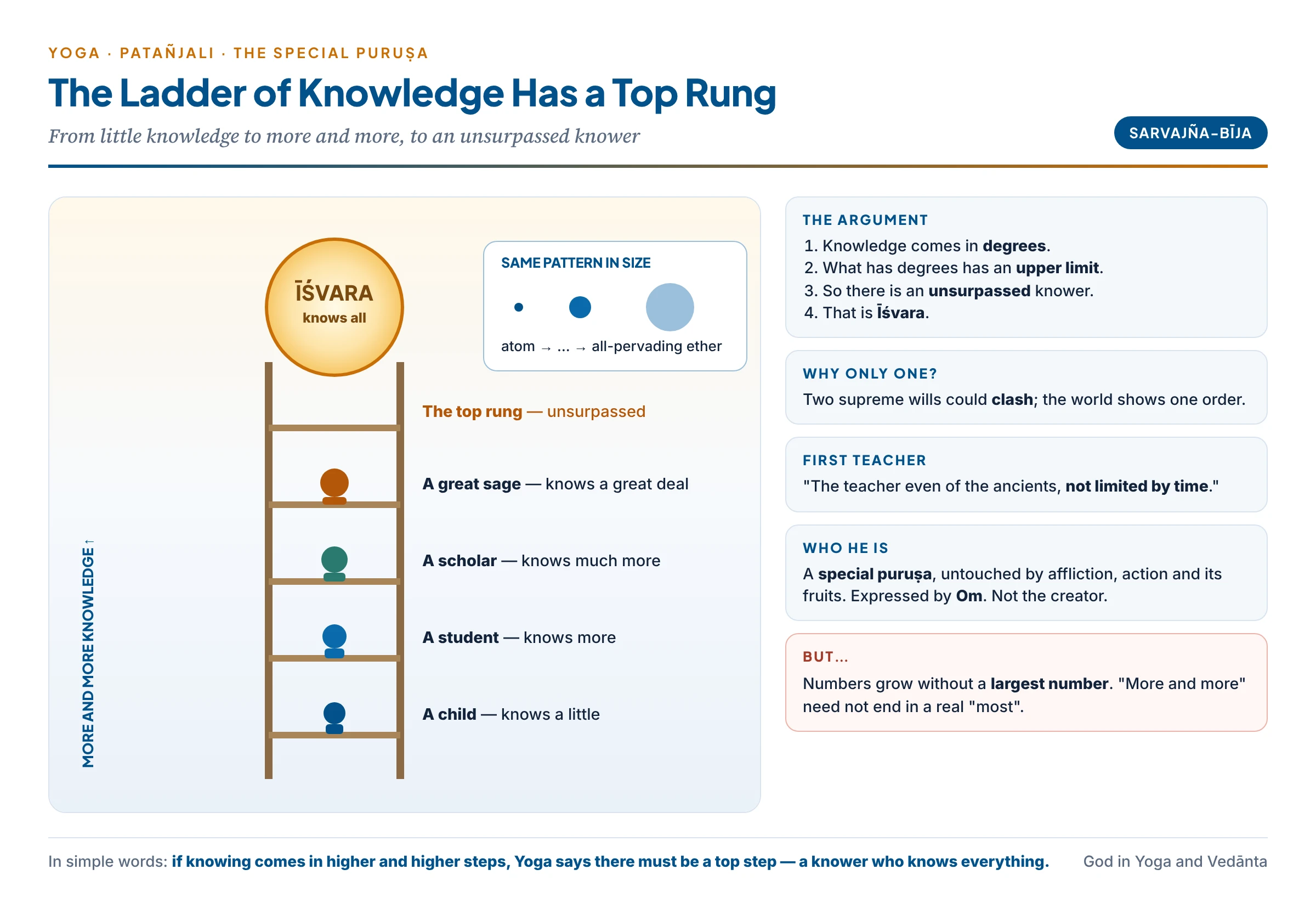
Argument 1 — the unsurpassed seed of omniscience.
- Patañjali’s line. “In him the seed of omniscience is unsurpassed” (niratiśaya sarvajña-bīja).
- The argument, as the commentators unfold it.
- Knowledge exists in degrees — some know a little, some know more, some know a great deal.
- Whatever exists in degrees, rising one above another, must have an upper limit — as size runs from the smallest (the atom) to the largest (all-pervading ether).
- So there must be a being in whom knowledge reaches its unsurpassed limit — omniscience.
- That being is Īśvara.
- Why only one? If there were two equally supreme beings, their wills could clash, and the world would fall into confusion; and if one were greater, the lesser would not be supreme. So there is one Īśvara.
In simple words
Climb a ladder of runners: a child runs slowly, a schoolboy faster, an athlete faster still, an Olympic champion fastest of all. Yoga argues that knowledge, too, is such a ladder — and that a ladder of “more and more” must have a top rung. On the knowledge ladder, the top rung is a knower who knows everything. That knower is Īśvara.
Argument 2 — the first teacher.
- Patañjali’s line. God “is the teacher even of the ancients, being not limited by time”.
- The argument. Knowledge of liberation is handed down from teacher to pupil. In every cycle of creation there must be a first teacher who was not himself taught — one beyond time. That is Īśvara.
Argument 3 — scripture.
- The Vedas and Upaniṣads speak of a Supreme Self, and Yoga accepts testimony (āgama) as a pramāṇa.
- The commentator Vyāsa notes a mutual support: God’s excellence is known from scripture, and scripture’s reliability comes from God’s perfect, pure knowledge; he treats this relation as beginningless, like seed and sprout.
Argument 4 — joining and separating Prakṛti and Puruṣa.
- The argument (later commentators, especially Vijñānabhikṣu).
- Creation begins when Prakṛti comes into association with the selves; dissolution and liberation come with dissociation.
- Prakṛti is unconscious; the selves are inactive and do not know their own karma.
- So an intelligent being must bring them together and apart according to the karma of each self. That being is Īśvara.
- Note. Here Yoga comes close to Nyāya’s argument from adṛṣṭa (Article 7).
Argument 5 — devotion works (pragmatic).
- Devotion to God (Īśvara-praṇidhāna) is a sure means to concentration. That the practice works shows, at least, the value of the idea of God — a practical justification rather than a strict proof.
God’s role in samādhi and kaivalya.
- An alternative path. Patañjali says samādhi comes through practice and detachment, “or by devotion to Īśvara”. Devotion is optional, not compulsory.
- Part of the discipline. Devotion to God is one of the three parts of kriyā-yoga (with austerity and self-study) and the last of the five niyamas.
- What God does. Meditation on God and repetition of Om remove the obstacles (disease, doubt, sloth and the rest) and weaken egoism. Later commentators add that God’s grace helps the devotee.
- What God does not do. Kaivalya (liberation) is the isolation of the aspirant’s own self from Prakṛti. God is a model and a helper, not the giver of a new nature. The aspirant still has to discriminate self from Prakṛti.
Common confusion
Does the Yoga Sūtra contain an “ontological argument” for God? No. Some notes list Patañjali’s argument among ontological proofs. An ontological argument (Article 2) moves from the mere idea of God to his existence, without looking at the world. Yoga’s argument starts from an observed fact — knowledge comes in degrees — and argues to an upper limit. It is closer to Aquinas’s fourth way (from degrees of perfection) than to Anselm.
Does Yoga prove God in the same way as Nyāya?
- Only partly. Both accept scripture and both arrive at an omniscient being; Yoga’s argument from joining and separating Prakṛti and Puruṣa also resembles Nyāya’s argument from adṛṣṭa.
- The main routes differ. Nyāya argues cosmologically — from the world as an effect to its maker. Yoga argues from the perfection of knowledge to its unsurpassed limit, and from God as the first teacher.
- The Gods differ. Nyāya’s God orders the world out of atoms; Yoga’s God does not create the world, which Prakṛti produces by itself.
How strong is the Yoga argument?
- Weakness — “more and more” need not end in “most”. Numbers go on increasing without a largest number; a light can get brighter without there being an infinitely bright light. Gradation shows direction, not an actual maximum.
- Weakness — the step from “limit” to “person”. Even if knowledge has a highest degree, why must it belong to a single eternal person?
- Sāṃkhya’s reply. Yoga itself admits that Prakṛti evolves for the selves without God; so God seems superfluous to the system.
- Strength. As the ideal of perfect knowledge and freedom, Īśvara gives Yoga’s practice a living goal and a model.
2. Śaṅkara: Brahman Known by Scripture, Reason as Its Servant
Why inference cannot establish Brahman.
- Brahman is beyond the senses. It has no colour, shape or sign; so neither perception nor ordinary inference (which needs an observed link between sign and signified) can reach it.
- Inference gives too little. From the world as an effect one can infer some intelligent maker; one cannot infer the infinite, one, all-knowing Brahman of the Upaniṣads. A finite creation proves at most a finite creator.
- Reasoning has no fixed ground (tarkāpratiṣṭhāna). What one clever reasoner establishes, a cleverer one overturns. Arguments built on reason alone can always be reversed; so on matters beyond the senses only scripture gives settled knowledge.
- So the sūtra on Brahman as cause is not an inference. It sums up what the Upaniṣads teach. Inference is used only where it agrees with them, to help understand and confirm them.
What reason can do.
- Remove doubts and misunderstandings about scripture.
- Refute rival systems that claim to be rational (Sāṃkhya, Nyāya, Buddhist).
- Prepare the mind for direct realisation.
- Self-evidence of the self. Śaṅkara also notes that the existence of the self needs no proof — no one ever thinks “I am not“. But that this self is Brahman is known only from scripture (“That thou art“) and finally from direct realisation (anubhava).
Śaṅkara’s critique of a God who is only the efficient cause. Śaṅkara attacks the view (held by Nyāya and some Śaiva schools) that God is merely the efficient cause, working on an independent matter.
- Partiality and cruelty. Such a God creates some beings happy and others miserable; he would be partial and cruel. If he acts according to karma, then karma moves God and God moves karma — a mutual dependence.
- No possible relation. God and an independent matter (or souls) cannot be related: not by contact (both are partless and all-pervading), not by inherence (neither is part of the other).
- The body problem. A potter works on clay with a body; a God who works on matter from outside would need one too — and then he would be limited and subject to pleasure and pain.
- The knowledge dilemma. Either God knows the full extent of matter, souls and himself — then they are finite and will one day be exhausted — or he does not — then he is not omniscient.
- Śaṅkara’s own view. Brahman (as Īśvara) is both the efficient and the material cause of the world — as a spider spins its web from itself — and the world is its appearance (vivarta), not a separate stuff worked on from outside.
The design argument against Sāṃkhya (“pradhāna-malla”).
- Why Sāṃkhya is the “chief wrestler.” Sāṃkhya is Vedānta’s closest and strongest rival: it shares the pre-existence of the effect, the self as pure consciousness and liberation by knowledge, and claims Upaniṣadic support — but it makes an unconscious Pradhāna (Prakṛti) the first cause. Defeat the chief wrestler, and the lesser ones (the atomists and others) fall with him.
- The scriptural point. The Upaniṣad says the first cause “thought: may I be many”. Only a conscious being can think; so the first cause is Brahman, not Pradhāna.
- The rational points.
- No design without a designer. The world shows order and purpose — bodies fitted for experience, a cosmos fitted for moral life. Bricks, stones and mortar never build a palace without an architect; unconscious Pradhāna cannot produce such order.
- No activity without a conscious mover. A chariot moves only when driven; clay takes shape only in a potter’s hands. What moves Pradhāna out of balance?
- The milk analogy fails. Sāṃkhya says Pradhāna works for the self as milk flows unconsciously for the calf. But milk flows because a living cow loves her calf.
- The grass analogy fails. Grass turns into milk only inside a cow, not when it lies in the field or is eaten by a bull.
- No reason to start or stop. With nothing outside it, why should Pradhāna sometimes evolve and sometimes rest?
- No purpose fits. Pradhāna is said to act for the self’s experience or liberation; but the self is changeless and already free.
- The lame-and-blind and the magnet fail. The lame man and the blind man are both conscious; the magnet’s presence would act always, not sometimes.
- The Sāṃkhya defence. Nature is full of unconscious purposiveness — seeds grow into trees, wounds heal — without any designer.
- An apparent tension. Śaṅkara denies that reason can prove Brahman, yet argues like a design theorist against Sāṃkhya. The answer: his argument is a reductio against an opponent who relies on reason alone, and it supports what scripture teaches; it is not offered as an independent proof.
In simple words
A pile of bricks, cement and steel can lie on a plot for a hundred years and remain a pile. A house appears only when an engineer plans it. Śaṅkara uses exactly this against Sāṃkhya: the world is like a well-planned house, so its first cause must have a mind. But he will not use the same reasoning to prove Brahman, because a house proves only a builder — not the infinite Brahman of the Upaniṣads.
Śaṅkara’s God and evil. Īśvara gives each being what its own karma deserves, as rain helps every seed grow according to its own nature — rice as rice, barley as barley. Inequality comes from the seeds (karma), not from the rain (God). And Brahman creates out of sport (līlā), from fullness, not need.
3. Rāmānuja: Why Inference Cannot Reach God
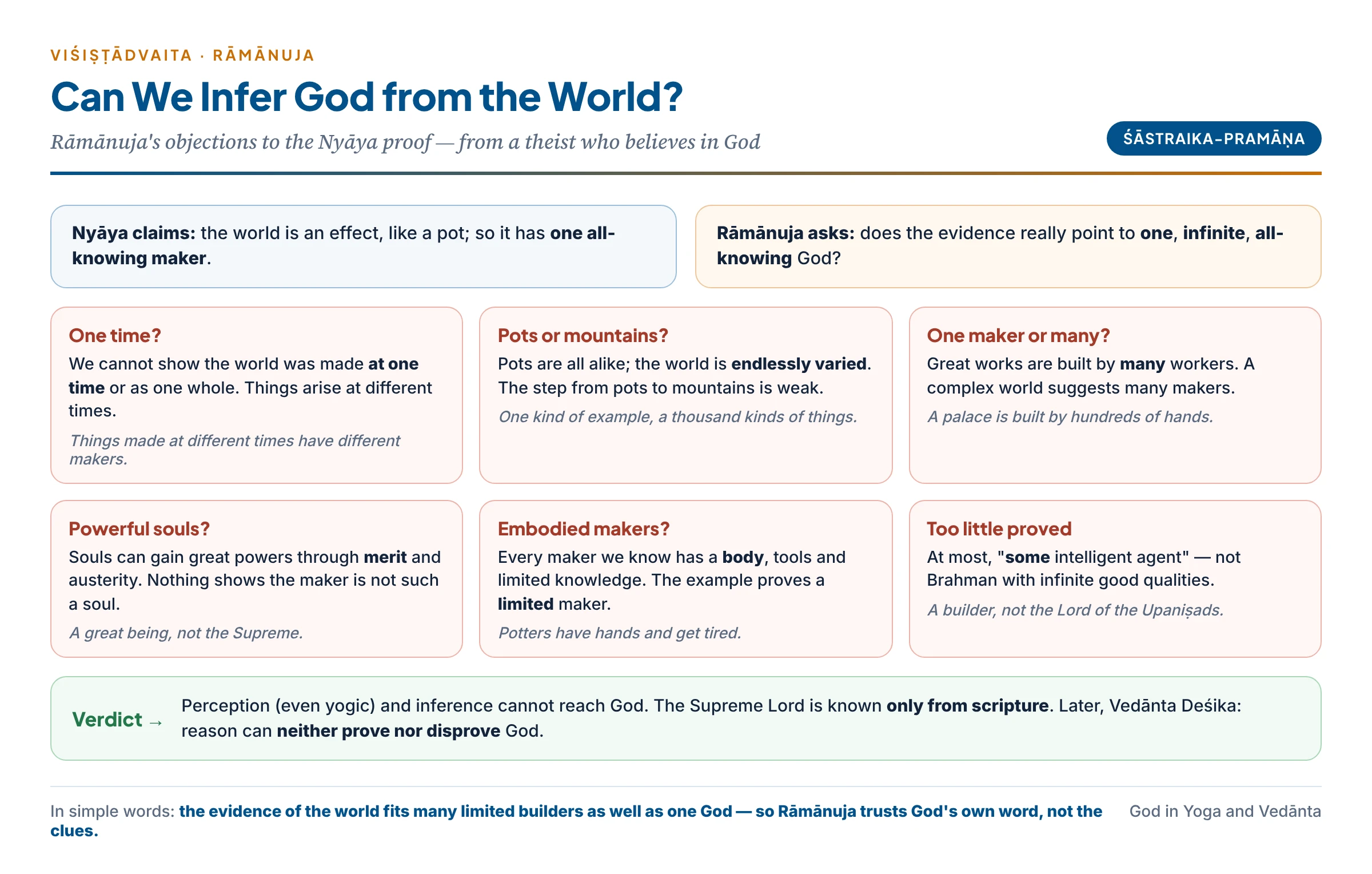
Rāmānuja accepts a fully personal God with infinite good qualities, yet he gives the most detailed Indian refutation of the Nyāya proof. For him, God is known only from scripture (śāstraika-pramāṇa).
Perception cannot reach God.
- Sense perception grasps only objects in contact with the senses.
- Yogic perception, however vivid, only re-presents what was once experienced; it gives nothing new about a being never perceived.
Inference cannot reach God.
- Specific inference (from a sign always seen with its object, like smoke with fire) fails — God has never been perceived with any sign.
- General inference (from a general likeness) fails too — there is no observed universal link between “being an effect” and “having an all-knowing maker”.
The specific objections to the Nyāya proof.
- No single act of making. It cannot be shown that the world was produced at one time or as one whole; things arise at different times. Things produced at different times are seen to have different makers.
- The world is not one kind of thing. Pots are all alike and come from potters; the world’s contents are endlessly varied. The step from pots to mountains is weak.
- Many makers are more likely. Great works — palaces, temples — are built by many workers. A complex world suggests many makers, not one.
- Powerful souls could do it. Individual souls, through great merit and austerity, can gain extraordinary powers; nothing in inference shows that the world’s maker must be other than such a soul.
- Makers are embodied and limited. Every maker we know has a body, works with tools and has limited knowledge. If the inference followed the example strictly, it would prove a limited, embodied maker — not God.
- The conclusion overshoots. At most the inference proves an intelligent agent; it does not prove the Brahman of the Upaniṣads, with infinite auspicious qualities and free from all defect.
- Rāmānuja’s verdict. Inference from the world is “overturned by observation“; therefore the Supreme Lord, the highest Person, is known only through scripture.
- A later refinement. The Viśiṣṭādvaita logician Vedānta Deśika sharpened this: inference can neither prove nor disprove God, because there is no observed link either way. When the school argues that Sāṃkhya’s Pradhāna needs a conscious controller, it is reasoning in support of scripture, not proving God independently.
In simple words
A detective finds a beautifully carved temple in a forest. Can he conclude that one all-knowing sculptor made it in one day? No — the evidence fits better with many masons working over many years, each with ordinary skill and ordinary bodies. Rāmānuja tells Nyāya: your evidence points to many, limited, embodied workers — not to the one infinite God. To know that God, you must listen to his own word.
4. Madhva’s Arguments for the Existence of God
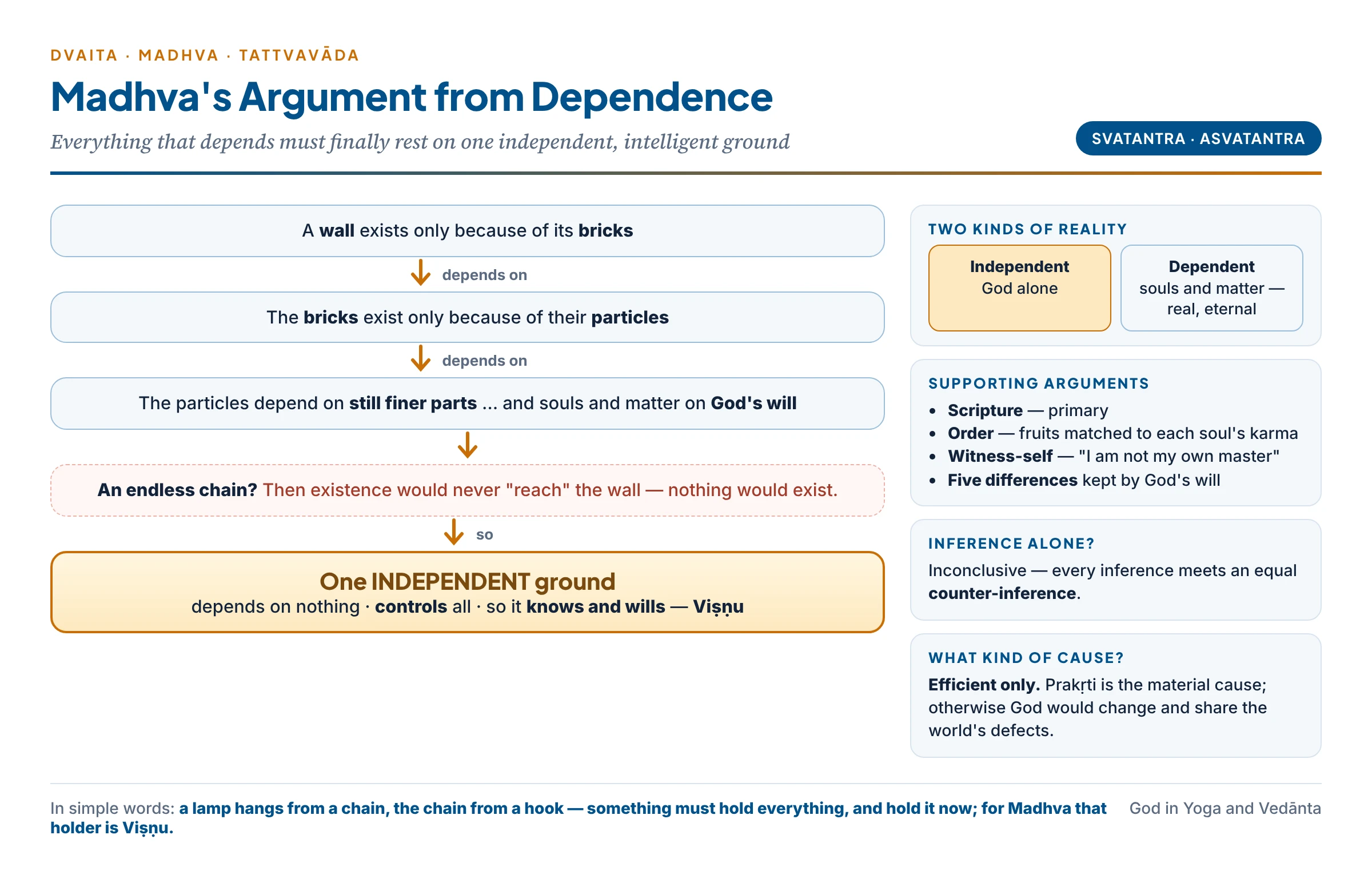
Madhva (thirteenth century), the founder of Dvaita (dualism), calls his system Tattvavāda, “the doctrine of reality”. Reality has two kinds: the independent (svatantra) — God, Viṣṇu, alone — and the dependent (asvatantra or paratantra) — souls and matter, real and eternal but wholly dependent on God.
Step 1: inference alone is inconclusive.
- Every inference meets a counter-inference. “The world has a maker, because it is an effect” can be matched by “the world has no maker, because it was not made by any embodied agent, like the sky”. Two arguments of equal strength cancel each other.
- The world as a whole. We have never seen a whole world being produced; so we cannot show that the world as a whole is an effect.
- The example misleads. All makers we know are embodied and limited; strictly, the inference yields only such a maker.
- So reason shows God’s possibility. Reason alone can show that God is possible and can support what scripture teaches, but cannot by itself prove that God exists.
Step 2: scripture is primary.
- The authorless Veda. Madhva accepts three pramāṇas — perception, inference and verbal testimony (āgama). The authorless Vedas, read with the Upaniṣads, the Gītā and the Brahmasūtra, reveal Viṣṇu as the supreme, independent Lord. “Scripture is the source” of the knowledge of Brahman.
Step 3: the argument from dependence.
- The argument (as set out by Madhva and his commentator Jayatīrtha).
- The things of the world are composite — a wall depends on its bricks, the bricks on their particles, and so on.
- Whatever is composite is dependent — it exists only through what it depends on.
- The chain of dependence cannot go back for ever; if it did, existence would never “reach” anything, and nothing would exist.
- So all dependent things rest on one independent reality that depends on nothing.
- That reality controls all dependent things, so it must be intelligent — a knowing, willing being.
- That independent, intelligent ground is Viṣṇu.
- Not only composites. Even eternal souls and eternal matter are dependent — they exist, know and act only by God’s will. Their dependence is not a past event but a permanent fact.
- Western echo. Aquinas’s third way and Leibniz’s argument from contingency (Articles 3 and 4).
Step 4: the argument from order and co-ordination.
- Souls are countless, each with its own karma; matter is unconscious. The precise matching of bodies, experiences and fruits to each soul’s deserts requires an intelligent controller who knows every soul.
- Western echo. The design argument (Article 5).
Step 5: the witness’s testimony.
- Madhva’s witness-self (sākṣī) directly knows the self as limited and dependent — “I am not my own master”. This inner awareness of dependence points to the One on whom we depend.
Step 6: the five differences need a Lord.
- Madhva’s five-fold difference (pañca-bheda) — between God and souls, God and matter, souls and matter, soul and soul, and one material thing and another — is real and eternal. These real distinctions are known and maintained by God’s will.
What kind of God does this prove?
- Efficient cause only. Viṣṇu creates, sustains and dissolves the world, but is not its material cause.
- If God were the material cause, he would change with the world and share its imperfections and evil.
- The material cause is Prakṛti, real and eternal, shaped and controlled by God.
- Creation as dependence. Creation is not a one-time event but the constant dependence of the world on God’s will; it is God’s sport (līlā), done from fullness, not need.
- Creation out of nothing? Madhva alone among Indian philosophers allows that God could create a world without pre-existing matter, but holds that, as a fact, he has not chosen to.
Common confusion
Do all Vedāntins, including Madhva, hold that God is both the material and the efficient cause of the world? No. Some notes say that “in Nyāya and Vedānta (Śaṅkara, Madhva) God is both the material and efficient cause of the world”. Śaṅkara (and Rāmānuja) do make Brahman both causes. But Madhva, like Nyāya, makes God the efficient cause only: the material cause is the eternal, dependent Prakṛti. If God were the material cause, Madhva argues, he would change and share the world’s defects.
Evaluating Madhva’s arguments.
- Strengths.
- Epistemic modesty. Like Kant, Madhva sees that speculative reason cannot demonstrate God, and avoids overclaiming.
- Real features of experience. Dependence, order and the felt limitation of the self are genuine data.
- Coherence. The dependence argument fits his whole ontology — the independent and the dependent.
- Weaknesses.
- Circularity for the doubter. Resting the case on the Veda persuades only those who already accept the Veda.
- The regress question. Why can the chain of dependence not be infinite, or end in matter itself (Hume’s question, Article 4)?
- Why one, why personal? Even if there is an independent ground, the argument does not obviously show that it is one, personal and Viṣṇu.
- Eternal dependents. If souls and matter are eternal, in what sense do they “depend” on God for existence? Madhva’s answer — dependence is permanent, not temporal — is coherent but unusual.
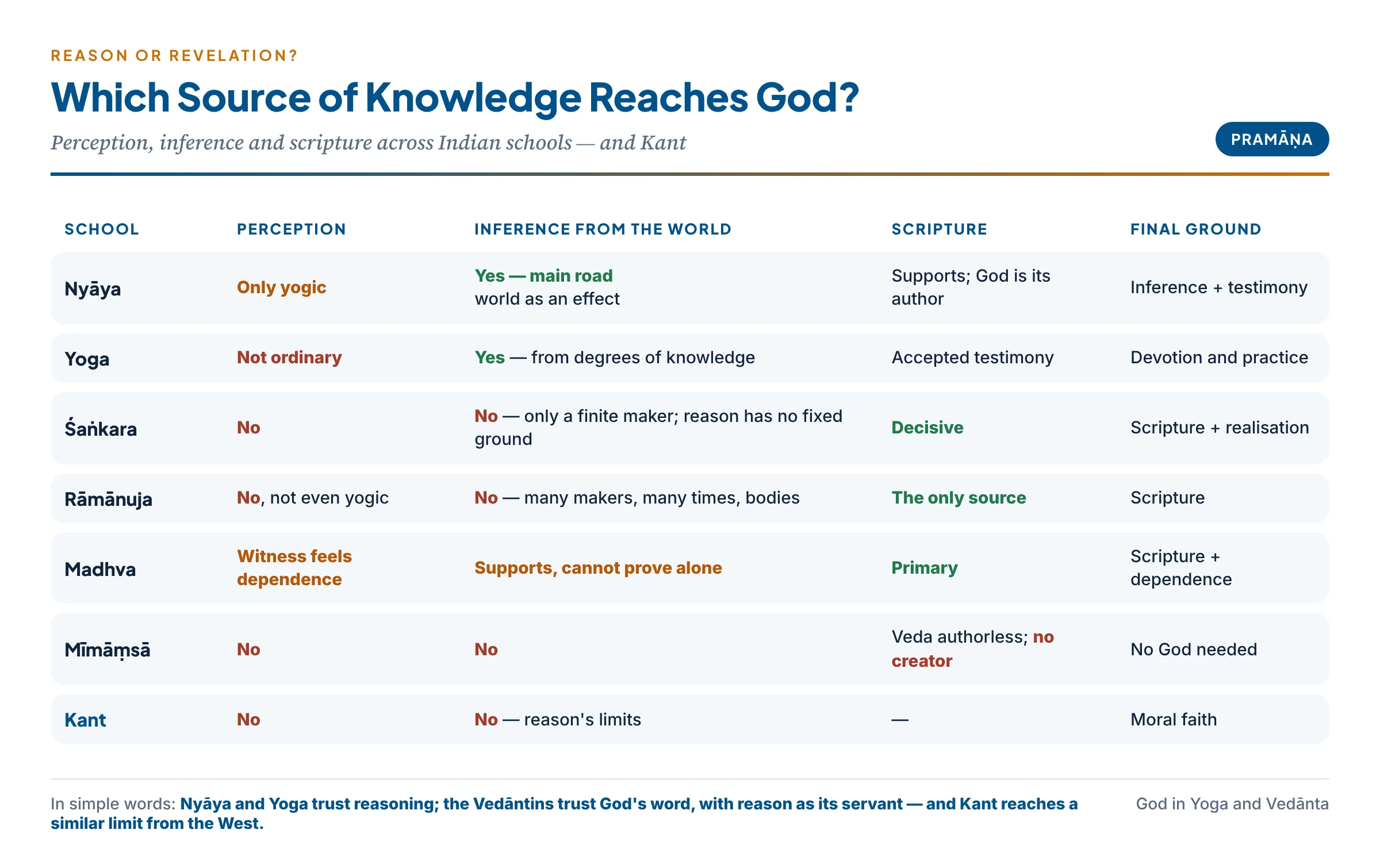
5. Which Pramāṇa for God?
| School or thinker | Can perception reach God? | Can inference prove God? | Role of scripture | Final ground |
|---|---|---|---|---|
| Nyāya | Only yogic perception | Yes — the main route | Supports; God is its author | Inference plus testimony |
| Yoga | Not ordinary perception | Yes — from degrees of knowledge | Accepted testimony | Practice and devotion |
| Śaṅkara | No | No — gives only a finite maker | Decisive | Scripture and direct realisation |
| Rāmānuja | No (not even yogic) | No — refuted in detail | Only source | Scripture |
| Madhva | Witness-self senses dependence | Supports, cannot prove alone | Primary | Scripture, backed by dependence |
| Mīmāṃsā | No | No | Veda is authorless; no creator | No God needed (Article 9) |
| Kant | No | No — reason’s limits | — | Moral faith (Article 6) |
Critical Evaluation
Objections
- Against the scripture-first position.
- Circularity. If God is known only from the Veda, and the Veda’s authority is accepted on faith, the argument persuades only believers.
- Rival scriptures. Buddhists, Jainas, Christians and Muslims also have scriptures; scripture alone cannot settle whose God is real.
- Disagreement within Vedānta. The same Upaniṣads yield Śaṅkara’s impersonal Brahman, Rāmānuja’s qualified whole and Madhva’s eternal difference — so “scripture” needs interpretation, and interpretation is reasoning.
- Against Yoga. Gradation does not prove an actual maximum; and a God who neither creates nor liberates seems superfluous (the Sāṃkhya complaint).
- Against Śaṅkara. He rejects rational proofs of God but uses the design argument against Sāṃkhya — critics call this selective use of reason. And if Īśvara belongs to the empirical level, the God of devotion seems only provisionally real.
- Against Rāmānuja. If inference cannot reach God, why should scripture’s claims about God be accepted rather than doubted? And his objections (many makers, embodied makers) are exactly those atheists use — has he given them a weapon?
- Against Madhva. The dependence argument faces the regress and composition objections that Western critics press against the cosmological argument (Article 4).
Replies
- Scripture as a pramāṇa, not blind faith. For Vedānta, testimony is a source of knowledge like perception and inference — we rely on reliable testimony every day (for history, geography, medicine). The Veda is the testimony that speaks of what lies beyond the senses.
- Reason has a real place. Every Vedāntin reasons constantly — to interpret scripture, remove doubt and refute rivals. What they deny is that reason alone, starting from the world, can reach the infinite.
- Śaṅkara’s consistency. His design reasoning against Sāṃkhya is a reductio within the opponent’s own rational framework, in support of what scripture already teaches.
- Rāmānuja’s honesty. By showing that inference cannot prove God, he also shows that it cannot disprove God (Deśika). Theism is then left neither refuted nor proved by reason, but grounded in revelation and experience.
- Madhva’s dependence. The regress objection can be answered by distinguishing a chain stretching back in time from a chain of present dependence — a hanging lamp is held now by its chain and hook, not by a chain going back into the past.
Critics and Defenders
Criticism — Critics
- Circularity: God known only from a Veda accepted on faith.
- Rival scriptures: scripture cannot decide between competing revelations.
- Yoga: “more and more” need not end in “most”; God seems superfluous.
- Śaṅkara: rejects proofs of God yet uses design against Sāṃkhya.
- Rāmānuja: hands atheists their best arguments.
- Madhva: dependence faces the regress and composition objections.
Defence — Defenders and strengths
- Testimony is a pramāṇa, relied on daily, not blind faith.
- Reason serves: it interprets, removes doubt and refutes rivals.
- Śaṅkara’s design reasoning is a reductio supporting scripture.
- Rāmānuja and Deśika: reason can neither prove nor disprove God.
- Madhva: present dependence, like a lamp held by its hook, needs no backward chain.
- Epistemic modesty anticipates Kant’s limits of reason.
Cross-Tradition Comparison
Indian Theisms and Western Philosophy of Religion
| Indian position | Western parallel | Point of contact | Difference |
|---|---|---|---|
| Yoga — degrees of knowledge to an unsurpassed knower | Aquinas‘s fourth way (degrees of perfection) | Gradation implies a maximum | Yoga’s God does not create |
| Śaṅkara — reason cannot prove Brahman; scripture reveals | Kant — reason cannot prove God; practical faith | Limits of speculative reason | Kant grounds God in morality, Śaṅkara in scripture and realisation |
| Śaṅkara‘s critique of a merely efficient God | Kant: the design argument proves only an architect, not a creator | A God working on an independent matter is limited | Śaṅkara makes Brahman the material cause too |
| Śaṅkara against Sāṃkhya | Paley and the design argument | Order needs a mind | Used as support, not as independent proof |
| Rāmānuja‘s critique of inference | Hume‘s Dialogues (many makers, weak analogy) | Same objections — many workers, embodied makers | Rāmānuja is a theist; Hume a sceptic |
| Rāmānuja — scripture alone | Fideism, Kierkegaard, reformed epistemology | God not reached by evidence from the world | Rāmānuja’s ground is revelation, not inner leap |
| Madhva — dependence on an independent ground | Aquinas‘s third way; Leibniz; Clarke | Dependent things need a self-existent ground | Madhva’s dependents are eternal |
Indian Connect — Key takeaways
- Yoga argues from the gradation of knowledge to an unsurpassed knower and values God chiefly for devotion.
- Śaṅkara holds that Brahman is known by scripture, that reason has no fixed ground, and that a merely efficient God is incoherent — yet he wields the design argument against Sāṃkhya.
- Rāmānuja gives India’s sharpest critique of inferring God: many makers, many times, embodied makers — so scripture alone reveals the Lord.
- Madhva joins scripture to an argument from dependence (like the Western contingency argument), with God as efficient cause only.
- All three Vedāntins anticipate Kant: speculative reason cannot demonstrate God.
Synthesis (Siddhānta)
- Two broad Indian routes to God. Nyāya trusts inference from the world (Article 7); Yoga argues from the degrees of knowledge and relies above all on practice; the Vedāntins trust scripture, with reason in its service.
- Śaṅkara shows why reason alone fails — it yields at most a finite maker, and it has no fixed ground — and attacks the incoherence of a God who is only the efficient cause; yet his design argument against Sāṃkhya shows how reason can support revelation.
- Rāmānuja turns the atheists’ objections against Nyāya — many makers, many times, embodied makers — to conclude that God is known only from scripture; Deśika adds that reason can neither prove nor disprove God.
- Madhva accepts that inference alone is inconclusive, makes scripture primary, and supports it with arguments from dependence, order, the witness-self and the five differences, proving a God who is the independent, intelligent, efficient cause of a real, dependent world.
- A balanced verdict. The Vedāntic critique of inferential theism is one of India’s great contributions to philosophy of religion: it reaches, centuries earlier and from within theism, the conclusion Kant reached from outside — that the infinite cannot be demonstrated from the finite world. What remains is the question of how far testimony and experience can bear the weight that proof cannot.
- Contemporary relevance.
- Debates on reformed epistemology (whether belief in God may be rational without arguments) echo the Vedāntic reliance on testimony.
- The dependence argument lives on in modern discussions of contingency and the sustaining cause of the universe.
- Interfaith dialogue between Hindu and Christian theology often meets on these very questions — reason, revelation and the limits of proof.
“Because it has no form and the like, this is not an object of perception; because it has no characteristic marks, it is not an object of inference; it is to be known through scripture alone, like dharma.” — Śaṅkara, commentary on the Brahmasūtra
Previous Year Questions
- 2026Explain and examine Madhvacharya’s arguments for the existence of God.
- 2025Why does Śaṅkara consider Sāṃkhya Philosophy as his chief opponent (pradhāna malla)? Examine his arguments against Sāṃkhya Philosophy.
- 2025Explain the nature of God and its role in Kaivalya in Yoga philosophy.
- 2018How do the Naiyāyikas prove the existence of God? Do the Yoga philosophers prove God in the same way? If yes, how? And if no, why? Give reasons for your answer.