

Proofs for the Existence of God and their Critique (Indian and Western).
Official Syllabus: Paper II, Section B, Unit 2
The ontological argument is the boldest of all the proofs for God. It does not look at the stars, the order of nature or the voice of conscience. It looks only at the idea of God and claims that, rightly understood, this idea cannot fail to have a real object: the being “than which nothing greater can be conceived” must exist, because a greatest being that existed only in thought would not be the greatest. The name comes from the Greek ontos (“being”): the argument holds that existence belongs to the very essence of God. First stated clearly by St. Anselm in the eleventh century, defended by Descartes, Spinoza, Leibniz and Hegel, attacked by Gaunilo, Aquinas, Hume, Kant, Frege and Russell, and revived in the twentieth century in “modal” form by Hartshorne, Malcolm and Plantinga, it remains the argument that philosophers find hardest either to accept or to refute cleanly.
In simple words
Imagine a friend says: “Picture the greatest possible cricketer — the best batsman, bowler and fielder who could ever be.” You picture him. Then your friend adds: “But a cricketer who exists only in your head cannot score a single run. A real one would be greater. So if you are really picturing the greatest possible cricketer, you must be picturing one who is real.” That is the shape of the ontological argument. It feels like a trick — and the history of the argument is the history of trying to say exactly where the trick lies, if there is one.
Context & Problem
What Makes the Argument “Ontological”
- From essence to existence. The main claim is that existence is the very essence (ontos) of the idea of God. If we analyse the idea of a perfect being, we can deduce that it exists.
- A priori and deductive. It uses no empirical premise. It is meant to be as certain as a theorem of geometry (Article 1).
- Its built-in weakness. Precisely because it is a priori, it seems unable to establish a fact. To repair this defect, the cosmological, teleological and moral arguments were put forward, each adding experience to the bare idea.
- “The nerve of all the arguments”. Since, on Kant’s view, the other proofs secretly rely on it, the ontological argument is often called the nerve of all theistic arguments (Article 1).
Roots before Anselm
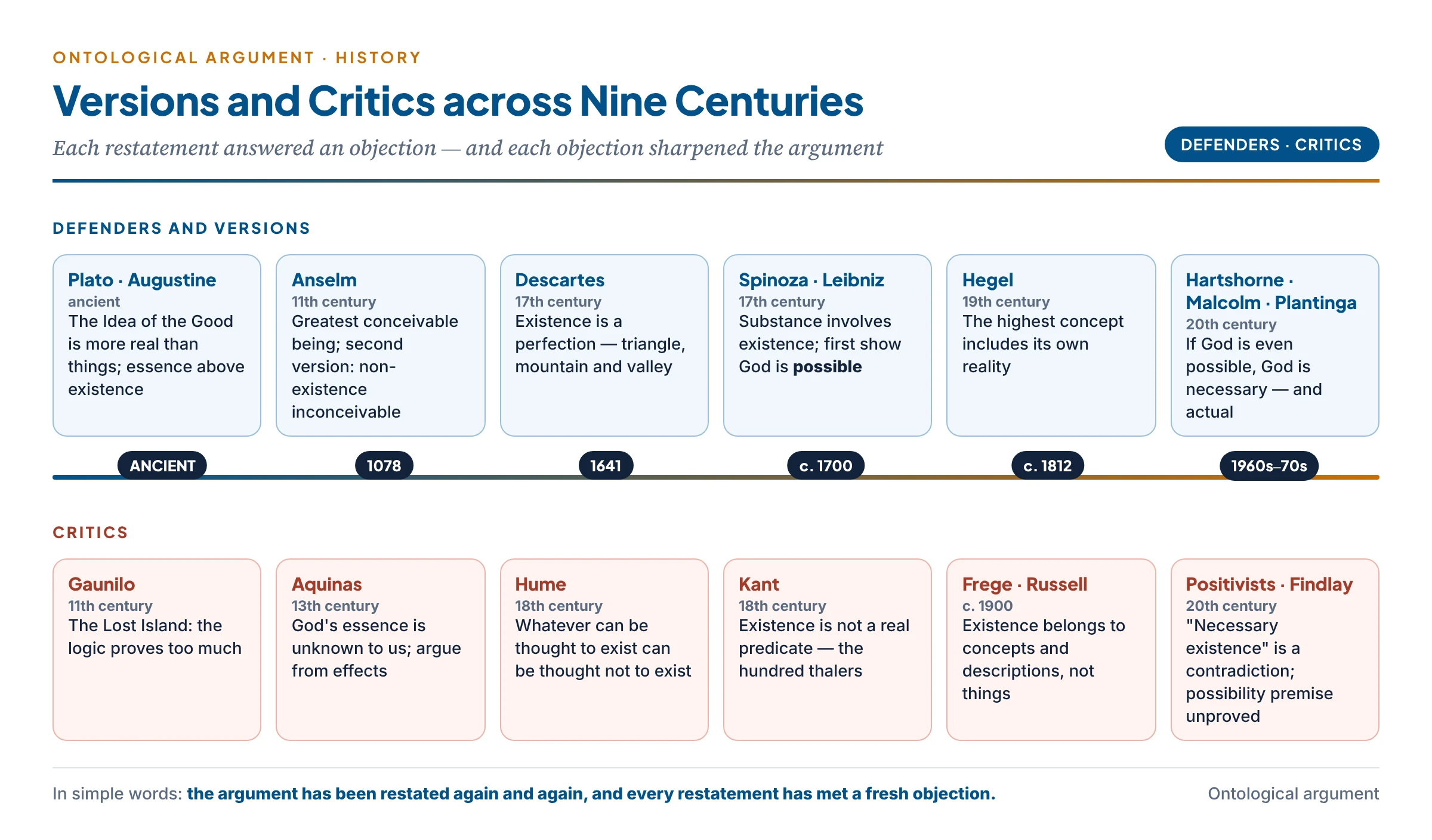
- Plato. For Plato the Ideas (Forms) were more real, more valuable and more fundamental than existing things. The Idea of the Good — nothing less than God for many later readers — was the supreme principle that drew all things to itself; so the idea of the Perfect Being carried its own self-validation and reality. Plato valued essence more than mere existence — in that sense he shares the spirit of the argument.
- St. Augustine (354–430) gave it a more explicit form: the eternal, unchanging Truth that the mind finds above itself is God.
The Cast of the Debate
- Supporters. Anselm (1033–1109) stated it most clearly; Descartes (1596–1650) restated it; Spinoza and Leibniz (1646–1716) accepted it; Hegel (1770–1831) defended it.
- Opponents. Gaunilo (Anselm’s contemporary), St. Thomas Aquinas (1225–1274), Hume, and above all Kant (1724–1804). In the twentieth century A.J. Ayer and the logical positivists attacked it, while Hartshorne, Malcolm and Plantinga revived it.
Anselm’s Setting: Faith Seeking Understanding
- Faith comes first. Anselm offered the proof to strengthen and understand faith, not to replace it. For him faith is a precondition of understanding God: “I do not seek to understand in order that I may believe; I believe in order that I may understand.” His motto is “faith seeking understanding” (fides quaerens intellectum).
- A prayer, not a lecture. The Proslogion, where the argument appears, is written as an address to God.
- The Fool. Anselm answers the “Fool” of the Psalms, who “has said in his heart, There is no God“. Anselm’s point: even the Fool understands the word “God” — and that is enough to refute him.
Core Doctrine
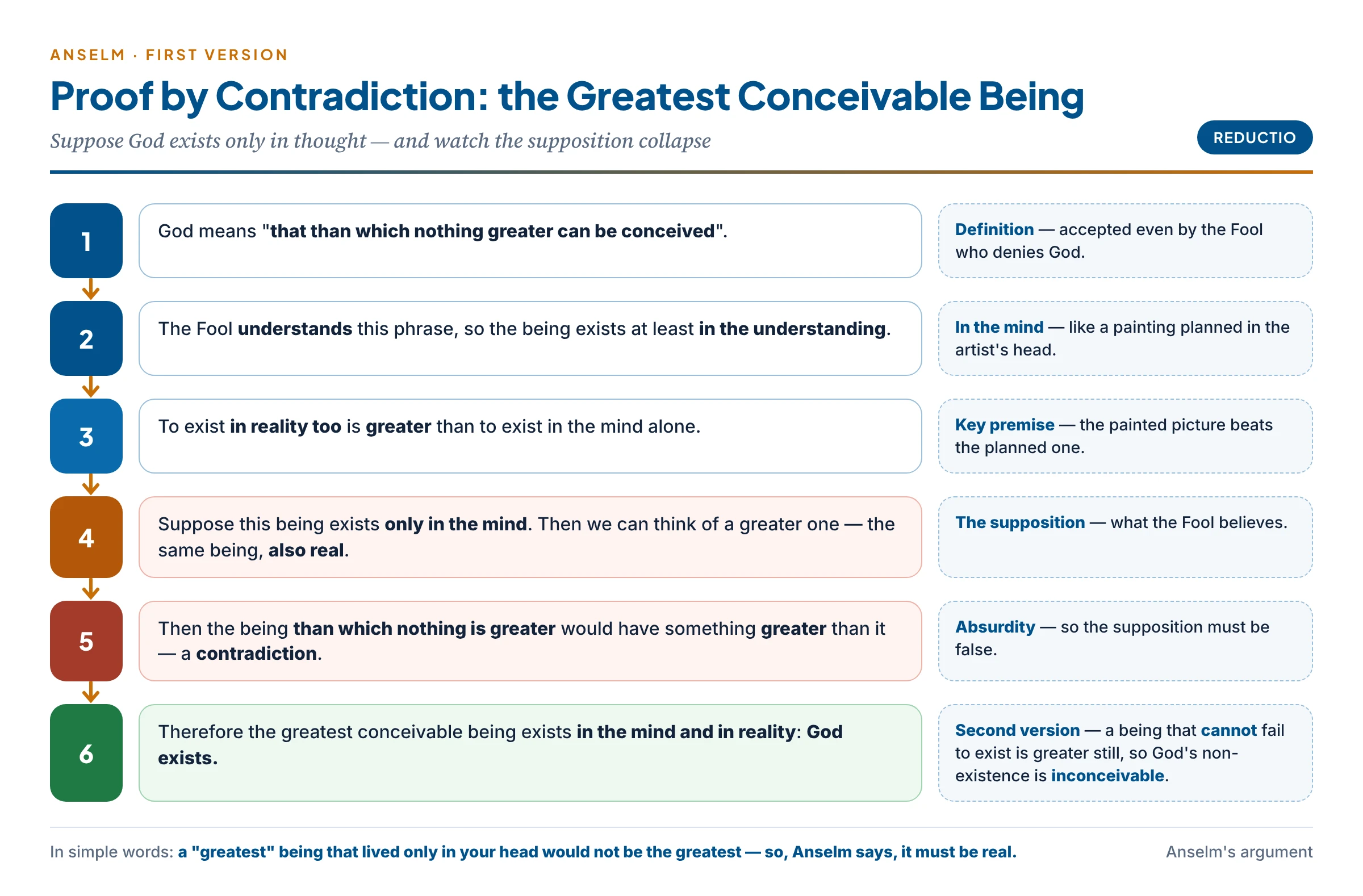
1. Anselm’s First Version: the Greatest Conceivable Being
- The definition. God is “that than which nothing greater can be conceived” (aliquid quo nihil maius cogitari possit).
- Two ways of existing. A thing can exist in the understanding (in intellectu) — as an idea in the mind — or in reality (in re) as well.
- The steps.
- Even the Fool understands the phrase “that than which nothing greater can be conceived”. So this being exists at least in the understanding.
- To exist in reality as well as in the understanding is greater than to exist in the understanding alone. (A painting the artist has actually painted is greater than the same painting only planned in his head.)
- Suppose this being existed only in the understanding.
- Then we could conceive of something greater — the same being existing in reality too.
- So “that than which nothing greater can be conceived” would be something than which a greater can be conceived — which is a contradiction.
- Therefore the greatest conceivable being exists both in the understanding and in reality.
- The method: reductio ad absurdum. Anselm proves his conclusion by showing that its denial leads to absurdity — a classic method of proof by contradiction.
“If that than which nothing greater can be conceived exists in the understanding alone, then the very being than which nothing greater can be conceived is one than which a greater can be conceived. But obviously this is impossible.” — Anselm, Proslogion
2. Anselm’s Second Version: Necessary Existence
- A stronger claim. Anselm goes further. A being whose non-existence is impossible (one that exists necessarily) is greater than a being whose non-existence is possible (one that exists contingently).
- So God cannot even be thought not to exist. If God could be conceived as not existing, we could conceive something greater — a being that cannot fail to exist. Hence God’s non-existence is inconceivable; to call it conceivable is to limit the very idea of the most perfect being.
- Why it matters. This version is not about existing “in the mind or in reality” but about necessary versus contingent existence. It is the version the modern defenders (Malcolm, Hartshorne, Plantinga) regard as the real argument.
In simple words
A building that might collapse in the next earthquake is less excellent than one that cannot collapse. Anselm says the same of God: a God who might not have existed would be less great than a God whose existence is unshakeable. So the greatest conceivable being must be a being that could not fail to exist.
3. The Argument in the Language of Worship
A common reconstruction of Anselm, closer to the believer’s attitude:
- Worthy of worship. God is the object of worship; to be worshipful, God must be the highest — greater than whom nothing can be conceived.
- Existence as an excellence. Existence is a state of the highest perfection, a quality like omnipotence, omniscience and goodness.
- Necessary existent. So God’s non-existence cannot be thought; necessary existence is contained in the very notion of the greatest being.
- A commitment, not only a deduction. Read this way, the necessity is not merely logical. It expresses the involvement of the total personality — “the cry of the whole man, the highest crescendo of the chorus: God exists, hallelujah!” Belief, commitment and self-involvement give the argument its real significance: the worshipper cannot imagine the One to whom he has surrendered himself not existing even for a moment; deciding for God is deciding to be an authentic self.
- The same symbolic statement appears, in the end, in Descartes, Spinoza and Leibniz.
4. Descartes: Existence Belongs to a Supremely Perfect Being
- The idea of a perfect being. We have a clear and distinct idea of a supremely perfect being (ens perfectissimum) — infinite, independent, all-knowing, all-powerful.
- Existence is a perfection. A perfect being possesses every perfection; existence is a perfection; so a perfect being exists. Lacking existence, it would lack something — and would not be perfect.
- The triangle analogy. Just as it follows from the idea of a triangle that its three angles together equal two right angles, so existence follows from the idea of God. We cannot conceive God without existence any more than a triangle without that property.
- The mountain and the valley. To think of a supremely perfect being lacking existence is as contradictory as to think of a mountain without a valley.
- The short form. God lacks nothing; a being that does not exist lacks something; therefore God exists.
- Difference from Anselm. Anselm reasons from “greatest conceivable“; Descartes from “supremely perfect” and from the clear and distinct idea, on the model of geometry.
Common confusion
Is “the idea of God in my mind must have been caused by God” also an ontological argument? No. Some notes list it as Descartes’ “second form” of the ontological argument. That proof — the finite mind cannot itself produce the idea of an infinite being, so the idea must have been placed in us by God, “like the mark of the craftsman stamped on his work” — is a causal argument (it reasons from an effect, the idea, to its cause). It comes earlier in the Meditations and is closer to the cosmological family. Descartes’ ontological argument is the separate, later proof from the essence of a supremely perfect being (the triangle and the mountain–valley analogies).
5. Spinoza, Leibniz and Hegel
- Spinoza — geometry of God. Spinoza’s whole argument is geometrical: definitions, axioms, propositions. Substance is “that which is in itself and is conceived through itself”; God is “a being absolutely infinite, a substance consisting of infinite attributes”. A self-contained substance can only be one, and its idea involves its existence. So, given his definitions, God exists necessarily. Critics note that geometrical deduction concerns definitions — it shows what follows if we define God so, not that anything actual corresponds.
- Leibniz — completing the proof. Leibniz thought Descartes’ proof was sound but incomplete: it shows that if God is possible, God exists. So one must first show that the idea of God is possible — that the perfections do not contradict each other. Since each perfection is purely positive and simple, no two can conflict; so a most perfect being is possible, and therefore actual. He also held that every possible thing has a claim to existence in proportion to the amount of perfection it contains; God, containing all perfection, necessarily exists.
- Hegel. For Hegel the concept (the Absolute Idea) is not an empty thought set against reality; the highest concept includes its own reality. He thought Kant’s objection applied to finite things, not to God.
6. Two Popular Illustrations
- The red rose. To say “God is all-perfect but does not exist” is like saying “this rose is red but not coloured“. Colour is contained in redness; existence, the defender says, is contained in perfection.
- The triangle. As the idea of a triangle contains “angles adding up to 180 degrees”, so the idea of a perfect being contains existence. If God did not exist, God would not be all-perfect; so for God to be perfect, God must exist.
In simple words
Ask someone to imagine a bachelor who is married. They cannot — “unmarried” is part of “bachelor”. The defender of the ontological argument says: try to imagine a perfect being that does not exist; you will fail in the same way, because “existing” is part of “perfect”. The critic replies that the bachelor case is about the meaning of words, and no amount of word-meaning can put a real being into the world. Keep these two voices in mind — the whole debate is between them.
7. The Modern Revival: Modal Versions
“Modal” means concerned with necessity and possibility. Philosophers speak of possible worlds: complete ways things could have been. Something necessary is true in every possible world; something possible is true in at least one.
- Charles Hartshorne and Norman Malcolm (Malcolm, 1960) argued that the real argument is Anselm’s second version:
- God, by definition, cannot come into or go out of existence by chance; a God who merely happened to exist would not be God.
- So God’s existence is either necessary or impossible — it cannot be a mere accident.
- It is impossible only if the idea of God is self-contradictory.
- The idea is not self-contradictory.
- So God’s existence is necessary — and hence actual.
- Alvin Plantinga (The Nature of Necessity, 1974) gave the best-known form:
- Define maximal greatness as having maximal excellence (all-powerful, all-knowing, wholly good) in every possible world.
- It is possible that a maximally great being exists — that is, it exists in some possible world.
- But a being that is maximally great in one possible world is, by definition, maximally excellent in every possible world.
- So it exists in every possible world — including the actual one. God exists.
- Kurt Gödel, the great logician, privately worked out a similar proof from the idea of “positive properties”.
- Plantinga’s own modesty. Plantinga claims only that the argument is valid and that its key premise is reasonable to accept — it shows that belief in God is rational, not that every rational person must accept it.
- The main objection: the possibility premise. Everything hangs on the claim that a maximally great being is possible. But one can argue in the same way: “It is possible that no maximally great being exists; so it fails to exist in some world; so it is not maximally great anywhere; so God does not exist.” The two arguments mirror each other, so the modal argument cannot settle the question unless we already know which premise is true.
- Findlay’s “disproof” (1948) turns the tables: a being worthy of worship would have to exist necessarily; but, on the then-popular view, necessity belongs only to propositions (true by the meaning of words), never to existence; so a worship-worthy God is impossible. The modal revival rejected this narrow view of necessity.
Critical Evaluation
1. Gaunilo: the Lost Island
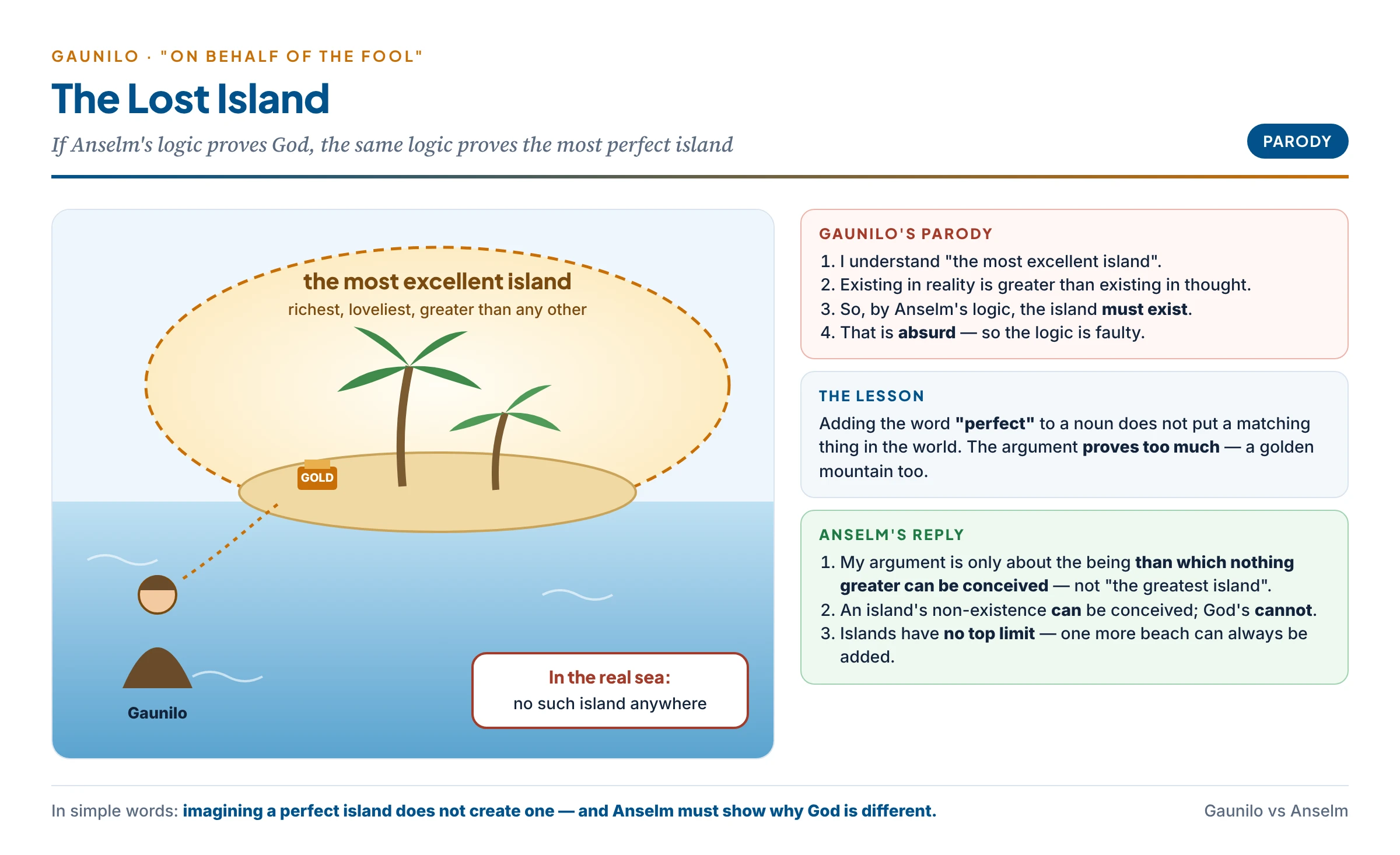
- The parody. Gaunilo, a monk of Marmoutiers, replied “on behalf of the Fool“. Imagine the most excellent island, richer and lovelier than any other — the “Lost Island”. Since it is greater to exist in reality than only in thought, this island must exist in reality, otherwise any real island would surpass it. But that is absurd.
- The lesson. If Anselm’s reasoning proves God, the same reasoning would prove a perfect island, a golden mountain, or any perfect thing we like. Adding the word “perfect” to a noun does not create a corresponding object in the world; the idea of a perfect island proves only the idea, not the island. So the argument must contain a mistake, even if we cannot at once say where.
- Anselm’s reply.
- His reasoning applies only to “that than which nothing greater can be conceived” — not to “the greatest island”, which is only the greatest of its kind.
- An island is finite and contingent; its non-existence can always be conceived. Only God’s non-existence is inconceivable.
- Later defenders add that islands have no intrinsic maximum — one can always add one more palm tree or one more beach — whereas God’s perfections (all-powerful, all-knowing) do have a maximum.
2. Aquinas: Self-evident in Itself, Not to Us
- We do not know God’s essence. Aquinas rejected Anselm’s proof. “God exists” is self-evident in itself (God’s essence is his existence), but not self-evident to us, because we do not know God’s essence.
- Only God could use it. The argument would work only for someone who fully understands the divine essence — and only God does. We must reach God a posteriori, from his effects (Article 3).
- Different understandings of “God”. Not everyone who hears the word “God” understands it as “that than which nothing greater can be conceived”; and even granting the definition, it does not follow that what the word means exists outside the mind. Aquinas’ rejection led many Catholic theologians to reject the argument too.
3. Hume: No Existence Can Be Demonstrated
- Whatever can be conceived as existent can be conceived as non-existent. There is no being whose non-existence implies a contradiction. So no matter of fact — including God’s existence — can be demonstrated a priori.
- “Necessary existence” is empty. The words “necessary existence” have no consistent meaning; if God is a real being, then, as Hume showed, it is absurd to demonstrate a matter of fact by any a priori argument. This is why many thinkers turned to the cosmological argument (Article 4).
4. Kant: “Existence Is Not a Real Predicate”
Kant gave the classic refutation in the Critique of Pure Reason (see also the Paper I article on Kant’s critique).
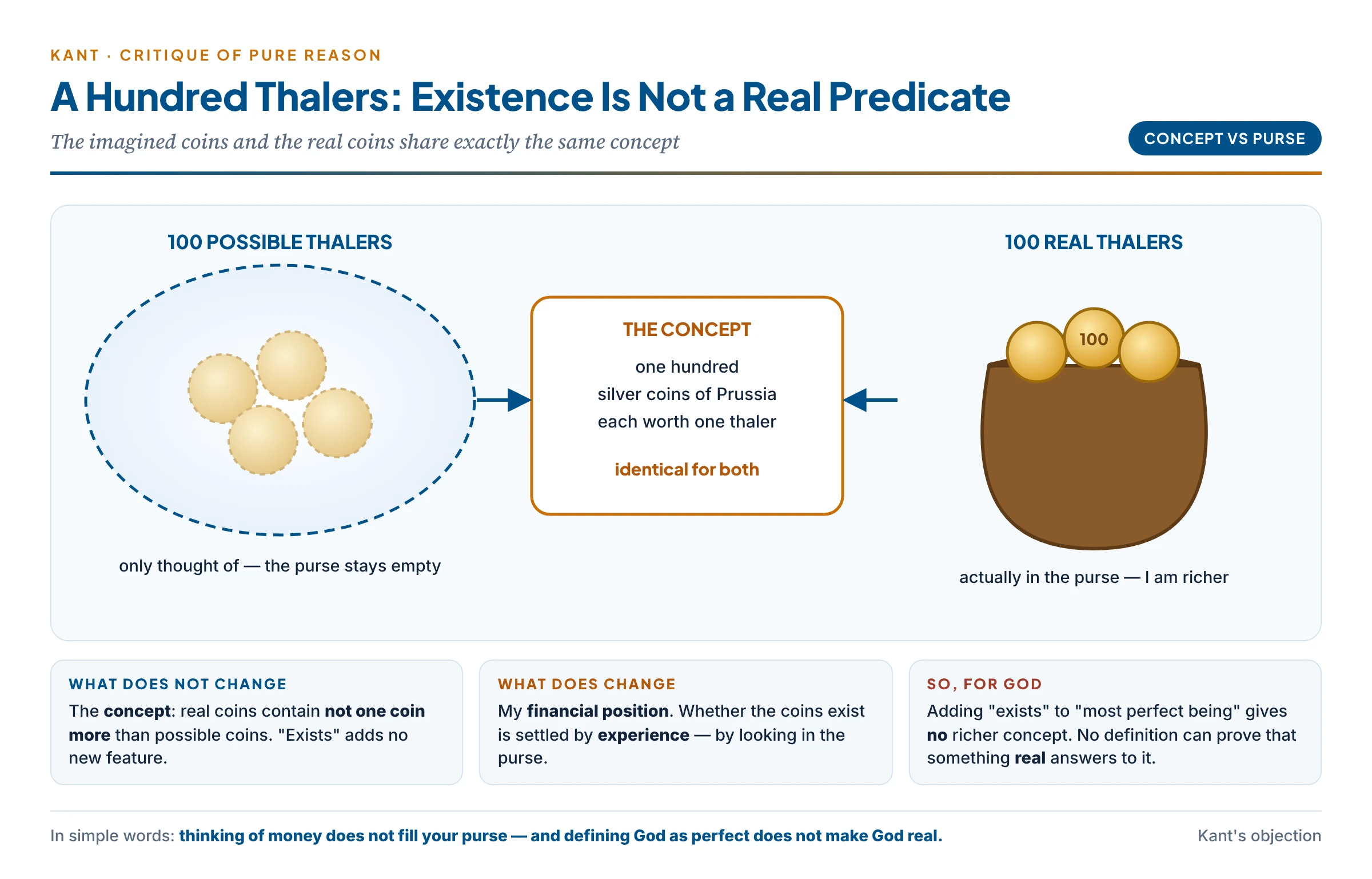
- (a) A real predicate adds to a concept. “Omnipotent” adds something to the concept of God. But “God is” or “God exists” adds nothing new to the concept; it only posits the subject, with all its predicates, as an object of possible experience.
- (b) The hundred thalers. A hundred real thalers (coins of Kant’s day) contain not a single coin more than a hundred possible (imagined) thalers. The concept is the same; the difference is in my financial position, not in the concept. So existence is not one more property that a perfect being could “have” or “lack”.
- (c) Existential judgements are synthetic. A proposition is analytic when its predicate cannot be denied without contradiction (“a triangle is bounded by three straight lines”). A synthetic proposition can be denied without contradiction — and every proposition saying that something exists is synthetic. If I reject the triangle together with its three angles, there is no contradiction; likewise, if I reject God together with all his predicates, there is no contradiction. The ontological argument hides a synthetic claim in an analytic dress.
- (d) “Necessary being” is a confusion. “Necessary” properly applies to propositions — to the link between a subject and a predicate in a definition — not to things or beings. Any existing thing can be imagined otherwise, or as not existing at all. If God is a being, he is not “necessary” in this sense; if he is “necessary”, he is not a being. To call God a “necessary being” is, on this view, as self-contradictory as a square circle.
- (e) Thought cannot create. By mere thinking on a concept we cannot bring anything into existence; otherwise, by thinking hard enough, everyone would be a king. From the idea of God we can infer the idea of his existence, not his actual existence — just as having the idea of a hundred dollars in my pocket does not put them there.
In simple words
Write a cheque for one lakh rupees in a notebook. Now write the same cheque on a real bank form and have it honoured. The description on both is identical — same amount, same payee, same date. Nothing in the description says “this one is real”. Whether the money exists is settled outside the description, at the bank. Kant says the same of God: whether a being matching the description “most perfect” exists is not settled by the description.
5. Frege and Russell: Existence Belongs to Concepts
- Frege. “Exists” is not a property of things at all; it is a property of concepts — the property of applying to at least one thing. “Lions exist” means “the concept lion has something falling under it”. So you cannot build existence into a concept and then read it off, any more than you can make the concept moon of the Earth have exactly one instance by defining it carefully. (Frege compared existence to number: “there are no unicorns” says the concept unicorn has the number zero.)
- Russell. “God exists” means “there is something which has all the divine properties“. Whether that is true depends on the world, not on the definition. Russell also showed how sentences about things that do not exist can be meaningful without those things having any shadowy “being”.
- The upshot. Modern logic gives Kant’s insight a precise form: existence is not a feature that a perfect being could have or lack; it is a matter of whether anything at all answers to the description.
Common confusion
For Russell, is “The present King of France is bald” neither true nor false? No. Some notes say Russell held that such a sentence is “neither true nor false because there is no King of France”. That is the view of his critic P.F. Strawson. Russell held that the sentence is simply false, because it says “there is one, and only one, present King of France, and he is bald” — and the first part is false. The relevance to the ontological argument is the same either way: a description does not guarantee that anything fits it, so “the most perfect being exists” cannot be true by definition alone.
6. The Logical Positivists
- Two kinds of meaningful statement. Following Hume, the positivists (A.J. Ayer) held that necessary statements are analytic — true by the meaning of words and saying nothing about the world — while existential statements are contingent and empirical.
- So “necessary existence” is self-contradictory. A statement cannot be both necessary and about existence. “God necessarily exists” either is an empty tautology about the word “God” or is a contingent claim that needs evidence.
- Theistic reply. Defenders reply that this simply assumes the narrow positivist view of necessity, which philosophers no longer generally accept (see the modal revival above).
7. Further Objections
- Circularity. “Anything perfect exists; God is perfect; so God exists.” The conclusion is already assumed in the first premise — a jugglery of words. And on what ground is God accepted as perfect in the first place?
- The triangle is a poor parallel. We can perceive triangles and check that their angles add up to two right angles; we deduce God’s existence without perceiving any of his supposed attributes. And the triangle proof says only that if a triangle exists, its angles have that sum — it never proves that a triangle exists.
- God is beyond the categories. In Kant’s terms God is a noumenal idea, beyond the categories of the understanding: he can neither be proved nor disproved by theoretical reason.
- “Mere wordplay”. Richard Dawkins called the argument a piece of verbal trickery. Defenders reply that many truths are known a priori — “two plus two is four” is known without counting apples — so the a priori form of the argument is not itself a fault.
- Concept and reality. We can conceive a unicorn, a dragon or Sherlock Holmes perfectly well; none of them exists. Logical necessity inside a definition does not guarantee reality, and the argument offers no empirical verification.
8. Merits and Demerits
| Merits | Demerits |
|---|---|
| A purely rational proof — no dependence on disputed empirical facts | Treats existence as a predicate (Kant) |
| Aims at God’s necessary existence, which no argument from a changing world can reach | Gaunilo: the same reasoning would prove a perfect island |
| Refined by great rationalists — Descartes, Leibniz — and by modern modal logic (Plantinga, Gödel) | Moves from logical necessity to real existence without justification |
| Clarifies the concept of God: a God who merely happened to exist would not be God | Possibility premise of the modal version is unproved; a mirror argument “disproves” God |
| Expresses the believer’s commitment — God as one who cannot not be | Offers no empirical verification; may be circular |
9. Is Anselm’s Proof Logical?
- Valid or sound? An argument is valid if the conclusion follows from the premises; sound if it is valid and its premises are true.
- Validity. Granted its premises — that the greatest conceivable being exists “in the understanding”, and that existing in reality is greater — the conclusion does seem to follow. Most critics grant something close to validity.
- Soundness is the problem.
- Is existence a great-making property? Kant and Frege say existence is not a property at all.
- Does “exists in the understanding” mean that a being exists somewhere in the mind, or only that we understand a phrase? If the latter, nothing yet exists that could then be “greater in reality”.
- Is the idea of a greatest conceivable being even coherent (Leibniz’s worry)? Could not “greater” be endless, like “the largest number”?
- So. Anselm’s argument is ingenious and formally tidy, but whether it is sound remains disputed; most philosophers think it fails, though few agree on exactly why.
10. Does the Concept of God Entail His Existence? Is It Self-Contradictory to Accept the Idea but Deny the Existence?
- The distinction. One may accept the idea (concept) of God as meaningful while denying that anything real answers to it — as we understand the idea of a unicorn without believing in unicorns.
- Arguments that denial is contradictory.
- Anselm and Descartes: God is defined as the greatest or most perfect being; denying his existence contradicts the definition.
- Leibniz and Plantinga: if God is a necessary being, a “non-existent necessary being” is a contradiction in terms — like a married bachelor.
- Some theists say that discussing God’s attributes while denying God is like describing the properties of a square circle.
- Arguments that denial is not contradictory.
- Kant: existence is not a predicate; I may reject the subject together with all its predicates without contradiction — as I may conceive an all-powerful dragon that does not exist.
- Positivists and humanists: “God” may be a concept created by human culture — one can study Zeus or Thor without believing in them.
- Non-realist readings (from Kierkegaard to some followers of Wittgenstein): God may function as a symbol or moral ideal — as Sherlock Holmes has meaning in literature but no existence.
- Verdict. The answer depends on the definition of God. If God is defined as necessarily existing, denial looks contradictory within that definition; but whether anything satisfies the definition is a further question that the definition alone cannot answer.
Critics and Defenders
Criticism — Critics
- Gaunilo: the same logic proves a perfect island — so it proves too much.
- Aquinas: we do not know God’s essence; “God exists” is not self-evident to us.
- Hume: whatever can be conceived as existing can be conceived as not existing.
- Kant: existence is not a real predicate; a hundred real thalers contain no more than a hundred possible ones; “necessary being” confuses propositions with things.
- Frege, Russell, the positivists: existence belongs to concepts or descriptions; necessity belongs only to analytic statements.
Defence — Defenders and replies
- Anselm: the argument applies only to the being whose non-existence is inconceivable — not to islands.
- Descartes and Spinoza: existence is contained in the idea of a supremely perfect substance, as angle-sums in a triangle.
- Leibniz: once God’s possibility is shown, existence follows.
- Malcolm, Hartshorne, Plantinga: necessary existence is a perfection; if God is possible, God is necessary — and actual.
- The believer’s reading: the argument expresses total commitment to the One who cannot not be.
Cross-Tradition Comparison
Is There an Indian Ontological Argument?
- No classical equivalent. Indian theism argues for God mainly by inference from the world (Nyāya) or accepts God on scriptural authority (Vedānta). No major school argues from the mere concept of a perfect being to its existence.
- Why not? Indian epistemology asks which pramāṇa (perception, inference, testimony) gives knowledge of a thing (Article 1). A bare concept is not a pramāṇa; an inference needs a real mark (hetu) observed in a real subject. An Anselm-style deduction would look to a Naiyāyika like a definition, not a proof.
- Yoga’s argument from degrees. Some notes classify the Yoga argument as “ontological”: knowledge and power exist in degrees, so there must be a being in whom they reach their unsurpassed limit — the omniscient Lord. It shares with Anselm and Descartes the idea of a maximum or perfection, but it starts from observed degrees, so it is closer to Aquinas’ fourth way (Articles 3 and 8).
- Advaita: being that cannot be denied. The nearest parallel lies in Advaita. Śaṅkara argues that the Self is self-evident: nobody thinks “I am not“; even doubting presupposes the doubter. And Brahman is Sat — Being itself — which cannot be denied, since every denial is itself something that is. Yet Śaṅkara does not deduce Brahman from a definition: Brahman is known from scripture and realised in direct experience.
- On “existence as a property”. Interestingly, Nyāya–Vaiśeṣika does treat existence (sattā) as a highest universal shared by substances, qualities and actions — a kind of property. Buddhists, by contrast, identify existence with causal efficiency (arthakriyā-kāritva) — what exists is what does something — a view closer to Kant’s insistence that existence is shown in experience, not in concepts.
| Point | Anselm and Descartes | Kant | Advaita Vedānta | Nyāya |
|---|---|---|---|---|
| Starting point | Concept of the greatest / most perfect being | Critique of that concept | Self-evident Self; scripture | The world as an effect |
| Is existence a property? | Yes — a perfection | No — not a real predicate | Brahman is Being itself | Existence (sattā) is a universal |
| How God is known | By pure reason | Not by theoretical reason; postulated by moral reason | By śruti and direct realisation | By inference and testimony |
| Necessity | Necessary existence | Necessity belongs to judgements | Brahman alone is ultimately real | God eternal, but proved, not defined |
Indian Connect — Indian Connect
- India’s theists reason from the world (Nyāya) or rest on scripture (Vedānta); the jump from concept to existence is foreign to the pramāṇa method.
- Śaṅkara’s “no one thinks ‘I am not’” is the closest echo of Anselm and of Descartes’ cogito: something whose denial defeats itself.
- The Buddhist test of existence — causal efficiency — sides with Kant: what exists must show itself by doing something, not by being well defined.
- Yoga’s argument from the degrees of knowledge is a perfection-argument, but a posteriori — nearer Aquinas than Anselm.
Synthesis (Siddhānta)
- What the argument says. From the idea of “that than which nothing greater can be conceived” (Anselm) or of a “supremely perfect being” (Descartes), it deduces that God exists, and in its stronger form that he exists necessarily — his non-existence is inconceivable.
- Its history. Rooted in Plato and Augustine, stated by Anselm as faith seeking understanding, restated by Descartes, Spinoza and Leibniz (who added the need to show God’s possibility), defended by Hegel, it was attacked by Gaunilo (the Lost Island), Aquinas (God’s essence unknown to us), Hume (no existence demonstrable), Kant (existence not a predicate; the hundred thalers; “necessary being” a confusion), Frege and Russell (existence belongs to concepts and descriptions) and the positivists (necessary existence a contradiction).
- Its modern form. Hartshorne, Malcolm and Plantinga recast it in terms of necessity and possibility: if God’s existence is even possible, it is necessary. The argument becomes valid, but its key premise — that God is possible — is exactly what the sceptic doubts, and a mirror argument can be built in reply.
- Balanced verdict. Most philosophers hold that the argument fails to prove God’s existence, mainly because existence cannot be extracted from a concept. Yet it has lasting value:
- It clarifies the concept of God — a God who merely happened to exist, or who might cease to exist, would not be the God of worship.
- It shows the depth of the believer’s commitment — the God of faith is one who cannot not be.
- It forced philosophy to think hard about existence, necessity and possibility, shaping modern logic from Kant to Frege to modal logic.
- Contemporary relevance. The modal debate continues in analytic philosophy of religion; it also connects with discussions of necessary truths in mathematics and logic, and with the question whether anything could exist necessarily — God, numbers, or the universe itself (Article 4).
“Being is obviously not a real predicate; that is, it is not a concept of something which could be added to the concept of a thing.” — Kant
“I believe in order that I may understand.” — Anselm
Previous Year Questions
- 2024Present an exposition of ontological proof for the existence of God along with its criticism.
- 2024Critically examine Kant’s objections against the ontological argument for the existence of God.
- 2021Explain how Cartesian formulation of ontological argument is criticised by Kant.
- 2020Is ontological proof for the existence of God by St. Anselm logical? Discuss.
- 2018Does the concept of God entail the existence of God? Examine from the perspective of ontological argument.
- 2015Examine the ontological and cosmological arguments in favour of existence of God.
- 2014Discuss the ontological argument for the existence of God, and show its merits and demerits.
- 2014Can it be self-contradictory to accept the idea of God but deny the existence of God?
- 2009Comment on Kant’s objections against the ontological argument for the existence of God.
- 2008Different versions of ontological arguments and Kant’s critique of these arguments. Critical note.
- 2005“If God exists only in someone’s mind, the greatest conceivable being is not after all the greatest conceivable being.” Critical notes.