

Proofs for the Existence of God and their Critique (Indian and Western).
Official Syllabus: Paper II, Section B, Unit 2
St. Thomas Aquinas (1225–1274), the greatest philosopher-theologian of medieval Christianity, did not think that God’s existence could be proved from the mere idea of God, as Anselm had tried (Article 2). He held instead that we must begin from what we see: things move, things cause other things, things come into being and pass away, things are better and worse, and things without minds act for ends. From each of these five plain facts of experience he argued to a first source on which the whole series depends. These are the famous Five Ways (Quinque Viae) of the Summa Theologiae. The first three are the classical forms of the cosmological argument (from motion, from efficient cause, from contingency); the fourth argues from degrees of perfection; the fifth is a teleological (design) argument. This article explains each Way step by step, the Aristotelian background that gives them their meaning, why Aquinas rejects an infinite regress, what each Way actually proves, and the main criticisms and replies.
In simple words
A long goods train is moving through a station. Each wagon moves only because the wagon in front pulls it. Add a hundred more wagons, or a million — none of them can move the train by itself. If there were only wagons, however many, nothing would move at all. The fact that the train is moving shows there is an engine somewhere that pulls without being pulled. Aquinas looks at the world the same way: everything we see receives its motion, its causal power and its very existence from something else — so there must be a first source that gives without receiving. “And this,” he says, “everyone understands to be God.”
Context & Problem
Aquinas’ Project: Faith and Reason
- Two routes to God. Aquinas distinguishes revealed theology (truths known only because God revealed them, like the Trinity) from natural theology (truths reason can reach by itself, like the existence of God). The Five Ways belong to natural theology.
- Faith and reason do not conflict. Both come from God, so a sound argument can never contradict true faith. Reason can prepare the way for faith (“preambles of faith”).
- Why argue at all? Many people believe in God through faith; but some do not, and reason gives a common ground on which believer and unbeliever can meet.
- The Summa Theologiae. The Five Ways are set out very briefly — each in a short paragraph — at the very start of this great work, in answer to the question “Whether God exists?”.
Why Not the Ontological Argument?
- Self-evident in itself, not to us. Aquinas grants that “God exists” is self-evident in itself, since in God essence and existence are the same. But it is not self-evident to us, because we do not know God’s essence.
- We cannot start from God’s definition. Different people mean different things by “God”, and even if one understands “that than which nothing greater can be thought”, it does not follow that such a being exists outside the mind. Only one who fully grasps God’s essence — God himself — could use the ontological argument (Article 2).
- So we must start from effects. We know a cause from its effects, as we infer a fire from its smoke. The arguments must be a posteriori — from the world to God.
The Aristotelian Background
- Rediscovery of Aristotle. Aquinas wrote when Aristotle’s works had returned to Europe through Arab and Jewish thinkers. He built his proofs on Aristotle’s ideas.
- Potentiality and actuality. A thing that can be something but is not yet is in potentiality; when it becomes that thing it is in actuality. Cold water is potentially hot; when heated it is actually hot. Change (or “motion”) is the passage from potentiality to actuality.
- Nothing gives what it does not have. Only what is already actual can bring something from potentiality to actuality — only something actually hot (fire) can make cold wood hot.
- The four causes. Aristotle named four causes: material (what a thing is made of), formal (its form), efficient (what makes it) and final (what it is for). Aquinas uses efficient causation in the Aristotelian sense — a cause that acts with an end in view, not merely a mechanical push.
- God as the architect and Unmoved Mover. For Aristotle the first source of all motion is the Unmoved Mover, pure actuality with no potentiality at all. In Aquinas’ hands the First Cause is like an architect with a design: the effect (the world) reflects that design, and the cause is more perfect than the world it shapes.
- Plato’s earlier hint. Plato, in the Laws, had argued that all motion goes back to a self-moved motion — the soul — which is the source of every other motion and is its own ground. The cosmological argument thus has Greek roots.
The Common Shape of the Five Ways
- Start from an observed fact — motion, causation, contingency, gradation or order.
- Apply a principle — nothing moves itself, nothing causes itself, nothing contingent explains itself, the more and less imply a most, and mindless things need a mind to direct them.
- Reject an infinite regress in a chain of things that depend on one another here and now.
- Conclude to a first term — a first mover, first cause, necessary being, maximum or intelligent governor.
- Name it God — “and this all men speak of as God”.
In simple words
A rumour reaches you through a chain of friends: A heard it from B, B from C, C from D… If everyone in the chain only heard it from someone else, the rumour could never have started. Somewhere there is a person who saw the event and did not hear it from anyone. The Five Ways apply this logic not to rumours but to motion, causal power and existence itself.
Two Kinds of Causal Series
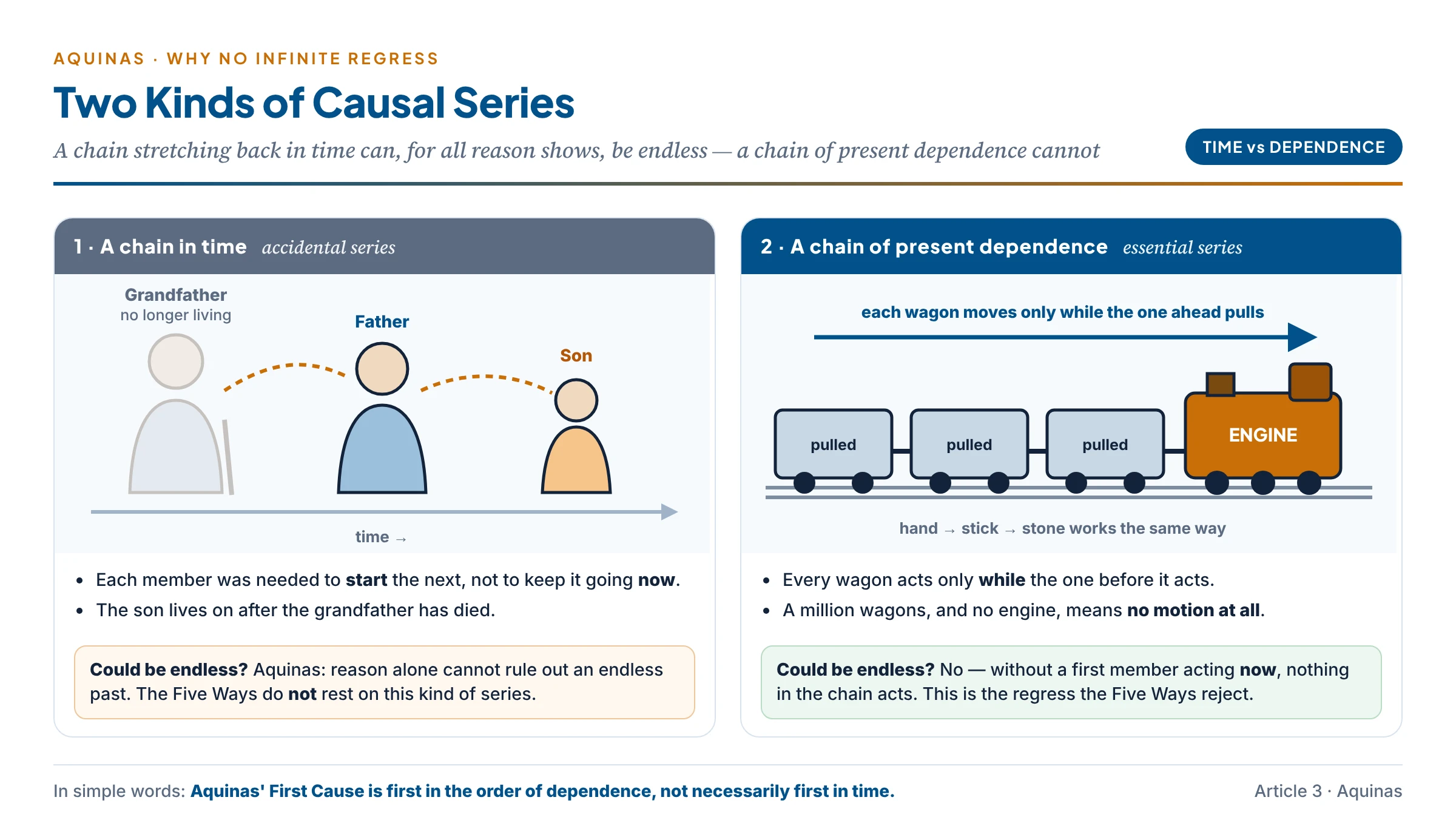
- A temporal (accidental) series. Grandfather → father → son. The grandfather can die and the son still lives and has children. Each member was needed to start the next, but not to keep it going now. Aquinas admits that reason alone cannot prove that such a series had a beginning; it might, for all philosophy can show, go back for ever.
- A hierarchical (essential) series. A hand moves a stick, the stick moves a stone. Here each member acts only while the one before it acts — the moment the hand stops, the stick and the stone stop. Such a series cannot go back for ever, because if there were no first member actually acting, nothing in the series would be acting now.
- Why this matters. The Five Ways are mainly about the second kind of series — dependence here and now, not a chain stretching back in time. Aquinas’ First Cause is not mainly the cause that came first in time but the cause that is first in the order of dependence — the ground holding everything up at every moment.
Core Doctrine
The First Way: From Motion (Ex Motu)
- “Motion” in a wide sense. For Aquinas, motion means any change — from potentiality to actuality — not only movement from place to place. Growth, heating, learning and ripening are all “motion”.
- The argument.
- Some things in the world are in motion — this is evident to the senses.
- Whatever is in motion is moved by another, for nothing can bring itself from potentiality to actuality. A thing cannot be, at the same time and in the same respect, both actually hot (to give heat) and only potentially hot (to receive heat).
- If the mover is itself moved, it too must be moved by another, and that by another.
- But this cannot go on to infinity, because then there would be no first mover, and so no other mover either — second movers move only because they are moved by the first, as a stick moves only because a hand moves it.
- Therefore there must be a first mover, moved by no other — the Unmoved Mover (Primum Movens Immobile). “And this everyone understands to be God.”
- What the Unmoved Mover is. Not a big object that happens to be standing still, but pure actuality (actus purus) — a being with no unrealised potentiality, which therefore needs nothing to “move” it. It is the source of change, not a thing at rest.
- Example. Fire makes a pot of water boil; the fire burns because of the gas; the gas flows because of pressure… Each link only passes on what it receives. The First Way says the whole sequence of passing-on needs a source that does not merely pass on.
Indian Connect — Indian parallel — Āyojanāt
- Nyāya’s āyojanāt argument says that atoms are inert at the beginning of creation and cannot combine by themselves; an intelligent being must impart the first motion that joins them into dyads.
- Both arguments move from the passivity of the moved to a mover who is not itself moved by another. But Nyāya’s God moves eternal atoms that he did not create, while Aquinas’ God is the source of everything that exists (Article 7).
The Second Way: From Efficient Causation (Ex Causa Efficiente)
- The argument.
- In the world of sense we find an order of efficient causes — things that bring about other things.
- Nothing can be the efficient cause of itself, because then it would have to exist before itself, which is impossible.
- In an ordered series of causes, the first is the cause of the intermediate, and the intermediate of the last. Take away the cause and you take away the effect.
- If the series went on to infinity there would be no first cause, so no intermediate causes and no last effect — yet effects plainly exist.
- Therefore there is a First Efficient Cause (Causa Prima), which everyone calls God.
- How it differs from the First Way. The First Way looks at change (things acquiring new states); the Second looks at production (things being brought about). A carpenter does not merely change wood; he produces a chair.
- Others who argued this way. Descartes (from the idea of God in me), Berkeley (God as the cause of our ideas) and Bonaventure also used causal arguments; Islamic thinkers like al-Ghazālī and Christian thinkers like Duns Scotus gave related versions (Article 4).
- Example. A light bulb glows because current flows; the current flows because the power station generates it; the station runs because coal burns… Each depends on something prior now. Without a first cause actually at work, the bulb would be dark.
Indian Connect — Indian parallel — Kāryāt
- Nyāya’s kāryāt argument: the earth, mountains and plants are effects because they are made of parts; every effect needs an intelligent maker who knows its material, as a pot needs a potter; so the world has an all-knowing maker — Īśvara.
- Like the Second Way, it moves from effects to a cause; unlike it, Nyāya’s maker is only the efficient cause who arranges eternal atoms, and the stress is on intelligence (knowledge, desire, effort) rather than on stopping a regress (Article 7).
The Third Way: From Contingency and Necessity (Ex Possibili et Necessario)
This is the most philosophically developed of the Ways, and the one asked about directly in recent papers.
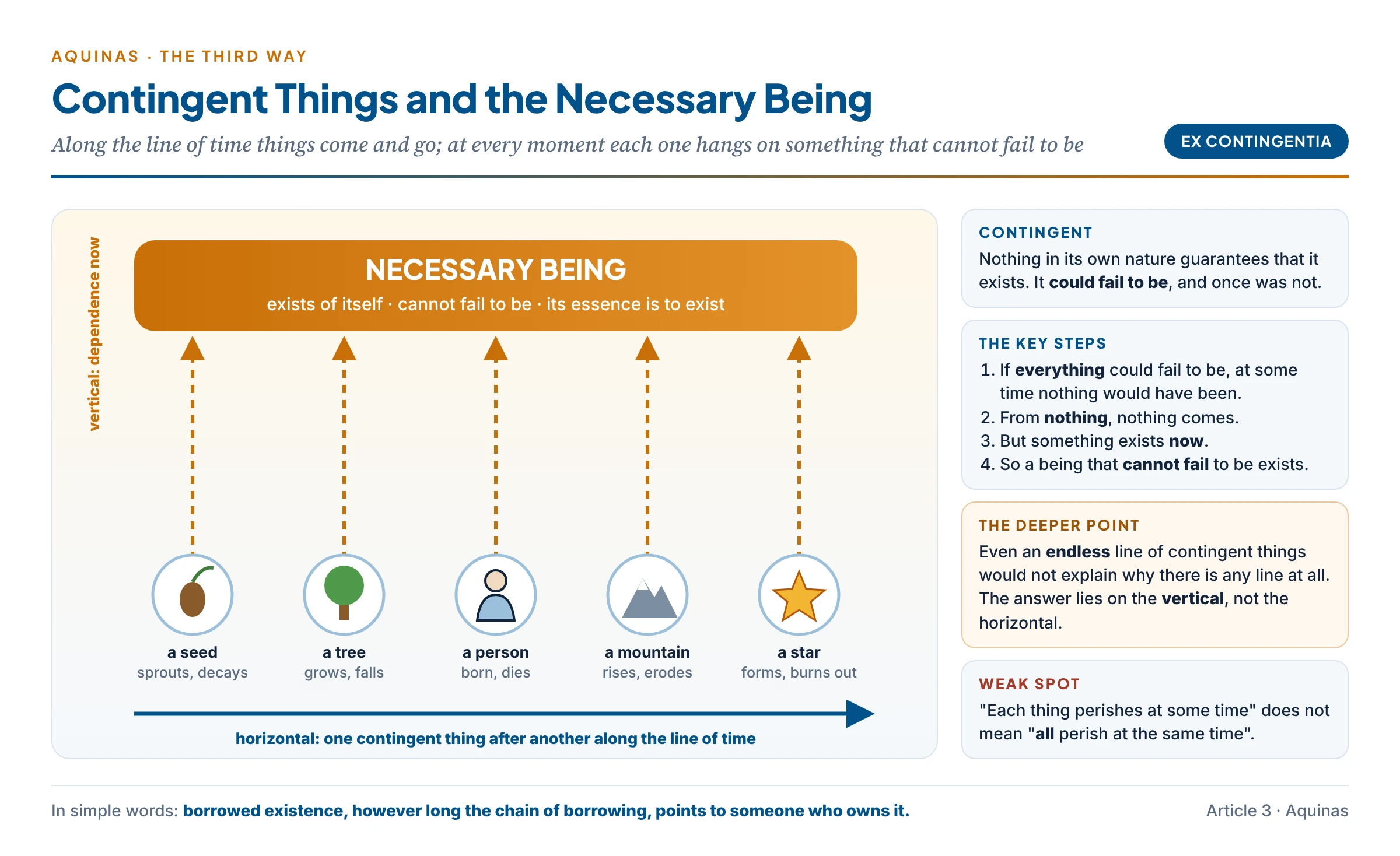
- Contingent things. We see things that are possible to be and not to be — they are born and they perish. A thing is contingent when there is nothing in its own nature to guarantee its existence; it does not carry the ground of its own existence within itself.
- The argument in simple steps.
- All the things of the world are contingent — each of them, at some time, can pass away.
- What can fail to exist, at some time does not exist.
- If everything were contingent, then — given an infinite stretch of time already past — at some time all things would have ceased to exist. There would have been a complete void.
- If there was ever a complete void, there would be nothing even now, because out of nothing, nothing comes (ex nihilo nihil fit).
- But something exists now. So not everything is contingent: there must be at least one necessary being — a being that cannot fail to exist.
- A necessary being either has its necessity from another or from itself. A chain of beings necessary through another cannot go on for ever, for the same reason as in the first two Ways.
- So there is a being necessary of itself, which does not receive its existence from anything, and which causes the necessity of others. This all men call God.
- Put very briefly. “If anything exists, then an absolutely necessary being exists. But something exists. Therefore an absolutely necessary being exists.”
- God’s essence is his existence. In every creature, what it is (essence) and that it is (existence) are different: knowing what a horse is does not tell you whether any horse exists. In God alone essence and existence are identical — God does not have existence, he is existence itself (ipsum esse). Aquinas’ point is not that God’s existence follows from his concept (that would be the ontological argument), but that the being who actually grounds the world turns out to be one whose essence is to exist.
- Existence before idea. This way of thinking gives priority to existence. We should not say “there must be a perfect being because we have an idea of him”; rather, “we have an idea of him because he exists”. And the ground of the world must be an actuality, not a bare possibility — only something actual can explain anything (a point already found in Plato and Aristotle).
- The transient implies the permanent. The deepest thought here is that to see a thing as contingent — as something that might not have been — is already to see it as depending on something that is not contingent.
In simple words
Imagine a library where every book has been borrowed from another library, and that library borrowed it from a third… If no library actually owned any book, there would be no books on any shelf at all. The books on your table prove that somewhere a book is owned, not borrowed. Contingent things “borrow” their existence; the Third Way says their presence proves an owner of existence — a being that does not borrow it.
The Hidden Assumptions of the Third Way
- First assumption — the world needs explaining. The argument assumes that the contingent world stands in need of explanation: the question “why are things as they are, and why are they at all?” is a legitimate question. If this is granted, the answer, for Aquinas, can only be a necessary being.
- Second assumption — an infinite time has already passed. The step “at some time everything would have perished” assumes that an infinite series of time has already gone by, so that every possibility of perishing would have been realised. This is the weakest step: “an infinite series of time” means a series that has not come to an end and can never be said to have “passed away”. If time is still going on, perhaps the contingent world has not yet come to nought. Without this assumption, however, the argument cannot proceed.
- Third assumption — the whole chain needs explaining. The argument is not merely about escaping a regress backward in time. It assumes that all things are dependent, and that the whole chain of dependent things, even if endless, needs explaining just as much as each link does — and must be explained by something beyond and other than itself.
- Fourth assumption — necessity of fact, not of logic. Normally “necessary” is said of propositions (“two plus two is four”), not of things. Aquinas means a factual or metaphysical necessity — a being that cannot not be — not a logical necessity.
Is the Contingency Argument More Than a Logical Exercise?
- The charge. From Hume and Kant to Russell and Ayer, many have held that statements about facts can only be contingent; to call any existing being “necessary” is, they say, self-contradictory. On this view the argument is a play with words.
- First reply — it starts from a fact. The argument begins with the most basic fact of all: that something exists and that the things we know need not have existed. It asks a real question — why is there anything at all? — rather than unpacking a definition.
- Second reply — necessity of a different kind. “Necessary being” is a metaphysical or ontological idea, to be understood in its own terms, not in the language of empirical science. Many theists add that it must be grasped existentially or convictionally: the believer meets God not as one more fact but as the ground of all facts.
- Third reply — it shapes life and science. The argument expresses the human sense of dependence and wonder — as Wittgenstein put it, “not how the world is, but that it is, is the mystical” —, and it is still discussed in debates about the beginning and contingency of the universe (Article 4).
- The other side. Critics answer that the argument shows, at most, that the question is natural, not that it has an answer; the world might be a brute fact (Russell), or matter itself might be the necessary being (Hume). So the contingency argument is more than a logical exercise — it is a serious metaphysical argument — but it is not a demonstration that compels assent.
Common confusion
Does the Third Way say that the universe began at a point in time? No. Many notes present the Third Way as “the universe had a beginning, so it needs a creator”, and link it to the Big Bang. Aquinas himself held that reason cannot prove that the world had a beginning in time — he believed it did, but on the basis of revelation. The Third Way is about dependence: even if the world had always existed, its contingent things would still need a necessary being to ground them at every moment. The “it began to exist” argument is the separate Kalām argument (Article 4).
The Fourth Way: From Degrees of Perfection (Ex Gradibus)
- The argument.
- We find in things more and less — some are more good, more true, more noble than others.
- “More” and “less” are said of things according as they approach something that is the maximum — as a thing is hotter the nearer it comes to what is hottest.
- So there is something which is truest, best and noblest, and therefore most fully being (since what is most true is most fully real).
- The maximum in any kind is the cause of all in that kind — as fire, the hottest, is the cause of the heat in all hot things.
- Therefore there is something which is the cause of the being, goodness and every perfection of all things — and this we call God.
- Its roots. This Way is the most Platonic of the five: things are good by sharing in (participating in) the Good itself, as Plato taught with his Form of the Good. It also echoes Anselm’s “greatest conceivable being”.
- Example. We call one judge more just than another. Aquinas asks: more just by what standard? The very comparison points to a standard of perfect justice, and things have justice by sharing in it.
In simple words
Exam marks go 40, 60, 75, 90… We call one answer “better” than another only by comparing both with the ideal answer that would deserve full marks. The Fourth Way says goodness, truth and nobility work like this: “better” and “worse” make sense only against a perfect standard — and things are good by sharing in that standard.
- An Indian parallel. Yoga argues that knowledge and power come in degrees among beings; whatever has degrees has an upper limit; so there is a being of unsurpassed knowledge — Īśvara, the “seed of omniscience” (Article 8).
Common confusion
Are all Five Ways “cosmological” arguments? Not strictly. Some notes call all five the cosmological argument. Only the first three — from motion, efficient cause and contingency — are cosmological in the usual sense, since they argue from the existence and change of the world to its first cause. The Fourth argues from degrees of perfection (closer to Plato and Anselm), and the Fifth is a teleological or design argument from the order of nature.
The Fifth Way: From the Governance of the World (Ex Gubernatione)
- The argument.
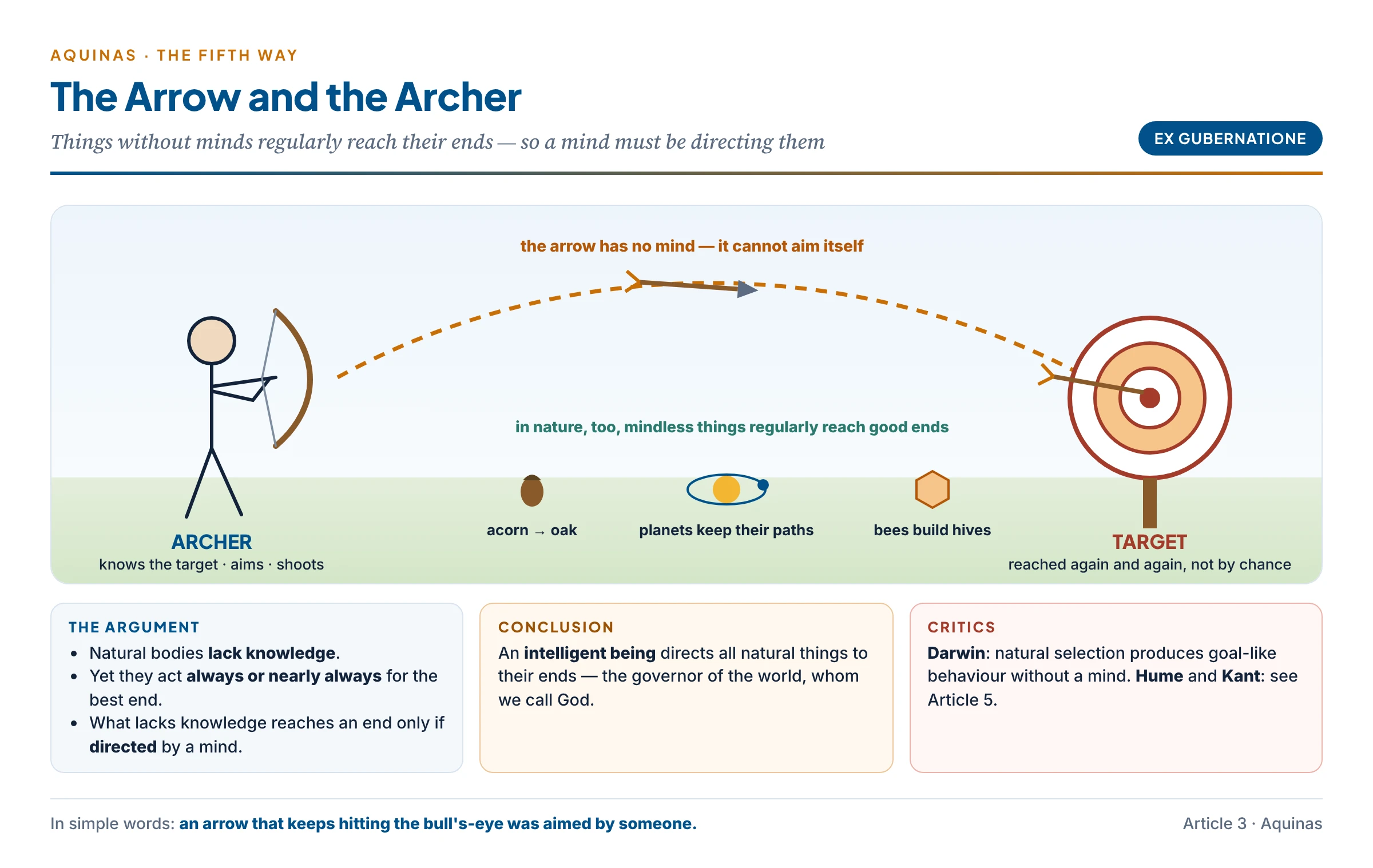
- We see that things which lack knowledge, such as natural bodies, act for an end — they act always, or nearly always, in the same way so as to obtain the best result.
- This happens not by chance but by design.
- But what lacks knowledge cannot move towards an end unless it is directed by something with knowledge and intelligence — as the arrow is shot to its mark by the archer.
- Therefore some intelligent being exists by whom all natural things are directed to their end — and this we call God.
- What is distinctive. Unlike later design arguments (Paley’s watch), the Fifth Way does not rest on complexity or machinery. It rests on the simple fact that regular, goal-directed behaviour is found throughout nature — acorns grow into oaks, not into frogs; planets keep their paths. Regularity towards an end, in things that cannot think, points to a mind directing them.
- The fuller story of the design argument, from Paley to fine-tuning, and its critics Hume, Kant and Darwin, is given in Article 5.
What the Five Ways Prove
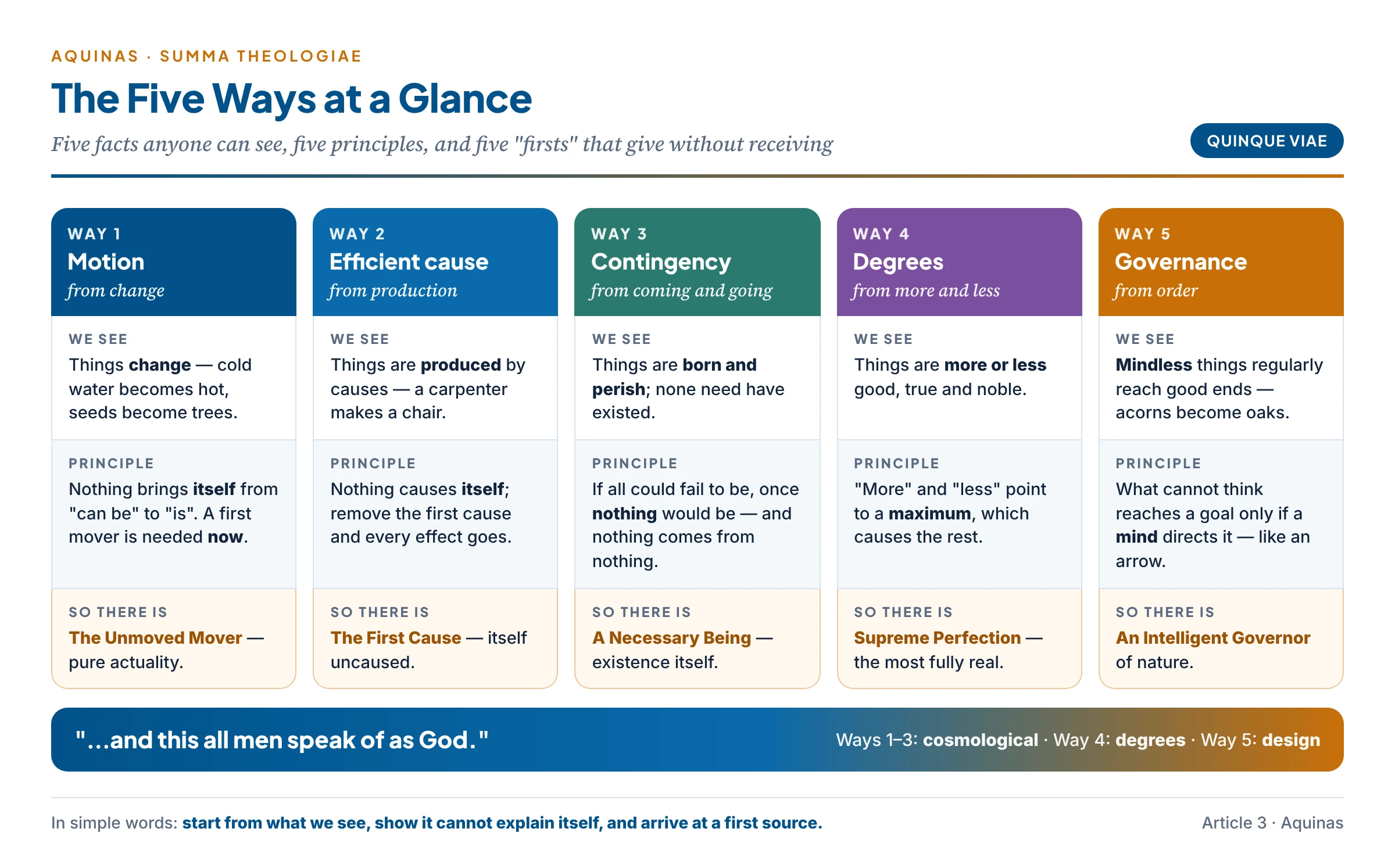
| Way | Starts from | Principle | Concludes to |
|---|---|---|---|
| 1. Motion | Things change | Nothing moves itself from potential to actual | Unmoved Mover, pure actuality |
| 2. Efficient cause | Things are produced by causes | Nothing causes itself; no endless chain of present causes | First Cause, uncaused |
| 3. Contingency | Things come to be and pass away | What can fail to exist needs a ground | Necessary Being, existing of itself |
| 4. Degrees | Things are more or less good, true, noble | The more and less imply a maximum that causes them | Supreme Perfection, the most fully real |
| 5. Governance | Mindless things act for ends | Direction to an end needs a mind | Intelligent Governor of nature |
- Each Way reaches a “first”. None of them, taken alone, reaches the full God of Christian faith — loving, personal, three-in-one. Each ends with “and this all call God“, a step that later critics found too quick.
- Aquinas fills the gap later. In the following questions of the Summa he argues that the first being must be simple, perfect, good, infinite, unchanging, eternal and one — attributes drawn out from the idea of pure actuality.
- The problem of finite to infinite. How can we reach an infinite God from finite data? Aquinas’ answer is the analogy of being (analogia entis): we can speak of God by analogy with the perfections we find in finite things, since God is their cause. Many thinkers feel this device shows the difficulty of proving an infinite God from finite premises more than it solves it.
Critical Evaluation
Objections to the First Way
- Newton’s inertia. Modern physics says a body in motion stays in motion without any mover; motion needs no continual push. So “whatever is moved is moved by another” seems false.
- Quantum physics. Some events at the atomic level seem to happen without a determining cause.
- An “unmoved mover” is self-contradictory. In our experience, whatever moves another is itself changed in doing so; an unchanging mover goes against all experience.
- Other explanations of change. Sāṃkhya takes Prakṛti, the ever-changing primal nature, as the source of change, with no need for God; modern cosmology speaks of forces such as dark energy; Buddhist momentariness explains change without any permanent mover.
- God himself may change. Whitehead’s process philosophy holds that God is himself in process; Sri Aurobindo sees the Divine as constantly active in involution and evolution — not an unmoved mover.
- Replies.
- “Motion” for Aquinas means any passage from potential to actual, including coming into existence; inertia describes how bodies move, but does not explain why there is a world of change at all.
- “Unmoved” means not needing to be moved — fully actual — not static or inert. A source of all activity need not itself be “changed” in giving.
Objections to the Second Way
- Special pleading. If everything must have a cause, God must have a cause too. If God need not have one, why must the world? (This objection, pressed by Mill and Russell, is examined in Article 4.)
- Infinite chains are possible. Russell saw nothing absurd in an infinite series: in mathematics the series of numbers has no first member and causes no trouble.
- No necessary connection. Hume argued that we never observe a necessary connection between cause and effect, only regular sequence; so causal reasoning cannot carry us beyond experience to God.
- The whole is not a part. Even if every event has a cause, the totality need not have one — the fallacy of composition (Article 4).
- A first cause is not a personal God. The Big Bang, if it was a beginning, does not show a personal, loving creator; a first cause might be an impersonal physical state.
- Replies.
- The principle is not “everything has a cause” but “whatever comes to be or receives existence has a cause”; God, who is pure actuality, does not come to be.
- The regress Aquinas rejects is in a series of causes acting here and now (the hand-stick-stone kind), not in a mathematical series or a chain backward in time.
Objections to the Third Way
- A slip in reasoning. From “each thing at some time does not exist” it does not follow that “at some time nothing exists”. Every guest at a wedding leaves at some time, but the hall need not ever be empty — new guests keep arriving. Contingent things might overlap for ever.
- The infinite-time step. As noted above, the claim that an infinite time has already elapsed is weak.
- The universe might itself be necessary. Why not say that matter or the universe as a whole is the necessary being? (Hume; Article 4.)
- Contingent does not imply permanent. From the fact that something is contingent it does not follow logically that its opposite — a permanent being — exists.
- “Necessary being” is a contradiction. Kant and the logical positivists held that necessity belongs only to propositions, and that the cosmological argument, in moving to a necessary being, quietly relies on the ontological argument (Article 4).
- Quantum randomness. If some events happen by chance, the demand for a necessary ground for every contingent thing looks less compelling.
- Replies.
- Aquinas’ deeper point does not depend on the infinite-time step: even an endless series of contingent things, taken as a whole, has no explanation of its existence within itself.
- “Necessary” here means metaphysically incapable of not existing — a different idea from logical necessity — so the charge of contradiction misses the target.
- Matter cannot be the necessary being, since every material thing we know is changeable and dependent on conditions.
Objections to the Fourth Way
- It assumes objective values. It presupposes that goodness, truth and nobility are real and graded; a sceptic about values will not grant this. Modern secular ethics explains morality without any divine standard.
- Degrees need not have a maximum. Numbers get bigger without end, yet there is no biggest number. “Hotter” does not require a “hottest” thing.
- Outdated physics. “Fire, the hottest thing, causes all heat” belongs to medieval physics; nothing in physics is the maximum of heat that causes all other heat.
- Reply. Aquinas is speaking of perfections (being, goodness, truth) that admit of an unlimited fullness, not of quantities like number or heat; the fire example is only an illustration of participation.
Objections to the Fifth Way
- Darwin’s natural selection explains goal-directed behaviour in living things without any designer.
- Evil and disorder in nature tell against a perfectly wise governor.
- These and other objections (Hume, Kant) are discussed fully in Article 5.
General Objections to the Five Ways
- Why stop the regress? Russell: there is no reason to bring in God merely to avoid an infinite regress.
- Causality only in experience. Kant: causality is a category of the human understanding, valid only for phenomena (the world as experienced); to use it to reach a cause beyond experience is an illegitimate leap.
- From “first” to “God”. Even if there is a first mover, first cause and necessary being, why must they be one being, and why the God of religion? The final step “this all call God” is the weakest link.
- Finite to infinite. No finite premises can deliver an infinite conclusion; analogy only hides the gap.
- Science has replaced the Aristotelian physics on which the First and Fourth Ways rest.
Which Way Is Philosophically Most Interesting?
- The case for the Third Way.
- It asks the most fundamental question of all — why does anything exist rather than nothing?
- It does not depend on Aristotelian physics (unlike the First and Fourth Ways) and so is less exposed to scientific objections.
- It connects with modern cosmology, which asks whether the universe is self-explaining.
- Its weakness — the possibility that the universe itself is necessary — is precisely the point on which serious debate still turns (Article 4).
- The case for other Ways.
- The First Way contains Aquinas’ deepest metaphysics — the idea of God as pure actuality.
- The Fifth Way has had the longest life: it lives on in today’s fine-tuning arguments (Article 5).
- The Fourth Way is the most Platonic and links with Indian arguments from the gradation of knowledge (Yoga).
Critics and Defenders
Criticism — Critics
- Hume: no necessary connection; the universe or matter may be self-sufficient.
- Kant: causality applies only to experience; the necessary being relies on the ontological argument.
- Russell: infinite series are possible; the universe may be a brute fact.
- Modern science: inertia, quantum chance and natural selection weaken the First, Second and Fifth Ways.
- Logical point: “each thing perishes sometime” does not mean “everything perishes at once”.
- Theological gap: a first cause is not yet the personal God of faith.
Defence — Defenders and strengths
- The Ways concern dependence here and now, not a chain in time — so an infinite past is no objection.
- “Unmoved” means fully actual, the source of all activity, not inert.
- God does not “need a cause” because he does not come to be; only what receives existence needs a cause.
- The Third Way asks a genuine question — why anything exists — that science cannot answer from within.
- Aquinas derives God’s unity, goodness and infinity in the following arguments of the Summa.
Cross-Tradition Comparison
Aquinas and the Nyāya Proofs
| Point | Aquinas (Five Ways) | Nyāya (Udayana) |
|---|---|---|
| Method | Reason from effects (natural theology) | Inference (anumāna) from effects, plus scripture |
| Motion | First Way: Unmoved Mover | Āyojanāt: God gives first motion to inert atoms |
| Causation | Second Way: First Efficient Cause | Kāryāt: the world as an effect needs an intelligent maker |
| Sustaining | Third Way: necessary being grounds contingent things | Dhṛtyādeḥ: the world is upheld and dissolved by God’s will |
| Degrees | Fourth Way: supreme perfection | (Yoga, not Nyāya: unsurpassed knowledge) |
| Order | Fifth Way: intelligent governor | Kāryāt again: order needs a knowing maker |
| Moral argument | Not among the Five Ways | Adṛṣṭāt: karma needs a conscious dispenser |
| Scripture | Kept apart, in revealed theology | Pratyayataḥ, śruteḥ, vākyāt — the Veda’s authority and author |
| God and matter | God creates out of nothing and gives existence | God orders eternal atoms and souls; efficient cause only |
Indian Connect — Key takeaways
- The first three Ways have close Nyāya parallels in āyojanāt, kāryāt and dhṛtyādeḥ; the Fourth has a Yoga parallel; the moral and scriptural proofs of Nyāya have no place among the Five Ways.
- Aquinas’ Third Way has no exact Nyāya counterpart, since for Nyāya atoms, souls, space and time are themselves eternal and necessary.
- Both traditions face the same objections — the body or nature of the maker, the regress, the gap to a personal God — from their sceptics (Hume, Kant; Cārvāka, Buddhists, Jainas). The full comparison is in Article 10.
Synthesis (Siddhānta)
- What Aquinas achieved. The Five Ways are the classical attempt to reach God from the world rather than from an idea. They start from facts anyone can see — change, causation, contingency, gradation, order — and argue that each points beyond itself to a first that gives without receiving.
- Their core insight. The deepest version is about dependence, not time: a world of things that borrow their motion, causal power and existence cannot be explained by more borrowing, however long the chain. Hence God is pure actuality and existence itself.
- Their limits. The First and Fourth Ways rest on Aristotelian physics; the Third has a doubtful step about infinite time and must face the reply that the universe may itself be necessary or a brute fact; all five need extra argument to reach the personal God of religion; Kant questions whether causal reasoning can go beyond experience at all.
- A balanced verdict. The Five Ways are not knock-down demonstrations. But they are far more than a logical exercise: they show that the existence of a contingent, changing, ordered world raises a real question, and that theism offers one serious answer to it. For a believer they show that faith is reasonable; for an unbeliever they show what must be denied in order to reject God — that the world needs any explanation at all.
- Contemporary relevance.
- Cosmology — debates over whether the universe had a beginning and whether it explains itself revive the Second and Third Ways (Article 4).
- Cosmic fine-tuning — the Fifth Way’s question about regular, goal-directed order returns in physics (Article 5).
- Interfaith dialogue — Aquinas’ natural theology meets Udayana’s rational theism on common ground (Articles 7 and 10).
“It is necessary to arrive at a first mover, moved by no other; and this everyone understands to be God.” — Thomas Aquinas, Summa Theologiae
Previous Year Questions
- 2026Discuss Aquinas’ argument from the contingency of the world to prove the existence of God.
- 2022Present a critical exposition of different arguments offered by St. Thomas Aquinas to prove the existence of God also known as ‘Five Ways’. Which one of them do you find philosophically most interesting? Give reasons in support of your answer.
- 2018Compare St. Thomas Aquinas’ five ways of knowing God with the arguments of the Nyāya School of Indian Philosophy for the existence of God.
- 2010Is contingent argument for the existence of God anything more than a logical exercise? Discuss.