

Proofs for the Existence of God and their Critique (Indian and Western).
Official Syllabus: Paper II, Section B, Unit 2
Among all Indian schools, Nyāya–Vaiśeṣika is the one that tries hardest to prove God by reason. Its God (Īśvara) is not first accepted on faith and then explained; it is reached as the conclusion of an inference (anumāna), the same tool the school uses to infer fire from smoke. The classical statement is Udayana‘s Nyāyakusumāñjali — “a handful of flowers of reasoning” offered to God — written to answer the atheist schools of India: Cārvāka, Mīmāṃsā, Buddhist, Jaina and Sāṃkhya. This article explains what kind of God Nyāya proves, how its main inference is built in the five-membered Indian syllogism, each of Udayana’s nine arguments, why the maker of the world must be one, all-knowing and bodiless, how God acts as the dispenser of karma, and then puts the whole case on trial — with the objections of rival schools, of Western critics and of Nyāya’s own internal tensions, and the replies Nyāya gives.
In simple words
You come home and find your kitchen cleaned, the dishes washed and stacked by size, and a hot meal on the table. Nobody is in sight. You do not say “it happened by itself”. You say: someone was here, someone who knew where things go, wanted the kitchen clean and worked to make it so. Nyāya looks at mountains, rivers, seeds and living bodies in exactly this way. They are put together from parts, in a definite order, at a definite time — so they too point to someone who knew, wanted and worked. And because the world’s parts are as fine as atoms, which no human can see, that someone must know everything.
Context & Problem
Theism in the Nyāya–Vaiśeṣika Tradition
- The sūtra period. The Nyāya Sūtra of Gautama discusses God only briefly. It argues that God is a cause, because human effort is sometimes fruitless — so results depend on something more than our effort — and yet God does not act without human effort, so God’s causation works in accordance with the deeds of beings. The Vaiśeṣika Sūtra of Kaṇāda does not name God at all; it explains the first motion of atoms by adṛṣṭa (the unseen force of past deeds).
- The commentators. Later writers turn this sketch into full theism. Praśastapāda makes the will of the Great Lord (Maheśvara) the start of creation and dissolution. Uddyotakara and Vācaspati Miśra defend God against the Buddhists. Jayanta Bhaṭṭa argues at length for God in his Nyāyamañjarī.
- Udayana. The decisive figure is Udayana (around the late tenth century), whose Nyāyakusumāñjali gives the classical list of proofs and answers the atheists point by point. Later Gaṅgeśa, founder of the new school (Navya-Nyāya), refines the main inference with great technical care.
- One school, two halves. Nyāya supplies the logic (theory of pramāṇa); Vaiśeṣika supplies the metaphysics (atoms, substances, qualities). The proofs need both: the logic of inference and the atomic theory of creation.
Why Nyāya Tries to Prove God
- A question of knowledge. God is not seen with the eyes. So the question is whether God can be known through another pramāṇa (source of valid knowledge) — inference or testimony. Nyāya says yes to both.
- A crowded field of atheists.
- Cārvāka denies God outright and accepts only perception.
- Mīmāṃsā accepts the Veda and the law of karma, but says neither needs God: the Veda is authorless and eternal, and karma works through its own unseen potency.
- Buddhists explain the world by dependent origination (pratītyasamutpāda) without any permanent creator.
- Jainas hold the world to be uncreated and karma to be self-operating.
- Classical Sāṃkhya finds no proof for God and explains the world by Prakṛti.
- Udayana’s plan. In broad outline, Udayana takes up the atheist’s main objections one by one — that there is no unseen cause of future fruits; that the means to higher goods can be had without God; that God does not exist because he is not perceived; that God could not be a source of valid knowledge; and that there is simply no proof — and answers each. Only after clearing these objections does he set out his positive proofs.
- The spirit of the work. The title shows the attitude: reasoning itself is offered as worship. For Udayana, logic is not opposed to devotion; it is one of its forms.
Common confusion
Did Nyāya give “five main arguments”, and are dhṛtyādeḥ, padāt and saṅkhyā-viśeṣa really moral, scriptural and “consciousness” arguments? No. Some notes say Udayana gave five proofs, call dhṛtyādeḥ the “moral argument”, padāt the “argument from scriptural authority”, and saṅkhyā-viśeṣāt an argument from “unique knowledge and consciousness”. Udayana’s verse names eight grounds, to which the argument from adṛṣṭa is usually added, making nine. Dhṛtyādeḥ is about the world being held together and destroyed by a will. Padāt is about the tradition of arts and the first fixing of word-meanings. Saṅkhyā-viśeṣāt is about the number two needed to produce the size of the first atomic dyad. The moral argument is the one from adṛṣṭa; the scriptural ones are pratyayataḥ, śruteḥ and vākyāt.
Core Doctrine
1. What Kind of God Does Nyāya Prove?
- A self, but a unique self. Īśvara belongs to the substance “self” (ātman), but is the Supreme Self (Paramātman): never bound, never born, free from merit and demerit, untouched by pleasure and pain.
- One, eternal, all-pervading. There is a single God, without beginning or end, present everywhere.
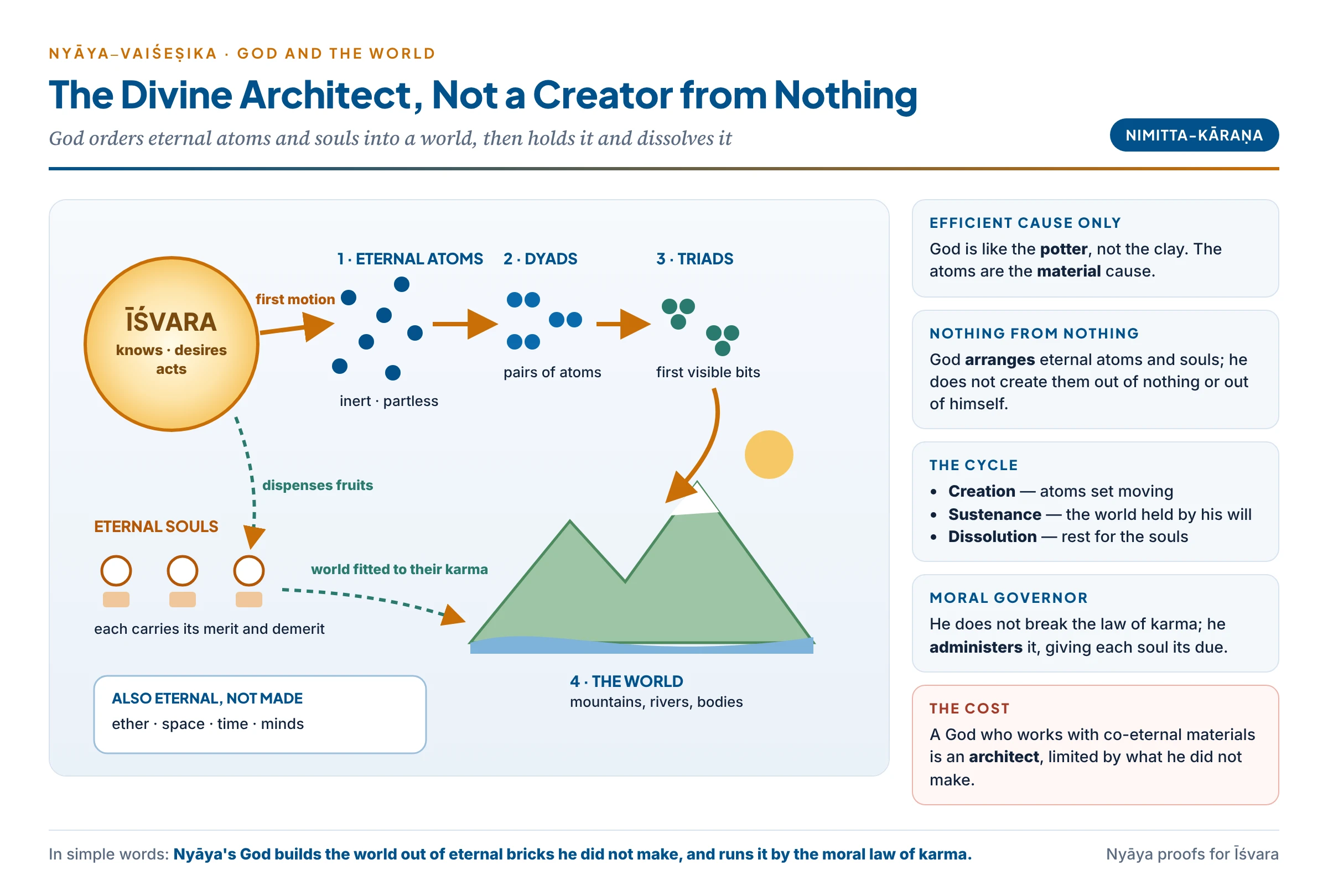
- Efficient cause only. God is the efficient cause (nimitta-kāraṇa) of the world, as the potter is of the pot. He is not its material cause (upādāna-kāraṇa), as the clay is. The material of the world is the eternal atoms of earth, water, fire and air.
- Co-eternal realities. Atoms, ether (ākāśa), space, time, minds and the countless individual souls are all eternal, like God. God neither creates them out of nothing nor out of himself. Creation means God arranging these eternal reals into a world.
- Creator, sustainer, destroyer. God brings atoms together at the start of a cycle, keeps the world in being, and dissolves it when the souls need rest from their karma.
- Three powers of a maker. God has eternal cognition (jñāna), desire (icchā) and effort (prayatna) — exactly what every maker needs. In us these come and go; in God they never cease.
- Omniscient (sarvajña). God knows everything directly — every atom and every soul’s store of merit and demerit.
- Six perfections (ṣaḍ-aiśvarya). Majesty, almighty power, glory, beauty, knowledge and perfect freedom from attachment.
- Moral governor. God does not override the law of karma; he administers it. He is the dispenser of the fruits of action (karma-phala-dātā) and the “directive agent” (prayojaka-kartā) of beings, guiding them as a wise father guides a child according to its abilities and past conduct.
- Author of the Veda. Against Mīmāṃsā, Nyāya holds the Veda to be authored — by God. Its authority comes from the reliability of its author.
- Giver of liberation. Later Nyāya holds that the knowledge that frees the soul, and liberation itself, come by God’s grace.
- Theism, not deism. This God is not a clock-maker who sets the world going and leaves. He holds it in being and governs it at every moment.
Common confusion
Is the Nyāya God an impersonal principle, and is he both the material and the efficient cause of the world? Neither. Some notes say Nyāya’s Īśvara is “not a personal deity”, and others put Nyāya with Vedānta as holding God to be “both the material and efficient cause”. Nyāya’s God is fully personal — he knows, desires, acts, rewards and shows grace. And he is the efficient cause only: the eternal atoms are the material cause. The view that God is both material and efficient cause belongs to Advaita and Viśiṣṭādvaita, not to Nyāya (and not to Madhva either — see Article 8).
2. The Main Inference in Five-Membered Form
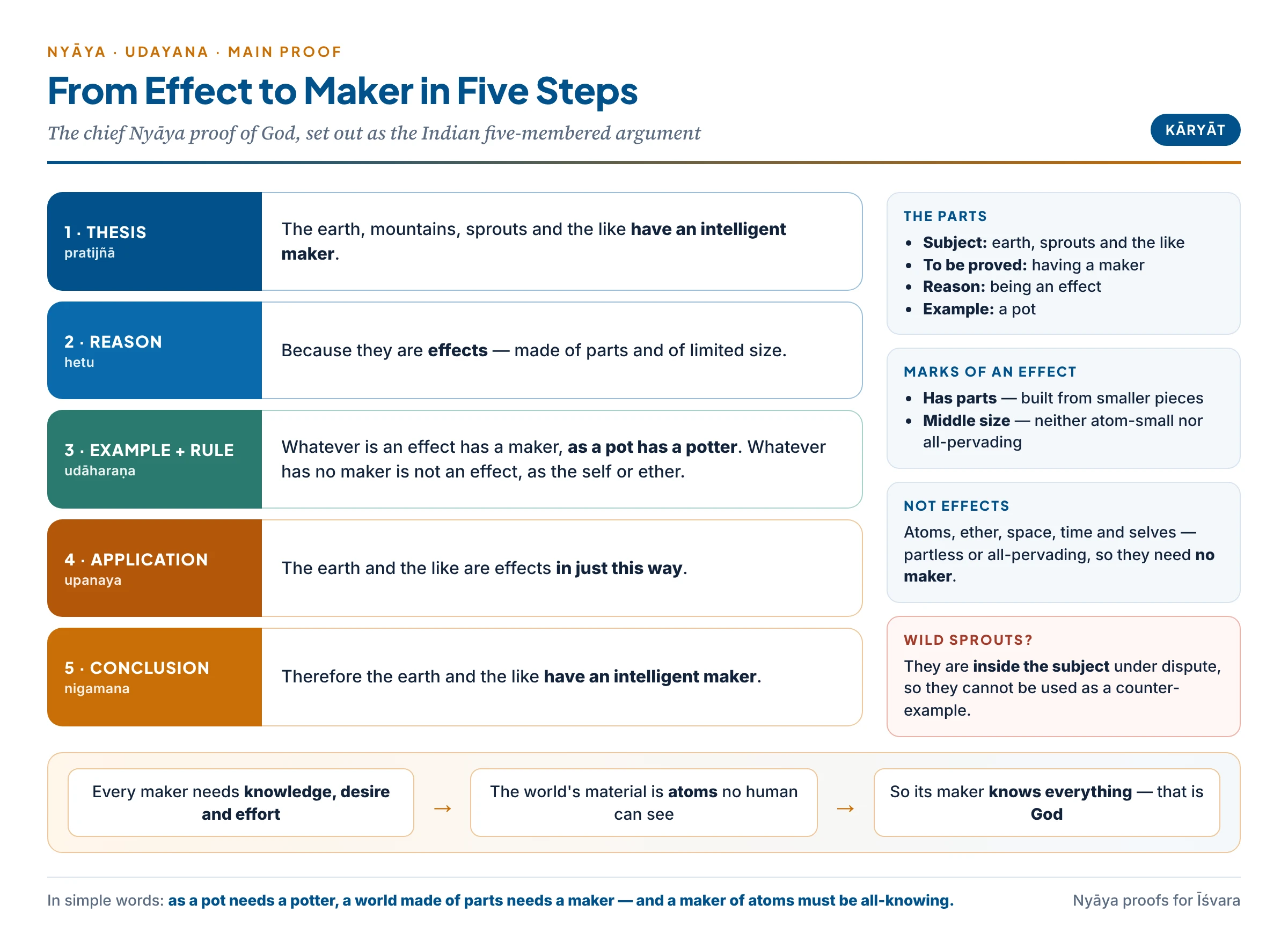
Nyāya’s chief proof is the inference from effect to maker (kāryāt). It is set out in the standard Indian five-membered syllogism (pañcāvayava), used when one argues for others (parārtha-anumāna).
The parts of the inference.
- Subject (pakṣa): the earth, mountains, sprouts and the like — “the earth, sprouts and similar things“.
- What is to be proved (sādhya): that they have a maker (sakartṛkatva).
- Reason (hetu): that they are effects (kāryatva).
- Example (dṛṣṭānta): a pot.
The five members.
- Thesis (pratijñā): The earth, mountains, sprouts and the like have an intelligent maker.
- Reason (hetu): Because they are effects.
- Example with the universal rule (udāharaṇa): Whatever is an effect has an intelligent maker, as a pot has a potter; and whatever has no maker is not an effect, as the self or ether.
- Application (upanaya): The earth and the like are effects in just this way.
- Conclusion (nigamana): Therefore the earth and the like have an intelligent maker.
The classical one-line form. “The earth, sprouts and the like have a maker, because they are effects, like a pot” (kṣity-aṅkurādikaṃ sakartṛkaṃ kāryatvāt ghaṭavat).
How we know they are effects. Udayana gives two marks:
- Having parts (sāvayava). Mountains and bodies are built up of smaller parts.
- Having a limited, middle size (avāntara-mahattva). They are neither infinitely small (like atoms) nor all-pervading (like ether). Whatever has both marks has been produced.
- What is not an effect. Atoms (partless), and ether, space, time and selves (all-pervading or partless) are not effects and need no maker. That is why the example of “no maker, no effect” is the self or ether.
From “a maker” to “an all-knowing maker”.
- Every maker needs knowledge of the material, a desire to make, and effort (jñāna, cikīrṣā, kṛti).
- The material of the world is atoms, which no human sees or handles.
- So the maker of the world must directly know atoms — and every soul’s karma, since the world is shaped to fit them. Such a maker is omniscient, and that is God.
In simple words
A potter must see his clay, want a pot and work the wheel. Now imagine a “pot” whose clay is so fine that no microscope can find it, and whose shape must suit the past deeds of millions of people who will live in it. The maker of such a pot must see what no one sees and know what no one knows. That is how Nyāya moves from “the world has a maker” to “the world has an all-knowing maker”.
Why wild sprouts are not a counter-example.
- The objection. Grass and trees spring up in forests where no one planted them — so here are effects without a maker, and the universal rule fails.
- The reply. The sprouts are part of the subject (pakṣa) of the inference — “the earth, sprouts and the like”. In Indian logic, a counter-example must come from outside the subject; one cannot use the very thing under dispute to refute the rule. Whether wild sprouts have a maker is precisely what is being argued, so they cannot be cited against it.
3. Udayana’s Nine Arguments
Udayana sums up his proofs in one verse: “From effects, from combination, from support and the rest, from tradition, from authoritativeness, from scripture, from sentences and from the special number, the all-knowing, imperishable one is to be established.” The argument from adṛṣṭa completes the list of nine.
(a) Kāryāt — from effects.
- Argument.
- The earth, mountains, oceans, sun and stars are effects, because they have parts and a limited size.
- Every effect has an intelligent maker who knows, wants and works.
- So the world has an intelligent maker; since its material is atomic, the maker is omniscient — God.
- What it adds. Material causes alone give possibility; only an intelligent cause gives order, direction and timing — why this effect, here, now.
- Western echo. The causal and design arguments of Aquinas and Paley (Articles 3 and 5).
(b) Āyojanāt — from combination.
- Argument.
- At the start of creation, atoms must combine — two into a dyad (dvyaṇuka), three dyads into a triad (tryaṇuka) — to form visible things.
- Combination needs motion; but atoms are inert by nature.
- Motion in inert things comes only from an intelligent source — a chariot moves only when driven, an axe only when swung.
- Souls at that time have no bodies and cannot act; adṛṣṭa is unconscious and cannot select and direct. So God gives the first motion to atoms.
- Western echo. Aquinas’s first way and Aristotle’s unmoved mover.
In simple words
A box of loose beads will never become a necklace by being shaken for a thousand years in the right pattern. Someone must pick the beads, thread them and tie the knot. Nyāya sees the atoms at the start of creation as such beads: real, but inert. The thread-maker who sets them moving into pairs and triples is God.
(c) Dhṛtyādeḥ — from support and the rest.
- Argument.
- The world is held together (dhṛti) and does not fall apart, as a twig held in a flying bird’s beak does not drop — because the bird holds it.
- “And the rest” (ādi) — the world is also destroyed in due time.
- Holding and destroying are acts of a will. Unconscious adṛṣṭa cannot do them. So the world is sustained and dissolved by God’s will.
- Western echo. The theistic idea that God conserves the world in being at every moment, not only at the start.
(d) Padāt — from tradition.
- What “pada” means here. The word covers both usage (the tradition of practice) and words.
- Argument.
- The arts and crafts — weaving cloth, making pots — and the conventions that link words to their meanings are always learned from earlier teachers.
- At the beginning of each new creation, after dissolution, there are no human teachers.
- So the arts and the meanings of words must have been first taught by an intelligent being present at the start of creation — God, the first teacher.
(e) Pratyayataḥ — from the authoritativeness of the Veda.
- Argument.
- The Veda is a valid source of knowledge. Where its teachings can be tested — as in its medical and practical parts — they work, as a medical text proves itself when its cures succeed.
- For Nyāya, the validity of testimony comes from the excellence of the speaker — a reliable person (āpta).
- The Veda speaks about things beyond the senses (heaven, merit, the results of rituals). Only a speaker who knows such things could be reliable about them. So the Veda’s author is omniscient — God.
(f) Śruteḥ — from scripture.
- Argument. The Veda itself testifies to God: it speaks of “the Lord of all, the ruler of all, the protector of all”, and of “the one God hidden in all beings, all-pervading, the inner self of all, the controller and sustainer of all”. What a valid scripture affirms must be accepted.
(g) Vākyāt — from the sentences of the Veda.
- Argument.
- The Veda is made of sentences, and many of them are commands — “do this”, “avoid that”.
- Sentences have authors, as the Mahābhārata has its author; and a command presupposes one who commands.
- So the Veda has a personal author — God. The moral law it states is not an impersonal imperative floating in the void; it is a command that moves a person to do right and avoid wrong for his own good.
(h) Saṅkhyā-viśeṣāt — from the special number.
- Background. In Vaiśeṣika, an atom has the smallest possible size. Two infinitely small things put together cannot add up to a bigger size by adding their sizes. So the size of a dyad is said to be produced by its number — “two“.
- Argument.
- The number “two” (and every number above one) is produced by a relating cognition (apekṣā-buddhi) — a mind that takes the things together.
- At the first moment of creation no human mind exists to count the first atoms.
- So the relating cognition must belong to an eternal mind present then — God.
- Uniqueness. This proof has no Western parallel; it grows out of Vaiśeṣika’s special theory of number and atomic size.
(i) Adṛṣṭāt — from the unseen moral force.
- Argument.
- People are born rich or poor, healthy or sick, gifted or dull, without having earned it in this life. These differences must have causes — past deeds.
- Deeds leave behind merit and demerit (adṛṣṭa, also called dharma and adharma), which bear fruit after long gaps, even in later lives.
- Adṛṣṭa is unconscious (jaḍa). It cannot by itself bring exactly the right joy or sorrow to the right person at the right time and place. Souls do not even know their own adṛṣṭa.
- So an all-knowing being must supervise adṛṣṭa — the overseer of karma (karmādhyakṣa) — as a just king rewards and punishes each subject according to desert.
- Western echo. Kant‘s moral argument: someone must ensure that happiness matches virtue (Article 6).
In simple words
After an examination, thousands of answer scripts lie in a hall. The scripts are real, and each one deserves a definite mark — but no script can grade itself, and no student even knows exactly what his own script deserves. An examiner who reads every page must give each its due. Nyāya says adṛṣṭa is like those scripts: real, deserving, but blind. The examiner who gives every soul exactly its due result, in the right life and at the right time, is God.
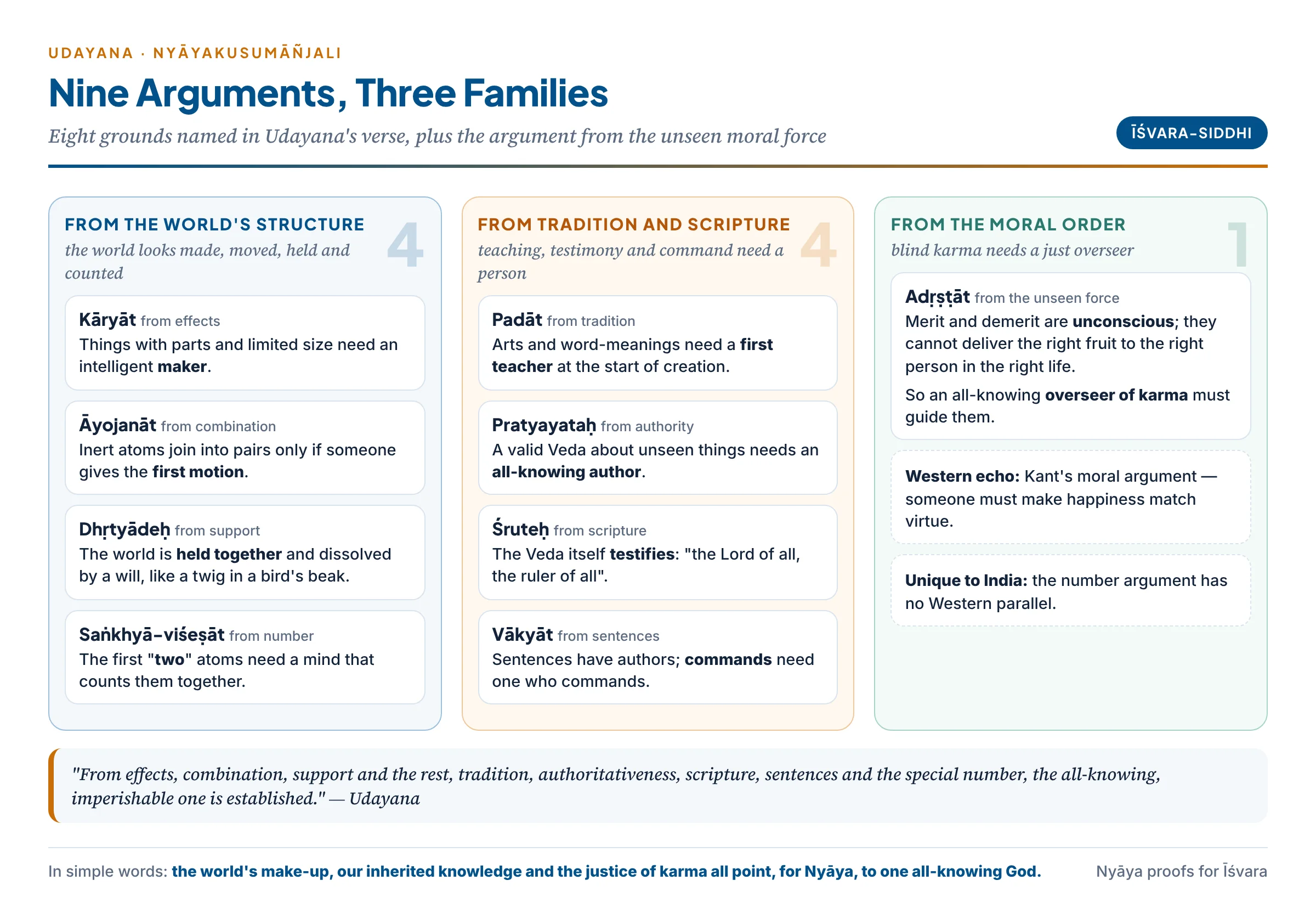
The nine arguments at a glance.
| Group | Argument | One-line idea | Nearest Western parallel |
|---|---|---|---|
| World’s structure | Kāryāt | Effects need an intelligent maker | Aquinas’s second way; Paley |
| Āyojanāt | Inert atoms need a first mover | Aquinas’s first way | |
| Dhṛtyādeḥ | The world is held and dissolved by a will | God as conserver | |
| Saṅkhyā-viśeṣāt | The first “two” needs a counting mind | None | |
| Tradition and scripture | Padāt | Arts and word-meanings need a first teacher | — |
| Pratyayataḥ | A valid Veda needs a reliable, all-knowing author | Argument from revelation | |
| Śruteḥ | The Veda testifies to God | Argument from revelation | |
| Vākyāt | Commands need a commander | Moral law as command | |
| Moral order | Adṛṣṭāt | Blind karma needs a just overseer | Kant’s moral argument |
4. Why One God, Why All-Knowing, Why Bodiless?
- Why one, not many?
- Many independent makers with their own wills could clash; the world shows one coherent order — one set of laws, one moral law.
- Economy of explanation: one adequate cause is preferred to many.
- If many gods worked together, they would need a co-ordinator — and that co-ordinator would be the real God.
- Why all-knowing? Only one who directly knows every atom and every soul’s merit can arrange a world in which each receives exactly what it deserves.
- Why bodiless?
- A body is itself an effect made of parts and would need a maker; so a bodily God would lead to a regress.
- A body is the instrument through which a limited self acts; God’s will acts directly, as my will moves my body without needing a second body.
- Why eternal? A maker who came into being would need a maker; the regress ends only in an eternal one.
5. God, Karma and Liberation
- God works through karma, not against it. The Nyāya Sūtra notes that human effort is sometimes fruitless (so results depend on a higher cause) but never succeeds without effort (so God acts in step with our deeds). God is like a just judge applying a law he has not broken.
- Why suffering? God creates out of compassion, but he cannot create a world of pure happiness, because each soul’s own good and bad deeds must bear fruit. Suffering is the result of our deeds, justly delivered.
- Grace and liberation. In later Nyāya, the knowledge that cuts bondage and liberation itself (apavarga) are attained through God’s grace. God thus completes the school’s soteriology: he is the beginning of the world and the helper towards its end.
Critical Evaluation
1. Objections and Nyāya Replies
The rival schools attacked every step. Their full critiques are set out school by school in Article 9; here are the main objections with the Nyāya answers.
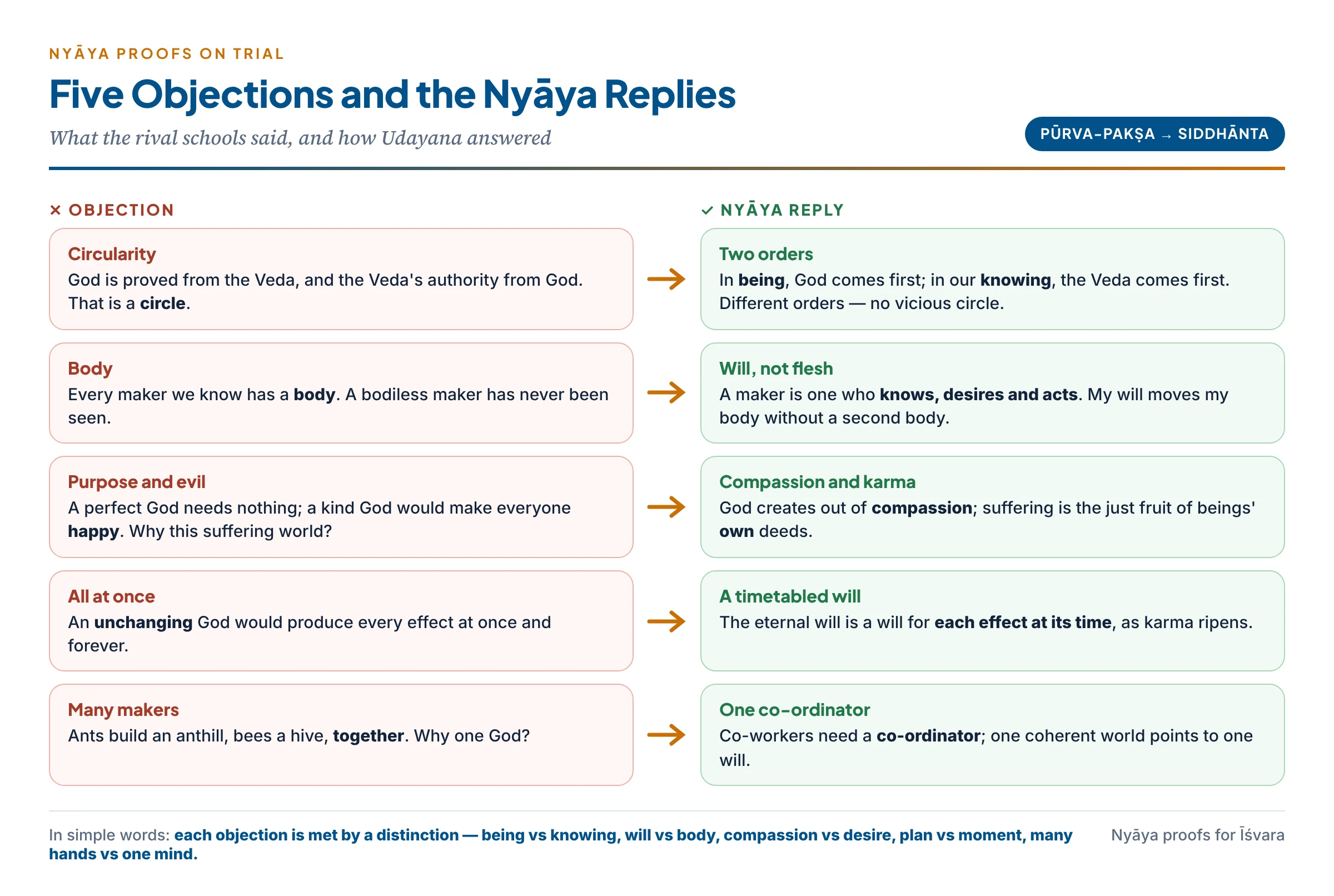
- The circularity objection.
- Objection. Nyāya proves God from the authority of the Veda (pratyayataḥ, śruteḥ), and proves the Veda’s authority from its being God’s word. That is arguing in a circle.
- Reply. Distinguish the order of existence from the order of knowledge. In existence, God comes first and reveals the Veda. In our knowledge, the Veda comes first (we learn it from teachers) and leads us to God. Dependence in different orders is not a vicious circle — as a child first knows its father through its mother’s word, though the father existed first.
- The body objection.
- Objection. Every maker we know — potter, weaver, carpenter — has a body. A bodiless maker has never been seen; so the example of the pot does not support a bodiless God.
- Reply. What makes a maker a maker is knowledge, desire and effort, not flesh. In us, will acts through a body; the divine will need not. Besides, my own will moves my body without another body to move it.
- The purpose objection.
- Objection. Why would a perfect God create? Not for himself — he lacks nothing. Not for others — then he would make them all happy, yet the world is full of misery.
- Reply. God creates out of compassion, to let souls work out their karma and reach liberation. A purely happy world is impossible, because beings must reap what they have sown. The moral law by which God creates is rooted in his own nature, so it does not limit him from outside.
- The “proofs assume God” objection.
- Objection. The theist first believes in God and then looks for reasons. The arguments are pleas for a faith already held, not proofs; and the idea of existence is not actual existence.
- Reply. The origin of a belief does not decide its truth. The question is only whether the inference is valid — whether its reason is present in the subject and really pervaded by what is to be proved.
- The simultaneity objection (Buddhist).
- Objection. If God and his will are eternal and unchanging, all effects should appear at once and forever. Effects appear one after another, so either God changes or he is not their cause.
- Reply. God’s eternal will is a will to produce each effect at its proper time, in step with the ripening of adṛṣṭa. An unchanging plan can contain a timetable; eternity of will does not mean simultaneity of effects.
- The “many makers” objection.
- Objection. At most the argument shows some maker or makers. Ants build an anthill together; bees build a hive together. Why one omniscient God?
- Reply. Co-operating makers need a co-ordinator, and a coherent world points to a single ultimate will.
- The natural-causation objection (Sāṃkhya, Buddhist).
- Objection. Prakṛti’s own evolution (Sāṃkhya) or the chain of dependent origination (Buddhist) explains the world without God.
- Reply. Unconscious causes give material but not direction; order and timing need intelligence.
- The automatic-karma objection (Mīmāṃsā, Jaina).
- Objection. Karma is an automatic force. It needs no controller, as a seed needs no farmer to know how to sprout.
- Reply. A seed sprouts only when the right conditions meet; karma’s fruits arrive after long gaps, across lives, matched to particular persons. Such precise delivery needs a knower.
- The scripture objection. Buddhists, Jainas and Cārvākas reject the Veda’s authority, so four of the proofs (padāt, pratyayataḥ, śruteḥ, vākyāt) carry no weight with them. Nyāya replies that its other proofs (kāryāt, āyojanāt, dhṛtyādeḥ, saṅkhyā-viśeṣāt, adṛṣṭāt) rest on inference alone.
- The materialist objection (Cārvāka). God is not perceived; inference is unreliable; even consciousness is a product of the body and brain, so a disembodied mind is unthinkable. Nyāya replies by defending inference itself (the inference that rejects inference is still an inference) and by arguing that consciousness belongs to the self, not to matter.
- The idealist objection (Advaita). If the world is ultimately appearance (māyā), it is not truly “made”, and the whole causal proof loses its subject. Nyāya, as a realist school, holds that the world is fully real.
- The problem of evil (Jaina, Sāṃkhya). A compassionate, almighty creator would not make a world of disease and cruelty. If he must follow karma, he is not free; if karma does the work, God is superfluous. Nyāya’s answer is the karma theodicy above — suffering is deserved — but many find that it explains suffering only by assuming countless past lives.
2. Internal Tensions
Even sympathetic readers find strains inside the Nyāya system.
- An architect, not a creator. A God who works with co-eternal atoms and souls is limited by them — closer to Plato’s divine craftsman than to an infinite creator.
- External theism. God, atoms and souls stand side by side, related only externally. There is no inner union between God and soul; devotion (bhakti) finds little room in so intellectual a system.
- Who really decides? If adṛṣṭa fixes what each soul receives, God only executes it; if God’s will fixes it, adṛṣṭa is idle. Nyāya wants both, and the balance is hard to keep.
- Two kinds of consciousness. In human selves, consciousness is an adventitious quality, arising only when the self meets mind and senses; in God it is eternal. Why should one self differ in kind from all the others?
- Dependence on one analogy. The whole case rests on the pot-and-potter model (ghaṭa-dṛṣṭānta). If the world is unlike a pot in the relevant ways, the inference loses its example.
- “Effect” is not clear. Is the world as a whole an effect, or only its parts? We have seen pots being made; we have never seen a mountain or the world being made.
3. Western Critics
- Hume. The likeness between the world and human artefacts is weak; we have no experience of worlds being made; the world could have had many makers, or a clumsy one, or order could arise without design. These points fall on kāryāt exactly as they fall on Paley (Article 5).
- Kant. Every argument from the world (a posteriori) secretly relies on the ontological argument when it leaps from “a first cause” to “a supremely perfect being”; and causality applies only within experience, not to the world as a whole. So the a posteriori proofs are a priori in essence. God may be a postulate of moral faith, not an object of proof (Articles 2, 4 and 6).
- Darwin. Natural selection explains the appearance of design in living things without a designer — the very order kāryāt and dhṛtyādeḥ appeal to.
- Russell and the fallacy of composition. That every part of the world has a cause does not show that the whole has one (Article 4).
4. Defences and Strengths
- The analogy is about structure. Nyāya does not claim that mountains look like pots. It claims that whatever has parts and limited size is produced, and that ordered production needs intelligence — a point about structure, not appearance.
- A timetabled eternal will. God’s will is eternal, but its content includes when each effect appears.
- Karma as justice. The karma theodicy explains why a good God permits suffering: it is the fruit of our own free deeds.
- The two orders. The circle between God and Veda dissolves once the order of being and the order of knowing are separated.
- A cumulative case. The nine arguments do not stand or fall singly; together — from the world’s structure, from tradition and from the moral order — they converge on one conclusion.
- Rigour. Even critics grant that Udayana and Gaṅgeśa produced the most rigorous rational theology in Indian thought, matching the medieval scholastics in precision.
Strengths and weaknesses in brief.
- Strengths.
- Uses reason (anumāna), not blind faith.
- Offers many proofs — cosmological, design-like, moral and scriptural — so it is philosophically robust.
- Joins karma theory to divine justice, giving a moral as well as a causal God.
- Weaknesses.
- Attacked by Buddhist, Jaina, Sāṃkhya, Mīmāṃsā and Cārvāka thinkers on every step.
- Assumes that the universe needs an external cause rather than being self-sustaining.
- Four proofs need the Veda, which opponents reject.
- The single pot-maker paradigm leaves it open to every objection against analogy.
Critics and Defenders
Criticism — Critics
- Circularity: God proved from the Veda, the Veda from God.
- Body: every maker we know is embodied; a bodiless maker is unknown.
- Purpose and evil: a perfect, kind God would not make a suffering world.
- Simultaneity: an unchanging God would produce everything at once.
- Hume, Kant, Darwin: weak analogy, reason’s limits, design without a designer.
- Internal: a God limited by co-eternal atoms and souls is only an architect.
Defence — Defenders and strengths
- Two orders: God first in being, the Veda first in our knowing.
- Will, not flesh: knowledge, desire and effort make a maker.
- Compassion and karma: suffering is the just fruit of our own deeds.
- Timetabled will: an eternal plan contains the time of each effect.
- Structure, not looks: whatever has parts and limited size is produced.
- Cumulative case: nine arguments from structure, tradition and morality converge.
Cross-Tradition Comparison
Nyāya Proofs and Western Proofs (short table)
The full Aquinas–Nyāya comparison is in Article 10.
| Point | Nyāya (Udayana) | Western theism (Aquinas, Paley, Kant) |
|---|---|---|
| Main method | Inference in the five-membered form | Syllogistic and inductive argument |
| Causal proof | Kāryāt — the world as an effect | Aquinas’s first cause; Paley’s watch |
| First motion | Āyojanāt — inert atoms | Aquinas’s first way; Aristotle’s unmoved mover |
| Moral proof | Adṛṣṭāt — blind karma needs an overseer | Kant — virtue and happiness need God (not among the Five Ways) |
| Scripture | Three proofs from the Veda | Natural theology keeps revelation separate |
| Kind of creation | Ordering eternal atoms and souls | Creation out of nothing |
| God’s causality | Efficient cause only | Efficient cause and source of all being |
| Unique proof | Saṅkhyā-viśeṣāt (number two) | Contingency (Aquinas’s third way) has no exact Nyāya match |
Nyāya and Yoga: Do They Prove God in the Same Way?
| Point | Nyāya | Yoga |
|---|---|---|
| Kind of God | World-ordering Supreme Self | A special puruṣa (puruṣa-viśeṣa), untouched by affliction and karma |
| Main proof | From the world as an effect | From the degrees of knowledge to an unsurpassed limit |
| Other proofs | Combination, support, tradition, Veda, sentences, number, adṛṣṭa | Scripture; God as the one who joins and separates Prakṛti and Puruṣa |
| Role in liberation | Grace in later Nyāya | Devotion (Īśvara-praṇidhāna) as a means to samādhi |
- Answer in brief. Only partly the same. Both accept scripture and both prove an omniscient being. But Nyāya argues cosmologically — from the world to its maker — while Yoga argues mainly from the perfection of knowledge, and Yoga’s God does not create the world. Article 8 sets out the Yoga arguments in full.
Indian Connect — Key takeaways
- Nyāya gives India’s most systematic rational proofs of God, built on its theory of inference and its atomism.
- The main inference — the earth and the like have a maker because they are effects, like a pot — is set out in the five-membered form.
- Udayana’s nine arguments combine cosmological, scriptural and moral grounds.
- Nyāya’s God is a personal efficient cause and moral governor, not the creator of matter out of nothing.
- The saṅkhyā-viśeṣa proof is uniquely Vaiśeṣika; the adṛṣṭa proof is India’s moral argument.
Synthesis (Siddhānta)
- What is proved. Nyāya’s God is the one, eternal, all-pervading, all-knowing Supreme Self, with eternal knowledge, desire and effort — the efficient cause who orders co-eternal atoms into a world, sustains and dissolves it, dispenses the fruits of karma and grants liberation by grace.
- How it is proved. By a main inference from effect to maker, set out in the five-membered syllogism, and by Udayana’s nine grounds: effects, combination, support and destruction, tradition, the Veda’s authority, scripture, Vedic sentences, the special number and adṛṣṭa.
- How it fares. Every step was attacked — by Cārvāka, Mīmāṃsā, Buddhist, Jaina and Sāṃkhya thinkers, by Hume, Kant and Darwin, and by the internal tension of a God limited by co-eternal reals. Nyāya’s replies — the two orders, the bodiless will, the timetabled eternal will, karma as justice and the structural reading of effect-hood — keep the system consistent, though they do not compel the unbeliever.
- A balanced verdict. The Nyāya proofs show that belief in God can be reasoned and defended with great rigour; they do not show that it is demonstrably true. Their real achievement is to have made theism a matter of argument in India, inviting equally rigorous atheism in reply (Article 9).
- Contemporary relevance.
- Design and fine-tuning debates in modern cosmology revive the spirit of kāryāt and āyojanāt.
- The problem of evil remains the central objection, as the Jainas and Sāṃkhyas saw.
- Interfaith philosophy finds in Udayana a partner for dialogue with Christian and Islamic natural theology.
“From effects, combination, support and the rest, tradition, authoritativeness, scripture, sentences and the special number, the all-knowing, imperishable one is established.” — Udayana, Nyāyakusumāñjali
Previous Year Questions
- 2025What proofs do Nyāya philosophers offer for the existence of God?
- 2023Critically examine the arguments of Nyāya for the existence of God.
- 2021Discuss the nature of God as propounded in Nyāya philosophy.
- 2019How does Udayana prove the existence of God through Kāryāt, Āyojanāt, Dhṛtyādeḥ and Śruteḥ? Discuss.
- 2018How do the Naiyāyikas prove the existence of God? Do the Yoga philosophers prove God in the same way? If yes, how? And if no, why? Give reasons for your answer.
- 2018Compare St. Thomas Aquinas’ five ways of knowing God with the arguments of the Nyāya School of Indian Philosophy for the existence of God.
- 2015Examine the Nyāya arguments in favour of the existence of God.
- 2011Do you find any inadequacy in the proofs for the existence of God as given by Naiyāyikas? Give reasons in support of your answer.