

Proofs for the Existence of God and their Critique (Indian and Western).
Official Syllabus: Paper II, Section B, Unit 2
India produced one of the most powerful rational theologies in the world — the Nyāya proofs of Udayana (Article 7). It also produced one of the most powerful rational critiques of theism. Five schools — Cārvāka, Mīmāṃsā, Jaina, Buddhist and Sāṃkhya — rejected the idea of a creator God (jagat-kartā Īśvara), each for its own reasons. Most of them were not irreligious: Jainas and Buddhists seek liberation, Mīmāṃsakas defend the Veda and its rituals, Sāṃkhyas seek freedom from suffering. What they deny is that the world needs an all-knowing, all-powerful maker. This article sets out each school’s critique — the Cārvāka’s perception-only challenge, Kumārila‘s “who saw creation?”, the Jaina objections of Hemacandra, Malliṣeṇa and Guṇaratna together with the Jaina proof of an omniscient being, the Buddhist arguments of Dharmakīrti, Śāntarakṣita, Vasubandhu and Aśvaghoṣa, and the Sāṃkhya verdict that God is “not proved” (īśvarāsiddheḥ) — and then the Nyāya replies.
In simple words
A detective is told that a murder was committed by “an invisible man who leaves no fingerprints, needs no weapon and was seen by nobody”. She does not have to prove that no such man exists. She only has to show that the evidence does not need him — the facts are already explained without him. This is the strategy of most Indian critics of God. They do not usually prove that God is impossible; they show that the world, karma and the Veda are explained without a creator, and that the arguments offered for one do not work.
Context & Problem
Theism, Non-theism and Atheism in India
- Theism (Īśvaravāda). The view that one supreme, conscious God creates or orders the world, governs it morally and is the object of worship. Its great defenders: Nyāya–Vaiśeṣika (by inference), Yoga (by the degrees of knowledge), and the theistic Vedānta of Rāmānuja and Madhva (by scripture) — Articles 7 and 8.
- Non-theism (nirīśvaravāda). Rejecting a personal creator God while accepting other spiritual realities — soul, karma, liberation, nirvāṇa, kaivalya, the Tīrthaṅkaras, the Buddha. Jainism, Buddhism, Sāṃkhya and Mīmāṃsā are non-theistic in this sense.
- Atheism in the strong sense. Denying God and every other spiritual reality — soul, karma, rebirth, liberation. Only the Cārvāka is atheist in this sense.
- Two kinds of “no”.
- Negative non-theism — “there is no good reason to believe in God” (the classical Sāṃkhya, and in part the Buddha’s silence).
- Positive atheism — “there is no God”, argued with counter-proofs (the Cārvāka, the later Buddhist and Jaina logicians, Kumārila).
- A common distinction. Calling someone an “atheist” usually adds a feeling of criticism or contempt; “non-theist” simply says that God is not accepted, without denying all that is sacred.
Common confusion
Do “āstika” and “nāstika” mean believer and non-believer in God? No. In classical Indian usage āstika means one who accepts the authority of the Veda, and nāstika one who rejects it. So Sāṃkhya and Mīmāṃsā are āstika although they reject a creator God; Jainism and Buddhism are nāstika although they are deeply spiritual. Only the Cārvāka is nāstika in both senses — rejecting the Veda and every transcendent reality.
What Exactly Is Being Attacked?
- The target is the Nyāya God — one, eternal, all-pervading, all-knowing, independent, the efficient cause who arranges eternal atoms into a world and dispenses the fruits of karma (Article 7).
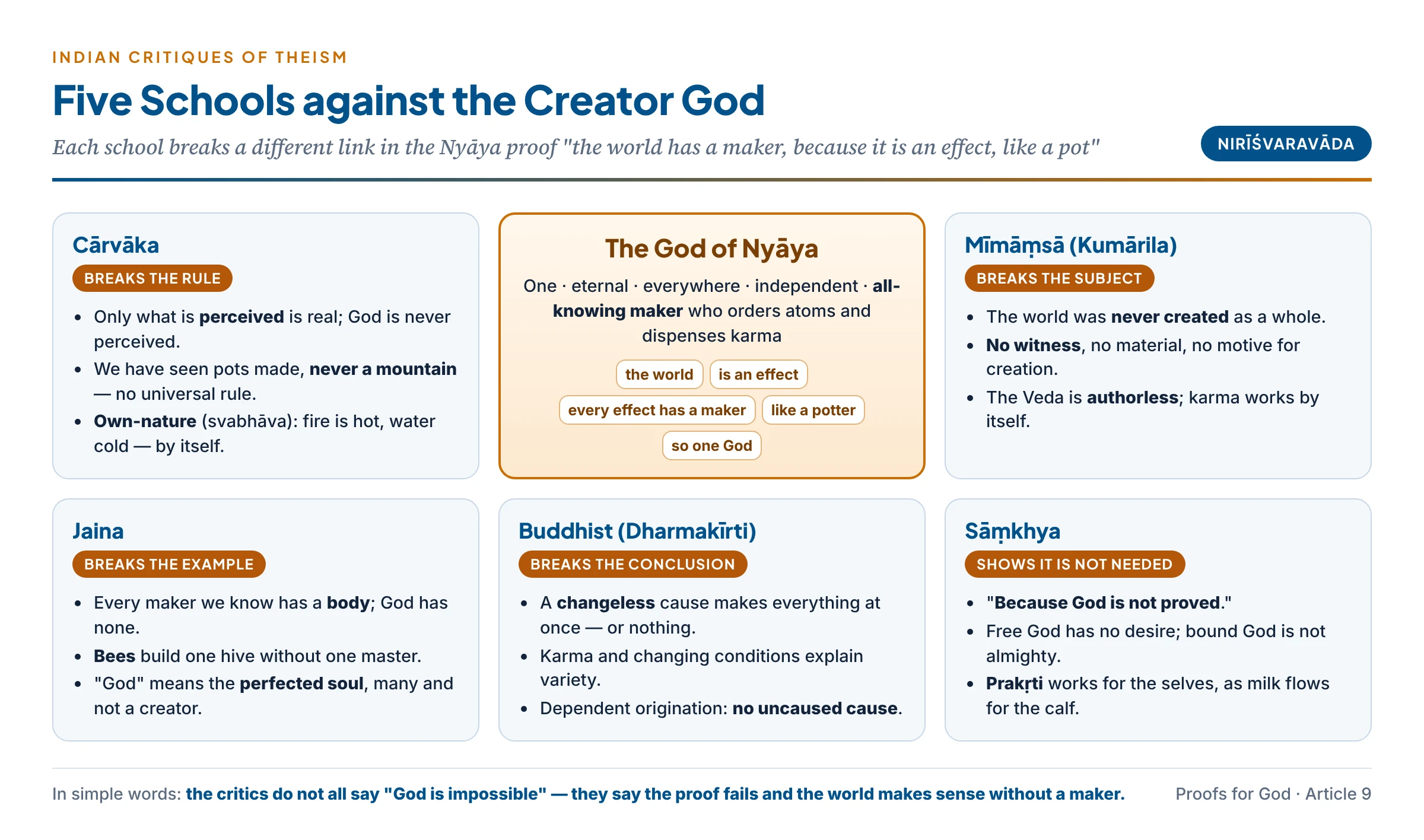
- The target is the main Nyāya inference. “The earth, sprouts and the like have a maker, because they are effects, like a pot” (kṣityaṅkurādikaṃ sakartṛkaṃ kāryatvāt ghaṭavat). Almost every critique below attacks one of its parts:
- The subject — is “the world” really one effect?
- The reason — what does “being an effect” mean, and is it true of mountains?
- The rule (vyāpti) — has anyone observed that every effect has an intelligent maker?
- The example — a potter has a body, limited knowledge and needs; is God like him?
- The conclusion — even if there is “some maker”, why one, why eternal, why all-knowing?
- And the attributes. Even granting a maker, the critics ask: why would a perfect being create? Why create a world full of suffering? If God must follow karma, is God free? If karma does the work, is God needed?
In simple words
Think of the Nyāya proof as a five-link chain: “the world” → “is an effect” → “every effect has a maker” → “like a potter” → “so one all-knowing God”. The critics do not all break the same link. The Cārvāka attacks the rule (no one has seen it hold everywhere). The Jaina attacks the example (a potter has a body; God has none). The Buddhist attacks the conclusion (an unchanging God cannot make a changing world). The Mīmāṃsaka attacks the subject (the world was never “made” at all). The Sāṃkhya shows the chain is not needed — nature already explains the world.
Core Doctrine
1. The Cārvāka Critique: Only What Is Perceived Is Real
- The starting point. Perception (pratyakṣa) is the only valid means of knowledge. Inference and testimony are unreliable. So only what can be perceived may be asserted to exist — and God is never perceived.
- No vyāpti between world and maker. The inference “the world is an effect, therefore it has a maker” needs the universal rule “every effect has an intelligent maker“. We have seen pots with potters and houses with builders, but we have never seen a mountain, a river or a forest being made. The rule has never been observed in the cases that matter, so the inference has no foundation.
- Svabhāvavāda — nature is enough. Everything behaves according to its own nature (svabhāva). An old verse says: “Fire is hot, water is cold, the wind is cool to the touch — by whom was this variety made? It is established from their own nature.” The four elements combine by their own natures into the world; nothing is left for a creator to do.
- God as a priestly invention. Belief in God, heaven and hell is a tool by which priests earn their living and control people through fear and hope. “The only supreme lord is the king known to the world.”
- The problem of evil. An all-good, all-powerful maker would not make a world of disease, injustice and disaster.
- The Veda and God in a circle. The Veda is used to prove God, and God is used to prove the Veda’s authority — a circle. The Veda’s contradictions (now Indra supreme, now Agni) show human authorship.
- Suprasensible entities in general. The same argument removes every suprasensible entity: the soul (consciousness is a product of the living body, as intoxicating power arises from fermented ingredients), karma and adṛṣṭa, rebirth, heaven and hell, liberation, and the authority of the Veda. What replaces them: nature instead of God, the conscious body instead of the soul, death instead of liberation, pleasure instead of heaven.
- How strong is it?
- Strength — it forces theism to admit that God is not an object of perception; any proof must be by inference, and inference must be sound.
- Weakness — “not perceived, therefore not real” is itself an inference, which the Cārvāka officially rejects; and it would also abolish atoms, forces and fields, which science needs. (Paper I, Cārvāka unit.)
Indian Connect — Why the Cārvāka matters for the proofs
- The Nyāya proof was written against critics like the Cārvāka; Udayana’s whole work answers the question “how can the unperceived be known?“
- The Cārvāka’s demand — “show me the vyāpti” — is the Indian form of Hume‘s demand: “we have seen houses built, but never a world made”. Both say an inference from familiar effects to an unfamiliar cause stretches experience beyond its limit (Article 5).
2. The Mīmāṃsā Critique: Kumārila’s “Who Saw Creation?”
- The Mīmāṃsā background. Mīmāṃsā is an orthodox, Veda-centred school. Its business is dharma — the rightness of Vedic action. It holds:
- The Veda is eternal and authorless (apauruṣeya); its authority does not depend on any author, human or divine.
- The relation of word and meaning is eternal; it was never “fixed” by anyone.
- Rituals produce an unseen potency (apūrva) that later brings their fruit; karma works by itself.
- The world was never created and will never be dissolved as a whole: “the world was never other than it is” (na kadācid anīdṛśaṃ jagat). Things come and go within the world, as pots are made and broken; the world as a whole has no beginning.
- So God has no job. With an eternal Veda, an eternal word–meaning relation, a self-working karma and an uncreated world, a creator God would be redundant. Kumārila (7th century, in the Ślokavārttika) does not merely ignore God — he argues against a creator (whom he calls Prajāpati, “lord of creatures”).
Kumārila’s arguments:
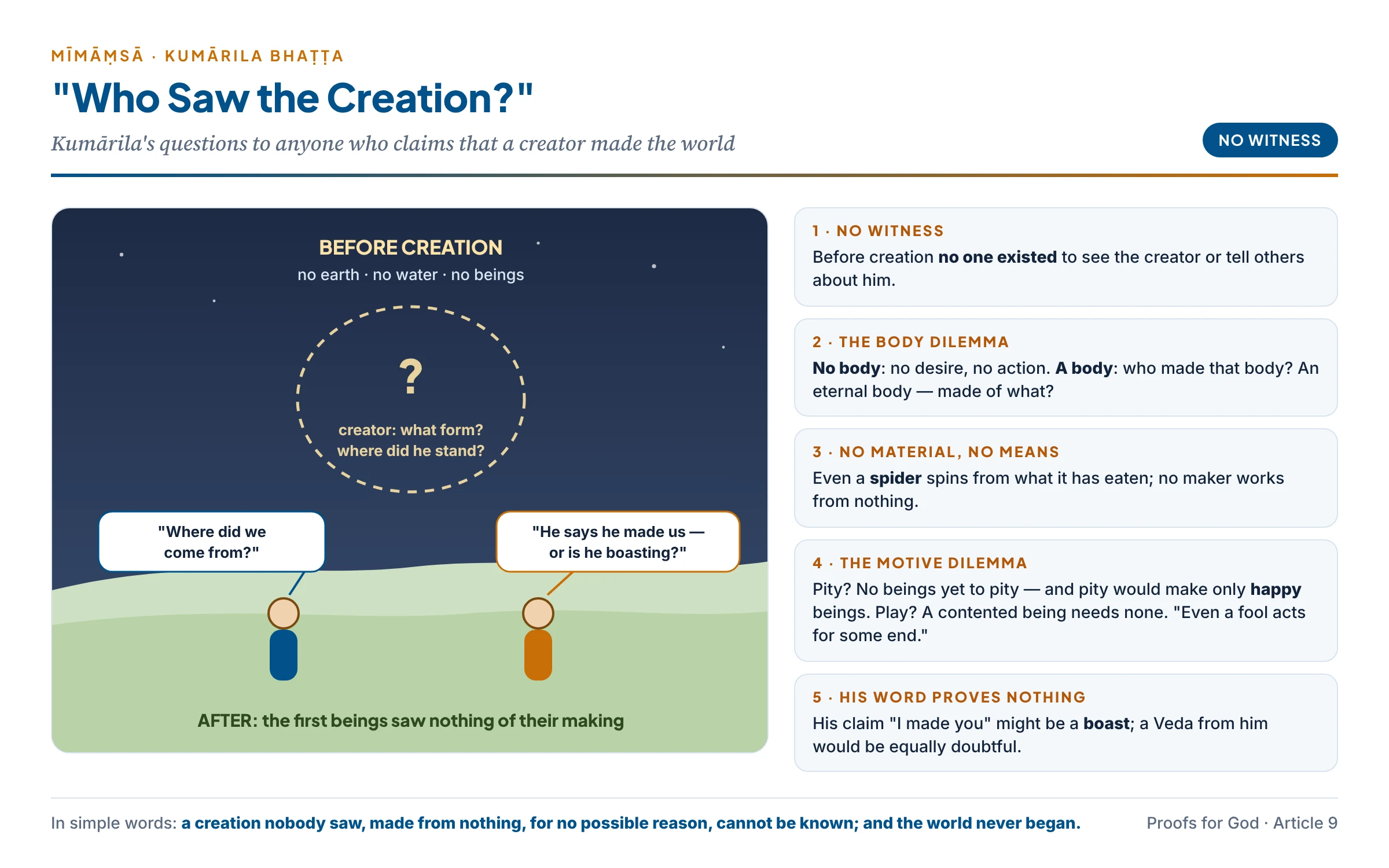
- No witness to creation. “When none of this existed, what was the state of things? Where was the creator, and what was his form? And who was there to know him and tell later beings about him?” A creation that no one could have seen cannot be known by perception; and inference about such a unique event has no example.
- The body dilemma.
- If the creator has no body, how can he have the desire to create, or act on matter at all? Desire and action belong to embodied beings.
- If he has a body, that body was not made by himself — so another maker is needed for it, and so on without end.
- If his body is eternal, of what material is it made before the earth and other elements exist?
- No means, no material. No maker makes anything without means and instruments. Even the spider spins its web from saliva produced by the flies it has eaten — it does not create from nothing.
- The motive dilemma.
- Compassion? Before creation there were no beings to pity, so compassion could not move him. And a compassionate creator would make only happy beings, not a world that is “mostly painful“.
- “Some pain is necessary.” If everything depends on his will alone, what could be impossible for him? If he must follow laws and karma, he is not independent.
- Some other purpose? “Without some end in view, even a fool does not act.” What end could a perfect being gain by creating? If he acts with no end, what use is his intelligence?
- Play (līlā)? Sport means a desire for amusement, which contradicts his ever-contented nature; and making a vast world would be toil, not play.
- Destruction is equally puzzling. Why would the same being, moved by the same compassion, wish to destroy the world at dissolution?
- His own word proves nothing. The first beings could not know where they came from. If the creator told them “I made you”, he might be boasting to show his power. A Veda produced by him would be equally doubtful.
- The eternal Veda cannot describe creation. If the Veda existed before creation, it could not describe events that had not yet happened. Passages that seem to narrate creation are praise (arthavāda) meant to encourage action, not literal history.
- Dissolution is unproved. There is no evidence for a total pralaya in which all karma stops bearing fruit; and if all karma were exhausted, what would start a new creation?
- Karma needs no supervisor. If the body’s organisation needs a conscious controller, why not the soul that lives in it, rather than God?
In simple words
Imagine waking up on an island with no memory, and a stranger says, “I built this island and put you here.” You did not see him build it. He may have built it — or he may simply be showing off. And if he is so powerful and kind, why did he fill the island with snakes and storms? Kumārila asks the same questions about a world-creator: who saw it, with what, why, and why like this?
3. The Jaina Critique: No Maker, but Godhood without God
(a) The Jaina world without a creator
- An uncreated universe. The six substances — souls, matter, the media of motion and rest, space and time — are eternal and uncreated. Every real thing arises, perishes and endures (utpāda-vyaya-dhrauvya) through its changing modes; nothing needs a maker (Paper I, Jaina unit).
- Self-working karma. Karma is a fine matter (pudgala) that sticks to the soul because of passions and bears fruit automatically. No judge or dispenser is required — the moral law works like a law of nature.
(b) Hemacandra’s verse
- In his hymn to Mahāvīra, Hemacandra (12th century) lists the Nyāya claims about God as “obstinate fancies” of those who do not follow the Jina: “There is a maker of the world; he is one; he is everywhere; he is independent; he is eternal.” His commentator Malliṣeṇa (13th century, Syādvādamañjarī) refutes each claim.
(c) Malliṣeṇa’s refutation, claim by claim
- “There is a maker.”
- Perception contradicts it. We see the earth, mountains and trees, but we never see a maker of them. The inference is precluded by what we perceive.
- No vyāpti is grasped. We know makers only in cases like pots and houses; the rule “every effect has a maker” has never been established for the world.
- The body dilemma. Did God make the world with a body or without one? If with a visible body, we should see it — we do not. If with an invisible body, like a ghost’s, then his special greatness is proved by the invisible body and the invisible body by his greatness — a circle. If without a body, the example fails: every maker we know, like the potter, has a body.
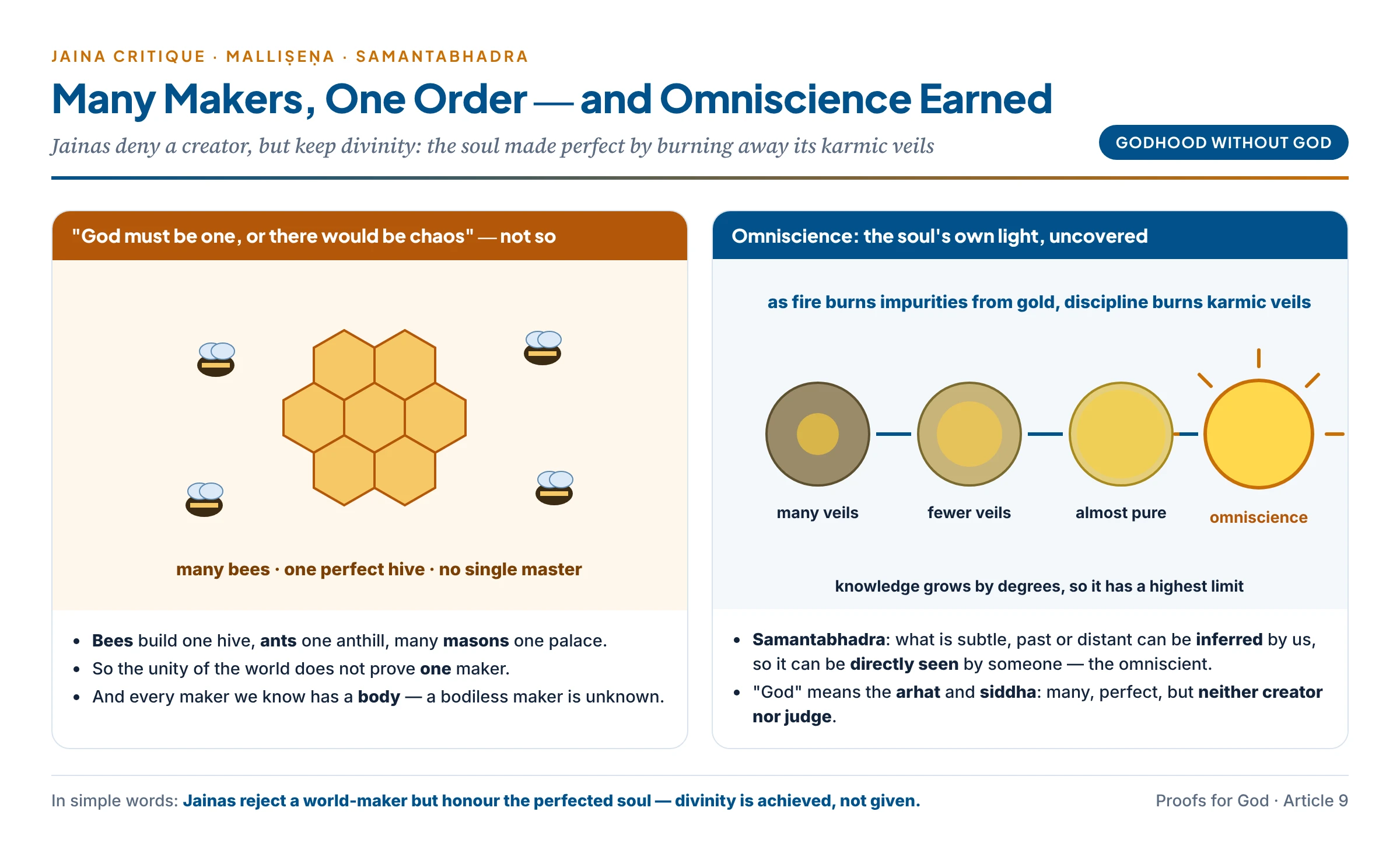
- “He is one.” Theists say many makers would produce chaos. But many agents can co-operate perfectly: bees build one hive, ants one anthill, many masons one palace. Unity of the work does not prove a single worker.
- “He is everywhere.” If God pervades everything, he leaves no room for anything else — the world is absorbed into him. And if he is all-knowing by direct experience, he must directly experience even hell and every impurity.
- “He is independent.” If God depends on the karma of beings to decide what to create, he is not independent; if he does not, he is unjust, creating some happy and some miserable for no reason.
- “He is eternal.” An eternal, unchanging God should produce his effects all at once and always; if he produces them at different times, he must change.
(d) Guṇaratna’s analysis of “being an effect”
- Guṇaratna (15th century, in his commentary on Haribhadra’s survey of philosophies) asks what Nyāya means by calling the earth “an effect“, and shows that every meaning fails:
- “Having parts” in the sense of being present in parts — then “partness” as a universal is eternal and uncaused, yet has parts: the reason is present where the conclusion (a maker) is absent — an irregular reason.
- “Being produced from parts (atoms)” — this is exactly what is in question; the reason is unproved.
- “Having portions” — space (ākāśa) has portions but, by Nyāya’s own account, is eternal and has no maker — again irregular.
- “Being known as having parts” — the same defect.
- Things without makers. Wild grass and forest plants are products, yet no one plants them. So “being a product” does not always go with “having an intelligent maker”.
(e) The motive and the problem of evil (all Jaina writers)
- Why create? If to satisfy a desire, God is imperfect; if out of play (līlā), he is frivolous — and cruel, since his play produces disease, torment and starvation.
- Who made God? If every effect needs a cause, God needs one too; if God needs none, the world may need none either.
- Omnipotence contradicted. If God made everything, why do we see people making houses and pots every day?
- Eternal perfection is empty. Perfection means removal of imperfection; a being never imperfect cannot meaningfully be called “perfect”.
- The ninth-century poet-monk Jinasena sums up: “Some foolish men declare that a creator made the world… If God created the world, where was he before creation? … No single being had the skill to make this world; how can an immaterial God create that which is material?”
(f) The Jaina proof of an omniscient being — “God” in the Jaina sense
- Godhood without God. Jainism denies a creator, not divinity. Every soul is potentially divine. A soul that destroys all its karma becomes omniscient (kevalin), blissful and free:
- Arhat — liberated while still living; the Tīrthaṅkaras (“ford-makers”, such as Mahāvīra) are arhats who teach the path.
- Siddha — fully liberated, dwelling at the summit of the universe, free of body.
These liberated souls are what Jainas call God (paramātman) — many, not one; perfect, but not creators and not dispensers of reward.
- So the “proofs for God” in Jainism are proofs that an omniscient being is possible and actual. Two classical arguments:
- Samantabhadra’s inference (in his examination of the true teacher): “Things that are subtle, hidden in time and distant in space are directly known by someone, because they are objects of inference — like fire on a hill.” Whatever can be inferred by us can be seen directly by someone better placed; so there is a being who directly sees everything — the omniscient.
- The argument from degrees and veils. Knowledge is seen to increase by degrees as obstacles are removed — a child knows less than a scholar, the scholar less than a sage. Knowledge is the nature of the soul, covered by karmic veils (jñānāvaraṇīya karma). As gold shines fully when its impurities are burnt away in fire, the soul’s knowledge shines fully when all veils are removed. What grows by degrees has a highest limit — omniscience (kevala-jñāna).
- What the Jainas reject and keep. They keep omniscience and perfection; they reject creatorship, oneness, omnipotence and grace. The liberated are examples, not rulers.
- Evaluating the Jaina “proofs”.
- Strength — coherent with the doctrine that knowledge is the soul’s nature; parallels Yoga‘s argument from the degrees of knowledge (Article 8) and Aquinas’s fourth way (Article 3).
- Weakness — “inferable, therefore directly seen by someone” assumes that every knowable thing is in fact known by some mind; and degrees need not have an actual maximum (speed has degrees, but no one runs infinitely fast).
- Religious value — worship of the Tīrthaṅkaras is not a plea for mercy; it purifies the mind and strengthens the will: “what man has done, man can do“.
Common confusion
Do Jainas offer “proofs for the existence of God” in the theistic sense? Many notes list “Jaina proofs for God” as: the world is eternal so needs no creator; the Tīrthaṅkaras have infinite knowledge; karma ensures justice. The first and third are actually arguments against a creator God, not proofs of one. What Jainas do prove is the existence of omniscient, liberated souls — by Samantabhadra’s inference and by the argument from the gradual removal of karmic veils. “God” in Jainism means the perfected soul (arhat, siddha), many in number, who neither creates nor rules the world.
4. The Buddhist Critique: A Changeless Cause Cannot Act
(a) The Buddhist starting points
- The Buddha’s attitude. The Buddha refused to discuss speculative questions that do not lead to the end of suffering, and gave no place to a creator in the path to nirvāṇa. Later Buddhist logicians argued against God in detail.
- Dependent origination (pratītyasamutpāda). Everything arises in dependence on conditions, and ceases when the conditions cease. There is no uncaused first cause; an uncaused God would be an exception the doctrine cannot admit.
- Momentariness (kṣaṇikavāda). Whatever exists is momentary and causally active; an eternal, unchanging God would be causally idle.
- No beginning. The world-process has no first beginning, so no first maker is needed.
- Karma works by itself. The variety of worlds, bodies and experiences arises from the intentional actions (cetanā) of beings; this is enough to explain it.
(b) Dharmakīrti’s refutation of the Nyāya inference (7th century)
- The theist’s three reasons. The world (abodes, bodies, enjoyments) has an intelligent maker because:
- things act after a rest — like an axe that lies still until someone picks it up;
- things have particular shapes — like a pot shaped by a potter;
- things serve purposes — like a tool made for an end.
- Dharmakīrti’s three replies.
- It proves what we already accept. If “maker” means only “some intention”, the Buddhist agrees: the world is shaped by the karmic intentions of beings. Nothing new is proved.
- The example does not fit. If “maker” means God — one, eternal, all-knowing — the examples fail: axes and pots are made by impermanent, embodied, limited makers; we have never seen a permanent maker of anything.
- The result is doubtful. Even granting some maker, the argument does not exclude other makers (such as karma) — so it cannot establish God.
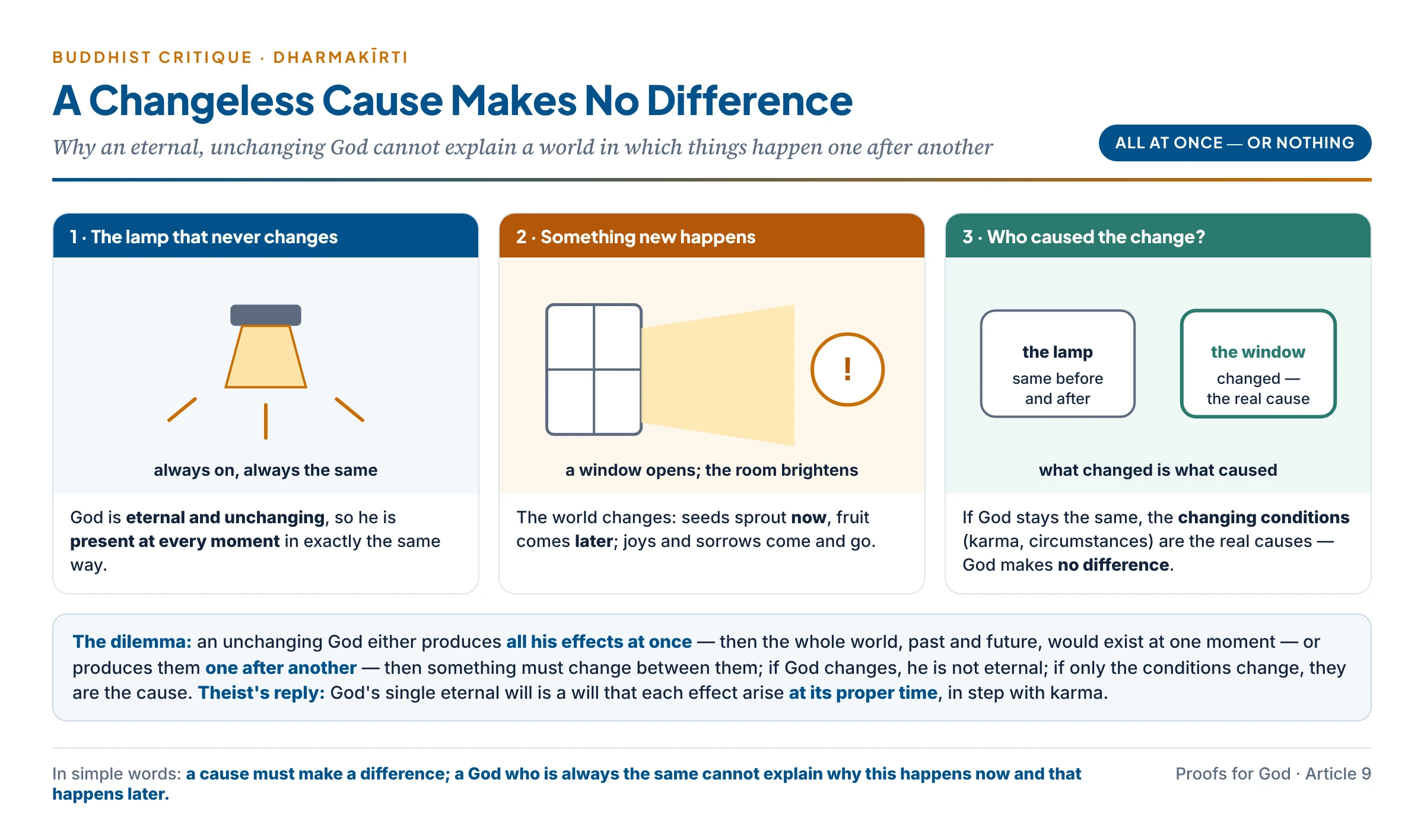
- The argument from permanence. A cause is that which makes a difference: when it is present the effect arises, when absent it does not. But a permanent God is always present. Then:
- either he produces all his effects at once — and the whole world, with all its past and future, should exist at one moment;
- or he produces them one after another — but then something must change between one moment and the next; if God changes, he is not permanent; if only the surrounding conditions change, it is they, not God, that are the real cause.
So a permanent being can be the cause of nothing. And since sufferings come and go, are many and varied, they cannot spring from one, unchanging source.
- Activity after rest applies to God too. If atoms must be controlled by an intelligent being because they begin to act after a rest, then God too begins to create after a rest — so he too would need another controller, and so on without end.
In simple words
A room has a lamp that is always on and never changes. One evening the room suddenly lights up more brightly. Was it the lamp? It cannot be — the lamp was exactly the same a moment ago. The real cause is something that changed — someone opened a window. Dharmakīrti says an eternal, unchanging God is like that lamp: since it is always the same, it can never explain why this happens now and that happens later. A changeless cause makes everything at once — or nothing at all.
(c) Śāntarakṣita and Kamalaśīla
- Śāntarakṣita (8th century) devotes a whole chapter of his Tattvasaṅgraha to the examination of God (Īśvara-parīkṣā), with Kamalaśīla‘s commentary. He presses Dharmakīrti’s points: an eternal cause with eternal will and knowledge should produce the world all at once; succession in nature shows that the causes are changing conditions, not one changeless God.
(d) Vasubandhu
- Vasubandhu (4th–5th century) argues: if the world came from God alone, it would have arisen all at once, since the cause would be complete from the beginning. But things arise gradually, one after another — seeds, then sprouts, then plants. This shows they depend on many changing causes, not on one.
- And if God needs other causes to help him, he is not the sole cause; and God’s own joy in creating would itself need a cause.
(e) Aśvaghoṣa (1st–2nd century)
- Cause and effect. If God is the cause and the world the effect, the effect should share the nature of the cause — a perfect cause should yield a perfect world.
- The moral argument rejected. If both virtue and vice come from God, there is no real difference between merit and demerit — morality loses its meaning. An omnipotent God cannot be bound by karma; and there is no need of him, since karma works autonomously through dependent origination.
- The motive. A perfect God has no motive of his own; if he creates without purpose, he is unintelligent; if for the well-being of souls, this is self-contradictory, since the souls themselves are said to be his creation.
- Atheists and polytheists. If an omnipotent God exists and wills to be known, why are there atheists? If God is one, why are there polytheists?
(f) The Jātaka verse on evil
- The Bhūridatta Jātaka puts the problem of evil memorably: “If there exists some Lord all-powerful to fulfil in every creature bliss or woe, and action good or ill, that Lord is stained with sin; man does but work his will.” If God causes everything, God is responsible for every evil, and human beings are mere instruments.
(g) Buddhism as a religion without God
- Is it a religion? If religion means belief in a creator, Buddhism is not one. But it has every other mark of a religion: a spiritual goal (nirvāṇa), a path (the Eightfold Path), refuge (Buddha, Dharma, Saṅgha), scriptures (the Tripiṭaka), monastic community, worship, the distinction of sacred and profane, and compassion for all beings.
- The Buddha is not God. He is a teacher who found the way, not a creator or judge: “be a lamp unto yourselves” (attadīpā viharatha). Liberation is by one’s own effort.
- Later developments. Mahāyāna Buddhism developed a near-divine Buddha (the Dharma-body, Amitābha’s grace) and saviour Bodhisattvas; popular devotion often treats the Buddha as God. But even here there is no creator.
- Two views. Some argue Buddhism and Jainism have made the Buddha and Mahāvīra into gods, since their images are enshrined and worshipped; others reply that they are worshipped as supernatural ideals, not as creators, sustainers or destroyers of the world — so these remain non-theistic religions.
Indian Connect — Buddhism and religion without God
- Buddhism shows that the core functions of religion — freeing from suffering, moral transformation, community, reverence — can be served without a creator.
- Its critics answer that grace and a personal object of love are lost; Mahāyāna’s devotional turn suggests that the religious heart seeks something like God even in a godless system.
5. The Sāṃkhya Critique: “Because God Is Not Proved”
- Classical Sāṃkhya is nirīśvara — without God. The Sāṃkhya Sūtra says simply: “because Īśvara is not proved” (īśvarāsiddheḥ).
- Not dogmatic atheism. Unlike the Cārvāka or the later Jaina and Buddhist logicians, Sāṃkhya does not mainly try to show that God cannot exist. It shows that there is no valid reason to suppose that there is one: God is not perceived, not validly inferred, and not taught by the Veda.
- Prakṛti and the Puruṣas are enough. The world evolves from unconscious Prakṛti for the sake of the conscious Puruṣas — as milk flows unconsciously from the cow for the nourishment of the calf. Purpose without a purposer: an unconscious teleology.
The Sāṃkhya arguments:
- The free-or-bound dilemma. Is God liberated or bound? If liberated, he has no desire and so would not create. If bound, he is ignorant and limited like us, not omnipotent. Either way, no creator.
- The unchanging cannot act. God is said to be eternal and immutable; what is unchanging cannot be the active cause of anything. The changing world needs a changing cause — Prakṛti.
- Not the material cause. By the Sāṃkhya theory that the effect pre-exists in its cause, a material, changing world cannot come from a spiritual, unchanging God.
- What motive? Not his own good — a perfect being lacks nothing. Not the good of others — no one labours for others with no gain to himself, and a world so full of suffering shows no such kindness.
- Evil and karma. If God follows karma, karma is enough and God is idle; if he does not, he is a tyrant.
- The status of souls. If souls are parts of God, they should share his powers; if created by him, they could be destroyed — but the Puruṣas are eternal.
- The Vedic passages. Sāṃkhya is orthodox, so it must explain Vedic verses that seem to speak of a Lord. It reads them as praise of liberated souls or of perfected beings with yogic powers, not as proof of a creator.
- Later theistic Sāṃkhya. Vijñānabhikṣu (16th century) argues that Sāṃkhya denies only an active creator; God may be admitted as the eternally perfect spirit whose mere presence stirs Prakṛti, as a magnet moves iron.
- Yoga — the theistic sister. Yoga accepts the whole Sāṃkhya world-picture but adds Īśvara, a special Puruṣa untouched by affliction and karma, chiefly as an object of devotion and as the teacher of the ancient seers — not as creator (Article 8).
In simple words
A garden grows beautifully every spring. One neighbour says, “There must be an invisible gardener.” Another says, “Seeds, soil, sun and rain explain it all; I see no gardener, and I need none.” The second neighbour has not proved there is no gardener — he has shown that the garden makes sense without one. That is classical Sāṃkhya’s position on God: not disproved, but not proved — and not needed.
6. Is There Need for God in Sāṃkhya and Yoga?
- Sāṃkhya: consistent without God. Its system — two eternal principles, satkāryavāda, the evolution of Prakṛti, liberation by discrimination — is complete without God. Introducing an active creator would conflict with satkāryavāda and with the independence of the Puruṣas.
- Yoga: God useful, not necessary for the system. Yoga’s metaphysics is the same as Sāṃkhya’s; Īśvara does not create Prakṛti or the souls. He is one of the means to concentration (Īśvara-praṇidhāna, devotion to God), offered as an alternative path. So the Yoga system too is consistent without God as a cosmic cause — but religiously it gains a personal object of devotion and grace.
- The theistic reply. Without an intelligent controller, the first stirring of Prakṛti out of equilibrium, and the matching of experiences to each soul’s karma, remain unexplained — the very points Śaṅkara presses against Sāṃkhya (Article 8).
7. The Nyāya Replies
The Naiyāyikas, Udayana above all, wrote their proofs as answers to these critics. Their main replies:
- To the Cārvāka (no perception, no vyāpti).
- Non-apprehension does not prove non-existence. Not perceiving God by the senses no more disproves him than not seeing atoms disproves atoms.
- The rule is established by many cases. Wherever we know the origin of a product, an intelligent agent is found; no counter-example has been proved. The Cārvāka’s own rejection of inference is itself an inference.
- To the Jaina and Mīmāṃsaka (the body problem). A maker needs knowledge, desire and effort, not a body. My own will moves my body without another body to move it; so a will need not act through a body.
- To the “who saw creation?” objection. What is known by inference need not be seen; the potter of a pot found in the desert was also not seen. And in the order of our knowledge we learn of God from the Veda, though in the order of existence God comes first — no vicious circle.
- To the motive objection. God creates out of compassion, but a world of pure happiness is impossible, because beings’ own deeds must bear fruit. Suffering is the fruit of their karma, justly dispensed; God is not cruel.
- To the dependence objection (“then God is not independent”). The moral law is rooted in God’s own nature; following it does not limit him, as a just king is not limited by justice.
- To the “many makers” objection (bees and ants). Bees and ants work in harmony because they follow one natural plan; the unity of the whole world, from atoms to moral order, points to one controlling intelligence. Simplicity also prefers one cause to many.
- To the Buddhist permanence argument. God’s eternal will is a will to produce each effect at its proper time, in step with the ripening of karma. Eternal will does not mean simultaneous effects — as a person’s single, lasting resolve (“I will finish this house”) can produce many acts in sequence.
- To Guṇaratna’s analysis. “Effect” means that which comes into existence (prāg-abhāva-pratiyogī, that which was preceded by its own absence); mountains and sprouts are seen to come into being and decay, so they are effects. Space and universals are not effects in this sense.
- To the Sāṃkhya. Unconscious Prakṛti cannot move itself from equilibrium, nor select each soul’s experiences; milk flows only because the cow is alive and loves the calf.
Critical Evaluation
How Strong Are the Indian Critiques?
- They expose real weaknesses.
- The analogy of the potter is weak exactly where it matters: we know embodied, limited makers of small things, not a bodiless, unlimited maker of everything.
- The step from “some maker” to “one, eternal, all-knowing God” is never fully justified.
- The problem of evil — pressed by Kumārila, the Jainas, Aśvaghoṣa, the Jātaka and Sāṃkhya — remains the hardest objection to every theism.
- Dharmakīrti’s point that a changeless cause cannot explain change is a deep metaphysical problem that Western theology also faced (how can a timeless God act in time?).
- But they have their own costs.
- Self-refutation (Cārvāka). Rejecting inference while arguing by inference.
- A beginningless world (Mīmāṃsā, Buddhist, Jaina). Explaining the world by an infinite past may only postpone the question of why there is any world at all — the question the cosmological argument raises (Article 4).
- Karma without a knower. Can an unconscious law deliver exactly the right fruit to the right person after many lives? The theist finds this harder to believe than God.
- Unconscious purpose (Sāṃkhya). Milk flows for the calf only in a living cow; the analogy smuggles in life and care.
- Momentariness (Buddhist). If everything is momentary, the Buddhist’s own causal chains face similar puzzles about memory, karma and responsibility (Paper I, Buddhism unit).
- The critics are not irreligious. Jainism, Buddhism, Sāṃkhya and Mīmāṃsā all keep morality, karma and liberation — showing that the Indian religious life did not stand or fall with a creator God.
Comparison with Western Critics
| Indian critic | Main point | Western parallel |
|---|---|---|
| Cārvāka | Only the perceived is real; no vyāpti between world and maker | Hume — no experience of worlds being made; logical positivists — God-talk unverifiable |
| Kumārila | No witness to creation; why create a painful world? | Hume — the world is unique, no comparison possible; Epicurus — the problem of evil |
| Jaina (Malliṣeṇa) | Many can co-operate; bodiless maker unknown | Hume — a ship built by many workmen; “why not many gods?” |
| Guṇaratna | “Effect” is ambiguous; wild grass has no planter | Darwin — order without a designer |
| Dharmakīrti | A changeless cause cannot produce successive effects | Debates on how a timeless God acts in time; Kant — causality applies only within experience |
| Aśvaghoṣa, Jātaka | If God causes all, God causes evil; morality loses meaning | Mackie — the inconsistent triad; the Euthyphro dilemma (Article 6) |
| Sāṃkhya | God not proved; nature is enough | Laplace — “I had no need of that hypothesis”; methodological naturalism |
Critics and Defenders
Criticism — Critics of the creator God
- Cārvāka: God is never perceived; nature (svabhāva) explains the world.
- Kumārila: no witness, no material, no motive; the world was never created.
- Jainas: a bodiless maker is unknown; bees and ants co-operate without one master; perfection is the soul’s own achievement.
- Buddhists: a changeless cause produces everything at once or nothing; karma explains variety.
- Sāṃkhya: God is not proved, and Prakṛti is enough.
Defence — Nyāya replies and strengths of theism
- Not perceiving God does not prove there is no God; atoms are not perceived either.
- A maker needs knowledge, will and effort — not a body.
- God’s eternal will produces each effect at its proper time, in step with karma.
- Suffering is the fruit of beings’ own deeds, justly dispensed by a compassionate God.
- An unconscious law or nature cannot select the right fruit for each soul.
Cross-Tradition Comparison
Four Kinds of Indian Non-theism
| School | Rejects | Keeps | Main weapon against God |
|---|---|---|---|
| Cārvāka | God, soul, karma, rebirth, liberation, Veda | Matter, perception, pleasure | Perception alone; svabhāva |
| Mīmāṃsā | Creator, creation and dissolution | Eternal Veda, dharma, apūrva, soul, heaven | No witness; motive dilemma; eternal Veda needs no author |
| Jaina | Creator, oneness, omnipotence, grace | Souls, karma, liberation, omniscient arhats and siddhas | Body dilemma; co-operation; meaning of “effect” |
| Buddhist | Creator, permanent self | Karma, rebirth, nirvāṇa, the Buddha as teacher | Dependent origination; changeless cause cannot act |
| Sāṃkhya | Creator (God not proved) | Prakṛti, many Puruṣas, karma, liberation | Free-or-bound dilemma; Prakṛti’s unconscious purpose |
Indian Connect — Key takeaways
- Indian atheism is mostly non-theism: denial of a creator, not of spiritual life.
- The critiques target the Nyāya inference link by link: subject, reason, rule, example and conclusion.
- Jainism keeps divinity as the perfected soul and proves an omniscient being, while rejecting creatorship.
- Buddhism shows that religion’s central functions can be served without God.
- Sāṃkhya shows that a complete philosophy can be built without God — and Yoga shows how God can be added back for devotion.
Synthesis (Siddhānta)
- India’s critique of theism is as rigorous as its theology. Five schools reject a creator God: the Cārvāka because only the perceived is real; the Mīmāṃsā because the world, the Veda and karma need no maker; the Jainas because a bodiless, single, all-pervading maker is incoherent and godhood is the soul’s own perfection; the Buddhists because a changeless cause cannot explain a changing, dependently arising world; and Sāṃkhya because God is simply not proved and Prakṛti suffices.
- Their arguments anticipate many Western objections — Hume‘s on analogy and many designers, Kant‘s on the limits of causal reasoning, Mackie‘s on evil — and add some of their own, such as Dharmakīrti’s argument that a permanent cause makes no difference.
- The Nyāya replies — on will without body, on timely eternal will, on karma needing an intelligent dispenser, on inference reaching the unperceived — keep theism rationally defensible, but cannot turn it into a demonstration.
- The lasting lesson is that in India religion did not depend on proving God. Jainism, Buddhism, Sāṃkhya and Mīmāṃsā kept morality, discipline and liberation without a creator; the theistic Vedāntins themselves rested God on scripture and experience more than on inference (Article 8). The debate over whether God can be proved is taken up in Article 10.
- Contemporary relevance.
- Naturalism in science — explaining the world by its own laws — echoes svabhāvavāda and Sāṃkhya’s “God not needed”.
- Religion without God — Buddhist and Jaina ethics, and modern secular spirituality — shows that meaning and morality can be sought apart from theism.
- The problem of evil remains the central challenge to theism, East and West.
“If there exists some Lord all-powerful to fulfil in every creature bliss or woe, and action good or ill, that Lord is stained with sin; man does but work his will.” — Bhūridatta Jātaka
Previous Year Questions
- 2025Discuss Carvaka’s critique of the belief in the existence of suprasensible entities.
- 2024State and evaluate Buddhism as a religion without God.
- 2019State and evaluate the proofs for the existence of God as propounded in Jainism.
- 1992“There is no need for God in Sāṃkhya and Yoga systems, as these are fully consistent even without the idea of God.” Notes.