

Problem of Evil.
Official Syllabus: Paper II, Section B, Unit 3
St. Augustine of Hippo (354–430) gave Christianity its classic answer to the problem of evil — the “majority report of the Christian mind” for fifteen centuries, as John Hick called it. Its three pillars are: evil is not a thing but a lack of good (privatio boni); evil entered the world through the free choice of angels and humans (the Fall); and therefore “all evil is either sin or the punishment for sin“. This article sets out Augustine’s background, each pillar, the aesthetic theme of the whole, its development by Aquinas, and a careful verdict on whether it gives a coherent account of both moral and natural evil.
In simple words
A rotten apple has no extra “rot-substance” added to it. The rot is simply the apple losing its firmness, colour and taste — good things it should have. Augustine says all evil is like that: not a thing God made, but a good thing going bad. And it goes bad, he says, because creatures who were made good turned away from the source of their goodness.
Context & Problem
Augustine’s Path to the Problem
- “Whence is evil?” — Augustine tells us in the Confessions that this question tormented him for years.
- The Manichaean answer (which he followed for about nine years as a “hearer”): there are two eternal principles, a kingdom of Light (good) and a kingdom of Darkness (evil) — a dualism traced to the Persian contrast of Ahura Mazda and Ahriman. Evil is a real substance; the good God is not to blame, but he is also not all-powerful, since he is at war with an independent evil.
- Why Augustine rejected it: a God who can be attacked and damaged by darkness is not the perfect, unchangeable God of Christian faith. And if evil is a substance, either God made it (then God is its author) or it exists independently of God (then God is not the creator of all).
- The Neoplatonic key: reading Plotinus, Augustine found the idea that evil is non-being — a lack in things lower on the ladder of being. This let him say that everything that is comes from God, while evil, which strictly is not, does not.
- Rejecting Plato’s matter: Plato had blamed evil on disorderly matter. Augustine could not: for a Christian, matter too is created by God, so blaming matter would make God the author of evil; and an omnipotent God cannot be limited by pre-existing matter.
- Main works: Confessions, On Free Choice of the Will, the Enchiridion (a handbook on faith, hope and love), and The City of God.
What Augustine Had to Hold Together
- God is omnipotent, wholly good and the creator of everything out of nothing.
- Creation is good — “God saw everything that he had made, and behold, it was very good.”
- Evil is real — Augustine never calls it an illusion; he had seen it in his own life and in the fall of Rome.
- Task: show how evil can be real without God being its author and without a second power beside God.
Core Doctrine
Pillar 1: The Goodness and Grading of Creation
- Everything that exists is good in its own way and degree. A stone, a worm, a horse, a human, an angel — each is good as what it is.
- A graded hierarchy — creation is a ladder of higher and lower, greater and lesser goods: angels above humans, humans above animals, animals above plants. A universe with all grades is richer than one with only the highest (later called the principle of plenitude).
- Mutability — because creatures are made out of nothing, they are changeable; only God is unchangeable. This changeability is the opening through which corruption can enter: what is made from nothing can slip back toward nothing.
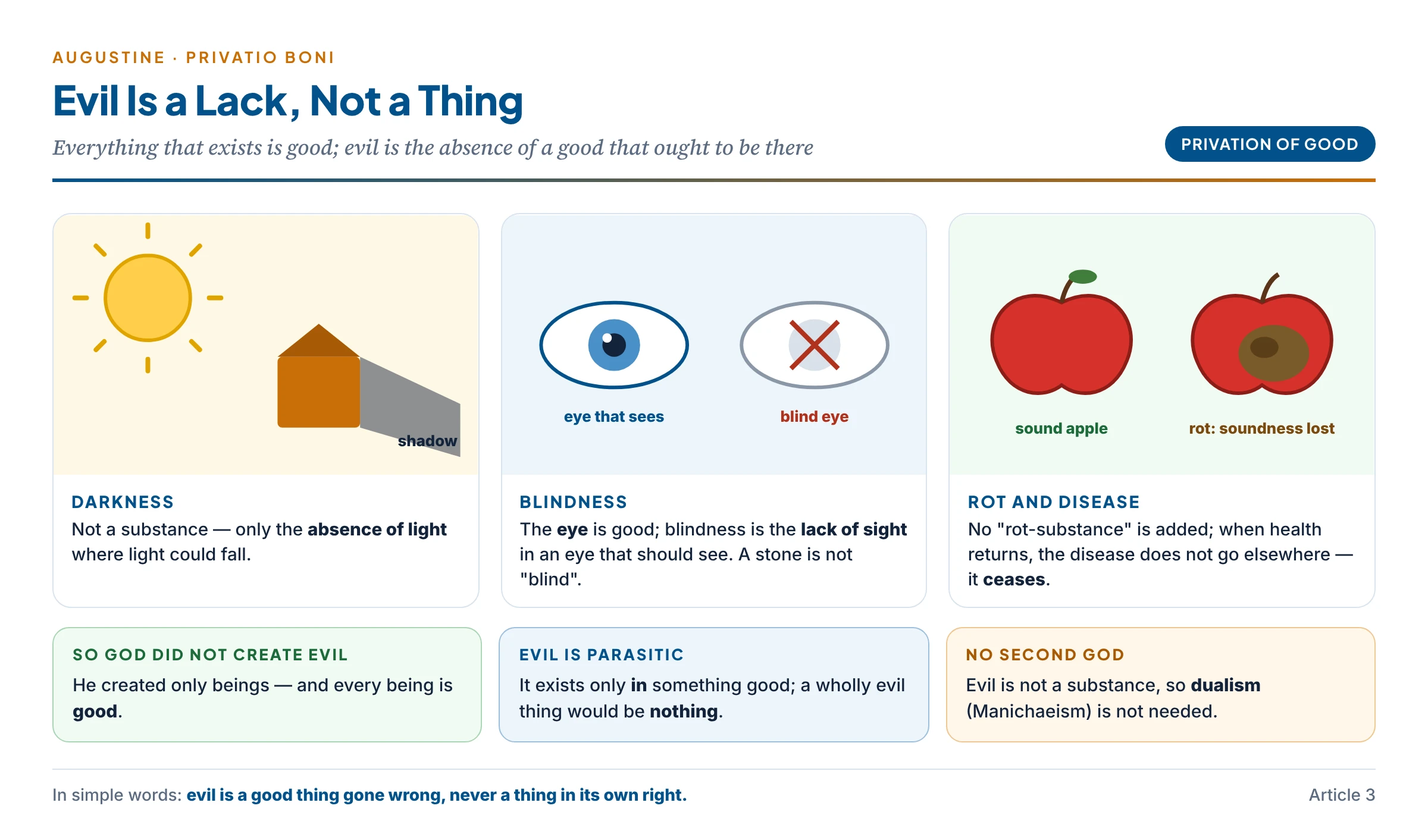
Pillar 2: Evil as Privation of Good (Privatio Boni)
- The core claim: evil has no positive nature; it is the absence, lack or corruption of a good that ought to be there. In the Enchiridion Augustine asks: “What is that which we call evil but the absence of good? In the bodies of animals, disease and wounds mean nothing but the absence of health.”
- Examples Augustine and his followers use:
- Blindness — not a “thing” in the eye; the only thing is the eye, which is good; blindness is the lack of sight where sight should be.
- Darkness — not a substance but the absence of light.
- Disease — when health is restored, the disease does not “go somewhere else”; it simply ceases to exist, because it was only a lack.
- Silence is the absence of sound; rot is the loss of soundness.
- Consequences:
- God did not create evil — he created only beings, and all beings are good; evil is not a being.
- Evil is parasitic — it can exist only in something good, as a wound exists only in a body. A wholly evil thing is impossible: if all good were removed, nothing would be left — not even the evil.
- No second God — since evil is not a substance, there is no need for a rival principle of darkness: dualism is refuted.
- “Lack of due good”, not every lack: a stone that cannot see is not blind; only a being that should have sight is blind. Evil is the absence of a good that belongs to a thing’s nature — a falling short of what it ought to be.
Common confusion
Does privatio boni mean that evil is unreal or an illusion? No. Augustine never says suffering is imaginary. Blindness is really there — it is a real lack. The privation theory is a claim about what kind of reality evil has (a lack, not a substance), not a claim that evil does not happen. Theories that call evil an illusion (Christian Science, some readings of Spinoza and Advaita) are a different view (Article 5).
Pillar 3: Free Will and the Fall
- Where did the privation begin? Not in God, and not in matter, but in the free will of rational creatures — first angels, then humans.
- The fall of the angels: some angels, led by Lucifer (Satan), turned in pride from the supreme Good (God) to a lesser good — themselves. They tempted Adam and Eve, who freely disobeyed God.
- Sin as disordered love: sin is not loving something evil (there is nothing positively evil to love); it is loving a lesser good more than a greater one — preferring the creature to the Creator, the self to God. The order of love (ordo amoris) is overturned.
- The evil will has no efficient cause: in The City of God Augustine says we should not look for an efficient cause of the evil will — “it is not efficient, but deficient“. A bad choice is a falling away, a defection; to look for its positive cause is like trying to see darkness or hear silence.
- Original sin: Adam’s sin is passed to all his descendants (“in Adam’s fall we sinned all“); humanity becomes a “mass of the damned“. Fallen humans have lost the freedom to do good by their own power and can be saved only by God’s grace, which God gives to whom he wills — the elect; the rest are justly left in their sin.
- Three states of the will (later summarised in Latin):
- Adam before the Fall — able not to sin (posse non peccare).
- Fallen humanity — not able not to sin (non posse non peccare).
- The saved in heaven — not able to sin (non posse peccare).
- Augustine vs Pelagius: the monk Pelagius held that every person is born innocent and free, that sin is always a personal misuse of free will, and that grace is a help, not a necessity. Augustine fought this as heresy — showing how central inherited sin is to his theodicy.
Pillar 4: “All Evil Is Either Sin or the Punishment for Sin”
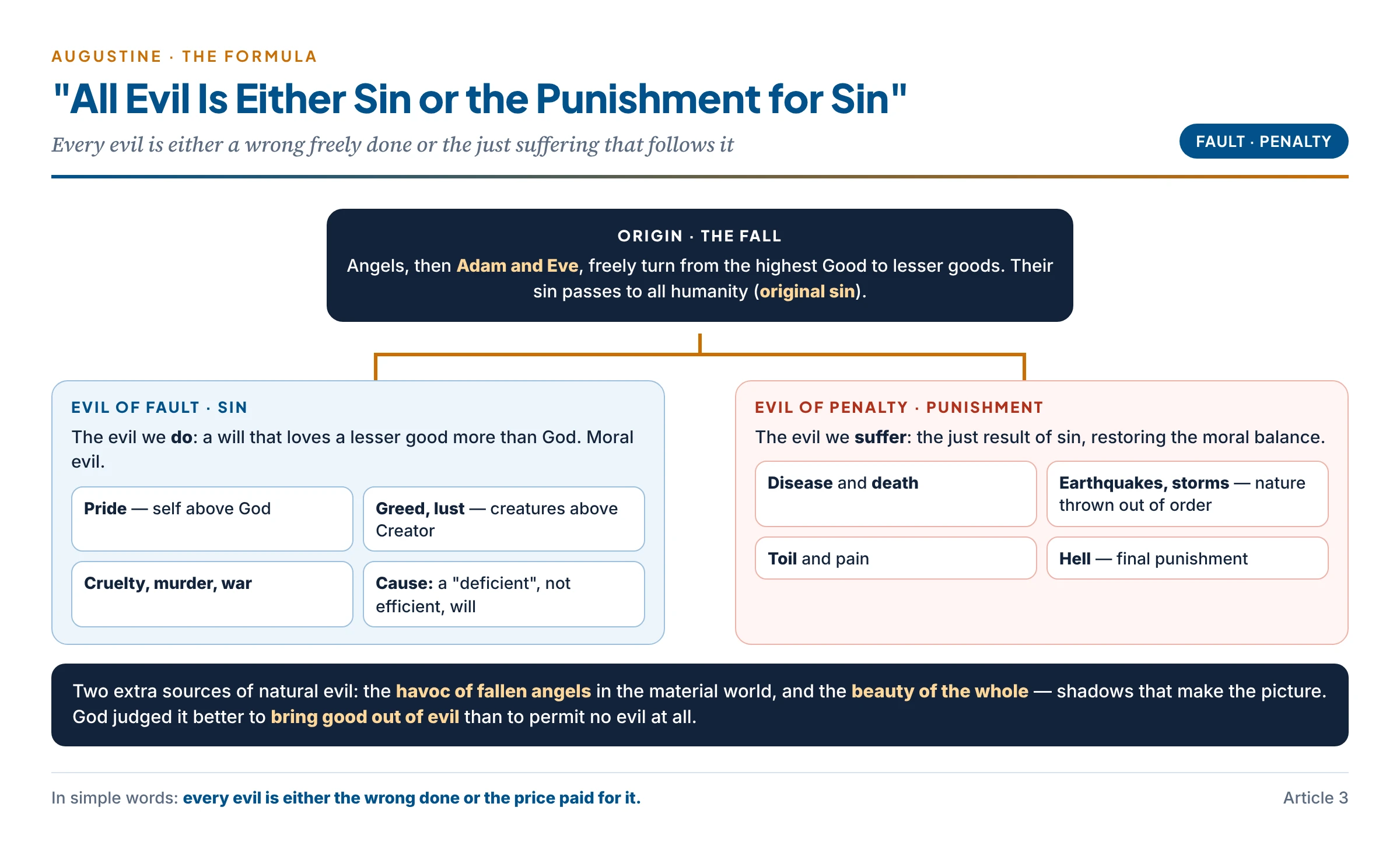
- Two kinds of evil — in On Free Choice of the Will Augustine notes that we speak of evil in two senses: the evil a person does and the evil a person suffers. Later thinkers named them:
- Evil of fault (malum culpae) — sin, moral evil, the misuse of free will.
- Evil of penalty (malum poenae) — suffering, the just consequence of sin.
- The formula: so Augustine can say “All evil is either sin or the punishment for sin.” There is no third kind — no evil that is neither a free wrong nor its just result.
- Natural evil as punishment: humanity was meant to be the guardian of the earth; its rebellion threw nature itself out of order. Disease, death, pain in childbirth, toil, decay, the hostility of wild beasts, storms and earthquakes are the penal consequences of sin. “Death entered the world through sin.“
- Natural evil and the fallen angels: the havoc wrought by fallen angels (demons) in the material world is a further source of natural evil.
- The principle of moral balance: sin is a dishonour to the universe; just punishment restores the balance. “Since there is happiness for those who do not sin, the universe is perfect; and it is no less perfect because there is misery for sinners.” Sin that is justly punished no longer mars the perfection of God’s creation.
- The final judgment: at the end of history many will enter eternal life, and many others, who rejected God’s offer, eternal torment.
In simple words
Think of a student who cheats in an examination. The cheating is the evil he does (sin); the failing grade and disgrace that follow are the evil he suffers (punishment). Augustine treats the whole world this way: every evil is either the cheating or the grade — the wrong-doing of creatures, or its just consequence.
Pillar 5: The Aesthetic Theme — Seeing the Whole
- Parts and whole: what looks evil from a part may contribute to the beauty of the whole. God has made the world like a beautiful poem with antitheses — contrasts that make the meaning shine.
- The painting analogy: in a great painting, dark shadows are needed to bring out the brilliance of the light; seen close up, a shadow is ugly; seen from afar, it serves the picture.
- Things harmful to us are good in themselves: fire, frost and wild beasts harm human beings, yet each is good in its own nature and has its place in the order of the world.
- God brings good out of evil: “For the almighty God… being supremely good, would never permit the existence of anything evil among his works, if he were not so omnipotent and good that he can bring good even out of evil.” He judged it better to bring good out of evil than to permit no evil at all.
- The man born blind: when asked whose sin caused a man’s blindness, Jesus answers, “Neither this man nor his parents, but that the works of God might be made manifest in him.” Some suffering serves a purpose we cannot yet see.
- Seminal goods: God planted germinal potentialities in creation; what now appears as evil may in time unfold into good — as parts of a barren desert were later found to hold oil.
Aquinas Develops the Augustinian View
- Evil is a privation: Thomas Aquinas keeps Augustine’s definition — evil is the absence of a due good.
- God permits but does not will evil: God wills a universe good on the whole; in such a universe some evil must be permitted.
- Natural evil in a graded world: a world with corruptible things — things that can come to be and pass away — is fuller than one without them; and corruptible things will in fact be corrupted. “A lion would cease to live if there were no slaying of animals; and there would be no patience of martyrs if there were no tyrannical persecution.“
- The world as a work of art: some imperfection is necessary to the excellence of the whole — like a villain in a tragedy.
- God causes the evil of penalty, not the evil of fault: in punishing, God brings about suffering as justice — a good; but God never causes sin, which comes only from a defective will.
- Purpose of free will — holy wills: God gave free will so that some would freely surrender their wills to him and become holy wills; the emergence of holy wills outweighs the failure of the many who fall.
- A modern Thomist point (Brian Davies, Herbert McCabe): moral failure is a gap between what is there and what ought to be there; a gap is not something that can be caused, even by God. The real question is not “Is God the cause of moral evil?” but “Why has God not caused more goodness?” — and Davies argues God is under no obligation to produce any particular amount of goodness.
Indian Connect — Indian Connect — privation and ignorance
- Augustine’s evil as lack has a cousin in Advaita Vedānta: evil belongs to the world of ignorance (avidyā); it has no reality at the level of Brahman, which alone is fully real.
- But the difference is sharp: for Augustine the world is really created and really good, and only evil is a lack; for Advaita the whole empirical world, good and evil alike, is less than ultimately real.
- A closer parallel is Rāmānuja: the world is real and good, and the soul’s suffering comes from its own karma, not from the Lord.
Critical Evaluation
Does Augustine Give a Coherent Account of Both Moral and Natural Evil?
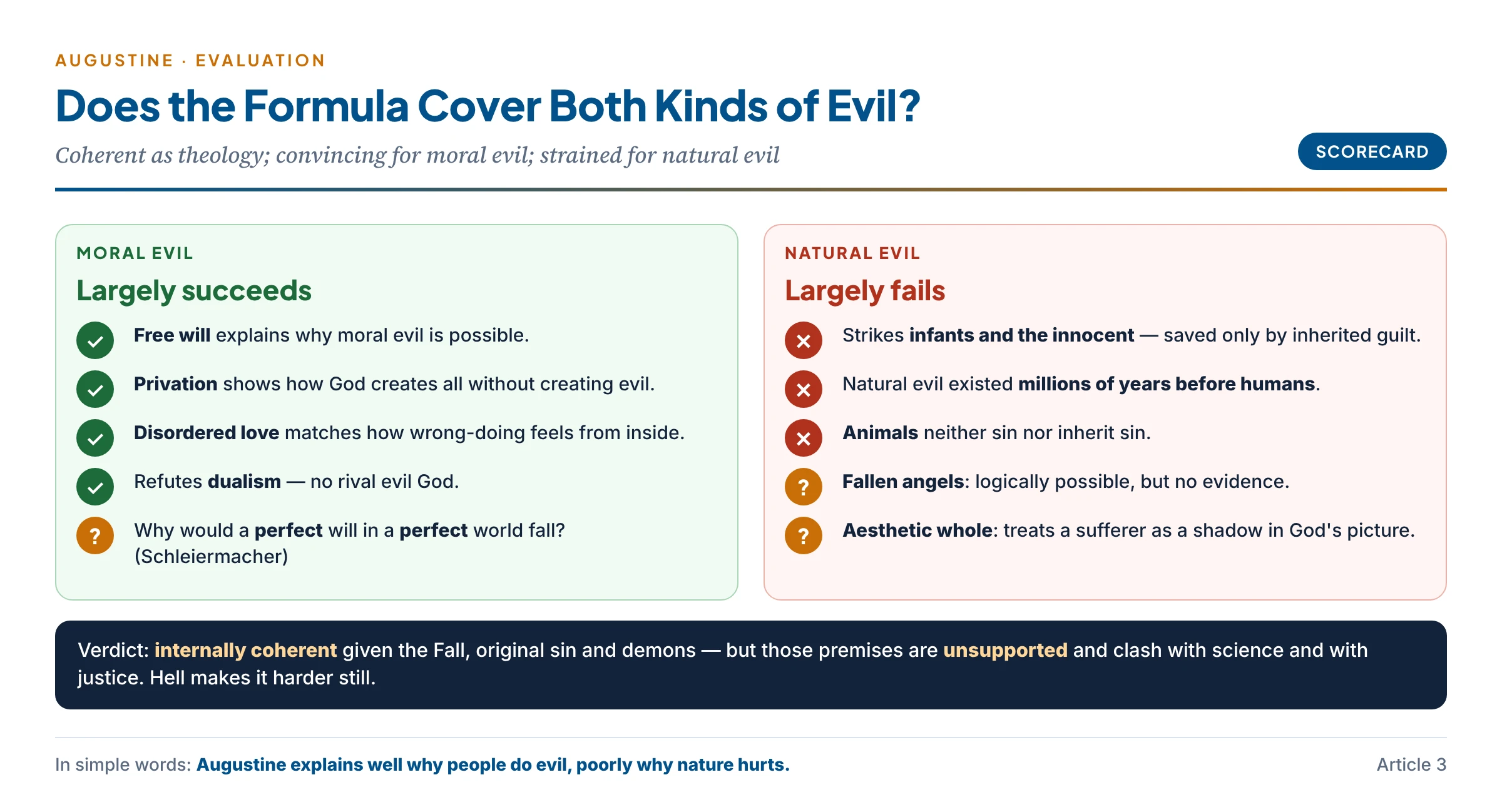
Moral evil — largely successful:
- Coherent core: free will explains why moral evil is possible; privation explains how God can create everything without creating evil; disordered love explains what sin is.
- Faithful to experience: we know from the inside that wrong-doing is a choice of a lesser good — greed, lust, pride — not love of evil as such.
- Answers dualism: no need for a rival evil God.
- But a gap remains: why did perfect angels and a perfect Adam, living in a perfect world, ever choose wrongly? (See Schleiermacher below.)
Natural evil — largely unsuccessful:
- Punishment of whom? Earthquakes, cancers and famines strike infants, the innocent and the righteous as much as the wicked. Augustine’s answer — inherited guilt from Adam — makes the suffering of a newborn “deserved”, which most modern readers find morally unacceptable.
- Before the Fall: we now know that predation, disease and natural catastrophe existed hundreds of millions of years before humans; signs of arthritis have been found in the bones of prehistoric animals. Natural evil cannot be the result of a human sin that came later.
- Fallen angels: blaming earthquakes and plagues on demons is logically possible (Plantinga used it as a mere possibility) but has no support in science and looks ad hoc.
- Animal suffering: animals do not sin, inherit no sin and need no punishment; their pain falls outside the formula “sin or punishment” altogether.
- The aesthetic theme: treating a child’s agony as a shadow that improves a cosmic painting seems to use the sufferer as a mere means for the beauty of the whole.
Verdict: the formula is internally coherent as a piece of theology — given the Fall, original sin and fallen angels, everything fits. It succeeds as an account of moral evil and of why God is not its author. It fails to give a credible account of natural evil, because its key premises (a historical perfect paradise, inherited guilt, demonic causation of nature) are unsupported and conflict with what we know about the world.
Schleiermacher’s Objection: Evil Out of Nothing
- Friedrich Schleiermacher (1768–1834), and later John Hick, argued that the very idea of a perfect creation going wrong is self-contradictory:
- If angels and humans were created finitely perfect — with no flaw or trace of evil — and placed in a perfect environment, they would never in fact fall, though they were free to.
- To say they fell spontaneously and without cause is to say evil created itself out of nothing.
- Augustine himself, asked why some angels fell and others did not, had to say that those who stood firm received more grace — so the difference goes back to God. “This is where the buck stops.“
In simple words
Imagine a cashier who is completely honest, well paid, content and working in a firm with no temptations — and one day he steals. Investigators would never accept “he just chose to, for no reason“. They would look for a hidden flaw in him or in the firm. Schleiermacher says the same of the Fall: a perfect creature in a perfect world has no reason to sin — so either the creature was not perfect, or the cause lies with whoever made it.
- Mackie’s link: this agrees with Mackie’s point that God could have made free beings who never in fact fall (Article 2).
The Privation Theory under Fire
- Pain is positive: pain is not felt as an absence; it is a vivid, positive experience. As Y. Masih puts it, pain is no less painful for being called “privative” — and if a painter paints a woman without eyes, is the omission not a real ugliness?
- Positive evils: a cancer is not a lack of cells but an excess of growth; cruelty and hatred are not mere absences of kindness but active forces.
- Defence: the privation theory is a metaphysical claim about the structure of evil, not a psychological claim about how it feels. Cancer cells are good as cells but lack the due order of the body; cruelty is real energy (good in itself) directed without due order. The theory explains why evil is parasitic and why God is not its author — which is all it set out to do.
- But it does not answer why God permits the privation. Calling evil a “lack” shows what it is, not why it is allowed. The privation theory must be joined to the free-will and aesthetic themes to become a theodicy.
Further Criticisms
- Hell: eternal torment, Hick argues, would build evil permanently into the structure of the universe — the sin of the damned and the pain of their punishment would never be redeemed. “Hell as conceived by Augustine or Calvin is a major part of the problem of evil.“
- Inherited guilt is unjust: punishing billions for the sin of one ancestor contradicts the very justice the theodicy wants to defend; why should a child suffer for Adam’s act?
- Freedom taken back: Augustine teaches indefeasible free will in his theory of knowledge but, in his theology, restricts real freedom to Adam alone and makes salvation depend on predestined grace — critics like Masih call this narrow and sectarian.
- Myth taken as history: the theodicy depends on a literal reading of Genesis — a historical Adam and Eve and a primeval paradise — which modern biology and biblical scholarship do not support.
- Defence by modern theologians: some (e.g. David Bentley Hart) reinterpret the Fall as timeless or cosmic — not an event in history but a deep disorder of creation — to save the structure of the theodicy without the history.
Is God the Cause of Natural Evil — on Augustine’s View?
- Indirectly, yes — as judge: natural evils are punishments, and punishment is inflicted by the just judge. So God is the cause of the evil of penalty.
- But not of sin: God is never the cause of the evil of fault; that comes only from the creature’s deficient will (Aquinas).
- Not as an arbitrary author: natural evil is either the just penalty of sin, the work of fallen angels, or the inevitable corruption of corruptible things in a good, graded world.
- Critics reply that a judge who punishes infants and animals, and who created a world that would predictably fall, cannot escape responsibility (Article 4 takes up this question in general).
Common confusion
Did Augustine teach that every sufferer is being punished for his own personal sins? No — that is the simple “punishment theodicy” Augustine is often reduced to. His formula is “sin or the punishment for sin” — and the sin may be the original sin of humanity, inherited by all, or the wider disorder of a fallen world. Like Jesus on the man born blind, Augustine did not say each person’s suffering matches his personal guilt. The harder objection is not that he blamed individuals, but that he blamed everyone — including infants — through inherited guilt.
Critics and Defenders
Criticism — Against Augustine
- Schleiermacher and Hick: a perfect creation could not go wrong — evil “out of nothing”.
- Modern science: no historical paradise; natural evil long before humans.
- Moral critics: inherited guilt and eternal hell are unjust.
- Masih and others: calling pain “privative” does not make it less painful.
- Animal suffering: outside the formula “sin or punishment” altogether.
- Aesthetic theme: uses sufferers as shadows in God’s picture.
Defence — For Augustine
- Privation shows why God is not the author of evil and why dualism is false.
- Free will explains moral evil coherently — evil is a misdirected love.
- Aquinas: a graded world of corruptible things must contain corruption; God brings good out of evil.
- Plantinga: fallen angels remain a logical possibility for natural evil.
- Davies and McCabe: moral evil is a gap, not a thing God causes.
- Modern reinterpretations: a timeless or cosmic Fall keeps the structure without the history.
Cross-Tradition Comparison
| Theme | Augustine | Indian parallel or contrast |
|---|---|---|
| Nature of evil | Privation of good; not a substance | Advaita: evil belongs to avidyā; not ultimately real |
| Origin | A first Fall of angels and Adam | No first fall: souls and karma are beginningless (anādi) |
| Natural evil | Punishment for (original) sin | Fruit of each being’s own karma |
| Inherited guilt | All sinned in Adam | Karma is individual — no one bears another’s deeds |
| Way out | Grace, chosen by God | Knowledge, devotion, grace (prapatti) — and one’s own effort |
| Dualism rejected | Against the Manichaeans | Vedānta against Sāṃkhya‘s independent Prakṛti |
Indian Connect — Indian Connect — karma vs original sin
- Both Augustine and the karma theory say the same thing at bottom: no suffering is undeserved. Augustine traces it to one sin of one ancestor; karma traces it to each soul’s own past.
- Karma therefore avoids the injustice of inherited guilt — but must posit beginningless past lives that no one remembers (Article 7). Each theory buys the justice of suffering with a premise that cannot be checked.
Synthesis (Siddhānta)
- Augustine answered Manichaean dualism with a monotheism in which everything that exists is good, and evil is a privation of due good — real, but not a substance and not created by God.
- Evil began in the free will of angels and humans, who turned from the highest Good to lesser goods; original sin spread it to all humanity, and only grace can heal it.
- Hence “all evil is either sin or the punishment for sin“: evil of fault and evil of penalty. Natural evils are the penal disorder of a fallen world and the work of fallen angels; the whole, seen from God’s view, is a beautiful order in which God brings good out of evil. Aquinas refined this into a theory of a graded, corruptible world and holy wills.
- Evaluation: the account is coherent for moral evil and shows why God is not its author; it is weak for natural evil, which it explains only through a historical paradise, inherited guilt and demons — premises that clash with science and with justice. Schleiermacher’s objection (evil out of nothing) and the doctrine of hell strain it further.
- Lasting value: the privation theory and the free-will theme survive in Plantinga, Davies and modern Thomism; the Fall survives in reinterpreted, non-historical forms. The Irenaean alternative (Article 5) grew precisely from Augustine’s weaknesses.
“Let no one look for an efficient cause of the evil will; for it is not efficient, but deficient.” — St. Augustine, The City of God
Previous Year Questions
- 2026In what sense does St. Augustine’s identification of all evil as either sin or as the punishment of sin succeed or fail in providing a coherent account of both moral and natural evil? Evaluate.
- 2023“All evil is either sin or punishment for sin.” – St. Augustine. Critically discuss.
- 2015Is God the cause of natural evil? Explain.