

Problem of Evil.
Official Syllabus: Paper II, Section B, Unit 3
When a theist is told “if God is all-powerful and good, he must wish to abolish all evil — yet evil is everywhere“, there are two classic replies. The free-willist says: evil comes from the misuse of the freedom God gave us to become his fellow-workers; God is not its author. The instrumentalist says: evil is a means to good — a warning, a discipline, a contrast, a school of virtue. This article explains both families of answers, their critics, the hard question whether an absolute creator leaves any room for human responsibility, and the special problem of natural evil: is God its cause, and is it a necessary counterpart of good?
In simple words
A parent lets a teenager learn to drive. There is a risk: the child may crash. If the parent forbids driving for ever, there will be no crash — but also no independent adult. Allowing the risk is not wanting the crash. That is the free-willist reply. Now think of a vaccination: the needle hurts, but the pain is a means to health. That is the instrumentalist reply. Most theodicies use both.
Context & Problem
The Theist under Attack
- The challenge (as UPSC once framed it): “If God is all-powerful, God must wish to abolish all evils; but moral and natural evils are rampant in the world.” The hidden premise is that a good God would remove every evil he can.
- Ways a theist reacts:
- Challenge the premise: a good being removes evil unless removing it would destroy a greater good or cause a worse evil (as a surgeon causes pain to save a life).
- Name the greater goods: free will (this article and Article 2), moral growth (this article and Article 5), a lawful, knowable world (this article), the best possible whole (Article 5).
- Limit God’s power (Article 6) or appeal to faith in reasons we cannot see (Articles 2 and 6).
- Appeal to karma (Article 7).
- Two families of justification:
- Free-willist view — evil is the by-product of a good gift: freedom.
- Instrumentalist view — evil is a tool God uses to bring about good.
- The difference: the free-willist says God permits evil he does not want; the instrumentalist says God uses evil for a purpose. The first explains moral evil best; the second tries to explain natural evil too.
Core Doctrine
The Free-Willist View: Man as God’s Co-creator
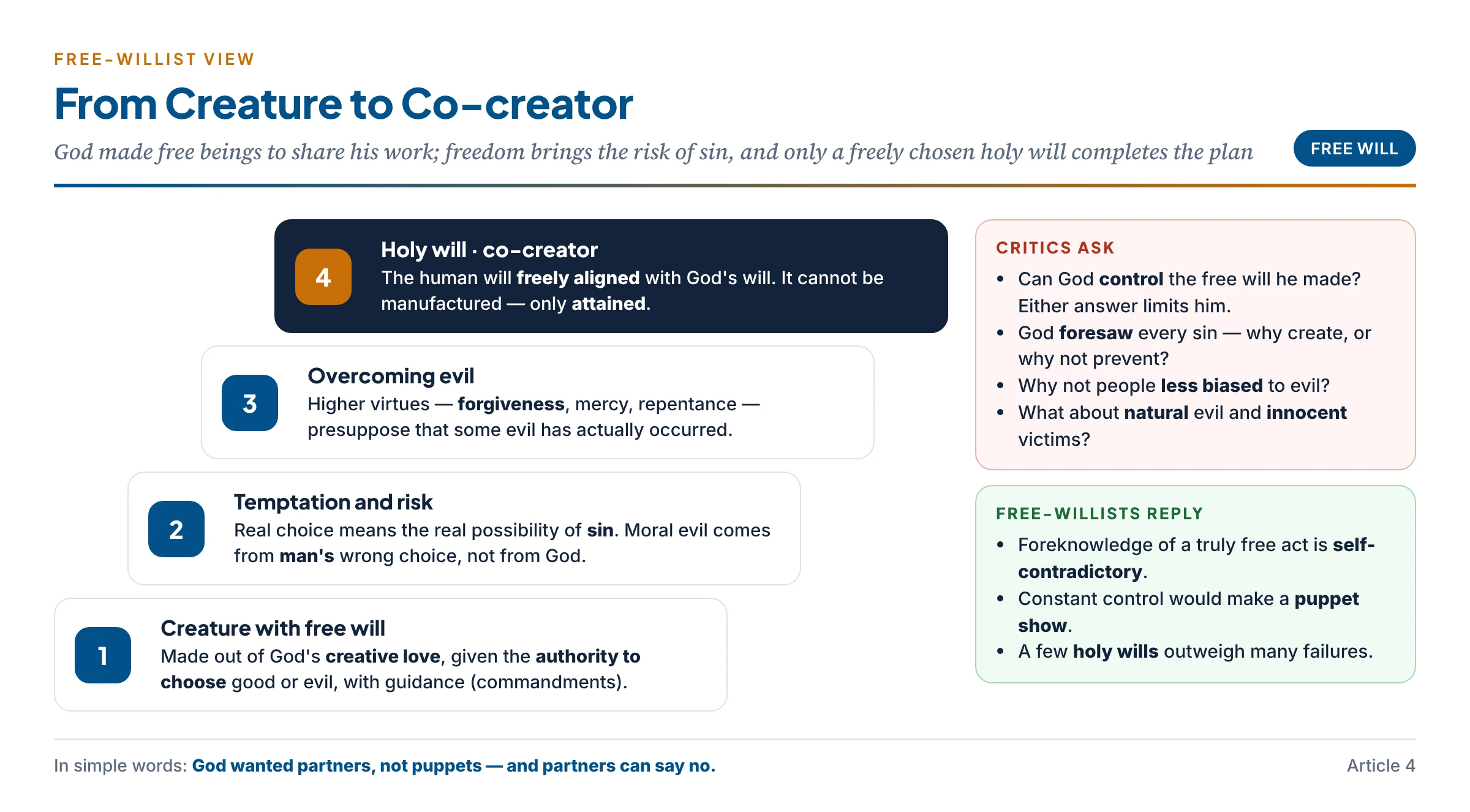
- God’s attributes kept intact: God is infinitely good, omniscient and omnipotent — where omnipotence means the power to do everything logically possible.
- Why God created: out of the abundance of his creative love, God made creatures who could become worthy of his fellowship — not servants or puppets, but co-creators, fellow-workers with God in the work of creation.
- What fellowship requires: a co-creator must choose the right freely, by overcoming the temptation to do wrong. So God gave man the authority to choose between good and evil, and guidance about which is which (for example, the Ten Commandments).
- The risk: the power to overcome temptation is also the power to give in. If free moral agents are to evolve as the supreme end of the universe, the possibility of sin must be conceded.
- Who is responsible: since evil arises from man’s wrong choice, man alone — not God — is responsible for moral evil.
- Higher virtues need evil: forgiveness presupposes not only free will but the actual occurrence of some wrong — otherwise, whom should one forgive, and for what? The same is true of mercy, repentance, reconciliation.
- The goal — a holy will: the supreme end of the universe is to transform the creature into a co-creator, which happens when the human will is made holy by aligning itself, freely, with the will of God, even in the face of every temptation to disobey.
- Why God cannot simply create a holy will: if God brought it about that people always do right, then it is God, not they, who does it. A holy will is a matter of realisation and attainment by overcoming evil — it cannot be manufactured.
Criticisms of the free-willist view:
- The control dilemma: God is said to be omnipotent — but can he control the free will he has created?
- If yes, he could prevent all sin — so why doesn’t he? And if he makes rules (freedom) that bind himself, he is no longer omnipotent once he has made them.
- If no, then he is not omnipotent (the paradox of omnipotence, Article 2).
- Foreknowledge: God is omniscient and knows in advance who will sin and how much. A God who is infinitely good, all-knowing and all-powerful would not have created such free beings — or would have prevented the sins he foresaw.
- Better arrangements were possible: an omnipotent God could have ordered the world so that there were fewer chances of evil, or made human beings less biased towards evil, or made them always choose the right (Mackie: beings “finitely perfect“).
- The image of God: if man was made in God’s image, how could that image be corrupted?
- No divine will to match: human beings learn what is good and bad through their own experience and reflection; so there is no special “divine will” to which human will must be aligned — the goal of becoming a “co-creator” is a theological assumption.
- Natural evil untouched: earthquakes and diseases are not anyone’s choice; the free-will view explains them only by stretching (Augustine’s Fall, Plantinga’s demons — Article 3).
- Innocent victims: the free choice of one person (a murderer) brings suffering to another who chose nothing; why should God respect the murderer’s freedom more than the victim’s life?
- Eternal hell: if many free creatures are doomed to eternal punishment, God could at least have reduced the degree of evil; the risk seems too great.
Free-willist replies:
- Foreknowledge of a free act: some free-willists answer that foreknowledge of a genuinely free act is self-contradictory — a free act is not there to be known until it is done — so even an omniscient God does not foreknow it.
- Controlling freedom destroys it: a God who intervened every time we were about to choose wrongly would turn the world into a puppet show; choices with no real consequences are not real choices.
- The value of the outcome: the emergence of even a few holy wills — saints, people of real love — outweighs, in God’s eyes, the failures of the many (the Thomist view).
In simple words
A chess coach can let a student play a real game — where the student may lose — or he can sit behind the student and move the pieces for him. Only the first produces a chess player. But a critic replies: a good coach also chooses the opponent and stops the game before the student is humiliated beyond recovery. The free-will debate is about whether God is a coach who lets the game run too far.
If God Is the Absolute Creator, Can Responsibility for Evil Belong to Man?
- The case that it cannot:
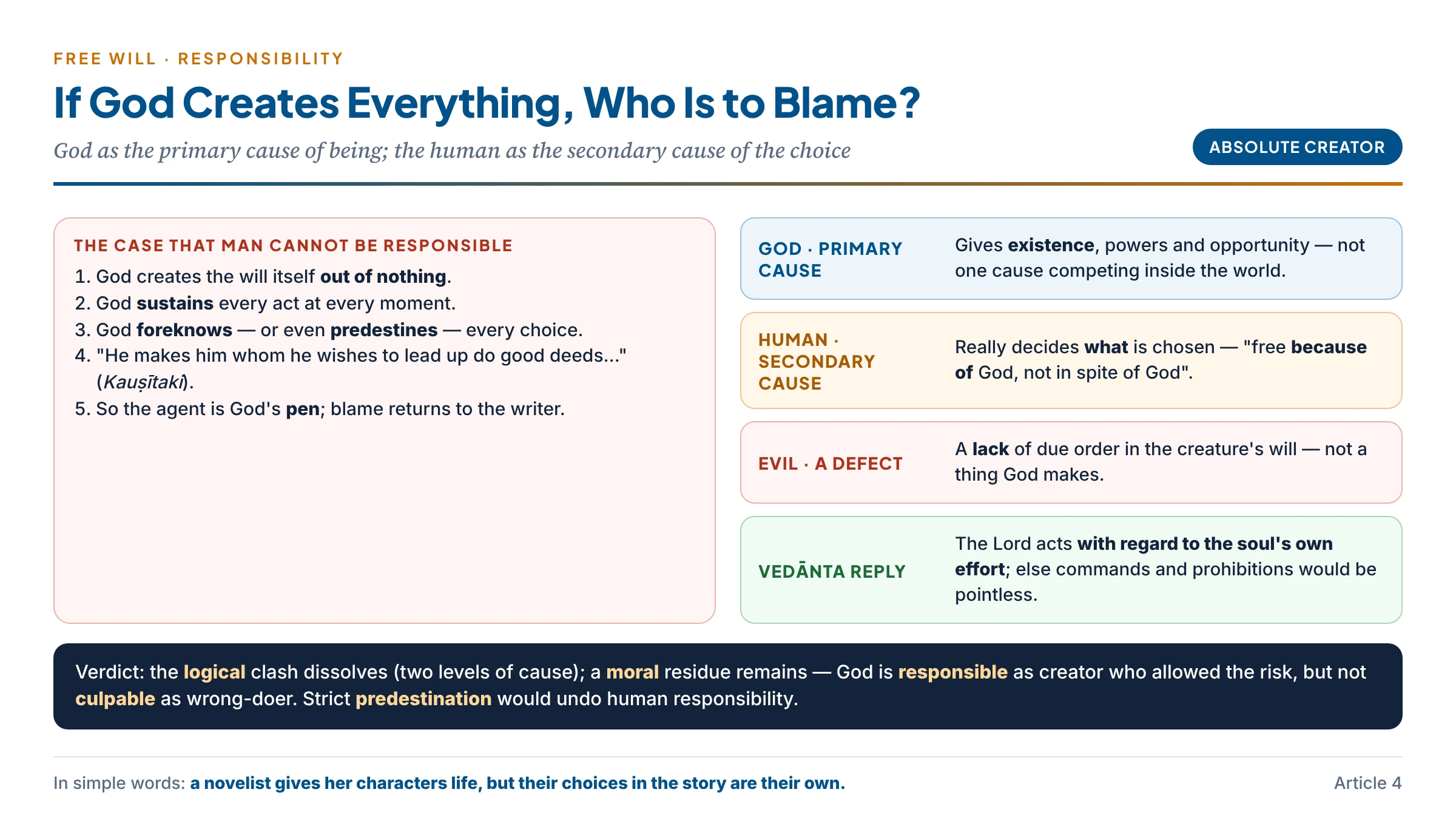
- Creation out of nothing — everything a creature is and has, including its will, comes wholly from God.
- Sustaining — God keeps every creature in being every moment; and in classical theism (Aquinas) God is the cause of every operation of things, including our acts.
- Foreknowledge and predestination — God knew before creating exactly what each would do; in Calvin‘s and in Augustine’s strong form, God predestines the elect and the damned.
- Upaniṣadic echo — the Kauṣītaki Upaniṣad says the Lord “makes him whom he wishes to lead up do good deeds, and makes him whom he wishes to lead down do bad deeds“.
- Conclusion: the “free” agent is God’s instrument; to blame it is like blaming a pen for what the writer writes. Spinoza drew the same consequence from his determinism: freedom is only ignorance of causes.
- The case that it can:
- Primary and secondary causes — God is the primary cause of the existence of agents and their powers; the human being is the real secondary cause of what is chosen. A novelist gives her characters life, yet within the story their choices are theirs; God is not one cause alongside others but the source of there being causes at all. As Herbert McCabe and Brian Davies put it, “we are not free in spite of God, but because of God“.
- Evil as defect — what God causes is the positive being of an act (desire, energy, movement); the evil in it is a lack of due order, coming from the creature’s deficient will, not from God (Article 3).
- Willing vs permitting — God wills that there be free beings; he permits their misuse of freedom. Permission for the sake of a greater good is not authorship.
- Self-limitation — the absolute creator chooses to make room for created freedom; this is an act of his power, not a loss of it.
- The Brahmasūtra answer — on the Kauṣītaki text, the Vedāntins (Śaṅkara, Rāmānuja) answer that the Lord causes the soul to act having regard to its own prior effort; otherwise the scriptural commands and prohibitions would be pointless. The Lord gives consent (anumati), like a lamp that lights a room for whoever works in it; the soul’s choice is its own.
- Evaluation:
- The logical difficulty can be met by the primary–secondary distinction: God and the human can both be causes, at different levels.
- A moral residue remains: if God knowingly creates beings who will fail, and could have created others, he bears some responsibility for allowing evil — as a parent who has a child bears some responsibility for the risks of life. Theists usually answer that God is responsible (as creator) but not culpable (as wrong-doer), because the good of freedom justifies the risk.
- If strict predestination is held, human responsibility does become doubtful — which is why most theists, Christian and Indian, reject it.
Common confusion
If God “permits” evil, isn’t that the same as causing it? Not morally. A teacher who permits students to choose their own project is not the author of a bad project, though she made the choice possible. Permitting becomes blameworthy only when there is no good reason to allow the risk, or when one could prevent the harm without losing the good. So the real question is never “did God permit evil?” (he obviously did) but “does the good gained justify the permission?“
The Instrumentalist View: Evil as a Means to Good
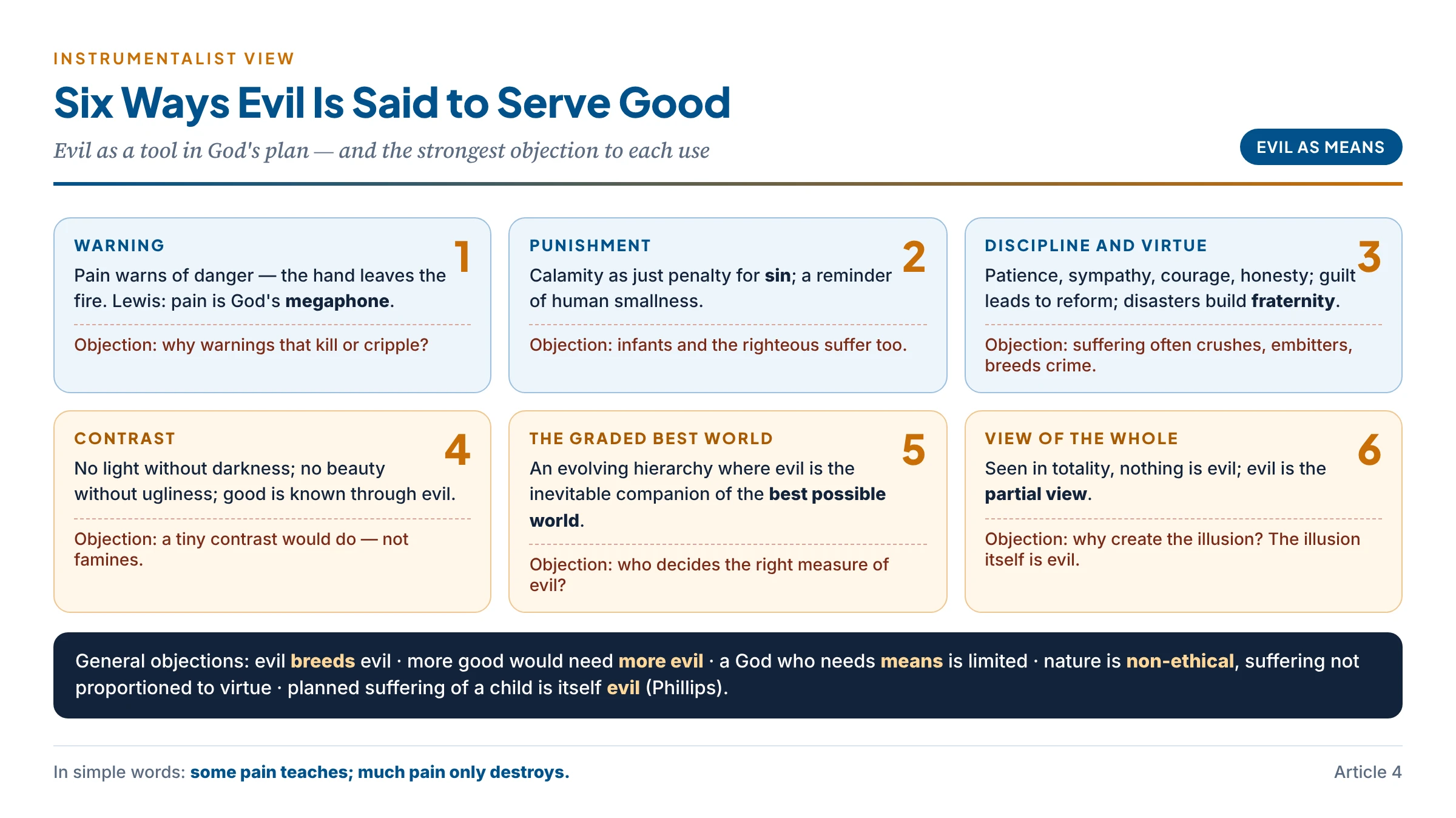
Evil is instrumental — it serves a purpose in God’s plan. Six versions are common:
- 1. The graded, evolving world — the world is evolutionary, giving rise to a hierarchy of graded things; in such a scheme physical and moral evil are the inevitable accompaniments of “the best possible world“. Taken as a whole, “all things work together for good” (Leibniz’s version in Article 5).
- 2. Warning (prophylactic) and punishment (punitive) — evil warns us of danger, as pain warns us to take our hand from the fire; at times it is a punishment. Such warnings remind human beings of their helplessness, weakness and smallness before God, so that they do not rise above God in pride. C. S. Lewis: “God whispers to us in our pleasures, speaks in our conscience, but shouts in our pains: it is his megaphone to rouse a deaf world.“
- 3. Moral excellence and discipline — suffering is the necessary condition for the growth of virtues: patience, tolerance, sympathy, honesty, courage. Only those who suffer can truly empathise; guilt leads to reformation; in natural calamities people forget their hatreds and develop fraternity.
- 4. Contrast — evil to appreciate good — without the experience of evil we could not appreciate goodness, as we cannot appreciate light without darkness, or beauty without ugliness. If there were no evil, the good would not be called good “in the true sense”.
- 5. Natural calamities as the result of sin — disasters are the consequences of human sin, sin being disobedience to God’s command. (This is the punishment theodicy; see below.)
- 6. No evil in the totality — reality taken as a whole is only good; evil is an illusion of the partial view (the Stoics, some idealists — Article 5). Reply: if evil is an illusion, why did God create the illusion? And the illusion is itself an evil — one evil is merely replaced by another.
Criticisms of the instrumentalist view:
- Evil breeds evil — evil often produces more evil of its own kind: a bodily illness creates greater susceptibility to other illness; trauma leads to despair and even suicide; natural calamities bring theft, looting and exploitation, not only fraternity.
- Who decides the measure? — even if some evil is needed for good, who can determine the proper amount of evil just enough to produce the maximum good? The evil of world wars and great famines seems to outweigh any good produced.
- Vicious logic — if evil is necessary for good, then more good requires more evil: the view becomes self-defeating.
- God subordinated to a principle — if God needs means to produce good, then he works under a law of means and ends and is not omnipotent (Mackie). Theists reply that working according to law does not take away God’s omnipotence — law is God’s own chosen order.
- Nature is non-ethical — if creation were just and the creator omnipotent, happiness and suffering would be distributed in proportion to virtue. In fact there are glaring inequalities: virtue is not rewarded; happiness and misery seem to depend on the accident of birth, the faults of parents, society and circumstance.
- Better ways were open — an infinitely kind and powerful God could have used gentler methods to teach us the worth of goodness.
- The moral objection — D. Z. Phillips: to say that a child’s death from cancer was planned as a means to someone’s good is “the deepest evil“; such a God would be revealed as evil. Dostoevsky’s Ivan Karamazov refuses any harmony bought with the tears of a tortured child (Article 6).
- The anthropocentric fallacy — the whole debate judges nature by human welfare: rain is “good” in a drought and “evil” in a flood; natural events are neither good nor evil in themselves. Reading purpose into nature also clashes with the mechanistic explanations of science.
Instrumentalist replies:
- The surgeon analogy — we praise a surgeon who amputates a leg to save a life, though it causes great pain; causing or permitting pain can be good when it serves a greater good.
- Privation transformed — since evil is only a privation, God can absorb it into good; evil serving the cause of good finally disappears.
- Spinoza’s remark — the saint and the wicked both serve God’s purpose; but the wicked, in fulfilling it, perish in the act.
In simple words
A gym trainer makes you lift heavy weights; the strain is a means to strength. That is the instrumentalist picture. But imagine a trainer who breaks your arm “to teach patience”, or who loads weights on a baby. Strain that builds strength is one thing; harm that crushes or falls on those who cannot grow from it is another. The critics say much of the world’s evil looks like the second.
“God Permitted Suffering to Discipline the Human Being”
- The claim: suffering is God’s discipline — like a parent’s correction. The Bible says, “The Lord disciplines the one he loves“; Lewis’s “megaphone” makes the same point.
- What is true in it:
- Suffering can teach humility, endurance and compassion, and break the illusion of self-sufficiency.
- Many people testify that their worst sufferings made them better persons.
- In Indian devotion, Queen Kuntī in the Bhāgavata Purāṇa prays for misfortunes, because in calamity she remembers Kṛṣṇa; suffering here is a spiritual opportunity.
- Why it cannot be the whole truth:
- Discipline must be intelligible: a child must be able to understand why it is corrected. Most sufferers cannot see any lesson.
- Discipline must fit the person: infants, the mentally disabled and animals cannot learn from suffering at all.
- Discipline must be proportionate: no loving parent “disciplines” by torture, famine or genocide.
- It often fails: suffering produces resentment, bitterness and despair as often as virtue (Hick admits this).
- It can blame the victim: if suffering is discipline, the sufferer seems to have needed it.
- Verdict: discipline explains some suffering of some people — especially mild, temporary, understandable suffering — but not the innocent, the excessive or the destructive.
The Punishment Theodicy and Its Limits
- The view: natural calamities and personal misfortunes are God’s punishment for sin.
- A famous Indian case: after the Bihar earthquake of January 1934, Gandhi called it “a divine chastisement for the great sin we have committed… against those whom we describe as untouchables“. Tagore publicly objected: “physical catastrophes have their inevitable and exclusive origin in certain combinations of physical facts“, and it is dangerous to link ethical principles with cosmic phenomena. Gandhi replied that he “instinctively felt” the connection and that his belief was a call to repentance and self-purification — even if mistaken, it would spur reform.
- Literary cases: in Camus’s The Plague, the priest Paneloux preaches “Calamity has come upon you, my brethren, and you deserved it“; after the Lisbon earthquake (1755), which some called divine retribution, Voltaire asked whether God had selected the least virtuous citizens to die.
- Objections:
- The innocent: a newborn with a painful disease or Down’s syndrome, or a minor girl who is raped — what sin is being punished?
- Distribution: disasters do not pick out the wicked; the righteous suffer and the wicked often prosper — as the Book of Job itself protests.
- Moral danger: it encourages blaming victims and excusing cruelty (“they deserved it”).
- What survives: Gandhi’s use shows a moral, not a scientific, reading — calamity as an occasion for self-examination — which avoids blaming victims only if it is turned on oneself, never on others.
Natural Evil: Is God Its Cause?
- Why the question is hard: moral evil can be laid at the door of creatures’ freedom; but earthquakes, tsunamis, plagues and genetic diseases are nobody’s choice. In classical theism God made nature and its laws — so he seems to be, in some sense, their cause.
- Five theistic answers:
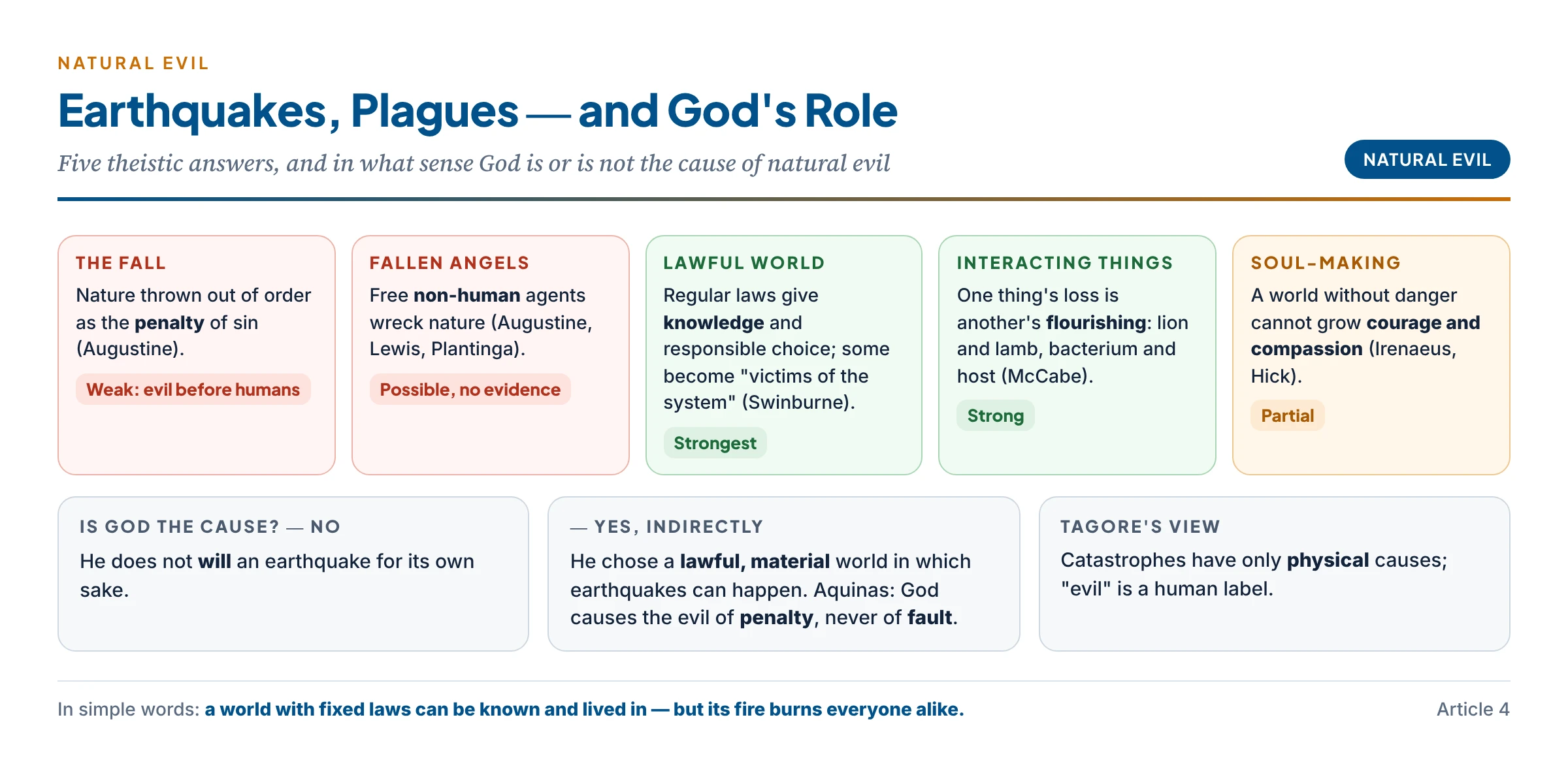
- The Fall (Augustine) — natural evil is the penal consequence of sin; nature was thrown out of order (Article 3). Weak: natural evil long precedes humanity.
- Fallen angels (Augustine, C. S. Lewis, Plantinga) — free non-human agents cause natural evil. Logically possible; evidentially idle.
- The lawful world (Richard Swinburne) — for humans to have knowledge of the results of their actions, and so a responsible choice of destiny, natural laws must work regularly. Regular laws will produce “victims of the system“. If God instead told us verbally what would happen, he would be too close — no one could doubt him, and our choices would be forced. So knowledge must come by normal induction from experience — including experience of serious natural evils.
- A world of interacting things (Davies, McCabe) — “there can never be a defect inflicted on one thing except by another thing that is, in doing so, perfecting itself“: the lamb’s death is the lion’s flourishing; the infection is the bacterium’s life. A material world like ours cannot exist without such losses.
- Soul-making (Irenaeus, Hick) — a world without danger could not produce courage, compassion and maturity (Article 5).
- So is God the cause?
- Directly and as an aim — no: God does not will an earthquake for its own sake; he wills a lawful, material world in which earthquakes are possible.
- Indirectly and as creator — yes: God is responsible for the kind of world in which natural evils occur. Aquinas says God causes the evil of penalty and the corruption of corruptible things (as part of the order of the whole), but never the evil of fault.
- From a non-theistic view — Tagore’s view: natural events have physical causes only, and are neither good nor evil in themselves; “evil” is a label from the human point of view.
- The residual objection: an omnipotent God could have chosen gentler laws — fewer tectonic disasters, no childhood cancers — or could intervene occasionally without destroying the regularity of nature. Theists reply that we cannot know what other set of laws would have been better on the whole.
Is Natural Evil a Necessary Counterpart of Good?
- The theist’s claim: good and evil are correlatives — as light and darkness, health and sickness; without evil, good could not exist or be known.
- Does it succeed?
- Logical counterpart (weak): Mackie replies that this limits omnipotence and that a tiny amount of evil would be enough for contrast — not plagues and famines. God and the blessed in heaven are thought to know goodness without evil.
- Psychological counterpart (partial): it may be true that we appreciate health more after illness — but that is a fact about human psychology, not a reason why the evil must exist; and appreciation does not require agony.
- Causal counterpart (stronger): the lawful-world argument (Swinburne) and the interacting-things argument (McCabe) show that certain goods — knowledge, responsibility, a living ecology — come bundled with the possibility of natural harm. This is the strongest form of the counterpart claim.
- Verdict: theists partly succeed — the causal link between a lawful world and natural harm is real; but the amount and distribution of natural evil, and animal suffering before any human could appreciate the contrast, remain unexplained.
Critical Evaluation
Critics and Defenders
Criticism — Against free will and instrumental justifications
- Mackie: God could have made people who always freely choose right.
- Foreknowledge: a God who foresaw sin would not create, or would prevent it.
- Evil breeds evil; who sets the right measure? More good would need more evil.
- Nature is non-ethical; suffering is not proportioned to virtue.
- D. Z. Phillips and Ivan Karamazov: planned suffering of children is itself evil.
- Tagore: catastrophes have physical, not moral, causes.
- Anthropocentric fallacy: “evil” in nature is only a human label.
Defence — For free will and the greater good
- Freedom is a great good; a holy will cannot be manufactured.
- Primary and secondary causes: God’s creation does not cancel human agency.
- Surgeon analogy: causing pain can be good when it serves a greater good.
- Swinburne: a lawful world is needed for knowledge and responsible choice.
- McCabe: in a material world one thing’s loss is another’s flourishing.
- Lewis: pain is God’s megaphone; suffering can discipline and deepen.
Cross-Tradition Comparison
| Theme | Western theism | Indian thought |
|---|---|---|
| Source of moral evil | Misuse of free will | Action (karma) driven by ignorance, desire, hatred |
| Agent’s responsibility | Real, as secondary cause under God | Real: the Lord acts with regard to the soul’s effort |
| Suffering as discipline | “The Lord disciplines the one he loves” | Suffering as tapas, purification; Kuntī’s prayer for misfortune |
| Natural evil | Fall, demons, lawful world, soul-making | Fruit of karma, individual and collective |
| Punishment theodicy | Paneloux; Lisbon “retribution” | Gandhi on the Bihar earthquake — contested by Tagore |
| Goal | Holy will, fellowship with God | Mokṣa; purification of the will |
Indian Connect — Indian Connect — freedom within karma
- Chatterjee and Datta stress that karma is not fatalism: one’s present lot (daiva) is the force of one’s own past deeds, and it can be overcome by strong present effort (puruṣakāra), as old habits are overcome by new ones.
- So the Indian theist, too, keeps human responsibility: the soul freely acts; God, the dispenser of fruits, merely ensures that actions bear their due consequences (Article 7).
Synthesis (Siddhānta)
- The free-willist view says God created free beings to become his co-creators; freedom makes moral evil possible, and higher virtues like forgiveness presuppose evil; a holy will must be won, not manufactured. It meets serious objections — foreknowledge, God’s control, better arrangements, natural evil, innocent victims — but gives the most convincing account of moral evil.
- Whether an absolute creator leaves room for human responsibility depends on how God’s causality is understood: as primary cause of being, God does not compete with the human secondary cause; the Vedāntic reply (the Lord acts with regard to the soul’s effort) says the same. Strict predestination, however, makes responsibility doubtful.
- The instrumentalist view sees evil as warning, punishment, discipline, contrast, a part of the best whole. It explains some mild, intelligible suffering, but fails for excessive, innocent and destructive evil; it also risks blaming victims and treating persons as means.
- Natural evil is God’s work only indirectly — as the price of a lawful, material, interacting world fit for knowledge and growth. The causal form of the “counterpart” argument is the theist’s strongest card; the amount and distribution of natural evil remain the weakest point.
- Contemporary relevance: debates after earthquakes, pandemics and floods still repeat the Gandhi–Tagore contrast — reading disaster as a moral call versus a physical event; the healthiest religious response, many now argue, is to treat disaster as a call to compassion and responsibility, never as a verdict on its victims.
“God whispers to us in our pleasures, speaks in our conscience, but shouts in our pains: it is his megaphone to rouse a deaf world.” — C. S. Lewis
Previous Year Questions
- 2022“If God is the Absolute Creator, then the responsibility of the evil cannot belong to the human agent.” Critically examine.
- 2016“If God is all-powerful, God must wish to abolish all evils; but moral and natural evils are rampant in the world.” How would a theist react to this?
- 2015Is God the cause of natural evil? Explain.
- 2013Do theists succeed in explaining the natural evil in the world as a necessary counterpart to good?
- 2012“God permitted suffering to discipline the human being.”