

Problem of Evil.
Official Syllabus: Paper II, Section B, Unit 3
Two great theodicies look at evil not as a mistake in God’s work but as part of a larger purpose. The soul-making theodicy of St. Irenaeus and John Hick says the world is not a paradise that went wrong but a school in which immature human beings grow into children of God — and a school needs real difficulties. The optimism of Leibniz says that this world, evils included, is the best of all possible worlds, and that even Adam’s sin was a “happy fault” (felix culpa). This article explains both, asks what role suffering plays in self-transcendence, examines Voltaire’s famous attack, and assesses the older view that evil is a mere illusion.
In simple words
A hotel is judged by comfort: the softer the bed and the fewer the problems, the better. A school or a gymnasium is judged differently: there must be hard lessons, heavy weights and the real possibility of failing — otherwise nobody grows. Hick says critics judge the world as if it were meant to be a hotel; he says it was meant to be a gymnasium of the soul.
Context & Problem
Two Christian Traditions
- Augustine (Article 3) looks backward: humanity was created perfect, fell, and now suffers the consequences. Perfection lies in the past.
- Irenaeus (c. 130–202), bishop of Lyons and an earlier Greek-speaking Father, looks forward: humanity was created immature and is being gradually perfected. Perfection lies in the future.
- Why the second view revived: Augustine’s theodicy depended on a historical paradise and Fall, and on inherited guilt, which modern science and moral sense find hard to accept. John Hick (Evil and the God of Love, 1966) rebuilt Irenaeus’s idea into a full theodicy for the modern age.
- The rationalist optimism of Leibniz (Theodicy, 1710 — the book that gave us the word) approached the same question from metaphysics: given an infinitely wise and good God, the world he chose must be the best possible.
Core Doctrine
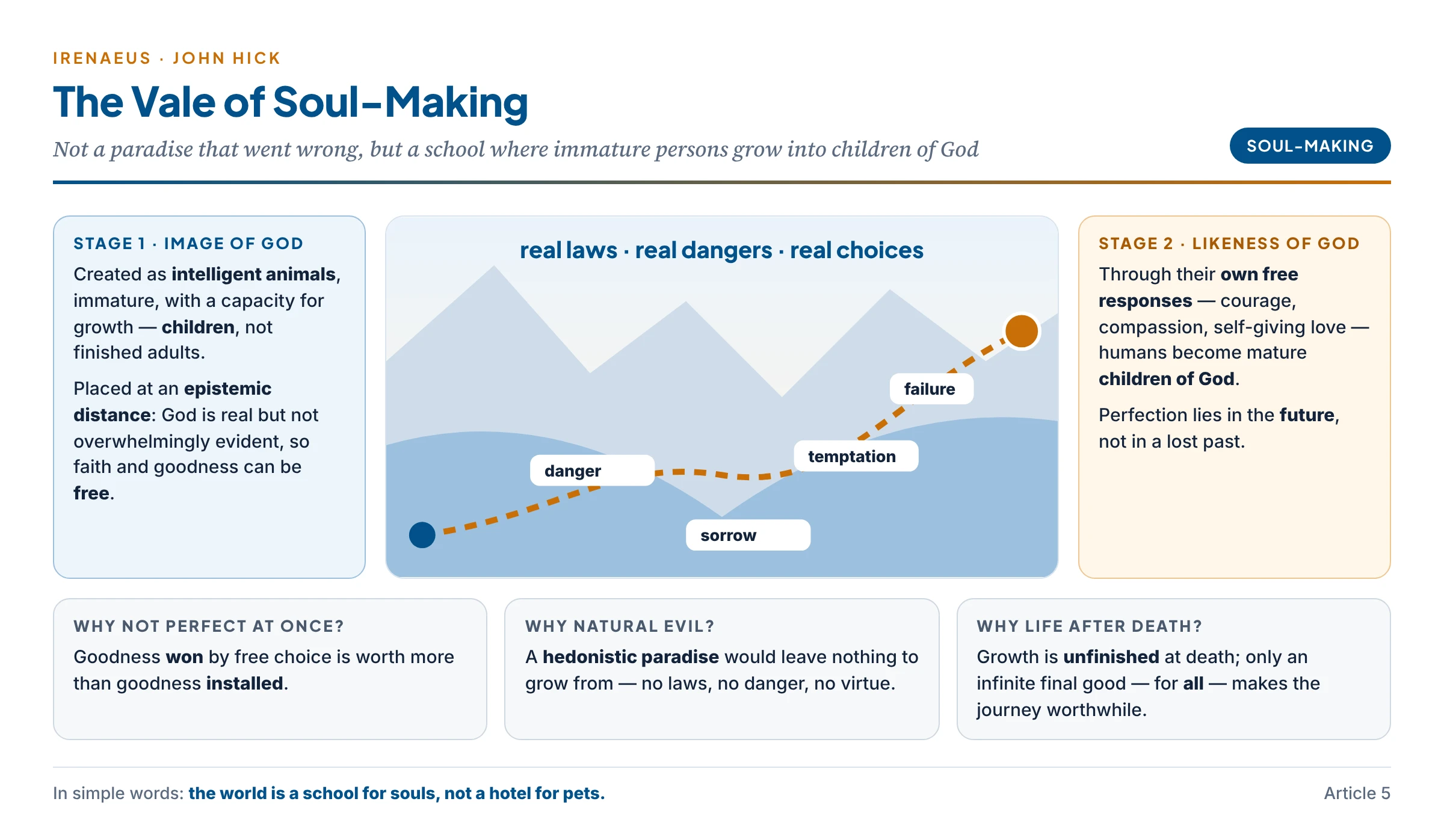
Irenaeus: Image and Likeness
- Two stages of creation — Irenaeus read the Genesis line “Let us make man in our image, after our likeness” as describing two stages:
- Image of God — human beings are created as intelligent animals with the capacity for great moral and spiritual development — like children, not finished adults.
- Likeness of God — through their own free responses to life, they are gradually transformed into mature, morally and spiritually perfect “children of God”.
- No perfect Adam: the first humans were immature creatures at the start of a long growth, not perfect beings who fell. Sin is an expected failure of the inexperienced, not an incomprehensible fall from perfection.
- Learning through contrast: Irenaeus held that humans come to know and choose the good more firmly by experiencing what is evil — as one learns the value of health through sickness.
Hick’s Soul-Making Theodicy
1. Why not create humans perfect at once? Two mutually supporting reasons:
- Goodness won is worth more — a goodness that has come through free, responsible choices in situations of real difficulty and temptation is intrinsically more valuable — perhaps limitlessly more valuable — than a goodness created ready-made.
- Epistemic distance — if humans had been created in God’s direct presence (infinite in power, goodness and knowledge), they would have no real freedom in relation to him; they could not help but obey. So God created them at a distance — not in space but in knowledge (epistemic distance). They live in an autonomous universe that works by its own laws, in which God is not overwhelmingly evident, but may be known through the free response of faith.
2. Moral evil: the human situation is a tension between our natural self-centredness (from the instinct for survival) and the call of morality and religion to transcend it. Moral evil is the necessary condition of creating persons at an epistemic distance, free to grow toward God by their own response.
3. Natural evil — the “negative path”:
- Not every pain can be shown to serve a purpose; but it can be shown that God’s purpose could not be served in a world designed as a permanent hedonistic paradise (a paradise of pleasure).
- The sceptic’s hidden assumption: that God’s aim was to build a comfortable dwelling for a finished creature — like someone building a cage for a pet, making it as pleasant as possible. Our world fails that test; but that was never God’s aim.
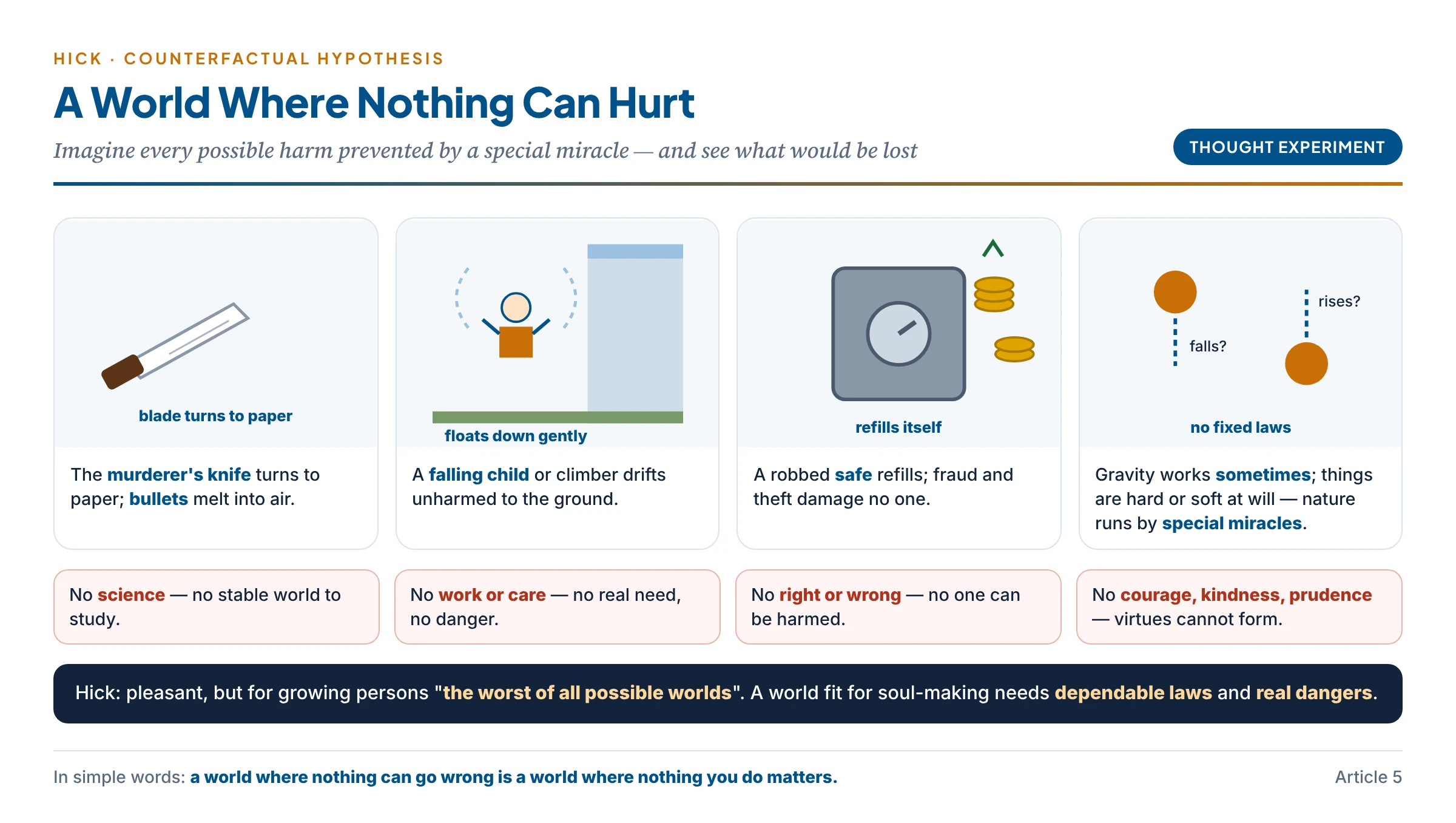
- The counterfactual hypothesis — imagine a world from which all possibility of pain was removed:
- The murderer’s knife would turn to paper, bullets to thin air; a robbed bank safe would refill itself.
- The mountain climber or a child falling from a height would float gently to the ground; the reckless driver would never crash.
- There would be no need to work, since nothing bad would follow from idleness; no call to care for others, since no one would ever be in real need or danger.
- Nature would work by special providences, not general laws: sometimes gravity would work, sometimes not — so there could be no science.
- Ethics would lose its meaning: if no one can be harmed, nothing is wrong — and nothing right in contrast; courage, generosity, kindness, prudence and self-giving love could not even be formed.
- Hick’s conclusion: such a world might maximise pleasure, but for growing persons it would be “the worst of all possible worlds“. A world fit for soul-making must have general, dependable laws and present real dangers, difficulties, failure, sorrow and defeat. Even if it did not contain our particular trials, it would have to contain others.
- “The vale of soul-making” — Hick borrows the phrase from the poet John Keats, who wrote in a letter: “Call the world, if you please, ‘the vale of Soul-making’… Do you not see how necessary a World of Pains and troubles is to school an Intelligence and make it a soul?“
4. Pointing beyond this life — the theodicy needs life after death, in three ways:
- Soul-making is incomplete: suffering sometimes breeds strength, courage and compassion, but often breeds resentment, fear and disintegration — so the process must continue beyond death.
- A future good great enough — only an infinite good at the end (the fulfilment of God’s love) can make the whole long, painful journey worthwhile.
- Universal salvation — to be complete, the theodicy needs all human beings eventually to reach the final good; an eternal hell would make some suffering permanently pointless.
In simple words
Picture a video game with the “invincible” mode switched on: no enemy can hurt you, every fall is harmless, your money refills itself. It is pleasant for a minute — then pointless, because nothing you do matters. Hick’s counterfactual paradise is a world on invincible mode: comfortable, but with no room for courage, skill, care or love to mean anything.
Common confusion
Does Hick say that God sends each particular suffering to teach a particular lesson? No. That would be the simple “discipline” view (Article 4). Hick’s argument is general and negative: he does not claim that every pain has a purpose, only that a world capable of soul-making must have real, law-governed dangers, which will strike unevenly and often pointlessly. He even admits that some suffering seems dysteleological (purposeless) and calls this a mystery — a world where suffering is not always visibly deserved makes genuine sympathy possible.
Evil, Suffering and Self-Transcendence
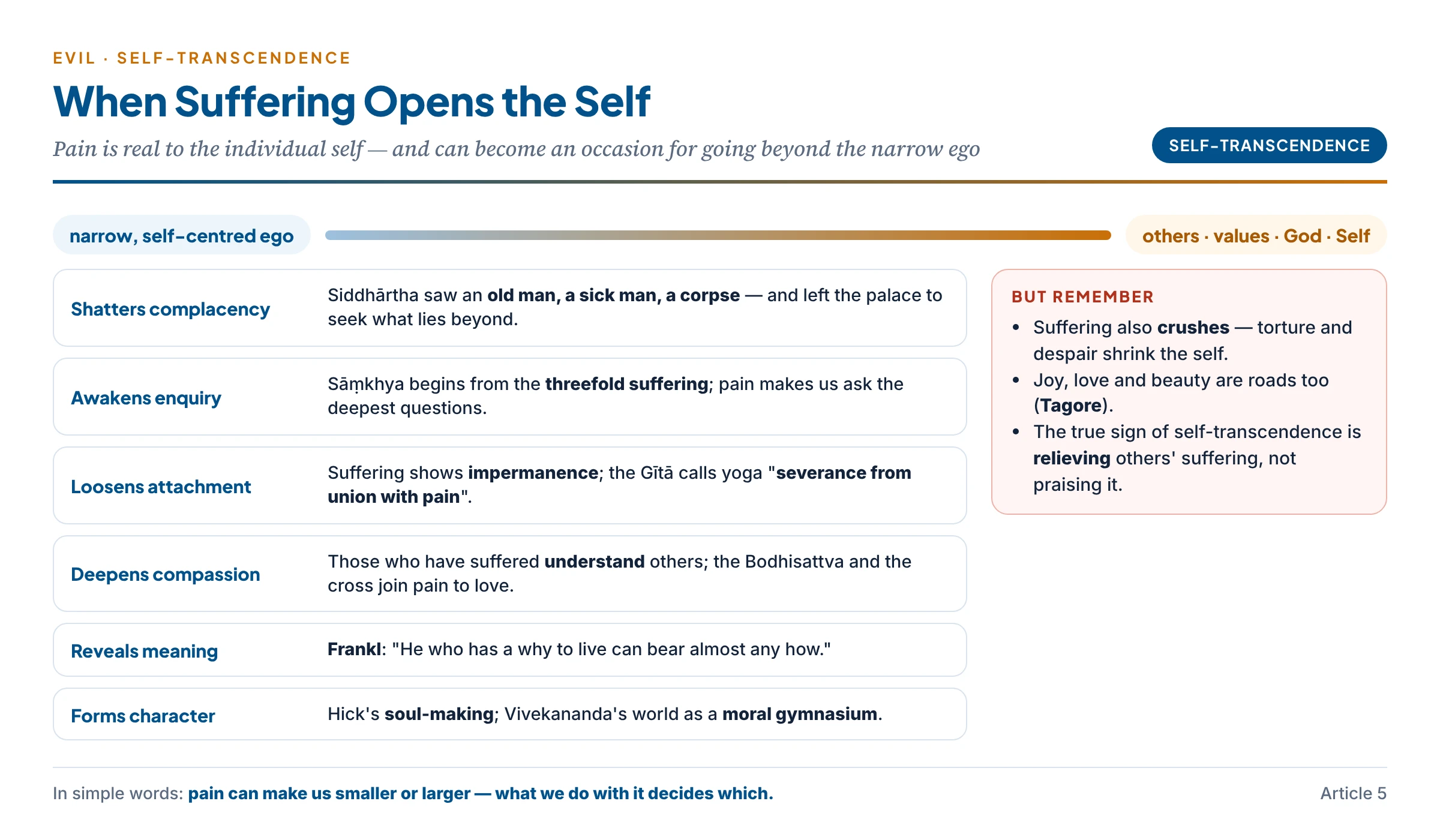
- Self-transcendence means going beyond the narrow ego — beyond self-centred desire and fear — toward others, higher values and, in religion, God or the Self.
- How suffering can serve self-transcendence:
- It shatters complacency — the young Siddhārtha set out on his quest after seeing an old man, a sick man and a corpse (and then a wandering ascetic); suffering made him ask what lies beyond.
- It awakens enquiry — Sāṃkhya begins philosophy from the threefold suffering; the desire to escape it makes one seek knowledge (jijñāsā).
- It loosens attachment — pain shows the impermanence of things and cultivates detachment (vairāgya); the Gītā defines yoga as “severance from union with pain“.
- It deepens compassion — those who have suffered understand others’ suffering; the Bodhisattva ideal and the Christian cross both join one’s own suffering to love for others.
- It reveals meaning — Viktor Frankl, a survivor of Nazi camps, observed that prisoners who found a meaning — a task, a person to live for — endured best; he quoted Nietzsche: “He who has a why to live can bear almost any how.“
- It forms character — Hick’s soul-making; Vivekananda: “this world is a great moral gymnasium wherein we have all to take exercise so as to become stronger and stronger spiritually“.
- Limits:
- Suffering destroys as often as it ennobles — torture, extreme poverty and despair can shrink the self rather than enlarge it.
- Self-transcendence also comes through joy, love and beauty (Tagore’s path) — suffering is one road, not the only one.
- Using suffering as a ladder must never become a reason to leave others in suffering; the true sign of self-transcendence is working to relieve it.
- Balanced view: evil and suffering are real experiences of the individual self, and they can become occasions of self-transcendence when met with reflection, faith and love; they do not guarantee it.
In simple words
Two people lose their jobs in the same week. One becomes bitter and blames everyone; the other uses the shock to ask what really matters, retrains, and starts helping others in the same situation. The event was the same; the response decided whether it shrank or enlarged the self. That is why suffering is an occasion, never a guarantee, of self-transcendence.
Indian Connect — Indian Connect — suffering as a doorway
- The Buddha’s First Noble Truth (dukkha), the Sāṃkhya opening verse on threefold suffering, and the Gītā‘s yoga as “severance from union with pain” all treat suffering as the doorway to liberation, not as an argument against God.
- Vivekananda’s “moral gymnasium” is the Vedāntic cousin of Hick’s “vale of soul-making”; Aurobindo sees the struggle with evil as part of an evolution of consciousness toward the Divine (Article 7).
- Hick himself, in later work, drew on the Indian idea of many lives to suggest that soul-making may continue through further existences after death.
Leibniz: The Best of All Possible Worlds
- The argument from reason:
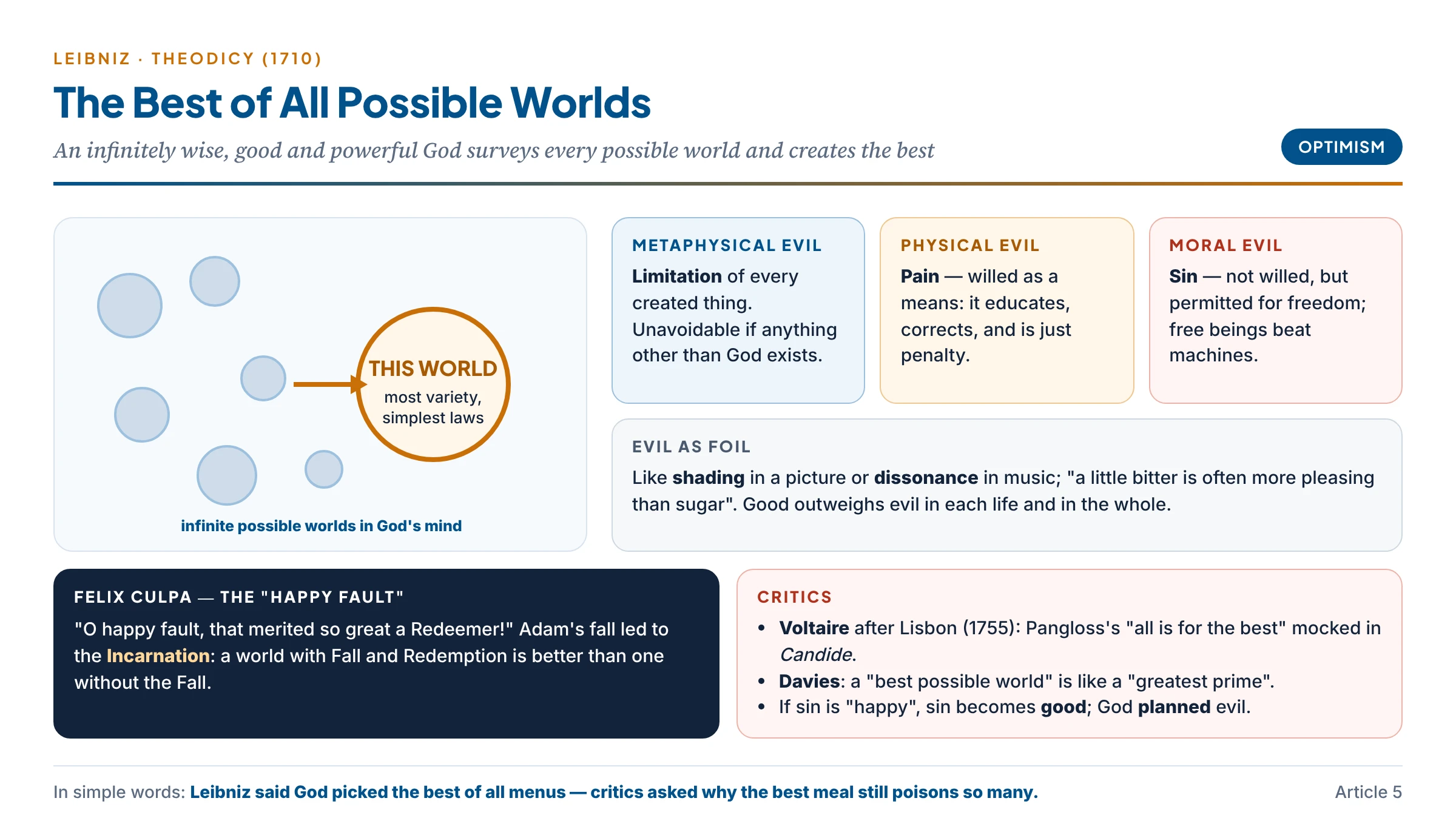
- By the principle of sufficient reason, God must have a reason for creating this world rather than another.
- God’s understanding contains infinitely many possible worlds.
- An infinitely wise God knows which is best; an infinitely good God wills the best; an infinitely powerful God can create it.
- Therefore the actual world is the best of all possible worlds — the one with the greatest variety and richness produced by the simplest laws.
- Moral, not blind, necessity: God was not forced to choose the best (as in Spinoza’s necessity); he chose it freely, by a moral necessity of his goodness.
- Antecedent and consequent will: God’s antecedent will desires the good of each creature; his consequent will, considering everything together, wills the best whole — which includes some evils.
- Three kinds of evil:
- Metaphysical evil — the mere limitation of every created being. Every monad is finite in body and mind; only God is unlimited. This evil is unavoidable if anything other than God is to exist.
- Physical evil (pain, suffering) — God wills it not for itself but as a means: physical pain educates and corrects, and serves as the just penalty of sin.
- Moral evil (sin) — God does not will it but permits it. He wanted a world peopled by free beings; freedom requires the possibility of wrong choice. God could have made beings who always did right, but they would have been machines — and machines, however good, are less perfect. “The road to perfection is through sin and suffering.“
- Evil as foil: evil, seen from the whole, enhances the good, as shading increases the beauty of a picture or a dissonance enriches music. “A little bitter is often more pleasing than sugar.” In the life of each individual, and in the universe as a whole, the sum of good outweighs the sum of evil.
Felix Culpa — the “Happy Fault”
- The phrase: in the ancient Easter hymn (the Exsultet) the Church sings “O happy fault, that merited so great a Redeemer!” Adam’s sin (the fault) led to the Incarnation and Redemption — a good so great that the world with Fall plus Redemption is better than a world with no Fall at all.
- Leibniz’s use: Leibniz quotes this line to show that God permitted evil to bring about a greater good; Adam’s fall raised humanity to a higher destiny than would otherwise have been possible.
- A modern revival: Alvin Plantinga later argued (in “Supralapsarianism, or O Felix Culpa”) that a world containing the Incarnation and Atonement is so immensely good that every world worthy of God contains sin and suffering to be redeemed.
- Evaluation:
- Strength: it captures a real moral truth — great goods (forgiveness, sacrifice, redemption) can arise only in response to evil; Augustine had said God judged it better to bring good out of evil than to permit no evil.
- Moral confusion: if sin is “happy” and necessary for the best world, sin becomes a good — and the sinner a benefactor. This seems to dissolve the seriousness of sin.
- God’s will implicated: if God planned the Fall as a means to Redemption, then God willed evil, not merely permitted it.
- Used persons: those who suffer from the Fall become means to a glory they may never share (especially on the Augustinian view of damnation).
- Confined to faith: the argument has force only within Christian belief in the Incarnation.
Voltaire, Lisbon and the End of Optimism
- The Lisbon earthquake of 1 November 1755 (All Saints’ Day) — followed by a tsunami and fire — destroyed one of Europe’s great cities and killed tens of thousands, many of them in churches at worship.
- Voltaire’s Poem on the Lisbon Disaster (1756) mocked the slogan “all is well“: would one say to the dying that their deaths were necessary for the best possible world? If it was divine retribution, did God select the least virtuous citizens?
- Candide (1759): the tutor Dr Pangloss keeps repeating that “all is for the best in the best of all possible worlds” while war, rape, shipwreck, earthquake and the Inquisition fall on him and his pupil. The novel ends with Candide’s practical advice: “We must cultivate our garden” — work and care, not metaphysical excuses.
- Rousseau’s reply (1756): nature did not build twenty thousand houses of six or seven storeys crowded together; much of the disaster was human — so do not blame God or nature for what our way of living made worse.
- Kant (1791) wrote an essay on the failure of all philosophical attempts at theodicy; he praised Job, who honestly admitted he did not understand God, over his friends who invented justifications.
- Schopenhauer turned Leibniz upside down: this is the worst possible world — if it were a little worse, it could not exist at all.
Other Criticisms of Leibniz
- “Best possible world” may be incoherent — Brian Davies (following C. J. F. Williams) argues that for any world God could create, there is a better one; talk of a “best possible world” is like talk of the “greatest prime number“. If so, God could not create the best — and is not to blame for not doing so.
- If several worlds are equally best, then God chose one among them, and the evils in this one could have been otherwise — so God remains responsible for them. Y. Masih argues that Leibniz could not escape Spinozism: either God’s choice is necessary (then no freedom) or it is arbitrary among equals (then the evils are not justified).
- Suggestive, not logical — that the good outweighs the evil “in each individual life” is asserted, not shown; the metaphor of shading in a painting cannot replace proof. “Pain does not become less painful by being told that it is necessary for the greater perfection of the universe.“
- Metaphysical evil is not evil — mere finitude is not suffering; calling limitation “evil” blurs the real problem (Article 1).
The Older View: Evil as Illusion or Partial View
- The Stoics: there is no evil in the whole; only a partial view sees evil. Natural evils challenge us to understand and conquer them; a shadow on the moon enhances the beauty of the full moon (Masih recalls Kālidāsa‘s image); moral excellence needs trials and temptations. Leibniz and the modern British idealists took up the first idea; Flew and Mackie discussed the second.
- Spinoza: good and evil are not positive things in nature but ways of thinking that arise when we compare things with our wishes; seen under the aspect of eternity, everything follows necessarily from God’s nature. Both the saint and the wicked serve God’s purpose — but the wicked perish in serving it.
- Christian Science (Mary Baker Eddy): “sin, disease, whatever seems real to material sense, is unreal“; all disharmony of mind or body is illusion.
- Some readings of Advaita: from the highest standpoint the world, with its evils, is appearance (Article 7).
- Objections:
- Grossly counter-intuitive — can anyone seriously hold that the hunger of a starving child is an illusion?
- Geach’s point: “If my mortal mind thinks I am miserable, then I am miserable, and it is not an illusion that I am miserable.” Even an illusory pain hurts — so evil is not nothing but illusion.
- Why create the illusion? If evil is an illusion, God created the illusion — and the illusion is itself an evil; one evil is merely substituted for another.
- Biblical realism: Hick rules the view out for Judaism and Christianity, whose scriptures treat evil as dark, menacing and crushing, never as unreal.
- Resignation, not answer: pantheistic solutions (Erigena, Spinoza) may teach resignation to the inevitable — a real wisdom — but they do not explain why the inevitable is so painful.
Common confusion
Is “evil is a privation” the same as “evil is an illusion”? No. Augustine’s privation theory says evil is a real lack — blindness really exists as a lack of sight (Article 3). The illusion theory says evil does not really exist at all; it only seems to. The first is defensible; the second is widely rejected because the experience of suffering is itself undeniable.
Critical Evaluation
Assessing the Soul-Making Theodicy
Strengths:
- Fits modern knowledge — no historical paradise, no Fall from perfection; humans emerged gradually from lower forms with limited moral awareness, as evolution shows.
- Explains natural evil better than Augustine — a world of dependable laws and real danger is needed for growth.
- Takes freedom seriously — goodness must be won, not installed; epistemic distance explains God’s hiddenness.
- Future-oriented and hopeful — it promises that evil will be redeemed, not merely punished.
Weaknesses:
- Excessive and crushing evil — the Holocaust, famines, torture and child abuse destroy persons rather than make them. Even if a soul-making world must allow some evil, must it allow this much?
- The moral objection — D. Z. Phillips: to plan a child’s dying of cancer for the sake of someone’s growth is “the deepest evil“.
- Is a paradise really worse? — Davies: courage needs danger, but love and doing good do not need agony; a paradise with people would arguably be better than our world. “A paradise would have no martyrs — but who wants martyrs?“
- Animal suffering — hundreds of millions of years of animal pain served no human soul-making; Hick himself leaves this aside.
- Persons as means — some suffer so that others may grow; the victim’s own life may receive no benefit.
- Universalism — if all will be saved anyway, do our choices in this life still matter? Christian critics also object that Hick drops the doctrines of the Fall and of final damnation.
- The heaven objection — if souls in heaven can be free and good without suffering, why not here?
Critics and Defenders
Criticism — Against soul-making and optimism
- Phillips and Ivan Karamazov: planned suffering of children cannot be justified by any future harmony.
- Davies: a paradise containing people would be better than our world.
- Voltaire: “all is for the best” is an insult to the dying of Lisbon.
- Schopenhauer: this is the worst possible world.
- Masih: pain is not less painful for being “necessary to the whole”.
- Animal suffering and crushing evils fit neither theodicy.
Defence — For soul-making and optimism
- Hick: goodness won freely is worth more than goodness installed; epistemic distance protects freedom.
- Counterfactual paradise: no laws, no science, no right or wrong — “the worst of all possible worlds” for growth.
- Keats and Vivekananda: the world as a vale of soul-making, a moral gymnasium.
- Leibniz: finite beings are necessarily limited; freedom requires the risk of sin; good outweighs evil in the whole.
- Felix culpa: redemption and forgiveness are goods that need evil to respond to.
Cross-Tradition Comparison
| Theme | Augustine | Irenaeus–Hick | Leibniz |
|---|---|---|---|
| Original state | Perfect; then the Fall | Immature, in God’s image | Finite creatures, chosen as the best set |
| Perfection lies | In the past (lost) | In the future (to be won) | In the whole (already chosen) |
| Moral evil | Inexplicable fall of free will | Expected failure of the immature | Permitted for freedom |
| Natural evil | Punishment for sin | Necessary environment for growth | Physical evil as a means to good |
| Final state | Heaven and eternal hell | Universal salvation | Best world; good outweighs evil |
| Indian echo | Karma as just penalty | Vivekananda’s moral gymnasium; Aurobindo’s evolution | Līlā; the whole as divine play |
Indian Connect — Indian Connect — rebirth as a longer school
- The Indian doctrine of rebirth gives soul-making more time: one life is too short to grow from selfishness to sainthood, but many lives are not. The soul learns, fails and grows across births until liberation.
- This answers Hick’s own worry that soul-making is incomplete at death — but it inherits the problems of the karma theory (Article 7).
Synthesis (Siddhānta)
- Irenaeus and Hick replace the backward-looking Fall with a forward-looking growth: humans are created in the image of God and grow toward his likeness through free responses in a world of real difficulty; epistemic distance protects their freedom; a hedonistic paradise would make science, ethics and virtue impossible; the process needs life after death and, for Hick, universal salvation.
- Suffering can serve self-transcendence — shattering complacency, awakening enquiry, loosening attachment, deepening compassion and revealing meaning — but it can also crush; it is an occasion, not a guarantee.
- Leibniz argued from God’s wisdom, goodness and power that this is the best possible world; he distinguished metaphysical, physical and moral evil, and saw even Adam’s fall as a felix culpa leading to Redemption. Voltaire’s Candide, the Lisbon earthquake and Kant’s essay ended easy optimism; the idea of a “best possible world” may even be incoherent.
- Calling evil an illusion (Stoics, Christian Science, some pantheism) fails before the undeniable experience of suffering.
- Overall: soul-making is the most influential modern theodicy — realistic, evolution-friendly and hopeful — but it does not explain the amount, distribution and animal dimensions of suffering; Leibniz’s optimism survives mainly as the insight that a world of free and finite beings cannot be free of evil.
- Contemporary relevance: in disaster and illness, many people find growth and meaning (post-traumatic growth in psychology echoes soul-making), yet the same theories, used carelessly, can blame victims or excuse inaction; the soul-making idea is best applied to oneself, not imposed on others’ suffering.
“Call the world if you please ‘the vale of Soul-making’… Do you not see how necessary a World of Pains and troubles is to school an Intelligence and make it a soul?” — John Keats
Previous Year Questions
- 2012“God permitted suffering to discipline the human being.”
- 2009If evil and sufferings are the real experiences of individual self, what role do they play in realising self-transcendence?
- 2007“God permitted evil to exist in order to bring about greater good, Adam’s fall was felix culpa (happy sin).” — Leibnitz. Critical notes.