

Problem of Evil.
Official Syllabus: Paper II, Section B, Unit 3
The problem of evil asks a simple, painful question: if God is all-powerful, all-knowing and perfectly good, why is there so much suffering and wickedness in the world? It is the oldest and strongest objection to belief in God, and every theist — Christian, Muslim, Jewish or Hindu — has had to answer it. This article explains what “evil” means, its kinds, the classic dilemma from Epicurus and Hume, why the problem is sharpest for some ideas of God and absent for others, what a non-theological concept of evil looks like, how evil and the profane relate to the foundations of religion, and whether evil is “a bitter pill which no theist can swallow“.
In simple words
A mother can see her child is about to touch a hot stove. If she could stop him and cares about him, she stops him. If the child gets burnt, we conclude that either she could not reach him or she did not care. Now imagine a mother who is everywhere, knows everything, can do anything and loves perfectly — and yet children are burnt every day. That puzzle is the problem of evil.
Context & Problem
What Is “Evil”?
- Evil, in philosophy of religion, is a wide word: it covers everything that is bad in the world — not only wicked people but also pain, disease, disaster and death.
- Two ways of defining it:
- Theological definition — evil is “what is contrary to God’s will“, sin, rebellion against God, or the work of Satan. This definition already assumes God.
- Ostensive definition (defining by pointing to examples) — John Hick prefers this: evil is simply physical pain, mental suffering and moral wickedness. Wickedness is one cause of the other two, since much human pain comes from “man’s inhumanity to man”.
- In simple terms, evil is suffering or sorrow together with the wrong-doing that causes much of it.
- Two sides of one fact: there is the evil people do (wickedness) and the evil people suffer (pain). Augustine named them evil of fault and evil of penalty (Article 3).
Kinds of Evil
- Moral evil — suffering caused by the free choices of moral agents: murder, theft, cruelty, war, oppression, greed, revenge, deceit. It is within human control — we could have chosen otherwise.
- Natural (physical) evil — suffering that comes from nature itself, not from any human choice: earthquakes, tsunamis, floods, drought, cancer in children, parasites, genetic disease, blindness from birth. It is beyond human control.
- Metaphysical evil — Leibniz’s third kind: the bare limitation or imperfection of any created thing. A creature is not God, so it must be finite — limited in knowledge, power and life (Article 5).
- Animal suffering — pain felt by animals for hundreds of millions of years before human beings existed: the lion eating the deer, the parasite eating its host from within. Darwin wrote that he could not believe a beneficent God would design wasps that feed inside the living bodies of caterpillars. Tennyson called it “nature, red in tooth and claw“.
- Horrendous evils — evils so terrible (torture, the murder of a child before its parents) that they seem to destroy the meaning of the victim’s whole life. Such evils test any theodicy most severely.
- Moral and natural evil are mixed in life: a famine may start with drought (natural) but kill because of hoarding, war and bad policy (moral); disease is made worse by poverty and neglect.
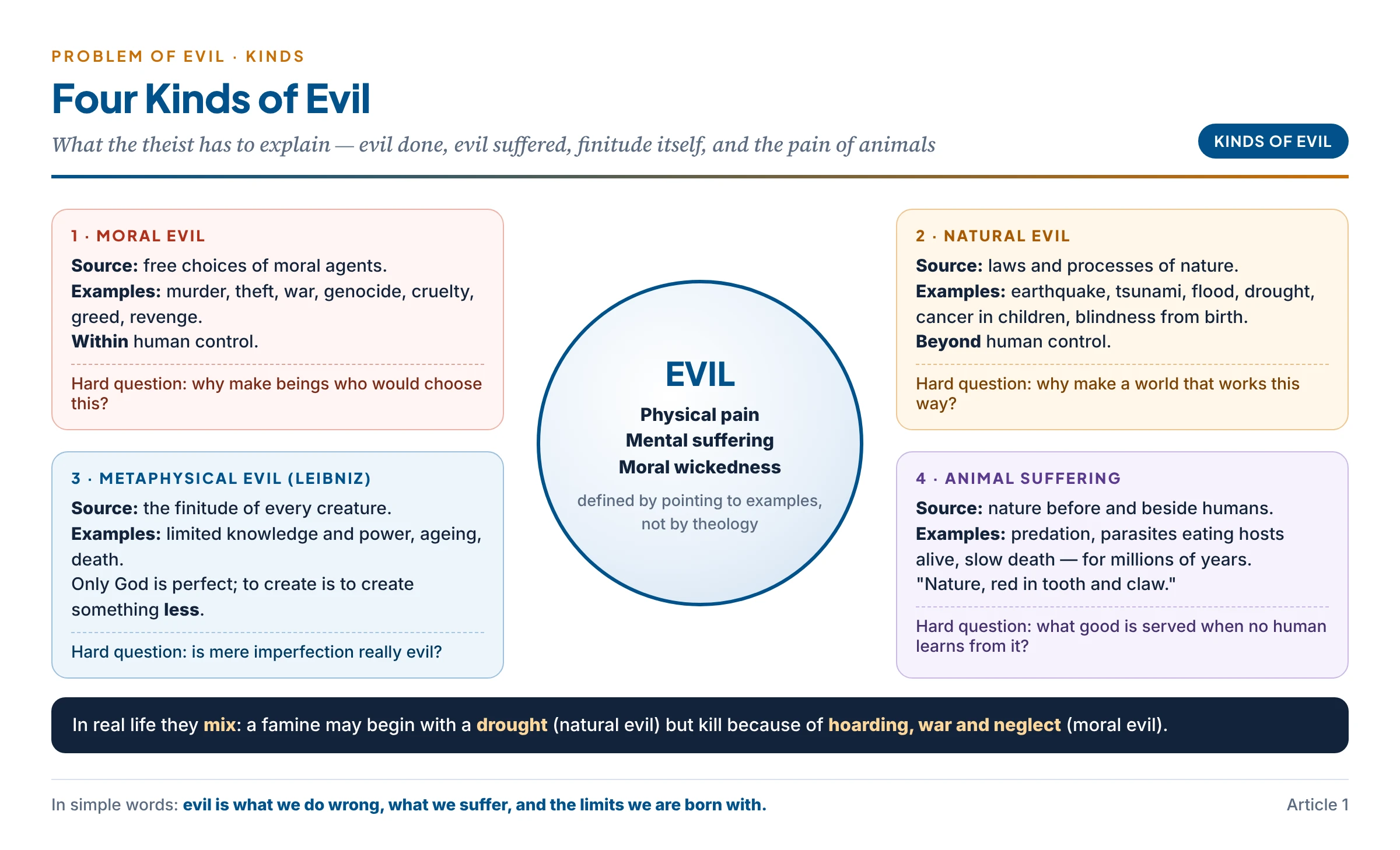
| Kind | Source | Examples | Hardest question for the theist |
|---|---|---|---|
| Moral | Free choices of agents | Murder, war, genocide, cruelty | Why did God make beings who would choose this? |
| Natural | Laws and processes of nature | Earthquake, cancer, famine, plague | Why did God make a world that works this way? |
| Metaphysical | Finitude of creatures | Limited knowledge, ageing, death | Why create finite beings at all? |
| Animal | Nature before and beside humans | Predation, parasites, slow death | What good does this serve when no human learns from it? |
Why Is It a “Problem”?
- Evil as such is not a problem of logic — everyone suffers. It becomes a philosophical problem only for a person who believes in a God who is:
- Omnipotent — able to do anything that can be done;
- Omniscient — knowing everything, including every evil before it happens;
- Omnibenevolent — wholly good, wishing the good of every creature.
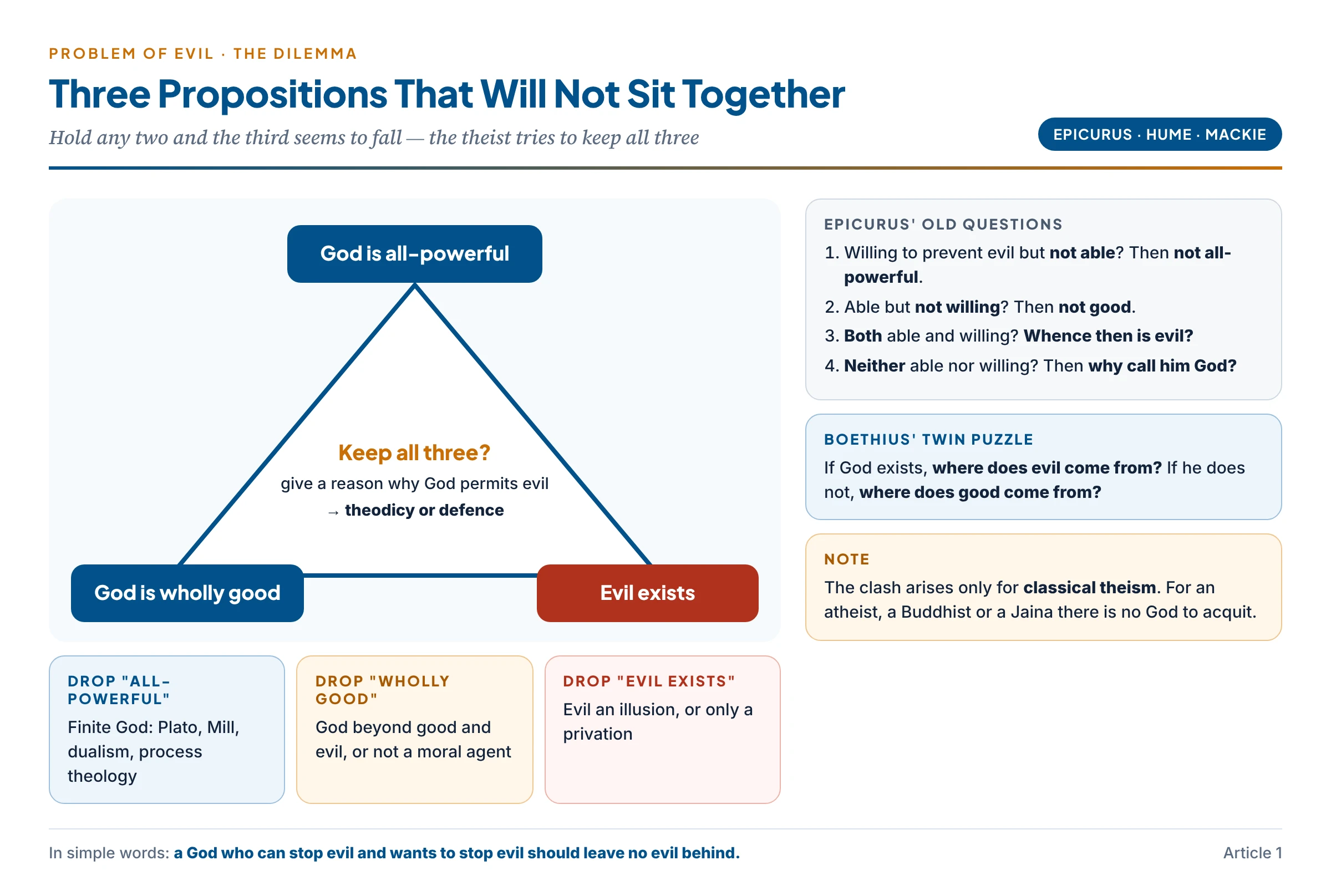
- The theist’s three propositions (classical theism):
- God is omnipotent.
- God is wholly good.
- Evil exists — both moral and natural.
- The tension: it seems that any two can be true only if the third is false. If God is omnipotent and wholly good, evil should not exist; if evil exists and God is good, God seems not to be omnipotent; if evil exists and God is omnipotent, God seems not to be good. J. L. Mackie later called this an inconsistent triad (Article 2).
- A further question: even if God is not to blame for evil, why does he permit it? Theists hold that God does not will evil but permits it — so they must say what good the permission serves.
The Classic Dilemma — Epicurus, Lactantius and Hume
- The best-known form is attributed to the Greek philosopher Epicurus; it survives through the Christian writer Lactantius, and David Hume made it famous in his Dialogues Concerning Natural Religion, where the sceptic Philo says that “Epicurus’s old questions are yet unanswered“:
- Is he willing to prevent evil, but not able? Then he is impotent (not omnipotent).
- Is he able, but not willing? Then he is malevolent (not good).
- Is he both able and willing? Whence then is evil?
- Is he neither able nor willing? Then why call him God? (the fourth line, found in Lactantius’s fuller list, is often added).
- Boethius, writing in prison in the sixth century, put the twin puzzle sharply: “If God exists, where does evil come from? And where does good come from, if he does not?” — evil is a problem for the believer, but good is a problem for the atheist.
- The heart of the matter: compromising any one perfect attribute of God feels to the believer like conceding defeat to the atheist. So theists try to keep all three propositions and show how they fit together. Such attempts are called theodicies.
Core Doctrine
Theodicy and Defence
- Theodicy — a word coined by Leibniz in 1710 from Greek theos (God) and dikē (justice): an attempt to “justify the ways of God to men” (Milton’s phrase in Paradise Lost) by giving God’s actual reasons for permitting evil.
- Defence — a more modest task, made famous by Alvin Plantinga: to show only that God and evil are not logically inconsistent, by offering a possible reason, without claiming to know God’s real reason (Article 2).
- The main families of answers (each has its own article):
- Evil as privation and the Fall — Augustine and Aquinas (Article 3).
- Free will — moral evil is the price of genuine freedom (Articles 2 and 4).
- Evil as a means to good (the instrumentalist view) — warning, discipline, contrast, growth of virtue (Article 4).
- Soul-making — Irenaeus and John Hick: the world is a school, not a paradise (Article 5).
- Best possible world — Leibniz: this world, with its evils, is the best God could create (Article 5).
- Limiting God — process theology and the finite God (Article 6).
- Faith and mystery — evil cannot be explained by reason, only lived through in trust (Article 6).
- Karma and rebirth — the Indian answer (Article 7).
- Hick’s summary: the three main Christian responses are the Augustinian (the Fall from original righteousness), the Irenaean (gradual creation of a perfected humanity in an imperfect world) and the process response (a God who is not all-powerful). Common to all three is some form of the free-will defence for moral evil.
In simple words
A theodicy is like a lawyer’s full defence in court: “My client did not do it, and here is what actually happened.” A defence in Plantinga’s sense is like saying only: “The prosecution has not proved its case — there is at least one possible innocent explanation.” The second is easier to win, and it is all that is needed against a charge of contradiction.
Ways Out of the Dilemma
Since the three propositions clash only if all are held, there are four broad ways out:
- 1. Deny God’s omnipotence — God is good but limited: limited by eternal matter (Plato’s Demiurge), by an evil rival (Zoroastrian dualism), by the freedom of the world (process theology), or by his own nature (J. S. Mill, E. S. Brightman). The problem disappears, but so does the God of classical worship (Article 6).
- 2. Deny God’s goodness — or say his goodness is not moral goodness — God is “beyond good and evil” (some pantheisms), or God is not a moral agent with duties at all, so he cannot be blamed like a negligent parent (Brian Davies). Most believers resist this: a God who is not good cannot be loved or worshipped (Article 6).
- 3. Deny the reality of evil — evil is an illusion (Christian Science; some readings of Advaita) or a mere privation, not a positive thing (Augustine). The reply: even an illusory pain hurts, so the illusion itself is evil (Articles 3 and 5).
- 4. Keep all three and give a reason — God permits evil for the sake of a greater good that could not exist without it: free will, soul-making, a lawful world, the best possible whole. This is the main road of Western theodicy (Articles 2–5).
Common confusion
Is the problem of evil a problem only for those who believe in God? Yes — as a logical problem. Mackie himself noted that the problem “signally does not arise” for world-views markedly different from traditional theism. An atheist, a Buddhist or a Jaina has no God to acquit. But everyone still faces the existential problem of suffering — how to live with it and find meaning in it. And the atheist faces the reverse puzzle Boethius named: where does good come from, and why do we judge the world’s cruelty to be unjust at all?
“An Offshoot of How God Is Conceptualised” — the Problem Changes with the Idea of God
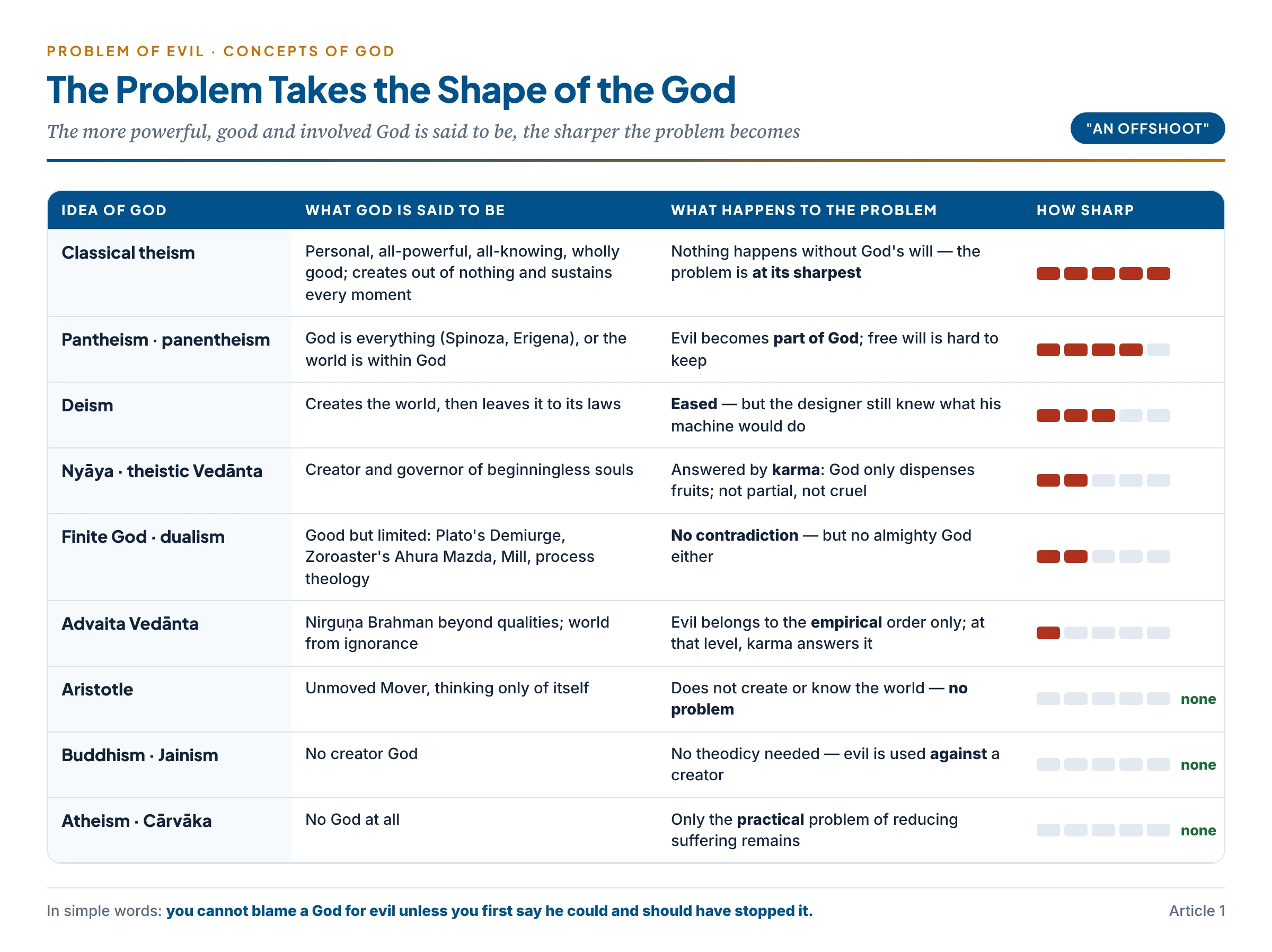
- The more perfect and the more involved God is said to be, the sharper the problem. The problem of evil is not one fixed puzzle; it takes its shape from the concept of God held in a system.
- Classical theism (Judaism, Christianity, Islam; also theistic Vedānta and Nyāya in part): God is personal, omnipotent, omniscient, wholly good, creator out of nothing, and sustainer of every moment. Here the problem is most acute: nothing exists or happens without God’s creative will.
- Deism: God creates the world and then leaves it to run by its laws like a clockmaker. The problem is eased (God does not interfere), but not solved — God designed the machine knowing what it would do; and deism cannot even say why God created a world full of pain.
- Pantheism (God is everything — Spinoza; the Neoplatonic emanation of Erigena): if all is God, then evil too is part of God. Erigena tried to call evil a mere privation, but that only renames it. Pantheism thus cannot keep God perfect while admitting evil, and it also leaves little room for free will.
- Panentheism (the world is in God, but God is more than the world): God inherits the evils of the world that is part of him; human freedom becomes hard to explain since God is the ultimate controller. Its defenders fall back on faith.
- Dualism: two ultimate powers — Ahura Mazda (good, Truth) and Angra Mainyu/Ahriman (evil, the Lie) in Zoroastrianism; light and darkness in Manichaeism. Evil has its own source, so the good God is not responsible — but he is not omnipotent either, and the world becomes a battlefield.
- Plato: God is good and “not the author of evil“; evil comes from the disorderly nature of matter and the body and from man’s surrender to momentary pleasures. Because Plato’s God is not an absolute creator, the problem is mild.
- Aristotle: the Unmoved Mover thinks only of itself and does not even know the world; it is not a creator or a provider, so no problem of evil arises.
- Finite God (Mill, Brightman, process theology): God is good but limited, struggling against an intractable world. No contradiction — but no guaranteed victory either.
- Advaita Vedānta: the ultimate reality (nirguṇa Brahman) is beyond qualities and does not really create; the world and its evils belong to the empirical order (vyāvahārika) produced by ignorance (avidyā, māyā). The problem arises only at the level of Īśvara, where it is answered by karma (Article 7).
- Nyāya and theistic Vedānta: God creates and governs, but according to the karma of beginningless souls; he is the dispenser, not the author, of their joys and sorrows (Article 7).
- Buddhism and Jainism: no creator God, so no theodicy is needed; indeed the fact of evil is one of their chief arguments against a creator (Article 7).
- Naturalism and materialism (Cārvāka, modern atheism): no God, so no problem of evil — suffering is just a natural fact to be reduced.
In simple words
Think of a factory fire. If one owner built the factory, runs every machine and knows every fault, the blame falls fully on him — that is classical theism. If he built it and left long ago, the blame is lighter — deism. If two rival owners share it and one is a saboteur, the good owner is not to blame but is not in full control — dualism. If each worker’s injury is decided by his own past conduct and the owner only applies the rules — that is karma. And if there is no owner at all, there is a fire to fight but no one to accuse — atheism.
Indian Connect — Indian Connect — why India had a milder problem
- Most Indian systems hold that souls and their karma are beginningless (anādi), so God is never the first cause of anyone’s suffering; he only arranges fruits according to past deeds.
- The Brahmasūtra itself raises the charge that a creator would be guilty of partiality (vaiṣamya) and cruelty (nairghṛṇya) — and answers it with karma and the rain analogy (Article 7).
- So in India the problem shows up mainly as a debate between schools (Mīmāṃsā, Buddhists and Jainas attacking the Naiyāyikas and Vedāntins) rather than as a crisis of faith.
Evil and the Argument from Design
- The problem of evil is also a weapon against the teleological (design) argument:
- Kant: the design argument looks only at order, selection and gradation, and ignores the disharmony, chaos and physical, mental and moral evil in nature.
- Hume: from a world like ours we could as well infer that it is the crude first attempt of an infant deity, or the work of a superannuated (senile) deity, or of a committee of gods. Philo lists four circumstances that cause most suffering, none of which seems necessary: pain used as a motive (pleasure could do the job), general laws that cannot bend for individuals, the frugality with which creatures are given powers, and the inaccurate workmanship of nature’s machine.
- J. S. Mill, J. Laird, Mackie and H. J. McCloskey pressed the same objection: the world’s unaccountable evil counts against a good designer.
- Darwin removed the need for a designer altogether, and his theory of natural selection makes suffering an engine of evolution — which raises the question why a good God would choose such a method.
Non-theological Concepts of Evil
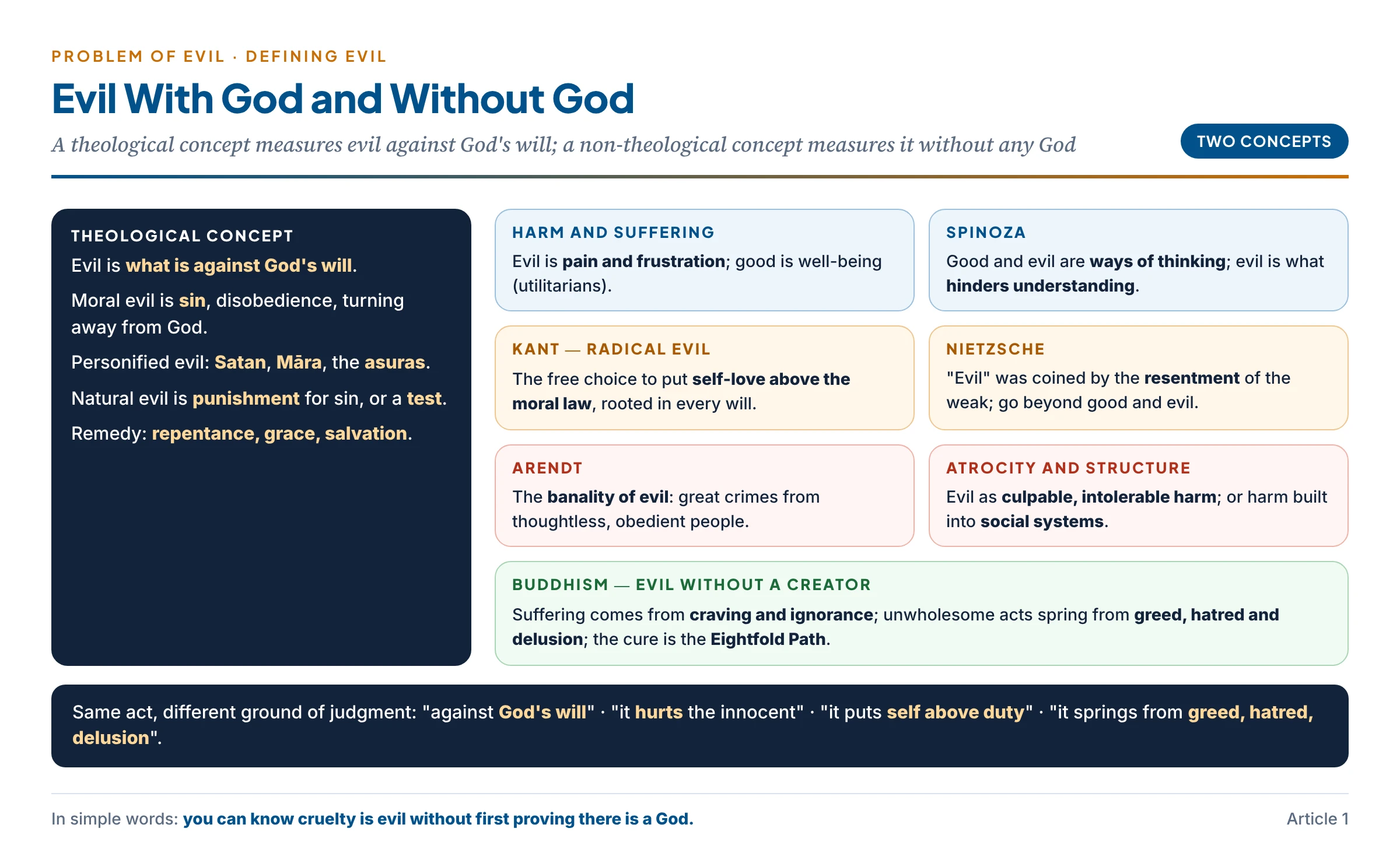
A theological concept defines evil by its relation to God — sin, disobedience, Satan. A non-theological concept defines evil without any reference to God. Several are important:
- Evil as harm and suffering — evil is simply pain, distress, frustration of desire; good is pleasure and well-being (the hedonistic view of Bentham and the utilitarians).
- Evil as relative to us — Spinoza: “good” and “evil” are not qualities in things but ways of thinking that arise when we compare things with our needs; “we know nothing to be good save what helps, and nothing to be evil save what hinders, understanding“. Nature in itself is neither good nor evil.
- Evil as a corruption of the will — Kant’s “radical evil”: every human being has a propensity to put self-love above the moral law when they conflict. Evil is not in our desires or our body but in the free choice to make the moral law second. It is “radical” because it lies at the root of our will — yet we are responsible for it and can overcome it.
- Nietzsche — “beyond good and evil”: the pair good/evil was invented by the “slave morality” of the weak, who called the strong “evil” out of resentment; the older noble pair was good/bad (excellent/inferior). Evil is thus a historical, psychological category, not a cosmic fact.
- Hannah Arendt — the “banality of evil”: watching the trial of Adolf Eichmann (1961), she found not a monster but a thoughtless bureaucrat who did terrible things by not thinking about what he was doing. Great evil can come from ordinary people and ordinary obedience.
- Evil as atrocity: modern secular philosophers (e.g. Claudia Card) define evils as foreseeable, intolerable harms produced by culpable wrongdoing — so evil needs a wrongdoer; an earthquake is bad, not evil.
- Structural evil: suffering built into social systems — poverty, caste, racism — with no single villain (the “structural violence” of Johan Galtung).
- Buddhism — evil without God: suffering (dukkha) arises from craving (taṇhā) and ignorance (avidyā); unwholesome action springs from the three roots — greed (lobha), hatred (dosa) and delusion (moha). Evil is explained psychologically and causally, and overcome by the Eightfold Path, not by appeal to a creator.
- Lisbon to Auschwitz: after the Lisbon earthquake (1755), evil was felt as a problem about God and nature; after Auschwitz, it became a problem about human beings — how ordinary people could do such things. The modern problem of evil is a problem about whether the world is intelligible at all.
In simple words
Ask “what makes this act evil?” A theologian answers: “It is against God’s will.” A non-theological thinker answers: “It hurts someone who did not deserve it” (utilitarian), or “It puts self-love above duty” (Kant), or “It comes from greed, hatred and delusion” (Buddhism). The act is the same; only the ground of the judgment changes.
Common confusion
Are earthquakes and cancer really “evil”? In theology both are called natural evil, because they are bad things in God’s creation. Many secular thinkers reserve “evil” for culpable wrongdoing and call natural disasters merely bad or harmful. For the problem of evil the label does not matter: the question is why a good and all-powerful creator permits any undeserved suffering, whether caused by a person or by a fault line.
Evil and the Profane: Do They Give Religion Its Foundation?
- Sacred and profane — Émile Durkheim defined religion through the sacred (things set apart and forbidden) and the profane (ordinary, everyday things). Mircea Eliade described religious life as a constant passage from the profane to the sacred.
- The profane is not the same as evil. The profane is simply the ordinary. Durkheim noted that the sacred itself has two poles — the pure sacred (gods, blessings) and the impure sacred (evil powers, pollution, death). So evil is a kind of sacred power to be feared and kept away, while the profane is neutral.
- How evil founds religion:
- Religion as response to suffering — the Buddha’s teaching begins with dukkha; Sāṃkhya begins with the threefold suffering (from oneself, from other beings, from natural and supernatural forces); Christianity begins with sin and redemption. Without evil there would be nothing to be saved from.
- Symbols of evil — Paul Ricoeur traced three layers: defilement (evil as a stain, needing purification — ritual baths, prāyaścitta), sin (evil as a broken relation with God, needing repentance), and guilt (evil as personal responsibility, needing conscience). Rituals of purification, sacrifice, confession and penance grow from these.
- Boundary-making — the profane must be kept away from the sacred (temples, fasting, purity rules); the line between them gives religion its structure of time, space and conduct.
- Theodicy as social glue — Max Weber and Peter Berger argued that every religion must explain why the good suffer and the wicked prosper; this explanation (theodicy) gives meaning to suffering and holds the social order together — the “sacred canopy“.
- Moral seriousness — the idea of Satan, Māra or the asuras gives moral struggle a cosmic drama; the Gītā’s promise that God comes “to destroy the wicked and establish dharma” makes ethics part of the divine plan.
- But evil also threatens religion: the same evil that calls people to God drives others away from him — the problem of evil is the most common reason given for atheism. And religions that lean on fear of the impure can become superstitious or exclusionary (untouchability was defended as protecting “purity”).
- Balanced view: evil and the profane give religion a foundation only when religion transforms them — turning fear into compassion, purity rules into inner purity, and suffering into growth; when it merely fears them, the foundation becomes a prison.
Indian Connect — Indian Connect — the threefold suffering
- Sāṃkhya opens with the claim that life is struck by threefold suffering — ādhyātmika (from body and mind), ādhibhautika (from other beings) and ādhidaivika (from natural and supernatural forces) — and that philosophy exists to end it.
- The Buddha’s First Noble Truth (dukkha) and the Upaniṣadic prayer “lead me from darkness to light, from death to immortality” show the same pattern: in India, suffering is the starting point of religion and philosophy, not an embarrassment to them.
Critical Evaluation
Is Evil “a Bitter Pill which No Theist Can Swallow”?
Why it seems so:
- Scale and intensity — wars, genocides, famines, pandemics, and the daily suffering of millions are too great to be explained as minor costs of a greater good.
- Innocent suffering — children born with painful diseases, victims of abuse; they have done nothing to deserve it and gain nothing from it.
- Animal suffering — hundreds of millions of years of pain before any human could learn from it.
- Distribution — happiness and misery seem to depend on the accident of birth, the faults of parents, society and circumstance, not on virtue.
- Every theodicy has a hole — privation, free will, soul-making, best possible world, karma: each meets a serious objection (Articles 2–7).
- Hick’s own admission: no intellectual justification can assuage the actual pains and sorrows of the human heart.
Why the theist can swallow it after all:
- The logical form has been answered — after Plantinga’s free-will defence even Mackie conceded that evil does not show theism to be logically inconsistent (Article 2).
- The evidential form is not decisive — if there are good independent reasons to believe in God (proofs, religious experience), they can outweigh the evidence from evil (the “reasonableness of belief” reply).
- Our limited view — finite minds cannot expect to see the reasons of an infinite God; what looks pointless to us may not be pointless (sceptical theism, Article 2). Some theists add that the problem arises only because we apply finite logic to the infinite.
- Evil presupposes good — to call the world cruel and unjust one needs a standard of justice; C. S. Lewis noted that his own argument against God from cruelty forced him to ask where his idea of “just” came from.
- Living answers — believers meet evil not with an argument but with trust, compassion and action; for them evil is less a refutation than a trial of faith (Job; Article 6).
- Verdict: evil is bitter for every theist — it never stops counting against belief — but it is not unswallowable: it forces theism to refine its idea of God (power, goodness, freedom, purpose) rather than to abandon it.
Is Evil Reconcilable with a Benevolent God?
- Benevolence means wishing the good of every creature. Reconciliation is possible only if God’s good will can be shown to include the permission of evil:
- If evil is the unavoidable side-effect of a greater good (freedom, growth, a lawful world);
- If every evil is finally defeated — made part of a good life for the sufferer, not merely outweighed by others’ gains;
- If God shares the suffering rather than watching it from outside (the “suffering God”, Article 6).
- Objections: a benevolent being prevents evil when it can; using one person’s pain for another’s growth treats that person as a mere means; the sheer amount of evil seems more than any good requires.
- Middle position: reconciliation is logically possible and reasonably arguable, but never demonstrated; it rests in the end on faith in a final good (eschatology) or on karma (Article 7).
The Imperfect World and the Goodness of God
- The problem is often stated as “reconciling the imperfect world with the goodness of God“. This needs care:
- Imperfection is not yet evil. Any created world must be finite — limited in being, knowledge and power (Leibniz’s metaphysical evil). Only God is perfect; to create at all is to create something less than God. So finitude cannot count against God’s goodness.
- The real problem is suffering and sin, not finitude. A finite world could have been finite and happy. The question is why the world contains pain, cruelty and waste beyond what finitude requires.
- Degrees of goodness: Augustine and Aquinas answer that a world with many grades of being (stones, plants, animals, humans, angels) is better than a world of one kind; lower grades will suffer loss (Article 3). Critics reply that grades of being do not need agony.
- Hume’s point stands: an imperfect world is consistent with a perfect God only if we already know God exists; it cannot by itself prove such a God.
Critics and Defenders
Criticism — Critics: evil counts against God
- Epicurus–Hume: God is either unable, or unwilling, or not God — “whence then is evil?”
- Mackie: the theist’s beliefs are positively irrational — an inconsistent set.
- Hume: the world suggests an indifferent first cause, “neither goodness nor malice”.
- Mill: nature does daily what we hang men for doing to one another.
- Rowe: pointless suffering like a burning fawn makes God improbable.
- Ivan Karamazov (Dostoevsky): no future harmony is worth a single tortured child.
- Buddhist and Jaina critics: a creator who made this world would be unjust.
Defence — Defenders: evil can be reconciled
- Augustine and Aquinas: evil is a privation, permitted for a greater good; God brings good even out of evil.
- Plantinga: free creatures are worth the risk of evil; no contradiction.
- Hick: the world is a vale of soul-making, not a paradise.
- Leibniz: this is the best possible world.
- Process theologians: God is persuasive, not coercive, and suffers with us.
- Nyāya and Vedānta: God dispenses fruits according to karma; he is neither partial nor cruel.
- Believers in faith: the reasons of an infinite God may lie beyond our sight.
Cross-Tradition Comparison
| Tradition | Main source of evil | Is God responsible? | Way out of evil |
|---|---|---|---|
| Judaism, Christianity, Islam | Free choice of creatures (sin), the Fall, Satan | No — God permits, does not will | Repentance, grace, final judgment |
| Zoroastrianism, Manichaeism | A rival evil principle | No — but God is not almighty | Siding with the good in the cosmic battle |
| Greek (Plato) | Disorderly matter, the body, ignorance | No — God is not the author of evil | Reason and contemplation of the Good |
| Advaita Vedānta | Ignorance (avidyā) and karma | Not at the ultimate level | Knowledge of Brahman (jñāna) |
| Nyāya, theistic Vedānta | Karma of beginningless souls | No — God only dispenses fruits | Right action, devotion, knowledge |
| Buddhism | Craving and ignorance | No creator God at all | Eightfold Path, nirvāṇa |
| Jainism | Karmic matter clinging to the soul | No creator God at all | Three jewels, stopping and shedding karma |
Indian Connect — Indian Connect — the same question, a different frame
- In the West the question is: “Why does God allow evil?” In most of India it is: “Why do I suffer, and how can I be free from suffering?“
- The first looks back to God’s reasons; the second looks forward to liberation (mokṣa, nirvāṇa, kaivalya). That shift in the question explains why karma, not theodicy, became the centre of Indian thought on evil.
Synthesis (Siddhānta)
- Evil covers moral evil (wickedness and its harms), natural evil (suffering from nature), metaphysical evil (finitude) and animal suffering; Hick’s ostensive definition — pain, suffering and wickedness — avoids building theology into the definition.
- The problem of evil arises when omnipotence, omniscience and perfect goodness are ascribed to a creator while evil exists: the Epicurus–Hume dilemma and Mackie’s inconsistent triad state it sharply.
- The problem is an offshoot of the concept of God: sharpest in classical theism, softened in deism, dualism and finite theism, swallowed into God in pantheism, absent in naturalism, Buddhism and Jainism, and answered by karma in Nyāya and Vedānta.
- Non-theological concepts — Spinoza’s relativity, Kant’s radical evil, Nietzsche’s genealogy, Arendt’s banality, the Buddhist roots of evil — show that evil can be understood without God, though the problem of suffering remains for everyone.
- Evil and the profane help found religion by giving it something to overcome; religion stays healthy when it transforms evil into compassion and growth.
- Evil is a bitter pill for the theist, but not an unswallowable one: it compels theism to rethink power, goodness and purpose — and the following articles examine each answer in turn.
- Contemporary relevance: pandemics, climate disasters and mass atrocities keep the problem alive; the most serious modern responses combine an honest admission of mystery with practical compassion — fighting evil rather than only explaining it.
“Is he willing to prevent evil, but not able? then is he impotent. Is he able, but not willing? then is he malevolent. Is he both able and willing? whence then is evil?” — Hume, Dialogues Concerning Natural Religion
Previous Year Questions
- 2024“The problem of evil is a direct offshoot of how God is conceptualised in a system.” Critically discuss.
- 2019What role do the concepts of evil and profane play to provide a firm foundation to religion?
- 2017How do you define a non-theological concept of evil? Explain.
- 2016“If God is all-powerful, God must wish to abolish all evils; but moral and natural evils are rampant in the world.” How would a theist react to this?
- 2015Do you think that evil is a bitter pill which no theist can easily swallow? Discuss.
- 2014Is evil reconcilable with the benevolent God?
- 2008How can a theist resolve the problem of evil? Does evil not tell upon omnipotence and omniscience of God? Can God be thought of as imperfect and powerless in this regard? Discuss critically for and against the two possible opposite views and justify your own position.
- 2005“The problem of evil is the problem of reconciling the imperfect world with the goodness of God.” Critical notes.