

Problem of Evil.
Official Syllabus: Paper II, Section B, Unit 3
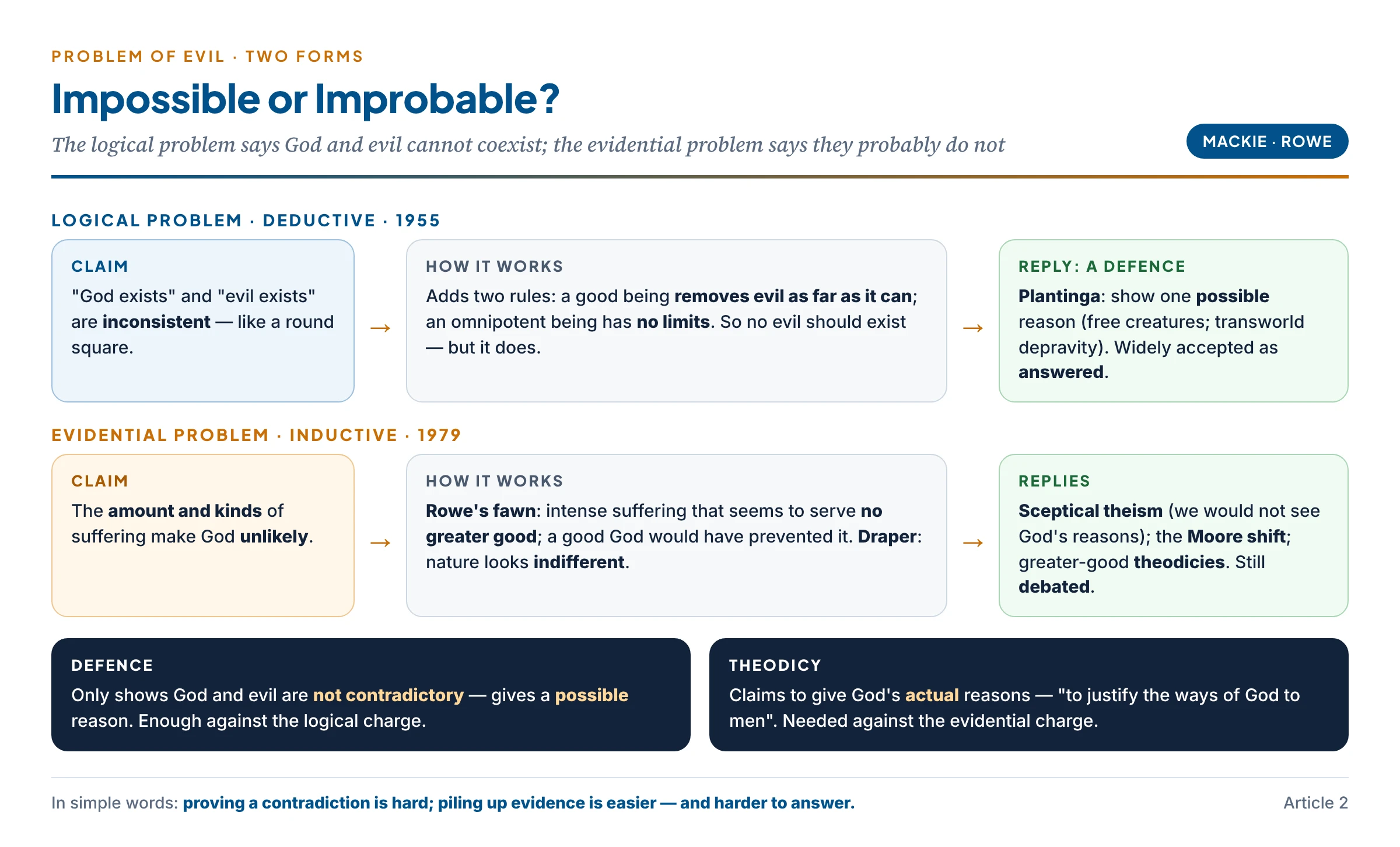
In the twentieth century the old problem of evil was sharpened into two precise arguments. The logical problem (J. L. Mackie, 1955) claims that God and evil are impossible together — belief in God is self-contradictory. The evidential problem (William Rowe, 1979) makes a weaker but more durable claim: given the amount and kinds of suffering we see, God’s existence is improbable. This article explains both, the paradox of omnipotence, Alvin Plantinga’s free-will defence (which most philosophers think answered the logical problem), Rowe’s fawn, the replies of sceptical theism, and the argument from innocent suffering.
In simple words
A detective can make two kinds of claim against a suspect. “He cannot be innocent — his alibi contradicts itself” is a logical charge: if it holds, the case is closed for ever. “All the evidence points to him” is an evidential charge: it can be strong, but new evidence might still clear him. Mackie brought the first kind of charge against God; Rowe brought the second.
Context & Problem
Two Forms of the Problem
- Logical (deductive, a priori) problem — tries to show that “God exists” and “evil exists” cannot both be true, just as “this square is round” cannot be true. If it succeeds, theism is not merely unproven but irrational.
- Evidential (inductive, a posteriori) problem — grants that God and some evil might coexist, but argues that the actual evils of our world — their quantity, intensity, distribution and apparent pointlessness — make God’s existence unlikely.
- Why the distinction matters: a theist needs very different answers. Against the logical charge it is enough to show one possible reason God might have (a defence). Against the evidential charge one must show that God’s existence is not improbable on the total evidence.
| Logical problem | Evidential problem | |
|---|---|---|
| Key thinker | J. L. Mackie, “Evil and Omnipotence” (1955) | William Rowe (1979); Paul Draper (1989) |
| Claim | God and evil are logically incompatible | Evil makes God’s existence improbable |
| Kind of reasoning | Deductive — certainty | Inductive — probability |
| Main theistic reply | Plantinga’s free-will defence | Sceptical theism; greater-good theodicies; the “Moore shift” |
| Present status | Widely thought answered | Still alive and debated |
Core Doctrine
Mackie’s Logical Problem
- Aim: Mackie wrote that the problem of evil shows “not that religious beliefs lack rational support, but that they are positively irrational” — several parts of theology are inconsistent with one another.
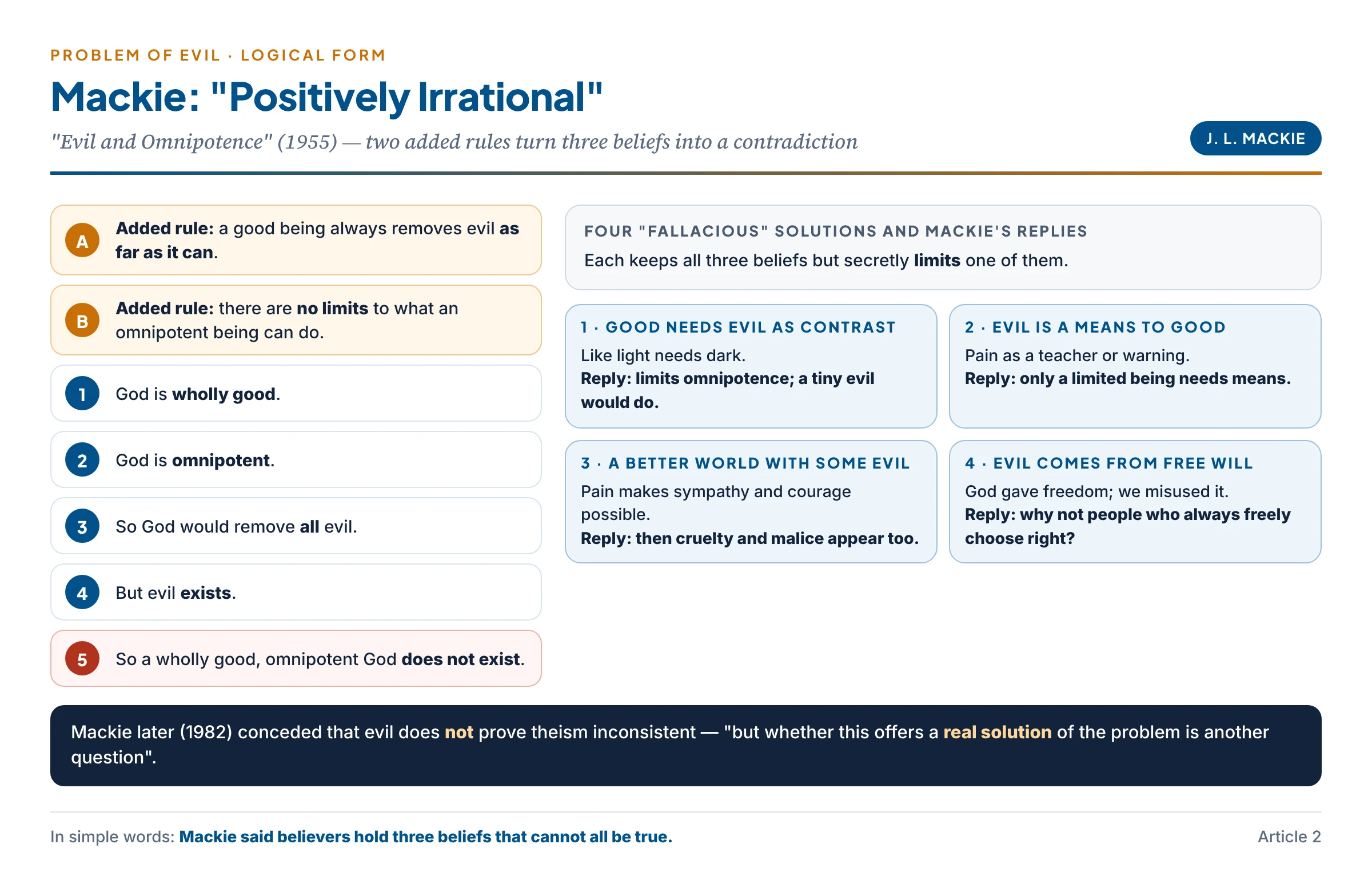
- The inconsistent triad: (1) God is omnipotent; (2) God is wholly good; (3) evil exists.
- No open contradiction yet: the three statements do not contradict each other on their face. Mackie adds two “quasi-logical rules” that he thinks every theist accepts:
- Good is opposed to evil in such a way that a good being always eliminates evil as far as it can.
- There are no limits to what an omnipotent being can do.
- The argument in five steps:
- A wholly good being eliminates evil as far as it can.
- An omnipotent being can do anything.
- So a wholly good, omnipotent God would eliminate all evil.
- But evil exists.
- Therefore a wholly good, omnipotent God does not exist.
- Adequate solutions: Mackie admits the problem disappears if the theist gives up one proposition — says God is not omnipotent, or not wholly good, or that evil is unreal. But these “adequate” solutions abandon traditional theism.
- “Fallacious” solutions: most theists try to keep all three while quietly limiting one of them. Mackie examines four:
- “Good cannot exist without evil” (evil as a necessary counterpart of good). Reply: this puts a limit on omnipotence — God cannot make good without evil. And at most a tiny amount of evil would be needed as contrast, not the vast amount we see.
- “Evil is necessary as a means to good.” Reply: only a limited being needs means; an omnipotent being could produce the good directly. Using means puts God under causal laws.
- “The universe is better with some evil in it.” Pain and misery (first-order evil) make possible second-order goods like sympathy, courage and benevolence. Reply: but then second-order evils also appear — malevolence, cruelty, callousness — and God could have produced the second-order goods without permitting the second-order evils. The argument also starts an endless ladder of higher goods and higher evils.
- “Evil is due to human free will.” Reply: if it is possible for a person to choose the good freely on one occasion, it is possible on every occasion; so God could have made people who always freely choose the right. His failure to do so counts against his goodness or power. This leads to the paradox of omnipotence.
In simple words
Mackie’s best point is this: suppose a teacher says, “I can’t make my students good without letting some of them cheat — freedom needs risk.” Mackie answers: “If one student can freely choose honesty on one test, why couldn’t God make students who freely choose honesty on every test?” Plantinga’s reply, below, is that this depends on what the students themselves would freely do — which even God cannot dictate without destroying their freedom.
The Paradox of Omnipotence
- The question: can an omnipotent being make things which it cannot afterwards control? Or — the same question — can it make rules which then bind itself?
- The trap:
- If yes — God can make free creatures he cannot control — then after making them there is something God cannot do (control them), so he is not omnipotent.
- If no — God cannot make such creatures — then there is already something he cannot do, so again he is not omnipotent.
- The popular form: “Can God create a stone so heavy that he cannot lift it?“
- Mackie’s distinction:
- First-order omnipotence — unlimited power to act.
- Second-order omnipotence — unlimited power to decide what powers other things shall have (for example, to give creatures a will independent of God).
- A being cannot have both at once; so God cannot be omnipotent in every sense. If God gives creatures independent free will (second-order power), he loses first-order control over them; if he keeps control, the creatures are not free — and moral evil is God’s own work.
- The paradox in the context of evil: the free-will defence says God cannot prevent moral evil without destroying freedom — but if God cannot, is he omnipotent? And if he can but does not, is he good?
Replies to the paradox:
- Omnipotence means power to do what is logically possible — Aquinas: God can do everything that does not involve a contradiction; a “stone too heavy for an all-powerful being to lift” is a self-contradictory description, not a real task, so failing to do it is no defect of power. C. S. Lewis: nonsense does not become sense when we put “God can” in front of it.
- Descartes’s opposite view: God’s power is so absolute that he created even the eternal truths of logic and mathematics and could have made them otherwise. This saves God’s power but makes it unintelligible — we can no longer say what God cannot do.
- Self-limitation: God’s choice to create beings he does not control is not a loss of power but an exercise of it — like a parent who lets a grown child make her own decisions. The limit is chosen, not imposed; God could withdraw it, but his love does not.
- Omnipotence at a time (Richard Swinburne): an omnipotent being can make a stone it cannot lift; it then simply ceases to be omnipotent. God never does so, so he remains omnipotent.
- For the free-will defence: making a creature that is free and also guaranteed never to sin is like making a round square — not a task at all. So the inability to do it does not count against omnipotence.
Common confusion
Does “omnipotent” mean that God can do absolutely anything, even the contradictory? No — not in classical theism. From Aquinas onwards, omnipotence has meant the power to do whatever is logically possible. “Make a free creature who is forced to choose freely” or “make a square circle” describe nothing at all, so God’s “inability” here is no limitation. Only Descartes held that God’s power extends even to the laws of logic — and most philosophers think that view makes talk about God meaningless.
The Free-Will Defence before Plantinga
- The strong form (as Hick states it): to be a person is to be a finite centre of freedom, free to act wrongly as well as rightly. So there can be no certainty in advance that a free agent will never go wrong; to say God should not have created beings who might sin is to say he should not have created persons at all.
- Mackie’s and Antony Flew’s objection: freedom only requires that actions are not externally compelled and flow from the agent’s own nature; God could have given people natures from which right actions always flow.
- The modified form (Hick): even if such beings could be called “free”, they would not be free in relation to God. They would be like patients carrying out post-hypnotic suggestions — they feel free, but their choices were fixed by the hypnotist. God wants sons and daughters, not puppets.
- God keeping his distance — the philosopher John Lucas put the self-limiting view simply: God knows how many hairs are on my head, but has not decided how many there shall be; he distances himself from detailed control to give us the freedom we need to be moral agents.
- A classical complication (Brian Davies): in classical theism God is the sustaining cause of everything, including every human act (Aquinas). Then is God not the cause of evil acts too? Davies answers that God, as creator, is not one more cause inside the world pushing us — “we are not free in spite of God, but because of God” — and that moral evil, being a failure or absence, is not a positive thing God creates (Article 3).
Plantinga’s Free-Will Defence
- Defence, not theodicy: Alvin Plantinga (God, Freedom and Evil, 1974) does not claim to know why God permits evil. He claims only to show that the theist’s beliefs are consistent, by describing a possible situation in which God and evil both exist. A theodicy, he says, tries “to justify the ways of God to man“; a defence only answers the charge of inconsistency.
- Key ideas (in plain words):
- Significant freedom: a creature is significantly free if it is free to do or not to do an action that is morally important, with nothing determining which way it chooses.
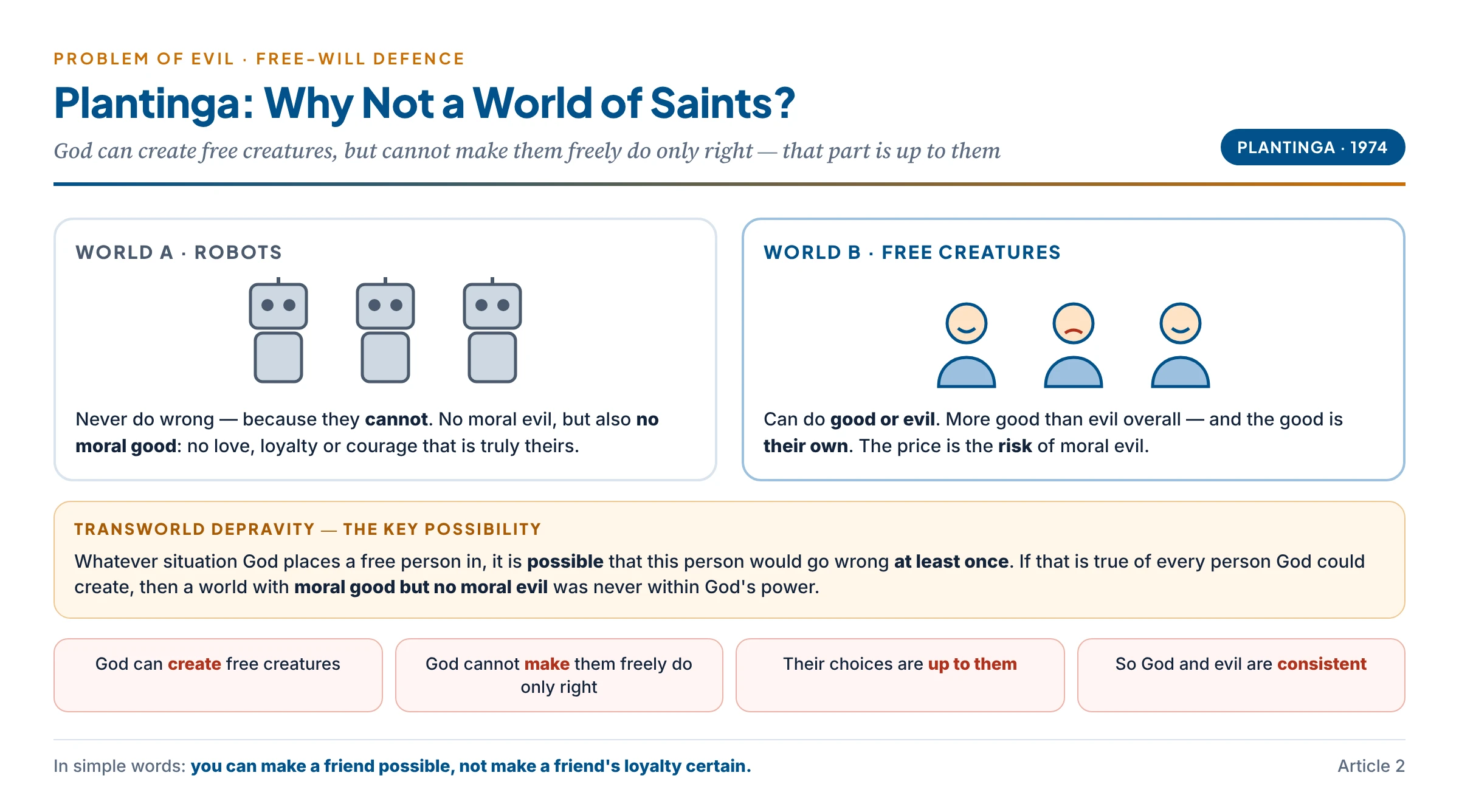
- Value of freedom: a world containing significantly free creatures who do more good than evil is more valuable than a world of automata who never do wrong because they cannot.
- God’s limit: God can create free creatures, but he cannot cause or determine them to do only what is right — for then they would not be free. “To create creatures capable of moral good, he must create creatures capable of moral evil.”
- Not every possible world can be created by God: there are possible worlds in which everyone always freely does right; but whether God can bring such a world about depends on what the creatures in it would freely do — and that is up to them, not God. Plantinga calls the assumption that an omnipotent God can create any possible world “Leibniz’s lapse“.
- Transworld depravity: it is possible that every person God could create is such that, in any situation God placed them in with significant freedom, they would go wrong at least once. If so, God could not create a world with moral good but no moral evil.
- The result: the following set of beliefs is consistent — God is omnipotent and wholly good; it was not within his power to create a world containing moral good but no moral evil; he created a world containing moral good. Together these imply that evil exists — so evil is compatible with God.
- Natural evil: Plantinga adds that it is possible that natural evil is due to the free actions of non-human persons (fallen angels) — a suggestion found in Augustine and C. S. Lewis. For a defence, mere possibility is enough.
In simple words
Suppose you want a friend who chooses to be loyal. You cannot program loyalty into him — then it would be programming, not loyalty. You can only make friendship possible and hope. If it turns out that every possible friend would let you down at least once, then “a friend who freely never fails me” is something even an all-powerful being could not guarantee. That is transworld depravity in everyday terms.
How Far Did Plantinga Succeed?
- The near-consensus: most philosophers, including many atheists, accept that the logical problem has been answered. Mackie himself wrote in 1982 that “we can concede that the problem of evil does not, after all, show that the central doctrines of theism are logically inconsistent with one another. But whether this offers a real solution of the problem is another question.” William Rowe agreed that, granting the libertarian view of freedom, there is a “fairly compelling” case that God and evil are consistent.
- Objections:
- It depends on libertarian freedom — the view that a free act is not determined by anything. If freedom is compatible with being caused (as Flew and Mackie held), God could have caused people to choose right freely.
- The “would freely do” facts — Plantinga needs truths about what each possible person would freely do in every situation. Critics ask what could make such statements true before the person exists or chooses.
- The heaven objection — believers expect that the redeemed in heaven will be free and yet never sin. If that is possible there, why not here?
- Natural evil — blaming earthquakes and cancer on fallen angels is logically possible but has no evidential support; it answers the logical problem only, not the evidential one.
- Amount of evil — the defence shows that some evil is compatible with God, not that this much evil is — which is exactly the evidential problem.
- Not a real explanation — as Mackie said, a bare possibility is not a solution; it does not show what God’s actual reasons are.
Common confusion
Did Mackie “withdraw” his atheism after Plantinga? No. Many notes say that Mackie accepted defeat. In fact Mackie conceded only the narrow logical point — that evil does not prove theism inconsistent — and immediately added that this is not a real solution. He remained an atheist and still thought evil a strong reason against belief. What collapsed after Plantinga was the logical form of the argument; the evidential form took its place.
Rowe’s Evidential Argument and the Fawn
- The argument (1979), in plain words:
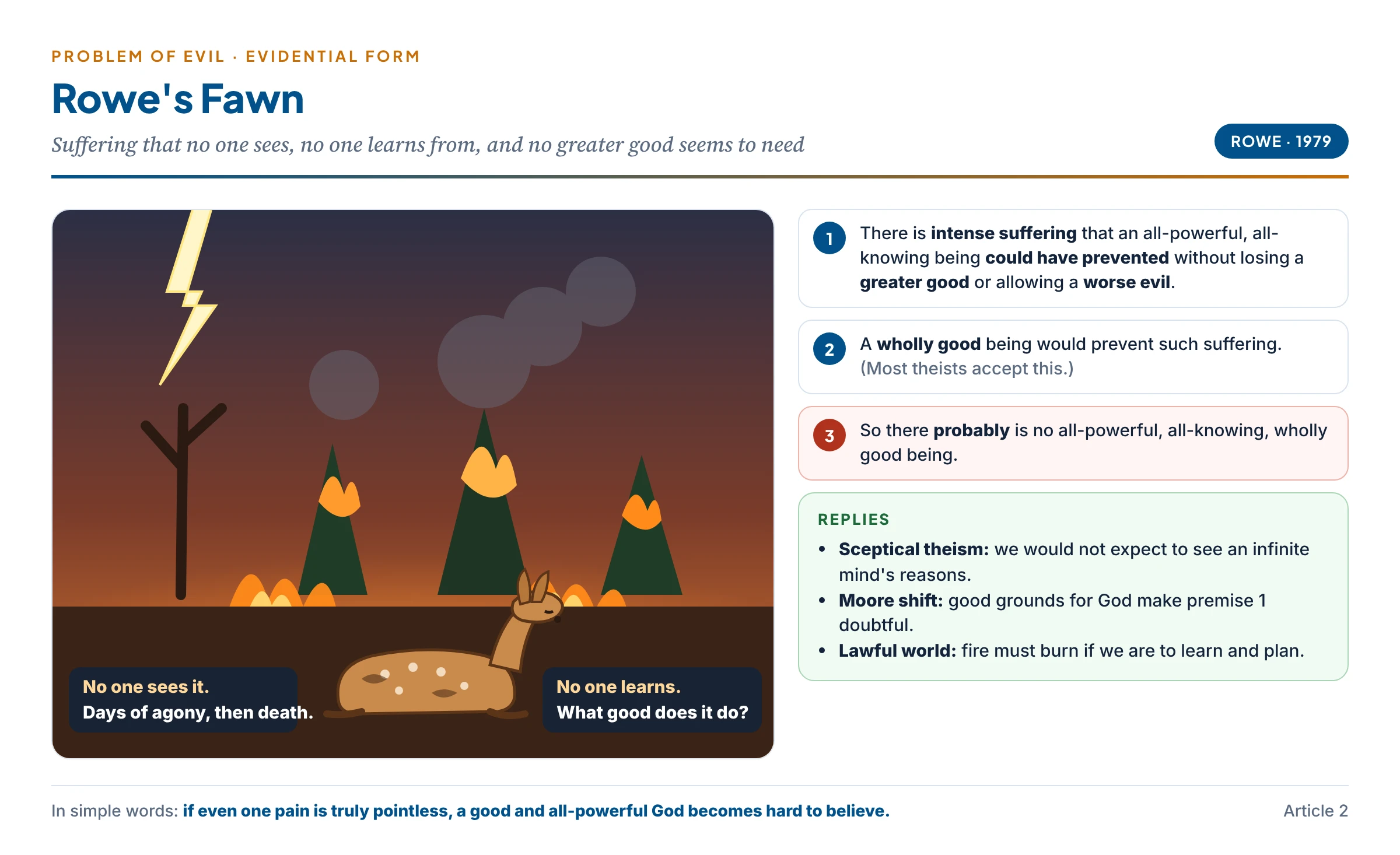
- There exist instances of intense suffering which an all-powerful, all-knowing being could have prevented without losing some greater good or permitting some equal or worse evil.
- A wholly good, all-knowing being would prevent any intense suffering it could, unless it could not do so without losing a greater good or permitting an equal or worse evil.
- Therefore there does not exist an all-powerful, all-knowing, wholly good being.
- The second premise is accepted by most theists — it is just what goodness means. All the weight falls on the first premise: is there really pointless (gratuitous) suffering?
- The fawn: “In some distant forest lightning strikes a dead tree, resulting in a forest fire. In the fire a fawn is trapped, horribly burned, and lies in terrible agony for several days before death relieves its suffering.” No human sees it, learns from it or is tested by it. It seems pointless. And such cases happen in nature countless times.
- A human case: Rowe later added the case of a five-year-old girl who was beaten, raped and strangled by an adult — suffering that seems to serve no greater good for anyone.
- Probability, not proof: Rowe does not claim to know that the fawn’s pain is pointless; he argues that it is reasonable to believe it is, because after careful thought we can find no good it serves. So it is reasonable to believe that God does not exist.
- “Friendly atheism”: Rowe also held that a theist may still be rational in believing in God — a believer with other strong grounds is not foolish, even if, in Rowe’s view, mistaken.
Replies to the Evidential Argument
- 1. Sceptical theism — “we would not expect to see God’s reasons”:
- Rowe moves from “we see no good reason” to “there is no good reason“. Stephen Wykstra argued this move is valid only if we would expect to see the reason if it existed.
- The gap between finite human minds and an infinite mind is enormous; it is not surprising that many of God’s reasons are invisible to us — as a small child cannot see why a loving parent lets a doctor give a painful injection.
- Davies: what falls within the plan of an omniscient being may be understood only by an omniscient being. The Book of Job ends on the same note: God answers Job not with reasons but with the vastness of creation — “Where were you when I laid the foundations of the earth?“
- Objection: if we can never judge whether a suffering is pointless, we also cannot judge whether preventing it is good — so sceptical theism threatens moral action, and also our confidence that God is good at all.
- 2. The “Moore shift” (named by Rowe after G. E. Moore’s reply to the sceptic): the theist can turn the argument around — “There is a wholly good, all-powerful God (for which I have good reasons); a good God prevents pointless suffering; therefore the fawn’s suffering is not pointless, even if I cannot see its point.” Which argument is more reasonable depends on the total evidence for God. Davies calls a similar move the “reasonableness of belief” defence.
- 3. Greater-good theodicies: the fawn’s pain may be the price of a lawful world — fire must burn whatever it touches if people are to learn, plan and be responsible (Swinburne, Article 4); a world able to produce soul-making must contain real danger (Hick, Article 5). Davies adds that Rowe’s case is a consequence of a world working by physical laws, not by a series of miracles.
- 4. Hick on dysteleological suffering: Hick admits there is suffering that seems utterly pointless (“dysteleological” — without purpose). But he argues that if all suffering were visibly deserved or useful, real sympathy and unselfish help would be impossible: we would help only when it “paid”. The mystery of pointless-seeming suffering may itself belong to a world where goodness is genuine.
- 5. Draper’s further challenge: Paul Draper (1989) argued that the actual pattern of pain and pleasure in nature — tied to survival and reproduction, falling on the good and bad alike — is much more likely if nature is indifferent than if a good God governs it. This echoes Hume: the first cause seems to have “neither goodness nor malice“.
Indian Connect — Indian Connect — the karma reply to “innocent” suffering
- Indian theists would reject Rowe’s first premise in a different way: there is no undeserved suffering, because every being carries karma from beginningless past lives; even the fawn’s pain is the fruit of its own past deeds (Article 7).
- This removes the “pointless suffering” — but at a price: it cannot be checked, and it seems to blame the victim. The Buddha himself denied that every feeling is due to past karma: some come from bile, phlegm, wind, the seasons, careless conduct or assault.
The Argument from Innocent Suffering
- The argument: the problem of evil arises when we ascribe infinite knowledge, power and goodness to God while acknowledging that innocent persons suffer. One cannot be mistaken about one’s own experience, and suffering is an experience; hence suffering is undeniably real, and God cannot have all three attributes.
- What is strong in it:
- The reality premise is sound: whatever else may be doubted, my pain is real to me. This refutes the view that evil is illusion — as Peter Geach put it, if my mind thinks I am miserable, then I am miserable. Even an illusory pain is a real evil.
- Innocence matters: suffering by those who have done nothing — infants, the mentally disabled, animals — cannot be explained as punishment or as a test they can learn from.
- Where it is weak:
- A hidden premise: from “suffering is real” it does not follow that it is pointless. The argument needs the extra premise that a good God could have no sufficient reason to permit it — exactly what theodicies dispute.
- “Innocent” is contested: Augustine’s doctrine of original sin and the Indian doctrine of karma both deny that anyone is wholly innocent — but both are controversial and unverifiable.
- Certainty of experience is not certainty of interpretation: I cannot be mistaken that I suffer; I can be mistaken about what my suffering means or leads to.
- Verdict: as a deductive proof the argument fails (like Mackie’s); as evidence it has real weight, and every theodicy must face the suffering of the innocent.
Critical Evaluation
Freedom of Will and an Omnipotent God
- The question: if God is omnipotent and omniscient, can human beings be really free?
- Power: whatever happens, God could prevent it; and in classical theism God sustains every act.
- Knowledge: if God knows today what I will choose tomorrow, can I choose otherwise?
- Replies: (a) God’s knowledge is timeless — he sees all times as present, so he sees rather than foresees, and seeing does not cause (Boethius, Aquinas); (b) knowledge is not causation; (c) God limits himself to make room for freedom; (d) some free-willists argue that foreknowledge of a genuinely free act is self-contradictory, so even an omniscient God does not “know” it in advance (later called open theism).
- Link to evil: if freedom and omnipotence are compatible, the free-will defence stands; if not, either we are not free (and moral evil is God’s) or God is not omnipotent.
If God Is the Absolute Creator, Can Man Be Responsible for Evil?
- The charge: if God creates everything out of nothing, sustains it every moment and knows every outcome, then he is the ultimate cause of every act — and responsibility for evil seems to slide back to God. The free-will defence would then shift blame to a creature who is only God’s instrument.
- Replies in outline (developed in Article 4):
- Primary and secondary causes — God is the primary cause of the being of every agent and act; the human being is the secondary, real cause of what the act is. A writer gives a character life, yet the character’s choices in the story are his own (Aquinas, McCabe).
- Evil as failure — what God causes is the positive reality of the act (movement, desire, energy); the evil in it is a lack of due order, which comes from the creature’s defect, not from God (Augustine, Article 3).
- Permission, not will — God wills freedom and permits its misuse.
- The remaining difficulty: if God knowingly creates beings who will fail, and could have created others, some share of responsibility seems to remain with the creator — which is why many theists end with faith or with a finite God (Article 6).
Critics and Defenders
Criticism — The case against God from evil
- Mackie: theism is positively irrational — God could have made people who always freely choose right.
- Paradox of omnipotence: God cannot both create independent wills and keep control.
- Rowe: intense, apparently pointless suffering (the fawn, the murdered child) makes God improbable.
- Draper and Hume: nature looks indifferent — neither good nor malicious.
- Critics of sceptical theism: if we cannot judge God’s reasons, we cannot judge his goodness either.
Defence — The theist’s replies
- Plantinga: God cannot guarantee free creatures’ choices; transworld depravity — no contradiction.
- Aquinas: omnipotence covers only what is logically possible.
- Wykstra: we would not expect to see an infinite mind’s reasons.
- Moore shift: good grounds for God outweigh our failure to see the point of suffering.
- Swinburne and Hick: a lawful world and a world fit for soul-making must contain real risk.
Cross-Tradition Comparison
| Western argument | Indian parallel |
|---|---|
| Mackie: why not creatures who always choose right? | Jinasena (Jaina): if God made the world out of love, why did he not make it wholly blissful? |
| Epicurus’ dilemma | Bhūridatta Jātaka (Buddhist): “If his wide power no limit can restrain, why is his hand so rarely spread to bless?” |
| Paradox of omnipotence | Sāṃkhya and Buddhist critics: if God is bound by karma he is not free; if not, he is a tyrant |
| Plantinga’s free-will defence | Brahmasūtra: the Lord acts according to the effort of the soul; the soul is a real agent |
| Rowe’s pointless suffering | Karma denies that any suffering is undeserved (Article 7) |
| Sceptical theism | Advaita: from the highest standpoint the question “why?” belongs to the realm of ignorance |
Indian Connect — Indian Connect — the soul as agent
- Rāmānuja and Śaṅkara both hold that God “makes” a soul act only with regard to its own prior effort — the Lord is like a rain or a king that responds to merit; the soul’s choices are its own.
- This is the Indian counterpart of the free-will defence: God supplies power and opportunity, the soul supplies direction — so the fault of an evil act is the soul’s, not God’s.
Synthesis (Siddhānta)
- The logical problem (Mackie) claims theism is self-contradictory; it depends on the hidden premises that a good being removes evil as far as it can and that omnipotence has no limits.
- The paradox of omnipotence shows that “unlimited power” needs careful definition; read as power to do what is logically possible, omnipotence does not include making free beings who are guaranteed to choose right.
- Plantinga’s free-will defence shows a possible situation — transworld depravity — in which God and evil coexist. Most philosophers, and Mackie in a narrow sense, accept that the logical problem has been answered.
- The evidential problem (Rowe’s fawn, the murdered child, Draper’s indifference) remains the live challenge. Theists reply with sceptical theism, the Moore shift, and greater-good theodicies; critics answer that these replies risk moral scepticism.
- The argument from innocent suffering rightly insists that suffering is real, but needs an extra premise to prove that it is pointless.
- Contemporary relevance: debates over vast animal suffering in evolution and over horrendous evils (genocide, child abuse) show that the evidential problem cannot be solved by logic alone; it calls for theodicies that speak to the victim, not only to the philosopher.
“We can concede that the problem of evil does not, after all, show that the central doctrines of theism are logically inconsistent with one another. But whether this offers a real solution of the problem is another question.” — J. L. Mackie
Previous Year Questions
- 2026Present an account of criticisms against omniscience and omnipotence as attributes of God.
- 2022“If God is the Absolute Creator, then the responsibility of the evil cannot belong to the human agent.” Critically examine.
- 2021Discuss the paradox of omnipotence of God in the context of the existence of evil.
- 2020What is the logical problem of evil? Discuss.
- 2020Is there any compatibility between ‘Freedom of Will‘ and ‘Omnipotent God‘? Discuss.
- 2010“The problem of evil arises when we attribute infinite knowledge, power and goodness to God acknowledging the fact of innocent persons’ suffering. One cannot be mistaken about one’s own experience and suffering is an experience. Hence, God cannot have at least one of the three attributes; infinite knowledge, power and goodness.” Evaluate this argument.