

Social Forestry — Origin, Definition & Objectives

Social forestry is the management and development of forests through afforestation of barren lands, undertaken specifically to achieve environmental benefit and rural development. Unlike conventional industrial or reserved forestry, social forestry is oriented toward the needs of local communities living around degraded and marginal land, rather than toward commercial timber production alone.
The term “social forestry” was first used by the National Commission on Agriculture (NCA), Government of India, in 1976. It was from this point that India formally embarked upon a social forestry project, with the twin aims of (i) taking pressure off existing natural forests, and (ii) making productive use of all unused and fallow land across the country.
Origin of the Term
The project’s initial focus was the reforestation of government forest areas located close to human settlements — land that had been progressively degraded over the years by continuous human activity and therefore needed active afforestation. In practice, plantation took place across a wide range of land categories:
- Trees were planted in and around agricultural fields;
- Plantations were carried out along railway lines, roadsides, and river and canal banks — the classic “linear plantation” or strip-plantation model; and
- Trees were also planted on village common land, government wasteland, and Panchayat land.
To ensure the survival of these plantations, the government extended financial and material incentives so that planted saplings would actually be cared for and maintained after planting — a critical design feature, since the survival rate of unprotected saplings on common land is historically very low. Initially, the government encouraged the free distribution of usufruct species (species whose fruit, fodder, or other yield could be directly used or sold by the planter, as opposed to pure timber species whose benefit accrues only after decades of growth). The entire programme was launched as a mass mobilisation programme, explicitly designed to involve the common population in afforestation rather than leaving it to the Forest Department alone.
How Social Forestry Was Implemented
India’s social forestry drive was not a single scheme but a family of related, World Bank-supported and state-level projects rolled out through the late 1970s and 1980s.
- The National Social Forestry Project, supported by World Bank funding between roughly 1976 and 1985, provided the initial institutional and financial architecture for the mass mobilisation model described above.
- Individual state governments — notably Uttar Pradesh, Gujarat, and Haryana — ran their own large-scale social forestry programmes under this broader umbrella, each adapting the model to local land-tenure and agro-climatic conditions.
- Implementation relied heavily on Forest Department nurseries supplying free or subsidised saplings, combined with village-level institutions (Panchayats, later Van Panchayats and Joint Forest Management committees) taking on local protection responsibilities.
This mass-mobilisation, incentive-driven model is precisely what generated both the celebrated successes and the well-documented structural failures of the programme.
Classification of Social Forestry Systems
Social forestry is not a single land-use category but an umbrella term covering several distinct systems, classified primarily by who owns the land and who benefits from the trees grown on it.
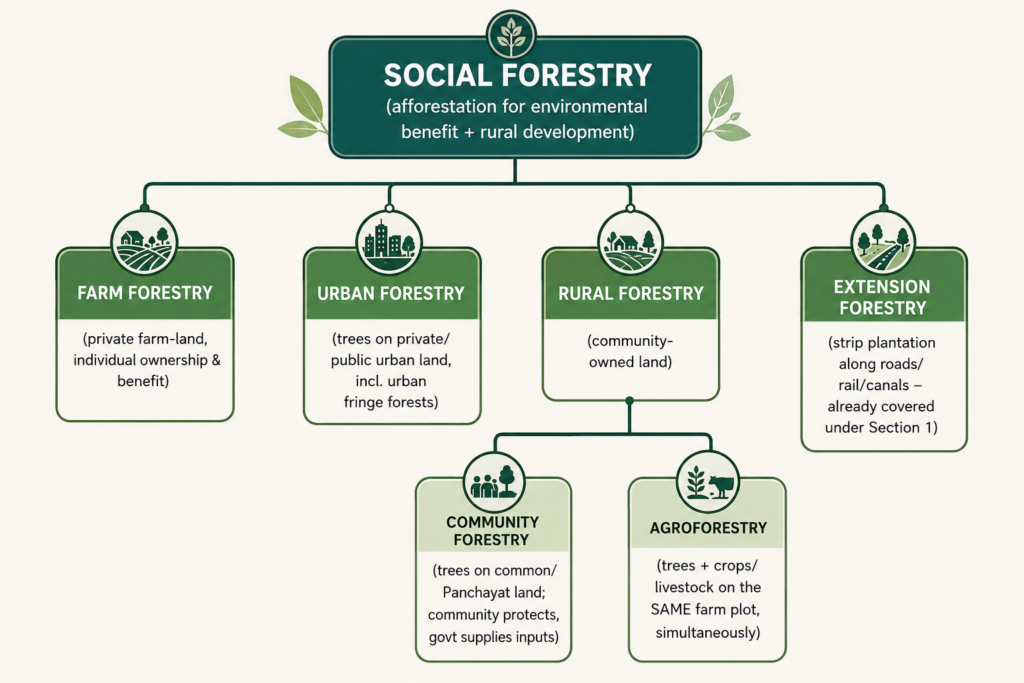
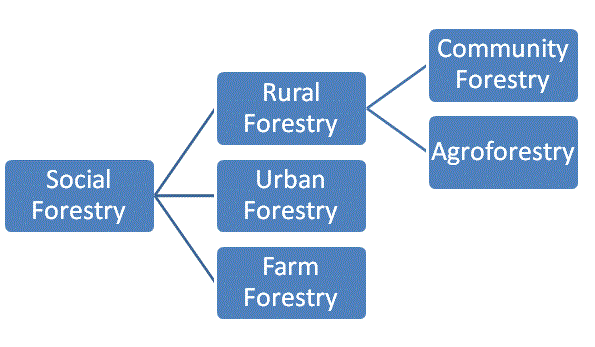
The four (sometimes five, if extension forestry — strip plantation along transport/canal corridors — is separated out as its own category rather than folded into farm/community forestry) recognised systems are: Farm Forestry, Urban Forestry, Community Forestry, and Agroforestry, with Community Forestry and Agroforestry together sometimes grouped under the broader head of Rural Forestry.
Benefits of the Social Forestry Programme
- Social forestry was intended to diversify non-farm and non-crop income options for poor farmers and landless labourers, giving them an alternative livelihood stream independent of seasonal crop output.
- It was designed to ensure better land use in situations where wasteland could be productively encroached into forestry plantations rather than left entirely unused.
- The programme was conceived as one of the initiatives under the broader afforestation scheme, with the specific objective of increasing India’s forested area toward the national target of 33% forest/tree cover.
- It became part of the wasteland development programme, actively encouraging forestry-based land use on slopes and in upstream catchment areas — directly linking it to soil and water conservation objectives.
- With the introduction of this scheme, the government formally recognised local communities’ rights to forest resources, and began actively encouraging rural participation in the management of natural resources.
- Through the social forestry scheme, the government institutionalised community participation as part of a broader drive toward afforestation and the rehabilitation of degraded forest and common lands.
Shortcomings of the Social Forestry Programme
Although social forestry as a concept was genuinely revolutionary, its implementation in India met with only limited success — a gap between design and delivery that is itself a recurring UPSC exam theme.
- The primary reason for underperformance was the wrong implementation of the incentive structure given to farmers and villagers to encourage participation. Because incentives were tied to land under tree cover rather than to sustained community benefit, many farmers diverted agricultural land to forestry plantations purely to capture the subsidy — directly compromising agricultural output and, by extension, local food security.
- Although the programme’s design suggested the use of usufruct species (fruit-, fodder-, or fibre-yielding trees that benefit the local community directly), the lack of ecological understanding and the absence of clear species-selection directives meant that most plantations in practice defaulted to Eucalyptus — a fast-growing exotic species that is not ecologically suitable in most Indian settings.
The Eucalyptus Controversy — Why It Matters
Eucalyptus was favoured administratively because it grows quickly, is easy to raise in nurseries, and produces a marketable pulpwood/timber crop within a short rotation. However, its extensive, water-hungry root system depresses the local water table, it offers little in the way of usufruct benefit (no fruit, poor fodder value, allelopathic leaf litter that suppresses undergrowth), and large monoculture blocks reduce local biodiversity. This mismatch between the stated objective (community usufruct benefit) and the actual species planted (commercial exotic monoculture) is widely cited as the single biggest structural failure of the social forestry programme in India.
Farm Forestry
At present, in almost all countries where social forestry programmes have been undertaken, both commercial and non-commercial farm forestry are being promoted in one form or another. Individual farmers are encouraged to plant trees on their own farmland to meet the domestic needs of the family — and in many areas, this tradition of growing trees on farmland already existed prior to any government scheme.
- Non-commercial farm forestry constitutes the main thrust of most social forestry projects in the country today.
- It is not always the case that a farmer grows trees purely for fuelwood — very often farmers are interested in growing trees for entirely non-economic reasons: to provide shade for agricultural crops, to act as a wind shelter, for soil conservation, or simply to make productive use of an otherwise idle patch of wasteland on the farm.
Urban Forestry
Urban forestry is the raising and management of trees on private or publicly owned land in and around urban centres, undertaken specifically to improve the urban environment. It is broader than it first appears:
- Urban forestry includes the management of individual trees as well as groups of trees — street avenues, park clusters, institutional campuses, and so on.
- It is not restricted to planted trees alone. Many urban trees establish themselves naturally through seed dispersal, though — in an environment where competition for land is intense — such naturally-established trees are unlikely to survive long unless they are actively cultivated and managed.
- Urban forestry also extends to the management of forests at the urban fringe, where city expansion pressure and forest/green-belt land directly compete.
Rural Forestry — Community Forestry
Rural forestry is conventionally divided into two sub-categories: community forestry and agroforestry (the latter treated separately in Sections 9–11 given its size and importance).
Community forestry is the raising of trees on community land, rather than on private land as in farm forestry. All community forestry programmes aim to provide benefit for the entire community, not for any single individual.
- Under the standard institutional arrangement, the government bears responsibility for providing seedlings and fertilisers, while the community bears responsibility for protecting the growing trees.
- Some communities manage their plantations sensibly and sustainably, ensuring that the village continues to benefit from the resource over the long term.
- Others, however, take advantage of the arrangement and sell the timber for short-term individual profit — a classic illustration of the “tragedy of the commons”: because common land is, in principle, everyone’s land, it is in practice very easy for any one group or individual to over-exploit it.
- Over the last several decades, large-scale planting of Eucalyptus — chosen as a fast-growing exotic species — has occurred across India as part of the broader drive to reforest the subcontinent and create an adequate rural timber supply under the aegis of “social forestry,” reinforcing the species-selection critique.
Agroforestry — Definition & Character
DefinitionAgroforestry is a land-use system that integrates trees and shrubs on farmlands and rural landscapes to enhance productivity, profitability, diversity, and ecosystem sustainability. It is a dynamic, ecologically-based natural resource management system that, through the deliberate integration of woody perennials on farms and in the agricultural landscape, diversifies and sustains production while also building social institutions around shared management practice.
Agroforestry combines forestry with agriculture in a way that gives it several distinctive structural properties:
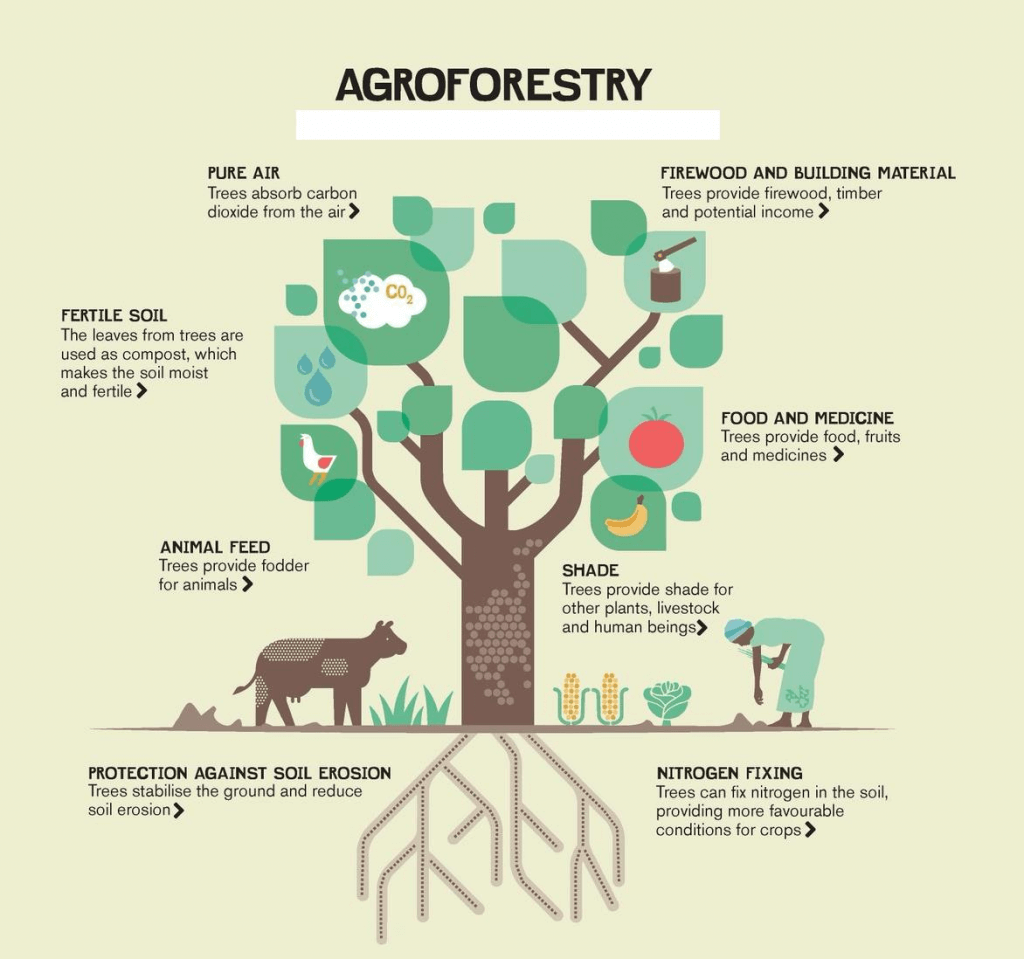
- It produces multiple outputs while simultaneously protecting the underlying resource base (soil, water, biodiversity).
- It places emphasis on the use of multiple indigenous tree and shrub species, rather than a single exotic monoculture.
- It is particularly suitable for low-input conditions and fragile environments, where high-input monoculture is neither affordable nor sustainable.
- It involves the interplay of socio-cultural values to a greater degree than most other land-use systems — species choice, tree tenure, and harvest rights are often governed by custom as much as by economics.
- It is structurally and functionally more complex than monoculture, precisely because multiple species and multiple production goals interact on the same plot simultaneously.
Agroforestry systems include both traditional and modern land-use arrangements in which trees are managed together with crops and/or animal production systems within agricultural settings. It is practised in both irrigated and rain-fed conditions, where it simultaneously produces food, fuel, fodder, timber, fertiliser (via green manure/leaf litter), and fibre — contributing to food, nutritional, and ecological security; sustaining rural livelihoods; alleviating poverty; and promoting a more productive and resilient cropping and farming environment overall.
Agroforestry also has the potential to enhance ecosystem services through carbon storage, prevention of deforestation, biodiversity conservation, and soil and water conservation. When strategically applied at scale, with an appropriate mix of species, agroforestry enables agricultural land to withstand extreme weather events such as floods and droughts, and to build broader resilience against climate change.
Types of Agroforestry Systems
Beyond the broad definition above, agroforestry is formally classified into several distinct system types based on which components — trees (silvi-), crops (agri-), and/or livestock/pasture (-pasture) — are combined on the same land unit.
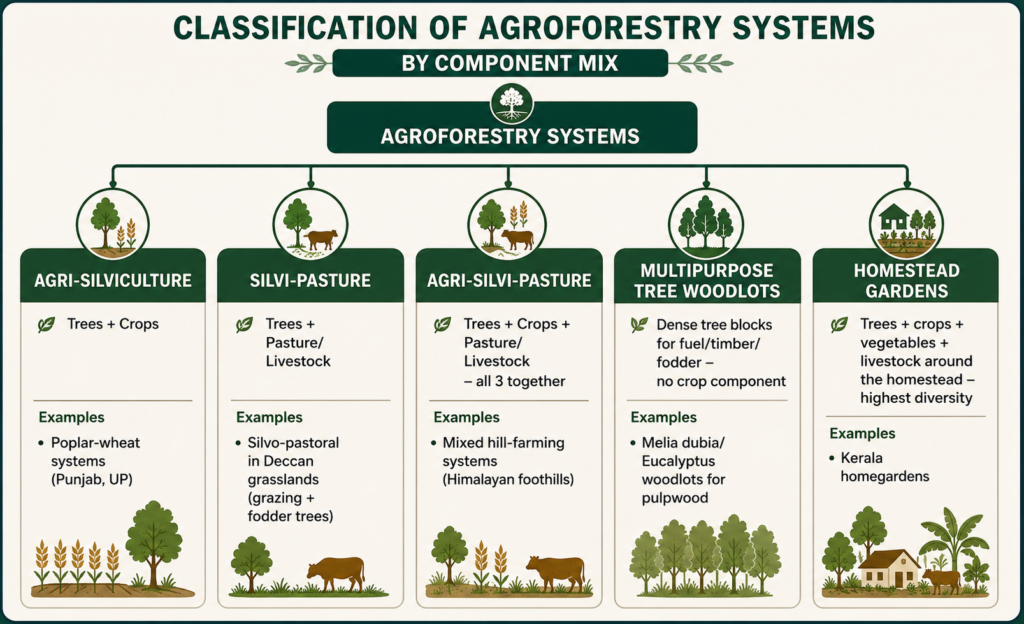
| System | Components Combined | Representative Example |
|---|---|---|
| Agri-silviculture | Trees + agricultural crops | Poplar–wheat/sugarcane systems of Punjab, Haryana, and western Uttar Pradesh |
| Silvi-pasture | Trees + pasture/livestock grazing | Fodder-tree-based grazing systems in the Deccan grasslands and drier peninsular tracts |
| Agri-silvi-pasture | Trees + crops + pasture/livestock, all three together | Mixed hill-farming systems of the Himalayan foothills, combining terraced cropping, fodder trees, and grazing |
| Multipurpose tree woodlots | Dense tree blocks grown for fuel, timber, or fodder, without an interspersed crop | Melia dubia and Eucalyptus woodlots grown as short-rotation pulpwood crops on farm boundaries |
| Homestead gardens | Trees + vegetables + spices + small livestock, all clustered immediately around the dwelling | The classic multi-storeyed Kerala homegarden, often cited as India’s most species-diverse agroforestry system |
Benefits of the Agroforestry System
Environmental Benefits
- Reduction of pressure on natural forests, since farm-grown trees substitute for wood otherwise extracted from natural stands.
- More efficient recycling of nutrients by deep-rooted trees present on the same site as shallow-rooted crops.
- Better protection of ecological systems overall, through the added structural complexity trees bring to a farm landscape.
- Reduction of surface run-off, nutrient leaching, and soil erosion through the impeding effect of tree roots and stems on these processes.
- Improvement of microclimates — lowering of soil surface temperature and reduction of soil-moisture evaporation, through the combined effect of mulching and shading.
- Increment in soil nutrients through the addition and decomposition of litterfall.
- Improvement of soil structure through the constant addition of organic matter from decomposed leaf litter.
- Agroforestry is widely recognised as perhaps the only realistic alternative to meeting the target of raising India’s forest/tree cover to 33% from the present level of less than 25%, as envisaged in the National Forest Policy, 1988 — since this scale of increase cannot plausibly come from reserved/protected forest expansion alone.
- Agroforestry is known to have the potential to mitigate climate change effects through microclimate moderation and natural-resource conservation in the short run, and through carbon sequestration in the long run. Agroforestry species are known to sequester as much carbon in below-ground biomass as primary forests do, and far more than comparable crop or grass systems.
Economic Benefits
- An increment in outputs of food, fuelwood, fodder, fertiliser, and timber from the same unit of land.
- A reduction in the incidence of total crop failure, which is a risk common to single-cropping/monoculture systems but is diluted where multiple species and production streams coexist.
- An increase in levels of farm income due to improved and sustained productivity across multiple outputs rather than a single crop.
- Agroforestry has significant potential to provide employment to both rural and urban populations through production, industrial application, and value-addition ventures. Current estimates show that about 65% of the country’s timber requirement is met from trees grown on farms — a striking statistic that underscores how central farm-grown timber has become to India’s wood economy. Agroforestry also generates substantial employment opportunities more broadly across processing and value chains.
Social Benefits
- Improvement in rural living standards arising from sustained employment and higher income.
- Improvement in nutrition and health due to the increased quality and diversity of food outputs available at the household level.
- Stabilisation and improvement of communities through the elimination of the need to periodically shift the sites of farm activities — a benefit especially relevant in areas that would otherwise depend on shifting/jhum cultivation.
Indian Policy Framework
- National Forest Policy, 1988 — set the 33% forest/tree cover target that both social forestry and agroforestry are explicitly designed to help achieve.
- National Agroforestry Policy, 2014 — India became the first country in the world to adopt a dedicated national agroforestry policy, aiming to encourage and expand tree plantation in farming systems in an integrated manner with crops and livestock for productivity, livelihood, and climate resilience.
- Sub-Mission on Agroforestry (SMAF), operated under the Rashtriya Krishi Vikas Yojana (RKVY) umbrella, provides financial and technical support for nursery development, quality planting material, and extension services to promote agroforestry adoption among farmers.
- Species policy relevance: the choice of species remains a live policy debate — fast-growing exotics such as Eucalyptus continue to dominate commercial woodlots for their short rotation and assured market, while species such as Melia dubia (increasingly popular for pulpwood) and Poplar (in agri-silviculture systems across Punjab, Haryana, and western UP) represent efforts to diversify the species base used in Indian agroforestry.
- Joint Forest Management (JFM) and related community-institution frameworks continue to underpin the “community protects, government supplies inputs” model first established under the community forestry component of social forestry.
Global Context
Agroforestry is not a uniquely Indian innovation — it is recognised internationally as a central strategy for reconciling agricultural production with ecosystem conservation, especially in the tropics.
- The World Agroforestry Centre (formerly ICRAF — International Centre for Research in Agroforestry), part of the CGIAR research network, is the leading global institution for agroforestry research, technology transfer, and policy advocacy.
- Agroforestry systems are recognised under global climate frameworks as a nature-based solution contributing simultaneously to mitigation (carbon sequestration) and adaptation (resilience to floods/droughts), linking the topic directly to countries’ Nationally Determined Contributions (NDCs) under the Paris Agreement.
- Traditional agroforestry analogues exist worldwide — the home-garden systems of Southeast Asia, the dehesa/montado silvi-pastoral systems of Spain and Portugal, and shade-grown coffee/cocoa systems across Latin America and West Africa all illustrate the same underlying principle of combining woody perennials with agricultural or livestock production.







God bless thee
https://youtu.be/aHD3G4fXm5o sir This video is a add on to this topic.
Okay, Pavan, I have embedded the video. Thanks for your suggestion.