

Background

- At the end of the Second World War (1939-45), there was a renewal of interest in the subject of development economics, and the stages of growth once again preoccupied many scholars. As a non-communist manifesto, W. W. Rostow’s stages of economic growth (1960, 1971) is a foray into positioning the sweep of modern economic history under capitalism into neat and hopeful epochs.
- Geographers often seek to categorize places using a scale of development, frequently dividing nations into the “developed” and “developing,” “first world” and “third world,” or “core” and “periphery.” All of these labels are based on judging a country’s development, but this raises the question: What exactly does it mean to be “developed,” and why have some countries developed while others have not?
- Since the beginning of the 20th century, geographers and those involved with the vast field of Development Studies have sought to answer this question, and in the process, have come up with many different models to explain this phenomenon.
- Prior to Rostow, approaches to development had been based on the assumption that “modernization” was characterized by the Western world (wealthier, more powerful countries at the time), which were able to advance from the initial stages of underdevelopment. Accordingly, other countries should model themselves after the West, aspiring to a “modern” state of capitalism and liberal democracy.
- Using these ideas, Rostow penned his classic “Stages of Economic Growth” in 1960, which presented five steps through which all countries must pass to become developed.
- Rostow’s Model of Stages of Growth, proposed by Walt Whitman Rostow in the 1960s, is a linear theory of economic development that suggests all economies progress through a series of five stages on their path to becoming modern and developed.
- This model was influenced by the success of the Marshall Plan after World War II, which helped Europe recover economically.
- The model assumes that industrialization, urbanization, and a free-market economy drive economic growth and that all countries can achieve development by following these stages.
Post-World War II
- Europe faced widespread economic ruin, joblessness, and a vicious cycle of poverty.
- USA’s Marshall Plan (initiated by Henry Truman and Secretary of State Marshall) aimed to revive Europe by providing an economic stimulus package and forming alliances like NATO.
Growth Theories Inspired by the Marshall Plan
- Several growth theories emerged, promoting industrialisation, urbanisation, and capitalism:
- Rostow’s Model (1960s)
- Growth Pole & Growth Centre by Jacques Boudeville & Francois Perroux (1950s)
- Trickle-Down Theory by Hirschman
- Core Periphery Model by Friedman
- Cumulative Causation Theory by Gunnar Myrdal (1970s)
- These theories were based on the assumption that social sector development would naturally follow economic growth and prosperity.
Rostow’s Model of Stages of Economic Growth
- Rostow’s Stages of Growth model is one of the major historical models of economic growth. It was published by American economist Walt Whitman Rostow in 1960. W. Rostow formulated the best-known non-spatial model in 1955 in which five stages of economic development were identified.
- Rostow was fiercely anticommunist and right-wing; he modelled his theory after Western capitalist countries, which had industrialised and urbanised. As a staff member in President John F. Kennedy’s administration, Rostow promoted his development model as part of U.S. foreign policy.
- Rostow’s model illustrates a desire not only to assist lower-income countries in the development process but also to assert the United States’ influence over that of communist Russia.
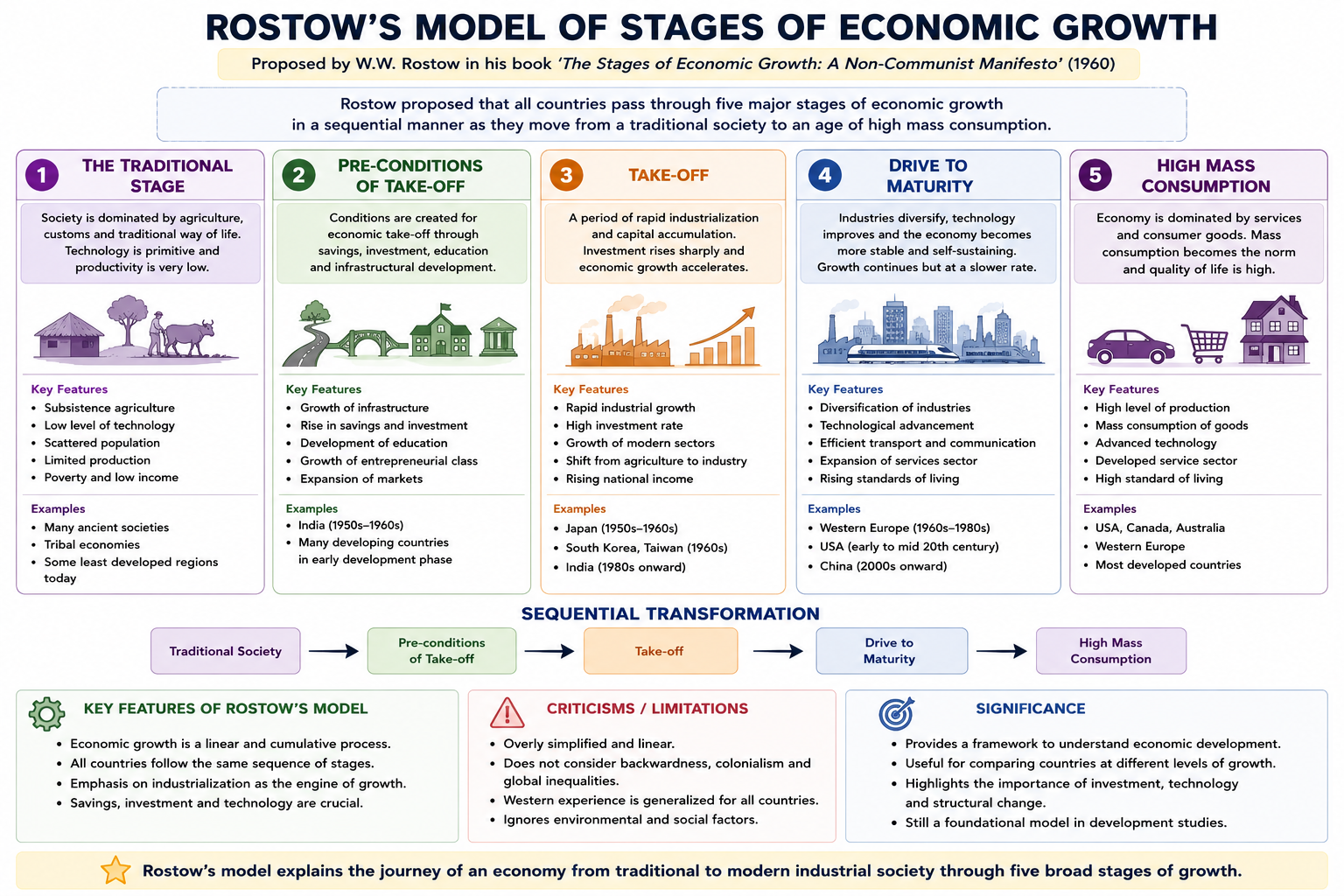
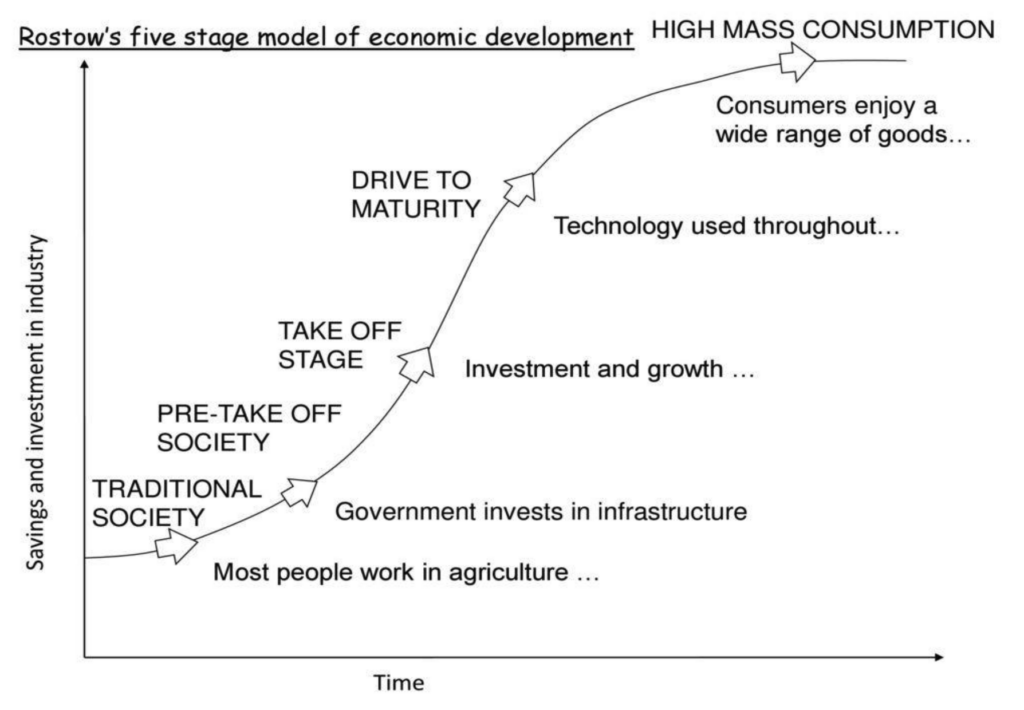
- In his view, at the beginning, a traditional society witnessed a few stages before attaining the level of the age of mass consumption. Rostow’s stages of economic development are shown below.
- Traditional society
- Preconditions for take-off
- Take-off
- Drive to maturity
- Age of High mass consumption
1. Traditional Society
- The traditional society has been defined as one where limited production functions are characterised by pre-Newtonian technology.
- The social structure is hierarchical, and political power is confined in the hands of a feudal aristocracy.
- More than 75 per cent of the population is engaged in agriculture, i.e. this stage is characterised by a subsistent, agricultural-based economy with intensive labour and low levels of trading, and a population that does not have a scientific perspective on the world and technology.
2. Preconditions to Take-off
- The second stage is a transitional phase, the preconditions-, of which were initiated mainly by four forces: the Renaissance, the New Monarchy, the New World (Political revolution), and the New Religion or the Reformation. These forces were cardinal factors behind the changes in social attitudes, values, etc.
- The pre-conditions are brought about by external factors. In most parts of Britain, the situation changed with the domination of Napoleon whose victory set in new revolutionary ideas. The preconditions for industrial development demand changes in non-industrial sectors, viz., (i) a buildup of social overhead capital, particularly in transport sectors; (ii) agricultural practices witnessing technological up-gradation, which leads to rising agricultural productivity; and (iii) import expansion.
- These conditions mainly comprise fundamental changes in the social, political and economic fields; for example:
- (a) A change in society’s attitudes towards science, risk-taking, and profit-earning;
- (b) The adaptability of the labour force;
- (c) Political sovereignty;
- (d) Development of a centralized tax system and financial institutions; and(e) The construction of certain economic and social infrastructure like railways, ports, power generation, and educational institutions. India did some of these things in the First Five Year plan period (1951-56).
- It is evident from above that in this second stage of growth foundations for economic transformation are laid. The people start using modern science and technology for increasing productivity in both agriculture and industry.
- Further, there is a change in the attitude of the people who start viewing the world where there are possibilities of future growth. A new class of entrepreneurs emerges in the society who mobilize savings and undertake investment in new enterprises and bear risks and uncertainty. In the sphere of political organization, it is during this stage that an effective centralized nation-state starts emerging.
- Thus in the stage of precondition for take-off Rostow views agriculture as performing three roles, first, agriculture must produce sufficient food-grains to meet the demand of the growing population and of the workers who get employment in agriculture.
- Secondly, increase in agricultural incomes would lead to the demand for industrial products and stimulate industrial investment.
- Thirdly, expanding agriculture must provide much of the savings needed for the expansion of the industrial sector.
3. The “Take-off” Stage
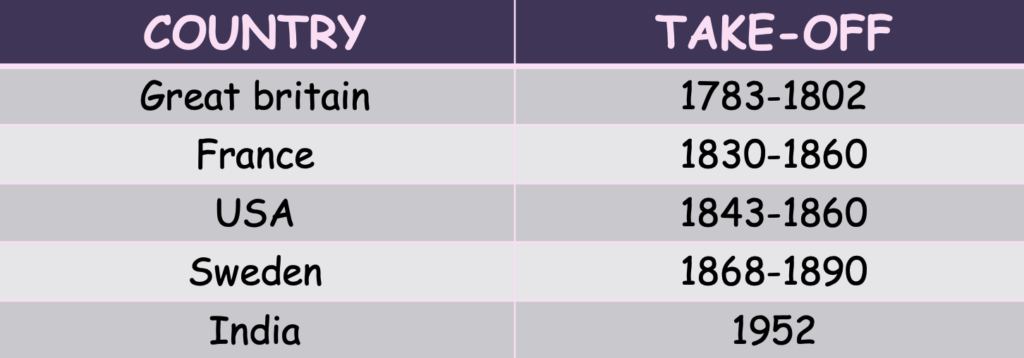
- This is the crucial stage which covers a relatively brief period of two to three decades in which the economy transforms itself in such a way that economic growth subsequently takes place more or less automatically. “The take-off” is defined as “the interval during which the rate of investment increases in such a way that real output per capita rises and this initial increase carries with it radical changes in the techniques of production and the disposition of income flows which perpetuate the new scale of investment and perpetuate thereby the rising trend in per capita output.”
- Thus, the term “take-off ” implies three things:
- first, the proportion of investment to national income must rise from 5% to 10% and more so as to outstrip the likely population growth;
- secondly, the period must be relatively short so that it should show the characteristics of an economic revolution;
- and thirdly, it must culminate in self-sustaining and self-generating economic growth.
- Thus, during the take-off stage, the desire to achieve economic growth to raise the living standards dominates society. Revolutionary changes occur in both agriculture and industry and productivity levels sharply increase.
- There are greater urbanization and urban labour force increases. In a relatively short period of a decade or two, both the basic structure of the economy and social and political structure is changed So that a self-sustaining growth rate can be maintained.
- It is worth noting that in the opinion of Rostow, the rise of the new elite (i.e. new entrepreneurial class) and the establishment of a nation-state are crucial for economic development.
4. Drive to Maturity
- The drive to maturity is the phase when the society has been able to apply a wide range of technology to development processes enabling it to achieve a long sustained economic growth extending well over four decades.
- At this stage, there are some important changes:
- The workforce becomes more skilled. People prefer to reside in urban areas. Real wages gallop, and workers are more organized to ensure social and economic security,
- The rugged entrepreneurs yield place to a new generation of sophisticated managers and chief executive officers,
- Society gets exhausted by the pace of industrialization and seeks changes that would lead to further change.
5. Age of High Mass Consumption
- The age of high mass-consumption has been characterized by the consumption of durable commodities, household gadgets, automobiles, etc. Society pays more attention to demand than supply, to problems of consumption than problems of production and welfare of the people.
- There are three forces which increase welfare during the post-maturity phase:
- The national policy is geared to enhance power and spreads its influence beyond national frontiers;
- For achieving the goal of a welfare state, the government makes provisions for more equitable distribution of income, social security, leisure to the workforce;
- Commercial centers of cheaper automobiles, houses, and sophisticated household devices, etc., are set up.
Criticism of Rostow’s Model
- Rostow’s model has been criticised by economists and social scientists belonging to other disciplines.
- The major criticisms are noted below:
- Rigid and Linear Approach: The model assumes a linear and unidirectional progression, which doesn’t account for reversals or variations in growth stages.
- Traditional society is not a pre-requisite qualification for development. Countries like the USA, Canada, Australia, and New Zealand were not ‘traditional’ when they were born.
- The precondition phase is not necessary before the take-off. It is hard to believe on the available evidence that a phase of agricultural revolution and build-up of overhead social capital in transport must precede the take-off.
- Stages tend to overlap. Countries such as New Zealand and Denmark experienced take-off as a result of agricultural development. In their cases, the different stages postulated by W.W. Rostow are not distinct.
- There are indiscrepancies in the matter of take-off. Rostow himself was sceptical regarding the date of take-off. This is suggested by his paradoxical reference to the years 1937 and 1952 as the years of India’s take-off. He did not consider the possibilities of economic recession during takeoff. The analysis of take-off hardly takes into account the impact of historical heritage, the extent of backwardness, and other associated factors.
- Regarding the essential conditions for take-off, some shortcomings are found:
- (a) The rate of productive investment of over 10 per cent of net national product is found to be arbitrary.
- (b) Rostow’s emphasis on the role of some leading sectors like textiles, railroad, etc., in the take-off can hardly be proved.
- (c) In the third condition, Rostow argued in favour of mobilising domestic capital, which is no different from the first condition.
- Regarding the essential conditions for take-off, some shortcomings are found:
- The drive to maturity is confusing. The stage contains all the features of the take-off, e.g., net investment over 10 per cent of national income, development of the latest production techniques, etc. Therefore, the need for a separate stage where growth is self-sustained is no longer required. In reality, no growth is absolutely self-sustaining or self-limiting.
- Chronological order is not maintained in the stage of high mass consumption. Some countries, like Canada and Australia, entered this stage even before attaining maturity.
- The concept of take-off ideally fits the case of developing countries. Rostow’s idea of over 10 percent capital formation and development.
- Eurocentric and Ethnocentric Bias:
- The model is based on European experiences, implying that industrialization is the only path to development.
- It dismisses the role of agriculture and assumes that countries should follow the European model.
- Applicability in Modern Times:
- The model does not adequately address technological advancements, globalization, and environmental concerns in contemporary development.







i love it
Very useful notes for geography optional
Thanks, Deepak
Thank u
Actually I don’t know ,how I will say thanks to you. You are providing awesome awesome content.
Sir needed its present application
Thank you sir