

- The Malthusian theory of population holds that human numbers tend to grow faster than the food needed to feed them, so growth must be held down by restraint or by hunger, disease and war.
- It was set out by Thomas Robert Malthus (1766–1834), an English clergyman and political economist, in An Essay on the Principle of Population, first published anonymously in 1798.
- It is the first systematic population-resource theory, and with the Marxian theory and demographic transition theory it forms the three classic accounts of population change.
- Its rigid ratios have failed. Its central question, whether numbers, consumption and resources can stay in balance, is still open.
The Theory

Background
- Population thought before Malthus was mostly about state power or balance.
- Kautilya and the mercantilists saw large numbers as strength; Plato and Confucius sought a limit; Ibn Khaldun tied dense populations to the rise of civilisations.
- Adam Smith and David Ricardo linked numbers to wages, rent and diminishing returns, and Edmond Halley built an early life table. These pre-Malthusian perspectives offered no general law.
- The immediate target was the optimism of William Godwin and the Marquis de Condorcet, who expected society to perfect itself. Malthus replied that pressure of numbers would always block unlimited progress.
- The work changed over time.
- The 1798 essay was a short argument. The 1803 edition appeared under his name, was far longer and drew on evidence from many countries. It also added moral restraint as a check. Six editions had appeared by 1826.
- He taught political economy from 1805 at the East India Company’s college at Haileybury, which trained officials for India.
- His evidence was uneven. The 25-year doubling came from the United States, then growing fast on abundant land. The food ratio was reasoned from the limits of farmland in Britain.
- His motive is still debated. Critics call the work a defence of the propertied classes, while others note that he wanted the poor to be better paid and educated, and that he began from the welfare of the labouring majority.
- Why it matters to geography: it was among the first attempts to link population to land, food and region. It tied population change to social and economic change, and later work on resources, carrying capacity and sustainability starts from it.
Assumptions
- Two postulates start the argument: food is necessary to human existence, and the passion between the sexes is necessary and will remain nearly constant.
- Other assumptions follow from them:
- Land is fixed, so farming cannot expand indefinitely.
- Diminishing returns operate: the best land is farmed first, and extra labour and capital on land eventually yield less.
- Technology gives no lasting escape from the gap between numbers and food.
- Overpopulation produces misery, through poverty, hunger, disease and conflict.
The Two Ratios
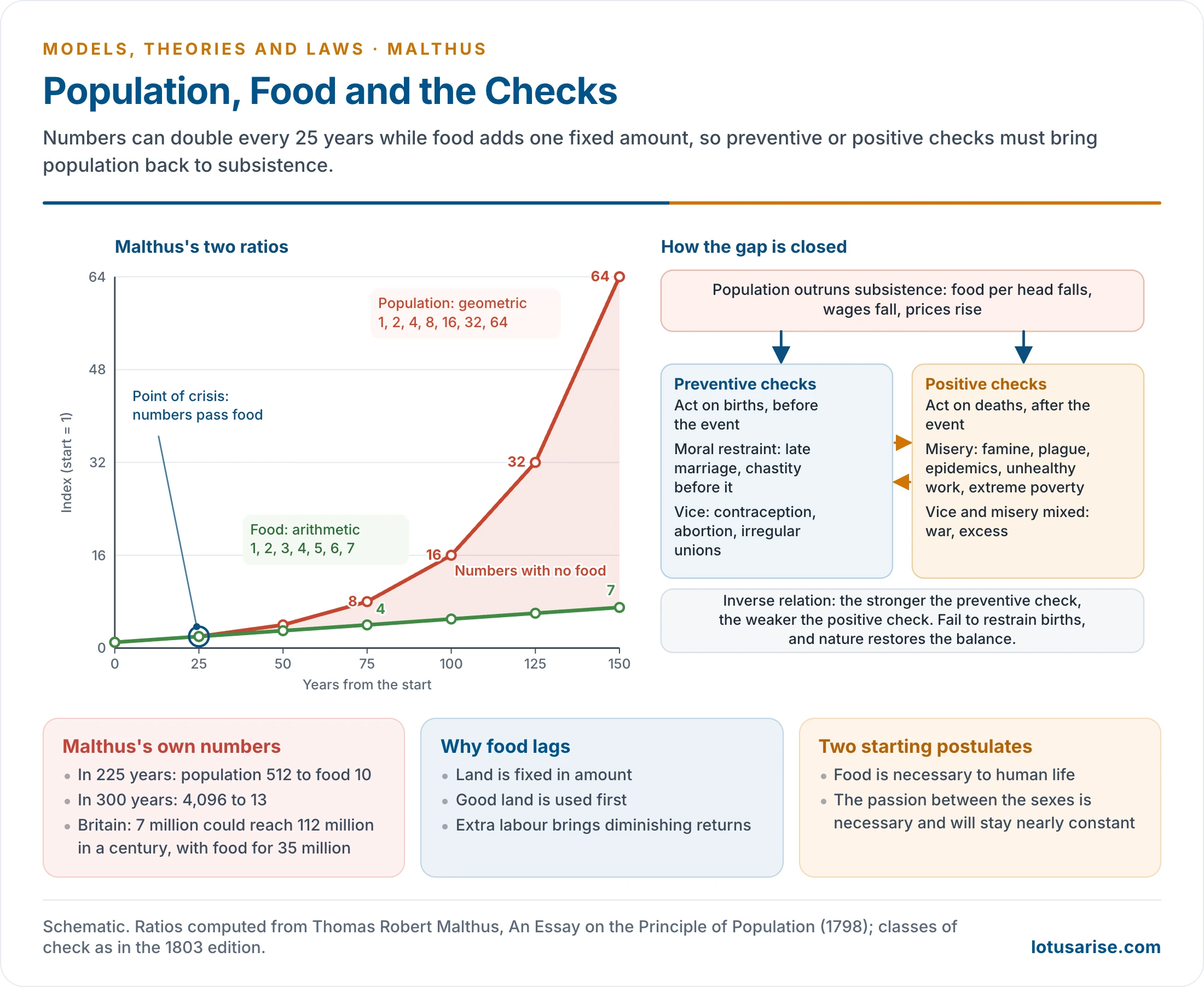
- The core statement: “Population, when unchecked, increases in a geometrical ratio. Subsistence increases only in an arithmetical ratio.”
- Population can double every 25 years: 1, 2, 4, 8, 16, 32.
- Food can at best add the same amount every 25 years: 1, 2, 3, 4, 5, 6.
| Years | 0 | 25 | 50 | 75 | 100 | 225 | 300 |
|---|---|---|---|---|---|---|---|
| Population | 1 | 2 | 4 | 8 | 16 | 512 | 4,096 |
| Food | 1 | 2 | 3 | 4 | 5 | 10 | 13 |
- His worked example for Britain: 7 million people could become 112 million within a century, with food for only 35 million. That leaves 77 million unprovided for.
- He reduced the theory to three propositions:
- Population is necessarily limited by the means of subsistence.
- Population invariably rises where subsistence rises, unless powerful checks prevent it.
- All such checks resolve into moral restraint, vice and misery.
Checks on Population
| Check | Works through | Timing | Malthus’s examples |
|---|---|---|---|
| Preventive | Lower birth rate | Before birth | Late marriage, chastity before it, foresight about supporting a family |
| Positive | Higher death rate | After birth | Famine, plague, epidemics, unhealthy work, extreme poverty, bad nursing of children, war |
| Class | Meaning | Examples |
|---|---|---|
| Moral restraint | Delay of marriage with chastity meanwhile | The only check he approved |
| Vice | Conduct he held to be immoral | Contraception, abortion, irregular unions |
| Misery | Suffering from the laws of nature | Famine, disease |
- War and excess are mixed: vice brings them on and misery is their result.
- He rejected contraception. He classed it as vice and believed that the need to postpone marriage was a spur to hard work.
- The two checks are inversely related. Where restraint is strong, famine and disease are less needed; where it is weak, they do the work.
- Later lists go beyond him.
- Modern preventive checks include contraception, family planning, female education, women’s employment, urban living, a later age at marriage, lower infant mortality and access to reproductive health care. Malthus accepted only the later marriage.
- Positive checks are often extended to floods, droughts, earthquakes and tsunamis, which have little to do with numbers.
- Modern demography keeps the distinction between checks that lower fertility and checks that raise mortality, while dropping his moral judgement on contraception.
- An Indian trace: India’s population actually fell between 1911 and 1921, the only census decade to show a decline. The death rate reached about 47 per 1,000 in 1911–20, chiefly through the 1918 influenza, with famine and plague. Epidemic mortality worked here as a positive check, though the influenza owed nothing to food pressure.
The Oscillation and the Malthusian Crisis
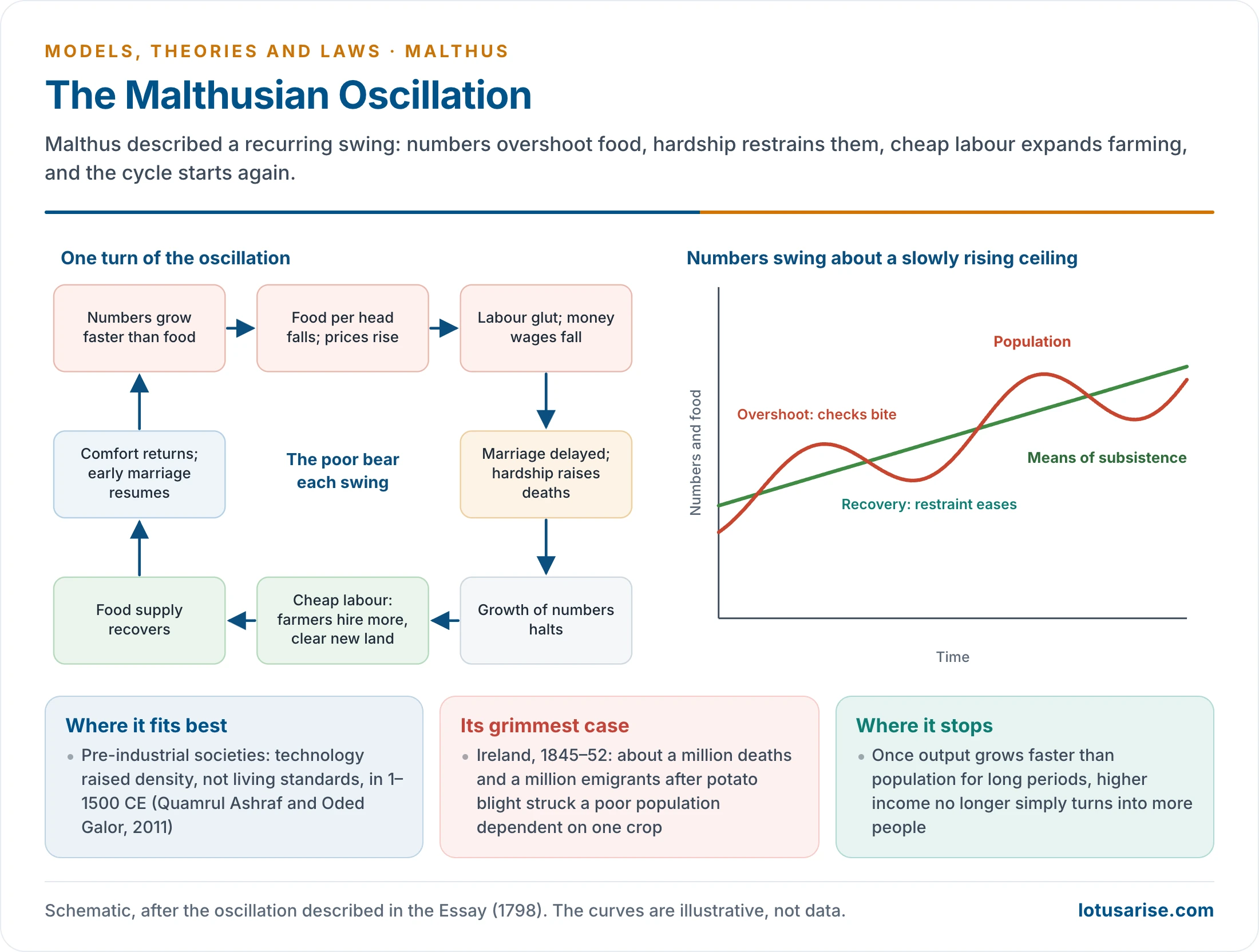
- Malthus did not expect one great collapse. He described a recurring swing:
- Numbers outgrow food, so food per head falls and prices rise.
- The labour market gluts and money wages fall.
- Marriage is delayed and hardship raises deaths, so growth halts.
- Cheap labour lets farmers hire more and clear new land, food recovers, and the cycle restarts.
- A Malthusian crisis is the sharp form of this swing: population exceeds what food and resources can carry, living standards fall and mortality rises.
- Its forms include food shortage, famine, epidemics, land fragmentation, falling wages, resource conflict, out-migration and environmental damage.
- Such crises were common in pre-industrial societies, with low yields, poor transport, weak medicine and little food trade.
- Ireland (1845–52) is the classic case: about a million died and a million emigrated after potato blight struck a poor population dependent on one crop. Yet poverty and policy mattered too, and later research does not treat overpopulation as the principal cause.
- Why Europe escaped: sustained technical change, fossil energy, overseas land and food, and mass emigration to the New World all lifted the ceiling just as he wrote. In the modern world, technology, trade and welfare systems make full crises rare at the global level, but local Malthusian conditions persist where conflict, climate shocks, poverty and weak government meet.
Policy Views
- He opposed the Poor Laws, arguing that relief raised numbers without raising food and so depressed the poor as a whole. He proposed abolishing the parish laws, so that labourers could move freely in search of work.
- His remedy was individual: the poor should learn that their condition lay in their own hands, and delay marriage until they could support a family. Education was therefore central to his later editions.
- The idea travelled to India. Many officials of the Raj took Malthusian ideas as their long-run view of Indian famine. Lord Lytton, Viceroy during the famine of 1876–78, firmly believed in them, and the doctrine supported a largely negative approach to relief (S. Ambirajan, 1976).
Geographical Interpretation
- Population-resource relation: the theory is the root of the idea of carrying capacity, with food and land as the main limits.
- Population above the resource base means overpopulation, below it underpopulation, and at balance an optimum.
- Environmental determinism: the theory has a deterministic tone. Nature finally sets the limit through famine, disease and scarcity, and human adjustment counts for little.
- Agricultural geography: farming stands at the centre, since limited land and diminishing returns explain the food ratio. Questions of intensity, yield and cropping systems all bear on it.
- Regional inequality: pressure is felt most in drought-prone, fragile mountain, semi-arid and densely settled farming regions, which often show poverty, food insecurity and out-migration. The Sahel and the Ganga plain are different examples.
- Human ecology: pressure on land, water, forests and ecosystems links the theory to the ecological footprint and sustainability.
Evaluation
Criticism
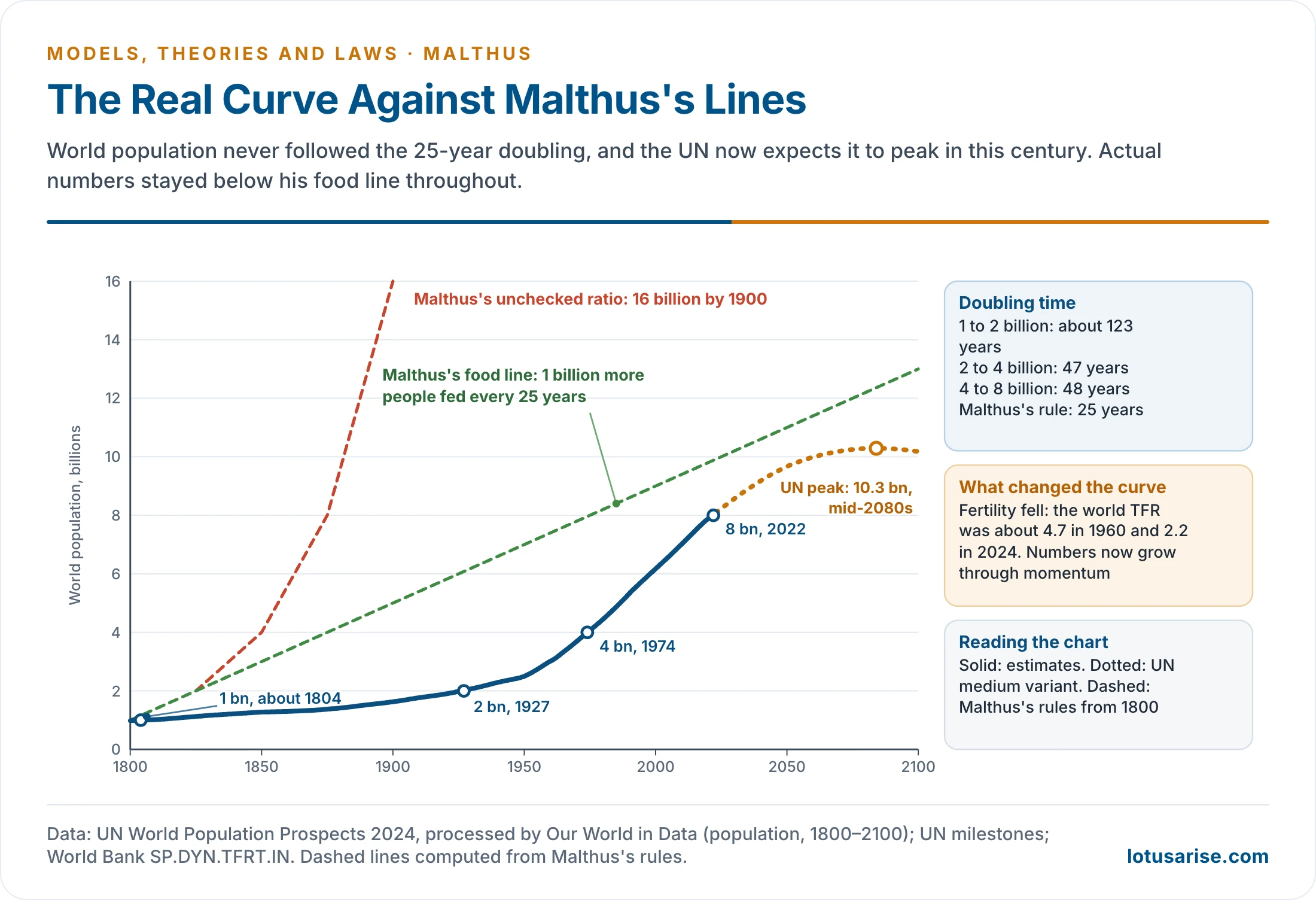
- Population does not follow the ratio. World population has never doubled every 25 years. It took about 47 years to go from 2 to 4 billion and 48 years from 4 to 8 billion.
- Growth varies with fertility, mortality, migration, education, income, culture and policy, so the doubling period differs by country and stage of development.
- Many rich countries now face low fertility, ageing and even decline, the opposite of his fear.
- Food does not follow the ratio either.
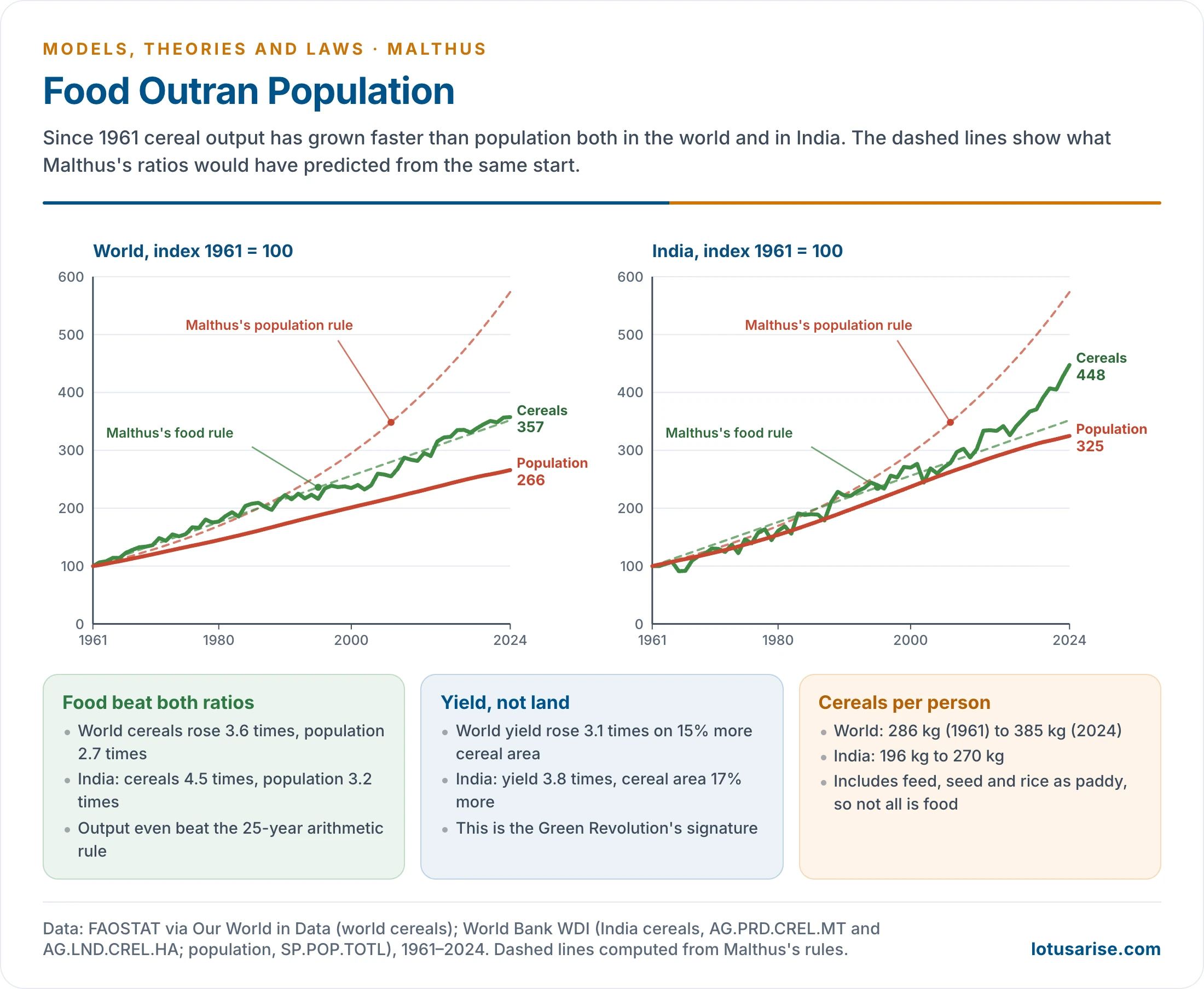
- Since 1961, world cereal output has risen 3.6 times against 2.7 times for population. India’s rose 4.5 times against 3.2 times.
- Yield did most of the work: world yield rose about 3.1 times on only 15% more cereal area.
- Hybrid seed, irrigation, fertiliser, mechanisation, cold storage and trade all broke the assumed limit.
- He underrated technology. He could not foresee the agricultural, industrial, medical, transport and digital revolutions, each of which raised carrying capacity.
- Ester Boserup (1965) reversed his causation. Population pressure is what drives farmers to intensify, moving from long fallow to short fallow, annual cropping and multiple cropping. The intensively double-cropped Indo-Gangetic plain supports her case.
- Julian Simon (1981) called human ingenuity the ultimate resource.
- India’s own forecast failure makes the point: Paul Ehrlich’s The Population Bomb (1968) expected mass famine within years, just as the Green Revolution began.
- He missed the fertility decline. Modern population stabilisation came mainly through contraception, female education and family planning, which he rejected. As the demographic transition shows, rising living standards eventually lower fertility rather than raise it.
- He treated people only as mouths. As Edwin Cannan put it, a baby comes into the world not only with a mouth and a stomach but also with a pair of hands. Population also means labour, skill and innovation.
- Hunger is often about access. Amartya Sen (1981) showed through his entitlement approach that famine can occur with food available, as in Bengal in 1943, when people lose the means to buy it.
- Poverty, inequality, poor distribution, market failure and conflict can each cause hunger with no absolute shortage.
- India’s food stocks and public distribution system, with grain for about 81 crore people, show that access can be engineered by policy.
- Capitalism, not nature, is blamed by Karl Marx. The Marxian critique sees poverty as the product of unequal ownership.
- Other objections complete the case:
- Weak causal link: natural calamities strike thinly peopled areas as well, so positive checks do not prove overpopulation.
- Sex is not the desire for children: the first is a biological urge and the second a social choice.
- Moralism: moral and scientific claims are mixed together, and some argue that his views held back demography as a science.
- Pessimism: he gave little credit to human cooperation, planning and institutional reform.
- Weak evidence: the first essay rested on limited data and deduction rather than verified measurement.
- A poor prophet in Europe: except perhaps in Ireland, the predicted misery did not arrive. Output outran numbers in the nineteenth century, and birth rates fell, first in France, as living standards rose.
What Survives
- He described the pre-industrial world well. Across 1–1500 CE, better technology and land raised population density but not living standards, which is the core Malthusian claim (Quamrul Ashraf and Oded Galor, 2011).
- He began theory-building in population studies and linked demographic change to economic and social change.
- His warning had effect. Some argue that fear of overpopulation itself encouraged later marriage and family limitation in Europe, so that the prophecy helped to defeat itself.
- He influenced others: Charles Darwin drew on him for the struggle for existence, and David Ricardo and John Stuart Mill built him into classical economics.
- Limits remain real at some scales:
- Ecological limits: seven of nine planetary boundaries were assessed as breached in the Planetary Health Check 2025.
- Climate limits: human-caused climate change has cut global farm productivity by about 21% since 1961 (Ariel Ortiz-Bobea and others, 2021).
- Hunger: 645 million people, or 7.8% of the world, faced hunger in 2025 (FAO, SOFI 2026). Africa now has the largest number, 309 million, followed by Asia with 292 million.
- These pressures reflect conflict, price and poverty as much as numbers. Hunger has eased for three years even as population grew, which argues against a simple Malthusian reading.
- His concerns were carried forward by the neo-Malthusians, who accept birth control and widen subsistence to the whole environment.
- Paul Ehrlich’s warning of food and environmental crisis, Garrett Hardin’s tragedy of the commons and the Club of Rome’s Limits to Growth model all belong to this line.
- The debate thereby shifted from food alone to resource scarcity, pollution and ecological limits.
Malthus and Sustainable Development
- The theory poses a basic question for sustainability: can population, consumption and resources stay in balance?
- It also bears on SDG 2 (zero hunger): the world is not on course for its 2030 target, with about 510–520 million people still expected to face hunger in 2030 (SOFI 2026).
- Modern debates extend the question to carrying capacity of ecosystems, food security under climate change, water scarcity, land degradation, biodiversity loss, urban ecological footprint, energy demand, waste and intergenerational equity.
- Numbers alone no longer explain the pressure. Consumption is the larger issue in rich countries, and a low-fertility, high-income household can use far more than a large poor one.
- A short way to state the modern position: population pressure, high consumption, inequality and climate stress together produce resource crises. This is wider than Malthus and closer to a neo-Malthusian reading.
Applicability
| Region | Fit | Why |
|---|---|---|
| Western Europe | Poor | Food supply and industry outran numbers; welfare reduced misery; fertility fell through later marriage and then contraception |
| Developing countries | Partial | Low yields, small holdings, dense population, weak family planning and climate shocks create pressure, but distribution, conflict and governance count equally |
| Sahel, parts of South Asia | Local | Fragile land, high fertility in some areas and water stress keep Malthusian conditions alive |
| World today | Weak on food, stronger on ecology | Population is projected to peak at about 10.3 billion in the mid-2080s (UN WPP 2024) |
- The global trend now runs against him.
- In more than half of all countries and areas, fertility is already below 2.1, and 63 countries had passed their population peak by 2024 (UN WPP 2024).
- In nine countries, including Niger and Somalia, numbers are still expected to double between 2024 and 2054. Pressure on land and food will be sharpest there.
- Developing regions fit him best where farm productivity is low, holdings are fragmented, density is high, poverty limits access to food, and education and health care are weak. Even there, numbers are rarely the only cause.
Malthus and India
- Conditions that recall him: pressure on land, small and fragmented holdings, rural poverty, drought-prone food shortage and import dependence before the mid-1960s, and regional hunger and malnutrition.
- The Green Revolution as an answer:
- Foodgrain output rose from 50.8 million tonnes (1950–51) to a record 357.7 million tonnes (2024–25), a sevenfold rise, while population rose about fourfold from 361 million to about 1.46 billion.
- High-yielding seed, irrigation, fertiliser and state support disproved the arithmetic limit.
- Pressure is regionally uneven: Punjab, Haryana and western Uttar Pradesh gained most, while eastern India, dryland and tribal areas still face food and livelihood stress.
- Plenty has not ended malnutrition: 29.3% of children under five were stunted in NFHS-6 (2023–24), down from 35.5% in NFHS-5. The problem has moved from the amount of grain to diet, health and income.
- Pressure has changed form:
- Water: groundwater depletion in Punjab and Haryana shows scarcity shifting from food to water.
- Cities: Mumbai, Delhi and Kolkata show pressure on housing, water, transport and sanitation.
- Fertility has fallen without misery:
- India was the first country to adopt a national family planning programme, in 1952.
- The total fertility rate is now 1.9 (SRS 2024), below the replacement level of 2.1, through education, health care, later marriage and contraception.
- The range is wide, from 2.9 in Bihar to 1.2 in Delhi, so pressure of numbers is a regional rather than a national issue.
- Numbers can be an asset. If healthy and skilled, the working-age bulge is a demographic dividend, which weakens the pessimistic side of the theory.
Has the Theory Been Discredited?
| Claim | Verdict | Evidence |
|---|---|---|
| Geometric population, arithmetic food | Discredited | Output has outrun numbers since 1961; growth is slowing |
| Fertility rises with income | Discredited for modern societies | Rich countries have the lowest fertility |
| Population presses on resources in pre-industrial societies | Largely supported | Living standards stagnated before about 1800 |
| Limits to growth exist | Open | Water, soil, climate and biodiversity stress |
- The fair conclusion: the law has failed, but the question survives. Modern geography replaces food alone with population, consumption, technology, inequality and environment taken together.
Malthus and Later Theories
| Aspect | Malthus | Neo-Malthusian | Demographic transition |
|---|---|---|---|
| Main concern | Food shortage | Resources and ecology | Birth and death rates with development |
| Technology | Underrated | Accepted but seen as limited | Part of modernisation |
| Population growth | Geometric | Exponential pressure on resources | A temporary surge between two balances |
| Crisis | Famine, disease, war | Climate change, pollution, water scarcity | Rapid growth in the transitional gap |
| Remedy | Moral restraint | Contraception, family planning | Education, health, development |
| Orientation | Moral and economic | Ecological and policy-led | Empirical and evolutionary |
- Transition theory partly answers Malthus: growth does not continue indefinitely, because fertility falls with development. Yet his concern is sharpest in its expanding stage, when deaths have fallen and births have not.
- The full comparison of Malthus, Marx and transition theory shows that they answer different questions rather than simply contradicting each other.
Summary
| Category | Details |
|---|---|
| Author | Thomas Robert Malthus (1766–1834) |
| Work | An Essay on the Principle of Population, 1798; enlarged 1803 |
| Postulates | Food is necessary; the passion between the sexes is constant |
| Law | Population grows geometrically, food arithmetically; doubling every 25 years |
| Checks | Preventive (moral restraint), positive (misery), with vice as a third class |
| Main critique | Technology, fertility decline, human capital, distribution |
| Value today | The question of limits; pre-industrial history; local and ecological pressure |





 History Optional PYQ Master Pack: Topic-wise Model Answers (1985–2025) by LotusArise IAS
thank you so much
So we’ll prepared blog.. supreme quality content,short,crisp and exam oriented.. no words for u sir!
Thanks, Keep Reading
Thank you sooo much….I don’t have words…for all your work…I was bit afraid taking geography optional…..now I’m not afraid thank you sir
sir thanks
This really helps a lot…..But I want PDF of this…. can anyone pls tell me how Can I downld PDF of these notes
u can just C&P on word
Very nice sir. Keep doing this service. God bless you
Thank you so much for the kind words and blessings! Happy to help, keep studying hard.
Thank you so much. Very happy to locate this amazing resource..
Thank you! Thrilled to hear you’re finding it useful.
God level repository… Please never remove this…
Thank you so much! Comments like this make all the hard work worth it. Don’t worry, it’s here to stay!
its a very helpful content and informative