

- Federalism divides power between a centre and its constituent units. Its geographical basis is the set of physical, socio-cultural and economic forces that make such a division both possible and necessary.
- Geographical federalism arises when the centripetal (unifying) and centrifugal (diversifying) forces within a country are in balance. It is the spatial expression of unity in diversity.
- India is the classic case: a Union of 28 States and 8 Union Territories since 26 January 2020, in a land held together by mountains, sea and monsoon but divided by relief, language and history.
Federalism and Its Geographical Basis
The Balance of Forces
- William S. Livingston (1952) placed the essence of federalism in the forces of society, economic, social, political and cultural, and less in legal wording. A society is federal when its diversities are grouped territorially.
- The terms come from political geography. Richard Hartshorne (1950) read a working state through its centripetal and centrifugal forces.
- On this reading, the form of a state follows from the balance:
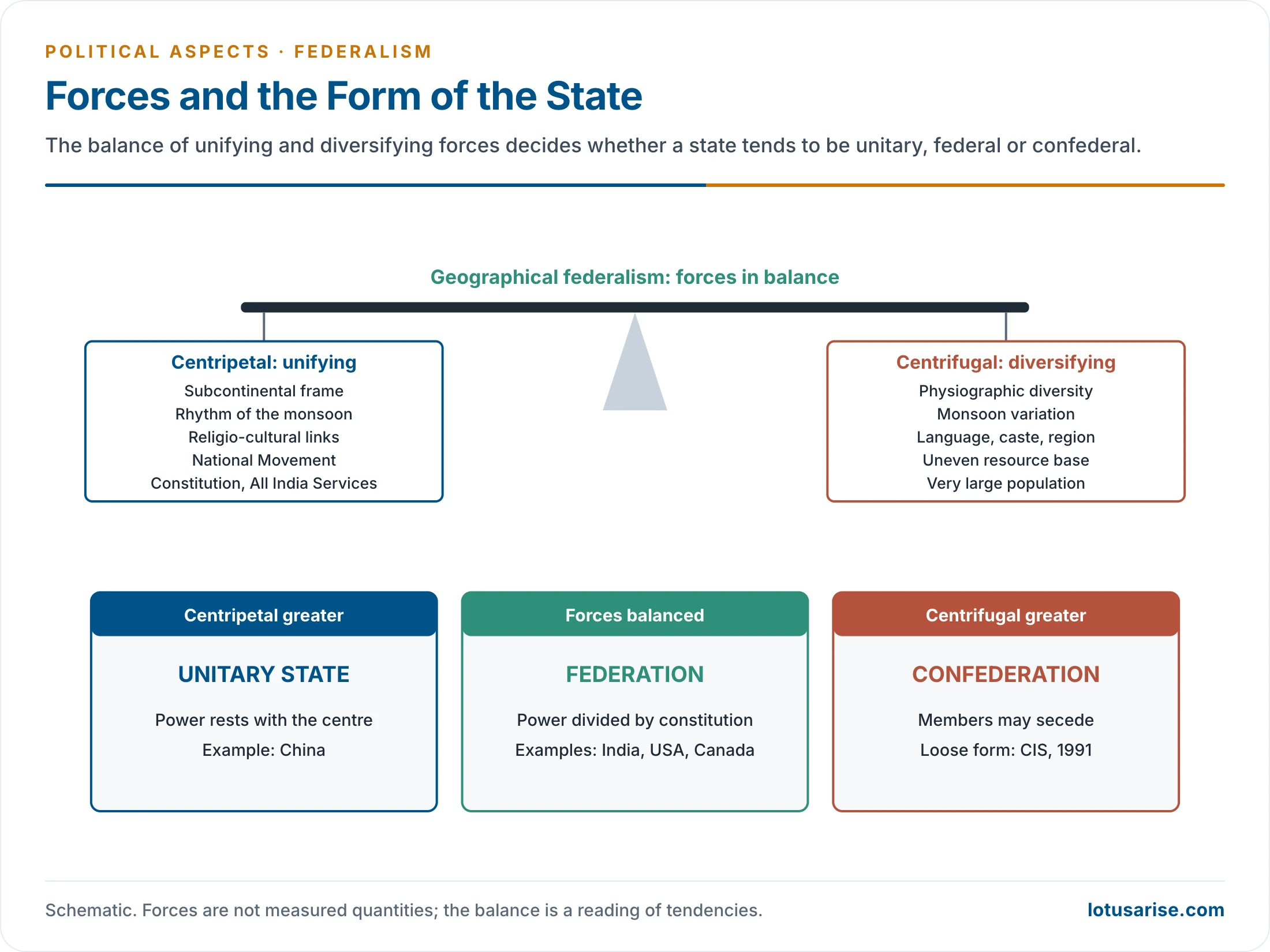
| Balance of forces | Political form | Character | Example |
|---|---|---|---|
| Centripetal > centrifugal | Unitary | Power rests with the centre | China |
| Centripetal = centrifugal | Federal | Power is divided by the constitution | India, USA, Canada, Australia |
| Centripetal < centrifugal | Confederation | Member states keep the power to secede | CIS, as a loose association of former Soviet republics since 1991 |
- The United Arab Emirates, often listed with confederations, has been a federation of seven emirates under its constitution of 2 December 1971, though loosely bound in practice.
- Geographical federation means the inherent and genetic causes: the physiographic, socio-cultural and economic forces and processes that create a balance between unifying and diversifying forces.
| Feature | Geographical federalism | Political federalism |
|---|---|---|
| Origin | Inherent forces and processes in the land and its people | Superimposed by statutory provisions |
| Direction of flow | Bottom to top | Top to bottom |
| Durability | Lasting, as it grows from the ground | Depends on continued agreement and law |
What Federalism Means
- Federalism is a political institution in which the population of a geographical unit comes together for a certain political objective.
- It is a system of government in which powers are divided between the centre and constituent parts such as states or provinces.
- It is an institutional mechanism to accommodate two sets of politics: one at the national level and one at the regional or provincial level.
- A federation is thus an institutional form of political organisation, and one of the two forms of political administration, the other being unitary.
- Four criteria of political federalism:
- Supremacy of the constitution
- Written constitution
- Independent judiciary
- Division and separation of power
- Its further basis in practice:
- Two sets of governments
- Rigid constitution
- Bicameralism at the federal level, with one chamber representing the states
- Separate agencies through which the federal government and federating units exercise their power
- Federalism is needed when a political area develops two kinds of politico-administrative objectives:
- Common objectives: subjects of core national interest such as defence, currency and communication. These are the responsibility of the central government.
- Regional interests: these are executed by provincial and local governments, within a hierarchy of central, provincial and local government.
- In these terms, centripetal forces resemble the common objectives and centrifugal forces resemble regional interests.
- In India, the Seventh Schedule gives this division a legal form through the Union, State and Concurrent Lists, which began with 97, 66 and 47 entries.
- Article 1 calls India a Union of States.
- Fifth and Sixth Schedules add special arrangements for tribal areas. The Sixth covers tribal areas of Assam, Meghalaya, Tripura and Mizoram.
- The Inter-State Council (Article 263, set up in 1990), the five Zonal Councils (States Reorganisation Act, 1956) and the North Eastern Council (1971) are its forums for coordination.
Centripetal and Centrifugal Forces in India
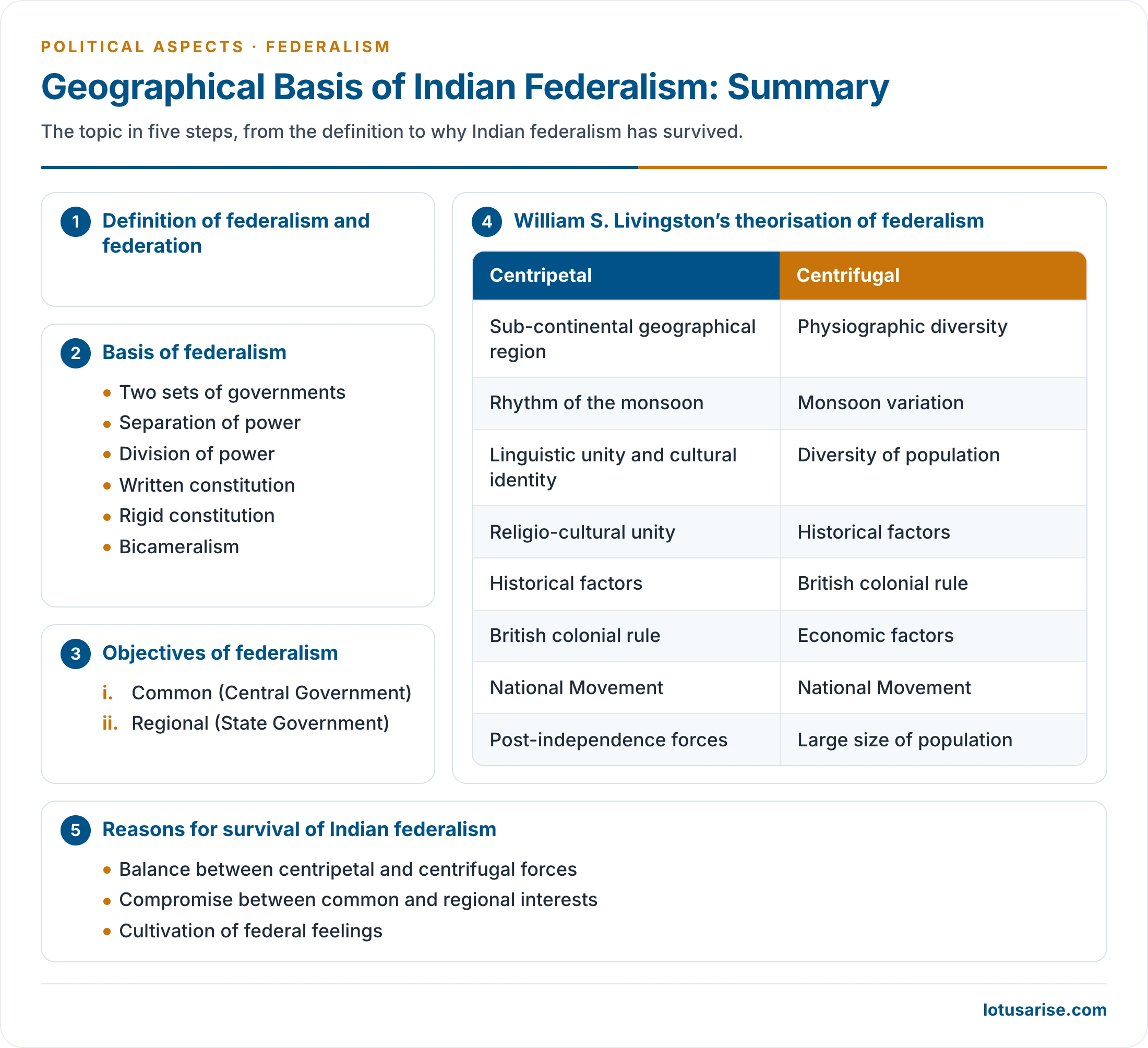
Centripetal Forces
- Sub-continental geographical region: India’s layout gives it a continental character.
- Himalaya in the north.
- Ocean on three sides in the south.
- Rugged mountain terrain in the north-east.
- Desert in the west, and the lines of the 1947 Partition in the west and east.
- George Goudie Chisholm saw the Indian subcontinent as the clearest example anywhere of a region set apart by nature.
- George B. Cressey also called India a subcontinent, a single unit holding many physical and cultural parts. Some Indian geographers object to the term as a colonial legacy, and some scholars prefer South Asia.
- The Great Plains, lying between the Himalaya and the Peninsula, have a unifying role of their own.
- Rhythm of the monsoon: the monsoon binds India as one climatic region.
- Its normal dates now run from onset over Keralam (Kerala) on 1 June, through cover of the whole country by 8 July, to withdrawal starting on 17 September and ending by 15 October. The older account gave 1 June to 15 September.
- Rainfall bunched into a few months, and the farming tied to it, is an all-India experience.
- Its rhythm has shaped songs, ragas, dance forms and music, a bond across the whole country.
- Linguistic unity and cultural identity:
- Linguistic groups have regional concentrations, which became the basis of linguistic States. The success of this arrangement shows a hidden linguistic unity: language need not be a dividing line.
- Indic culture: the culture related to India and the people living in it.
- Carl Ortwin Sauer’s cultural geography, in which culture works on the natural area to produce a cultural landscape, explains why a country’s geography leads to cultural regionalisation.
- English has emerged as a link language.
- Devanagari is common to many northern languages, and the southern scripts descend, as Devanagari does, from Brahmi.
- Hindustani has grown as a people’s language, carried by Indian films and Indian Railways.
- Religio-cultural unity: there are hidden religious and cultural links across regions.
- Coconut from Keralam is used in worship throughout India.
- Rama and Ravana are both revered in different parts of the country.
- Saint-poets preached the brotherhood of all people, and the Ramayana and Mahabharata give themes even to tribal dance and music.
- Shared shrines draw devotees across faiths: Hindus visit dargahs and mosques, and Muslims visit temples.
- Partition was argued on the two-nation theory, yet India kept a very large Muslim population, 17.22 crore or 14.23% in Census 2011, within a secular Constitution.
- Federalism was adopted with limited resistance.
- Historical factors:
- Major rulers aspired to rule India from Kanniyakumari to Kashmir.
- The Arthashastra of Chanakya describes the chakravartikshetra, the realm from the Himalaya to the sea. A saying attributed to him sets the protection of Aryavarta above that of a single janapada. Both point to an old idea of the whole.
- Bharat itself recalls King Bharata, whom tradition credits with seeing the country’s underlying unity.
- Invaders came for India, not for a single province.
- British colonial rule: administrative unification gave a further boost to centralising forces.
- National Movement: the most significant unifying force. It brought people into contact, and the Indian National Congress served as a common platform.
- Post-independence forces:
- Common defence and military organisation.
- Trade, transport and communication, with a national home market: Assam tea, Punjab and Haryana wheat, Chotanagpur minerals and southern spices reach the whole country.
- The Constitution of India, which imparts the feeling that India belongs to all Indians.
- All India Services.
Centrifugal Forces
- Physiographic diversity: plains, plateaus, hills, coasts and deserts have produced diverse cultural elements.
- In very large countries such as Australia, Canada, India, the USA and the former USSR (now Russia), the centre cannot look into the day-to-day economic affairs of every region. Healthy federalism becomes necessary.
- Monsoon variation: although the monsoon links the whole country, its annual variability and its spatial and temporal variation in rainfall have created regional diversity in farming patterns, food habits and industrial regions.
- The range runs from Mawsynram in Meghalaya to Jaisalmer in the Thar.
- Diversity of population: Indian society holds many sub-national, linguistic, regional and caste groups, so regional feeling is strong.
- Regional governance has a long history. The British recognised this geography and governed through Presidencies.
- The Government of India Act, 1935 laid the foundation of federalism in India.
- Language: an older count gave 744 languages and dialects, with 97% of the people speaking 14 languages. Census 2011 gives 121 languages, of which the 22 scheduled languages are the mother tongue of 96.71%.
- Religion: India has the world’s largest populations of Hindus, Sikhs and Parsis, and the third-largest Muslim population.
- Historical factors: kings enjoyed regional autonomy, and needed only to pay revenue to the ruler at the centre.
- British colonial rule: princely states were recognised, 562 of them beside nine British provinces at independence, and zamindars functioned independently under the zamindari system.
- Economic factors: the uneven natural resource base calls for a strong federal structure to distribute resources fairly.
- Mineral-bearing States won a major ruling on 25 July 2024, when a nine-judge bench of the Supreme Court upheld, 8 to 1, their power to tax mineral rights.
- National Movement: the British policy of divide and rule, and the regard shown to princely states and zamindars, made these groups act as safety valves for colonial rule.
- Large size of population: India had 17.5% of the world’s people at Census 2011, against the 17% often quoted.
- Uttar Pradesh alone had 19.98 crore. Only four countries then had more, counting India itself: China, India, the USA and Indonesia.
- Even provincial governments thus serve very large populations.
The Himalaya: Both Forces at Once
- As a unifying frontier: the Himalaya shields the north, feeds the great rivers and carries a shared pilgrim geography. The war of 1962 showed, however, that it is no complete defence barrier.
- As a diversifying belt: deep valleys and isolation have kept distinct hill identities, and regional disparity between hills and plains has fed separatist sentiment in peripheral hill areas, above all in the north-east.
- In federal terms: several Himalayan units are products of this geography, from hill States such as Uttarakhand to the Union Territory of Ladakh.
Why Indian Federalism Has Lasted
Comparison and Accommodation
- Centripetal factors let Indian federalism emerge and survive. After the Second World War, several federal states broke up: Yugoslavia, the USSR and Czechoslovakia.
- Indonesia, a unitary state, faced serious pressures: Timor-Leste became independent in 2002, and the Aceh conflict ended in a peace agreement in 2005.
- In India, regional forces have mostly sought regional demands within the Union, and many have been met by negotiation.
- Punjab: the accord of 1985 addressed basic demands of the Punjabi people during the Khalistan movement, and violence there subsided in the following decade.
| Region | Settlement | Date | Later position |
|---|---|---|---|
| Punjab | Rajiv–Longowal Accord | 24 July 1985 | Met many demands of the agitation; Chandigarh’s transfer, agreed in it, not carried out |
| Mizoram | Mizoram Peace Accord with Laldenga’s Mizo National Front | 30 June 1986 | Statehood on 20 February 1987 |
| Assam | Assam Accord | 15 August 1985 | Ended the agitation begun in 1979 |
| Darjeeling | Darjeeling Gorkha Hill Council; then Gorkhaland Territorial Administration | 1988; 18 July 2011 | Administrative and financial powers, none legislative; the statehood demand continues |
| Ladakh | Autonomous hill councils; then Union Territory | 1990s–2003; 31 October 2019 | Talks on statehood and the Sixth Schedule stood deadlocked in October 2026 |
| New States | Chhattisgarh, Uttarakhand, Jharkhand; Telangana | 2000; 2014 | Meets demands inside the Union |
- Jammu and Kashmir became a Union Territory on 31 October 2019. In its judgment of 11 December 2023, the Supreme Court upheld the end of special status and recorded the Union’s assurance on restoring statehood, a demand still pressed in 2026.
- Fiscal federalism is a further test.
- GST began on 1 July 2017 under the 101st Amendment, with a GST Council under Article 279A. States’ revenue was protected for five years, to 30 June 2022.
- The Sixteenth Finance Commission, whose report was tabled on 1 February 2026, kept the States’ share at 41% for 2026–31 and added a State’s contribution to GDP as a criterion.
- Representation is another. Lok Sabha seat numbers are frozen until the first census after 2026.
- The Constitution (131st Amendment) Bill of April 2026, which would have raised the House to 850 seats, was defeated on 17 April 2026 by 298 to 230, short of two-thirds.
- The next count, Census 2027, has the reference date of 1 March 2027, with 1 October 2026 for Ladakh and snow-bound areas.
What the Balance Requires
- A federation is a compromise between common and regional interests, so the federal government holds the key to its success.
- The centre should be neither too rigid nor too flexible towards regional demands. Either extreme endangers the system.
- It must cultivate federal feeling and gradually reduce extreme regionalism and divisive sentiment.
- Genuine demands should be met promptly, which eases regional feeling.
- Demands without a genuine basis are to be discouraged and contained, within the law where they turn violent.
- India’s record in meeting these needs helps explain the survival of its federalism.
- Under-development and economic disparity can be reduced substantially in a federal structure, because governments of backward areas can frame and carry out their own regional plans.
- Size matters: small states with a long historical past are largely ethnically based, and generally have unitary governments. Countries with large areas and populations, and many ethnic, cultural and linguistic groups, are better governed through a federal government.
- In sum: the physical, cultural, social and historical factors above show that geography has played a vital role in forming regional units with distinct identities, and has thereby helped the cause of Indian federalism.
Previous Year Questions
2019Discuss the political aspects of the Himalaya. Explain how it has affected geo-strategy, geo-politics and regional consciousness of Indian federalism.2017Goods and Services Tax (GST) has a differential impact on developed and backward States of the country. How and why?2006Examine the geographical basis of Indian federalism.1996Write short note: Geographical basis of the Indian Federation.1993Examine critically the geographical basis of the Indian federation.




Can i get pdf of these notes
You can copy and paste in your online notebook.
Great 👏👏👏👏
Absolutely Great Content!
♥️♥️♥️♥️♥️♥️♥️♥️♥️♥️
In Purchsed notes there will be more content or same ??
Same
Great content. Thank you
Thank you 😊