

Gender Discrimination: Female Foeticide, Land and Property Rights; Empowerment.
Official Syllabus: Paper II, Section A, Unit 9
Gender discrimination means treating people unequally — giving them fewer rights, opportunities, resources or respect — because of their gender. In almost every known society the burden of this unequal treatment has fallen on women. The philosophical problem behind it is old and deep: is the lower position of women a fact of nature (written into biology) or a product of culture (made by human societies and therefore changeable)? If it is natural, perhaps nothing can or should be done. If it is made, then it is a matter of justice, and society owes women a remedy. This article explains what gender discrimination is, the crucial distinction between sex and gender, whether inequality is rooted in biology, how gender as a social construct shapes people’s opportunities, rights and access to resources, the spheres in which discrimination operates, the arguments for and against it, and the meaning and need of gender equality as a demand of social justice. Beauvoir’s classic account of how “one becomes a woman” follows in Article 2; the theories of feminism in Articles 3 and 4; and the three syllabus issues — female foeticide, land and property rights and empowerment — in Articles 5, 6 and 7.
In simple words
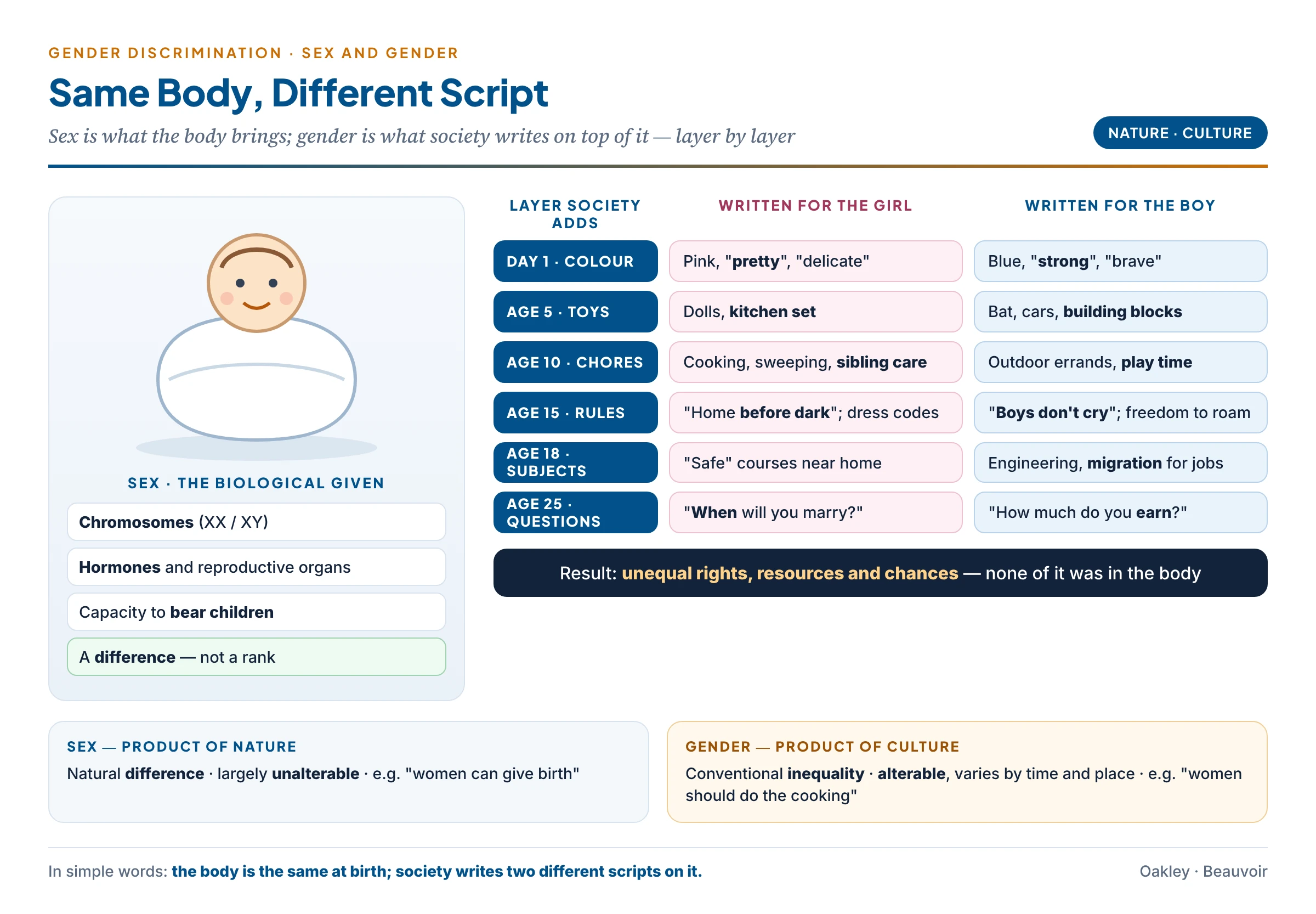
Two babies are born in the same hospital on the same day. Biologically one is a girl and one is a boy — that is sex. Within a week the girl is wrapped in pink and called “pretty”, the boy in blue and called “strong”. At five she gets a kitchen set, he gets a cricket bat. At fifteen she is told to be home before dark, he is told to “be a man”. At twenty-five she is asked when she will marry, he is asked about his salary. None of this was in their bodies. All of it was added by society — that is gender. Gender discrimination begins where these added expectations are turned into unequal rights and chances.
Context & Problem
What Is Gender Discrimination?
- Definition: gender discrimination is the differential treatment of men and women solely on the basis of gender, where the difference in treatment cannot be justified by any relevant reason and leaves one group worse off.
- The UN definition (Article 1 of CEDAW, the Convention on the Elimination of All Forms of Discrimination against Women, 1979): “any distinction, exclusion or restriction made on the basis of sex which has the effect or purpose of impairing or nullifying the recognition, enjoyment or exercise by women… of human rights and fundamental freedoms in the political, economic, social, cultural, civil or any other field”.
- “Effect or purpose” — discrimination need not be intended. A rule that looks neutral but hurts women in practice (for example, promotions that require uninterrupted service, which women with child-care breaks rarely have) is also discrimination.
- “Any field” — it covers the home and the family, not only the state and the market.
- Kinds of discrimination:
- Direct discrimination — openly treating a woman worse because she is a woman (refusing to hire women for a job they can do).
- Indirect discrimination — a neutral-looking rule with an unequal effect (height requirements for police jobs; meetings fixed late in the evening).
- Structural or systemic discrimination — inequality built into institutions, customs and expectations, so that nobody has to “decide” to discriminate (inheritance customs, the unpaid “double shift” of housework).
- Intersectional discrimination — when gender combines with caste, class, religion, disability or race (a Dalit landless woman faces all of these at once — Article 4).
Patriarchy — the System behind Discrimination
- Patriarchy (literally “rule of the father”) is a social system in which men hold primary power in the family, property, religion, politics and culture, and in which male authority is treated as natural.
- The sociologist Sylvia Walby describes six connected structures of patriarchy:
- Paid work — women are kept in lower-paid, less secure jobs.
- Household production — women’s unpaid domestic labour is appropriated by husbands and families.
- Culture — media, religion and education present women as lesser or as objects.
- Sexuality — double standards (a man’s “conquest”, a woman’s “dishonour”).
- Male violence — domestic violence, harassment, assault, used to control women.
- The state — laws and policies that, until recently, openly favoured men.
- The Indian feminist Kamla Bhasin explained patriarchy in everyday words: it is the system in which the father is the head of the household, the son carries the family name, and the daughter is “paraya dhan” (another’s wealth), raised to be given away.
How Did It Arise?
- In early societies, biological differences — pregnancy, breast-feeding and, on average, greater male muscle strength — produced a division of labour: men hunted and fought, women cared for children and the home.
- With the growth of technology, sweeping changes took place in every other part of social organisation — but the old division of labour between men and women remained unchanged. A role that once had a practical reason became a fixed hierarchy, producing a systematic deprivation of women from power.
- Engels linked this to private property: when men began to own herds and land, they wanted heirs of certain paternity, which required control over women’s sexuality — “the world-historic defeat of the female sex” (Article 3).
Why It Is a Philosophical Problem
- Personhood: are women full persons, ends in themselves, or “supporter-creatures” for others?
- Nature vs nurture: what is natural about men and women, and what is made? Can an “is” (a biological difference) ever justify an “ought” (unequal rights)?
- Equality and justice: does justice require treating men and women the same, or treating them differently to make them equal?
- Public and private: should justice stop at the door of the home, where much of women’s inequality lives?
Core Doctrine
Sex and Gender — the Key Distinction
- Sex is the biological difference between male and female bodies: chromosomes (XX/XY), hormones, reproductive organs and secondary sexual characteristics. It is, broadly, a product of nature.
- Gender is the set of socially, culturally and historically constructed roles, behaviours, identities, expectations and power relations attached to being male or female. It is a product of culture.
- The distinction was made popular in the social sciences by Ann Oakley in Sex, Gender and Society (1972): “‘Sex’ refers to the biological division into male and female; ‘gender’ to the parallel and socially unequal division into femininity and masculinity.”
- Its philosophical root is Simone de Beauvoir’s sentence (1949): “One is not born, but rather becomes, a woman” (Article 2).
| Point of comparison | Sex | Gender |
|---|---|---|
| Basis | Biology — body, chromosomes, hormones | Culture — roles, norms, expectations |
| Source | Product of nature | Product of society and history |
| Kind of difference | Natural difference | Conventional inequality |
| Can it change? | Largely unalterable | Alterable — varies across times and places |
| Example | Women can bear children | Women “should” do the cooking |
| Moral status | Difference without rank | Often a hierarchy of power |
In simple words
Think of sex as the hardware of a phone and gender as the apps society installs on it. The hardware sets some limits, but most of what the phone actually does depends on the apps. Two identical phones can behave completely differently, and the apps can be uninstalled and replaced. Gender discrimination is like installing “less useful” apps on half the phones and then saying those phones were “naturally” weaker.
Masculinity and Femininity as Instruments of Social Control
- Every society attaches expected traits to each sex:
- Masculinity — aggressiveness, logic, toughness, dominance, ambition, control of emotions.
- Femininity — gentleness, intuition, emotion, submissiveness, care, modesty, beauty.
- These traits are presented as natural, but they work as instruments of social control that reinforce male dominance. The “masculine” traits happen to be those needed for power (in politics, business, the army); the “feminine” ones are those needed for service (in the home).
- Gender roles are the tasks expected of each sex; gender stereotypes are the fixed beliefs behind them (“women are bad at mathematics”, “men don’t cry”); gender identity is a person’s inner sense of being a man, a woman or neither.
- These expectations become the foundation of gender inequality: a girl who is assertive is called “bossy”, a boy who is gentle is called “weak”, and both are pushed back into line.
- Socialisation, the process by which children learn these roles, works through the family (chores, toys, freedom of movement), school (subject choices, textbooks showing mothers cooking and fathers at office), religion (rituals in which only sons can perform certain rites), media (advertisements showing women only in kitchens or as decoration) and language (“man-made”, “chairman”, abuses that insult a man’s mother or sister).
- Even the body is shaped by these norms. The rapid rise in women’s athletic records in recent decades — once girls were allowed to train, compete and eat well — shows that social norms had shaped biology and held back women’s physical development.
Is Gender Inequality Rooted in Biology?
This is the oldest question in the debate. There are two broad positions.
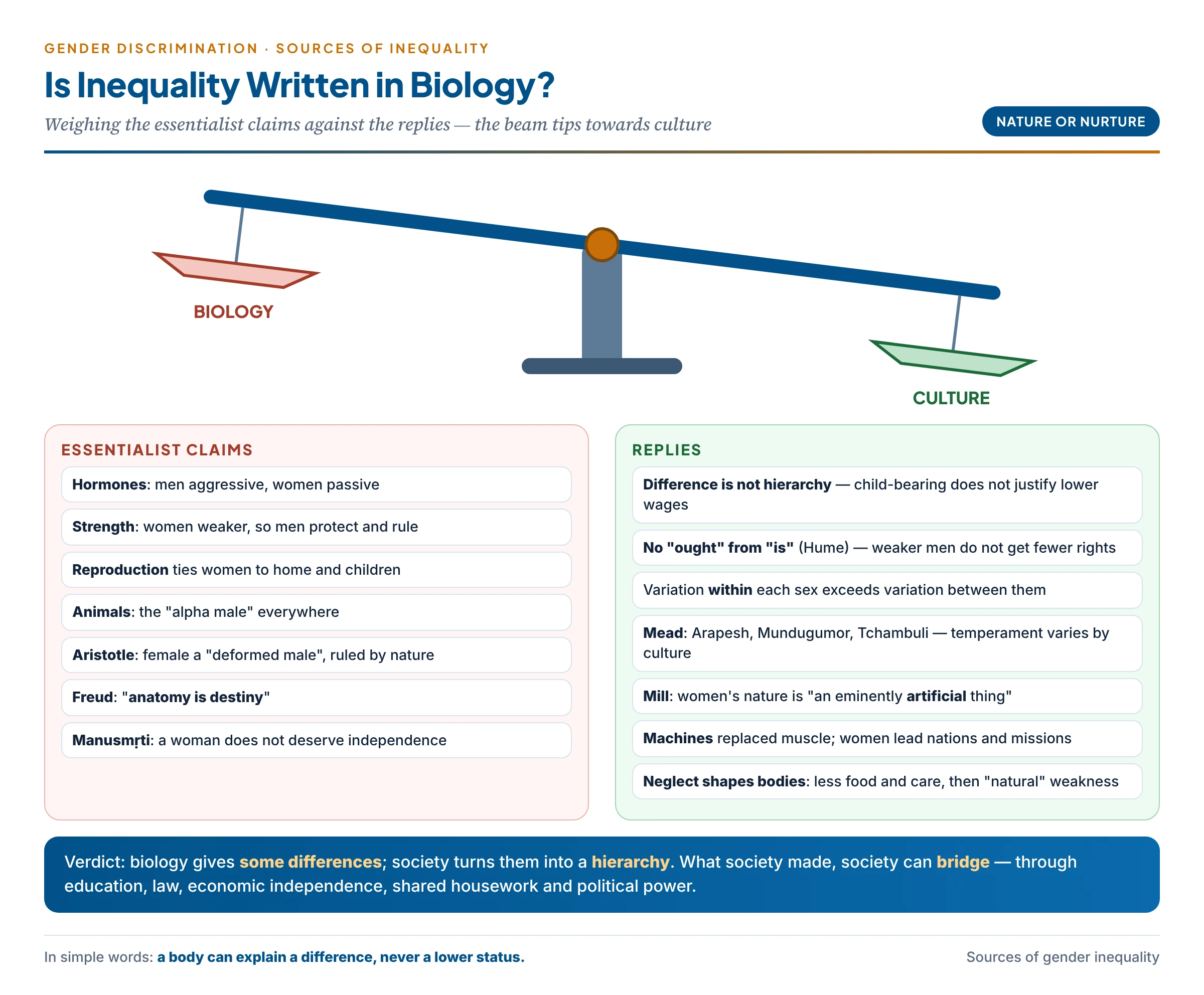
1. The biological (essentialist) view — inequality follows from nature:
- Hormones: male hormones (testosterone) make men aggressive and competitive; female hormones make women passive and nurturing.
- Physical strength: women are, on average, smaller and physically weaker, so men naturally became protectors, hunters and warriors.
- Reproduction: pregnancy and breast-feeding tie women to children and the home.
- The animal world: male dominance (the “alpha male”) is seen across much of the animal kingdom.
- Aristotle: the relation of male to female is “by nature” that of ruler to ruled; the female is “as it were a deformed male“, lacking full deliberative authority. Aquinas repeated the idea of woman as a “misbegotten male“.
- Freud: “Anatomy is destiny” — a girl’s discovery that she lacks a penis shapes a weaker, more passive and more envious personality.
- Evolutionary psychology (a modern version): men and women evolved different strategies of mating and parenting, so some psychological differences may be inherited.
- Indian scripture: the Manusmṛti declares “na strī svātantryam arhati” — a woman does not deserve independence: her father protects her in childhood, her husband in youth, her sons in old age.
2. The cultural (constructionist) view — inequality is made, not born:
- Difference is not hierarchy. Biology may explain that women bear children; it cannot explain why that should mean lower wages, no inheritance or no vote. A difference becomes an inequality only through social rules.
- The is–ought gap. As Hume taught, no “ought” follows from an “is” alone. Even if women were on average weaker, it would not follow that they ought to have fewer rights — we do not give weaker men fewer rights.
- Variation within each sex is larger than between them. Many women are stronger, more logical or more aggressive than many men.
- Cultures differ. The anthropologist Margaret Mead (Sex and Temperament, 1935) found three New Guinea peoples who did not fit Western stereotypes: among the Arapesh both sexes were gentle, among the Mundugumor both were aggressive, and among the Tchambuli the women were dominant and practical while the men were decorative and emotional. If temperament were fixed by sex, such variety could not exist.
- “An eminently artificial thing.” J.S. Mill (The Subjection of Women, 1869): “What is now called the nature of women is an eminently artificial thing — the result of forced repression in some directions, unnatural stimulation in others.” Nobody can know women’s “nature” while they have never been free.
- Technology has removed the relevance of strength. In a world of machines, computers and law, muscle power no longer decides who can be a pilot, judge, surgeon or prime minister.
- Biology itself is shaped by society. Girls given less food and medical care grow up shorter and weaker — social neglect produces the “biological” weakness later used to justify the neglect. Amartya Sen showed that where there is no discrimination, women in fact outlive men and outnumber them (Article 5).
- Women’s achievements disprove claims of natural incapacity: Indira Gandhi, Margaret Thatcher and Golda Meir (the “Iron Lady” of Israel) took firm decisions in war and crisis; women scientists led India’s Mars and Moon missions.
In simple words
Suppose a school gives one group of children half the food and no sports period for ten years, and then announces that this group is “naturally” weaker at sports. Nobody would accept that. Yet this is exactly the reasoning behind many “biological” arguments about women: first society limits women’s food, education, training and freedom, then it points to the result and calls it nature.
- Settled view: biology gives some differences (above all, the capacity to bear children); it does not give a hierarchy. Inequality is primarily cultural, and therefore it can be bridged — through education, law, economic independence, shared domestic work, changed socialisation and political power.
Butler: Is Even “Sex” a Construction?
- Judith Butler (Gender Trouble, 1990) radicalised the sex–gender distinction.
- Gender is performative. Gender is not something we are but something we do — a repeated performance of gestures, dress, speech and behaviour, learned and enforced by society. “There is no gender identity behind the expressions of gender; that identity is performatively constituted by the very ‘expressions’ that are said to be its results.”
- Sex is not a pure biological “given”. The way we divide bodies into exactly two sexes is already shaped by gender norms. Intersex people (born with mixed sex characteristics) show that nature is less tidy than the two-box picture.
- Subversion: if gender is a repeated performance, it can be performed differently — the norms can be “troubled”.
- Criticisms:
- Bodies are real. Pregnancy, menstruation, menopause and sex-specific diseases are not merely performances; a theory that dissolves sex may lose sight of women’s real bodily needs (maternity care, sanitary facilities).
- Where is the subject? If there is no “doer behind the deed”, who resists and who is oppressed?
- Too abstract for the poor. Martha Nussbaum criticised Butler’s style as a retreat into “symbolic” politics, far from the material struggles of poor women for food, land and safety.
- Balanced view: Butler is right that gender norms go “all the way down” and are kept alive by repetition; but a workable ethics of gender must still recognise real bodily differences while denying that they justify hierarchy.
Common confusion
Is “gender” just a polite word for “sex”? No. Sex names a biological category (male, female, intersex). Gender names the social meanings, roles and power attached to it (masculine, feminine). “Women can give birth” is a statement about sex; “women should not work after marriage” is a statement about gender. Mixing the two is exactly how social customs disguise themselves as nature.
Gender as a Social Construct: How It Shapes Opportunities, Rights and Access to Resources
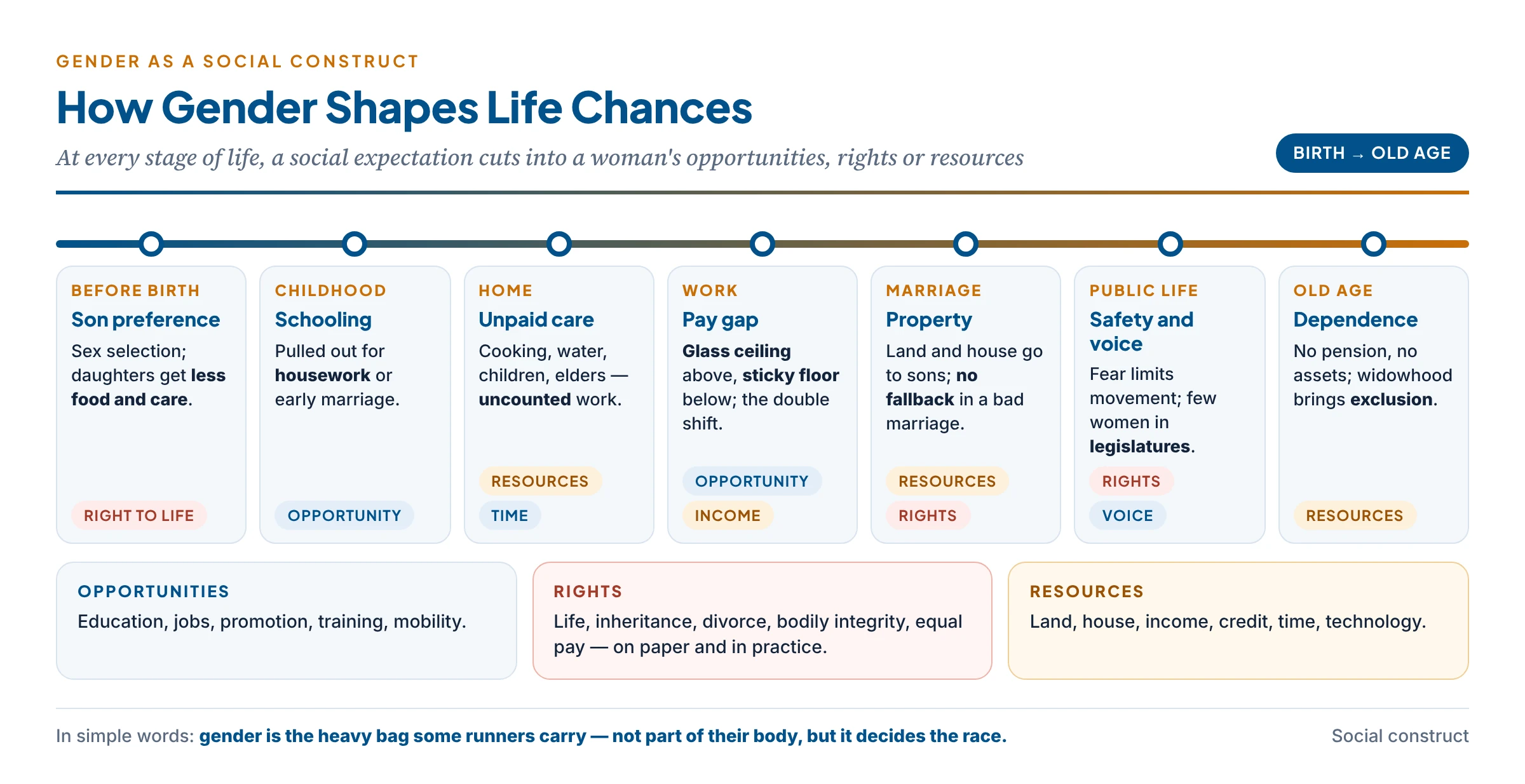
Because gender is made by society, it can be — and has been — used to distribute life-chances unequally. It works through every stage of life:
- Before birth and childhood: son preference leads to sex-selective abortion and neglect of daughters in food, vaccination and medical care (Article 5).
- Education: girls are withdrawn from school for housework, sibling care or early marriage; they are steered away from science, engineering and sports.
- Work and income:
- Unpaid care work — women do most of the cooking, cleaning, fetching water and caring for children, the sick and the old, and this work is not counted in national income.
- The double burden — women in paid jobs still do most of the housework (“the second shift”).
- Occupational segregation and the pay gap — women are crowded into low-paid “feminine” work (domestic service, nursing, teaching small children) and paid less for similar work.
- The glass ceiling (an invisible barrier to the top posts) and the sticky floor (being stuck in the lowest-paid jobs).
- Property and resources: land, houses, credit and inheritance pass mainly to sons, leaving women without a fallback position (Article 6).
- Rights in law and in practice: personal laws on marriage, divorce, maintenance and inheritance long favoured men; even equal laws are weakened by custom and family pressure.
- Mobility and safety: fear of harassment limits where and when women can travel, study or work.
- Voice and power: few women in parliaments, boardrooms, courts and religious bodies, so decisions are made about them without them.
- Technology: fewer women own mobile phones or use the internet — a “digital gender divide“.
- Health: anaemia, maternal mortality and lack of control over one’s own fertility are partly products of low status.
In simple words
Imagine a race in which some runners must carry a heavy bag — housework, safety worries, no money of their own, no land, family permission for every step. Everyone starts at the same line and the rules say “equal race”. Yet the runners with bags keep falling behind. Gender as a social construct is the bag: it is not part of the runner’s body, but it decides who wins.
Spheres of Discrimination against Women
- Political sphere
- Feminists argue that society discriminates between men and women in the allocation of benefits and burdens: men get power and visibility, women get duties and invisibility.
- Late franchise: women won the vote in the USA in 1920 and in Switzerland only in 1971 (India gave universal adult franchise from the start, in 1950).
- Low representation: women make up only about 14% of India’s Lok Sabha (74 of 543 members elected in 2024).
- Why so few women leaders? Taking the USA, which has never had a woman president, as an example: most candidates come from elite professions like law; a record of military service or high standing in business is the usual stepping stone; and party workers are less willing to raise funds for women candidates.
- Violence as political control: sexual harassment, molestation on streets and in offices and domestic violence keep women out of public life.
- Women can lead: Indira Gandhi, Margaret Thatcher and Golda Meir took bold decisions in times of crisis; women have led the Chipko movement and the Narmada Bachao Andolan — though, notably, they have often fought for the welfare of society at large while scarcely building their own political careers.
- Economic sphere
- Women’s contribution to economic life has been largely ignored: the system of national income accounting leaves out the unpaid work women do for family and community.
- Ironically, women who do this huge amount of unpaid work are stigmatised as “dependent” on men.
- Lower wages, insecure informal work, fewer assets and less access to credit (Articles 6, 7).
- Cultural sphere
- Social practices reflect a climate of masculine dominance.
- Language: most abuses insult a person’s mother, sister or daughter — a woman’s body is treated as the family’s honour.
- Objectification: women’s looks and voices are widely used in advertising to sell products, reducing them to objects of display.
- Mythology and ritual: in Indian tradition women have been treated as an object of donation (kanyādāna, “the gift of a virgin”); among Hindus, the cremation rites are traditionally performed by a son to ensure the parent’s place in heaven — one reason for son preference.
- Social and domestic sphere — dowry, child marriage, restrictions on movement and dress, honour killing, domestic violence, unequal food and health care within the household.
- Legal and religious sphere — unequal personal laws, exclusion from priesthood and from some places of worship, and religious sanction for inequality (Article 6).
Arguments for Gender Discrimination — and Their Replies
| Argument | What it says | Reply |
|---|---|---|
| Biological | Hormones make men aggressive and women passive; women are weaker; male dominance is natural in animals; “anatomy is destiny” (Freud) | Difference is not hierarchy; variation within sexes; social neglect shapes bodies; no “ought” from “is” |
| Historical | Women have been treated as inferior since time immemorial; so long a practice must be justified; Aristotle — women are by nature ruled | Age does not make a practice just — slavery and untouchability were also ancient; Aristotle also defended slavery |
| Cultural | Masculine and feminine roles keep society orderly | These roles are instruments of social control that reinforce male dominance |
| Religious / scriptural | Scriptures assign separate and subordinate duties to women | Scriptures also contain egalitarian strands (Gārgī, Maitreyī; Bhakti saints); religion must answer to justice, not the reverse |
| Functional | A family works best when the husband earns (the “instrumental” role) and the wife cares (the “expressive” role) — a view of the sociologist Talcott Parsons | It ignores women’s unpaid labour, makes women dependent, and assumes only one family form |
Arguments for Gender Equality
- Moral argument — men and women have equal moral worth. Kant: every rational being must be treated as an end in itself, never merely as a means. Using women merely as means to men’s comfort, lineage or honour violates this. Hence gender equality is morally justified.
- Political argument — a good political system needs maximum participation. Democracy without half the population is incomplete; laws made without women’s voices ignore their needs.
- Economic argument — it is economically unproductive to keep half the population out of the economy. Countries where women work in large numbers gain far more from their talent: women’s share of output is much higher in China than in India, whose female workforce participation has long been low (Article 7).
- Social argument — a society that excludes women from decision-making cannot be called progressive. Social progress is measured by how a society treats its weakest members.
- Human-rights argument — the Universal Declaration of Human Rights (1948) and CEDAW (1979) recognise equal rights “without distinction of any kind, such as… sex”.
- Capability argument — Sen and Nussbaum: justice is about what people are actually able to do and be; discrimination shrinks women’s capabilities (health, education, bodily integrity, practical reason) (Article 7).
- Contractarian argument — behind Rawls’s veil of ignorance, nobody knows whether they will be born male or female, so nobody would choose a society that discriminates by sex (Article 4).
Gender Equality — Meaning and Need
- Meaning: gender equality means that women and men enjoy equal rights, opportunities, resources, responsibilities and respect, and that their different needs and aspirations are equally valued. It does not mean that men and women become the same; it means that being born male or female does not decide one’s life-chances.
- Levels of equality:
- Formal (legal) equality — the same rights in law (equal vote, equal right to property).
- Equality of opportunity — the same real chances to compete (education, safety, child-care, no hiring bias).
- Substantive equality — equality in actual outcomes and conditions, which may need special measures (maternity benefits, reservations, joint land titles). CEDAW’s core principles are non-discrimination, state obligation and substantive equality.
- Gender equity vs gender equality: equity means fairness in treatment according to need (giving more to those who start with less); it is the means, while equality is the goal.
- Gender justice: the wider aim of ending the structures — patriarchy, unequal laws, violence — that produce inequality.
- Gender mainstreaming: the Beijing Platform for Action (1995) asked governments to examine every policy for its effect on women and men, not just “women’s programmes”.
- Why it is needed:
- Justice — discrimination violates equal moral worth and rights.
- Democracy — equal citizenship requires equal voice.
- Development — educated, healthy, working women raise family income, child health and national growth; gender equality is Goal 5 of the UN Sustainable Development Goals.
- Peace and social harmony — societies with fewer women (through foeticide) see more trafficking, crime and instability (Article 5).
- Freedom for men too — rigid masculinity also harms men (pressure to earn, suppress emotion, use violence).
In simple words
Equality is giving every child the same size shoe. Equity is giving each child a shoe that fits. Gender equality is the goal that every child can walk; equity is the method — sometimes the person who has been carrying the heavier load needs extra support to reach the same place.
Gender Discrimination as a Violation of Equality and Social Justice
- The formal principle of justice (Aristotle): treat like cases alike and unlike cases differently, in proportion to relevant differences. Sex is not a relevant difference for voting, owning land, studying, earning or holding office. Treating women worse in these matters is therefore unjust by the most basic test.
- Rawls: sex, like race and class, is “arbitrary from a moral point of view” — nobody deserves to be born a man or a woman, so it cannot ground unequal shares of basic liberties or opportunities.
- Ambedkar: political democracy cannot last without social democracy — a way of life that recognises liberty, equality and fraternity. A society that subordinates women lacks social democracy. “I measure the progress of a community by the degree of progress which women have achieved.“
- Social justice means the fair distribution of benefits and burdens in society and the removal of structural disadvantage. Gender discrimination loads the burdens (housework, care, violence) on women and the benefits (property, power, leisure) on men — the opposite of social justice.
- The Indian Constitution makes gender equality a constitutional value:
- Preamble — justice (social, economic, political), equality of status and opportunity, dignity of the individual.
- Article 14 (equality before law), Article 15(1) (no discrimination on grounds of sex), Article 15(3) (the state may make special provisions for women and children), Article 16 (equal opportunity in public employment).
- Directive Principles — Article 39(a) (equal right to livelihood), 39(d) (equal pay for equal work), 42 (maternity relief).
- Fundamental Duty — Article 51A(e): to renounce practices derogatory to the dignity of women.
- Articles 243D and 243T — one-third reservation for women in panchayats and municipalities (1992).
- Not every difference in treatment is discrimination: maternity leave, separate toilets, women’s reservations and special criminal-law protections treat women differently in order to make them equal in substance. This is positive (protective) discrimination, permitted by Article 15(3); it repairs inequality rather than creating it.
Common confusion
If equality means equal treatment, isn’t maternity leave or a women’s quota itself “discrimination against men”? No. Justice treats like cases alike and unlike cases differently in proportion to the relevant difference. Pregnancy is a relevant difference for leave; centuries of exclusion are a relevant reason for temporary special measures. Discrimination in the wrong sense is a difference in treatment based on an irrelevant ground that disadvantages a group. Special measures that remove disadvantage are what substantive equality requires — which is why CEDAW and Article 15(3) expressly allow them.
Critical Evaluation
Objections to the Constructionist Picture
- The “difference” objection: some feminists (often called difference feminists) argue that by stressing that gender is “only” a construction, we may ignore real and valuable differences — women’s experience of motherhood, care and relationships (Article 4). Equality should not mean women becoming like men.
- The scientific objection: research does find some average sex differences (in physical strength, some interests). Critics warn against denying all biology.
- Reply: average differences, even where real, are small compared with variation within each sex, and they never justify unequal rights. The constructionist claim is not that bodies do not exist, but that social meanings and hierarchies are not fixed by bodies.
Objections to the “Discrimination” Framework
- Men also suffer: higher suicide and work-accident rates among men, conscription, custody disputes. Some argue the debate is one-sided.
- Reply: rigid gender roles hurt men too, which is a further reason to dismantle them; but the overall structure of power, property and violence still runs against women in most societies.
- Cultural relativism: some say Western ideas of equality should not judge other cultures.
- Reply: the demand for dignity and against violence comes from women within every culture — from Savitribai Phule and Pandita Ramabai in India to women’s movements across Asia and Africa. Equality is not a Western import but a universal human aspiration.
Critics and Defenders
Criticism — Critics of the equality programme
- Aristotle: women are by nature ruled; the household is a natural hierarchy.
- Freud: “anatomy is destiny” — women’s psychology follows their bodies.
- Biological essentialists: hormones and evolution make roles natural.
- Traditionalists: the Manusmṛti‘s “a woman does not deserve independence”; separate spheres keep families stable.
- Functionalists (Parsons): complementary instrumental and expressive roles make the family efficient.
Defence — Defenders of gender equality
- Mill: women’s “nature” is “an eminently artificial thing”; nobody can know it while women are not free.
- Beauvoir: “one is not born, but rather becomes, a woman” — inferiority is a situation, not an essence.
- Margaret Mead: temperament varies by culture, not by sex.
- Kant and Rawls: every person is an end; sex is morally arbitrary.
- Ambedkar and Sen: women’s progress is the measure of social progress; discrimination is a deep injustice that can be removed.
Cross-Tradition Comparison
Western and Indian Views on the Status of Women
| Theme | Western tradition | Indian tradition |
|---|---|---|
| Classical subordination | Aristotle: female a “deformed male”, naturally ruled; Aquinas: “misbegotten male” | Manusmṛti: “na strī svātantryam arhati”; father, husband, son as guardians |
| Counter-voices in the classics | Plato (Republic): guardian women educated and ruling like men | Vedic women seers and philosophers: Gārgī questioning Yājñavalkya, Maitreyī seeking immortality rather than wealth, Lopāmudrā |
| Image of the sexes | Dualism: reason (male) above emotion and body (female) | Ardhanārīśvara — Śiva as half-woman: the two as complementary halves of one whole; Śakti as cosmic power |
| Spiritual equality | Christianity: equal souls, unequal roles | Buddhism admitted women to the order (Mahāprajāpatī Gotamī; the Therīgāthā poems of nuns) but with extra rules; Jaina Śvetāmbaras allow liberation for women, Digambaras deny it in a woman’s body |
| Modern reform | Wollstonecraft, Mill, suffrage movements | Raja Ram Mohan Roy (against sati), Vidyasagar (widow remarriage), Jyotiba and Savitribai Phule (girls’ schools), Pandita Ramabai, Tarabai Shinde, Ambedkar (Hindu Code Bill) |
Indian Connect — Indian Connect — the takeaway
- Indian tradition holds both the subordinating voice of the Manusmṛti and the dignifying voices of Gārgī, Maitreyī, the Bhakti saints (Mīrābāī, Akka Mahādevī) and the image of Ardhanārīśvara. The reform movement chose the second against the first.
- Tarabai Shinde’s Stri Purush Tulana (1882) is one of the first Indian feminist texts: it turned the usual charges against women back on men, asking why the faults of men are never discussed.
- The Constitution completed this turn: equality of sex became a fundamental right, and renouncing practices “derogatory to the dignity of women” became a fundamental duty.
Synthesis (Siddhānta)
- Gender discrimination is the unequal treatment of people on the irrelevant ground of gender; it is direct, indirect, structural and intersectional, and it is held together by patriarchy.
- The distinction between sex (biological, largely unalterable) and gender (cultural, alterable) is the key to the whole debate: most of what is presented as women’s “nature” is in fact gender — a social construction that distributes opportunities, rights and resources unequally.
- Biology gives difference, not hierarchy. The essentialist arguments (hormones, strength, Aristotle, Freud, the Manusmṛti) fail before the is–ought gap, cross-cultural evidence (Mead), Mill’s “artificial nature” and women’s achievements. Because inequality is made, it can be bridged.
- Gender equality means equal rights, opportunities and respect — formal, real and substantive — and it is needed for justice, democracy, development and peace. Discrimination violates the most basic principle of justice (treat like cases alike) and the constitutional promise of equality and dignity.
- Contemporary relevance:
- India’s low female labour-force participation and women’s heavy load of unpaid care work show that gender, more than ability, still shapes economic life.
- The 106th Constitutional Amendment (2023) reserving one-third of Lok Sabha and assembly seats for women answers the political sphere of discrimination.
- Debates on transgender rights (the NALSA judgment, 2014) extend the sex–gender distinction beyond the male–female binary.
“What is now called the nature of women is an eminently artificial thing.” — J.S. Mill, The Subjection of Women
Previous Year Questions
- 2025How does gender as a social construct affect individuals’ opportunities, rights, and access to resources?
- 2022Discuss gender as a cultural category as opposed to sex as a biological category.
- 2015What does gender discrimination mean? Is it not a violation of equality and social justice? Discuss.
- 2013What do you understand by ‘gender equality’ and why is it important?
- 2005Critically examine – “Sex is the biological category whereas gender is a culturally shaped expression of sexual difference.”
- 2003What, in your view, is the source(s) of gender inequality? Is it primarily rooted in human biology? In what way, if at all, can this inequality be bridged? Explain and defend your position on these issues.