

Gender Discrimination: Female Foeticide, Land and Property Rights; Empowerment.
Official Syllabus: Paper II, Section A, Unit 9
Female foeticide is the deliberate termination of a pregnancy, after a prenatal test reveals the sex of the foetus, solely because the foetus is female. It is the most extreme form of gender discrimination: it denies a girl not equal rights but the right to exist at all. It shows that violence against women can begin before birth. In India it has produced one of the world’s most skewed sex ratios, millions of “missing women“, and a chain of social harms — from bride-trafficking to rising violence. Philosophically, it raises hard questions: is the wrong in the abortion or in the discrimination? Can a woman’s “choice” to abort a female foetus be free when it is made under patriarchal pressure? Is the problem technology, or the society that uses it? This article explains the meaning and scale of female foeticide, Amartya Sen’s “missing women”, its causes (and whether it is merely a “demonic” use of technology), how discrimination produces social imbalance, its ethical analysis (rights, Kant, utilitarianism, the feminist dilemma of choice), the law and policy response, the role of women’s empowerment in curbing it, and its link with social progress.
In simple words
Imagine a village where every family secretly decides, “Just one more son, and no daughter.” Each family thinks only of itself. Twenty years later the village has hundreds of young men and too few young women. Brides are “bought” from distant states, some women are trafficked, girls are watched and controlled more fiercely, and frustrated young men turn to crime. Every family made a “private” choice — but together they produced a public disaster. Female foeticide is a private act with a social cost.
Context & Problem
Meaning and Related Terms
- Female foeticide: aborting a foetus because it is female, after the sex has been found out through a test.
- Sex-selective abortion: the general term for the same practice; sex selection also includes pre-conception methods (choosing the sex before pregnancy, for example in IVF).
- Female infanticide: killing a girl after birth — an older practice once recorded among some communities and landed groups (the British passed a Female Infanticide Prevention Act in 1870).
- Post-natal neglect: girls given less food, medical care and vaccination, so that more of them die in childhood.
- Gendercide: the systematic killing or elimination of members of one sex — female foeticide is its modern form.
- Double vulnerability: the unborn girl is vulnerable as a child (she cannot speak for herself) and as a female. When her gender intersects with age, caste, class and culture, she suffers a “multiple vulnerability syndrome“.
Sen’s “Missing Women”
- Amartya Sen, “More Than 100 Million Women Are Missing” (New York Review of Books, December 1990):
- The biological baseline: when men and women receive similar care, women survive better than men at almost every age. Female foetuses and infants are biologically hardier. So in Europe and North America there are around 105–106 women for every 100 men.
- The deficit: in South Asia, West Asia and China the ratio falls to about 94 women per 100 men or lower — in parts of India to below 900 females per 1,000 males.
- The calculation: comparing the actual number of women with what we would expect under equal care, Sen estimated that over 100 million women were “missing” — they had died from neglect or had never been allowed to be born.
- Two waves of discrimination:
- Mortality inequality — post-natal neglect of girls in food, health care and attention.
- Natality inequality — in his later essay “Many Faces of Gender Inequality” (2001), Sen named this new, “high-tech” form: parents wanting the newborn to be a boy, now able to act on the wish through sex-determination technology and abortion. He listed it among seven forms of gender inequality: mortality, natality, basic facility, special opportunity, professional, ownership and household inequality.
- Later estimates: the UN Population Fund (State of World Population 2020) estimated 142.6 million missing females worldwide in 2020, of whom 45.8 million in India. A Pew Research study (2022) estimated about 9 million “missing” female births in India between 2000 and 2019.
The Indian Sex Ratio — the Evidence
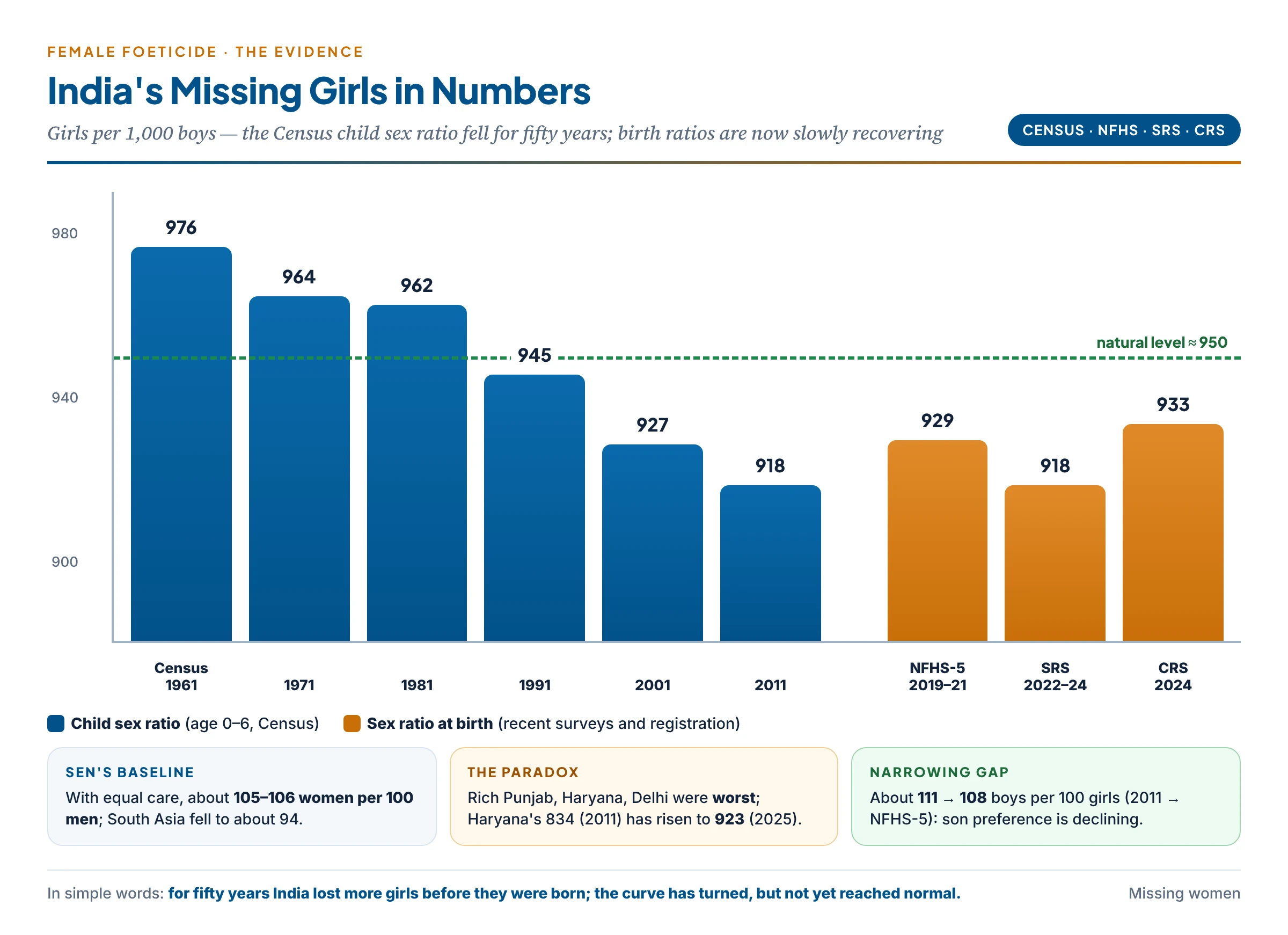
- Child sex ratio (girls per 1,000 boys aged 0–6, Census): 976 (1961) → 964 (1971) → 962 (1981) → 945 (1991) → 927 (2001) → 918 (2011) — the lowest since Independence, even as the overall sex ratio improved to 943 in 2011.
- Sex ratio at birth (girls born per 1,000 boys):
- NFHS-5 (2019–21): 929 for children born in the previous five years (NFHS-4: 919), while the overall population sex ratio was 1,020 — more women than men for the first time in the survey.
- Sample Registration System: 918 for 2022–24 (up from 914 a few years earlier).
- Civil Registration System: 933 for registered births in 2024.
- Haryana, once the worst state (a child sex ratio of 834 in 2011), recorded a sex ratio at birth of 923 in 2025.
- Trend: Pew found that the gap has been narrowing — from about 111 boys per 100 girls (2011) to about 108 (NFHS-5) — a sign that son preference is declining, though the ratio is still well below the natural level (about 950 girls per 1,000 boys).
- The development paradox: some of the richest and most educated regions — Punjab, Haryana, Delhi, parts of Gujarat and Maharashtra — long had the worst ratios, while poorer Kerala and the North-East did better. Prosperity and access to technology, without a change in values, made discrimination easier.
Common confusion
Does an overall sex ratio of 1,020 (NFHS-5) mean the problem of missing girls is solved? No. The overall sex ratio reflects women’s longer life expectancy in old age and the way the survey counts households (migrant men are often away). The measure of foeticide is the sex ratio at birth, which was still only about 929 — well below the natural level of roughly 950. More old women does not mean enough girls are being born.
Core Doctrine
Causes of Female Foeticide
1. Son preference — the root
- Economic:
- Dowry — a daughter is seen as a financial burden; dowry inflation makes her “costly”.
- Old-age security — in a patrilocal society, sons stay with and support parents; daughters “leave” at marriage.
- Inheritance and land — property and land pass through sons, so a family without a son “loses” its land (Article 6).
- Labour — sons are expected to work the family farm or business.
- Undervalued female labour — women’s domestic labour is never given its due worth, so they appear “economically less important”.
- Socio-cultural and religious:
- Lineage — the son carries the family name and continues the line (vaṃśa).
- Rituals — among Hindus, the son performs the funeral rites (śrāddha, lighting the pyre) believed to secure the parents’ place in heaven. The Manusmṛti even derives the word putra from the son’s role in saving the father from a hell called “put”.
- Patrilocality — the daughter is “paraya dhan” (another’s wealth), raised to be given away (kanyādāna).
- Honour and safety — fear for a daughter’s “honour”, sexual safety and the costs of protecting her.
2. The small-family norm
- As families choose to have fewer children, the pressure to make sure that at least one is a son grows stronger. With one or two children, there is no “room” for daughters — demographers call this the fertility squeeze.
3. Technology
- Amniocentesis (from the mid-1970s) and especially cheap, portable ultrasound machines (from the 1980s) made foetal sex detection easy. Clinics openly advertised that paying a small fee for a test now would “save” a large dowry later.
- Today, newer methods — early blood tests, pre-conception sex selection in IVF — and online advertising raise new risks.
4. Weak enforcement and complicit professionals
- Unethical doctors and radiologists, coded messages (“Jai Mata Di” for a girl, “Jai Shri Krishna” for a boy), mobile clinics across state borders, and very few convictions.
5. Low status of women and internalised preference
- Mothers themselves often want sons — because their own status in the family depends on bearing them, and because they have absorbed patriarchal values. Mothers-in-law and elder women often enforce son preference.
6. Other linked evils — dowry deaths (5,737 recorded in 2024), bride burning and dowry suicides, honour killings — all express the same low valuation of women’s lives.
Is Female Foeticide the Result of a “Demonic Application of Technology” Only?
- The case for blaming technology:
- Before ultrasound, discrimination took slower forms (neglect, infanticide); technology made elimination easy, early, cheap and invisible.
- Sex ratios at birth fell sharply after the spread of ultrasound in the 1980s–90s.
- Commercial medicine turned discrimination into a business, with clinics advertising sex tests.
- Why technology is not the only cause:
- Technology is morally neutral — the same ultrasound saves mothers’ and babies’ lives every day. It becomes an instrument of elimination only when embedded in patriarchal social structures.
- Discrimination came first: female infanticide and neglect of girls existed for centuries before any machine; Sen’s “missing women” include those who died after birth.
- The same technology exists in countries without skewed ratios, because those societies do not prefer sons.
- Where son preference declined (South Korea from the 1990s; parts of India recently), ratios improved even though technology became more available.
- Conclusion: technology is the instrument; patriarchal son preference is the cause. The famous phrase can be put precisely: female foeticide is “the dark meeting of modern technology and old patriarchal morality“. Regulating technology is necessary but not sufficient; the deeper remedy lies in changing values, economics and women’s status.
In simple words
A knife can be used to cut vegetables or to hurt someone. If many people in a town start hurting others with knives, banning knife-sellers may help a little, but the real question is why so many people want to hurt others. Ultrasound is the knife; son preference is the intention.
How Gender Discrimination Leads to Foeticide and Social Imbalance
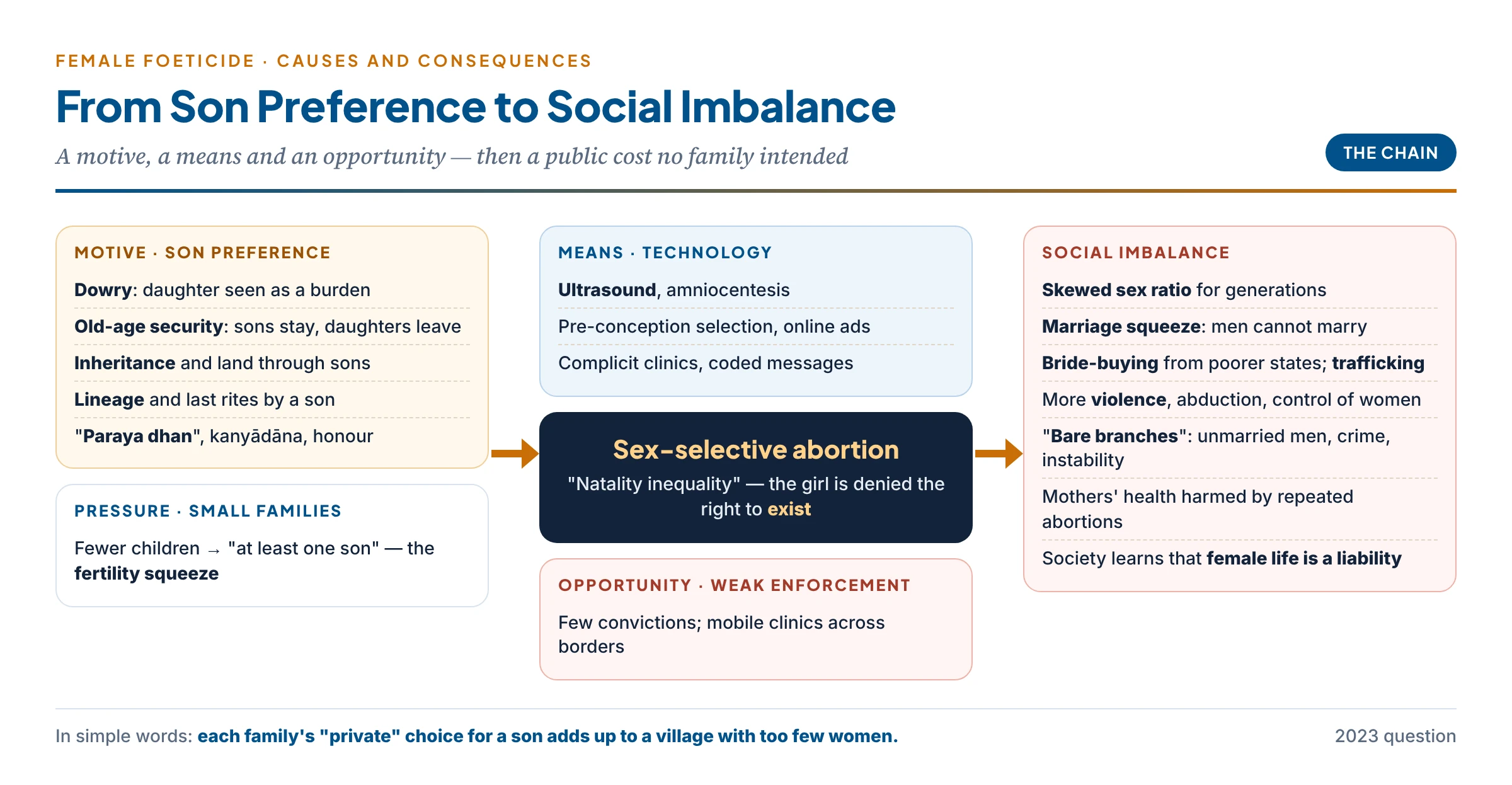
- From discrimination to foeticide: when a society values sons and devalues daughters — through dowry, inheritance, rituals, unequal work and honour codes — it creates a motive; technology provides the means; weak law provides the opportunity.
- Social imbalance — the consequences:
- Skewed sex ratio — demographic imbalance for generations.
- Marriage squeeze — too few brides; many men cannot marry. In parts of Haryana and Punjab, brides are “bought” from poorer states such as Assam, West Bengal, Odisha and Jharkhand; such women often face isolation and abuse.
- Trafficking — the shortage drives human trafficking and bride-buying across borders (for example, Pakistani and Nepali women trafficked to China as brides, where the one-child policy produced a similar shortage).
- More violence and control — fewer women does not raise their status; it increases sexual violence, abduction, early marriage and tighter control over women. Scholars of China and India have warned that large numbers of unmarried young men (“bare branches“) can fuel crime and instability.
- Strain on marriage and the family — cases of shared wives and forced polyandry have been reported; the institution of marriage itself comes under strain.
- Health harms to women — repeated pregnancies and late, unsafe abortions endanger mothers’ health and lives.
- Moral harm — society learns that female life is a liability; violence against women begins before birth and continues through life.
- Development harm — half the human potential is reduced; the demographic dividend is distorted.
Ethical Analysis
1. The right to life
- Female foeticide denies the most basic right — the right to life — even before birth.
- But India permits abortion under the Medical Termination of Pregnancy Act (1971), widened in 2021 (up to 20 weeks generally and up to 24 weeks for some categories). So the wrong of foeticide cannot lie simply in abortion — otherwise all abortion would be wrong.
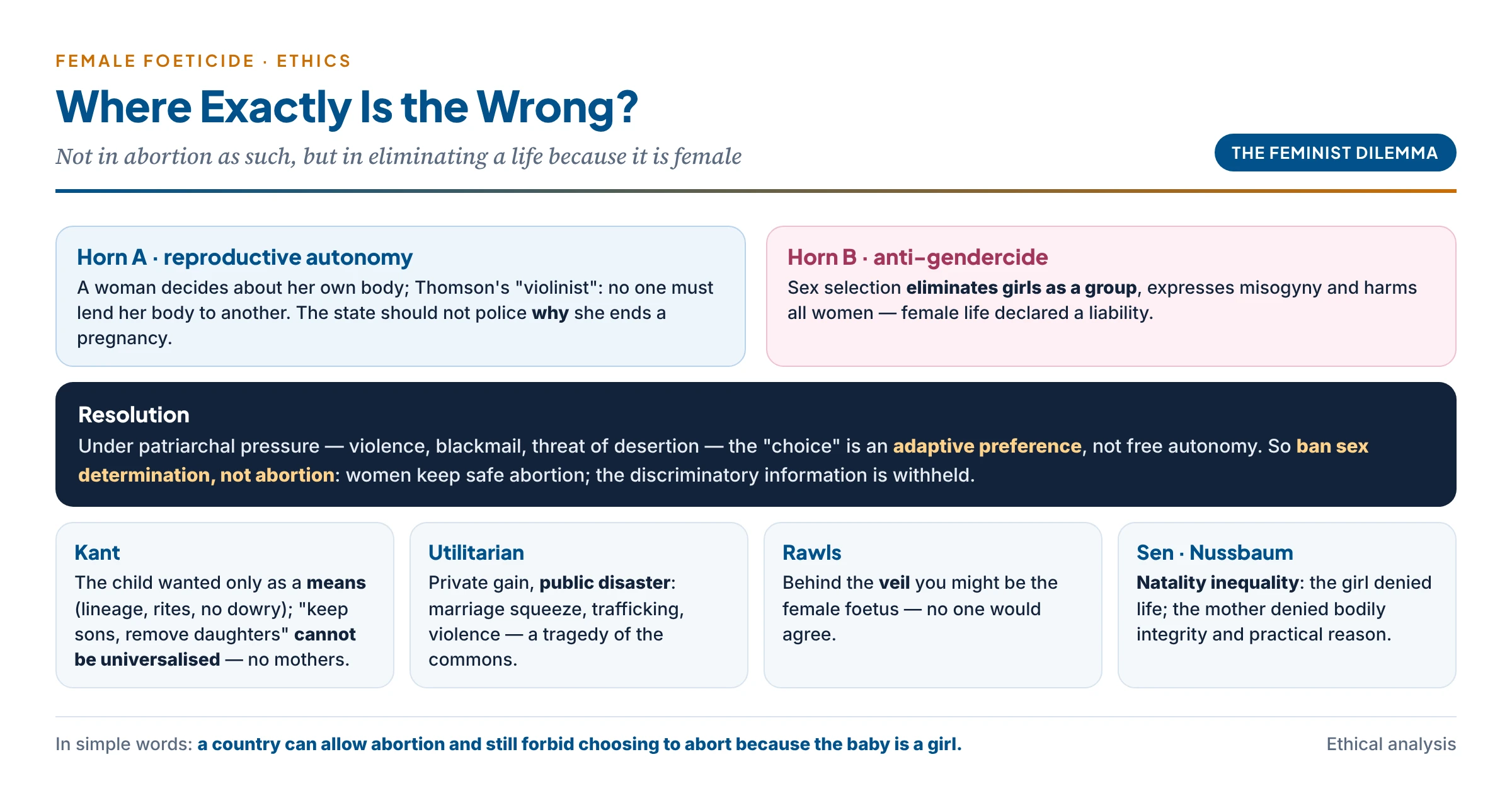
- The real wrong is the reason: the foetus is destroyed because it is female. The act discriminates — it declares that a girl’s life is worth less than a boy’s. This is why a society can consistently allow abortion and ban sex-selective abortion.
2. Kantian ethics
- Humanity formula: persons must be treated as ends, never merely as means. In sex selection, a child is wanted only as an instrument — for lineage, old-age security, rituals or avoiding dowry. A girl is rejected because she does not serve these purposes.
- Universalisability: the maxim “eliminate daughters and keep sons” cannot be universalised — if everyone acted on it, there would be no women, no mothers, no next generation. It defeats itself.
- Dignity: the practice degrades not only the unborn girl but the mother, whose body is used as a means to produce sons.
3. Utilitarian ethics
- Each family may think a son increases its welfare. But the total consequences are disastrous: marriage squeeze, trafficking, violence, insecurity, demographic distortion. It is a “tragedy of the commons” — individually rational choices produce collective harm.
- A rejected argument: some economists once argued that scarcity would raise women’s value (like any scarce good). The evidence shows the opposite — scarcity increased trafficking and control, not respect. Women are not commodities whose “price” rises with scarcity.
4. Rawls’s veil of ignorance
- Behind the veil, nobody knows whether they will be born male or female. Nobody would agree to a society in which they might be eliminated before birth for being female. Sex selection fails the test of fairness.
5. The feminist dilemma: reproductive choice vs sex selection
- Horn A — reproductive autonomy: feminists defend a woman’s right to decide about her own body and pregnancy. Judith Jarvis Thomson’s famous “violinist” argument (1971) holds that even if the foetus has a right to life, a woman is not obliged to let it use her body. On this view, the state should not police why a woman ends a pregnancy.
- Horn B — anti-gendercide and equal worth: sex-selective abortion eliminates girls as a group, expresses and reinforces misogyny, and harms women collectively.
- Resolution:
- The myth of free choice: liberal defenders assume the pregnant woman acts freely. In reality, in many patriarchal families a woman who undergoes sex-selective abortion faces marital violence, emotional blackmail and the threat of desertion if she does not produce a son. Her “choice” is an adaptive preference formed under duress (Sen, Nussbaum) — not authentic autonomy.
- Structural subjugation: unlike an individual abortion, sex selection targets a vulnerable social group for demographic elimination and sends the message that female existence is inferior and burdensome.
- Protecting autonomy properly: banning sex determination (not abortion) protects both values — women keep their right to safe abortion, while the discriminatory information that drives selection is withheld.
- Caution: feminists warn that campaigns against foeticide must not become campaigns against abortion or surveillance of all pregnant women, which would hurt women’s health and rights.
In simple words
A “choice” made with a knife held to one’s throat is not really a choice. When a pregnant woman is told by her husband and in-laws that she will be thrown out or beaten if she gives birth to another daughter, her “decision” to have a sex test is made under that knife. Respecting her autonomy means removing the knife — not pretending she chose freely.
6. Capability approach — Sen and Nussbaum: the girl is denied the most basic capability, life; her mother is denied bodily integrity and practical reason (Article 7).
Law, Policy and Social Response
The Legal Framework
- PCPNDT Act: the Pre-natal Diagnostic Techniques (Regulation and Prevention of Misuse) Act, 1994 (in force from 1 January 1996) banned the use of prenatal tests to determine sex. An amendment in force from 2003 renamed it the Pre-conception and Pre-natal Diagnostic Techniques (Prohibition of Sex Selection) Act and extended it to pre-conception selection.
- All ultrasound clinics and machines must be registered; records of every scan must be kept.
- Communicating the sex of the foetus, and advertising sex determination, are offences.
- Penalty: imprisonment up to three years and a fine up to ₹10,000 for a first offence, higher for repeat offences; a doctor’s registration can be suspended.
- The Supreme Court:
- CEHAT v Union of India (orders of 2001 and 2003), a public-interest case, forced the Centre and the states to implement the Act seriously.
- Voluntary Health Association of Punjab v Union of India (2016) issued detailed directions on enforcement, monitoring and speedy trials.
- The Court also directed internet search engines to block advertisements for sex selection (the Sabu Mathew George case).
- MTP Act (1971, amended 2021): permits safe abortion — the law targets sex selection, not abortion as such.
- Dowry Prohibition Act (1961) and laws against dowry deaths address a key cause.
Schemes and Social Campaigns
- Beti Bachao Beti Padhao (“Save the daughter, educate the daughter”), launched at Panipat, Haryana, on 22 January 2015 in 100 districts with the lowest child sex ratio; government health-system data show the sex ratio at birth improving from 918 (2014–15) to 930 (2023–24).
- Sukanya Samriddhi Yojana (2015) — a savings scheme for girls’ education and marriage.
- Conditional cash transfers for daughters — Haryana’s Ladli, Dhanalakshmi, Tamil Nadu’s cradle baby scheme (1992), which let parents leave unwanted infants safely with the state.
- Community campaigns — “Selfie with Daughter” (begun in Bibipur village, Haryana, 2015), village panchayats honouring families with daughters, religious leaders speaking out.
Reforms Needed
- Change in attitude — the root is son preference; education, media and religious leaders must challenge it.
- Economic empowerment of women — when daughters earn and inherit, they are no longer seen as burdens.
- Effective control of dowry.
- Effective control over misuse of technology — strict enforcement of PCPNDT, decoy operations, tracking of machines, speedy trials.
- A greater role for elder women — mothers and mothers-in-law in the emancipation of the girl child.
- Equal inheritance and old-age security — pensions and daughters’ property rights remove the “need” for sons.
- Universal child allowances and girls’ education incentives.
The Role of Women’s Empowerment in Curbing Foeticide
- Education: educated women marry later, have more say in fertility decisions and are more able to resist pressure; their daughters are more likely to be educated too.
- Income and work: when women earn, daughters are seen as future earners, not burdens; the “economic” logic of son preference weakens.
- Property and inheritance: equal inheritance (Article 6) ends the idea of the daughter as “paraya dhan” and gives her a stake in the natal family.
- Bargaining power: a woman with resources and a fallback position can refuse a sex test demanded by her husband or in-laws (Sen’s cooperative conflict).
- Political voice: women in panchayats and assemblies can campaign against sex selection and enforce the law locally.
- Collective action: self-help groups and women’s organisations create “power-with” — social pressure against families and clinics.
- Limits: education alone has not always reduced selection — some educated, wealthy families used technology more. Empowerment works only when it changes values and family power, together with law and men’s attitudes.
- Evidence: South Korea had one of the world’s most skewed ratios (about 116 boys per 100 girls around 1990) but returned to near-normal levels by the late 2000s, as women’s education and employment rose, laws were enforced and son preference faded — showing that empowerment and cultural change can reverse the trend.
Female Foeticide and Social Progress
- Is there a necessary connection between social progress and protection against female foeticide?
- Normatively, yes: social progress means progress in human dignity, justice and capabilities — not merely in income. A society that eliminates its daughters before birth cannot be called socially progressive, however rich it becomes. Protecting girls’ right to life is a necessary condition and an indicator of social progress — exactly Ambedkar’s test of measuring a community’s progress by the progress of its women.
- Empirically, no automatic link with economic growth: the development paradox (Punjab, Haryana, Delhi) shows that economic progress can even worsen foeticide, by spreading technology and the small-family norm faster than values change.
- Conclusion: economic development does not guarantee protection of girls; but genuine social progress — in values, women’s status and justice — necessarily includes it. Protecting girls is both a measure and a means of social progress.
In simple words
A family that buys a bigger car, a new house and the latest phone, but will not let a daughter be born, has become richer — not better. Social progress is measured not by what a society owns, but by how it treats those who cannot speak for themselves — beginning with the unborn girl.
Critical Evaluation
Debates and Criticisms
- Instrumental campaigns: some campaigns urge saving daughters so that men will have brides or society will have mothers — treating girls as means again. Feminist scholars insist girls must be valued for themselves.
- Surveillance of women: strict monitoring may lead clinics to refuse legitimate abortions or scans, pushing women to unsafe providers; the burden falls on women rather than on the families that pressure them.
- Weak enforcement: convictions under PCPNDT remain few; a law without enforcement only drives the practice underground.
- Cultural roots: law cannot change values by itself; without economic and cultural change, sex selection shifts to new technologies or to neglect after birth.
- A “liberal” objection: some argue that parents should be free to choose the sex of their child (as in “family balancing” in some Western clinics). The reply: in a society with strong son preference, the “free choice” is neither free nor harmless — it reproduces discrimination and causes collective harm.
Critics and Defenders
Criticism — Critiques of the present approach
- Technology-centred laws treat the symptom, not the cause (son preference).
- Instrumental slogans value girls as future brides and mothers.
- Policing pregnant women threatens safe abortion access.
- Low conviction rates: the law is widely evaded through mobile clinics and coded messages.
- “Free choice” arguments: parents’ liberty to choose a child’s sex.
Defence — Defence of a combined strategy
- Ban sex determination, not abortion — protects both autonomy and equality.
- Empower women — education, income, inheritance, voice weaken son preference.
- Change values — dowry eradication, rituals open to daughters, community campaigns.
- Evidence of success — narrowing gap (111 to 108 boys per 100 girls), Haryana’s recovery, South Korea’s reversal.
- Moral clarity — elimination for being female violates dignity (Kant), fairness (Rawls) and capability (Sen).
Cross-Tradition Comparison
| Theme | Western / global | Indian |
|---|---|---|
| Moral principle | Kant: persons as ends; Rawls: veil of ignorance | Ahiṃsā (non-injury); Dharmaśāstra texts count bhrūṇahatyā (killing of the embryo) among grave sins |
| Sacred feminine vs practice | Marian devotion alongside exclusion of women from church office | Kanyā-pūjā in Navarātri — girls worshipped as the goddess — alongside the elimination of girls before birth |
| State policy | China’s one-child policy (1980–2015) produced missing girls; South Korea reversed its skew | PCPNDT, Beti Bachao Beti Padhao; Kerala and the North-East with better ratios |
| Reformers | Mill on women’s equal worth | Jyotiba and Savitribai Phule’s home (1863) to prevent the killing of infants born to widows |
Indian Connect — Indian Connect — the takeaway
- The paradox of a culture that worships Devī and performs kanyā-pūjā while aborting daughters shows that reverence for an idealised feminine is no substitute for respect for real girls.
- India’s own ethical resources — ahiṃsā, the condemnation of bhrūṇahatyā, the Phules’ practical work — support the campaign against foeticide from within the tradition.
- The improvement in Haryana (from 834 to 923) shows that sustained enforcement, schemes and community campaigns can change behaviour within a generation.
Synthesis (Siddhānta)
- Female foeticide — aborting a foetus because it is female — is natality inequality (Sen), the high-tech form of an old discrimination; it has produced millions of missing women in India and the world.
- Its cause is son preference, rooted in dowry, inheritance, old-age security, lineage, rituals and patrilocality, intensified by the small-family norm; technology is the instrument, not the root — so it is not a “demonic application of technology” only.
- Discrimination leads to foeticide and foeticide to social imbalance: marriage squeeze, bride-buying, trafficking, violence, control over women and moral degradation.
- Ethically, the wrong lies not in abortion as such but in discrimination: it violates the right to life, Kant’s dignity, Rawlsian fairness and the capability of life; the woman’s “choice” is often an adaptive preference under duress.
- The remedy combines law (PCPNDT, ban on sex determination, not on abortion), policy (BBBP, incentives, pensions), cultural change and above all women’s empowerment — education, income, inheritance, voice and collective action. Protecting girls is both a measure and a means of genuine social progress.
- Contemporary relevance:
- The narrowing of the sex ratio gap (Pew; SRS; CRS 2024; Haryana 2025) shows progress — but the ratio is still below natural levels.
- New risks: pre-conception sex selection, online advertising and cross-border clinics.
- NFHS-6 no longer reports the sex ratio indicators, making independent monitoring through SRS and CRS more important.
“Gender inequality can manifest itself in the form of the parents wanting the newborn to be a boy rather than a girl.” — Amartya Sen
Previous Year Questions
- 2024Discuss gender equality as a necessary condition to achieve empowerment of women. Also examine the role of women empowerment in curbing the menace of female foeticide.
- 2023How does gender discrimination lead to female feticide and social imbalance? Discuss.
- 2021What are the main causes of female foeticide in India? Is it the result of demonic application of technology only? Discuss.
- 2018How do you evaluate gender discrimination in the context of female foeticide?
- 2012Is there any necessary connection between social progress and protection against female foeticide? Discuss.