

Gender Discrimination: Female Foeticide, Land and Property Rights; Empowerment.
Official Syllabus: Paper II, Section A, Unit 9
Empowerment of women is the process by which women who have been denied the ability to make strategic choices about their own lives — whom to marry, whether and when to have children, whether to study or work, how to spend their money, whether to speak in public — acquire that ability, individually and together. It is the third and final syllabus issue of this unit: female foeticide denies women the right to exist, the lack of land and property denies them the material basis of autonomy, and empowerment is the realisation of their full moral agency. But “empowerment” is also a much-used and much-abused word — sometimes a radical demand for transforming power, sometimes a slogan for small schemes. This article explains what empowerment means, the theories of Naila Kabeer (resources, agency, achievements), Jo Rowlands (four kinds of power), Martha Nussbaum (capabilities), Amartya Sen (women’s agency) and Paulo Freire (critical consciousness); the economic, political, social and legal dimensions of empowerment in India; and the questions UPSC asks: Can empowerment eliminate discrimination? Is economic or political empowerment enough? Do women become empowered through collective reflection? Why does political representation matter? Is gender equality a necessary condition for empowerment? Will severe punishment for crimes against women change society’s mindset?
In simple words
A caged bird can be given more food, a bigger cage and a nicer perch — that is welfare. Opening the cage door is rights. But a bird kept caged for years may not fly even when the door is open; it must discover that it can fly, gain strength, and fly with others for safety. Empowerment is all of this together: the resources (food and strength), the door (rights), the confidence to fly (power within), and the flock (power with).
Context & Problem
Meaning of Empowerment
- Simple definition: empowerment is the degree of autonomy and self-determination in people and in communities — their ability to represent their interests and act on their own authority.
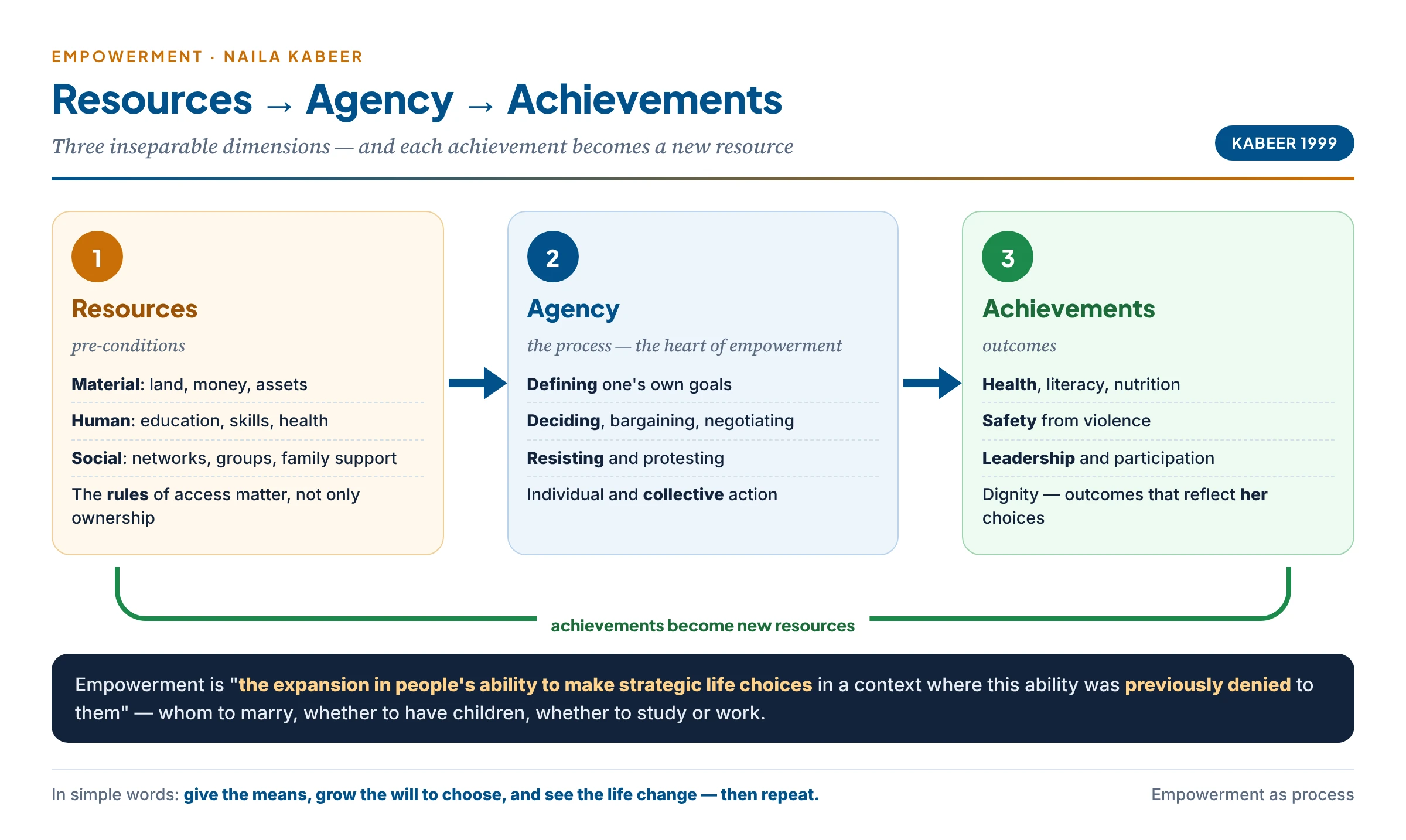
- Naila Kabeer’s definition (1999): empowerment refers to “the expansion in people’s ability to make strategic life choices in a context where this ability was previously denied to them“.
- “Expansion” — empowerment is a process of change, not a fixed state.
- “Strategic life choices” — choices that shape a whole life (marriage, children, work, mobility), as distinct from minor daily ones.
- “Previously denied” — a rich, powerful person is not “empowered”; the term applies to those who were disempowered.
- What empowerment is not: it is not charity, benevolence or welfare delivered from above; not merely quotas; not simply giving goods to passive beneficiaries. A woman who receives a gas cylinder but has no say in her life is a beneficiary, not yet empowered.
- What empowerment is: an internal, transformative process of expanding agency — women becoming subjects of their own lives rather than objects of others’ decisions (compare Beauvoir’s Subject and Other, Article 2).
- Origins of the idea: Paulo Freire’s pedagogy of the oppressed (1968–70), the Third World feminist network DAWN (1985), and the Beijing Platform for Action (1995), which made the “empowerment of women” a global goal.
Core Doctrine
1. Kabeer: Resources, Agency and Achievements
Kabeer saw empowerment as the inseparable interplay of three dimensions:
- Resources (pre-conditions)
- Material (land, money, assets), human (education, skills, health) and social (networks, groups, family support) resources that enlarge one’s capacity to choose.
- Resources matter not only by ownership but by the rules that govern access to them.
- Agency (process) — the heart of empowerment
- The ability to define one’s own goals and act upon them. It includes decision-making, bargaining and negotiation, and also resistance, protest and even subtle forms of manipulation used by the powerless.
- Agency is not only visible action; it includes the meaning and motivation people bring — their “sense of agency” or power within.
- It can be individual (a woman deciding to study) or collective (women organising together).
- Achievements (outcomes)
- The well-being outcomes that result: health, literacy, freedom from violence, political participation, dignity, leadership.
- Kabeer warns that achievements must reflect choices made — not outcomes imposed on women.
- The three are linked: resources make agency possible; agency turns resources into achievements; achievements, in turn, become new resources.
In simple words
A self-help group teaches Lakshmi to sew and gives her a small loan — a resource. She decides, against her husband’s first objection, to start a tailoring business — agency. Two years later she earns her own income, sends her daughter to college and is elected to the panchayat — achievements. Her income and confidence then become new resources for her next choice.
2. Rowlands: The Four Kinds of Power
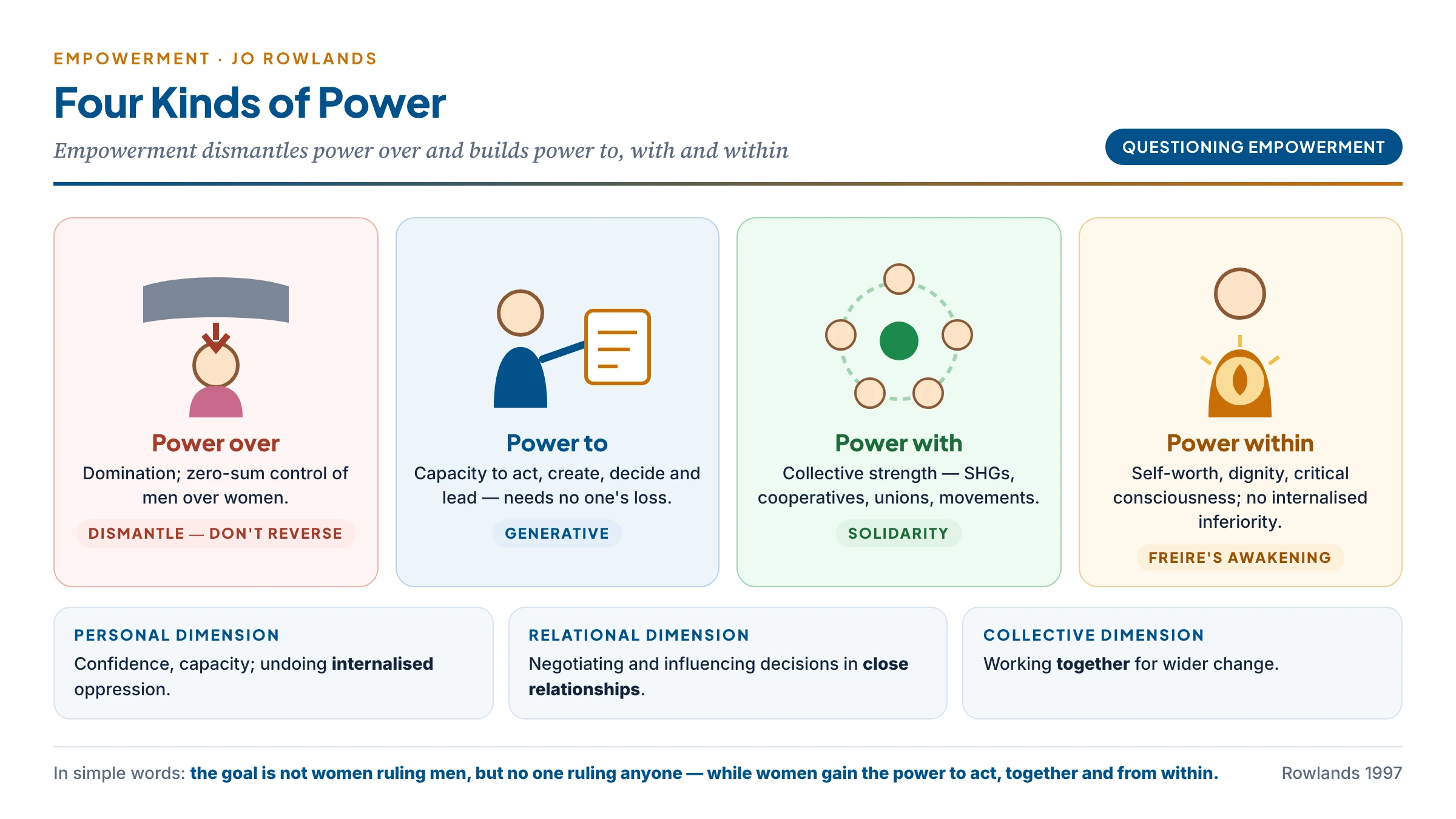
Jo Rowlands (Questioning Empowerment, 1997), from her work with women in Honduras, distinguished four forms of power:
- Power over — coercive domination of one group by another, a zero-sum relation (men’s control over women). True empowerment does not seek to replace male domination with female domination; it seeks to dismantle power over altogether.
- Power to — the productive capacity to create, decide, lead and act — generative power that need not reduce anyone else’s.
- Power with — collective power: solidarity, organising, sisterhood — the strength of self-help groups, cooperatives, unions and women’s movements, which turns individual weakness into collective bargaining power.
- Power within — inner strength: self-worth, dignity, confidence and critical consciousness; the removal of internalised feelings of inferiority, fatalism and submissiveness.
- Three dimensions in which empowerment happens:
- Personal — developing confidence and capacity, undoing internalised oppression.
- Relational (close relationships) — the ability to negotiate and influence decisions within the family.
- Collective — working together for wider impact.
3. Nussbaum: Capabilities and Each Woman as an End
- Martha Nussbaum (Women and Human Development, 2000) argued that women across the world have been treated as “supporter-creatures” — instruments for others’ ends: child-bearing, domestic labour, men’s comfort — rather than as ends in themselves.
- The principle of each person as an end: justice must look at each woman’s life, not only at the family’s average well-being.
- Ten central capabilities that a just constitution must guarantee to every person up to a threshold: life; bodily health; bodily integrity (freedom from violence, choice in reproduction); senses, imagination and thought; emotions; practical reason (planning one’s own life); affiliation (dignity, non-discrimination); other species; play; and control over one’s environment (political participation; holding property and seeking work on an equal basis).
- Practical reason and affiliation are “architectonic” — they organise and pervade all the others.
- Adaptive preferences: women deprived for long often do not want what they have been denied (they say they do not need education or more food). Their stated preferences cannot be the measure of justice; empowerment includes widening what women feel entitled to want.
- Her example: Vasanti, a poor woman in Ahmedabad who left an abusive husband and, with a loan from the Self-Employed Women’s Association (SEWA), bought a sewing machine, repaid her debts and gained independence and dignity — resources, agency and achievement in one life.
In simple words
A child who has never tasted sweets does not ask for them; a girl who has always eaten last, after the men, may honestly say she is “not hungry”. Such adaptive preferences are why we cannot measure women’s well-being only by what they say they want. Empowerment widens the horizon of what women feel entitled to want.
4. Sen: Women’s Agency and Social Change
- Amartya Sen (Development as Freedom, 1999) distinguished women’s well-being (being better off) from women’s agency (being active agents of change).
- Women’s agency — through education, paid work outside the home, property ownership and voice — has strong effects on child survival, lower fertility and family welfare; Sen cites the example of Kerala, where female literacy and women’s property traditions went with low child mortality and fertility.
- So empowering women is not only good for women; it is one of the most powerful forces of social change.
5. Freire: Critical Consciousness
- Paulo Freire (Pedagogy of the Oppressed) argued that the oppressed often internalise the oppressor’s view of themselves. Liberation begins with conscientisation (conscientização) — critical consciousness gained through dialogue and reflection on one’s own situation, followed by action to change it.
- Applied to women: empowerment requires women to name their oppression together (“the personal is political”), see it as social and changeable, and act — the source of the idea of collective reflection.
Do Women Become Empowered through Collective Reflection and Decision-Making?
- Yes — the case for collective processes:
- Power within grows when women discover in groups that their “private” problems — violence, dowry, debt, lack of voice — are shared and social (Freire).
- Power with: groups give bargaining strength against families, money-lenders, officials and employers.
- Learning democracy: group decision-making builds skills of speaking, negotiating, managing money and leading — many women panchayat leaders began in self-help groups.
- Indian evidence: SEWA (founded by Ela Bhatt, 1972) organised informal women workers into a union and cooperatives; Mahila Samakhya (from 1989) formed village women’s collectives (sanghas) for “education for women’s equality” — reflection first, action after; Kudumbashree (Kerala, 1998) built a statewide network of neighbourhood groups linked to local government; under DAY-NRLM about 10 crore women are organised in some 91 lakh self-help groups; Chipko and rural women’s anti-liquor movements show collective action changing public policy.
- Limits:
- Elite capture — dominant-caste or better-off women may control groups.
- Credit traps — groups reduced to microcredit can lead to over-indebtedness (as in the Andhra Pradesh microfinance crisis of 2010).
- Social conformity — groups can also enforce conservative norms.
- Structural barriers — collective reflection cannot by itself change unequal laws, property rules or markets.
- Conclusion: collective reflection and decision-making are powerful means of empowerment — especially for building power within and power with — but they must be joined to resources, rights and institutional change.
Dimensions of Women’s Empowerment in India
1. Economic empowerment
- Paid work, income of her own, assets, credit, bank accounts and control over spending.
- Indian picture:
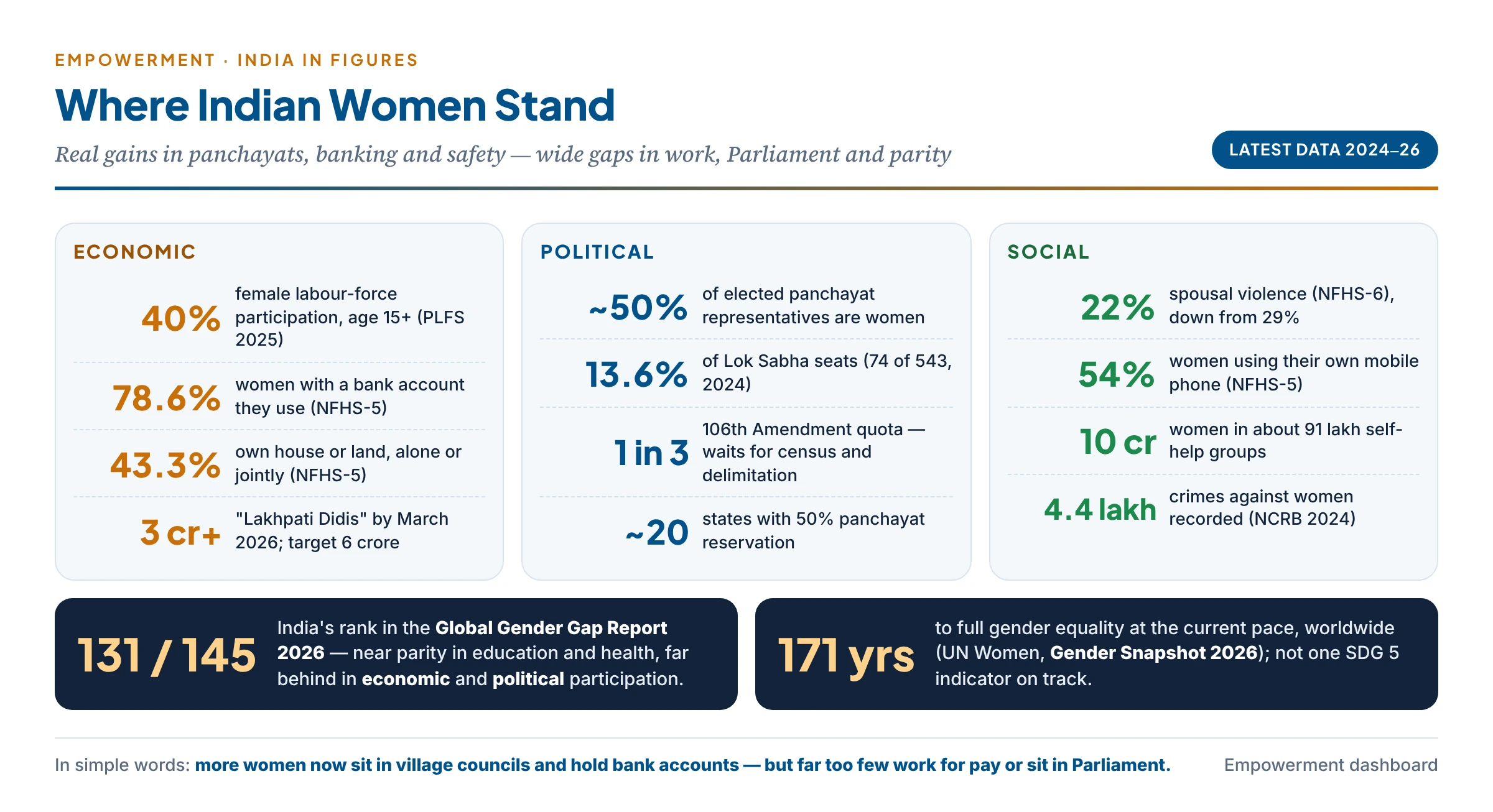
- Female labour-force participation (age 15+) was about 40% in 2025 (Periodic Labour Force Survey) — rising in recent years but still among the lowest of major economies.
- NFHS-5: 78.6% of women had a bank account they used themselves; 43.3% owned a house or land alone or jointly (Article 6).
- Women still carry most unpaid care work; the gender pay gap and occupational segregation persist.
- Programmes: self-help groups, Lakhpati Didi (over 3 crore women earning at least ₹1 lakh a year by March 2026; target now 6 crore), MUDRA loans, Stand-Up India.
2. Political empowerment
- Panchayats and municipalities: the 73rd and 74th Amendments (1992) reserved at least one-third of seats and chairperson posts for women; about 20 states have raised this to 50%. Women are now about half of all elected panchayat representatives (some 12 lakh of 24 lakh).
- Parliament and assemblies: the 106th Amendment (Nari Shakti Vandan Adhiniyam, assent 28 September 2023) reserves one-third of seats in the Lok Sabha and state assemblies for women, for 15 years, after the next census and delimitation. It was brought into force in April 2026, but a further amendment to apply the quota from 2029 was defeated in the Lok Sabha (17 April 2026), so its timing remains tied to delimitation. Women hold about 13.6% of Lok Sabha seats (74 of 543, 2024).
- Problems: “sarpanch-pati” or proxy representation, where husbands exercise power in the names of elected wives; violence and harassment against women politicians.
3. Social empowerment
- Education (girls now outnumber boys in many higher-education enrolments), health and nutrition, freedom from violence, mobility, freedom in marriage.
- NFHS-6 (2023–24) reported spousal violence falling to about 22% of ever-married women, from about 29% in NFHS-5 — progress, but still very high.
4. Legal empowerment
- Equal rights in law and the ability to use them: legal literacy, legal aid, women’s police desks, family courts, one-stop centres.
5. Psychological and digital empowerment
- Self-confidence, awareness and the “power within”; access to mobile phones and the internet (only about 54% of women in NFHS-5 had a mobile phone they used).
6. Cultural empowerment
- Day-care facilities so that women can work; development of a non-sexist vocabulary (“chairperson” instead of “chairman”); suitable norms for the representation of women in the mass media, including advertising.
Common confusion
Is women’s empowerment the same as welfare schemes or reservations for women? No. Welfare schemes (free cylinders, cash transfers) improve women’s well-being; reservations give them positions. Empowerment happens only when women gain real agency — the ability to make and act on strategic choices. A scheme that a woman receives passively, or a panchayat seat her husband controls, is not yet empowerment; both can contribute to it when they expand her own control over her life.
The Constitutional, Legal and International Framework
- Constitution: the principle of gender equality is enshrined in the Preamble, Fundamental Rights, Fundamental Duties and Directive Principles; the Constitution not only grants equality to women but empowers the state to adopt positive discrimination in their favour (Article 15(3)). Also Articles 14, 16, 39(a), 39(d), 42, 51A(e), 243D, 243T and the 106th Amendment (Article 330A, 332A).
- Important laws:
- Dowry Prohibition Act (1961).
- Immoral Traffic (Prevention) Act (1956).
- Indecent Representation of Women (Prohibition) Act (1986).
- Hindu Succession Act (1956; amended 2005).
- Protection of Women from Domestic Violence Act (2005) — civil remedies, protection orders, the right to residence.
- Sexual Harassment of Women at Workplace (Prevention, Prohibition and Redressal) Act (2013), building on the Vishaka guidelines (1997).
- Maternity Benefit (Amendment) Act (2017) — 26 weeks of paid maternity leave and crèche facilities.
- PCPNDT Act (1994/2003) and the MTP Act (1971/2021) (Article 5).
- Criminal Law (Amendment) Acts of 2013 and 2018, and the Bharatiya Nyaya Sanhita (in force from 1 July 2024), with a chapter on offences against women and children.
- Institutions: the National Commission for Women (1992) and state commissions.
- CEDAW (adopted by the UN in 1979; India signed in 1980 and ratified in 1993): its core principles are non-discrimination, state obligation and substantive equality.
- Beijing Declaration and Platform for Action (1995) and Sustainable Development Goal 5 (gender equality and empowerment of all women and girls).
Can Empowering Women Eliminate Gender Discrimination?
- How empowerment reduces discrimination:
- Economically empowered women have a stronger fallback position, more say in decisions, and can resist dowry demands and violence (Sen, Agarwal).
- Educated women raise healthier, better-educated children — including daughters — breaking the cycle (Sen, Kerala).
- Politically empowered women change policy priorities: a well-known study of panchayats in West Bengal and Rajasthan found that villages with women heads invested more in drinking water and other goods women had asked for.
- Psychologically empowered women challenge stereotypes and become role models.
- Why it cannot do it alone:
- Discrimination lives in men and institutions too — in men’s attitudes, family structures, markets, religious norms, police and courts. Empowering women while leaving these untouched places the whole burden of change on women.
- Backlash: women who gain independence sometimes face more violence from those who resent the change.
- Structural barriers — unequal laws, inheritance customs, lack of child-care, the pay gap — need state action.
- Intersectional limits — empowerment programmes may reach better-off women first; Dalit, Adivasi, disabled and poor women need specific measures (Article 4).
- Co-option: “empowerment” can shrink into small loans or schemes that make women more productive workers without changing power relations — sometimes called “smart economics“.
- Conclusion: empowering women is necessary and powerful, but discrimination is relational and structural; its elimination needs women’s empowerment plus the transformation of men’s attitudes, institutions, laws and culture. Empowerment reduces discrimination; on its own it cannot eliminate it.
Does Economic Empowerment of Women Eliminate Gender Discrimination?
- It helps greatly: economic independence is the precondition of other freedoms (Beauvoir, Engels, Agarwal); it raises bargaining power and social status.
- But it does not eliminate discrimination: earning women still face the double burden, harassment at work, the glass ceiling, dowry demands and violence; wealthy families have practised sex selection; economic power without social and political change leaves patriarchal norms intact.
- Conclusion: economic empowerment is a necessary but not sufficient condition — as with land rights (Article 6) and economic independence (Article 3).
Can Only Political Empowerment Wipe Out Gender Discrimination in a Male-Dominated Society?
- Its value: political power lets women make the laws that shape their lives, change budgets and priorities, and serve as role models; panchayat reservation has brought over a million women into public life.
- Its limits:
- Proxy representation (“sarpanch-pati”) — reserved seats without real power.
- Representation is not transformation: some women leaders may share patriarchal views; elite women may not represent poor women.
- Discrimination in the home, market and culture is not removed by law alone; it needs education, economic independence and social change.
- Conclusion: political empowerment is essential but not sufficient — “only” political empowerment cannot wipe out discrimination; it must be combined with economic, social, legal and psychological empowerment.
In simple words
Imagine a village meeting on where to build toilets and water taps, attended only by men. They may choose the market square, convenient for them — while women, who fetch water at dawn and need safe toilets near home, are not there to say so. Who sits at the table decides what is on the menu.
Why Is Adequate Representation of Women in Political Institutions Important?
- Justice and equality: a democracy in which half the citizens hold a small fraction of seats is incomplete; equal citizenship implies a fair share of power.
- Descriptive and substantive representation: following Hanna Pitkin (The Concept of Representation, 1967), representatives may “stand for” a group by sharing its characteristics (descriptive) and “act for” it by advancing its interests (substantive); women in office are more likely to raise issues such as violence, health, water and child-care.
- The politics of presence (Anne Phillips, 1995): some experiences cannot be fully represented by others; who is present in the room matters, not only what ideas are represented.
- Critical mass: once women form a significant minority (often put at about 30%, the target set at Beijing), they can change the culture and agenda of institutions rather than being tokens.
- Legitimacy and trust: institutions that look like society command more trust.
- Role models: women leaders change what girls believe they can become.
- Better decisions: diverse bodies consider a wider range of experiences.
Gender Equality as a Necessary Condition for Empowerment
- Gender equality (equal rights, opportunities and respect) and empowerment (the expansion of women’s agency) are mutually reinforcing (Article 3):
- Equality enables empowerment: without equal rights in law — to property, education, work, divorce, safety — women’s attempts to act on their own choices are blocked or punished. Equality provides the space in which agency can grow.
- Empowerment produces equality: women with resources, voice and confidence demand and defend equal rights; equality on paper becomes equality in life only when women can claim it.
- Necessary, not merely helpful: empowerment achieved without equality is fragile — a woman who earns but has no right to her property or her body can lose everything. In this sense gender equality is a necessary condition of genuine and lasting empowerment.
- But not sufficient: formal equality alone does not empower if women lack resources and confidence; hence the need for both.
Women’s Empowerment and Social Justice
- Social justice means the fair distribution of benefits and burdens and the removal of structural disadvantage.
- Women’s empowerment is an instrument and a component of social justice:
- Rawls: fair equality of opportunity and the priority of the least advantaged — very often poor women.
- Ambedkar: social democracy requires liberty, equality and fraternity; women’s progress is the measure of a community’s progress.
- Nancy Fraser (three dimensions of justice): redistribution (of income and property), recognition (of women’s equal status and the value of care) and representation (equal political voice). Empowerment touches all three.
- Sen: social justice is judged by people’s real capabilities; empowerment expands them.
- Conclusion: there can be no social justice while half of society is disempowered; empowerment is social justice in practice.
Will Severe Punishment for Crimes against Women Change Society’s Mindset?
- Background: after the Delhi gang rape of December 2012, the Justice Verma Committee (report of January 2013) recommended sweeping reforms; the Criminal Law (Amendment) Act 2013 widened definitions of sexual offences and added stalking, voyeurism and acid attacks; a 2018 amendment introduced the death penalty for rape of a girl under 12. The Bharatiya Nyaya Sanhita (2024) carries these forward. After the R.G. Kar Medical College case (2024), West Bengal passed the Aparajita Bill with mandatory death penalties; it was returned by the Centre in 2025 as disproportionate.
- The case for severe punishment:
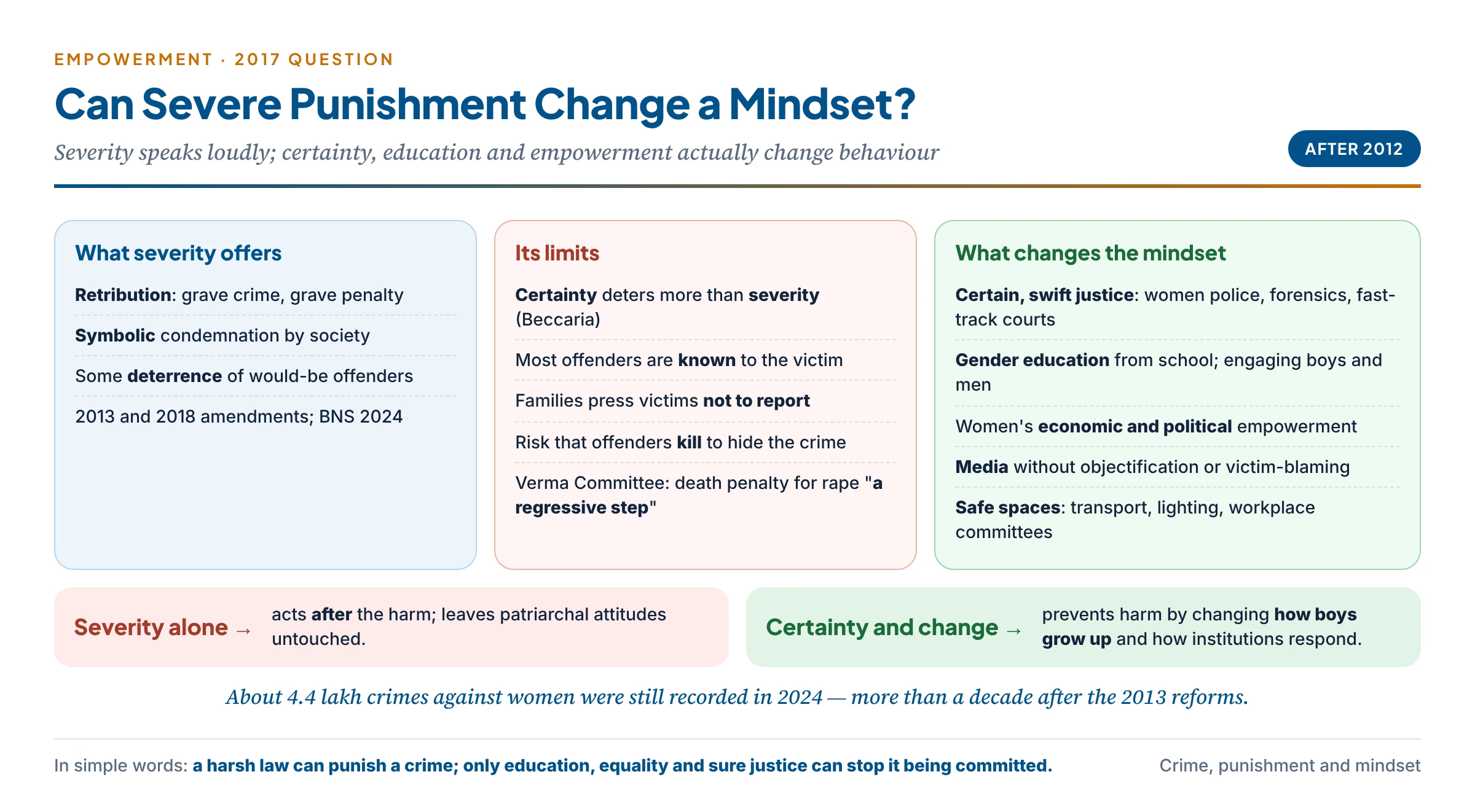
- Retribution: grave crimes deserve grave punishment; it expresses society’s condemnation.
- Deterrence: fear of punishment may deter some offenders.
- Symbolic value: it signals that crimes against women are taken seriously.
- Why severity alone will not change the mindset:
- Certainty matters more than severity: as Beccaria argued in the eighteenth century, it is the certainty and swiftness of punishment, not its harshness, that deters. With low reporting, slow trials and modest conviction rates, even death sentences deter little.
- Most offenders are known to the victim — relatives, neighbours, acquaintances. Very harsh penalties may make families pressure victims not to report, and may increase the risk that offenders kill the victim to destroy evidence.
- The Verma Committee itself rejected the death penalty for rape, calling it “a regressive step” in sentencing and noting that it “may not have a deterrent effect”.
- Mindset is formed earlier — in the family, school, media, peer groups and religion. Violence grows out of patriarchal attitudes, entitlement and the view of women as property or “honour”; punishment acts after the damage is done.
- Data: crimes against women recorded by the National Crime Records Bureau remained very high — about 4.4 lakh cases in 2024 — more than a decade after the 2013 reforms; the largest category was cruelty by husbands or relatives.
- What does change the mindset:
- Certain and swift justice — more women police, better investigation and forensics, fast-track courts, witness protection.
- Gender-sensitive education from school onwards; engaging boys and men.
- Women’s empowerment — economic independence, property, voice (Articles 6, 7).
- Media and cultural change — ending objectification; campaigns against victim-blaming.
- Safe public spaces — lighting, transport, workplace committees under the 2013 Act.
- Conclusion: severe punishment has a limited, expressive and deterrent role, but a society’s mindset changes through certainty of justice, education, empowerment and cultural transformation — not through severity alone. (The theories of punishment are discussed in Unit 7.)
Critical Evaluation
Critiques of the Empowerment Discourse
- Co-option and dilution: once a radical demand for transforming power, “empowerment” is now used by governments, banks and corporations for programmes that may change little — a beneficiary scheme labelled “empowerment”.
- “Smart economics”: empowering women because it is efficient (women repay loans, spend on children) treats women as instruments of growth rather than as ends — the very fault Nussbaum warned against.
- Individualisation: focusing on individual “choice” and entrepreneurship can ignore structures — markets, patriarchy, caste.
- Added burdens: programmes may add paid work and meetings on top of unpaid care — a triple burden.
- Measurement problems: agency is hard to measure; indicators (bank accounts, seats) may not show real control.
- Western concept? Critics say empowerment reflects Western individualism. Reply: the strongest empowerment theory and practice came from the Global South — DAWN, Kabeer (Bangladesh), SEWA, Kudumbashree, Freire (Brazil).
Critics and Defenders
Criticism — Critics of the empowerment approach
- Co-option: the word used for schemes that leave power relations intact.
- Smart economics: women valued for productivity, not as ends.
- Individualism: structural causes of discrimination ignored.
- Burden on women: men and institutions left unchanged; the triple burden.
- Proxy power: reserved seats run by husbands; microcredit debt traps.
Defence — Defenders and achievements
- Kabeer: empowerment as expanding strategic choices — resources, agency, achievements together.
- Rowlands: dismantle power over; build power to, with and within.
- Nussbaum and Sen: capabilities and agency — each woman an end; women as agents of social change.
- Evidence: half of panchayat seats held by women; SEWA, Kudumbashree, 10 crore SHG women; falling spousal violence.
- Balance: empowerment plus equality, plus men’s change, plus structural reform.
Cross-Tradition Comparison
| Theme | Western / global thought | Indian thought and practice |
|---|---|---|
| Power | Rowlands’ four powers; Freire’s conscientisation | Śakti — feminine power as the creative energy of the cosmos; the goddess as source of strength |
| Each woman an end | Kant; Nussbaum’s “each person as an end” | Ambedkar: women’s progress as the measure of a community’s progress |
| Collective action | Women’s movements, unions, consciousness-raising groups | SEWA, Mahila Samakhya, Kudumbashree, Chipko, anti-arrack movements |
| Political presence | Pitkin, Phillips, critical mass | Panchayat reservation (1992), the 106th Amendment (2023); Sarojini Naidu and the women of the freedom movement |
| Moral power | Care ethics (Article 4) | Gandhi: women as natural leaders of non-violence (Article 4) |
Indian Connect — Indian Connect — the takeaway
- The Indian idea of Śakti gives empowerment a cultural root: power is not foreign to the feminine but its very nature — though, as the paradox of worshipping the goddess while devaluing daughters shows, the idea must be turned into real rights.
- India’s grassroots institutions — SEWA, Kudumbashree, women’s self-help groups and panchayat reservation — are among the world’s largest experiments in collective empowerment.
Synthesis (Siddhānta)
- Empowerment is the expansion of women’s ability to make strategic life choices where it was previously denied (Kabeer) — a process involving resources, agency and achievements, and the growth of power to, with and within while dismantling power over (Rowlands).
- Nussbaum grounds it in capabilities and the principle of each woman as an end; Sen shows women’s agency as a force for social change; Freire shows the role of collective reflection.
- In India, empowerment has economic (work, income, assets), political (panchayats, the 106th Amendment), social, legal, psychological and cultural dimensions, supported by the Constitution, laws, CEDAW and SDG 5 — yet low labour-force participation, unpaid care, violence and low parliamentary representation remain.
- Gender equality and empowerment are mutually necessary; empowerment (economic, political or collective) is necessary but not sufficient to eliminate discrimination, which also lives in men’s attitudes and institutions; representation matters for justice, presence and policy; severe punishment alone cannot change the mindset — certainty of justice, education and empowerment can.
- Contemporary relevance:
- The fate of the women’s reservation in Parliament after the 2026 delimitation debate.
- The care economy — child-care and elder-care — as the key to raising women’s labour-force participation.
- Digital empowerment — phones, digital payments and online safety — as a new frontier.
“I measure the progress of a community by the degree of progress which women have achieved.” — B.R. Ambedkar
Previous Year Questions
- 2024Discuss gender equality as a necessary condition to achieve empowerment of women. Also examine the role of women empowerment in curbing the menace of female foeticide.
- 2020Do you agree that empowering women can eliminate gender discrimination? Discuss.
- 2017Will a severe punishment for crimes against women change the mindset of society? Justify your position.
- 2016Do you agree that women become empowered through collective reflection and decision-making? Discuss.
- 2015Does economic empowerment of women eliminate gender discrimination? Discuss.
- 2013Why is adequate representation of women in political institutions important in this context?
- 2012Woman empowerment and social justice.
- 2010Can only the political empowerment of women wipe out gender discrimination in a male-dominated Indian society?