

Gender Discrimination: Female Foeticide, Land and Property Rights; Empowerment.
Official Syllabus: Paper II, Section A, Unit 9
Simone de Beauvoir (1908–1986), French existentialist philosopher and novelist and lifelong companion of Jean-Paul Sartre, published Le Deuxième Sexe — The Second Sex — in 1949. Its most famous sentence, “One is not born, but rather becomes, a woman“, became the founding idea of modern feminist philosophy and of the distinction between sex and gender (Article 1). Beauvoir asked a simple but explosive question: why, in every known society, has woman been treated as the Other — the second sex, defined only in relation to man? Her answer was that woman’s inferiority is not a fact of nature but a situation created by men and history, and that a situation can be changed. This article explains the origin and method of The Second Sex, the categories of Subject and Other and of transcendence and immanence, why she rejects biological, psychoanalytic and Marxist explanations, the myth of the eternal feminine, how a girl is made into a woman, her analysis of marriage, love and motherhood, women’s complicity and bad faith, the way out through the independent woman and economic freedom, Judith Butler’s development of her idea — and the strong criticisms her book has faced, including from feminists themselves.
In simple words
A child born in a small village is not born a “farmer” or a “villager” — she becomes one by growing up there, learning its work, speech and habits. Put the same child in a city school and she becomes something else. Beauvoir says “woman”, in the social sense, is like that: not something a female baby already is, but something she becomes — through the toys she is given, the praise she receives for being pretty and obedient, the work she is assigned and the future she is told to expect.
Context & Problem
How the Book Began
- In 1946 Beauvoir wanted to write a personal confession and asked herself: “What has it meant to me to be a woman?” At first she answered that it had not counted for very much.
- Sartre replied: “All the same, you weren’t brought up the same way as a boy; you should look into it more closely.”
- Her “revelation”, in her own words: “this was a masculine world; my childhood had been nourished by myths invented by men“. She spent two years studying, in the Bibliothèque Nationale in Paris, “all the myths about femininity” — in history, religion, literature, biology and psychoanalysis — and published the result in 1949.
The Philosophical Background: Existentialism
- Beauvoir applied the existentialist ontology of Sartre’s Being and Nothingness (1943) to the condition of women.
- Existentialism (Sartre, Beauvoir) holds that “existence precedes essence“: human beings are not born with a fixed nature or purpose; they exist first and then make themselves through free choices and actions.
- A human being is a subject — a free consciousness that projects itself into the future through projects (plans and actions that create something new). Sartre calls this mode of being “being-for-itself” (pour-soi); a mere thing, which simply is what it is, is “being-in-itself” (en-soi).
- Bad faith (mauvaise foi) is self-deception: pretending that one is not free — that one’s role, nature or circumstances fix one’s life — to escape the anxiety of responsibility.
- Beauvoir’s move: if no human being has a fixed essence, then woman has no fixed essence either. Whatever women are today is the result of their situation, not of an “eternal feminine” nature.
- She also draws on Hegel’s master–slave dialectic: self-consciousness defines itself by opposing an “Other”, and relations between consciousnesses tend to become relations of domination and recognition.
Method and Plan of the Book
- The Second Sex is not a cold scientific study. It mixes facts, history, myth, philosophy and literature and is openly polemical and committed (engagé) — Beauvoir believed writers should try to change the world.
- Volume I — “Facts and Myths” examines woman from three angles:
- Destiny — what biology, psychoanalysis and historical materialism say about woman’s fate.
- History — how men turned woman’s biological dependence into permanent social, political and existential dependence.
- Myths — the images of woman woven by men (mother and goddess, virgin and temptress, idol and devil), which always end with her as “the Other”, “the inessential”.
- Volume II — “Lived Experience” shows woman’s situation today: childhood and girlhood, sexual initiation, marriage, motherhood, social life, the woman in love, the narcissist, the mystic, old age — and finally “Towards Liberation“, the independent woman.
Core Doctrine
Woman as “the Other”
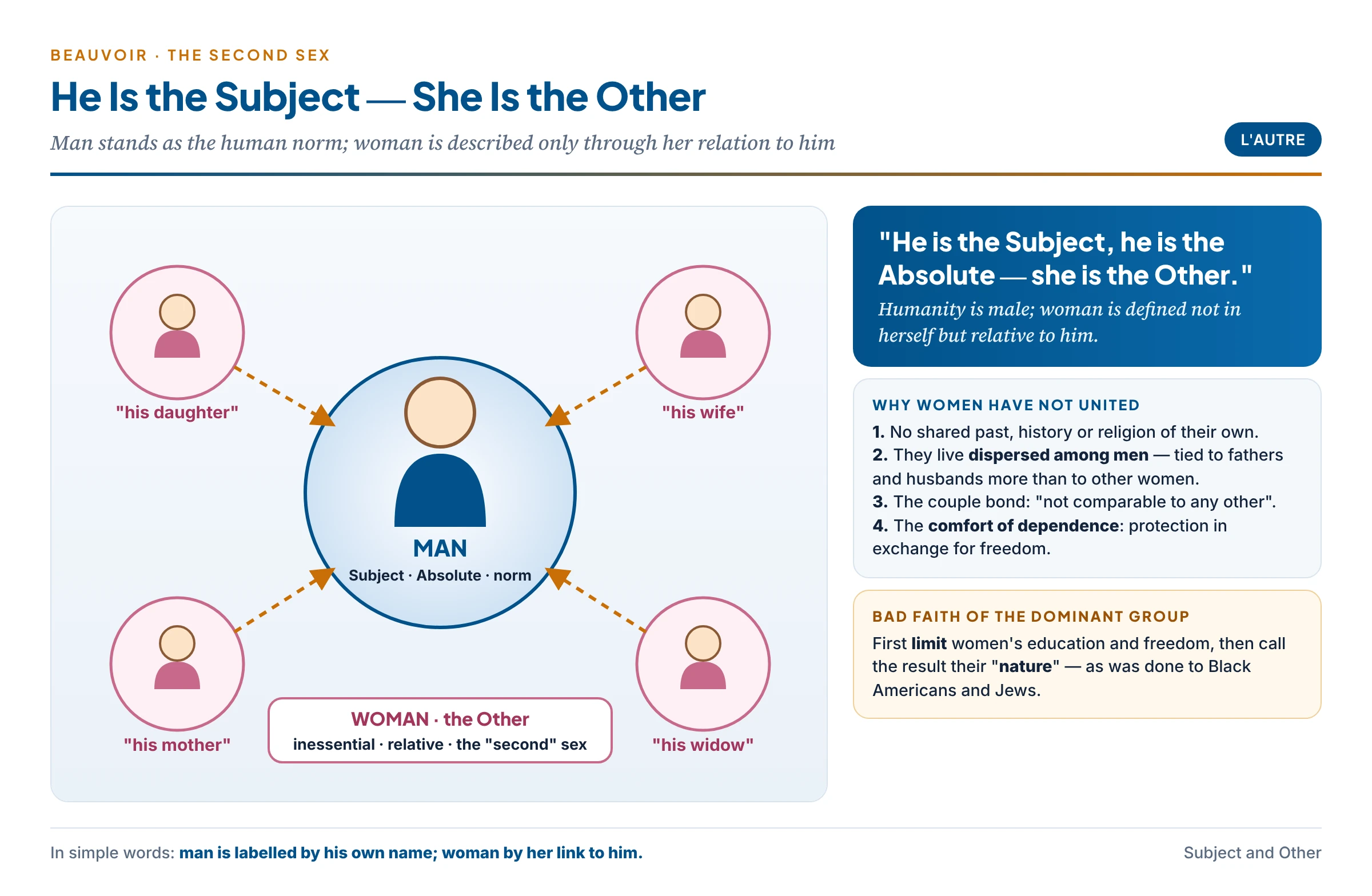
- The central category. “Humanity is male, and man defines woman not in herself but as relative to him; she is not regarded as an autonomous being.”
“She is defined and differentiated with reference to man and not he with reference to her; she is the incidental, the inessential as opposed to the essential. He is the Subject, he is the Absolute — she is the Other.” — Simone de Beauvoir, The Second Sex
- What “Other” means:
- Man is the norm: “man” stands for both “male” and “human being”. A man never begins by saying “I am a man”; a woman must first declare “I am a woman”.
- Woman is defined negatively: as the “not-man”, the “second” sex — the daughter of, wife of, mother of someone. Beauvoir borrows the historian Michelet’s description of woman as an “occasional being” — a secondary, relative creature.
- Woman is the object, man the subject: she is looked at, desired, protected, possessed; he looks, chooses and acts.
- Every group sets up an Other (natives see strangers as Other; Christians saw Jews as Other). But in those cases the relation is reciprocal: the stranger sees the native as Other too. Between men and women, man has made himself the only Subject, and woman has not succeeded in making him her Other.
Why Have Women Not Revolted like Other Oppressed Groups?
- Workers and colonised peoples have said “we” and fought as a class or a nation. Women have not, Beauvoir argues, because:
- No shared past or history — “they have no past, no history, no religion of their own”.
- No separate community — unlike workers in factories or a people in a territory, women “live dispersed among the males“, attached by residence, housework, economic condition and social standing to particular men — fathers and husbands — more firmly than to other women.
- Biological interdependence — the couple is a fundamental unity; “the bond that unites her to her oppressors is not comparable to any other”. Women cannot simply separate themselves as a group.
- Privileges of dependence — by accepting the role of the Other, woman gains material security and is spared the anxiety of freedom; man offers protection in exchange for submission. This temptation makes many women accomplices in their own subordination.
- The comparison with other oppressed groups. Beauvoir compares women’s position to that of Black Americans and Jews: the oppressor first confines the oppressed to conditions hostile to free development, then declares the resulting “inferiority” natural. Man restricts woman’s education, then calls her “naturally” emotional, scatter-brained and incapable. She unmasks “the bad faith with which a dominant group attributes the effects of its own oppression to the natural tendencies of its victims”.
In simple words
Think of a family photograph in which every caption reads “X’s daughter“, “X’s wife“, “X’s mother” — but X is labelled simply with his own name. Everyone else exists in the picture only through their link to him. That is what Beauvoir means by woman as “the Other”: man is the reference point, woman is described in relation to him.
Transcendence and Immanence
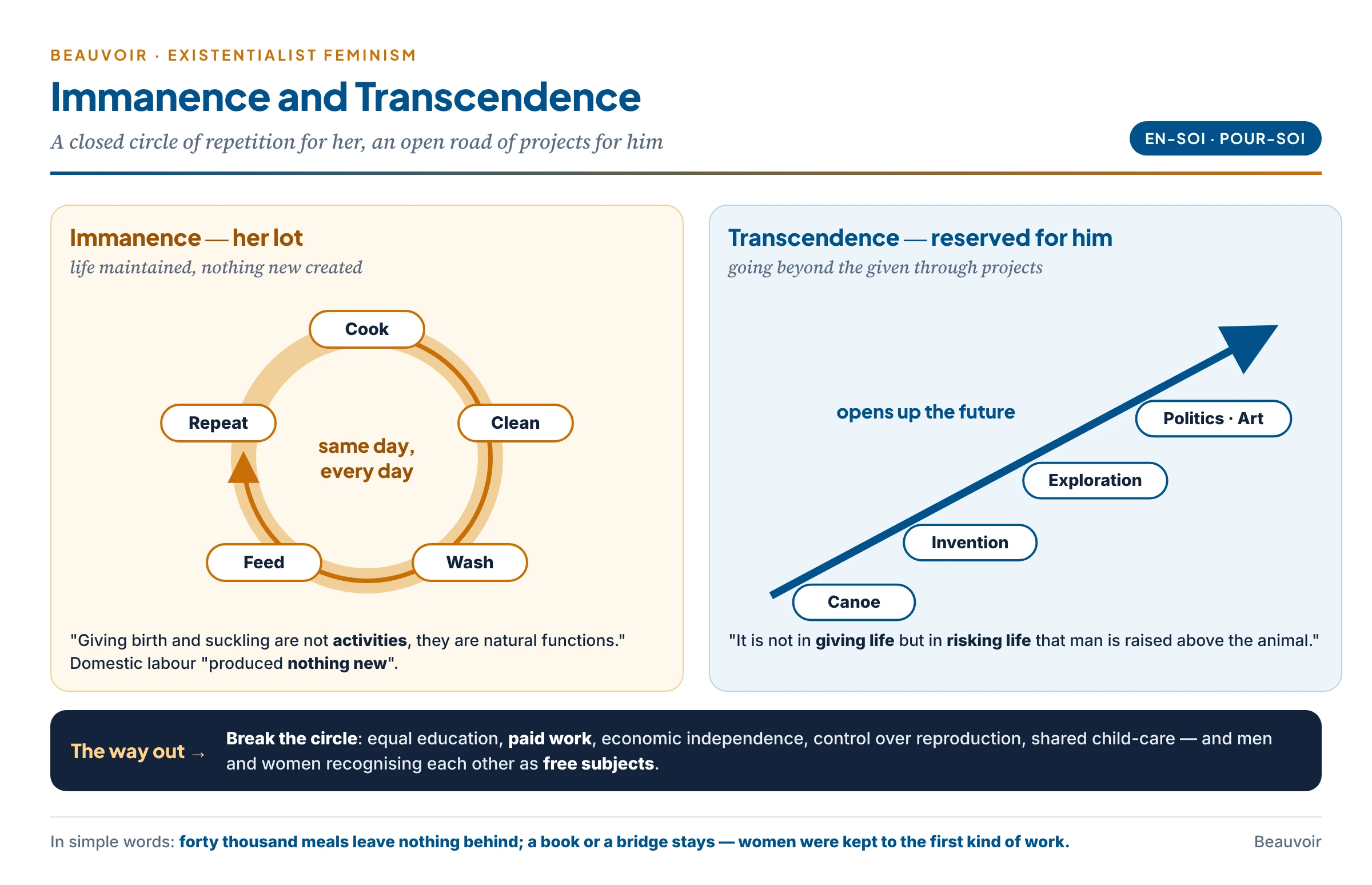
- Transcendence is the human capacity to go beyond the given — to invent, explore, create, build, fight and shape the future through projects. It is the mark of free existence.
- Immanence is being stuck in the given — repetitive maintenance of life that produces nothing new: cooking, cleaning, washing, feeding, the same tasks every day.
- The division of the world: men have reserved transcendence for themselves; women have been confined to immanence — and then blamed for being passive and uncreative.
- Giving life vs risking life. For Beauvoir, “giving birth and suckling are not activities, they are natural functions; no project is involved”. The domestic labours that fell to women “imprisoned her in repetition and immanence… they produced nothing new”. Primitive man, by contrast, did not just bring home fish; he built the canoe and conquered the water — “he burst out of the present, he opened up the future”.
“It is not in giving life but in risking life that man is raised above the animal; that is why superiority has been accorded in humanity not to the sex that brings forth but to that which kills.” — Simone de Beauvoir
- The tragedy of woman: society denies women access to transcendence, imprisons them in immanence, and then accuses them of being naturally passive and lacking genius — a social cycle disguised as nature.
In simple words
Picture a woman who cooks three meals a day for forty years — about forty thousand meals. Each one is eaten and gone; the next day starts from zero. Beauvoir calls this immanence: life maintained, but nothing new created. Now picture someone writing a book, building a bridge or founding a company — the work stays and opens new possibilities. That is transcendence. Beauvoir’s complaint is not that cooking is worthless, but that one half of humanity was locked into the first kind of work and shut out of the second.
Three Explanations Rejected: Biology, Psychoanalysis and Historical Materialism
- Biology
- Beauvoir accepts the facts: woman is, in a sense, more “enslaved to the species” — menstruation, pregnancy, childbirth and menopause weigh heavily on her body.
- But biological facts do not explain why woman is the Other. They have meaning only within a situation: the same body is experienced differently in different societies and economies. Biology tells us how woman’s body works, not why society ranks her lower.
- Psychoanalysis
- She rejects Freud’s picture of woman as a “mutilated man” defined by “penis envy“, and scorns the old idea of Aquinas that woman is a “defective man“.
- If a girl envies the boy, it is not the organ but the privileges it symbolises — freedom, prestige, power — that she envies. Psychoanalysis mistakes a social fact for a sexual destiny.
- Historical materialism (Engels)
- Engels (The Origin of the Family, Private Property and the State, 1884) linked women’s subordination to the rise of private property. Beauvoir takes this seriously but finds it insufficient: economics cannot explain why the passage to private property led to the enslavement of women in particular.
- What is missing is the existential element: man’s original drive to assert himself as Subject and to set up an Other. Abolishing private property alone will not free women unless this attitude changes.
The Myth of the “Eternal Feminine”
- Men have woven contradictory myths of woman: Mother and Goddess, Virgin and Temptress, Muse and Witch, Nature to be conquered and Mystery to be adored. She is idolised and defamed at once.
- The “eternal feminine” is the myth that there is a fixed, timeless essence of woman — mysterious, intuitive, emotional, maternal, frivolous. Beauvoir denounces it as a man-made image that keeps women in their place. One of her sharp lines: “If a woman is not treacherous, frivolous, frightened and indolent, she loses her attractiveness” — men love women for the very faults they create.
- She is equally sharp on male self-importance: when the critic Claude Mauriac claimed that women writers’ wit only reflected “ideas which came from us“, she replied that with this “equivocal us” he identified himself with St Paul, Hegel, Lenin and Nietzsche, and from their height looked down on women who dared to speak to him as equals.
- Exceptions among men: Beauvoir praises the novelist Stendhal, “a feminist” who treated woman “simply as a human being” and whose heroines know that “the source of true values is not in external things but in human hearts“.
- She also attacks the long misogynist tradition — Aristotle, St Paul, Luther, Balzac — that presented women’s inferiority as God-given or natural.
“One Is Not Born, but Rather Becomes, a Woman”
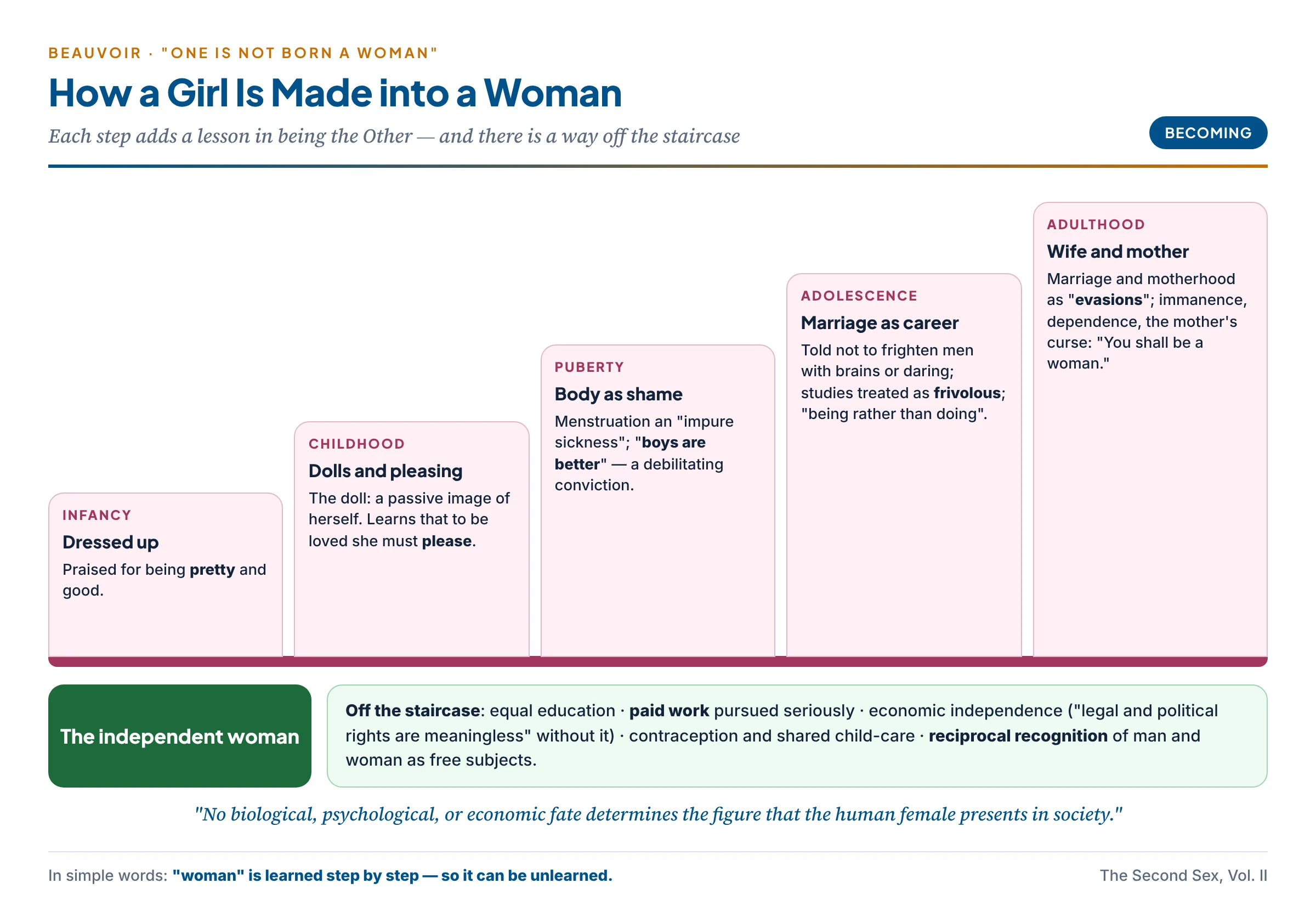
“One is not born, but rather becomes, a woman. No biological, psychological, or economic fate determines the figure that the human female presents in society; it is civilization as a whole that produces this creature, intermediate between male and eunuch, which is described as feminine.” — Simone de Beauvoir
- Meaning: apart from the physiological sexual functions there is no innate feminine psychology. All of woman’s typical attitudes come from her situation. “Woman” in the social sense is a cultural product, made by the whole of civilisation.
- “Situation”, not nature: the faults attributed to women — pettiness, timidity, laziness, frivolity, servility — “simply express the fact that their horizons are severely limited“. “Yes, women on the whole are today inferior to men; that is to say, their situation opens up fewer possibilities.”
- Consequence: if woman’s inferiority is man-made, it can be unmade. The thesis turns a “fate” into an injustice.
In simple words
A plant kept in a dark cupboard grows pale and weak. Nobody says the plant is naturally weak — everyone knows it was denied light. Beauvoir says the same of women’s supposed faults: timidity, pettiness or frivolity are what a life without light — without education, work and freedom — produces. Change the situation, and the so-called “nature” changes too.
How a Girl Is Made into a Woman
- Childhood: the boy is pushed towards independence, adventure and pride in his body; the girl is dressed up, praised for being pretty and good, given dolls — a doll is a passive image of herself — and taught that to be loved she must please.
- Learning to please: “men do not like tomboys, or bluestockings, or brainy women; too much daring, culture, or intelligence, too much character, will frighten them”. “Any self-assertion will diminish her femininity and her attractiveness.”
- Puberty as shame: the girl experiences her changing body with embarrassment; menstruation is presented as an “impure sickness“. She learns that “boys are better” — “a debilitating conviction” — and goes towards the future “wounded, shameful, culpable”.
- Marriage waits in the wings: since marriage is presented as her career, she is encouraged to be frivolous about her studies. Her vivacity is checked, which breeds day-dreaming, moodiness and, at times, lying and secrecy — because “being rather than doing is her lot“.
- Her compensating gift: because she is kept out of action, the girl observes, feels and records the world with unusual sensitivity.
- The mother’s curse: many mothers, resentful of their own condition, greet a daughter with an ambiguous curse: “You shall be a woman.“
- The plain heroine wins: Beauvoir noticed that in novels the passive, clinging girl usually wins the hero — she never forgave Little Women for letting Laurie choose the “insipid Amy” over the spirited Jo.
Marriage, Love and Motherhood
- Marriage as evasion: for women, marriage as a “career” and motherhood as a justification of existence are “insufficient and in a certain sense cowardly evasions“. A woman supported by her husband lives through another; her days repeat themselves.
- The bleak evening: Beauvoir paints the dull married evening — reading, radio, desultory talk, “each remains alone under cover of this intimacy”, the wife wondering whether “something will happen”.
- The woman in love (l’amoureuse): quoting Byron, “in man’s life love is only a part-time occupation whereas for woman it is her whole existence“. The woman who makes love her entire life idolises the man, adopts his tastes, friends and opinions and lives “at his mercy“. “There are few crimes which exact a worse punishment than this generous fault: to put oneself entirely in another’s hands.”
- Authentic love would join two equally free persons, “neither one would relinquish his self-transcendence, neither would be maimed”. It is rare today because woman is not economically free. Héloïse is her model of recovery: separated from Abelard, she was not wrecked, because she built an independent existence governing an abbey.
- Motherhood: Beauvoir grants that mother-love has a grandeur because it implies no reciprocity, but she attacks the “religion of Maternity” that declares all mothers saintly. Maternity is “usually a strange mixture of narcissism, altruism, idle daydreaming, sincerity, bad faith, devotion, and cynicism”. A frustrated, dependent mother often seeks compensation through her child.
- The great paradox: “It is outrageously paradoxical to deny women all activity in public affairs, to shut her out of masculine careers, to assert her incapacity in all fields of effort, and then to entrust to her the most delicate and the most serious undertaking of all: the moulding of a human being.”
- Against self-sacrificing devotion (le dévouement): women are trained to be the “Christian martyrs” of society. Beauvoir argues (in her essay Pyrrhus et Cinéas) that we cannot truly do another’s good for him — “his real good is that freedom which belongs only to him”. Forced self-sacrifice breeds resentment and subtle tyranny.
- Old age is harsher for women: valued as erotic objects and mothers, they are “abruptly robbed” of their social justification while still young, with half their adult lives still ahead.
Complicity and Bad Faith
- Woman as accomplice: society makes it easy for women to “take the easy way out” — to accept protection and a defined role instead of the risks of freedom. So “woman becomes an accomplice in her own slavery“. This is bad faith: fleeing freedom by pretending to be a “nature”.
- “It is the fault of everybody and no one… Everyone is guilty, but woman is the victim.” Beauvoir does not blame women more than men; she shows how the situation invites complicity.
- Women’s conservatism: excluded from history, many women, she argues, distrust the future, accept “what is“, and side with whoever holds power — a product of exclusion, not of nature.
The Way Out: the Independent Woman
- Economic independence first: “Legal and political rights are meaningless as long as woman remains economically dependent on the male.” Women must become independent through paid work, pursued as seriously as men pursue it.
- “Moral parasitism”: Beauvoir’s term for the dependent woman. From her own life: “To earn one’s own living is not an end in itself; but it is only in this way that one can attain a substantial inner freedom.”
- Social conditions: she calls for equal education, contraception and the right to abortion, collective child-care — and, politically, a socialist society in which work and child-rearing are reorganised.
- Reciprocity, not reversal: the goal is not to put women on top but mutual recognition of both as free subjects.
“To emancipate woman is to refuse to confine her to the relations she bears to man, not to deny them to her; let her have her independent existence and she will continue none the less to exist for him also: mutually recognizing each other as subject, each will yet remain for the other an other.” — Simone de Beauvoir
- Liberation will not kill love: desire, possession, love, dream and adventure will survive the end of domination; men too will gain, because domination “poisons the atmosphere” and is “a dubious triumph”.
Common confusion
Does “one becomes a woman” mean Beauvoir denies any difference between male and female bodies? No. Beauvoir accepts biological facts — she even writes at length about menstruation, pregnancy and menopause. Her claim is that these facts do not decide what women’s lives and status must be. The meaning of the body, and the rank given to it, come from society. “Woman” in the sense of a subordinate social role is made; the female body is given. That is exactly the later distinction between sex and gender.
Butler: “Becoming” as Performance
- Judith Butler read Beauvoir’s “becoming” radically: if one becomes a woman, then gender is never finished — it is something one keeps doing through repeated acts (Article 1).
- Butler goes further than Beauvoir: Beauvoir still assumed a sexed body on which gender is built; Butler argues that even the idea of two natural sexes is shaped by gender norms. Gender is performative — produced by its own repeated performance — and can therefore be performed differently.
Critical Evaluation
Strengths
- Founding text: Beauvoir is the “patron saint” of second-wave feminism; later radical feminists, including Kate Millett (Sexual Politics, 1970), were deeply indebted to her.
- Women as an oppressed group: her central message — that women form an oppressed class whose subordination rests less on legal exclusion than on massive social conditioning — became “common coin” of the women’s movement.
- The sex–gender insight: by separating the female body from the social role, she made gender open to criticism and change.
- Brilliant analysis of male psychology, the history of oppression and the myths of femininity.
The Main Criticisms
- Masculine values as the norm: the book treats traditionally “masculine” values — action, conquest, creativity, power, success — as the only truly human values, so the female condition appears inferior in itself, not merely disadvantaged. The praise of the warrior who “kills” is a striking example of the very male values feminists criticise.
- Contempt for women’s traditional virtues: gentleness, kindness, care and devotion are treated almost as defects. Critics reply that these are genuine human virtues that both sexes should cultivate. The anthropologist Ashley Montagu (The Natural Superiority of Women) put the opposite view: “civilization is the art of being kind, an art that women have learned much better than men.” And the blindness Beauvoir attacked was real — Tocqueville, listing those excluded from the vote in America, named slaves, servants and paupers and simply forgot women.
- Motherhood devalued: her picture of pregnancy (the mother as “an incubator, an egg”) and of maternity is so negative that even sympathetic critics demur. As one critic put it, she seems unacquainted with “the very simple but deep love” between mother and child; and maternal love, others note, is the model of all love.
- The myths come back: Volume I demolishes the myths of femininity, but Volume II’s portrait of real women — vain, petty, clinging — is so harsh that a reader may exclaim, “But then the myths are true after all!” She mocks Freud’s “mutilated man” yet seems to share the picture.
- Economic independence is necessary but not sufficient: the heroines of her own novels — Françoise in L’Invitée, Anne in Les Mandarins — earn their own living yet remain emotionally dependent. Inner freedom needs more than a salary.
- Dependence is part of every human life: everyone depends on others — children on parents, the sick on carers, lovers on each other. Treating dependence as a moral failing ignores this and can glorify egoism.
- “Femininity” is never defined: if it is not an essence, what is it? Is motherhood part of it? Does every woman who is content in a traditional role live in “bad faith”? Calling the contentment of millions self-deception is presumptuous.
- Biology or culture? Left unresolved: the slogan “one becomes a woman” points to culture, but her bleak account of pregnancy, menstruation and ageing makes biology itself seem a curse. The book never settles whether woman’s misfortune is imposed from outside or lies within.
- Character, not only situation: her own memoirs end in despair at fifty-four (“I am astonished… how thoroughly I have been cheated”), which suggests that temperament and the human condition, not only woman’s situation, shape suffering.
- The “token woman”: brilliant, successful and comfortable among men, she sometimes judged ordinary women harshly — an attitude critics call typical of the woman who has “made it”.
- Narrow social base: later critics — bell hooks and Black and Third World feminists — noted that her “woman” is largely the white, middle-class, European woman; caste, race and colonialism are absent (Article 4).
- Difference feminists such as Luce Irigaray object that Beauvoir wants women to become equal to men on men’s terms, instead of valuing a distinct female way of being.
Critics and Defenders
Criticism — Critics of Beauvoir
- Literary and feminist critics: male values made the human norm; women’s virtues scorned; a “diatribe against the female sex” as much as a defence of it.
- Defenders of motherhood: maternity reduced to animal immanence; the love of mother and child ignored.
- Difference feminists (Irigaray): equality on men’s terms erases what is valuable in women’s experience.
- Black and Third World feminists (bell hooks): one “woman” stands for all — race, caste, class and colonialism are left out.
- Psychological realists: character, temperament and the human condition explain more than “situation”.
Defence — Defenders and strengths
- Founder of gender theory: “one becomes a woman” turned fate into injustice.
- Women as an oppressed group: subordination works through conditioning, myth and economics, not only law — a lasting insight.
- Reciprocity as the goal: not reversal but mutual recognition of free subjects.
- Economic independence: her stress on paid work, contraception and child-care shaped later policy.
- Butler and later theorists built on her “becoming”; the Women’s Liberation movement kept her diagnosis while valuing care and gentleness in everyone.
Cross-Tradition Comparison
Beauvoir and Indian Thought
| Theme | Beauvoir | Indian parallel |
|---|---|---|
| Woman defined through man | Woman as the Other — daughter of, wife of, mother of | The pativratā ideal and the Manusmṛti‘s guardianship of father, husband and son; kanyādāna — the daughter “given away” |
| Subject and object | Man the seeing Subject, woman the seen object | Sāṃkhya: puruṣa (pure consciousness, the seer) and prakṛti (nature, the seen) — prakṛti is compared to a dancer who withdraws once she has shown herself to the spectator |
| Gender not the true self | No fixed feminine essence; “one becomes a woman” | Advaita Vedānta: the Self (ātman) is genderless; male and female belong to the body, an upādhi (limiting adjunct) mistakenly superimposed on the Self (adhyāsa) |
| Breaking the role | The independent woman’s projects | Akka Mahādevī casting off clothes and convention for her devotion; Mīrābāī defying royal family norms; Gārgī debating Yājñavalkya |
| Economic independence | Paid work as the condition of freedom | Savitribai Phule’s schools and Pandita Ramabai’s Sharada Sadan for widows — education and work as the road out of dependence |
Indian Connect — Indian Connect — the takeaway
- The Advaita teaching that the Self is beyond male and female gives a metaphysical ground to Beauvoir’s denial of a “feminine essence”: gender belongs to the body and society, not to the knower within.
- The Sāṃkhya image of prakṛti as the dancer before the seeing puruṣa is a striking example of the Subject–Other structure Beauvoir criticises — consciousness pictured as male, the object of sight as female.
- Tarabai Shinde (Stri Purush Tulana, 1882) anticipated Beauvoir’s attack on male bad faith, asking why men blame women for faults that men themselves possess more fully.
Synthesis (Siddhānta)
- Beauvoir’s existentialist feminism rests on two ideas: woman has been made the Other — defined only in relation to man, the Subject — and she has been confined to immanence while men claimed transcendence.
- She rejects biology, psychoanalysis and Engels’s economics as complete explanations; woman’s condition is a situation created by history, myth and men’s drive to dominate, maintained also by women’s complicity and bad faith.
- “One is not born, but rather becomes, a woman” turns a supposed fate into an injustice and lays the foundation of the sex–gender distinction.
- The way out is the independent woman: education, economic independence, control over reproduction, collective child-care and, above all, reciprocal recognition of men and women as free subjects.
- Her limits are real — male values taken as the human norm, scorn for care and motherhood, an unresolved tension between biology and culture, a narrow social base — and later feminists corrected them by valuing care, attending to race and caste, and seeing that economic freedom is necessary but not sufficient.
- Contemporary relevance:
- Unpaid care work — still mostly women’s — is Beauvoir’s “immanence” in modern statistics.
- The demand for women’s economic independence (paid work, property, bank accounts) is the backbone of today’s empowerment policy (Articles 6, 7).
- Advertising and social media still present women as objects to be looked at — the Subject–Other structure in a new form.
“Mutually recognizing each other as subject, each will yet remain for the other an other.” — Simone de Beauvoir
Previous Year Questions
- 2022Discuss gender as a cultural category as opposed to sex as a biological category.
- 2014“One is not born woman, but she becomes a woman.” Critically comment on it.
- 2005Critically examine – “Sex is the biological category whereas gender is a culturally shaped expression of sexual difference.”