

Gender Discrimination: Female Foeticide, Land and Property Rights; Empowerment.
Official Syllabus: Paper II, Section A, Unit 9
Feminism is both a social movement and a body of theory. As a movement, it aims at the removal of discrimination against women — in rights, in opportunities for self-development and in the sharing of political power. As a theory, it asks why women have been subordinated and what must change to end it. Feminists agree that women’s subordination is unjust and changeable, but they disagree sharply about its root cause and its remedy: is the problem unequal laws (liberal feminism), capitalism and private property (Marxist and socialist feminism), or patriarchy itself, reaching into sexuality and the family (radical feminism)? This article explains the meaning and the waves of feminism, the three classical schools — liberal, Marxist/socialist and radical — with their thinkers, arguments and limits, two questions UPSC has asked directly — Can gender equality be realised within a socialist regime? and Is feminism an ideology for empowerment or for equality? — and whether economic independence is essential for equality between men and women. Later schools — eco-feminism, intersectional and Dalit feminism, the ethics of care and Indian voices — follow in Article 4.
In simple words
Imagine three doctors examining the same patient, who suffers from constant weakness. The first says, “The rules of the hospital deny her proper food — change the rules” (liberal). The second says, “The whole economy of the hospital profits from keeping her weak — change the economy” (Marxist/socialist). The third says, “The illness is in the family she lives in and the way she is treated at home — change the home and the relationships themselves” (radical). All three agree she is unwell and can be cured; they differ on diagnosis and treatment. That is the story of feminism’s schools.
Context & Problem
Meaning of Feminism
- Definition: feminism is a social movement and ideology which aims at the removal of discrimination against women in terms of rights, opportunities for self-development and sharing of political power.
- Its two core beliefs:
- Women are disadvantaged because of their sex/gender — they suffer injustice as women.
- This disadvantage is not natural and can and should be removed.
- Is feminism an ideology? An ideology is a set of ideas that (a) describes the present order, (b) offers a picture of a better society and (c) guides political action to get there. Feminism does all three: it diagnoses patriarchy, envisions gender justice and mobilises women’s movements. Yet unlike liberalism or socialism, it is a cross-cutting ideology — it combines with other ideologies (liberal feminism, socialist feminism, anarcha-feminism), which is why it has many schools.
“The Personal Is Political”
- This slogan of the 1960s women’s movement (from Carol Hanisch’s essay of that title, 1969) is the key to modern feminism.
- Traditional political theory treated the public sphere (state, market, law) as political and the private sphere (family, marriage, sexuality, housework) as natural and outside justice.
- Feminists answered that what happens inside the home — who cooks, who decides, who is beaten, who owns property, whose career is sacrificed — is shaped by power and is therefore political.
- Democratisation of the public sphere is not possible without prior democratisation of the private sphere; inequalities within the family are as relevant to social justice as inequalities in the public sphere.
The Waves of Feminism
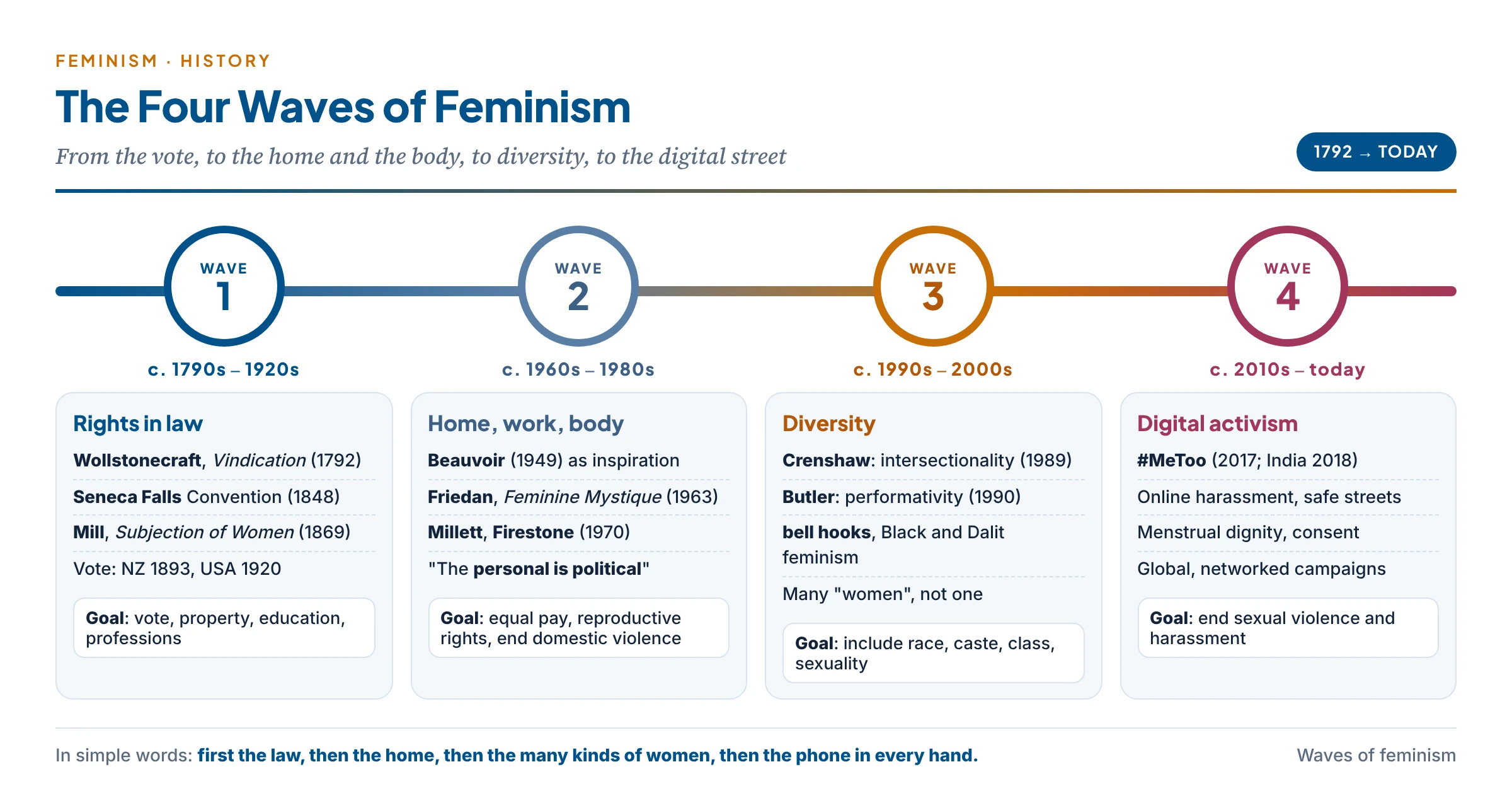
- First wave (late 18th to early 20th century) — legal and political equality: the right to vote, own property, enter universities and professions. Landmarks: Mary Wollstonecraft’s A Vindication of the Rights of Woman (1792); the Seneca Falls Convention (1848, USA); J.S. Mill’s The Subjection of Women (1869) and his suffrage amendment in the British Parliament (1867); women’s suffrage in New Zealand (1893), Britain (1918/1928), the USA (1920).
- Second wave (1960s–1980s) — beyond law to culture, family, sexuality, work and the body: Beauvoir’s The Second Sex (1949, its inspiration), Betty Friedan’s The Feminine Mystique (1963), Kate Millett’s Sexual Politics (1970), Shulamith Firestone’s The Dialectic of Sex (1970); campaigns for equal pay, reproductive rights, against domestic violence; “the personal is political”.
- Third wave (1990s) — diversity and difference: Black, Third World, Dalit and lesbian women challenged the idea of a single “woman”; intersectionality (Crenshaw, 1989), Butler’s performativity (1990).
- Fourth wave (2010s onwards) — digital activism against sexual harassment and violence: the #MeToo movement (worldwide from 2017; in India from 2018), campaigns against online abuse, for safe public spaces and menstrual dignity.
Core Doctrine
1. Liberal Feminism
Core idea: women are rational individuals just like men; their subordination comes from unequal laws, customs and education that deny them equal rights and opportunities. Equality must be established within the existing framework of liberal democracy — through legal reform, not revolution.
- Mary Wollstonecraft (A Vindication of the Rights of Woman, 1792):
- Women appear frivolous and weak not by nature but because they are denied education and trained only to please men.
- Women have the same reason and the same soul as men, so they deserve the same education and moral respect.
- “I do not wish them to have power over men; but over themselves.”
- John Stuart Mill (The Subjection of Women, 1869, written with the influence of Harriet Taylor):
- The “legal subordination of one sex to the other is wrong in itself, and now one of the chief hindrances to human improvement; and… it ought to be replaced by a principle of perfect equality, admitting no power or privilege on the one side, nor disability on the other.”
- Women’s “nature” is “an eminently artificial thing” — nobody can know what women can do until they are free (Article 1).
- Marriage law of his time made the wife a kind of slave — without property, without rights over her children, without protection from a violent husband.
- Equality would double the mental resources of humanity and improve men too, who are corrupted by unearned power.
- Mill moved the first parliamentary amendment for women’s suffrage (1867).
- Betty Friedan (The Feminine Mystique, 1963):
- Educated American housewives in comfortable suburbs suffered from “the problem that has no name” — emptiness, boredom and depression, despite having homes, husbands and children.
- The “feminine mystique” was the belief that women find fulfilment only as wives and mothers.
- Remedy: education, careers and equal opportunities; she co-founded the National Organization for Women (1966).
- Programme of liberal feminism: equal voting rights, equal education, equal pay, equal access to professions, anti-discrimination laws, reproductive rights, representation in politics, breaking the glass ceiling.
- Strengths: practical, gradual, achievable through democratic means; won the vote, property rights, education and anti-discrimination laws in most countries.
- Criticisms:
- Public–private split: liberalism keeps the family outside justice, so housework, care and domestic violence escape scrutiny.
- Male norm: it asks women to become equal to men on men’s terms — to compete in a world built around workers who have no care duties.
- Class and race blindness: it speaks mainly for educated, middle-class women; equal opportunity means little to a poor, landless woman.
- Formal equality is not enough: equal laws leave untouched the deeper structures of patriarchy (radical critique) and capitalism (socialist critique).
2. Marxist Feminism
Core idea: women’s oppression is rooted in class society and private property; it will end only with the end of capitalism.
- Friedrich Engels (The Origin of the Family, Private Property and the State, 1884):
- In early societies descent was traced through the mother (mother-right) and women had high status.
- When men began to own private property (herds, land), they wanted to pass it to heirs of certain paternity. This required control over women’s sexuality, produced the monogamous family (monogamy for the wife only) and overthrew mother-right — “the world-historic defeat of the female sex“.
- In the family, “he is the bourgeois and the wife represents the proletariat“.
- Remedy: abolish private property; bring all women back into public industry; make household work and child-care a public, social responsibility. Then the economic basis of male dominance disappears.
- Alexandra Kollontai in revolutionary Russia argued for communal kitchens, crèches and laundries so that women would be freed from “domestic slavery”.
- Strengths: links women’s oppression to economics and property; shows why economic independence matters.
- Criticisms: patriarchy is older than capitalism and survives in socialist states; Marxism treats women’s oppression as a secondary issue that will disappear “after the revolution”; it ignores sexuality, violence and the family’s emotional power.
In simple words
Engels saw the family like a small factory. The husband is the owner who brings in the wage and decides; the wife is the unpaid worker who cooks, cleans and raises the next generation of workers — for no salary and no say. Just as a worker is freed only when the factory changes, the wife is freed only when property and housework are reorganised.
3. Socialist Feminism
Core idea: women face two systems of domination at once — patriarchy and capitalism — which are separate but intertwined. Both must be fought together.
- Two divisions of capitalist society:
- Men and women, in which men dominate.
- Capitalists and workers, in which capitalists dominate.
- Sheila Rowbotham: the struggle for women’s liberation is essentially bound up with the struggle against capitalism. From historical evidence she showed that class exploitation and women’s oppression are closely linked — capitalism uses women as cheap labour and as unpaid producers of the next generation of workers.
- Juliet Mitchell (Woman’s Estate, 1971): women’s condition is shaped by four structures — production, reproduction, sexuality and the socialisation of children — and all four must change.
- Heidi Hartmann (“The Unhappy Marriage of Marxism and Feminism”, 1979): the marriage of Marxism and feminism has been “like the marriage of husband and wife in English common law: Marxism and feminism are one, and that one is Marxism“. Socialist feminism needs a dual-systems theory that gives patriarchy its own weight.
- The domestic labour debate and “Wages for Housework” (Mariarosa Dalla Costa, Selma James, Silvia Federici, 1970s):
- Unpaid domestic and reproductive labour — cooking, cleaning, bearing and raising children, caring for the sick — reproduces the workforce every day. Capitalism gets this labour free.
- Federici: “They say it is love. We say it is unwaged work.”
- Demand: recognise and pay for housework, or socialise it (public child-care, community kitchens).
- Strengths: explains the double burden of working women and the invisibility of care work in national income (Article 1).
- Criticisms: difficult to say exactly how the two systems interact; it may still underplay race, caste and culture.
4. Radical Feminism
Core idea: patriarchy — the systematic domination of women by men — is the oldest, deepest and most universal form of oppression, older than class and present in every society. It operates above all through sexuality, the family and reproduction. Ending it requires a radical reordering of society in which male supremacy is eliminated in all social and economic contexts.
- Kate Millett (Sexual Politics, 1970):
- “Sex is a status category with political implications“: relations between the sexes are power relations — this is “sexual politics”.
- Patriarchy is the most pervasive ideology of our culture, older than class, maintained mainly through the family, socialisation, religion, myth and, finally, force (rape, violence).
- Using Max Weber’s theory of domination, she argued that society exercises domination over women in two forms: through social authority (the legitimate power of men as heads of families and institutions) and through economic sources (control over money, property and work).
- She exposed sexual domination in the novels of D.H. Lawrence, Henry Miller and Norman Mailer.
- Shulamith Firestone (The Dialectic of Sex, 1970):
- Rewriting Marx, she argued that the first and basic division of society is not class but sex — the “sex class is so deep as to be invisible”.
- Its root is biology: women’s role in reproduction made them dependent on men; the biological family is the original power unit.
- Remedy: a feminist revolution that seizes control of reproduction — reproductive technology (even artificial reproduction outside the womb) and collective child-rearing — to free women from the “tyranny of their reproductive biology” and abolish the biological family.
- “The personal is political”: radical feminists made sexuality, marriage, housework, beauty norms and violence central political issues.
- Andrea Dworkin and Catharine MacKinnon campaigned against pornography as a practice of subordination; Adrienne Rich criticised “compulsory heterosexuality“.
- Two strands: radical-libertarian feminists (who wanted to free women from all fixed gender roles, even to become androgynous) and radical-cultural feminists (who celebrated distinctly female values — care, cooperation, intimacy — and sometimes favoured women-only spaces).
- Strengths: brought violence, sexuality, reproduction and the family into politics; produced laws against domestic violence and sexual harassment.
- Criticisms:
- Universalism: treats all women as one “sex class”, ignoring differences of class, race and caste.
- Essentialism: cultural radicals risk repeating the old stereotype of a fixed female nature.
- Biological pessimism: Firestone’s call to abolish natural reproduction seemed utopian and alienating to many women.
- Accused of treating men as the enemy rather than patriarchal structures.
In simple words
If an office manager controlled an employee’s money, decided where she could go, shouted at her and hit her, we would call it an abuse of power. For centuries, when the same things happened in a home, they were called a “family matter”. Radical feminism’s slogan “the personal is political” simply says: power is power, wherever it is exercised.
Anarcha-Feminism (a Brief Note)
- Anarcha-feminists (such as Emma Goldman) see patriarchy and traditional gender roles as forms of involuntary, coercive hierarchy, like the state and capital; they should be replaced by decentralised free association. Anarcha-feminism arose as a response to patriarchy within both society and radical movements.
Radical and Liberal Feminism on the Family
| Point | Liberal feminism | Radical feminism |
|---|---|---|
| View of family | A private institution that can be made fair through law and shared roles | The original site of patriarchy and women’s oppression |
| Cause of women’s oppression | Unequal laws, education and opportunities | Male control over women’s sexuality and reproduction |
| Remedy | Equal rights, divorce law, property rights, child-care | Transform or abolish the patriarchal family; control over reproduction |
| Public–private | Keeps them separate; reforms the public | “The personal is political” — dissolves the divide |
| Method | Gradual legal reform | Radical restructuring of society and culture |
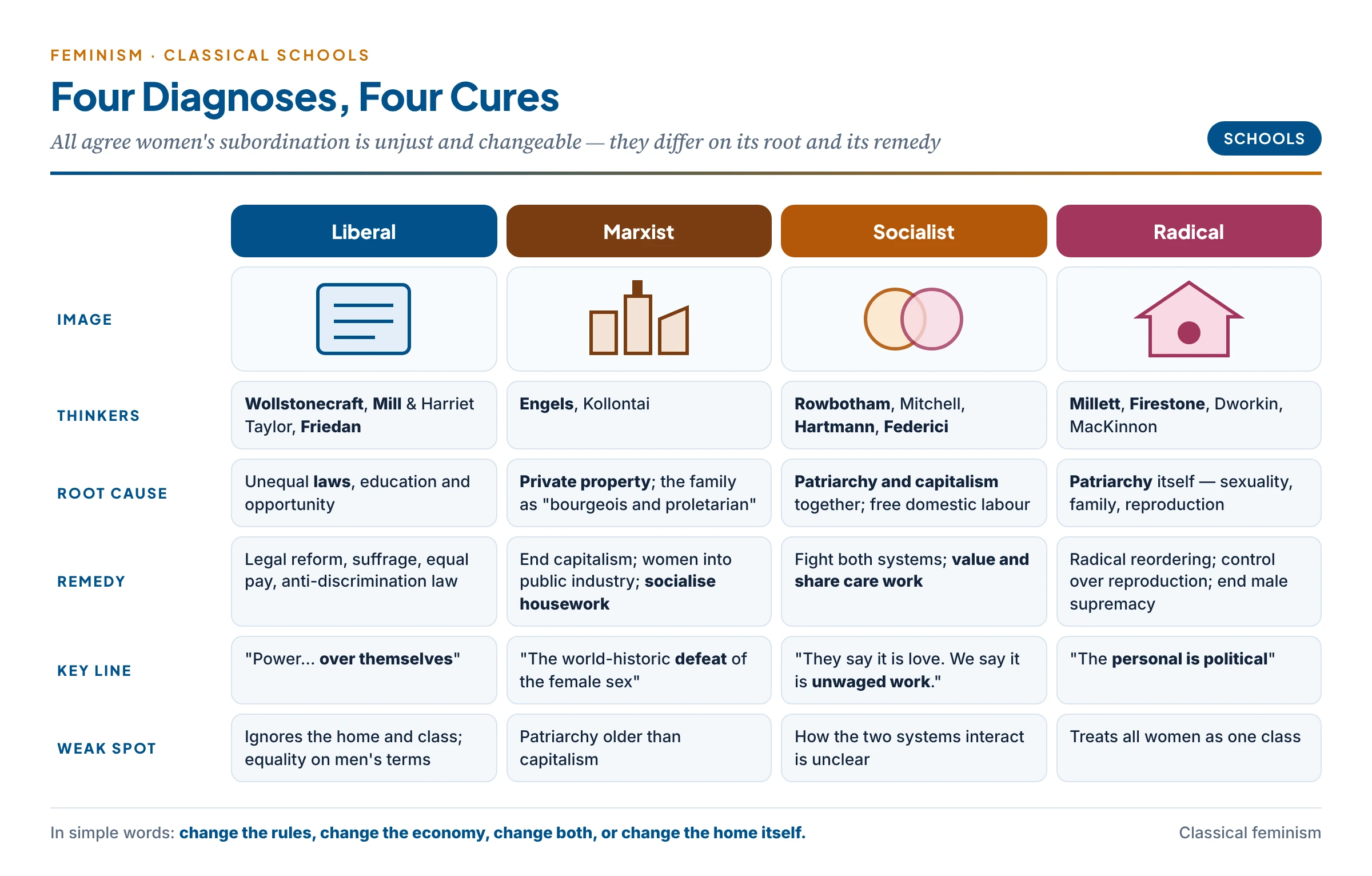
The Schools at a Glance
| School | Thinkers | Root cause | Remedy |
|---|---|---|---|
| Liberal | Wollstonecraft, Mill, Friedan | Unequal laws, education, opportunity | Legal reform, equal rights, education, representation |
| Marxist | Engels, Kollontai | Private property, class society | Abolish capitalism; women in public industry; socialised housework |
| Socialist | Rowbotham, Mitchell, Hartmann, Federici | Patriarchy and capitalism together | Fight both; value and socialise care work |
| Radical | Millett, Firestone, Dworkin, MacKinnon | Patriarchy — sexuality, family, reproduction | Radical reordering; end male supremacy in all spheres |
| Anarcha-feminist | Emma Goldman | Coercive hierarchy (state, patriarchy) | Free, decentralised association |
Common confusion
Is Simone de Beauvoir a “radical feminist”? Many revision notes list Beauvoir with the radical feminists, and her influence on them (especially Millett) was enormous. But Beauvoir’s own position is better called existentialist feminism, and politically it was socialist: she put economic independence and the socialisation of work and child-care at the centre, and did not see biology or sexuality as the single root of oppression. It is safest to call her the forerunner of second-wave feminism, whose ideas fed both the radical and the socialist schools.
Can Gender Equality Be Realised within a Socialist Regime?
This question has been asked in two forms: whether gender equality can be realised within a socialist regime, and whether it can be realised only within one.
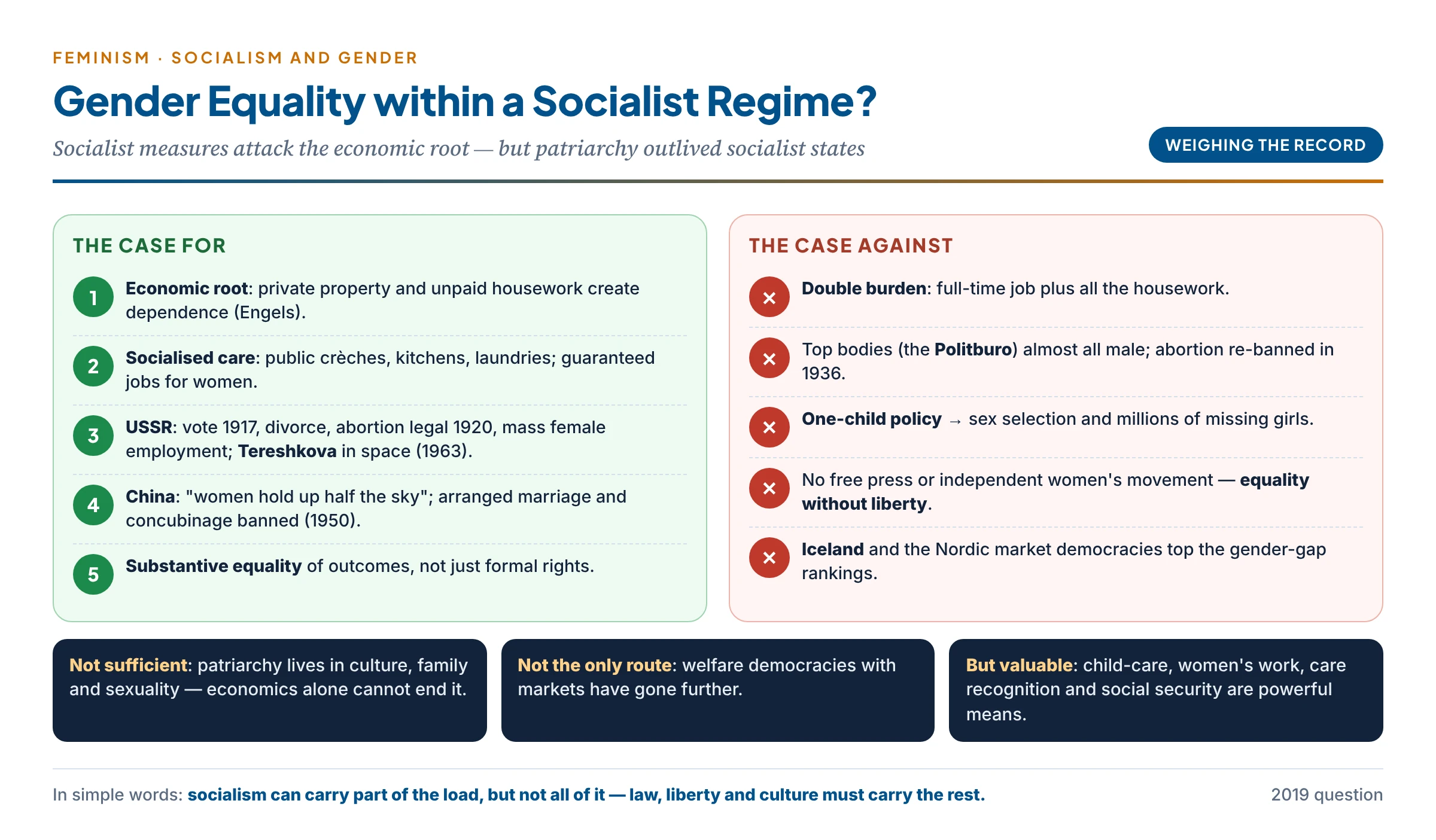
The case for socialism:
- Economic root: if women’s dependence comes from private property and unpaid domestic labour (Engels, socialist feminists), then a regime that socialises property, guarantees employment for women and provides public child-care, kitchens and laundries attacks the root.
- Historical record:
- Soviet Russia gave women the vote in 1917, legalised divorce and (in 1920) abortion, and drew women into the workforce in very large numbers; Valentina Tereshkova became the first woman in space (1963).
- China proclaimed that “women hold up half the sky” (Mao), abolished concubinage and arranged marriages by law (1950) and brought women into work.
- Substantive equality: socialism promises equality of outcomes, not merely formal rights.
The case against:
- Patriarchy survives socialism: Soviet women carried a double burden — full-time jobs plus all the housework — while top political bodies such as the Politburo remained almost entirely male. Stalin re-criminalised abortion in 1936 and promoted the “heroine mother”.
- State control of women’s bodies: China’s one-child policy (1980–2015) led to sex-selective abortion and millions of “missing girls” — showing that a socialist economy can coexist with fierce son preference.
- Equality without freedom: socialist regimes often denied women (and men) political liberty, free association and an independent women’s movement.
- Non-socialist success: the countries ranked highest for gender equality — Iceland, Norway, Finland, Sweden — are liberal democracies with market economies and strong welfare states. Iceland has topped the World Economic Forum’s Global Gender Gap index for more than fifteen years and became the first country to require employers to certify equal pay (2018).
- Radical feminist objection: economic change alone cannot end patriarchy, which lives in culture, family and sexuality.
Balanced conclusion: socialist measures — public child-care, women’s employment, recognition of care work, social security — are powerful means to gender equality, and the welfare-state experience shows their value. But socialism is neither sufficient (patriarchy survived it) nor the only route (social democracies with markets have done better). Gender equality needs economic justice plus political liberty, legal reform and cultural change together.
Is Feminism an Ideology for Empowerment or for Equality?
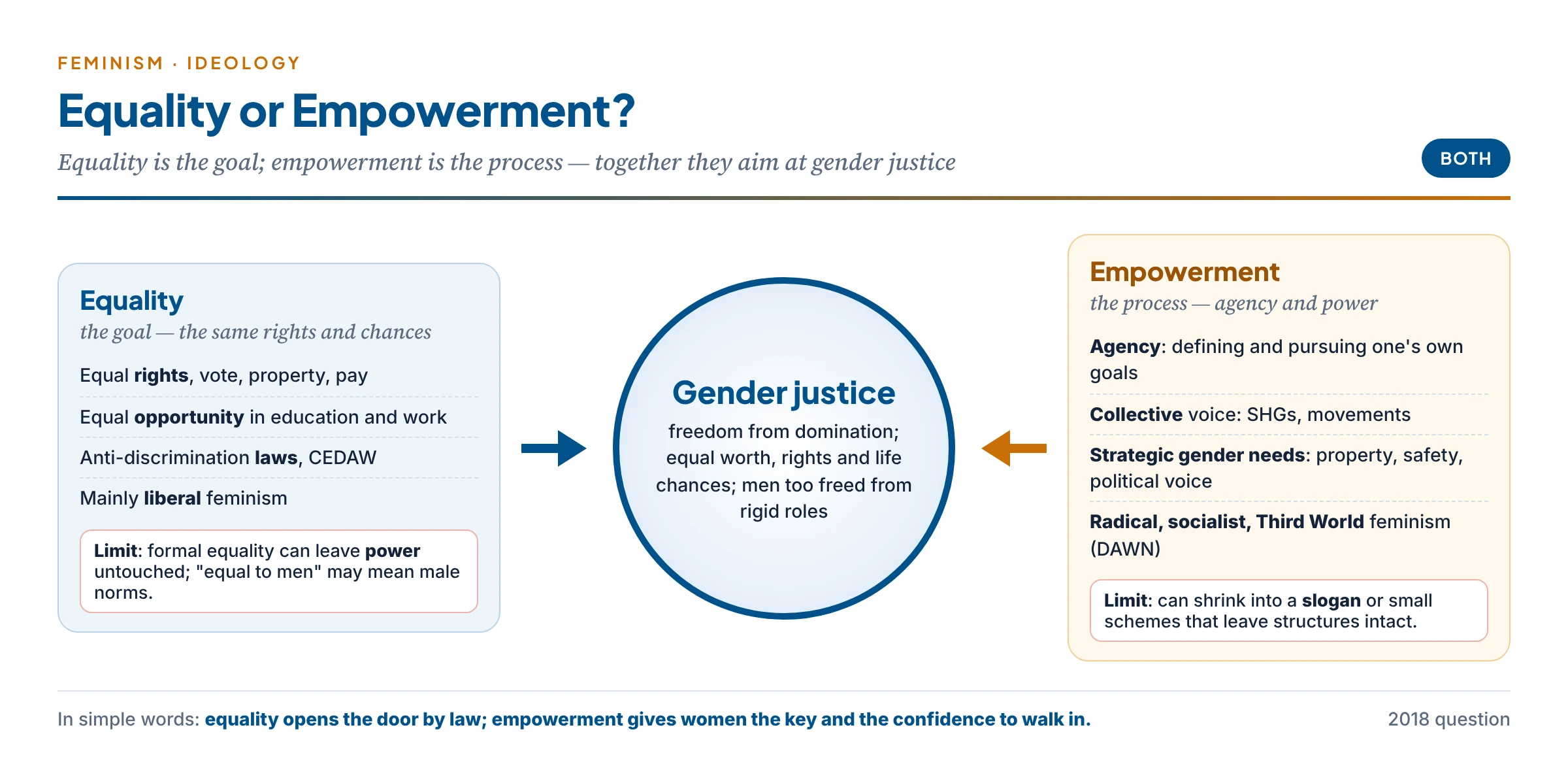
- Equality strand:
- The classical demand of liberal feminism — equal rights, equal opportunity, equal pay, equal treatment in law.
- Strength: a clear, universal standard; easy to embody in constitutions and laws (Articles 14–16; CEDAW).
- Limit: formal equality can leave power untouched — equal law in a patriarchal family or market may still produce unequal results; and “equal to men” can mean adopting male norms.
- Empowerment strand:
- Associated with radical, socialist and Third World feminism — transforming power relations so that women gain agency: the ability to define their own goals and act on them, individually and collectively.
- The DAWN network of Third World feminists (Development Alternatives with Women for a New Era, 1985) and theorists such as Naila Kabeer and Jo Rowlands made “empowerment” the central idea (Article 7).
- Practical and strategic gender needs (Caroline Moser): practical needs (water, health, income) improve women’s lives within existing roles; strategic needs (property rights, freedom from violence, political voice) change those roles.
- Limit: “empowerment” can become a vague slogan — used by governments and markets for small loans or schemes that leave structures intact.
- Difference and care strand: some feminists seek neither sameness nor power but recognition of women’s distinct experiences and values (Article 4).
- Conclusion: feminism is an ideology for both. Equality is the goal — equal worth, rights and life-chances. Empowerment is the means and the process — without agency and power, equality on paper stays on paper; without the standard of equality, empowerment has no direction. Its deepest aim may be called liberation or gender justice: freedom from domination for women, and from rigid roles for everyone.
In simple words
Think of a locked door. Equality is a law that says, “Women may enter this room.” Empowerment is getting the key, the confidence to walk in, and enough friends to keep the door from being shut again. A law without the key leaves women outside; a key without the law can be taken away. Feminism needs both.
Is Economic Independence Essential for Equality between Men and Women?
- Yes — it is essential:
- Engels and the socialist feminists: dependence on the husband’s income is the economic root of subordination.
- Beauvoir: “legal and political rights are meaningless as long as woman remains economically dependent on the male” (Article 2).
- Mill: a wife who earns can bargain as an equal.
- Sen and Agarwal: a woman with income or property has a stronger fallback position, so she gains bargaining power in the household (Article 6).
- Without money of her own, a woman cannot leave an abusive marriage, educate her daughter as she wishes or take part in public life.
- But it is not sufficient:
- Many earning women still carry the double burden and hand over their wages to husbands or in-laws.
- Violence, dowry and harassment affect working women too.
- Legal rights, social attitudes, political voice and bodily autonomy are equally necessary.
- Emotional and cultural dependence may remain even with a salary — as Beauvoir’s own heroines show (Article 2).
- Conclusion: economic independence is a necessary condition, not a sufficient condition, of gender equality (compare the 2026 question on land rights, Article 6).
Critical Evaluation
General Criticisms of Feminism
- Conservative critique: feminism undermines the family and traditional roles that give stability and meaning; it devalues motherhood and homemaking.
- Reply: feminism attacks domination, not the family as such; a family of equals is stronger, not weaker. Many feminists value care — they want it shared and recognised.
- “Women are already equal”: in many countries formal equality exists, so feminism is outdated.
- Reply: wage gaps, violence, unpaid care, under-representation and son preference show that substantive equality is far from achieved; UN Women’s 2026 Gender Snapshot estimates that, at current rates, full gender equality would take about 171 years.
- Internal critique (third wave): early feminism spoke for white, middle-class, Western women; Black, Dalit and Third World women felt excluded (Article 4).
- Charge of “man-hating”: a caricature of radical feminism; the mainstream goal is a just relationship between the sexes, not the subjection of men.
Critics and Defenders
Criticism — Critics of feminism
- Conservatives: the family and natural roles are undermined; motherhood devalued.
- Marxists: liberal feminism ignores class; women’s issues are secondary to the class struggle.
- Black, Dalit and Third World feminists: mainstream feminism universalised the experience of privileged women.
- Postmodern critics: “woman” is not a single, stable category to build a politics on.
- Anti-feminist populism: feminism is said to have “gone too far” and harmed men.
Defence — Defenders and achievements
- First wave: the vote, property rights, education, entry to professions.
- Second wave: equal-pay laws, reproductive rights, laws against domestic violence and harassment.
- Theory: “the personal is political” brought justice into the home.
- Third and fourth waves: diversity, intersectionality, #MeToo and safe public spaces.
- Balance: each school corrects another — liberal law, socialist economics, radical attention to the body and family together make a fuller picture.
Cross-Tradition Comparison
The Western Schools and the Indian Women’s Movement
| Western school | Indian counterpart |
|---|---|
| Liberal — rights, education, suffrage | Social reform movement (Raja Ram Mohan Roy against sati, Vidyasagar for widow remarriage), Savitribai Phule’s girls’ schools (1848), the All India Women’s Conference (1927), universal adult franchise in the Constitution (1950), the Hindu Code Bills |
| Marxist / socialist — women and labour | Women in peasant and trade-union struggles (Telangana, Tebhaga), SEWA (Ela Bhatt, 1972) organising self-employed women workers, socialist women’s organisations |
| Radical — violence, body, family | The 1970s–80s autonomous women’s movement: the Mathura custodial rape protests (1979–80) leading to the 1983 criminal-law amendment, anti-dowry campaigns, the Towards Equality report (1974) exposing declining sex ratios |
| Eco-feminism (Article 4) | Chipko (1973), with Gaura Devi and the women of Reni hugging trees |
Indian Connect — Indian Connect — the takeaway
- Indian feminism grew from within Indian society — from Phule, Ramabai, Tarabai Shinde and Ambedkar — not merely as a Western import, though it learned from the Western schools.
- Its distinctive feature is its link with caste, class and rural livelihood: questions of land, water, forests, dowry and son preference shape Indian women’s lives as much as the vote or the glass ceiling.
- The Towards Equality report (1974) of the Committee on the Status of Women in India found that the declining sex ratio and the poverty of women had worsened since Independence — a turning point that launched the modern Indian women’s movement.
Synthesis (Siddhānta)
- Feminism seeks to end discrimination against women in rights, self-development and political power; it is a cross-cutting ideology whose schools differ on the root cause of oppression.
- Liberal feminism (Wollstonecraft, Mill, Friedan) won legal and political equality but left the private sphere and economic structures untouched.
- Marxist and socialist feminism (Engels, Rowbotham, Mitchell, Hartmann, Federici) linked women’s oppression to property, capitalism and unpaid care work; socialist measures help, but socialism is neither sufficient nor the only route to gender equality.
- Radical feminism (Millett, Firestone) exposed patriarchy in sexuality, the family and violence — “the personal is political” — though at the risk of universalising women’s experience.
- Feminism is an ideology both for equality (the goal) and for empowerment (the process); and economic independence, while essential, is not sufficient without legal rights, social change and political voice.
- Contemporary relevance:
- Unpaid care work — the socialist feminists’ theme — is now measured in time-use surveys and recognised in debates on social security and child-care.
- #MeToo and the law on workplace harassment continue the radical feminist demand that sexual power be treated as political.
- The Nordic model of equal pay certification and shared parental leave shows how liberal democracies can absorb socialist-feminist ideas.
“I do not wish them to have power over men; but over themselves.” — Mary Wollstonecraft
Previous Year Questions
- 2019Can gender equality be realised within a socialist regime?
- 2018Is feminism an ideology for empowerment or for equality? Discuss.
- 2013Is economic independence essential for equality between men and women?