

Gender Discrimination: Female Foeticide, Land and Property Rights; Empowerment.
Official Syllabus: Paper II, Section A, Unit 9
Land and property rights are the material basis of women’s autonomy. A woman who owns land, a house or other assets in her own name can feed herself, borrow money, bargain within the family and, if necessary, leave an abusive marriage. A woman who owns nothing depends on her father, husband or sons for her very survival. Yet across the world — and especially in South Asia — women work the land far more than they own it, and laws, customs and religious traditions have long passed property through sons. Philosophically, the question touches personhood (is property an extension of the self?), justice (who deserves what one has laboured on?) and equality (can there be equality without economic independence?). This article explains the gender property gap, why property matters — through Locke, Hegel, Engels, Woolf, Bina Agarwal and Amartya Sen — the evolution of Indian law (from the Hindu Succession Act to Vineeta Sharma and the latest Supreme Court rulings on tribal women), the gap between law and practice, the role of religious sanction, and the questions UPSC keeps asking: have land and property rights empowered women, and are they a necessary or a sufficient condition for gender equality?
In simple words
Two sisters in the same village are both beaten by their husbands. The first owns, in her own name, a small plot of land her father left her. She can say, “If this continues, I will go back and live on my land.” Her husband knows she can leave. The second owns nothing; her parents’ land went to her brothers. If she leaves, she has nowhere to go and nothing to eat. The violence is the same, but the power in the two homes is completely different. That difference is what land rights give: a fallback position.
Context & Problem
The Gender Property Gap
- Women work the land; men own it.
- Worldwide, women make up about 38% of agricultural workers (Food and Agriculture Organization, 2023), and in South Asia about 71% of working women are employed in agriculture and food systems.
- Yet fewer than 15% of agricultural landholders worldwide are women.
- India: women held only 13.96% of operational landholdings, covering 11.72% of the operated area (Agriculture Census 2015–16).
- NFHS-5 (2019–21): 43.3% of women aged 15–49 said they owned a house and/or land alone or jointly — but most of this is joint ownership, often on paper only.
- How women hold land: mostly through male family members — fathers, husbands, sons. They therefore risk losing access on divorce, widowhood, or the husband’s migration.
- Smaller and poorer land: where women do hold land, their parcels are generally smaller and of lower quality.
- Feminisation of agriculture: as men migrate to cities, women increasingly run farms — but without titles they cannot get credit, insurance, subsidies or recognition as “farmers”.
- Feminisation of poverty: women are the worst affected victims of poverty because they are economically dependent on men.
- Beijing 1995: the Fourth World Conference on Women made women’s land and property rights a central theme of its Platform for Action.
Common confusion
Do women really produce “60–80% of the world’s food”? This widely repeated figure (often attributed to the UN) has no solid statistical basis. The Food and Agriculture Organization’s own careful estimate is that women make up about 38% of agricultural workers worldwide (2023), with much higher shares in parts of Asia and Africa. The correct point is not a dramatic percentage but the gap: women do a very large share of farm work yet hold fewer than 15% of agricultural land.
Core Doctrine
Why Property Matters — the Philosophical Grounds
1. Locke: labour creates property — and the feminist critique
- John Locke (Second Treatise of Government, 1690): a person acquires a right to property when he mixes his labour with nature — the farmer who clears and tills the land makes it his.
- Feminist critique: women have mixed their labour with land, seeds, water and livestock for millennia — sowing, weeding, transplanting, harvesting, tending animals, processing food. By Locke’s own logic they should own what they have worked. Yet patrilineal inheritance and patrilocal residence systematically disinherit daughters and wives and give title only to men — a vast, systematic appropriation of women’s labour.
2. Hegel: property as the embodiment of personality
- Hegel (Philosophy of Right, 1820): a person gives her freedom an external existence through property; owning things is how the will becomes real in the world and is recognised by others.
- Application: a woman denied all property is denied a basic sphere of personhood and recognition — she exists only through others.
3. Engels: property and the origin of women’s subordination
- Engels linked the rise of private property to the overthrow of mother-right and the subordination of women (Article 3). The remedy lies in women’s economic independence.
4. Woolf and Beauvoir: money and a room of one’s own
- Virginia Woolf (A Room of One’s Own, 1929): “a woman must have money and a room of her own if she is to write fiction” — material independence is the condition of creative freedom.
- Beauvoir: “legal and political rights are meaningless as long as woman remains economically dependent” (Article 2).
5. Nussbaum’s capabilities
- Among the central capabilities is control over one’s environment — including “being able to hold property (both land and movable goods) on an equal basis with others” (Article 7).
Bina Agarwal: A Field of One’s Own (1994)
The economist Bina Agarwal provided the classic theoretical and empirical foundation for women’s land rights in South Asia. She gave four arguments:
- Welfare
- Land is the most reliable buffer against poverty in rural economies. Income controlled by women is spent more on children’s food, health and schooling than income controlled by men.
- Women’s own welfare does not automatically follow from the household’s — resources inside the family are unequally shared.
- Efficiency
- Women farmers with secure title can get credit, inputs and technology, invest in the land and produce more; insecure, borrowed access discourages investment.
- Equality
- Equal property rights are a matter of gender justice in themselves — sons and daughters, husbands and wives, should be treated alike.
- Empowerment
- Land strengthens women’s bargaining power in the family and the community and their ability to challenge social and political gender inequality.
- Why land is special: employment and microcredit are volatile; land is a permanent, secure, immovable asset that gives food, income, collateral for loans and social status in an agrarian society.
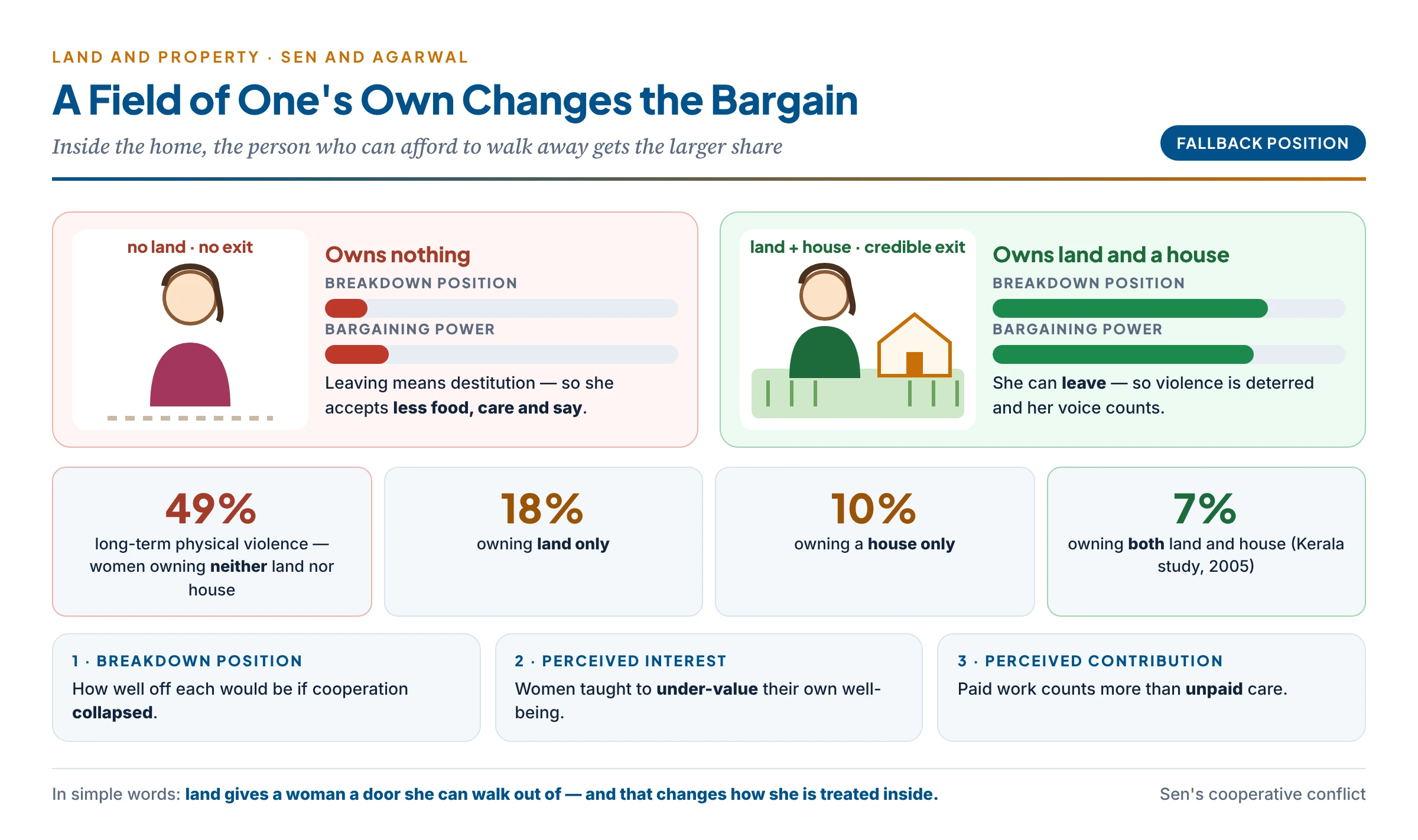
- The fallback position: an independent title gives a woman a credible threat of exit from an abusive marriage — which deters domestic violence and commands respect within the household and community.
- Independent, not only joint: Agarwal stressed independent titles where possible — a joint title can still be controlled by the husband, and is hard to enforce if the marriage breaks.
- Rights in law vs rights in practice: a right is effective only when it is (a) recognised in law, (b) socially accepted, (c) actually enforced, and (d) accompanied by real control over the land and its produce.
- Evidence: a study by Pradeep Panda and Bina Agarwal (2005) of women in Kerala found that 49% of women who owned neither land nor a house had experienced long-term physical violence, compared with only 7% of women who owned both; psychological violence was 84% against 16%. Property-owning women who faced violence were far more likely to leave.
Sen: The Household as “Cooperative Conflict”
- Traditional economics (Gary Becker) treated the household as a harmonious unit with one shared utility — as if all members had the same interests and resources were shared fairly.
- Amartya Sen (“Gender and Cooperative Conflicts”, 1990) argued that the household involves cooperation and conflict at the same time:
- Cooperation — members work together to produce more (income, food, care).
- Conflict — they also bargain, openly or silently, over how the fruits are divided (food, health care, education, leisure, assets).
- What decides the division? Three factors:
- Breakdown (fallback) position — how well off each person would be if cooperation collapsed. The stronger one’s fallback, the more one gets.
- Perceived interest — women are often socialised to under-value their own well-being and to identify it with the family’s (an adaptive preference).
- Perceived contribution — work that brings in money is seen as a bigger contribution than unpaid domestic work, so women’s share is perceived to be smaller.
- Bargaining power rises with the strength of the breakdown position. Without independent land, property or income, a woman’s breakdown position is catastrophic, so she accepts less food, less health care and subordinate status. Land ownership transforms the breakdown position — from helplessness to autonomy — and raises her perceived contribution.
In simple words
Think of two players in a game who must share a prize. Each knows what he will get if he walks away. The player with a better “walk-away” option can demand a bigger share, because he can afford to leave. A wife with land of her own has a good walk-away option; a wife with nothing has none. Land rights change the rules of bargaining inside the home.
Women’s Property Rights in Indian Law
Hindu law — from limited estate to coparcener
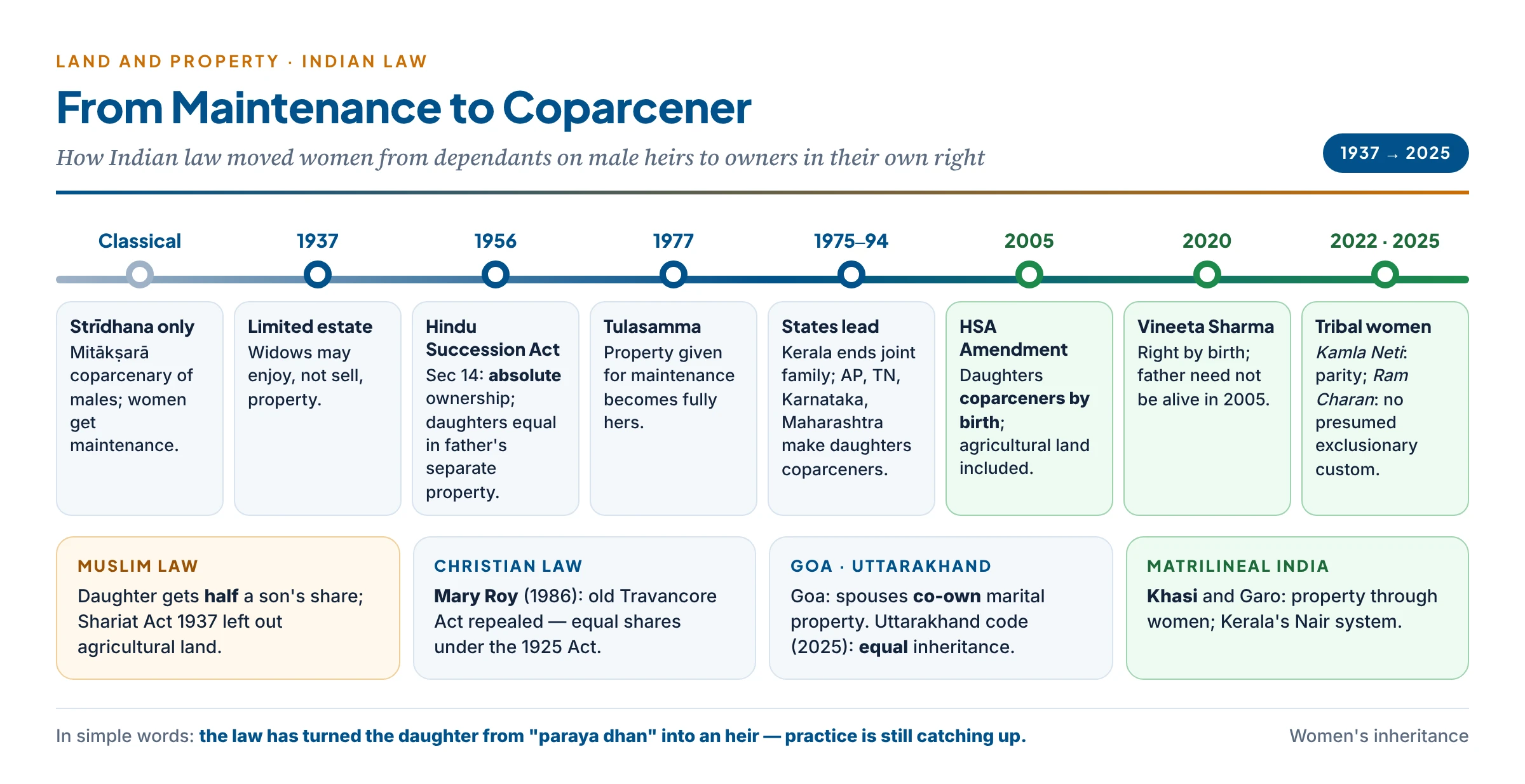
- Classical law: under the Mitākṣarā school, ancestral property belonged to a coparcenary of male descendants (a son acquired a share by birth); women had maintenance, not ownership, except for strīdhana (gifts, jewellery and certain property that was a woman’s own). The Dāyabhāga school (Bengal) gave widows somewhat better rights.
- Hindu Women’s Right to Property Act (1937) gave widows a limited estate — a right to enjoy property during life, not to sell or bequeath it.
- Hindu Succession Act (1956) — part of the reforms that grew out of Ambedkar’s Hindu Code Bill (Article 4):
- Section 14 turned women’s limited estates into absolute ownership; in V. Tulasamma v Sesha Reddi (1977) the Supreme Court read it broadly, holding that property given to a woman in lieu of maintenance becomes fully hers.
- Daughters became equal heirs with sons in a father’s separate property.
- But daughters were not coparceners in ancestral (joint family) property (Section 6), and agricultural tenancies were left to state laws (Section 4(2)), which often favoured male heirs.
- State reforms: Kerala abolished the joint family system altogether (1975); Andhra Pradesh (1986), Tamil Nadu (1989), Karnataka and Maharashtra (1994) made daughters coparceners.
- Hindu Succession (Amendment) Act, 2005 (in force from 9 September 2005):
- Daughters became coparceners by birth, with the same rights and liabilities as sons.
- Section 4(2) was deleted, bringing agricultural land under the equal-inheritance rules.
- The restriction on a daughter’s right to demand partition of the family dwelling house was removed.
- Vineeta Sharma v Rakesh Sharma (2020): a three-judge bench held that a daughter is a coparcener by birth, and her right does not depend on her father being alive on 9 September 2005 — overruling the narrower view in Prakash v Phulavati (2015).
Other personal laws
- Muslim law: daughters inherit, but generally half the share of a son (justified traditionally by the son’s duty to maintain the family and the wife’s right to mahr); widows receive a fixed fraction. The Shariat Application Act (1937) excluded agricultural land, which was then governed by state tenure laws often unfavourable to women; some states later removed the exclusion.
- Christian law: governed by the Indian Succession Act (1925), which gives daughters equal shares. In Mary Roy v State of Kerala (1986) — a case brought by the educationist Mary Roy — the Supreme Court held that the old Travancore Christian Succession Act, which had limited a daughter to a quarter of a son’s share or ₹5,000, had been repealed, so Syrian Christian women in Kerala became entitled to equal shares under the 1925 Act.
- Goa: its civil code, inherited from Portuguese law, gives spouses joint ownership of marital property (communion of assets) and equal inheritance to children.
- Uttarakhand’s Uniform Civil Code (in force from 2025) gives sons and daughters equal inheritance across communities in the state.
Tribal women
- The Hindu Succession Act does not apply to Scheduled Tribes (Section 2(2)) unless the Centre notifies otherwise; inheritance is governed by customary law, which in many communities excludes daughters.
- Kamla Neti v Special Land Acquisition Officer (2022): the Supreme Court said a female tribal is “entitled to parity with male tribal” and asked the Centre to consider amending Section 2(2).
- Ram Charan v Sukhram (2025): where custom was silent, the Court refused to presume an exclusionary custom and, applying “justice, equity and good conscience” with Article 14, gave a tribal woman’s heirs an equal share — “customs too, like the law, cannot remain stuck in time”.
- Matrilineal exceptions: among the Khasi and Garo of Meghalaya, property passes through women (among the Khasi, the youngest daughter, khadduh, is custodian of ancestral property), and Kerala’s Nair marumakkathāyam system was matrilineal until the twentieth century.
Schemes and administrative measures
- Joint or women’s titles in government housing: about three-quarters of rural houses under the Pradhan Mantri Awas Yojana–Gramin are in women’s sole or joint names.
- Lower stamp duty for property registered in women’s names (for example, 4% instead of 6% in Delhi).
- SVAMITVA (2020) — drone mapping and property cards for village homes, with the potential to record women as owners or co-owners.
- Women farmers: recognition of women as farmers for credit, insurance and extension services; self-help-group federations and the Lakhpati Didi programme (over 3 crore women by March 2026) to raise women’s own incomes.
In simple words
A concert ticket printed in your name is useless if your brother keeps it in his pocket and will not let you in. The law has now printed the ticket in the daughter’s name; practice — family pressure, records, custom — often keeps it in someone else’s pocket. Effective rights mean the ticket in her own hand, and the door open.
The Gap between Law and Practice
- Relinquishment under pressure: daughters are pressed to sign away their share (hak tyāg) in favour of brothers, to “keep relations” with the natal family — the brother’s house is often a married woman’s only refuge.
- Dowry as a substitute: families claim the daughter’s dowry was her share — though dowry is usually controlled by the husband’s family.
- Patrilocality: a daughter married into a distant village cannot easily cultivate or manage natal land.
- Records and procedure: revenue records (mutation) are not updated; registration offices and courts are costly, slow and male-dominated; many women are unaware of their rights.
- Violence and social sanction: women who claim land — especially widows — face harassment, accusations of witchcraft or eviction.
- Nominal ownership: property is sometimes put in a wife’s name only to save stamp duty or evade land ceilings, while control stays with the husband.
- Unintended effects: some studies of the reforms found families responding by giving dowry instead of land, or by intensifying son preference — a reminder that law interacts with values (Article 5).
Religious Sanction and Women’s Rights to Land, Property and Divorce
- Personal laws in India are largely rooted in religious traditions — Dharmaśāstra, Shariat, canon law — and several of them historically gave women unequal shares of property and unequal rights of divorce and maintenance.
- Constitutional tension: Article 25 protects freedom of religion; Articles 14 and 15 guarantee equality. In State of Bombay v Narasu Appa Mali (1952) the Bombay High Court held that uncodified personal laws are not “laws in force” to be tested against fundamental rights — which long shielded them from equality review.
- Landmarks:
- Shah Bano (1985) upheld a divorced Muslim woman’s right to maintenance; Parliament’s 1986 Act was later read in Danial Latifi (2001) to secure fair provision.
- Shayara Bano (2017) set aside instant triple talaq; the 2019 Act made it a criminal offence.
- Sabarimala (2018) addressed women’s entry to a temple (now before a larger bench).
- Article 44 (Uniform Civil Code) and Uttarakhand’s code (2025) aim at equal personal law.
- Is the empowerment of women a sufficient means to their equal rights to land, property and divorce, where these are tied to religious sanction?
- Empowerment helps: educated, earning, organised women know their rights, go to court, and press for reform within their communities (for example, Muslim women’s groups that campaigned against triple talaq).
- But it is not sufficient: when inequality is written into religiously sanctioned law, individual empowerment cannot overcome it alone; it needs legal reform (codification, judicial review), reinterpretation of religious texts by reformers within each faith, and social acceptance.
- Balance: reform should respect religious freedom while insisting that religious freedom does not include the power to deny equal dignity to women — reform best comes with the participation of the women of each community.
Have Land and Property Rights Empowered Women?
- Yes — evidence of empowerment:
- Lower domestic violence and greater ability to exit (Kerala study).
- Higher bargaining power and say in household decisions; more spending on children.
- Studies of the inheritance reforms found daughters more likely to inherit land, and linked the reforms with later marriage and more schooling for girls, though the effects were modest.
- Access to credit, government schemes and recognition as farmers; greater social status and voice in village meetings.
- Women’s ownership of houses (PMAY-G) has given many their first asset and a sense of security.
- Limits — why the effect is partial:
- Law is ahead of practice — relinquishment, pressure, poor records.
- Ownership without control — the husband or son manages the land and keeps the income.
- Landless women — for the millions of Dalit and Adivasi women whose families own no land, inheritance law offers little; they need land redistribution, wages, jobs and social security.
- Social norms — patriarchal attitudes, unpaid care work, violence and lack of political voice remain.
- Conclusion: land and property rights have begun to empower women where they are effective — legally recognised, socially accepted, enforced and controlled — but their full promise depends on closing the gap between law and practice.
Necessary or Sufficient for Social Equality between the Genders?
- A necessary condition is one without which the result cannot occur; a sufficient condition is one that by itself guarantees the result.
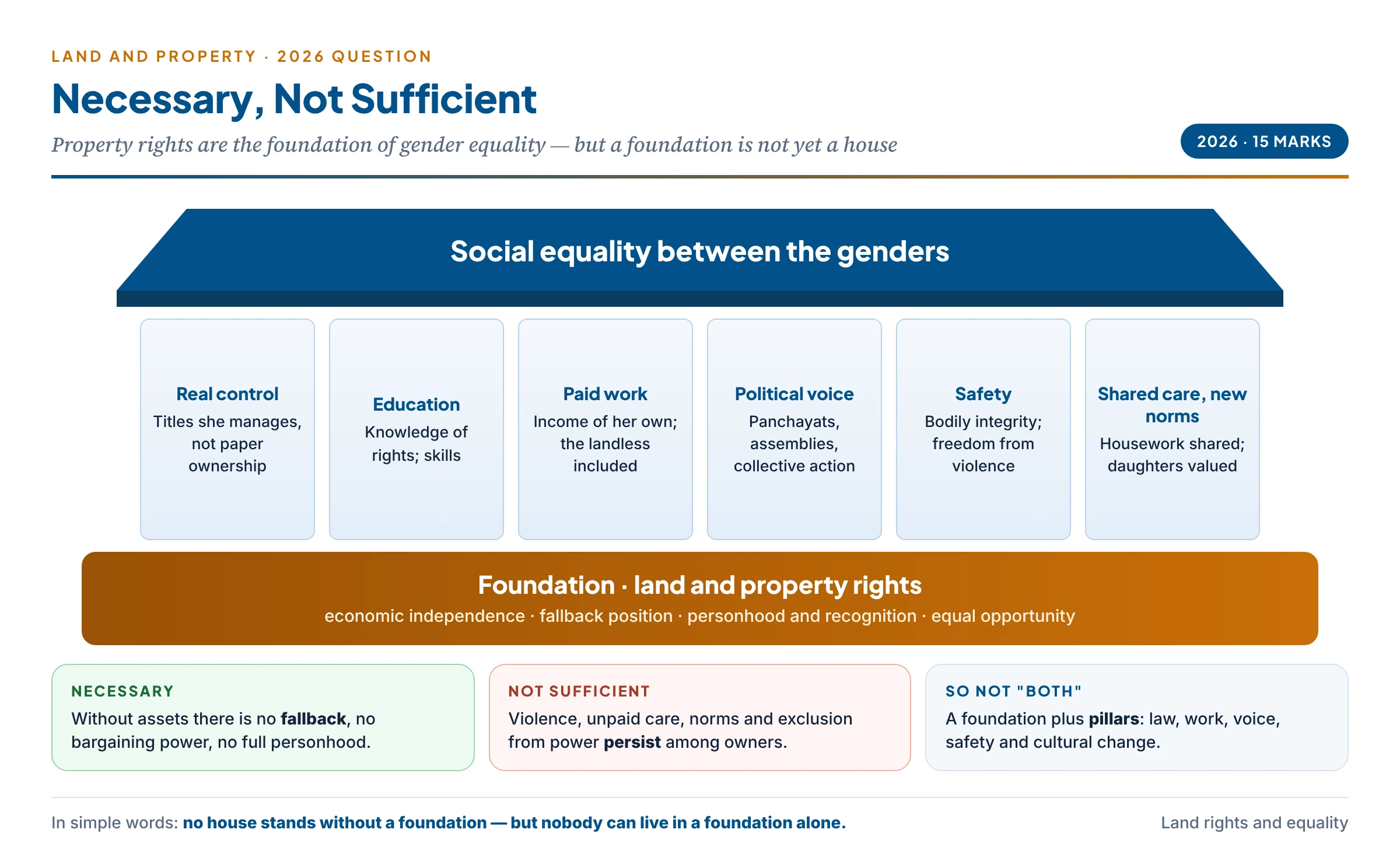
- Why property rights are necessary:
- In agrarian and property-based societies, economic dependence is the root of subordination (Engels, Beauvoir, Agarwal).
- Without assets, women have no fallback position and so no bargaining power (Sen).
- Denial of property is a denial of personhood and recognition (Hegel, Nussbaum).
- Equality of opportunity is hollow if one group starts with nothing.
- Why they are not sufficient:
- Titles without control leave power where it was.
- Violence, unpaid care work and social norms persist even among property-owning women.
- Equality also needs education, health, political representation, bodily integrity and changed attitudes — Beauvoir’s own propertied heroines remained emotionally dependent (Article 2).
- For landless women, property inheritance is not the route; jobs, wages and social security are.
- Verdict: land and property rights are a necessary but not a sufficient condition for social equality among the genders — a foundation on which other pillars (education, work, voice, safety, shared care, cultural change) must be built. Strictly, it is economic independence in some form that is necessary; land and property are its most important form in rural India.
In simple words
Think of a village pond. If each family fences a small corner for its own needs, everyone still has water and stays friendly. If one powerful family fences the whole pond, others go thirsty and the village turns bitter. Property can protect people’s security or destroy their fellowship — it depends on how it is shared and limited.
Does the Right to Property Create Economic Disparity and Threaten Fraternity?
- The critics of property:
- Rousseau (Discourse on Inequality, 1755): “The first man who, having enclosed a piece of ground, bethought himself of saying This is mine, and found people simple enough to believe him, was the real founder of civil society” — and of inequality, wars and miseries.
- Proudhon: “Property is theft.” Marx: private ownership of the means of production produces class division and exploitation.
- Gandhi: possessions beyond need are a kind of theft; the rich should hold wealth as trustees for society.
- Unlimited property concentrates wealth, deepens class inequality and weakens fraternity — the sense of shared membership that Ambedkar placed beside liberty and equality.
- The defenders:
- Locke and Nozick: property justly acquired through labour or free exchange is an entitlement; taking it violates liberty.
- Hegel: property is a condition of personhood and freedom.
- Property gives security and independence — especially to the weak, such as women, small farmers and tribal communities, whose lack of property is itself a cause of disparity.
- The Indian approach: the 44th Amendment (1978) removed property from the list of fundamental rights; it is now a constitutional right under Article 300A (no deprivation except by authority of law). Directive Principles 39(b) and (c) ask the state to prevent the concentration of wealth; land ceilings and land reforms put these into practice.
- Conclusion: an unlimited right to property can create disparity and erode fraternity; but a fairly distributed right to property — including equal property rights for women — reduces disparity and supports fraternity. The issue is not property as such but its distribution and limits.
Denial of Land and Inheritance as a Denial of Women’s Fundamental Humanity
- Personhood: property is the external sphere of a person’s freedom (Hegel); to deny it to women is to treat them as dependants, not persons.
- Labour: by Locke’s own standard, women’s labour on the land earns them a title.
- Human rights: the Universal Declaration of Human Rights (Article 17) says everyone has the right to own property; CEDAW requires equal rights for women in ownership, inheritance and management of property.
- Capabilities: holding property on an equal basis is a central capability (Nussbaum); without it, women’s capabilities of life, health, bodily integrity and practical reason are all at risk.
- Dignity: disinheritance tells a daughter she is “paraya dhan” — not a full member of her own family. This expressive harm is as real as the material loss.
Critical Evaluation
Objections to Women’s Land Rights — and Replies
- Fragmentation: dividing land among daughters makes holdings uneconomic.
- Reply: the same is true of division among sons, which nobody opposes; joint cultivation, leasing and cooperatives can keep land productive.
- Family harmony: claims by daughters will cause conflict with brothers.
- Reply: harmony built on one party’s disinheritance is not justice; many families accept equal shares peacefully once norms change.
- Land will pass to the husband’s family: a married daughter’s share leaves the natal lineage.
- Reply: exactly the patrilineal logic that subordinates women; the son’s wife likewise brings land in.
- Dowry is her share: daughters already receive dowry.
- Reply: dowry is usually movable, controlled by the in-laws, and itself a harmful practice; it is not equivalent to a secure, productive asset.
- Cultural and religious autonomy: communities should decide their own inheritance rules.
- Reply: autonomy of communities cannot include the power to deny equal dignity to their own women (Okin, Article 4); reform should come with the participation of those women.
Critics and Defenders
Criticism — Critics of an all-property approach
- Fragmentation and family conflict arguments against daughters’ shares.
- Cultural and religious autonomy of communities’ personal laws.
- Marxist critics: private property itself breeds disparity; giving women property may only spread inequality.
- Nominal ownership: titles in women’s names often serve men’s interests (tax, ceilings).
- Landless women gain nothing from inheritance reform.
Defence — Defenders of women’s property rights
- Agarwal’s four arguments: welfare, efficiency, equality, empowerment.
- Sen’s fallback position: property transforms bargaining power inside the home.
- Evidence: violence 49% vs 7% in the Kerala study; more schooling and later marriage after reform.
- Personhood and justice: Locke’s labour, Hegel’s recognition, Nussbaum’s capabilities.
- Law has moved: HSA 2005, Vineeta Sharma, Kamla Neti, Ram Charan — the direction is clear.
Cross-Tradition Comparison
| Theme | Western thought | Indian thought and practice |
|---|---|---|
| Basis of property | Locke: labour mixed with nature | Strīdhana — a woman’s own property (gifts, jewellery) recognised in the Dharmaśāstras and in the Arthaśāstra; widened by the Mitākṣarā commentator Vijñāneśvara |
| Property and personhood | Hegel: property as the external sphere of freedom | Ambedkar’s Hindu Code Bill: inheritance and divorce as conditions of women’s dignity |
| Property and inequality | Rousseau, Proudhon, Marx | Gandhi’s trusteeship; constitutional limits on concentration of wealth (Article 39) |
| Women as heirs | Married women’s property acts (Britain, 1870 and 1882) | Matrilineal Khasi, Garo and Nair systems; the Hindu Succession Act 2005; Uttarakhand’s code |
Indian Connect — Indian Connect — the takeaway
- Indian tradition already knew strīdhana and matrilineal inheritance — proof that women’s property is not alien to Indian culture; patrilineal coparcenary was one tradition among several.
- The journey from maintenance to coparcenary (1937 → 1956 → 2005 → 2020) and now to tribal women’s parity (2022, 2025) shows Indian law steadily moving from women as dependants to women as owners.
Synthesis (Siddhānta)
- Women work the land but rarely own it; the gender property gap (fewer than 15% of landholders worldwide; about 14% of holdings in India) is a root of economic dependence and the feminisation of poverty.
- Property matters because it embodies labour (Locke), personhood (Hegel), independence (Engels, Woolf, Beauvoir) and a central capability (Nussbaum). Agarwal’s welfare, efficiency, equality and empowerment arguments and Sen’s cooperative-conflict model show how property changes bargaining power inside the family.
- Indian law has moved from limited estates to coparcenary by birth (HSA 2005; Vineeta Sharma, 2020) and towards tribal women’s parity (Kamla Neti, 2022; Ram Charan, 2025), but a wide gap between law and practice remains — relinquishment, nominal ownership, poor records, violence.
- Where rights are tied to religious sanction, women’s empowerment is necessary but not sufficient; legal reform and reinterpretation within communities are also needed.
- Land and property rights have partly empowered women; they are a necessary but not a sufficient condition of gender equality — a foundation that needs control, education, work, voice, safety and changed norms. A fairly distributed right to property reduces disparity and strengthens fraternity.
- Contemporary relevance:
- Digitised land records and SVAMITVA property cards can record women as owners — or entrench men’s names if not designed carefully.
- Climate stress and male migration make women’s titles crucial for credit, insurance and relief.
- The debate on a Uniform Civil Code keeps the question of equal inheritance across communities alive.
“A woman must have money and a room of her own.” — Virginia Woolf
Previous Year Questions
- 2026Does providing land and property rights to women constitute a necessary condition or a sufficient condition or both for ensuring social equality among the genders? Discuss.
- 2023Do you agree that the rights concerning land and property have empowered women? Discuss.
- 2021How far can land and property rights be effective in empowerment of women? Explain.
- 2017Is empowerment of women a sufficient means to their equal rights to land, property and divorce? Discuss in the context of religious sanction.
- 2012“Denial of access and inheritance of land and property to women is denial of their fundamental as human.” Discuss.
- 2010Does the right to property bring economic disparity and threaten human fraternity? Discuss.
- 2009Examine the land and property rights of women in India. How far do they contribute to empower women?