

Development and Social Progress.
Official Syllabus: Paper II, Section A, Unit 8
The nineteenth century believed that progress was the law of history. The twentieth century tested that belief with two world wars, the Holocaust, Hiroshima, the labour camps of totalitarian states and an ecological crisis that now threatens the climate itself, all produced by the most “advanced” societies, using the most advanced science. Yet the same century also brought antibiotics, mass literacy, the end of colonial empires, universal suffrage and the steepest fall in extreme poverty in history. So does progress really progress? This article examines the great critiques of the idea of progress (Rousseau, Adorno and Horkheimer’s Dialectic of Enlightenment, Walter Benjamin’s “angel of history”, Nietzsche, cyclical and postmodern views) and the replies of its defenders. It then works through the main debates of this unit: whether economic development is a necessary or sufficient condition of social progress; whether technological development raises ethical standards; whether the ideal of social progress subordinates individual freedom to duties; whether social progress is possible without humanism; and how ethical and economic-political conceptions of progress relate. It closes with a synthesis of the whole unit.
In simple words
A train is going faster every year: new engines, smoother tracks, more comfortable seats. The passengers cheer. But nobody has checked where the track leads. Some critics say it ends at a cliff; others say it goes round in a circle. The critics of progress are not against speed; they ask whether we are measuring speed and calling it direction.
Context & Problem
- The optimism of the Enlightenment and the nineteenth century (Condorcet, Comte, Hegel, Spencer, Marx) held that history moves, by reason, science, Spirit, evolution or class struggle, towards a better and freer society. Progress seemed inevitable.
- The shock of the twentieth century: the First World War killed millions with machine guns and poison gas; Nazi Germany, a highly educated and scientific society, organised genocide with railway timetables and chemical engineering; atomic bombs destroyed Hiroshima and Nagasaki (1945); Soviet planning produced famine and labour camps.
- The ecological shock: industrial growth has altered the climate and driven a mass extinction of species; scientists now speak of a new geological age shaped by humans.
- The philosophical question: is progress a fact, a hope, an illusion, or something that must be won and defended each time?
Core Doctrine
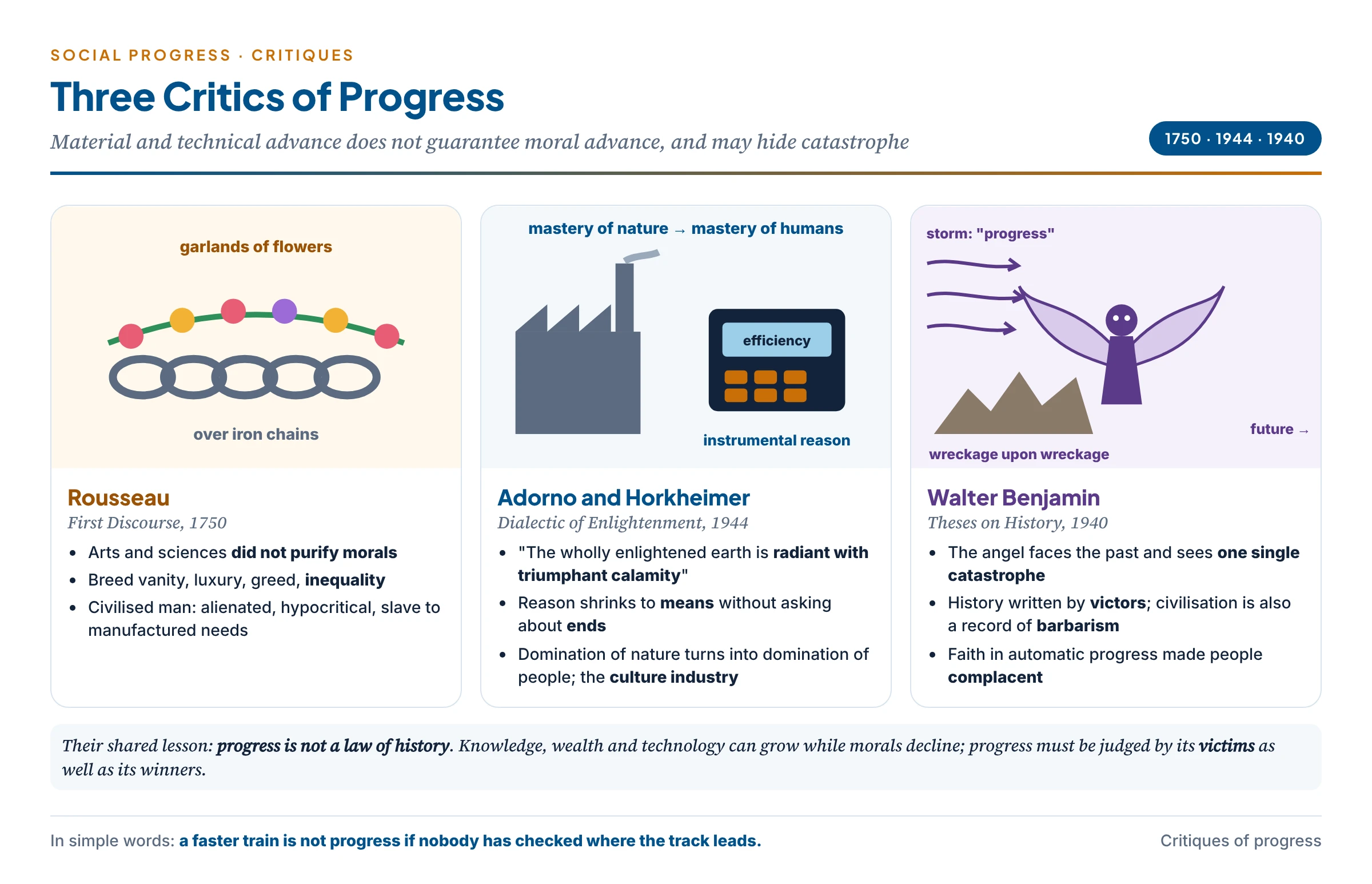
Rousseau: Progress as Moral Decline
- The occasion: in 1750 the Academy of Dijon set the prize question: “Has the restoration of the sciences and arts contributed to the purification of morals?” Jean-Jacques Rousseau answered no in his Discourse on the Sciences and Arts (the First Discourse), and won.
- His argument:
- Progress in the sciences and arts has not purified morals; it has cultivated vanity, artificiality, luxury, greed and inequality.
- The sciences themselves are born of vices: astronomy from superstition, geometry from avarice, physics from idle curiosity, moral philosophy from human pride.
- The arts and sciences “spread garlands of flowers over the iron chains” that weigh people down: they make people love their slavery.
- Civilised man is alienated from nature, enslaved by manufactured needs and luxury, and hypocritical: politeness masks envy and suspicion.
- Ancient Sparta, simple and virtuous, is praised over brilliant but corrupt Athens.
- The Second Discourse (On the Origin of Inequality, 1755) deepened the critique: human perfectibility (the capacity to improve) has led to private property, inequality and dependence: “The first man who, having enclosed a piece of ground, bethought himself of saying ‘This is mine’, and found people simple enough to believe him, was the real founder of civil society.”
- Not a call to return to the forest: Rousseau did not think we could go back. His later works (The Social Contract, Émile) seek a new, just order in which freedom and virtue can coexist with civilisation.
Common confusion
Did Rousseau want humanity to return to a “noble savage” state? No. The phrase “noble savage” is not his, and he said plainly that human beings cannot go back to the state of nature. His point was critical: material and intellectual progress does not automatically bring moral progress, and may corrupt it. His remedy was not primitivism but a reformed society based on the general will, simple manners and an education that follows nature.
Adorno and Horkheimer: The Dialectic of Enlightenment
- Max Horkheimer and Theodor Adorno, philosophers of the Frankfurt School who fled Nazi Germany, wrote Dialectic of Enlightenment (1944, published 1947) in American exile, in the shadow of the Holocaust.
- The famous opening: “Enlightenment, understood in the widest sense as the advance of thought, has always aimed at liberating human beings from fear and installing them as masters. Yet the wholly enlightened earth is radiant with triumphant calamity.”
- The two theses:
- “Myth is already enlightenment”: ancient myths were early attempts to explain and control nature.
- “Enlightenment reverts to mythology”: reason, which began as a tool of liberation, becomes a new blind fate: a system nobody controls.
- Instrumental reason: enlightenment reason narrowed into instrumental reason, a cold calculation of the most efficient means to any given end, without asking whether the ends are good. (Max Weber had called this “purposive rationality” and warned of an “iron cage” of bureaucracy.)
- From mastery of nature to mastery of humans: the project of dominating nature (Bacon’s “knowledge is power”) turned into the domination of human beings, who were reduced to things to be managed, counted and used up, in factories and, at the extreme, in death camps run with bureaucratic efficiency.
- The culture industry: mass culture (films, radio, advertising) produces standardised products and passive consumers, a new form of control disguised as entertainment.
- Not anti-reason: Adorno and Horkheimer wanted enlightenment to reflect on itself and recover reason’s critical and liberating side.
- Later development: Jürgen Habermas called modernity “an unfinished project” (1980): the remedy for the crisis of reason is not less reason but communicative reason, free and equal discussion aimed at mutual understanding.
Walter Benjamin: The Angel of History
- Walter Benjamin, a German-Jewish thinker close to the Frankfurt School, wrote his Theses on the Philosophy of History in 1940, shortly before taking his own life while fleeing the Nazis.
- The image: he owned Paul Klee’s drawing Angelus Novus (1920) and read it as the angel of history:
“Where we perceive a chain of events, he sees one single catastrophe which keeps piling wreckage upon wreckage and hurls it in front of his feet. The angel would like to stay, awaken the dead, and make whole what has been smashed. But a storm is blowing from Paradise … This storm is what we call progress.” — Walter Benjamin
- His points:
- The idea of progress as a smooth, automatic advance hides the suffering of the defeated.
- History is usually written by the victors: “There is no document of civilisation which is not at the same time a document of barbarism.”
- Faith in inevitable progress made the German left complacent before fascism.
- Progress must be redeemed by remembering the victims and interrupting catastrophe, not by trusting the storm.
Other Doubts about Progress
- Nietzsche: “Mankind does not represent a development toward something better or stronger or higher in the sense accepted today. ‘Progress’ is merely a modern idea, that is to say, a false idea.” For him modern “progress” often meant the triumph of mediocrity.
- Cyclical views of history:
- Giambattista Vico (The New Science, 1725): nations pass through an age of gods, an age of heroes and an age of men, then decline and begin again (corsi e ricorsi, courses and recurrences).
- Oswald Spengler (The Decline of the West, 1918–22): civilisations are like organisms with birth, maturity and death; the West was entering its winter.
- Arnold Toynbee (A Study of History): civilisations rise by successful responses to challenges and fall when creative minorities fail.
- Ibn Khaldun (14th century): dynasties rise on group solidarity (asabiyya) and decay within a few generations.
- The Indian yuga theory: history moves through Satya, Tretā, Dvāpara and Kali yugas in vast repeating cycles, with a decline of dharma within each cycle.
- Postmodernism: Jean-François Lyotard (1979) defined the postmodern as “incredulity toward metanarratives”: the grand stories of history moving towards emancipation (Enlightenment, Hegel, Marx) have lost credibility.
- Post-colonial critique: the language of progress justified colonialism as a “civilising mission”; even J. S. Mill wrote that despotism is “a legitimate mode of government in dealing with barbarians, provided the end be their improvement”.
- Ecological critique: progress measured by production has consumed its own future: the climate crisis is the bill for two centuries of “progress”.
The Defence of Progress
- The evidence of material and social gains: worldwide, the share of people in extreme poverty has fallen from the great majority two centuries ago to under a tenth; life expectancy has roughly doubled; literacy has become nearly universal in many countries; slavery and untouchability have been legally abolished; women have won the vote.
- Steven Pinker (Enlightenment Now, 2018) argues that reason, science and humanism have produced measurable progress in health, wealth, safety, knowledge and rights, and that pessimism ignores the data.
- The “expanding circle”: Peter Singer (The Expanding Circle, 1981) argues that moral concern has widened over history from family and tribe to nation, to all humanity, and increasingly to animals.
- Kant and Habermas: progress is not guaranteed, but it is a task reason sets us; we must act as if progress towards a just, cosmopolitan order is possible.
- The critics depend on progress: the very standards by which Rousseau, Adorno or Benjamin condemn modern society (freedom, dignity, the suffering of victims) are products of moral progress.
A balanced verdict: progress is real but uneven, reversible and ambiguous. Humanity has made great progress in knowledge, technology, health and legal equality; it has made far less secure progress in moral character, peace and harmony with nature. Progress is not a law of history but a fragile achievement that depends on human choice.
In simple words
A child grows taller every year, but whether she grows kinder and wiser depends on how she is brought up. Humanity’s height (knowledge, wealth, technology) has grown fast; its character has not kept pace. That is why we can be both amazingly advanced and capable of horrors.
Is Economic Development a Necessary or Sufficient Condition of Social Progress?
Not sufficient:
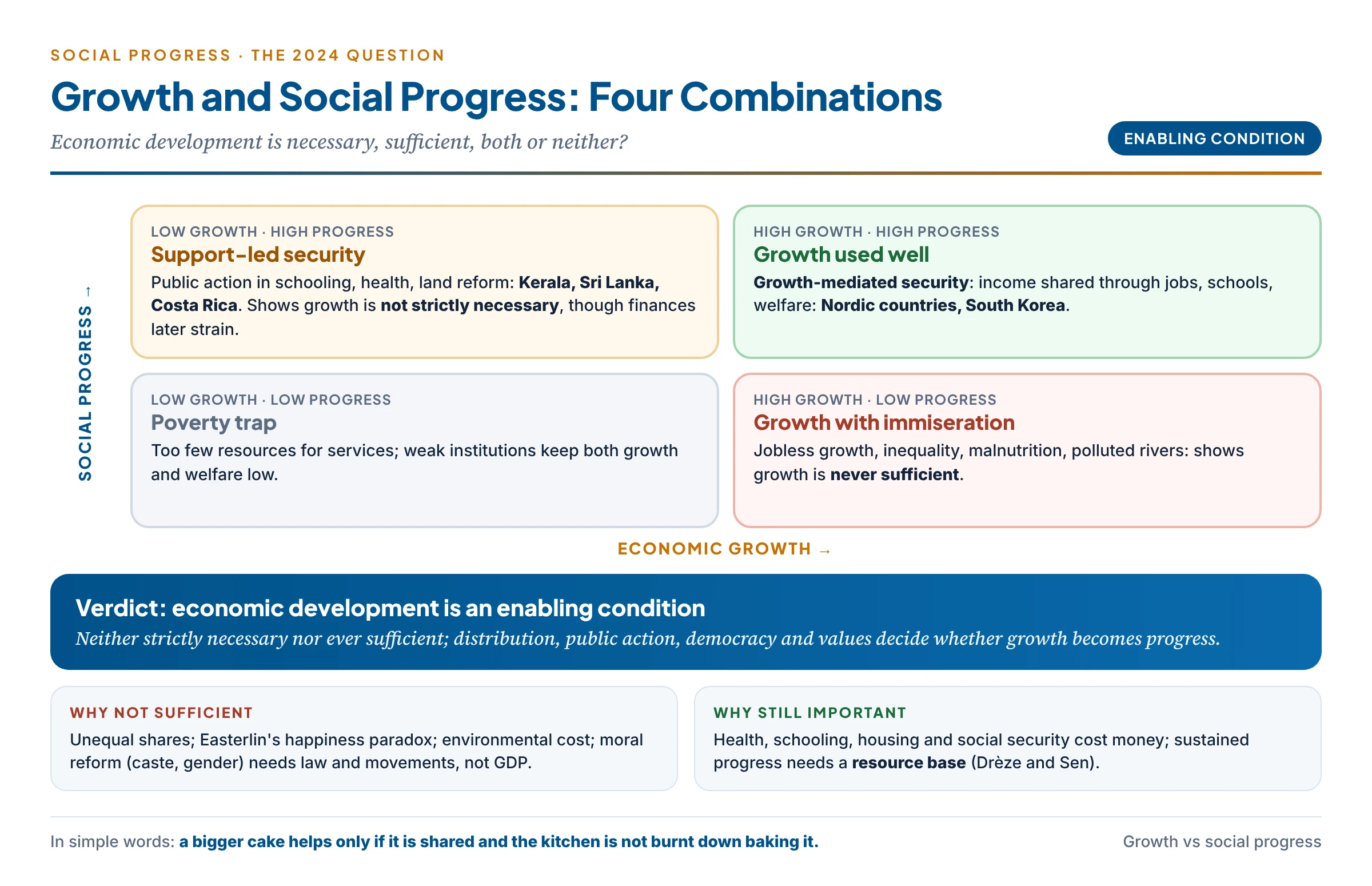
- Growth with immiseration: output can rise while infant mortality, malnutrition and inequality persist; the gains may go to a few.
- Rich but socially unequal: some high-income countries have high rates of violence, discrimination, poor public health or weak political rights; wealth alone does not create justice, dignity or freedom.
- The happiness paradox: the economist Richard Easterlin (1974) found that, beyond a point, rising average income does not raise average reported happiness much over time.
- Jobless growth and inequality: in India, fast growth after 1991 lifted millions out of poverty but left large gaps in employment, nutrition (child stunting) and regional equality.
- Environmental cost: growth that destroys forests, rivers and the climate undermines future progress.
- Moral and cultural progress (the end of untouchability, women’s equality, tolerance) depends on social reform and law, not on GDP.
Not strictly necessary for every dimension, but practically necessary in the long run:
- Social progress at modest income: Kerala, Sri Lanka and Costa Rica reached high literacy, low infant mortality and long life expectancy at modest income through public action: schooling, primary health care, land reform and social movements. Jean Drèze and Amartya Sen (Hunger and Public Action, 1989) called this “support-led security”, as against “growth-mediated security” (as in South Korea), where growth pays for social gains.
- Moral progress without growth: the abolition of sati, untouchability laws and women’s suffrage were won by reformers, not by rising income.
- But resources matter: sustained progress in health, education, housing and social security needs money; very poor societies cannot keep up public services without economic growth. Kerala’s model later faced fiscal strain and unemployment.
Conclusion: economic development is neither sufficient nor, strictly, necessary for social progress, but it is a powerful enabling condition: necessary beyond a point for sustaining material dimensions of progress, never enough without equitable distribution, public action, democracy and ethical values. The right question is not “how fast do we grow?” but “how is growth shared and used?”
Does Technological Development Raise Ethical Standards?
Arguments that it does:
- Knowledge and empathy: the printing press spread ideas of rights and reform; photography, television and the internet expose injustice (war, famine, police violence) to the whole world and widen moral concern.
- New freedoms: contraception gave women control over their lives; assistive technology gives disabled people new capabilities; mobile phones and digital payments empower the poor.
- Transparency: digital records, direct benefit transfers and the Right to Information make corruption harder.
- Ethics responds to technology: medical ethics (informed consent after the Nuremberg trials), environmental ethics after Silent Spring, and data protection laws show moral thinking growing with technology.
Arguments that it does not:
- Cultural lag: the sociologist William Ogburn (1922) showed that material culture (technology) changes faster than non-material culture (values, laws, institutions); ethics lags behind and catches up only slowly.
- Technology amplifies both good and evil: the same science gave vaccines and nuclear weapons; the same internet gives knowledge and misinformation, deepfakes, surveillance and cyber-crime; the first gene-edited babies (China, 2018) showed science running ahead of ethics.
- Heidegger (The Question Concerning Technology, 1954): modern technology makes us see everything, nature and people, as “standing reserve”, a stock of resources to be ordered and used up.
- Hans Jonas: our power to act has outgrown our ethics, which was made for small, near effects; we need a new ethics of responsibility for distant and future effects.
- Gandhi’s “seven social sins” (1925) include “science without humanity” and “knowledge without character”: knowledge alone does not make people good.
- Marcuse (One-Dimensional Man, 1964): advanced technological society creates comfortable unfreedom and false needs.
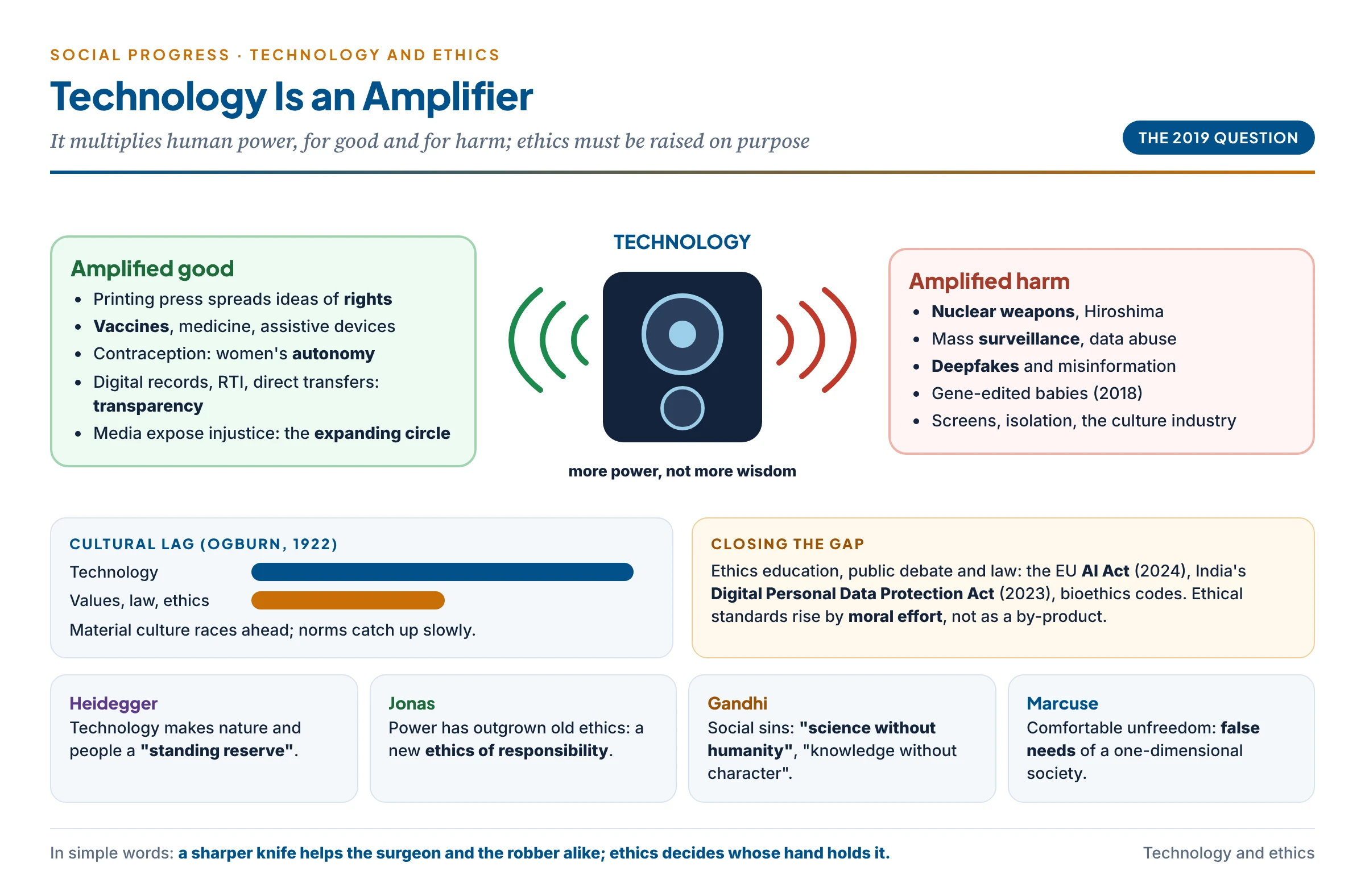
Conclusion: technology is ethically ambivalent: it increases our power, not automatically our wisdom. It can support ethical progress (by spreading knowledge, enabling transparency and widening freedom) only when values, education, law and democratic control keep pace: for example the European Union’s AI Act (2024) and India’s Digital Personal Data Protection Act (2023). Ethical standards rise through moral effort, not as a by-product of machines.
In simple words
A sharper knife lets a surgeon save a life and a robber take one. Making knives sharper does not make people kinder; it only makes their kindness and their cruelty both more powerful. Technology is the knife; ethics decides whose hand holds it and why.
Indian Connect — Indian Connect
Gandhi’s seven social sins (Young India, 1925) read like a checklist for progress that has lost its ethics: politics without principles, wealth without work, pleasure without conscience, knowledge without character, commerce without morality, science without humanity, and worship without sacrifice.
Does the Ideal of Social Progress Subordinate Individual Freedom to Duties?
Views that place duties and the collective first:
- Plato: each class must do its function in the just state; the individual’s good lies in the order of the whole.
- Hegel: true freedom is realised in the ethical life of the state; the individual finds freedom in fulfilling social duties.
- Comte: the “religion of humanity” demands altruism; his motto was vivre pour autrui, “live for others”.
- Marx and state socialism: the progress of the class and of society comes before “bourgeois” individual rights.
- Utilitarian and developmental states: the greatest good or the national plan can override individual claims (forced displacement for dams).
- Indian tradition and Gandhi: dharma and duty come first; Gandhi wrote that “all rights to be deserved and preserved came from duty well done”.
Views that make individual freedom central:
- J. S. Mill: individuality is “one of the principal ingredients of human happiness, and quite the chief ingredient of individual and social progress”; society progresses through free experiments in living and free discussion.
- Isaiah Berlin: “progress” pursued in the name of an ideal society has often justified tyranny over individuals (“forcing them to be free”).
- Amartya Sen: freedom is both the end and the engine of development; progress that suppresses freedom is not progress.
- History of reform: most real social progress (abolition of slavery, women’s rights, the fight against untouchability) came when individuals asserted their freedom against duties imposed by custom.
Synthesis:
- The ideal of social progress need not subordinate freedom to duty, though some versions (collectivist, authoritarian, developmentalist) have done so.
- Kant’s answer unites the two: true freedom is autonomy, obeying a moral law one gives oneself; duty rightly understood is the expression of freedom, not its enemy.
- Rights and duties are correlative: my right is your duty and vice versa; a society of rights without duties becomes atomised and selfish, a society of duties without rights becomes oppressive.
- The Indian Constitution balances them: Fundamental Rights (Part III) and Fundamental Duties (Part IVA, added in 1976; now eleven duties).
In simple words
In a football match, players are free to run, pass and shoot, but only because everyone accepts the duty to follow the rules. Remove the freedom and it is a drill, not a game; remove the duties and it becomes a brawl. A progressing society is a good game: freedom and duty make each other possible.
Is Social Progress Possible without Humanism?
- Humanism is the outlook that puts human beings, their dignity, reason and welfare at the centre of value: from Protagoras (“man is the measure of all things”) and the Renaissance to Enlightenment, secular, Marxist and radical humanism (M. N. Roy), and the “religion of man” of Rabindranath Tagore.
Why progress needs humanism:
- It supplies the measure: progress means progress for human beings: their dignity, freedom and flourishing. Without this standard, “progress” collapses into efficiency, output or power.
- Progress without humanism becomes inhuman: the Holocaust was “efficient”; forced collectivisation in the Soviet Union was “planned”; colonial “development” ignored the colonised; dams and mines that ignore the displaced are “growth”. Adorno and Horkheimer showed what reason becomes when cut off from human ends.
- It supplies the agent: humanism holds that human beings make their own history through reason and cooperation, rather than waiting on fate.
- It links to scientific temper: Article 51A(h) asks every citizen “to develop the scientific temper, humanism and the spirit of inquiry and reform”, tying humanism directly to India’s idea of progress.
Qualifications:
- Anthropocentrism: an exclusively human-centred humanism can justify the exploitation of nature; deep ecology asks for an ecological humanism that includes concern for other species.
- Religious critics argue that progress also needs a spiritual basis (Vivekananda, Gandhi, Aurobindo); but their spirituality is itself deeply humanist: service of humanity as service of God.
- Abstract humanism can hide inequalities: humanism has sometimes meant the “humanity” of European males. It must be universal in practice, including women, Dalits, tribals and the colonised.
Conclusion: genuine social progress is not possible without humanism in its essential sense (respect for the dignity and agency of every human being), though that humanism must be inclusive and ecologically aware.
Ethical Social Development vs Economic and Political Progress
- Ethics-first views (Gandhi, Vivekananda, Tagore, Aurobindo) hold that social development begins with moral transformation: truth, non-violence, self-restraint, service.
- Economic-political views (liberalism, Marxism, technocracy) hold that progress comes through institutions: markets, rights, the state, planning, ownership.
- Each needs the other: institutions without virtue become corrupt or empty; virtue without institutions leaves the oppressed at the mercy of the powerful (Ambedkar’s insistence on law and political power for Dalits). The Indian Constitution joins both: rights and directive principles, with fundamental duties and the moral ideals of the Preamble. (This debate is treated in detail in the article on Gandhi’s vision of development.)
Critical Evaluation
Critics and Defenders
Criticism — Critics of progress
- Rousseau: the arts and sciences decorate our chains; civilisation breeds inequality and vanity.
- Adorno and Horkheimer: instrumental reason turned mastery of nature into mastery of humans.
- Benjamin: progress is a storm piling wreckage upon wreckage; history is written by victors.
- Nietzsche, Spengler and cyclical thinkers: there is no single upward line of history.
- Lyotard and post-colonial critics: grand narratives of progress have lost credibility and served empire.
- Environmentalists: industrial progress has consumed its own future.
Defence — Defenders of progress
- Condorcet and Kant: reason frees humanity from superstition and tyranny; progress is our task.
- Habermas: modernity is an unfinished project; the cure is communicative reason.
- Pinker and the evidence: poverty, disease, illiteracy and violence have fallen dramatically.
- Singer: the circle of moral concern has steadily expanded.
- Sen and Ambedkar: progress is real when the freedoms of the weakest, especially women and Dalits, grow.
Cross-Tradition Comparison
| Question | Optimists (Condorcet, Hegel, Comte, Marx, Pinker) | Critics (Rousseau, Adorno, Benjamin, Nietzsche) | Indian thinkers (Gandhi, Vivekananda, Aurobindo, Ambedkar) |
|---|---|---|---|
| Is progress real? | Yes, and largely inevitable | Material yes; moral doubtful; often catastrophic | Material and moral progress must go together; moral progress is the test |
| Engine | Reason, science, Spirit, class struggle | Reason itself turned into domination | Self-restraint, service, social reform, law |
| Danger | Ignorance and superstition | Instrumental reason, mass society, empire | Greed, caste, loss of dharma |
| Measure | Knowledge, wealth, rights | The suffering of the defeated | The last person; women’s progress (Ambedkar) |
The Unit in One Table
| Approach | Key thinkers | What development or progress means | Main limitation |
|---|---|---|---|
| Growth model | Smith, Rostow, Friedman | Rising GDP, industrialisation, trickle-down | Growth without development |
| Capability approach | Sen, Nussbaum, Haq | Expanding real freedoms; HDI, MPI | Measurement; open list |
| Sustainable development | Brundtland, Rawls, Jonas | Present needs without compromising the future | Anthropocentric, “shallow” |
| Gandhian sarvodaya | Gandhi, Kumarappa, Schumacher | Limited wants, village self-rule, trusteeship | Hard to scale; romanticises the village |
| Post-development | Escobar, Sachs, Shiva | Alternatives to development; a pluriverse | No clear positive programme |
| Theories of progress | Condorcet, Hegel, Comte, Spencer, Marx | History moving towards freedom, science or communism | Inevitability; Eurocentrism |
| Critiques of progress | Rousseau, Adorno and Horkheimer, Benjamin | Progress as moral decline or catastrophe | May underrate real gains |
Indian Connect — Indian Connect
- Sri Aurobindo offers an Indian synthesis: history is the evolution of consciousness; outer progress in science and society is real but incomplete until humanity grows inwardly, from the rational to the spiritual age.
- Ambedkar’s test (progress measured by the progress of women) and Gandhi’s talisman (the face of the poorest) are two Indian answers to the question “progress for whom?”
Synthesis (Siddhānta)
- The critiques of Rousseau, Adorno and Horkheimer, and Benjamin destroyed the nineteenth-century faith that progress is automatic. They showed that material and technical advance can coexist with moral regress, and that progress must be judged by the fate of its victims.
- But the critics do not prove that progress is an illusion: real gains in health, knowledge, rights and the abolition of slavery and untouchability are facts. Progress is best understood as possible, uneven, reversible and dependent on human choice.
- In the debates of this unit:
- Economic development is an enabling condition of social progress, never sufficient and not strictly necessary for every dimension; distribution, public action and values decide the outcome.
- Technology raises power, not automatically ethics; ethical progress needs deliberate moral and legal effort.
- Individual freedom and social duty are not rivals but partners; progress that crushes freedom is not progress, and freedom without duty dissolves society.
- Humanism, inclusive and ecological, supplies the measure and the agent of progress.
- The final measure of development and progress is not GDP or technology but whether every human being, beginning with the last, becomes freer, more capable and more humane, on a planet that future generations can still inhabit.
“There is no document of civilisation which is not at the same time a document of barbarism.” — Walter Benjamin
Previous Year Questions
- 2024Is economic development a necessary condition, sufficient condition, both or neither, in order to achieve social progress? Give reasons and justifications for your answer.
- 2022Do you agree that economic development does not on its own lead to human development and social progress? Give reasons and justifications for your answer.
- 2019Does technological development lead to progress in the ethical standards of the society? Explain.
- 2017Critically evaluate whether the ideal of social progress gives a secondary significance to an individual’s freedom over his duties.
- 2017Evaluate the concept of social development as rooted in ethical principles against the concept of social progress being based on economic and political ideals.
- 2010Is social progress possible without humanism? Examine.