- Social Impact Assessment (SIA) is the systematic study of how a planned intervention (a project, plan, programme or policy) changes the lives of the people it touches, carried out before, during and after the intervention so that harm is avoided and benefits are spread fairly.
- The core premise: development must maximise social benefits and minimise social costs by identifying, predicting and managing its human consequences in advance.
- For long, development was judged through an economic lens alone: GDP growth, industrial output and per capita income.
- The idea of sustainable development, set out in Our Common Future by the Brundtland Commission (1987), widened the test. Development now has to meet social, environmental and inter-generational requirements together.
- A dam, highway, mine, port or power plant brings positive consequences (jobs, infrastructure, better access to services) and negative ones (displacement, cultural disruption, loss of livelihoods, environmental damage, psychosocial stress).
- SIA works alongside Environmental Impact Assessment (EIA), which studies biophysical consequences. Both are tools of environmental management.
- In India, SIA became a statutory requirement for land acquisition under the Right to Fair Compensation and Transparency in Land Acquisition, Rehabilitation and Resettlement Act, 2013 (RFCTLARR Act).
Concept and Evolution of SIA

Historical origins
- SIA was institutionalised by the US National Environmental Policy Act (NEPA), 1969, which required federal agencies to assess effects on the “human environment”, not only on nature.
- NEPA made explicit that altering an ecosystem also alters the culture and social organisation of the people who depend on it.
- SIA therefore grew first as a subset of EIA, and later as an independent field of research and practice.
- Milestones:
| Year | Milestone | Significance |
|---|---|---|
| 1969 | NEPA (USA) | “Human environment” brought into impact statements |
| 1977 | Mackenzie Valley Pipeline Inquiry (Canada), led by Thomas Berger | Landmark hearing of indigenous communities; pipeline deferred |
| 1994 | Interorganizational Committee guidelines (USA) | Standard framework: project stages, variables, ten steps |
| 2003 | IAIA International Principles for SIA (Frank Vanclay) | Global values and principles |
| 2007 | National Rehabilitation and Resettlement Policy (India) | SIA for large displacing projects |
| 2013 | RFCTLARR Act (India) | Statutory SIA before land acquisition |
| 2015 | IAIA SIA Guidance (Vanclay, Esteves, Aucamp, Franks) | Project SIA in four phases and 26 tasks |
| 2018 | World Bank Environmental and Social Framework in force | Social risk part of all lending |
Definitions
- International Principles for SIA (International Association for Impact Assessment, Frank Vanclay, 2003):
- SIA “includes the processes of analysing, monitoring and managing the intended and unintended social consequences, both positive and negative, of planned interventions (policies, programs, plans, projects) and any social change processes invoked by those interventions.”
- Its primary purpose is to bring about a more sustainable and equitable biophysical and human environment.
- Rabel J. Burdge and Frank Vanclay (1996): the process of assessing or estimating, in advance, the social consequences likely to follow from specific policy actions or project development, particularly within national, state or provincial environmental policy legislation.
- Interorganizational Committee (1994): social impacts are the consequences to human populations of any public or private action that alter the ways people live, work, play, relate to one another and organise to meet their needs.
- They include cultural impacts: changes to the norms, values and beliefs that guide people’s understanding of themselves and their society.
- Thomas Dietz (1987) described SIA as three linked steps:
- Identification: who is affected, and what consequences can be imagined;
- Analysis: assigning probabilities to these possibilities;
- Evaluation: combining the two to judge impacts both objectively and subjectively.
- In the simplest sense, a social impact is a significant improvement or deterioration in people’s well-being, or a significant change in an aspect of community concern.
- Features common to the modern definitions:
- SIA includes the adaptive management of impacts, not just their prediction;
- it applies to policies, plans and programmes, not only physical projects;
- it treats social and biophysical impacts as interconnected;
- its aim is social and ecological sustainability together.
What counts as a social impact
- The IAIA Guidance (2015) lists social impacts as changes to one or more of the following:
- Way of life: how people live, work, play and interact day to day;
- Culture: shared beliefs, customs, values and language;
- Community: cohesion, stability, character, services and facilities;
- Political systems: the extent to which people can take part in decisions that affect them;
- Environment: quality of air, water and food; exposure to dust, noise and risk; access to resources;
- Health and well-being: physical, mental, social and spiritual;
- Personal and property rights: economic loss, disadvantage or violation of civil liberties;
- Fears and aspirations: perceptions of safety and hopes for the future of the community and children.
- Social impacts are felt, not just measured. Because they are experienced at the level of individuals, households and communities, people’s perceptions and fears count as impacts in their own right.
Social change processes and social impacts
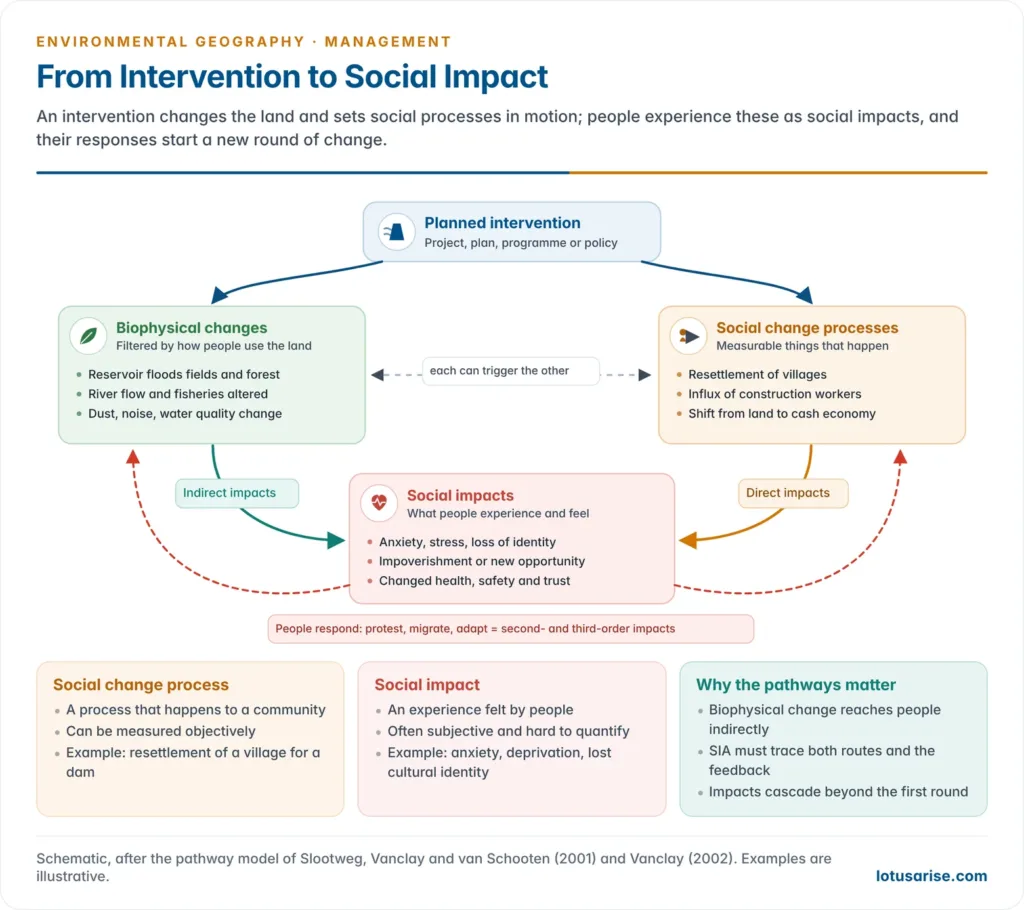
- A frequent conceptual error is to treat social change as social impact. Frank Vanclay (2002) distinguished them:
- A social change process is something that happens to a community: in-migration, resettlement, urbanisation, a shift in land use. It can often be measured objectively.
- A social impact is what people experience as a result: anxiety, stress, loss of identity, impoverishment or, equally, new opportunity. It is often subjective and hard to quantify.
- Example: resettlement of villagers by a dam is a change process; the anxiety, deprivation and loss of cultural identity that follow are the impacts.
- Pathways: following Pieter Slootweg, Frank Vanclay and Marlies van Schooten (2001):
- an intervention produces biophysical changes and social change processes;
- biophysical changes, filtered by how people use the landscape, cause indirect social impacts;
- social change processes cause direct social impacts.
- Impacts cascade. People respond to an impact (by protest, migration or adaptation), and these responses set off further social change processes and second- and third-order impacts. SIA must anticipate this chain, not only the first round.
SIA, EIA and evaluation research
- SIA is sometimes confused with evaluation research. Three differences separate them:
- Focus: SIA studies the consequences of projects and technological change; evaluation research studies the effects of policies and programmes.
- Intent: SIA looks especially at unintended consequences; evaluation research measures progress towards intended goals.
- Timing: SIA is prospective, a planning tool used before a decision; evaluation research is retrospective, done after a policy is in force.
| Basis | SIA | EIA | Evaluation research |
|---|---|---|---|
| Subject | People, communities, institutions | Air, water, land, biota | Policy or programme outcomes |
| Timing | Before, during and after | Mainly before approval | After implementation |
| Concern | Unintended social consequences | Biophysical change | Intended goals |
| Data | Social indicators, perceptions | Physical and biological data | Outcome indicators |
| Indian basis | RFCTLARR Act, 2013 | EIA Notification, 2006 | Programme evaluations |
SIA Framework, Principles and Process
Principles of SIA
IAIA International Principles (2003)
- Core values that underpin SIA:
- Fundamental human rights are shared equally across cultures and by men and women alike, and must be protected by the rule of law.
- People have a right to live and work in an environment conducive to good health and quality of life.
- Social dimensions of the environment (peace, quality of social relationships, freedom from fear, belongingness) are part of health and well-being.
- People have a right to be involved in decisions about interventions that will affect their lives.
- Local knowledge and experience are valuable and can improve planned interventions.
- Fundamental principles for development:
- respect for human rights should underpin all actions;
- equity and democratisation should drive planning, and impacts on the worst-off members of society should weigh heavily;
- diversity within and between cultures and among stakeholders must be recognised;
- decisions should be just, fair and transparent, with decision-makers accountable;
- expert opinion should not be the sole consideration;
- development should aim at capacity building, empowerment and human potential;
- “the environment” should be defined broadly to include the social.
- Principles specific to SIA practice (twelve in all). The central ones:
- equity is a fundamental element of assessment;
- many social impacts can be predicted, and interventions can be modified to reduce harm and enhance benefits;
- SIA should be integral to all stages, from inception to follow-up audit;
- alternatives and mitigation must be considered even where communities approve a project;
- ways should be sought to turn impacted people into beneficiaries;
- there must be no violence, harassment, intimidation or undue force in assessment or implementation, and no process that infringes human rights is acceptable.
Interorganizational Committee principles (1994)
- Involve the diverse public; analyse impact equity; focus the assessment on what matters most.
- Identify methods and assumptions and define significance; give planners feedback on social impacts.
- Use trained SIA practitioners; set up monitoring and mitigation programmes; identify data sources; plan for gaps in data.
Good-practice principles by theme
| Theme | Principles |
|---|---|
| All social impacts | Consider the gendered nature of impacts; respect spiritual and sacred places; keep quality of life central; examine second-order impacts and impact equity |
| Social and biophysical environment | Every biophysical impact has a social face; assess seasonality and its effect on livelihoods |
| Participation | Listen to grievances; use local knowledge and local languages; understand local power structures; be open and transparent; avoid exclusion |
| Impact management | Mitigate actively; train local people; ensure people are not made worse off |
| Community development | Focus on poverty reduction and vulnerability; keep communities intact; build enhancement programmes |
| Institutions and procedure | Adaptive management; qualified social scientists; adequate time and resources; transparent methods |
| Data integrity | Validate official data with community information; respect local intellectual property; apply the precautionary principle |
The four-stage project life cycle
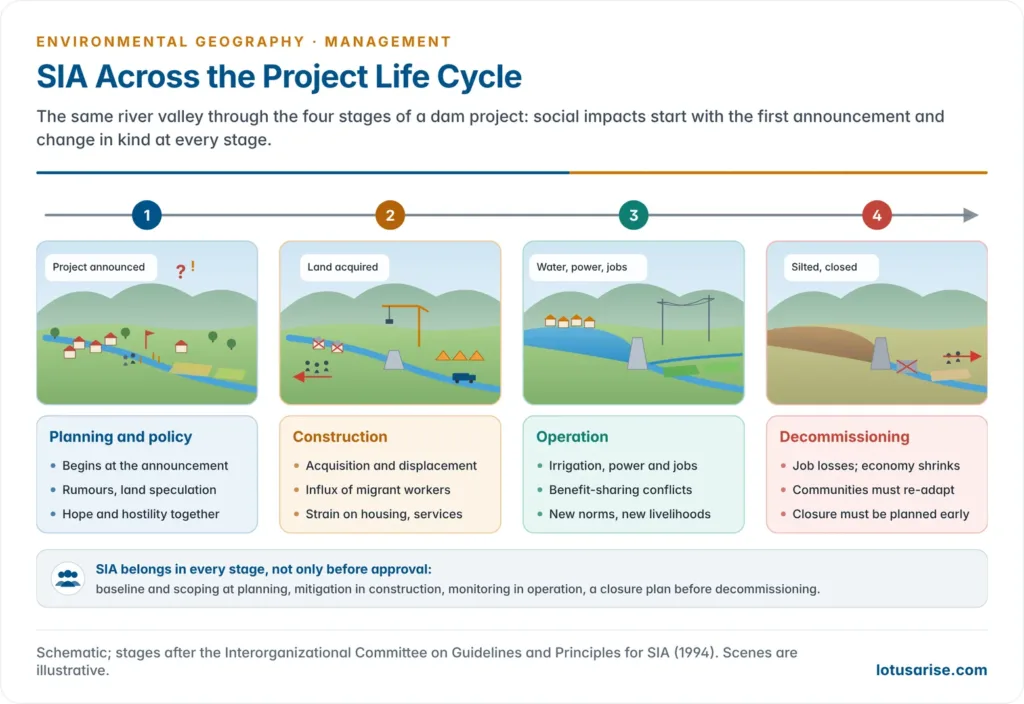
- The Interorganizational Committee on Guidelines and Principles for SIA (1994), a group of US social scientists and agencies, gave SIA its basic framework. Every project, whatever its sector, passes through four stages, each with its own social impacts:
- Planning and policy development: begins with the first announcement. Speculation, land-price changes, rumours, hope among some and hostility among others.
- Construction and implementation: land acquisition, displacement and relocation, an influx of migrant workers, pressure on housing and services, cultural disruption and changed land use.
- Operation and maintenance: long-term economic benefits (power, irrigation, jobs) for some, a stabilising population, new norms; benefit-sharing conflicts for others.
- Decommissioning and abandonment: job losses and economic disruption; dependent communities must re-adapt. Closure planning must start early.
- Social impacts begin before construction. As soon as a project is announced, communities start to react: the announcement effect. It is often missed in impact studies, although fear, speculation and early coalition-building shape everything that follows.
Comparative method and scoping
- Comparative method: the Committee proposed studying a community where a similar project has already happened and using its experience to forecast the course of events in the community about to receive the project.
- Since social impacts are hard to predict, this observed precedent reduces uncertainty and raises the predictive validity of the SIA.
- Scoping narrows the analysis to the most significant social issues at each stage, instead of trying to assess every conceivable impact. It is essential because SIA budgets and timelines are always limited.
SIA variables and indicators
- Social indicators are time-series data that allow comparison over time, showing long-term trends, periodic fluctuations and rates of change. They underpin strategy, monitoring and evaluation.
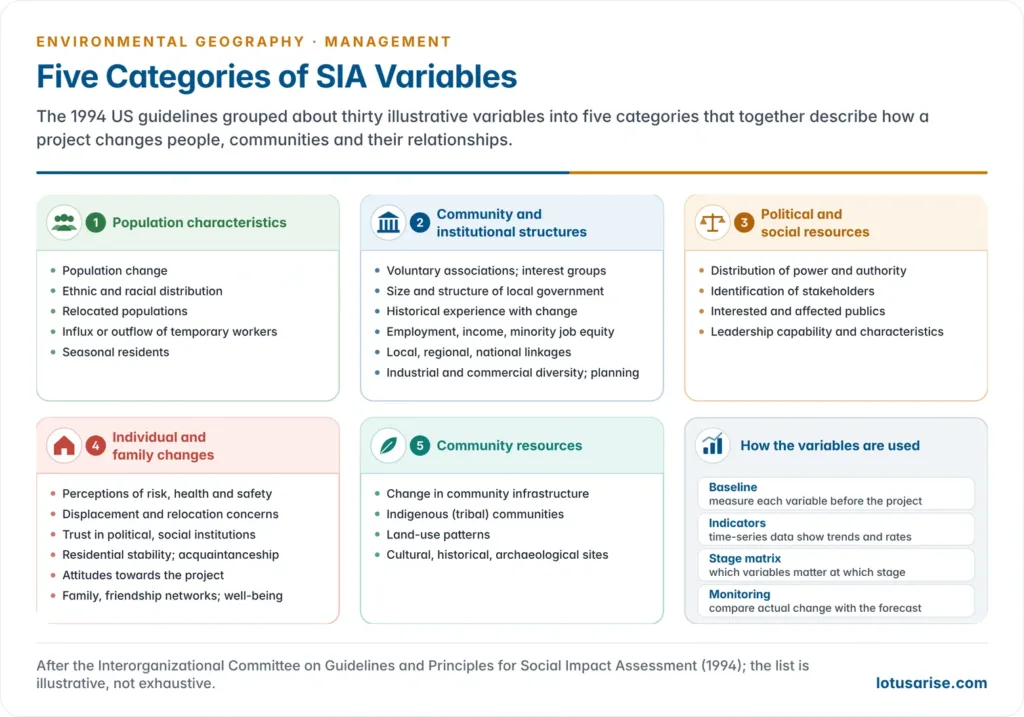
- SIA variables measure changes in people, communities and social relationships. The 1994 guidelines grouped about thirty illustrative variables into five categories:
- Population characteristics: population change; ethnic and racial distribution; relocated populations; influx or outflow of temporary workers; seasonal residents.
- Community and institutional structures: voluntary associations; interest-group activity; size and structure of local government; historical experience with change; employment and income; employment equity of minority groups; local, regional and national linkages; industrial and commercial diversity; planning and zoning.
- Political and social resources: distribution of power and authority; identification of stakeholders; interested and affected publics; leadership capability.
- Individual and family changes: perceptions of risk, health and safety; displacement and relocation concerns; trust in political and social institutions; residential stability; density of acquaintanceship; attitudes towards the project; family and friendship networks; concerns about social well-being.
- Community resources: community infrastructure; indigenous (tribal) communities; land-use patterns; cultural, historical and archaeological resources.
Variables for a mining project
- Mining shows how many variables a single project can disturb at once. Daniel M. Franks (2011) grouped the main domains of change:
| Domain | Key variables and indicators |
|---|---|
| Population and demography | In- and out-migration; worker camps; growth or decline of nearby towns; inclusion and exclusion; conflict between groups |
| Social infrastructure and services | Housing demand; pressure on health and education; childcare; skill shortages; training |
| Culture and customs | Changing family roles; spread of the cash economy; weaker civic participation and cohesion; sense of place; heritage |
| Access to resources | Land access; competition for groundwater and surface water; mineral rights; artisanal mining; post-mining land use |
| Physical infrastructure | Demand on roads, rail, ports, sewerage, power, telecommunications and water supply |
| Distribution of benefits | Employment patterns; royalties and taxes; local business spending; community development; fairness of compensation |
Matrix of variables and project stages
- A matrix of project stages against SIA variables is a core analytical tool. It shows which variables matter most at which stage, so no significant social dimension is overlooked.
| SIA variable | Planning | Construction | Operation | Decommissioning |
|---|---|---|---|---|
| Population change | Projection | Influx of workers | Stabilisation | Out-migration risk |
| Displacement and relocation | Identification | Physical displacement | Resettlement monitoring | Further disruption |
| Cultural heritage | Mapping | Risk of destruction | Ongoing protection | Legacy management |
| Employment equity | Policy design | Construction hiring | Operational workforce | Closure planning |
| Trust in institutions | Consultation | Grievance handling | Community relations | Accountability |
| Land use | Mapping | Acquisition effects | Changed access | Rehabilitation |
The SIA process
- At the project level, SIA manages the social consequences of planning and construction decisions with a dual objective: better outcomes for the local community and for the developer.
- Management should begin before regulatory approval is sought: early engagement reduces conflict, improves design and lowers costs.
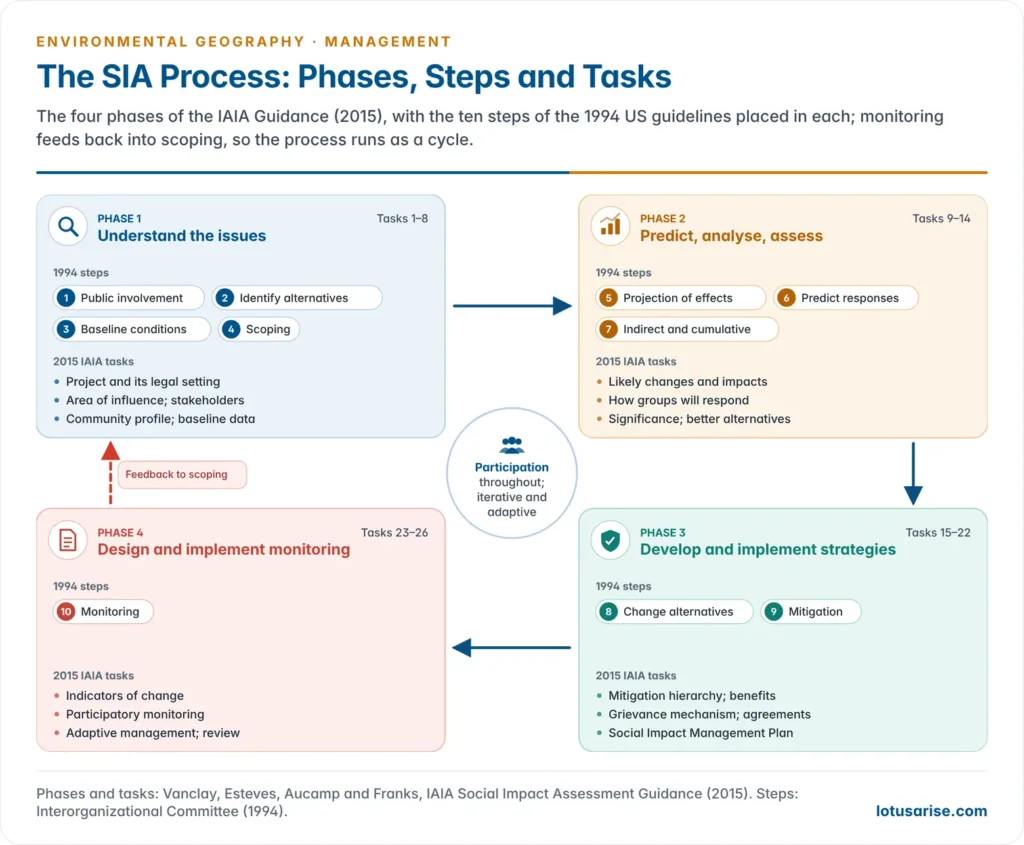
The ten steps (Interorganizational Committee, 1994)
- Public involvement: a plan to involve all potentially affected publics from the start.
- Identification of alternatives: describe the proposed action (scale, location, workforce, timing) and its reasonable alternatives.
- Baseline conditions: document the existing human environment and its history.
- Scoping: select the most significant impacts for study, using public input.
- Projection of estimated effects: predict likely impacts, often with the comparative method.
- Predicting responses to impacts: anticipate how affected people will react (protest, migration, adaptation).
- Indirect and cumulative impacts: trace second-order effects and the combined effect of other projects.
- Changes in alternatives: recommend modified or new alternatives.
- Mitigation: avoid first, then minimise, then compensate.
- Monitoring: track actual impacts and feed them back to management.
- The process is iterative, logical and cyclical (Burdge and Vanclay, 1996). Information is updated as project details and social data change.
The four phases of the IAIA Guidance (2015)
- The IAIA Guidance by Frank Vanclay, Ana Maria Esteves, Ilse Aucamp and Daniel M. Franks (2015) set out 26 tasks in four phases:
| Phase | Main tasks |
|---|---|
| 1. Understand the issues (tasks 1–8) | Understand the project; clarify laws and roles; identify the social area of influence and stakeholders; build a community profile; inform communities; set up inclusive participation; scope social and human-rights issues; collect baseline data |
| 2. Predict, analyse and assess impact pathways (9–14) | Determine likely changes and impacts; indirect and cumulative impacts; how affected groups will respond; significance; contribute to alternatives |
| 3. Develop and implement strategies (15–22) | Apply the mitigation hierarchy; enhance benefits; help communities cope; grievance mechanisms; Impacts and Benefits Agreement; Social Impact Management Plan |
| 4. Design and implement monitoring (23–26) | Indicators; participatory monitoring; adaptive management; evaluation and periodic review |
- Shift in emphasis: the Guidance treats SIA as managing social issues across the whole project life, not as a one-time report for approval.
- Its key output is a Social Impact Management Plan (SIMP), which sets out strategies for every phase, including after closure.
- It also links SIA to human rights, free, prior and informed consent (FPIC) for indigenous peoples, and the company’s social licence to operate, the level of acceptance a project enjoys among local communities.
SIA applied to dam construction
- Dams are the most studied context of SIA, especially in India. The social life cycle of a dam shows the full range of its use:
| Stage | Main social impacts |
|---|---|
| Conceptualisation and planning | Fear and uncertainty; speculation and rumours; early resistance or coalitions |
| Construction | Anxiety over relocation; upstream and downstream hydrological disruption; migrant labour influx; cultural and land-use dislocation |
| Operation and maintenance | Irrigation and power benefits and the social change they bring; benefit-distribution conflicts; long-term livelihood adaptation |
| Decommissioning | Loss of the project’s economic anchor; re-adaptation of dependent communities |
- Lessons from dam-related SIA:
- Resettlement of people who lose land or homes is the most critical issue.
- Non-material losses (attachment to place, sacred spaces, kinship networks) are regularly undervalued compared with physical and economic losses.
- People trade off better living standards against lost cultural values, and the trade-off is rarely fair.
- Indigenous peoples and ethnic minorities suffer disproportionate disruption.
- Where livelihoods depend directly on land, forest and river, as in much of the developing world, the environmental impacts of large dams (submergence, altered flows, lost fisheries) become amplified social impacts.
- Community participation and grassroots planning reduce adverse impacts significantly.
Paradigms of SIA: technocratic and constructivist
- SIA can be practised as an information-generating exercise or as a planning tool. Ana Aledo-Tur and José Andrés Domínguez-Gómez (2017) contrasted two underlying paradigms, using Egon Guba and Yvonna Lincoln’s (1994) framework of paradigm questions:
| Dimension | Technocratic paradigm | Constructivist (participatory) paradigm |
|---|---|---|
| Axiology (values) | Value-free and neutral; Western values assumed | Multiple value systems acknowledged |
| Ontology (reality) | Mechanistic, universal; certainty sought | Socially constructed; nature and culture integrated; uncertainty accepted |
| Epistemology (knowing) | Positivist; objective findings; nomothetic | Constructivist; post-normal science; ideographic |
| Methods | Expert-driven, top-down, quantitative; closed and time-bound | Participatory, bottom-up, mixed methods; open and continuous |
| Theory | Weak links to social theory; power ignored | Reflexive; power relations central |
| Governance | Closed; oriented to project approval | Open, deliberative; oriented to sustainability and acceptance |
- Current view: practice has moved towards the constructivist, participatory model, especially for projects affecting indigenous, tribal and marginalised groups, because it brings in local knowledge and power relations.
- The technocratic approach is efficient and measurable but misses non-quantifiable dimensions; most good SIAs combine the two.
Methods and Techniques of SIA
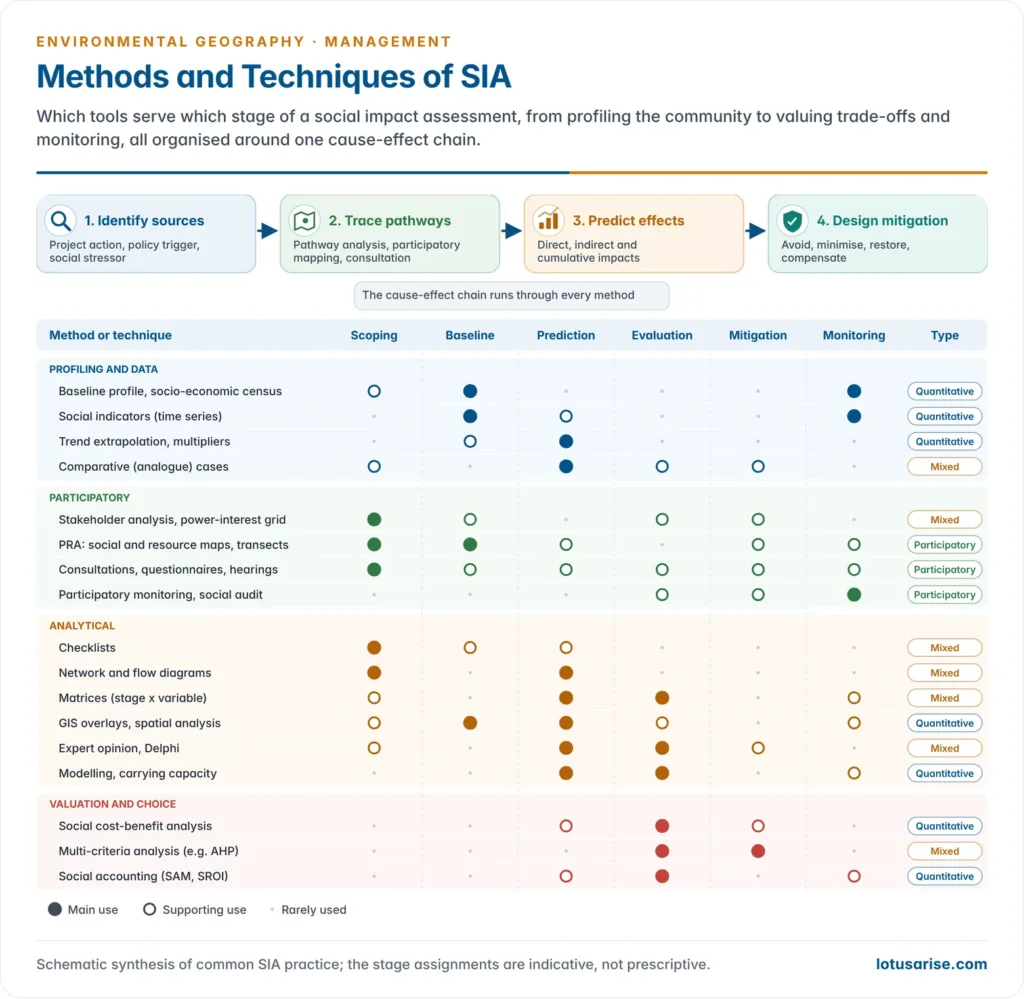
- SIA is a form of policy analysis that brings scientific inquiry into democratic decision-making. Method choice depends on:
- the stage of the process;
- the type and quality of data available;
- time, money and logistics.
- Methods are broadly deployed as follows:
- Scoping and identification: checklists, consultations and questionnaires, network analysis, spatial analysis;
- Prediction and evaluation: matrices, expert opinion, modelling, comparative cases;
- Thresholds and sustainability: carrying-capacity analysis;
- Valuation and choice: cost–benefit analysis, multi-criteria analysis, social accounting.
- Community consultation runs through all of them. It reveals the effects on vulnerable groups and lets local people help reduce uncertainty. Public opinion combined with expert opinion gives the most robust assessment.
Baseline profiling and social indicators
- A community profile describes the affected population before the project, so that change can later be measured against it.
- Content of a baseline:
- demography: size, growth, age and sex structure, households, migration;
- livelihoods: land holdings, tenure, occupations, incomes, dependence on commons, forests, fisheries and grazing;
- social organisation: caste, tribe, kinship, institutions, leadership;
- services and infrastructure: schools, health centres, water, roads;
- culture: sacred sites, festivals, language, heritage;
- vulnerability: landless households, women-headed households, the elderly, persons with disabilities.
- Sources:
- secondary data: the Census, National Sample Survey and other official surveys, land records, village and panchayat records;
- primary data: a socio-economic census of every affected household, sample surveys, key informant interviews and focus groups.
- Official data must be cross-checked against community-level information, since land records often miss informal users such as tenants, sharecroppers and forest dwellers.
- Projection techniques built on the baseline:
- trend extrapolation of population, employment or land use;
- population multipliers that convert direct project jobs into indirect jobs and in-migration;
- comparative (analogue) cases of similar projects;
- scenario building for uncertain futures.
Stakeholder analysis
- Stakeholders are all those who affect, or are affected by, the project: landowners, tenants and labourers, women, tribal communities, local bodies, the developer, government departments, NGOs and downstream users.
- Steps:
- identify stakeholders, including those without formal title to land;
- characterise their interests, dependence on the resource and capacity to act;
- map them by power and interest, as in the grid popularised by Aubrey Mendelow (1991);
- plan engagement for each group, from information to consultation to partnership.
- Vulnerable groups need separate attention, because they are least able to voice their concerns and most likely to bear the costs.
- Gender analysis asks how men and women differ in access to land, work, water and fuel, and in their say over compensation, which is often paid to male title-holders.
- Women’s knowledge of seeds, forests and biodiversity is easily lost when a community is moved, and rarely appears in compensation.
Participatory methods and PRA tools
- Participatory Rural Appraisal (PRA), developed by Robert Chambers in the late 1980s and early 1990s, lets communities analyse their own conditions with simple visual tools. In SIA these tools turn local knowledge into usable data.
| Tool | What it shows | Use in SIA |
|---|---|---|
| Social mapping | Households, castes or tribes, services, drawn by villagers on the ground or paper | Who lives where; who will be displaced |
| Resource mapping | Fields, forests, grazing, water sources, sacred sites | Common property and livelihood dependence missed by records |
| Transect walk | Land use, soils and vegetation along a line across the village | Land-use change and resources at risk |
| Seasonal calendar | Work, food, income, migration and disease across the year | Seasonality of impacts; timing of construction |
| Venn (chapati) diagram | Institutions and their importance and closeness | Trust and local power structure |
| Timeline and trend lines | Key events and changes over decades | Past experience of change; cumulative effects |
| Wealth or well-being ranking | Households grouped by local criteria | Vulnerable households; equity of compensation |
- Other participatory techniques: focus group discussions, key informant interviews, public hearings, community workshops and participatory monitoring.
- Advantages: quick, cheap, inclusive of the non-literate, and builds ownership of the outcome.
- Limits: dominant voices can capture meetings; results are hard to standardise; consultation can become tokenistic if the decision is already made.
Tools for identifying and analysing cumulative impacts
- These tools, borrowed largely from the cumulative-effects literature, trace how impacts add up across projects and over time:
| Method | Description | Advantages | Limitations |
|---|---|---|---|
| Expert opinion | Panels of specialists identify indirect and cumulative impacts | Integrates specialised knowledge across disciplines | Experts may be remote from the community |
| Consultations and questionnaires | Gather information on past, present and future actions affecting the area | Flexible; catches early impacts | Subjective; slow; low response rates |
| Checklists | Standard lists of likely impacts for a project type | Systematic; reusable | May miss effects; no cause–effect links |
| Network and flow diagrams | Chains linking an action to first-, second- and third-order impacts | Shows indirect pathways clearly | Can become complex; no magnitudes |
| Spatial analysis (GIS) | Overlay maps of where impacts occur and intersect | Flexible, updatable; handles many projects | Costly; social impacts hard to map |
| Matrices | Actions against variables, scored or weighted | Good visual summary; can apply thresholds | Cumbersome; hard to use with communities |
| Carrying-capacity analysis | Compares cumulative load with social and environmental thresholds | Addresses long-term limits | Thresholds hard to set; data-hungry |
| Modelling | Simulates cause–effect relationships | Quantifies effects within set boundaries | Expensive; depends on baseline quality |
- Cause–effect logic stays central. Social systems are complex, and units, theories and terms often conflict. Methods should therefore be simple enough for communities to take part, yet rigorous. A typical chain:
- identify sources: the development action, policy trigger or social stressor;
- trace pathways: linkages through pathway analysis, participatory mapping and consultation;
- predict effects: direct, indirect and cumulative;
- design mitigation from the predicted effects.
Valuation and decision tools
- Social cost–benefit analysis (SCBA): values all gains and losses to society, not just to the investor, at shadow prices that correct for distorted market prices.
- Classic methods: the UNIDO Guidelines of Partha Dasgupta, Stephen Marglin and Amartya Sen (1972) and the Little–Mirrlees method of Ian Little and James Mirrlees.
- Limits: hard to price cultural loss, sacred sites, community cohesion or stress; aggregate net benefit can hide who gains and who loses. Distributional weights or separate equity analysis are needed.
- The RFCTLARR Act builds this test into law: social costs must be weighed against benefits.
- Multi-criteria analysis (MCA): ranks alternatives against several criteria at once (economic, social, environmental, technical), each weighted.
- The Analytic Hierarchy Process of Thomas Saaty (1980) derives weights from pairwise comparisons. Weights can be set with stakeholders, which makes trade-offs explicit and negotiable.
- Useful for choosing sites and alignments that minimise displacement.
- Social accounting:
- a social accounting matrix (SAM) traces how a project’s spending flows between sectors, households and government, showing income effects by household group;
- Social Return on Investment (SROI) puts monetary proxies on social outcomes and compares them with the investment.
- Social impact measurement in impact investing, classified by Ivy So and Alina Staskevicius (2015), is a related but separate field. It judges the social returns of investments, not projects’ effects on host communities:
- expected-return methods estimate the social return of potential investments;
- theory-of-change and logic-model methods map the intended path from inputs to impact;
- mission-alignment methods check portfolios against the investor’s stated mission;
- experimental and quasi-experimental methods test outcomes, as in social impact bonds.
Models of displacement and resettlement
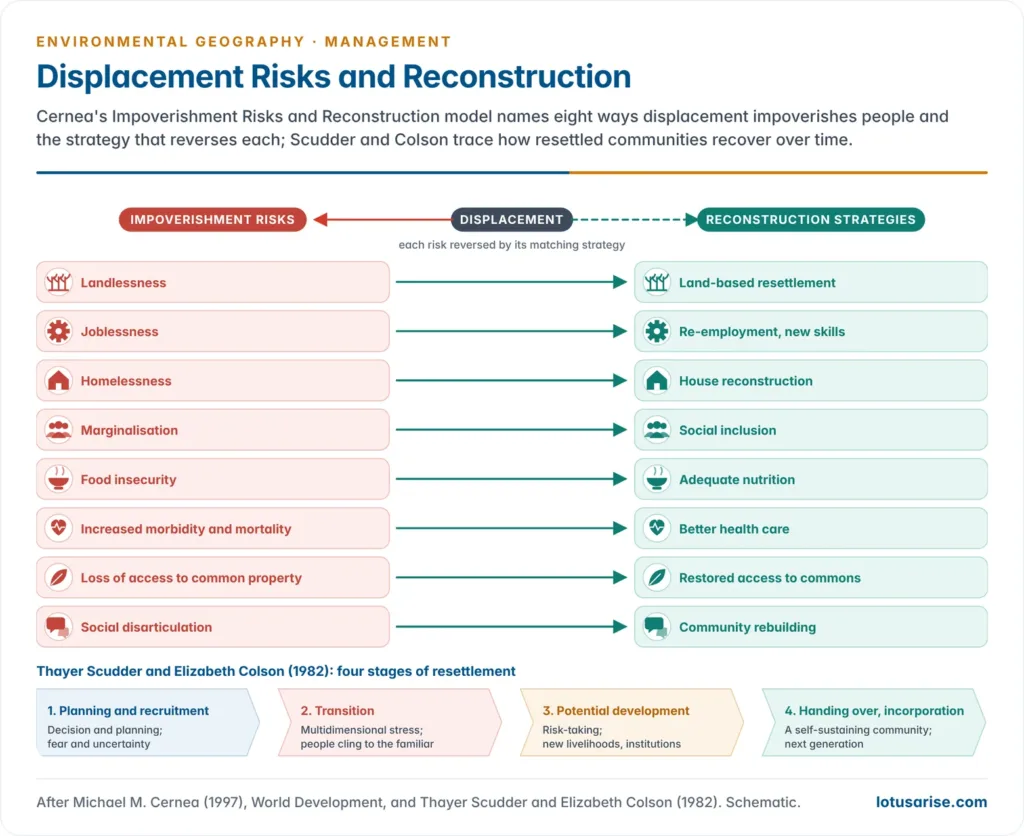
- Because displacement is the gravest social impact, two models are widely used to predict and prevent its harm:
- Impoverishment Risks and Reconstruction (IRR) model, Michael M. Cernea (1997): displacement carries eight risks of impoverishment:
- landlessness, joblessness, homelessness, marginalisation;
- food insecurity, increased morbidity and mortality;
- loss of access to common property (forests, grazing, water);
- social disarticulation, the breakdown of kinship and community networks.
- Each risk can be reversed by a matching reconstruction strategy: land-based resettlement, re-employment, house rebuilding, social inclusion, adequate nutrition, health care, restored access to commons and community rebuilding.
- In SIA, the model works as a checklist for prediction and a plan for mitigation.
- Four-stage resettlement model, Thayer Scudder and Elizabeth Colson (1982): planning and recruitment, transition (stress, people cling to the familiar), potential development (risk-taking and new livelihoods) and handing over and incorporation (the next generation takes over a self-sustaining community). Many resettled groups never get past the transition stage.
SIA in India
- India’s SIA practice grew out of displacement struggles, court judgments and legislation over three decades.
- Scale of the problem: Walter Fernandes estimates that development projects displaced or deprived about 70 million people between 1947 and 2010.
- About 40% were tribal, though tribal people form under a tenth of the population, and about 22% were Dalits.
- In the states he studied, only about 15% of those displaced were resettled by the projects that displaced them.
- The burden falls on the tribal areas of central and eastern India, where land, forests and minerals coincide.
Before 2013
- The Land Acquisition Act, 1894 allowed compulsory acquisition for a “public purpose” with no requirement to assess social impacts or to resettle anyone.
- The National Policy on Resettlement and Rehabilitation (2003) and the National Rehabilitation and Resettlement Policy, 2007 (NRRP) were policies, not statutes.
- NRRP 2007 called for a Social Impact Assessment where a project displaced 400 or more families in the plains, or 200 or more in tribal, hilly or Scheduled Areas.
- It emphasised land-for-land for agricultural families, community-based rehabilitation, and special provisions for Scheduled Castes, Scheduled Tribes and women.
- The EIA Notification, 2006 requires a public hearing and coverage of socio-economic aspects within EIA for listed projects. A 2020 draft that would have diluted public consultation drew wide protest and was not adopted in that form.
- Environmental and forest laws that give communities a voice:
- PESA, 1996 requires consultation with the Gram Sabha or Panchayat before land is acquired in Fifth Schedule Areas;
- the Forest Rights Act, 2006, with the MoEF circular of 2009, requires Gram Sabha consent before forest land is diverted.
- In Niyamgiri (Odisha), the Supreme Court (April 2013) left the decision on bauxite mining to the Gram Sabhas of the Dongria Kondh villages, which rejected it; the mine was then refused clearance.
The RFCTLARR Act, 2013: Chapter II
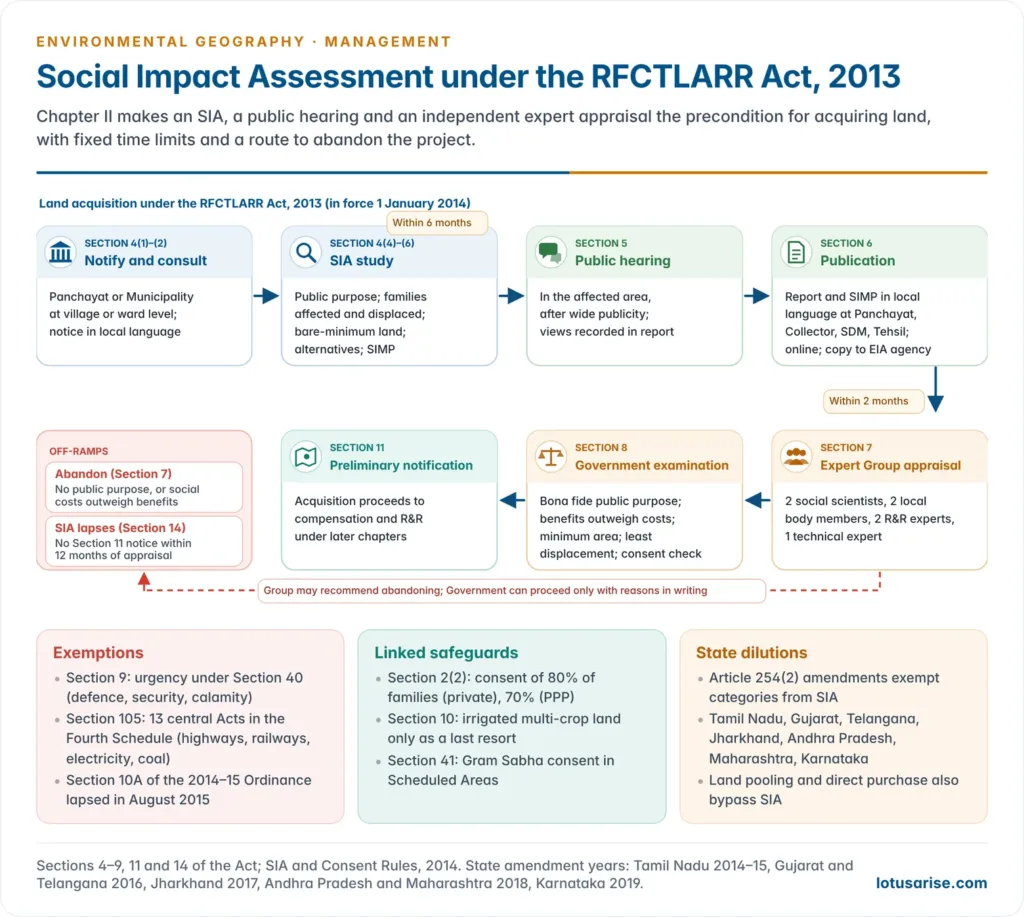
- The Act came into force on 1 January 2014, replacing the 1894 Act. Chapter II, “Determination of Social Impact and Public Purpose” (Sections 4–9), made SIA a legal precondition for acquisition, with the power to stop a project on social grounds.
- Section 4: preparation of the SIA study
- Whenever the appropriate Government intends to acquire land for a public purpose, it must consult the Panchayat, Municipality or Municipal Corporation at village or ward level and carry out an SIA in consultation with them.
- The notification must be issued in the local language and published in the affected area; Gram Sabha and local bodies must be adequately represented.
- The SIA must be completed within six months.
- Contents: whether the acquisition serves a public purpose; the number of affected families and of those likely to be displaced; the land, houses, settlements and common property affected; whether the land sought is the absolute bare minimum; whether an alternative site was considered; and the social costs of the project against its benefits.
- It must consider impacts on livelihoods and on public and community assets: roads, drainage, drinking water, water for cattle, community ponds, grazing land, fair price shops, health centres, schools, anganwadis, places of worship, land for traditional tribal institutions and burial and cremation grounds.
- A Social Impact Management Plan must list the ameliorative measures.
- An EIA, if required, runs simultaneously and does not wait for the SIA.
- Section 5: public hearing in the affected area, with adequate publicity, so that the views of affected families are recorded in the SIA report.
- Section 6: publication of the SIA report and Management Plan in the local language at the Panchayat, Collectorate, SDM and Tehsil offices and on the website; a copy goes to the EIA agency where an EIA is done.
- Section 7: appraisal by an independent multi-disciplinary Expert Group:
- two non-official social scientists; two representatives of the Panchayat, Gram Sabha or urban local body; two experts on rehabilitation; and one technical expert in the project’s subject.
- If the project serves no public purpose or its social costs outweigh its benefits, the Group must recommend, within two months, that it be abandoned. If the Government proceeds anyway, it must record its reasons in writing.
- Otherwise it recommends whether the land sought is the bare minimum and whether less-displacing alternatives exist.
- Section 8: examination by the Government, which must ensure a bona fide public purpose, benefits that outweigh social costs, acquisition of the minimum area, and that no earlier acquired land lies unutilised nearby. It then recommends the area that causes minimum displacement and the least disturbance to infrastructure and ecology.
- Section 9: exemption. The SIA may be skipped only where the urgency clause (Section 40) is invoked: defence, national security, or emergencies from natural calamities.
- Linked provisions:
- Section 2(2): consent of at least 80% of affected families for private projects and 70% for public–private partnership projects;
- Section 10: irrigated multi-cropped land may be acquired only as a demonstrable last resort, to safeguard food security;
- Section 14: the SIA report lapses if the preliminary notification (Section 11) is not issued within 12 months of its appraisal;
- Section 41: in Scheduled Areas, acquisition is a last resort and needs the consent of the Gram Sabha.
- The SIA and Consent Rules, 2014 (Central Government, August 2014):
- an independent SIA Unit appoints an SIA team of practitioners, academics and experts for each project, including at least one woman; members must have no conflict of interest with the acquiring body;
- consent is obtained in Gram Sabha meetings, with proceedings video-recorded and made public.
Exemptions and dilutions
- Section 105 and the Fourth Schedule: acquisitions under 13 central Acts, such as the National Highways Act, 1956, the Railways Act, 1989, the Electricity Act, 2003 and the Coal Bearing Areas Act, are outside the Act’s SIA chapter.
- An order of August 2015 extended only the Act’s compensation and rehabilitation provisions to them; the SIA requirement was not extended.
- The Ordinance of December 2014 (re-promulgated in 2015) inserted a Section 10A that exempted five categories from both the SIA and the food-security chapters:
- defence and national security;
- rural infrastructure, including electrification;
- affordable housing and housing for the poor;
- industrial corridors;
- infrastructure, including PPP projects, where the land remains with the Government.
- The Amendment Bill went to a Joint Parliamentary Committee and was not passed; the Ordinance lapsed in August 2015, so the central Act stands as enacted.
- State amendments: using Article 254(2) of the Constitution, several states passed their own amendments, with the President’s assent, exempting similar categories from SIA and consent:
- Tamil Nadu (2014–15, through separate state acquisition laws), Gujarat and Telangana (2016), Jharkhand (2017), Andhra Pradesh and Maharashtra (2018) and Karnataka (2019) are examples.
- Others act through rules under Section 109 or through land-pooling and direct-purchase routes that avoid acquisition.
- The result: large categories of public infrastructure can now be acquired without any SIA.
SIA in practice: Indian cases
- Sardar Sarovar Project (Narmada):
- submergence and canal works displaced tens of thousands of families, largely Adivasi, in Gujarat, Maharashtra and Madhya Pradesh;
- the Narmada Bachao Andolan, led by Medha Patkar, exposed failures: land-for-land promises unmet, non-material losses (identity, sacred sites, community networks) ignored, and too little consultation;
- the World Bank’s Independent Review (Morse Commission, 1992) found resettlement inadequate, and the Bank withdrew in 1993;
- in Narmada Bachao Andolan v. Union of India (October 2000) the Supreme Court allowed construction to proceed, but made the raising of the dam conditional on rehabilitation completed in step (pari passu) with construction and before submergence;
- in 2017 the Court awarded ₹60 lakh per family (for two hectares) to 681 families still awaiting land.
- Niyamgiri (2013): the decision of tribal Gram Sabhas, not an expert report, settled the social acceptability of a project.
- K-Rail SilverLine (Kerala), 2022: SIA surveys marked by concrete boundary stones met protests across the state. The Kerala High Court criticised the approach, and the government switched to geo-tagging before the project stalled. Poor communication in the SIA stage itself generated social conflict.
- Great Nicobar project (2024): the SIA for land for the international airport covered only settler families in two villages of Campbell Bay. Critics pointed out that the Shompen, a particularly vulnerable tribal group, and the Nicobarese were not consulted, a question of who counts as affected.
- Indian practice: common shortcomings:
- SIA teams appointed and paid through the acquiring agency, which weakens independence despite the Rules;
- studies done as paperwork after the site is fixed, so alternatives are not genuinely considered;
- informal users (tenants, labourers, forest and common-land users) left out of the counts;
- Expert Groups that rarely recommend abandonment;
- weak monitoring of the Management Plan after acquisition.
Global frameworks that shape practice
- World Bank Environmental and Social Framework (in force October 2018): ten Environmental and Social Standards.
- ESS1 covers assessment of environmental and social risks; ESS5, land acquisition, restrictions on land use and involuntary resettlement; ESS7, indigenous peoples (with FPIC in defined cases); ESS10, stakeholder engagement.
- IFC Performance Standards (2012): eight standards; PS1 (risk assessment and management), PS5 (land acquisition and involuntary resettlement) and PS7 (indigenous peoples). Banks that follow the Equator Principles apply them to project finance.
- UN Declaration on the Rights of Indigenous Peoples (2007) and ILO Convention 169 (1989) set the norm of free, prior and informed consent.
Significance and Challenges of SIA
Significance
- Social justice and equity: SIA keeps the costs of development from falling disproportionately on the marginalised, and exposes structural inequity.
- Community acceptance: projects that engage people genuinely face fewer protests, delays and cost overruns; social conflict is a major cause of stalled projects.
- Better design: early SIA finds less-displacing sites, alignments and alternatives, cutting both project cost and human harm.
- Local knowledge: it brings in what communities know about land, water, seasons and risks that technical studies overlook.
- Capacity building: the process builds local capacity to take part in development decisions and a sense of ownership of outcomes.
- Protection of the vulnerable: children, women, the elderly, indigenous peoples and the landless get structured attention.
- Bridging gaps between communities, developers, government and policy-makers, supporting the socio-economic and environmental sustainability of the region.
- Link to well-being: SIA asks whether a project improves or worsens social well-being and quality of life, not just output.
Challenges
- Complexity: many stakeholders with divergent values, interests and cultures; impacts resist simple quantification.
- Prediction: social impacts depend on human behaviour and perception, which are less predictable than physical processes.
- Limited participation: literacy, language, distance and fear limit the voice of those most affected.
- Power imbalances: affected communities have little power relative to proponents and the state, so consultation becomes tokenistic.
- Compliance mindset: SIA is treated as a tick-box for approval, not a planning tool; the unmitigated costs fall on the community or the state.
- Resources: rigorous SIA needs time, money and trained social scientists, which are often short.
- Data gaps: baseline social data are missing, outdated or unreliable, especially land records of informal users.
- Dilution in law: central exemptions and state amendments have taken large classes of projects out of SIA.
Way forward
- Make SIA independent of the acquiring body, with a public register of SIA reports and Expert Group decisions.
- Start SIA at the planning stage, so alternatives and sites are still open.
- Combine quantitative baselines with participatory tools and gender analysis.
- Integrate SIA with EIA, and use strategic and cumulative assessment for regions with many projects.
- Monitor the Social Impact Management Plan after acquisition, with grievance mechanisms and periodic social audits.
- Apply land-for-land and livelihood-based resettlement guided by the IRR model, so that people displaced by a project become its beneficiaries.