(a) Land revenue settlements In British India; The Permanent Settlement; Ryotwarl Settlement; Mahalwarl Settlement; Economic Impact of the revenue; arrangements; Commercialization of agriculture; Rise of landless agrarian labourers; Impoverishment of the rural society;
(b) Dislocation of traditional trade and commerce; De-industrlallsatlon; Decline of traditional crafts; Drain of wealth; Economic transformation of India; Railroad and communication network Including telegraph and postal services; Famine and poverty in the rural Interior; European business enterprise and its limitations.
Economic Impact of British Colonial Rule is the largest unit in Modern India. UPSC has set 59 questions on it between 1985 and 2026 — more than any other Indian history topic on this site — and it has appeared in nine of the last ten papers, with three questions in 2026 alone. If you have time to prepare only one Modern India unit thoroughly, this is the one.
Every question the Commission has asked on this topic is listed below, newest first, with a written model answer linked against each one.
| Questions asked (1985–2026) | 59 |
| Appeared in | 9 of the last 10 papers |
| Paper | Paper II, Section A (Modern India) |
| Usual mark value | 10, 15 or 20 marks |
| Model answers available | 56 of 59 |
PYQs: Economic Impact of British Colonial Rule [1985-2026]

| Year | Question | Answer |
|---|---|---|
| 2026 | "Permanent settlement policy resulted in an unfair distribution of assessment, particularly when there was no survey." | |
| 2026 | "The poverty of India was not a product of the Geography or of the lack of natural resources, it was mainly a product of the History of the last two centuries." | |
| 2026 | Underline the various factors for decline of the Indian cottage industries during the nineteenth century. | |
| 2025 | Do you agree that the idea of permanent fixation of land revenue of 1793 in Bengal was highly influenced by the Physiocratic school of thinking? Discuss. | View answer |
| 2025 | "The colonial rule opened the Indian markets for British-manufactured goods and led to 'deindustrialization' or destruction of indigenous handicraft industries." | View answer |
| 2024 | The pace of commercialisation of agriculture increased as a result of British revenue policies in India. — Critically examine. | View answer |
| 2023 | "Colonialism had a twisted logic of its own for commercialization. It emerges on analysis to have been often an artificial and forced process." Critically examine. | View answer |
| 2023 | Do you agree that 'the decline of traditional Indian artisan production was a fact, sad but inevitable'? Discuss. | View answer |
| 2022 | Explain how the Permanent Settlement initiated a rule of property in Bengal and what were its consequences? | View answer |
| 2022 | Famines were not just because of foodgrain scarcity, but were a direct result of colonial economic policies'. Critically examine. | View answer |
| 2021 | India has been the world leader in the field of hand spun and hand woven yarn and cloth for many centuries. Many nationalist and Marxist critiques considered that the British dominion deliberately shattered the traditional and world famous handicrafts of India. Comment. | View answer |
| 2019 | Critically examine: “Not until independence, when economic development became a conscious and pursued policy, did the Railways begin to realize their potential for assisting in the transformation of the Indian economy." | View answer |
| 2018 | Critically examine:"The passing of the land from the hands of the peasant proprietors into the hands of non-cultivating landlords brought about increasing polarization of classes in agrarian areas." | View answer |
| 2017 | Critically comment in 150 words: “The British railway construction policyin India benefitted British economy in the nineteenth century." | View answer |
| 2017 | Explain the factors responsible for the recurrence of famines in the nineteenth century. What remedial measures were adopted by the British Indian Government? | View answer |
| 2016 | Critically examine the causes responsible for the phenomenon called 'deindustrialisation' in India during the nineteenth century. | View answer |
| 2015 | "Under the forceful thrust of British colonialism, Indian economy was transformed into a colonial one, the structure of which was determined by the requirements of Britain’s fast developing industrial economy." Examine. | View answer |
| 2013 | “Ryotwari falls into three stages – early, middle and late, and the only description common to all is that it is a mode of settlement with small farmers, so small, indeed, that their average holding is, on recent figures, only about 6V2 acres”. Critically examine. | View answer |
| 2013 | "Weaving”, says R.C. Dutt, “was the national industry of the people and spinning was the pursuit of millions of women.” Indian textiles went to England and other parts of Europe, to China and Japan and Burma and Arabia and Persia and parts of Africa. Elucidate. | View answer |
| 2012 | “Plantations and mines, jute mills, banking, insurance, shipping and export – import concerns in India were run through a system of interlocking managing agencies." Critically examine. | View answer |
| 2012 | “The forces of free trade and the British determination to create a political and administrative environment conducive to trade and investment had shaped the British policy towards India in the first half of the nineteenth century."- Elucidate. | View answer |
| 2012 | “The railways, instead of serving as the catalyst of an industrial revolution as in Western Europe and the USA, acted in India as ‘the catalyst of complete colonization’. – Examine. | View answer |
| 2011 | “The need for a unilateral transfer of funds to Britain was a constant factor and in fact, progressively increased over time." Critically evaluate. | View answer |
| 2010 | Critically evaluate: “Railway development in India provides an interesting instance of private enterprise at public risk.” | View answer |
| 2010 | What role did the economic ideas plays in the early phase of the British rule in the shaping of land tenure policy? | View answer |
| 2010 | To what extent did the process of commercialization of agriculture affect the rural scene in India? | View answer |
| 2009 | “Though the Permanent Settlement had serious defects, it gave tranquillity to the countryside and stability to the government." Comment. | View answer |
| 2008 | Critically examine the impact of the famine policy on rural India. Describe the official remedial measures undertaken. | View answer |
| 2008 | Write a critique on the impact of the Drain Theory of Dadabhai Nauroji in the growth of economic nationalism. | View answer |
| 2007 | Examine the major factors shaping the British land-revenue policy in India. How it affected Indian society? | View answer |
| 2006 | “A self-sufficient village, based on agriculture carried on with the primitive plough and bullock-power, and handicrafts by means of simple instruments, was a basic feature of Pre-British Indian economy.” Comment. | View answer |
| 2006 | What do you mean by the commercialization of Indian agriculture? Discuss its results. | View answer |
| 2005 | ‘The impact of government on the people meant essentially the impact of government on the village.’ Comment. | View answer |
| 2005 | Trace the development of the famine policy of the British in India between 1876 and 1921. Did it provide relief to the people? | View answer |
| 2004 | ‘Permanent Settlement disappointed many expectations and introduced the results that were not anticipated.’ Comment. | View answer |
| 2004 | Discuss the causes that led to the ‘economic drain’ in Bengal following the Battle of Plassey. | View answer |
| 2003 | ‘Absentee landlordism was a consequential feature of Bengal’s Permanent land settlement.’ Comment. | View answer |
| 2003 | ‘India underwent suffering and mortality in the wake of recurring famines’ in the later half of the 19th century. Comment. | View answer |
| 2003 | What was the impact of early British land policy on the 'village communities’ of North India? | View answer |
| 2002 | “The recurring famines in the 19th century were the inevitable consequence of the British policy and expose the real character of the paternal solicitude for the peasantry on the part of the British administration." Examine this statement critically. | View answer |
| 2001 | ‘The British industrial policy in the nineteenth century ruined the Indian handicrafts.’ Comment. | View answer |
| 2001 | Discuss the main features of the ‘Raiyatwari Settlement’ in South India. Did it satisfy the aspirations of the peasantry? | View answer |
| 2000 | Discuss the view that the British rule brought about economic changes in India to serve the needs of the imperial economy and establish a dependent form of underdevelopment in this country. | View answer |
| 1999 | The Indian Middle Class firmly believed that “Britain had imposed a colonial economy on India which had impoverished the country.” Comment. | View answer |
| 1997 | The Permanent Settlement was a “bold, brave and wise measure.” Comment. | View answer |
| 1996 | The changing life in Indian village marked best the impact of the British administration on the Indian people. Explain, identifying the process and the extent of the change. | View answer |
| 1995 | Economic changes in India from the late 1920s influenced the course of the country’s politics. Elucidate. | View answer |
| 1994 | “The British Raj had a deeply racist aspect and it ultimately existed to protect colonial exploitation.” Comment. | View answer |
| 1994 | How do you account for the rise and growth of the Business enterprise in India during the first half of the 20th century? | View answer |
| 1993 | ‘The permanent settlement of Bengal though initiated with best of intentions, was a sadly blundering affairs.’ Comment. | View answer |
| 1991 | ‘The role of the East India Company proved disastrous to the handicraft industry in India for a number of reasons.’ Comment. | View answer |
| 1991 | Identify the distinct stages of colonialism in India. How did these stages affect the Indian economy? | View answer |
| 1990 | ‘The hey-day of the British power in India was also the high noon of laissez faire’ economic doctrine.’ Comment in about 200 words. | View answer |
| 1989 | Identify the main features of industrial development in India from 1914 to 1947 with special reference to the emergence of a class of factory labourers. | View answer |
| 1988 | "The impact of government on the people meant essentially the impact of government on the village.” Comment in about 200 words. | View answer |
| 1987 | Trace the gradual decline of the Indian town handicrafts between 1757 and 1880. In what way did it contribute to the economic unification of India? | View answer |
| 1986 | Bring out the pattern of commercialization of agriculture in the 19th century. Was it a forced process for the vast majority of poorer peasants? | View answer |
| 1985 | "Our system acts very much like a sponge, drawing up all the good things from the banks of the Ganges, and squeezing them down on the banks of the Thames.” Comment in about 200 words. | View answer |
| 1985 | Show how British rule led to the spread of land-lordism in certain parts of India, and how the peasant was progressively impoverished under this rule. | View answer |
What UPSC keeps asking about the economic impact of colonial rule
Fifty-nine questions sound unmanageable. Sorted, they fall into seven threads, and the first three — land revenue, de-industrialisation and the drain — account for half the unit.
1. Land revenue settlements (1985, 1993, 1997, 2001, 2003, 2004, 2007, 2009, 2013, 2018, 2022, 2025, 2026)
- Thirteen questions — the largest thread in the largest unit, and asked in three of the last five papers.
- The Permanent Settlement dominates: “bold, brave and wise” (1997), best intentions and bad results (1993, 2004), a rule of property (2022), an unfair distribution of burden (2026). Ranajit Guha’s A Rule of Property for Bengal is the historiography.
- Ryotwari (2001) and its three stages (2013) are the necessary comparison. Prepare Mahalwari too, even though it is rarely named.
2. De-industrialisation and the artisan (1987, 1991, 2001, 2012, 2013, 2016, 2021, 2023, 2025, 2026)
- Ten questions, four since 2021.
- R. C. Dutt on weaving as the national industry (2013), British industrial policy ruining handicrafts (2001), the causes of de-industrialisation (2016), whether artisan decline was a myth (2023), cottage industry decline (2026).
- This is where the historiography matters most: the nationalist thesis against Morris D. Morris and Tirthankar Roy’s revisionism. 2023 is framed to invite exactly that debate.
3. The drain of wealth (1985, 1999, 2004, 2008, 2010, 2011, 2026)
- Dadabhai Naoroji’s drain theory (2008), the drain from Bengal (2004), the unilateral transfer of funds (2011), and 2026’s claim that India’s poverty was a product of British policy.
- Know the components — Home Charges, interest, pensions, profits — and the economic nationalists who built the argument: Naoroji, Dutt, Ranade, Gokhale.
4. Commercialisation of agriculture (1986, 2006, 2010, 2023, 2024)
- Asked in consecutive years in 2023 and 2024.
- The examiner wants the “twisted logic” (2023): commercialisation driven by revenue demand and debt rather than by market opportunity, so that it produced indebtedness and vulnerability rather than prosperity.
- Indigo, cotton, jute and opium are the crops to use as evidence.
5. Famines and famine policy (2002, 2003, 2005, 2008, 2017, 2022)
- Why famines recurred (2017), whether they were inevitable (2002), the development of famine policy (2005, 2008).
- 2022 put it most sharply: famines were not only about grain scarcity. Amartya Sen’s entitlement approach is the frame the examiner is looking for.
6. Railways, industry and business (1989, 1994, 1995, 2010, 2012, 2015, 2017, 2019)
- Railways as a catalyst that failed to catalyse (2010, 2012, 2017), British control of plantations, mines, banking and shipping (2012), the growth of Indian business (1994), industrial development (1989).
- 2019 asked whether real economic development waited until independence — the question that ties the thread together.
7. Stages and character of colonialism (1988, 1990, 1991, 1994, 1996, 2000, 2005)
- Bipan Chandra’s three stages of colonialism (1991) — mercantile, free trade and finance capital — are the scaffolding for the whole unit.
- The older questions ask for overall impact on the village and the people. Use the stages framework to organise any general question.
The model answers to this unit, in one place
Knowing the questions is half the work. The other half is seeing what a full-mark answer to each one looks like — not a hint or a bullet outline, but a complete answer at the mark and the word limit, with the historians named inside the argument.
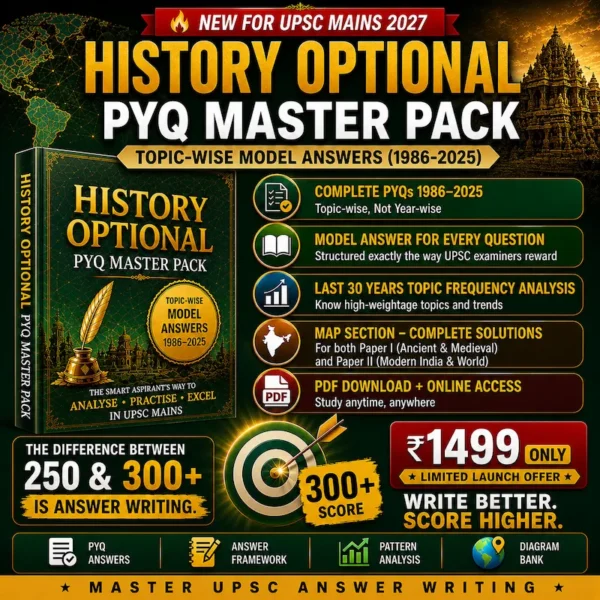
The History Optional PYQ Master Pack carries the same for every question the Commission has set since 1985, across the whole syllabus.
- PYQs 1985–2025, arranged topic-wise — revise a theme and see every way it has been asked
- Model answers with historiography — the debate cited where it belongs, not bolted on
- Map sections solved — the full 50-mark section, every year
- PDF plus online access — any device, permanently, no subscription
₹1,499 (regular ₹2,500). One-time payment, instant access.
How to use this topic list
Reading a question list feels like preparation and is not. Three sittings turn it into marks.
Sitting 1 — sort before you read (30 minutes)
- Copy the questions above into the threads identified in the previous section.
- Note which thread has gone longest without being asked — that is your priority, not the one you find most interesting.
Sitting 2 — write three answers cold (45 minutes)
- Pick the most recent question from three different threads.
- Seven minutes for a 10-marker, fifteen for a 20-marker. Stop when the time is up, even mid-sentence.
- Mark every place you wanted a historian’s name and could not produce one.
Sitting 3 — compare, then rewrite (45 minutes)
- Put your script beside the model answer for the same question.
- Compare structure first: opening claim, evidence, counter-view, judgement.
- Rewrite your weakest answer using that structure and no new content. Most candidates gain four to six marks from structure alone.
Two ways to prepare this optional
Two routes, depending on what is actually missing.
| PYQ Master Pack | Mains Master Kit 2027 | |
| Best when | Your notes are done; answer-writing is the gap | You are still building the subject |
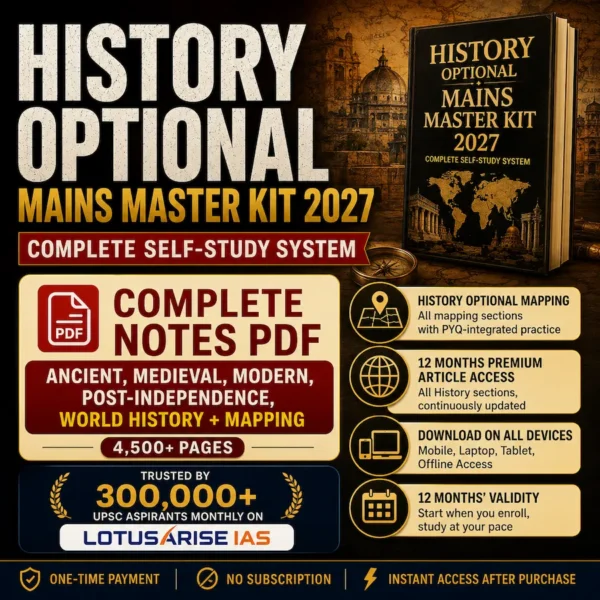
| What you get | Model answers to every question since 1985, topic-wise, map sections included | 4,500+ pages of notes, full mapping coverage, 12 months of article access |
| Price | ₹1,499 (reg. ₹2,500) | ₹1,770 (reg. ₹5,000) |
Frequently asked questions
Related topics
Colonial economy questions connect to:
- Early Structure of the British Raj
- Indian Response to British Rule
- Early Indian Nationalism
- Economic Development and Political Change
- All topics — History Optional PYQs, topic-wise
Prefer to work year by year?
The complete papers, with both papers in full, unit-wise analysis and the official PDFs:
- History Optional Question Paper 2026
- History Optional Question Paper 2025
- History Optional Question Paper 2024
- History Optional Question Paper 2023
- History Optional Question Paper 2022
- History Optional Question Paper 2021
- History Optional Question Paper 2020
- UPSC History Optional Map Solutions (2013–2025)