

- A culture realm is the largest areal unit of cultural similarity on the earth: a group of culture regions whose peoples share a broad complex of religion, language, social organisation, livelihood and landscape. Realms are therefore generalisations at the world scale.
- Culture is abstract but becomes visible in language, religion, ethnicity, customs, diet, dress, technology and the way a people perceive their environment. It is dynamic, changing slowly and enriched by cross-fertilisation when peoples meet.
Culture Realm, Region and Hearth

Building Blocks of Cultural Regionalisation
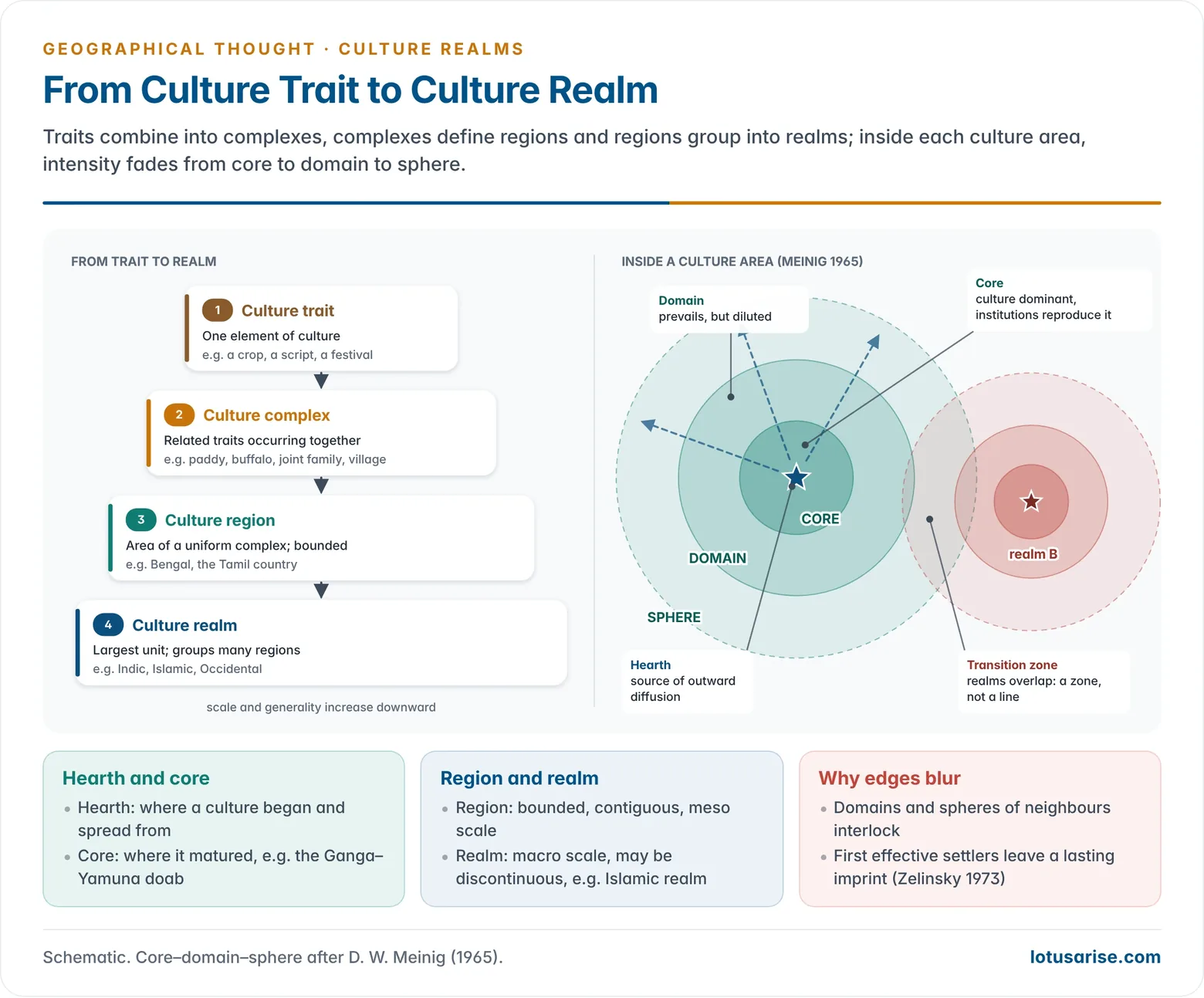
- Culture trait: a single element of culture, such as a crop, a house type, a festival or a script.
- Culture complex: a set of related traits that occur together, such as the paddy–buffalo–joint family–village complex of monsoon Asia.
- Culture region: an area over which a culture complex is relatively uniform and distinct from its neighbours.
- Regions may be formal, functional or vernacular (perceived by their own people).
- Culture realm: the widest sphere of a culture’s influence, grouping many regions; it has transition zones and can be discontinuous, as the Islamic realm is.
- Culture hearth: a source area from which ideas, innovations and ideologies radiated outward.
- Core: a secondary centre into which a hearth’s culture expanded and matured. India’s three classical cores are the Rigvedic core in the Sapta Sindhu (Punjab), the later Vedic core in the Ganga–Yamuna doab and the Dravidian core of the Kaveri delta around Thanjavur.
| Unit | Scale | Boundary | Example |
|---|---|---|---|
| Hearth | Point of origin | Not bounded | Indus valley, Mesopotamia |
| Core | Sub-regional | Fairly sharp | Ganga–Yamuna doab |
| Region | Meso | Bounded, contiguous | Bengal, Tamil country |
| Realm | Macro | Fuzzy, may be discontinuous | Islamic, Indic realm |
- Internal structure: Donald W. Meinig (1965), studying the Mormon culture region of the American West, showed that a culture area is a graded field:
- Core: the culture is dominant and reproduced by its institutions.
- Domain: the culture prevails but is diluted.
- Sphere: the culture survives only as a minority influence, overlapping the next region’s sphere, so realm boundaries are transition zones.
- Wilbur Zelinsky’s doctrine of first effective settlement (1973): the first group to establish a self-perpetuating society leaves an imprint far greater than its numbers.
Culture Hearths of the World
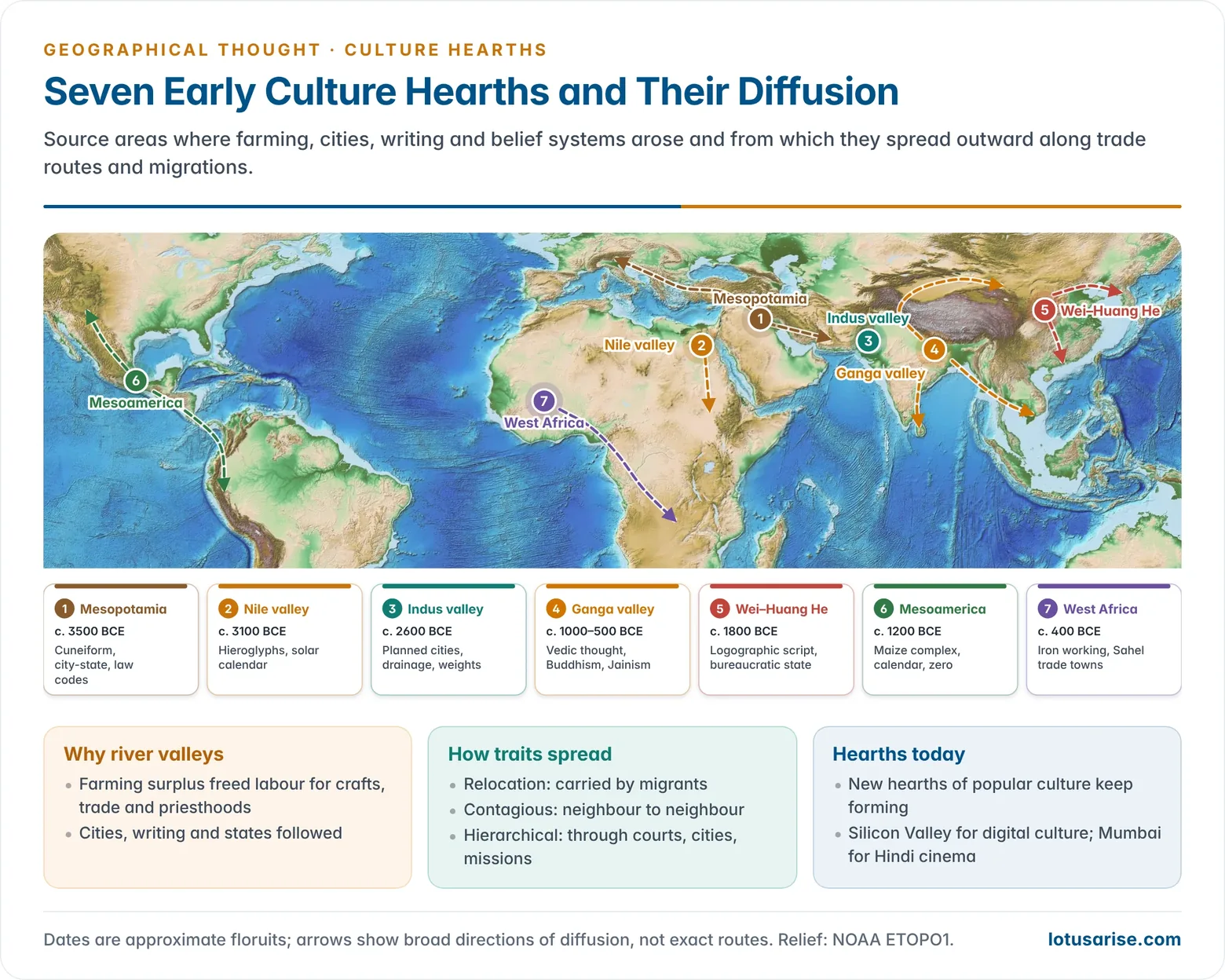
- Most early hearths were river valleys where a farming surplus allowed cities, writing, priesthoods and states to grow.
- Seven early culture hearths are commonly recognised:
| Hearth | Approx. floruit | Signature contributions |
|---|---|---|
| Mesopotamia (Tigris–Euphrates) | c. 3500 BCE | Cuneiform, city-state, law codes |
| Nile valley | c. 3100 BCE | Hieroglyphs, solar calendar, monumental stone |
| Indus valley | c. 2600 BCE | Planned cities, drainage, standard weights |
| Ganga valley | c. 1000–500 BCE | Vedic–Upanishadic thought, Buddhism, Jainism |
| Wei–Huang He (North China) | c. 1800 BCE | Logographic script, bureaucratic state |
| Mesoamerica | c. 1200 BCE | Maize complex, calendar, the zero |
| West Africa (Middle Niger) | c. 400 BCE | Iron working, Sahel trade towns |
- Diffusion carried hearth culture outward by migration (relocation), contact between neighbours (contagious) and rulers, cities and missionaries (hierarchical), processes that Torsten Hägerstrand later modelled as innovation diffusion.
- Modern hearths: new hearths of popular culture keep forming, such as Silicon Valley for digital culture and Mumbai for Hindi cinema.
Bases of Delimiting Culture Realms
- Cultural variables used to regionalise the world include race, religion, language, economic organisation, folk customs, diet, dress, beliefs and traditional values.
- Environmental factors create some differences, as people adapt diet, dress and shelter to climate.
- Social and emotional factors, above all language and religion, draw the sharpest dividing lines between peoples; European nation-states grew along linguistic lines.
- Intellectual roots: Friedrich Ratzel’s anthropogeography, the cultural landscape of Otto Schlüter and Carl O. Sauer (1925), and Paul Vidal de la Blache’s genre de vie in the French school.
Classification of World Culture Realms
Broek and Webb’s Classification
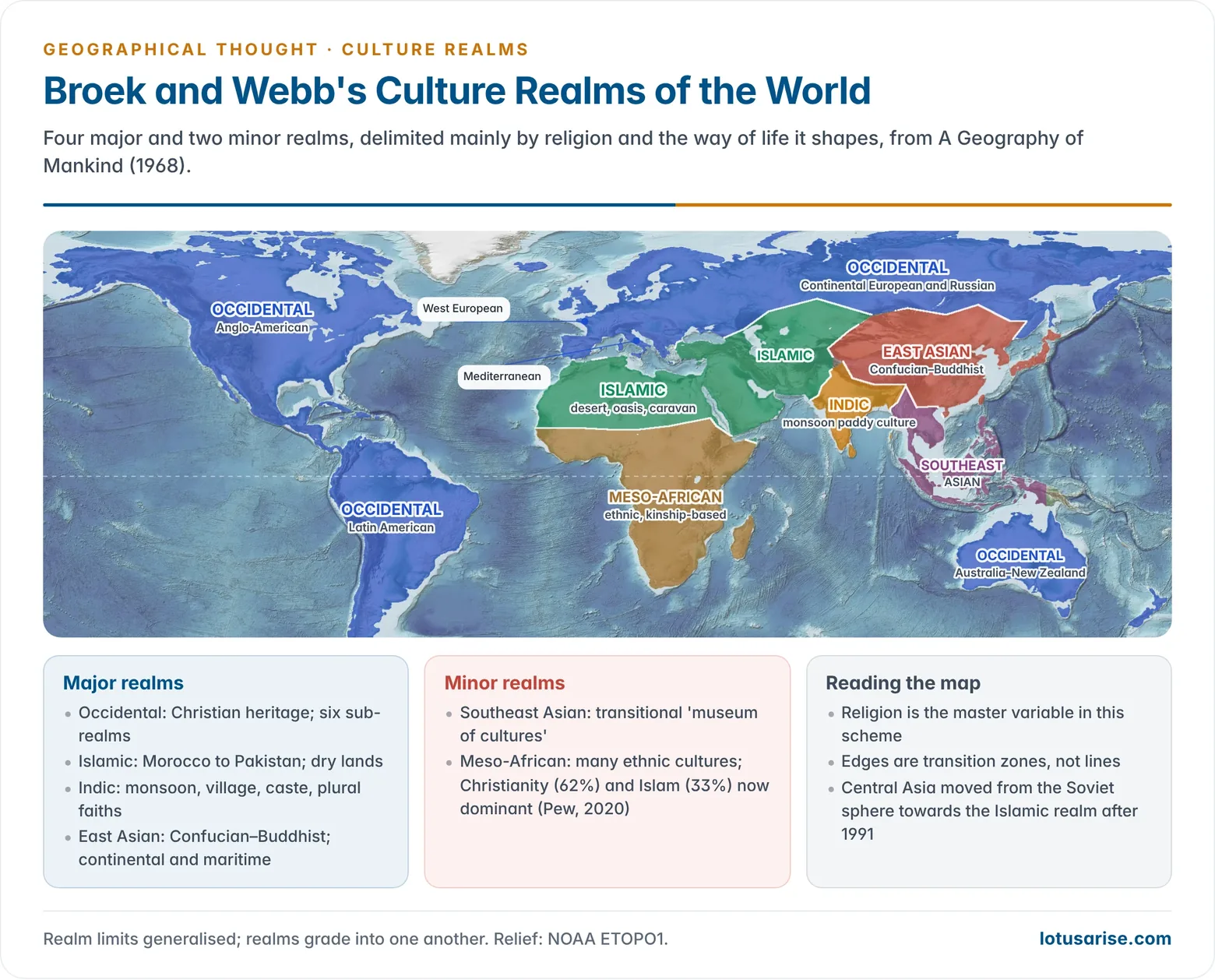
- Jan O. M. Broek and John W. Webb, in A Geography of Mankind (1968), gave the most widely used classification of world culture realms.
- They looked for the one phenomenon that dominates the evolution of a cultural landscape and found it in religion.
- In their view, religion shapes the economy, dress, diet and beliefs of a people, encourages the learning of certain languages, and sets limits on cultural mixing.
- When religious influence is withdrawn, a region’s culture tends to lose its coherence.
- Weighing the other variables too, they divided the world into four major realms and two minor realms, each with smaller sub-units.
- Major: Occidental, Islamic, Indic, East Asian.
- Minor: Southeast Asian, Meso-African.
Occidental Realm
- The culture of European society and of the lands Europeans settled. Christianity is its historic base.
- Its regional variety comes from different levels of industrialisation, urbanisation and colonisation and from contrasting political and economic thought.
- Modernisation has pushed religion to the margins, above all in post-industrial north-west Europe, among the most secular societies in the world.
- It has six sub-realms:
| Sub-realm | Distinctive features |
|---|---|
| West European | Most industrialised and urbanised; secular, service-based economies |
| Continental European | Shaped by contrasting political–economic systems, including the socialist legacy of the east; Christianity still significant |
| Mediterranean | South of the Alps; strong Catholic and family traditions; industrialised later than north-west Europe |
| Anglo-American | Settled mainly from north-west Europe; immigrant, urban, high-consumption |
| Australian (Australia–New Zealand) | An offshoot of west European culture with regional differences |
| Latin American | Iberian languages, Catholicism and colonial architecture; the only tropical and less developed part of the realm |
- Latin America joined the realm through conversion and colonisation and keeps close cultural ties with the Mediterranean lands.
Islamic Realm
- A realm of desert and semi-desert culture bound by Islamic values, stretching from Morocco in the west to Pakistan in the east.
- Population is sparse and clustered on coasts, river basins and oases; pastoral nomadism, oasis farming and caravan trade were the traditional livelihoods of a water-scarce land.
- Religion and settlement: five daily prayers facing Mecca and Friday congregational worship favoured permanent settlements around mosques.
- Recent change: oil wealth has rapidly urbanised the Gulf states, whose migrant workforces have made plural urban cultures.
- Transitional areas: Israel is a distinct culture in religious terms; the Central Asian republics, long tied to the Soviet system, have moved closer to the Islamic realm since independence in 1991.
Indic Realm
- The culture of the Indian subcontinent, also called a monsoonal or paddy culture.
- It is a well-framed realm: the Himalaya to the north, the Hindu Kush and Sulaiman ranges to the west, and the Indian Ocean to the south.
- Defining traits: the joint family and village community; the caste system and, historically, semi-feudal land relations; subsistence paddy farming on one monsoon calendar; and an underlying Vedic substratum of values, even among communities of other faiths.
- Religious plurality and tolerance: the hearth of four faiths (Hinduism, Buddhism, Jainism, Sikhism) and home to one of the world’s largest Muslim populations; many peoples entered and stayed, and communities borrowed each other’s customs, as in the Bhakti–Sufi traditions.
East Asian Realm
- The realm of China, Japan, the Koreas, Taiwan and Mongolia, built on Confucian ethics, Mahayana Buddhism, Daoism and, in Japan, Shinto, with a shared heritage of Chinese characters.
- Today social philosophy and economic system matter more than religion in defining the realm. It has two sub-realms:
- Continental (Chinese): shaped by the socialist tradition; commune farming gave way to market reforms after 1978, and the south remains a paddy culture.
- Maritime (Japan, South Korea, Taiwan): a Buddhist and Confucian imprint combined with democratic institutions and an industrial–commercial culture built after the Second World War. Japan, an island trading nation, is often called the “Britain of the East”.
Southeast Asian Realm (Minor)
- A transitional realm of cultural tolerance, often called a “museum of cultures”, where every major culture of Asia met and intermingled over a strong indigenous base on the sea route between India and China.
- Theravada Buddhism dominates in Myanmar, Thailand, Laos and Cambodia, and Confucian–Mahayana traditions in Vietnam.
- Islam prevails in Malaysia, Indonesia (the largest Muslim-majority country) and Brunei, and Christianity in the Philippines and Timor-Leste.
- Indic culture survives in Bali’s Hinduism and in monuments such as Angkor Wat.
Meso-African Realm (Minor)
- The culture of the ethnic communities of tropical (sub-Saharan) Africa, fragmented among many groups: Africa holds nearly a third of the world’s living languages.
- Belief: traditional, nature-centred (animist) beliefs were the old base; today Christianity (62%) and Islam (33%) dominate (Pew, 2020), often blended with older practice.
- Some geographers extend it to long-marginalised communities elsewhere, such as Australian Aborigines and the Inuit, making it a widely scattered realm.
Other Classifications
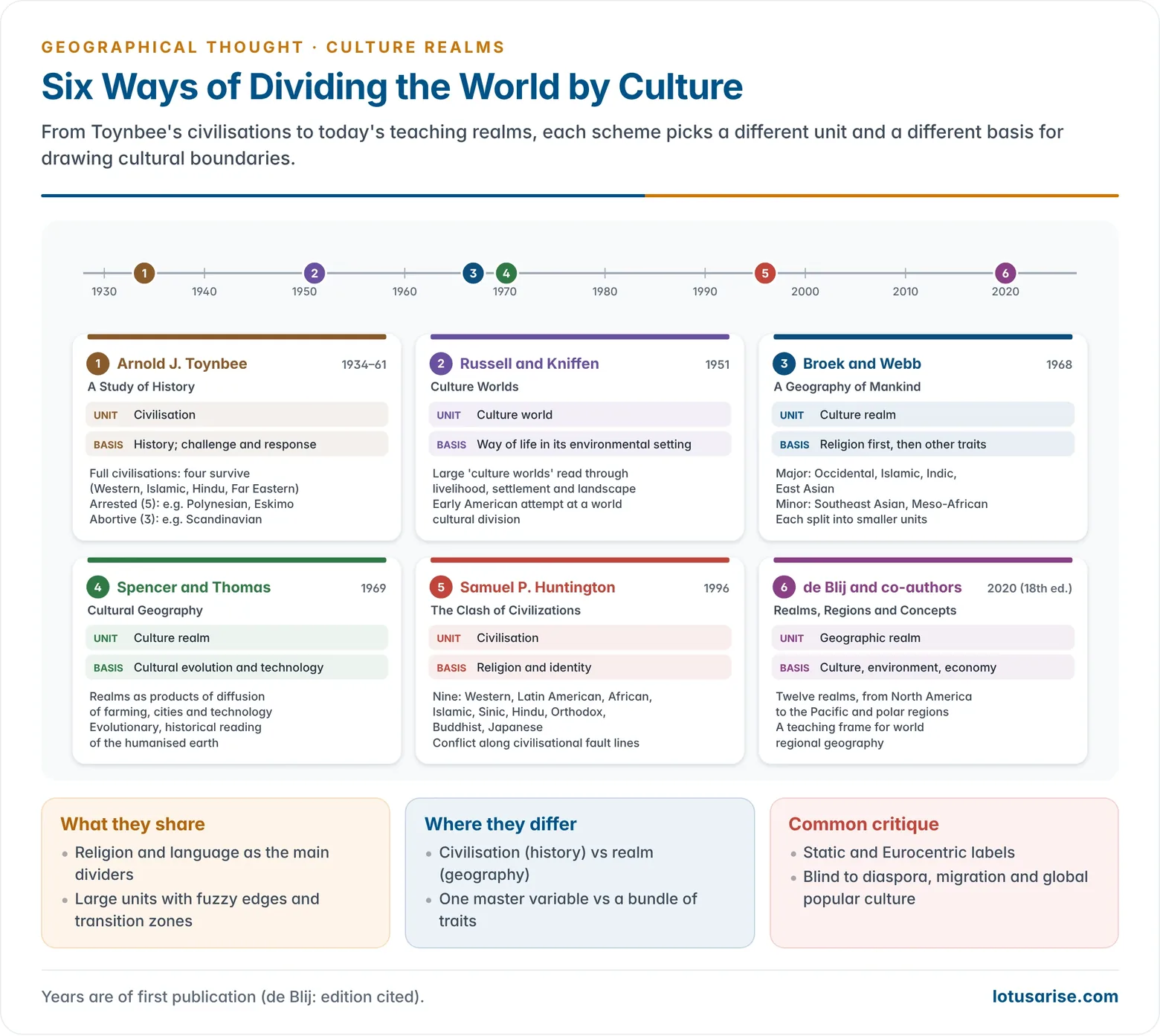
- Arnold J. Toynbee, in A Study of History (12 volumes, 1934–61), classified civilisations:
- full civilisations, of which five survive: Western, Orthodox Christian, Islamic, Hindu and Far Eastern;
- arrested: Polynesian, Eskimo, Nomadic, Ottoman and Spartan;
- abortive: Far Western Christian, Far Eastern Christian and Scandinavian.
- Richard J. Russell and Fred B. Kniffen (Culture Worlds, 1951) divided the earth into “culture worlds” by ways of life in their environmental settings.
- Samuel P. Huntington’s The Clash of Civilizations (1996) recognised nine civilisations: Western, Latin American, African, Islamic, Sinic, Hindu, Orthodox, Buddhist and Japanese.
| Scheme | Unit | Main basis | Number | Distinctive point |
|---|---|---|---|---|
| Toynbee (1934–61) | Civilisation | History, challenge and response | Full, arrested, abortive | Civilisations rise and decline |
| Broek and Webb (1968) | Culture realm | Religion first, then other traits | 4 major + 2 minor | Religion as the master variable |
| Joseph E. Spencer and William L. Thomas (1969) | Culture realm | Cultural evolution and technology | Evolutionary stages | Realms as products of diffusion |
| Huntington (1996) | Civilisation | Religion and identity | 9 | Conflict along fault lines |
| Harm de Blij and others (2020) | Geographic realm | Culture, environment, economy | 12 | Teaching framework for world regions |
The Indo-Gangetic Hearth and India’s Cultural Regions
The Indo-Gangetic Hearth
- The alluvial trough from the Indus plain through the Ganga–Yamuna doab to Magadha and the Bengal delta is a primary hearth, ranking with Mesopotamia, the Nile and the Huang He.
- Physical basis: deep, renewable Himalayan alluvium, perennial snow-fed rivers and monsoon rain gave a grain surplus that freed labour for crafts, trade, cities and a scholarly class. The environment made civilisation possible, not inevitable.
- Why it ranks among the richest realms:
- Antiquity with continuity: the mature Harappan cities (c. 2600–1900 BCE) were followed by an unbroken living tradition of Sanskrit-derived languages, ritual and village forms, whereas Sumer and ancient Egypt left no living successors.
- Four religions from one plain: Hinduism (Vedic–Upanishadic thought), Buddhism and Jainism (middle Ganga plain, 6th–5th centuries BCE) and Sikhism (Punjab, 15th century).
- Diffusive reach: Buddhism spread across Asia, and most Buddhists today live outside the hearth.
- Learning and statecraft: Panini’s grammar, the decimal place-value system, Pataliputra, and the universities of Taxila, Nalanda and Vikramashila.
- Syncretism: incomers from the north-west were absorbed in layers over the older culture, producing Indo-Islamic architecture, Hindustani music and Urdu.
- Living sacred geography: the Maha Kumbh at Prayagraj (2025) drew an officially estimated 66 crore pilgrims.
- Qualifications:
- “Richest” is an evaluative claim. The Chinese hearth rivals it in continuity, and Mesopotamia preceded it.
- The plain itself is a cultural mosaic.
Cultural Regions of India
- Within the Indic realm, India divides into culture regions based on language, religion, race and custom: the Himalayan cultures, the tribal cultures of the North-East, the Indo-Aryan cultures of the north and the Dravidian cultures of the south.
- Joseph E. Schwartzberg’s ten-fold scheme (1967) is the standard detailed regionalisation, and the States Reorganisation Act of 1956 turned many language regions into states.
Evaluation
- Merits: culture realms give a single framework for comparing ways of life worldwide, join religion, language and livelihood in one unit, and help explain why development differs between realms.
- Criticisms:
- Broek and Webb over-emphasise religion and neglect physiography and economic structure.
- Boundaries are arbitrary, since realms grade into one another.
- The schemes are static, describing a mid-20th-century world and missing migration, diaspora and urban plurality.
- Their labels are Eurocentric (“Occidental”, “Meso-African”), and older schemes used racial categories that science has abandoned.
- Scale problem: a realm hides great internal diversity; the Indic realm alone has hundreds of languages.
- Culture regions as units of diversity: each region is internally uniform yet distinct from its neighbours, so a map of regions displays an area’s diversity, as India’s language regions do. But uniformity is only relative, boundaries are transition zones, and economic and physical differences cut across cultural ones.
- The present: globalisation is weakening realm boundaries as media, migration and markets spread a global popular culture, but the same forces provoke revivals of identity and hybrid, glocal cultures.
Previous Year Questions
2015“Cultural regions are the most suited units to study the diversity of an area.” Comment.2014“Indo-Gangetic hearth is considered to be one of the world’s richest cultural realms.” Examine.2010Write short explanatory note on Occidental culture realm.2009Provide a broad classification of world cultural regions.2006Write short note: Cultural regions of the world.1989Write short note on – Major cultural realms of the world.


Thanks sir
Thank u very much for your efforts sir/madam
Thank you so much for these notes. Indebted for life!
Very précised notes. Thanks “lotusarise” for valuable efforts.
Wow… Best explanation..
Thank you Sir for these amazingly curated notes. Helped enormously in my preparation. My deep gratitude for your hardwork.
thank u so much….
Why the term ‘great naga culture’
We (Jamian) Appreciate……………………………..
Thank You much much
Great efforts by Lotus Aries
Thank you sir 🙏
Love you sir meri pehli salary me se aadha aapak after IAS meri taraf se tohfa