

- Lester Charles King (1907–1989), of the University of Natal, Durban, built a complete system of landscape evolution from the semi-arid and savanna landscapes of southern Africa.
- His system links a hillslope cycle, a river cycle and a landscape cycle, all resting on one mechanism: parallel retreat of scarps.
- The core of the system is the cycle of pediplanation: slopes retreat parallel to themselves, leave pediments at their foot, and the pediments merge into a pediplain.
- The idea appeared in South African Scenery (1942), was codified as the “Canons of Landscape Evolution” (1953) and extended to all continents in The Morphology of the Earth (1962).
- King offered it as the main alternative to the Davisian geographical cycle: landscapes are worn back by backwasting, where Davis had them worn down by downwasting.
Foundations of King’s Model
Sources of the Model
- King called his system new, but it is a synthesis of earlier ideas with his own African field observation.
| Borrowed from | Idea taken over | How King used it |
|---|---|---|
| William Morris Davis (1899) | Short, rapid uplift followed by long stillstand; youth–maturity–old age | Kept the cyclic frame and the three stages |
| Walther Penck (1924) | Slopes retreat parallel to themselves; piedmont steps | Made parallel retreat universal; staircases of pediplains |
| Alan Wood (1942) | Four hillslope elements: waxing slope, free face, debris slope, waning slope | Adopted the four elements as the “standard” hillslope |
| T. J. D. Fair (1947–48) | Scarp retreat and pediments on Natal slopes | Local field support for backwasting |
| Robert E. Horton (1945) | Overland flow and sheetwash on slopes | Sheetwash as the agent grading pediments |
| King’s own work | Pediments, inselbergs, scarps across Africa | Pedimentation + scarp retreat = pediplanation |
Assumptions
- Semi-arid and savanna landscapes are “normal”; the humid temperate lands on which Davis built his model were remodelled by Pleistocene glaciation and carry many relict periglacial forms, so they cannot serve as the standard.
- Uniformity across climates: the basic physical controls of landscape are the same in all climates except the frigid and the extremely arid (King, 1957), and climatic change has little effect on landforms shaped by running water.
- This openly rejects the core claim of climatic geomorphology that slope form changes with climatic type.
- Tectonic rhythm: each cycle begins with rapid, episodic, continent-wide uplift of an older pediplain, followed by a long period of crustal stability.
- Running water and mass movement are the main agents, and slopes always retreat parallel where relief and rock strength allow.
King’s Hillslope Model
Elements of the Standard Hillslope
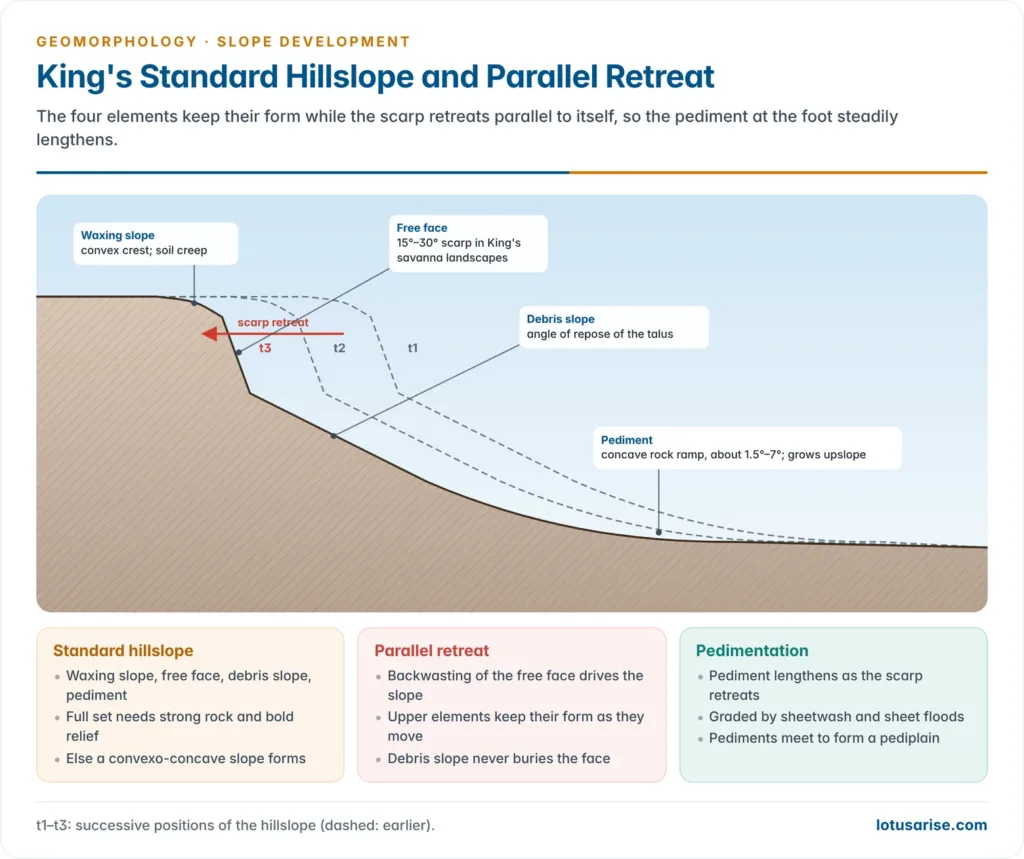
- King accepted Wood’s four elements as the standard (fully developed) hillslope of normal slope evolution by running water and mass movement.
| Element | Form | Dominant process | Behaviour over time |
|---|---|---|---|
| Waxing slope (summital convexity) | Convex crest of hill or scarp | Soil creep | Stays constant; supply of waste balances its removal |
| Free face (scarp) | Bare bedrock outcrop, steep | Rockfall, landslides, gullying | Most active element; retreats parallel and drives the whole slope |
| Debris slope (constant or rectilinear slope) | Straight slope at the angle of repose of the talus | Fall and slide of debris from the face | Does not grow upslope, so it never buries the free face |
| Pediment (waning slope) | Broad concave ramp cut in rock, with a thin veneer of debris | Sheetwash and sheet floods | Extends upslope as the elements above it retreat |
- Each element evolves semi-independently yet reacts on the others.
- Full development needs two conditions: strong bedrock and bold relief.
- Without them the free face disappears first, then the debris slope, leaving a convexo-concave slope that evolves by slope decline.
- King therefore read the widespread convexo-concave slopes of the temperate northern hemisphere as relict periglacial forms on weak rocks.
Mechanism of Parallel Retreat
- Backwasting of the free face controls the evolution of the whole hillslope: weathering makes the scarp retreat without losing steepness (about 15° to 30°), which King called scarp retreat.
- Growth of the pediment: as the free face and debris slope retreat, the pediment lengthens upslope at their expense.
- King regarded the pediment as the fundamental landform to which all landscapes shaped by running water tend; its making is pedimentation.
- End of the hillslope cycle: the free face and debris slope are consumed, pediments from opposite sides meet at the crest, and an extensive concave erosion surface, the pediplain, results.
Cycle of Pediplanation
Elements of the Landscape
- King saw the African landscape as built of three elements:
- Rock pediments flanking valleys, concave in profile and gentle, from about 1.5° to 7°.
- Scarps bounding the uplands, retreating parallel by weathering and rainwash.
- Inselbergs: steep-sided residual hills rising abruptly from the plains.
- Bornhardts are dome-shaped, bare-rock inselbergs; castle koppies are piles of joint-bounded boulders left when inselbergs decay; mesas and buttes form where a hard caprock is present.
- The cycle runs on twin processes: scarp retreat and pedimentation.
Stages of the Cycle
| Stage | River action | Slopes and scarps | Landforms | Relief |
|---|---|---|---|---|
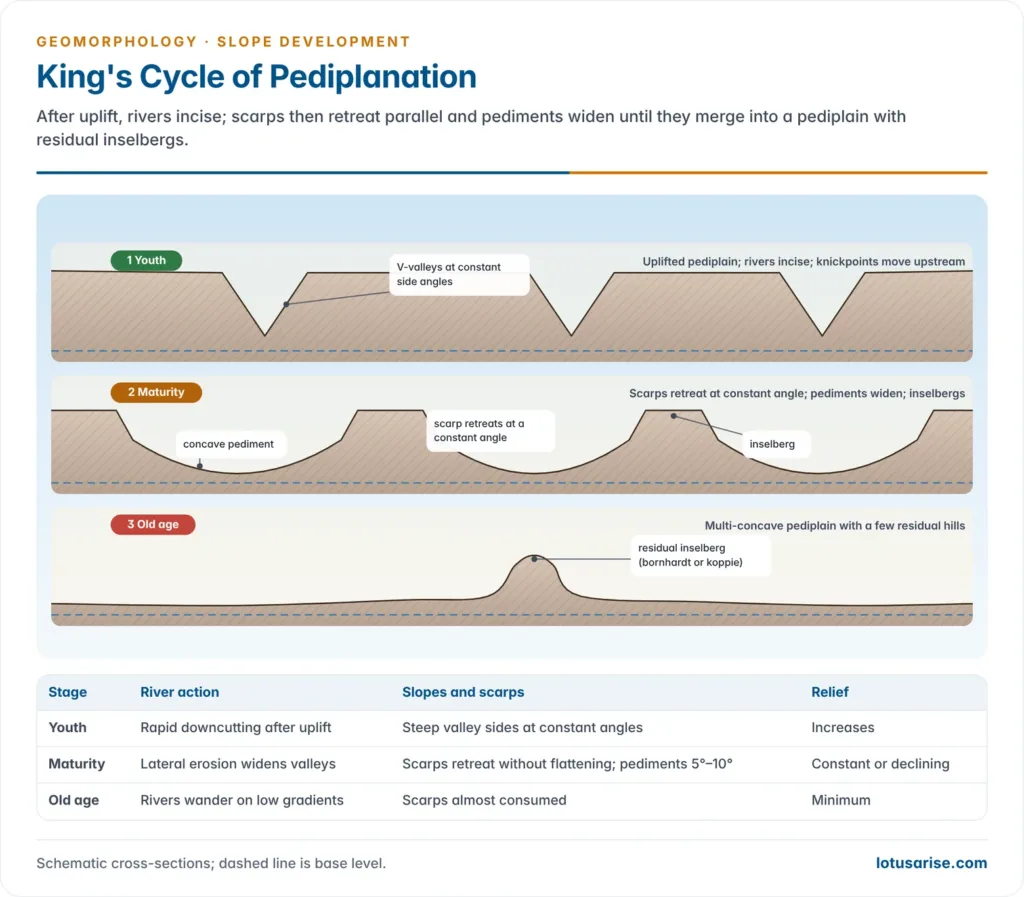
| Youth | Rapid downcutting after uplift; knickpoints migrate upstream | Steep valley sides at constant angles | Gorges, canyons; small pediments in valley bottoms by late youth | Increases |
| Maturity | Downcutting ends; lateral erosion widens valleys | Scarps retreat without flattening | Wide pediments (about 5°–10°); inselbergs fewer, many reduced to castle koppies | Constant or declining |
| Old age | Rivers wander across low gradients | Scarps almost consumed | Multi-concave pediplain with a few residual hills | Minimum |
- Youth: as incision slows, small pediments widen in valley floors, and by late youth most interfluves are narrowed into inselbergs, many rounded into bornhardts.
- Maturity: pediments of neighbouring valleys coalesce into a low, uneven plain of intersecting concave surfaces, still studded with remnant hills, which by old age becomes the multi-concave pediplain, the ultimate form of the cycle.
Headward Growth and Antique Pediplains
- A pediplain, once formed, keeps growing headward.
- Renewed uplift starts a new scarp at the outer edge of the old surface; its retreat consumes the older pediplain and leaves a younger, lower pediplain behind it.
- Repeated cycles build a staircase of intersecting pediplains, much like the piedmont steps of the Penck model.
- Antique pediplanation: because scarps retreat instead of wearing down, very old surfaces can survive on summits, especially on resistant rocks.
- King placed his highest remnants before the break-up of Gondwana and correlated surfaces across Africa, South America and Australia.
| King’s surface | King’s age | Relative position |
|---|---|---|
| Gondwana | Jurassic | Highest summit remnants, older than continental break-up |
| Post-Gondwana | Cretaceous | Below the Gondwana remnants |
| African | Late Cretaceous to mid-Tertiary | Most extensive surface of the continent |
| Post-African I | Miocene | Cut below the African surface |
| Post-African II | Pliocene | Lowest and youngest |
Evaluation
King, Davis and Penck Compared
- Common ground with Davis: King’s frame stands closer to Davis than to Penck: episodic uplift then long stability, three completed stages and an old, extensive final surface of subdued relief.
| Basis | Davis | Penck | King |
|---|---|---|---|
| Tectonics | Rapid uplift, then stillstand | Continuous, varying uplift | Rapid episodic uplift, then stillstand |
| Slope process | Downwasting; slope decline | Slope replacement from below | Backwasting; parallel retreat |
| “Normal” climate | Humid temperate | No climatic norm | Semi-arid and savanna |
| Final surface | Peneplain (convexo-concave) | Endrumpf | Pediplain (multi-concave) |
| After formation | Static until re-uplift | Evolves with uplift rate | Keeps growing headward |
| Residual hills | Monadnocks | Inselbergs | Inselbergs, bornhardts, castle koppies |
Criticism
- Generalised from one region: a model built in Africa was extended to very different climates, and uniform development in all environments is doubtful.
- No measurement: Anthony Young (1972) noted that King’s work contains no measurement of process or form.
- Evidence was chosen to fit preconceived views, and contrary cases were set aside as “not normal”.
- His hydraulic argument, that turbulent flow on the upper slope gives way to laminar sheet flow on the pediment, was never tested; the model is best read as a set of hypotheses.
- Largely deductive: much of the hillslope model repackages Wood, Fair, Penck and Horton.
- Antique pediplains are questionable because of the enormous time spans involved and poor knowledge of erosion rates in subhumid lands.
- Parallel retreat is not universal: R. A. Savigear (1952) showed on the coast of South Wales that parallel retreat and slope decline can operate side by side, depending on whether debris is removed from the slope foot.
Current View
- C. R. Twidale (2003), reviewing the “Canons” fifty years on, found scarp recession and the great age of some surfaces still valid.
- What has not survived is his downgrading of structure (rock type and jointing) and his necessary link between scarp retreat and pedimentation; pediments can form without retreating scarps.
- Etch (two-stage) origin: many inselbergs and planation surfaces are now explained by deep weathering followed by stripping of the weathered mantle (John Downie Falconer, 1911; Julius Büdel‘s etchplain).
- Dating evidence (cosmogenic nuclides; Paul Bierman and colleagues, 2014): southern Africa’s Great Escarpment retreated fast soon after Gondwana break-up and has since been nearly stable, which supports the survival of old surfaces but not steady scarp retreat.
- Kevin Burke and Yanni Gunnell (2008) read King’s separate African surfaces as one composite erosion surface made largely of etchplains, formed about 70–40 million years ago and later warped to different heights.
- King’s legacy is to have made planation surfaces, escarpments and inselbergs central to geomorphology.
Relevance to Peninsular India
- Vindhyan scarps (Kaimur, Rohtas, Rewa and Bhander plateaus): bold escarpments of massive, well-jointed sandstone over shales show all four slope elements.
- The sandstone free face retreats parallel, leaving capped mesas and buttes (Satna, Madhya Pradesh); where the cap is gone, hills turn to slope decline.
- Chotanagpur plateau: stepped surfaces from the high pat lands to the Ranchi surface are separated by scarps with waterfalls such as Hundru and Dasam, a staircase of planation cycles.
- The granite-gneiss inselbergs and tors around Ranchi resemble bornhardts and castle koppies.
- Other examples: granite inselbergs of Bundelkhand and Hampi, and the Western Ghats, a rift-margin great escarpment that has retreated landward since India separated from Madagascar and the Seychelles.
Previous Year Questions
2016“In explaining the concept of ‘Pediplanation’, King combined the ideas of Davis, Penck and Wood with his own.” Elaborate.2009Discuss views on slope development provided by L.C. King.





Very good notes , is this notes specifically created by you..? Any source coaching or book used for these notes ?.
Your explanation on Kings theory leans so much on Davis cycle of erosion to the effect that differences between the two theories are not clear