

“In explaining the concept of ‘Pediplanation’, King combined the ideas of Davis, Penck and Wood with his own.” Elaborate. (2016)
- Lester Charles King, working on the semi-arid and savanna landscapes of southern Africa, set out the cycle of pediplanation, most fully in 1953, and later extended it to all continents.
- Pediplanation reduces a landmass by parallel retreat of scarps and the growth of pediments at their foot until pediments coalesce into a pediplain.
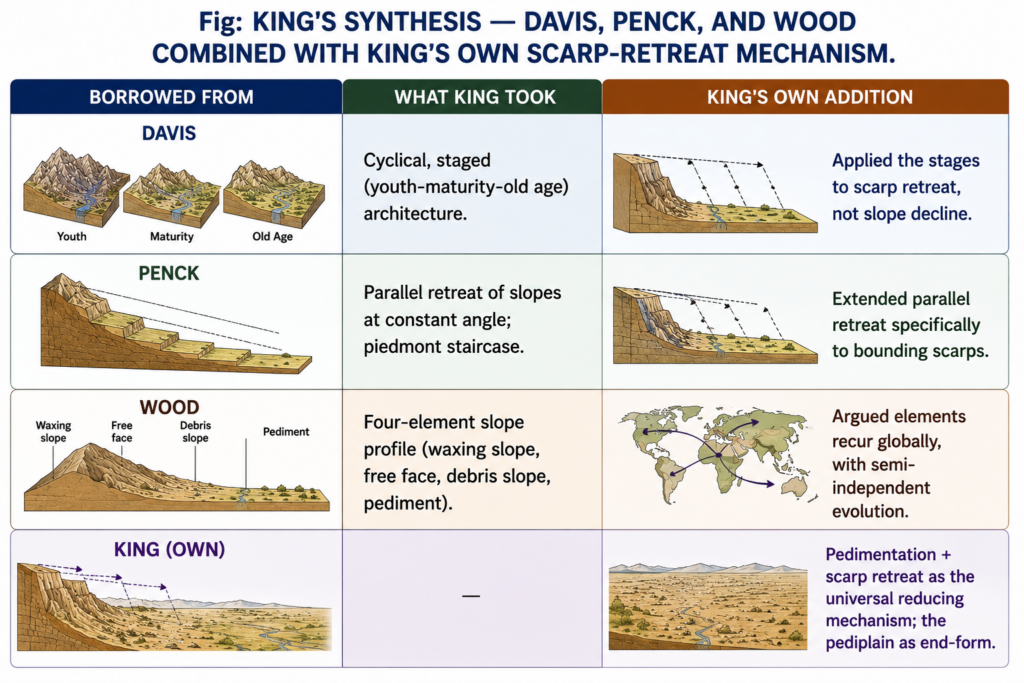
- The statement is accurate: Lester Charles King took the cyclic framework from William Morris Davis, the retreating-slope and stepped-surface ideas from Walther Penck, and the four-element hillslope from Alan Wood, and fused them with his own field evidence into a new, universal model.
The Inheritance from William Morris Davis
- A Davisian training: Lester Charles King studied in New Zealand under Sir Charles Andrew Cotton, a leading follower of William Morris Davis, so the cyclic habit of thought came first.
- The cycle itself: a short burst of rapid uplift followed by a long tectonic stillstand, during which the land passes through youth, maturity and old age to a low-relief end-plain — the pediplain standing where William Morris Davis placed the peneplain.
- Base level and rejuvenation: renewed uplift starts a new cycle, so landscapes are multicyclic; Lester Charles King’s stepped African surfaces are a Davisian idea in a new setting.
- The arid precedent: William Morris Davis’s arid cycle (1905), with its rock floors and inselbergs, and his later work on rock floors (pediments) in arid and humid climates (1930) had already placed pediments inside cyclic theory.
- What he rejected: the Davisian slope decline and the treatment of humid-temperate landscapes as the “normal” case; for him, semi-arid pedimentation was the norm.
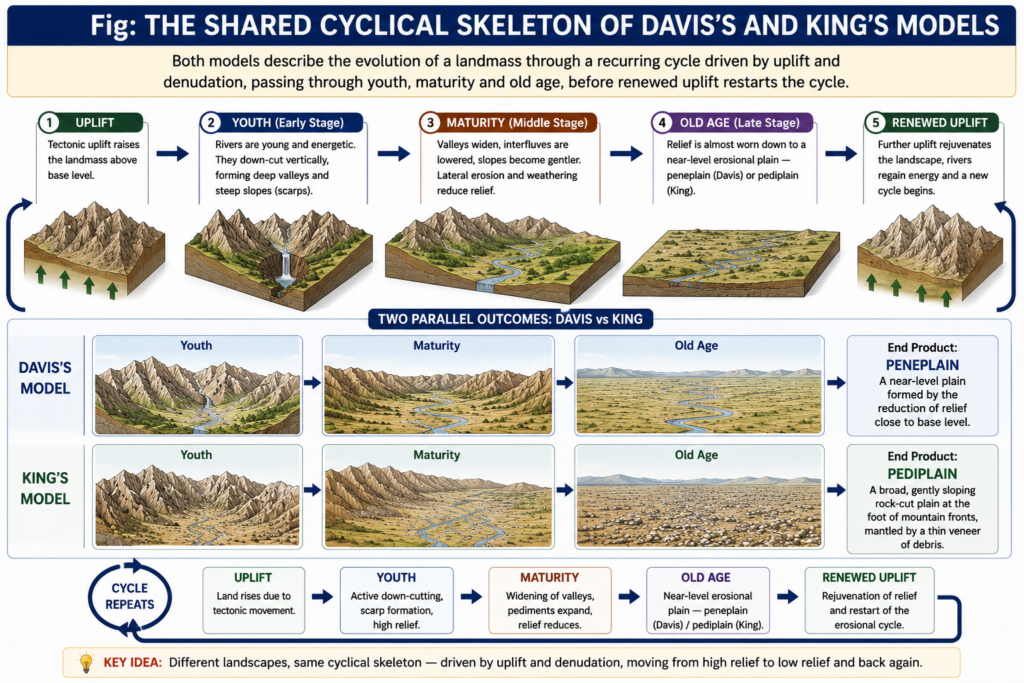
The Inheritance from Walther Penck
- Slopes retreat rather than decline: as Walther Penck’s work was then read in English, steep slopes retreat parallel to themselves while gentler basal slopes extend — the principle Lester Charles King applied to every escarpment. Later translations showed that Walther Penck himself described slope replacement from below, so the borrowing rested partly on a misreading.
- Piedmonttreppen: Walther Penck’s piedmont staircase of benches cut at the foot of a rising highland foreshadowed Lester Charles King’s stepped pediplains, each new surface eating headward into the one above.
- Residual hills: Walther Penck’s waning development ends in inselbergs that are finally consumed into the Endrumpf — matching Lester Charles King’s inselberg-studded pediplain.
- What he rejected: the Penckian continuous, accelerating uplift; he kept the Davisian episodic uplift, which is why his model ends up closer to the Davisian than to the Penckian scheme.
The Inheritance from Alan Wood
- Alan Wood (1942) divided a fully developed hillslope into four elements: the waxing (convex) slope, the free face, the constant (debris) slope and the waning slope at the base.
- Alan Wood showed that where debris is removed from its foot, the free face retreats parallel to itself; where debris accumulates, it buries the face and the slope declines.
- Alan Wood’s waning slope thus became Lester Charles King’s pediment, the element that does the actual planing as it extends at the expense of the slopes above.
- Lester Charles King adopted this as his standard hillslope — crest, scarp, debris slope and pediment — and argued it occurs in every climate with enough relief and active running water; where relief or rock strength is low, scarp and debris slope vanish, leaving a convexo-concave form.
The Original Contribution of Lester Charles King
- Twin processes: scarp retreat by weathering, rockfall and gullying, and pedimentation by sheetflood and rillwash. Pediments of about 1.5°–7° are separated from scarps of 15°–30° by a sharp piedmont angle.
- The pediplain: coalescing pediments form a multi-concave surface dotted with inselbergs, bornhardts and castle koppies; once formed, a pediplain keeps extending headward as the next cycle’s scarp retreats into it.
- Antique, correlated surfaces: Lester Charles King held that pediplains on resistant rock survive for very long periods, identifying a Gondwana surface (Jurassic, before continental break-up) and an African surface (Cretaceous–mid-Tertiary), and correlating them across Africa, South America, India and Australia.
- Tectonic driver: each cycle began with a burst of cymatogeny — broad, episodic arching of the continent, aided by isostatic rise of the margins as eroded sediment was unloaded offshore — followed by long quiescence in which the pediplain formed.
How Well Has the Synthesis Lasted?
- Strengths: it explains the escarpment-and-plain scenery of the southern continents better than slope decline, and its insistence on parallel retreat is supported where resistant caprocks keep escarpments steep.
- Weaknesses: it generalises from Africa to all climates; it gives little role to deep chemical weathering, which Julius Büdel and others made central for the tropics; and its long-distance correlations rest on height and assumed age.
- Current test (2018): François Guillocheau, Brendan Simon, Guillaume Baby, Paul Bessin, Cécile Robin and Olivier Dauteuil found that African relief is built of both etchplains and pediplains, stepped by local uplift. They identified the African Surface (about 70–45 Ma) of Central Africa as a lateritic etchplain, not a pediplain, and showed that Central Africa’s present relief is younger than about 40–30 Ma and shaped by mantle-driven doming.
- Judgement: Lester Charles King’s pediplanation is a genuine synthesis — William Morris Davis’s cycle, Walther Penck’s retreating slopes and staircase, and Alan Wood’s slope elements, welded together by Lester Charles King’s own scarp-retreat and pedimentation mechanism. Modern dating vindicates his stepped surfaces and episodic uplift but rejects his claim that one process shaped every surface, which leaves pediplanation one major mechanism among several rather than a universal law.