

- Integrated rural development (IRD) starts from the premise that rural poverty is multidimensional. Low income, landlessness, poor health, illiteracy, weak infrastructure and social exclusion reinforce one another, so no single-sector programme can break the cycle.
- It calls for the synchronised delivery of services across agriculture, allied activities, infrastructure, credit, education and health, so that the complementarities between sectors are used. The aim is to raise the living standards of the rural poor and make their development self-sustaining.
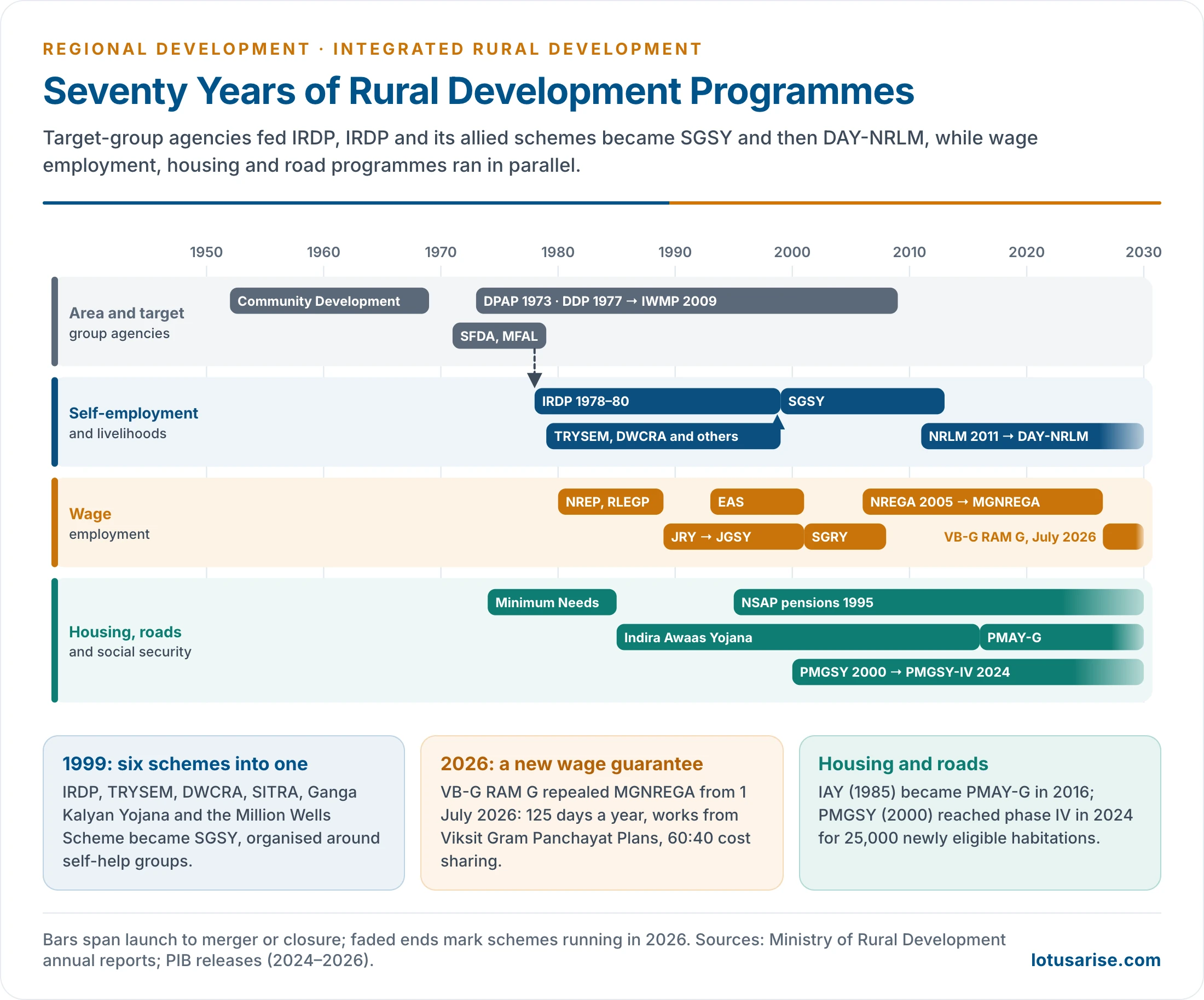
- In India the idea took programme form as the Integrated Rural Development Programme (IRDP, 1978–80). Its lineage runs through the Swarnjayanti Gram Swarozgar Yojana (SGSY, 1999) to the Deendayal Antyodaya Yojana–National Rural Livelihoods Mission (DAY-NRLM, 2011), alongside wage employment, housing and road programmes.
Concept of Integrated Rural Development

Meaning and Rationale
- IRD is a process as much as a programme: development of a rural area and its people in which economic growth, social services and institutions advance together.
- The approach grew out of the failures of earlier strategies:
- the Community Development Programme (1952) spread thin over every sector and every village, and its benefits were captured by the better-off;
- the Green Revolution of the mid-1960s raised output in irrigated regions but widened gaps between regions and between large and small farmers;
- the target-group programmes of the Fourth and Fifth Plans, such as the Small Farmers Development Agency (SFDA, 1971), the Marginal Farmers and Agricultural Labourers Agency (MFAL) and the Drought Prone Areas Programme (1973–74), ran in parallel with little coordination.
- IRD sits between the sectoral approach and the area approach. It is a form of the integrated area development and target-group strategies of regional development: plan for a defined area, but direct the benefits to identified poor households.
| Approach | Period | Unit of planning | Main idea | Limitation |
|---|---|---|---|---|
| Community development | 1952 onwards | Block of about 100 villages | All-round village uplift through extension | Benefits captured by landed elites |
| Sectoral (agricultural) | Mid-1960s | Irrigated districts | New seeds, fertiliser, credit in favoured areas | Widened regional and class gaps |
| Target group | Fourth and Fifth Plans | Small and marginal farmer households | Special agencies for the weaker sections | Many parallel agencies, little coordination |
| Special area | 1970s | Drought, desert, hill and tribal areas | Programmes fitted to the problem region | Thin funds, departmental works |
| Integrated rural development | 1978–80 onwards | Block, with household targets | Sector, space and poor households planned together | Delivery weaknesses, leakage |
| Livelihood and rights-based | 2005–11 onwards | Gram panchayat, women’s collectives | Legal guarantees and institutions of the poor | Uneven State capacity |
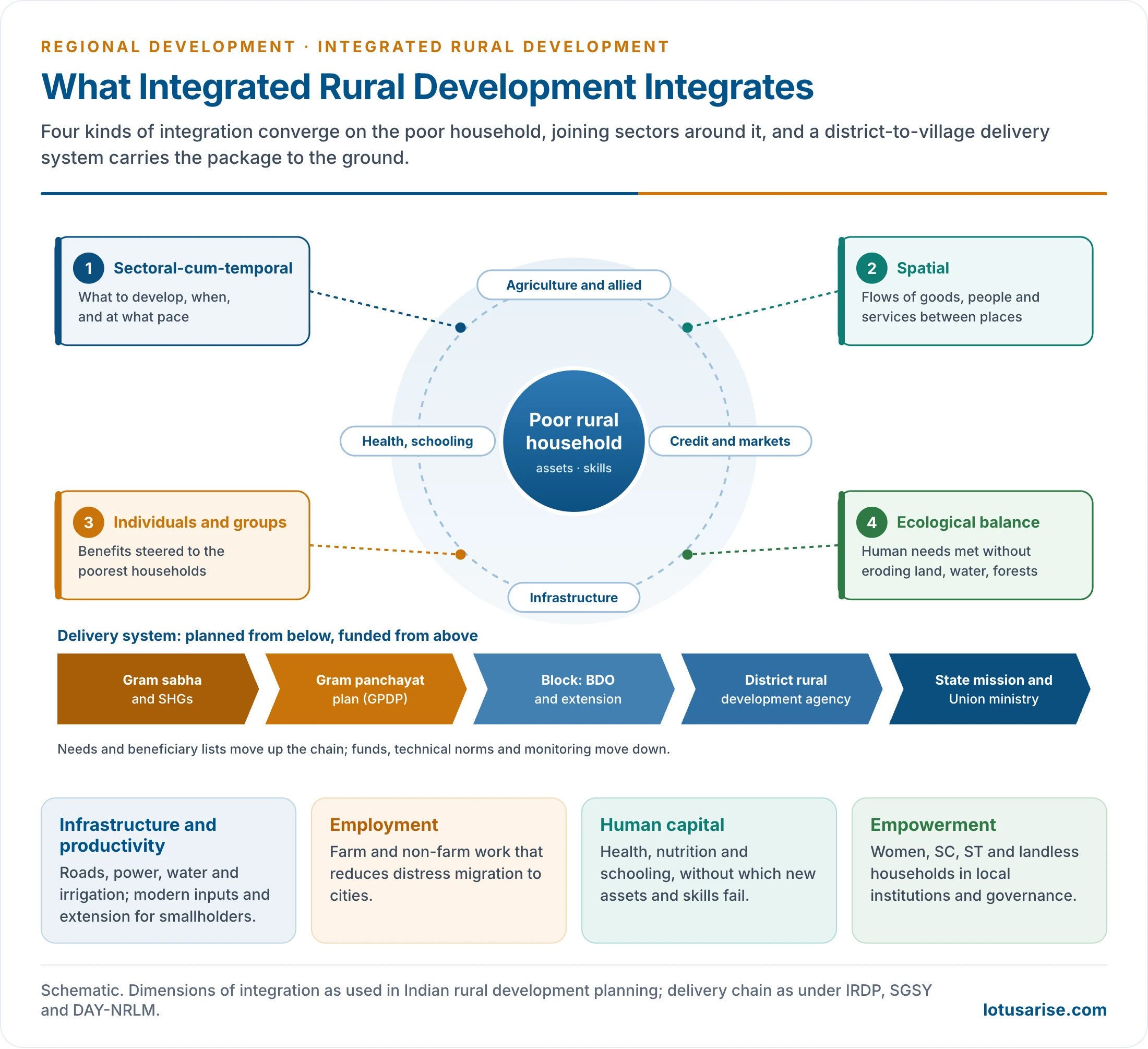
- The concept is hard to define precisely. Its meaning has changed over time, and it is never settled what should be integrated and how. Four aspects of integration are usually distinguished.
Dimensions of Integration
- Sectoral-cum-temporal integration: deciding which sectors (agriculture, education, health, industry) are to be developed, when, and at what pace and intensity, given the linkages between them.
- Irrigation must precede intensive cropping; credit and marketing must arrive with new assets, not years later.
- Spatial integration: linking places through the flows of raw materials, people, goods and services.
- Some areas supply raw materials, others are centres of processing and trade. A planned hierarchy of service centres and roads joins villages to market towns, the lower tiers of the growth foci that Indian planners proposed in the 1970s.
- Integration of individuals and groups: the fruits of development tend to concentrate in a few hands while the majority stay poor.
- IRD must steer benefits to the poorer sections, so that inter-personal disparities of income narrow.
- Integration of socio-economic and environmental goals: human resource needs (food, clothing, shelter, education, health and employment) must be met while resources, ecology and environment are kept healthy for future generations.
- About 37% of the population was below the poverty line on the older reckoning (37.2% on the Tendulkar line, 2004–05), and 21.9% in 2011–12.
- The national multidimensional poverty headcount was still 14.96% in 2019–21, and 19.28% in rural India (NITI Aayog National MPI 2023), so the human-development goal remains urgent.
| Dimension | Question it answers | Indian instrument |
|---|---|---|
| Sectoral-cum-temporal | What, when, how fast | Five-year district and block plans; convergence of line departments |
| Spatial | Where, and how places link | Growth points and service centres, PMGSY roads, rural clusters |
| Individuals and groups | Who benefits | BPL and SECC targeting, reservations for SC/ST, women, disabled |
| Socio-economic and environmental | At what ecological cost | Watershed development, natural resource works under wage programmes |
Core Objectives
- Rural development succeeds only when five interlinked objectives move together:
- Basic infrastructure: roads, electricity, drinking water and communication that connect remote villages to markets and services.
- Agricultural productivity: modern inputs, irrigation and extension for smallholders, for food security and income.
- Employment: farm and non-farm jobs that cut distress migration to cities.
- Health and education: human capital is a precondition; malnourished or unschooled workers cannot use new technology.
- Empowerment of marginalised groups: participation of women, Scheduled Castes, Scheduled Tribes and the landless in local institutions and governance.
Integrated Rural Development Programme (IRDP)
Origin
- IRDP was announced in the 1976–77 budget and tried in 20 selected districts.
- The Janata Government recast it in 1978–79. It was confined at first to 2,000 development blocks of the then 5,004, then widened to 2,300 blocks in 1978–79 and by 300 more in 1979–80.
- It brought together the methods of the running programmes: SFDA and MFAL, the Command Area Development Programme and DPAP.
- It was extended to all blocks of the country from 2 October 1980, at the start of the Sixth Plan (1980–85), which made it the main instrument of the direct attack on rural poverty.
- It was a centrally sponsored scheme, its cost shared 50:50 between the Centre and the States. Central funds went to States in proportion to their share of India’s rural poor.
Objectives and Target Group
- The main objective of integrated rural development is to eradicate poverty, hunger and unemployment from rural India. The National Common Minimum Programme of the Union Government restated the central place of villages in national development.
- IRDP was conceived as an anti-poverty, self-employment programme. Poor families would acquire productive assets, technology and skills through a mix of government subsidy and bank credit, and so rise above the poverty line.
- Assets included milch cattle, goats, bullock carts, pump sets, small shops and artisans’ tools.
- The target group was the below poverty line (BPL) household: small and marginal farmers, agricultural labourers, rural artisans, sharecroppers and SC/ST families.
- Selection was by family, not individual, starting with the poorest (“antyodaya”).
- By the Eighth Plan the income test was an annual family income below ₹11,000.
- At least 50% of assisted families were to be SC/ST, 40% of beneficiaries women and 3% persons with disabilities.
- First preference went to allottees of ceiling-surplus land and to green card holders under the bonded-labour and family welfare schemes.
- Women and persons with disabilities among SC/ST applicants received extra preference.
- Sectoral integration within the village: livestock and poultry, fishery, social forestry, and cottage and village industries to raise per capita income.
Planning Elements in the Sixth Plan
- A five-year development profile for each district, split into blocks, based on achievable potential in agriculture and allied sectors. It formed the framework of action for sectoral schemes.
- An operational programme by the extension agency to guide small and marginal farm families.
- A special programme for the poorest households, identified one by one, to lift them above the poverty line.
- A blueprint for the secondary and tertiary sectors in each block, with training and marketing linkages; target families were chosen against it.
- Assisted families were also to receive social services: health, education and housing.
Subsidy and Credit
| Beneficiary | Subsidy on project cost |
|---|---|
| Small farmers | 25% |
| Marginal farmers, agricultural labourers, rural artisans | 33.33% |
| SC/ST families and persons with disabilities | 50% |
- Subsidy ceilings: ₹4,000 per family in normal areas, ₹5,000 in DPAP and Desert Development Programme areas, and ₹6,000 for SC/ST families and persons with disabilities.
- The rest of the investment was a bank loan from commercial banks, cooperatives and regional rural banks.
Institutional Machinery
- District Rural Development Agencies (DRDAs): registered societies at district level that planned and monitored the programme.
- Their governing body included local MPs and MLAs, the chairman of the Zila Parishad, heads of district departments, bankers, and representatives of SC/ST communities and women.
- From 1 April 1999 DRDA administration had its own funding: 75:25 (Centre:State), 90:10 in the North-East, fully central in Union Territories.
- Block-level agencies: the Block Development Officer and extension staff identified families and prepared the block plan.
- State-level coordination committees supervised, and the Union Ministry of Rural Development framed policy and released funds.
- After the 73rd Amendment, panchayats took over the identification of beneficiaries through the gram sabha, a link to decentralised planning.
Allied Programmes
| Programme | Year | Purpose | Fate |
|---|---|---|---|
| Training of Rural Youth for Self-Employment (TRYSEM) | 15 August 1979 | Technical and entrepreneurial skills for BPL youth aged 18–35 | Merged into SGSY, 1999 |
| Development of Women and Children in Rural Areas (DWCRA) | 1982–83 | Groups of 10–15 poor women for income generation and services | Merged into SGSY, 1999 |
| Indira Awaas Yojana (IAY) | 1985 | Houses for rural SC/ST and BPL families | Restructured as PMAY-G, 2016 |
| Million Wells Scheme (MWS) | 1988–89 | Open irrigation wells for small and marginal farmers | Merged into SGSY, 1999 |
| Supply of Improved Toolkits to Rural Artisans (SITRA) | 1992 | Modern tools for artisans | Merged into SGSY, 1999 |
| Ganga Kalyan Yojana (GKY) | 1997 | Groundwater irrigation through wells and tube-wells | Merged into SGSY, 1999 |
- Detail of the allied schemes:
- TRYSEM: an integral part of IRDP. One member per family, from families earning under ₹3,500 a year, the poorest first, with preference to SC/ST, ex-servicemen and those who had finished nine months of adult education.
- DWCRA: cost shared equally by the Centre, the State and UNICEF; it also gave women’s health, education, child care and nutrition support.
- IAY: began in 1985 as a sub-scheme of the wage programmes. Funding was 75:25 (90:10 in the North-East, fully central in UTs), with about 3% for disabled BPL households; benefits were extended in 1995–96 to war widows and retired military and para-military personnel.
- Assistance from 1 April 2010 was ₹45,000 a unit in the plains and ₹48,500 in hilly or difficult areas, and ₹15,000 to upgrade a kutcha house.
- In 2010–11, 14.57 lakh houses were built against a target of 29.69 lakh. About 286.88 lakh had been built since inception.
- Million Wells Scheme: a sub-programme first of NREP and RLEGP, then of the Jawahar Rozgar Yojana (1 April 1989 to 31 December 1995), and independent from 1 January 1996. It served BPL small and marginal farmers and freed bonded labourers; non-SC/ST poor were admitted in 1993–94, and 3% was kept for the disabled. Panchayats drew up the beneficiary lists.
- SITRA: about 7.46 lakh tool kits went to artisans between 1992–93 and 1997–98.
- Ganga Kalyan Yojana: from 1 February 1997, funded 80:20 (Centre:State), for BPL farmers and groups of farmers.
- Council for Advancement of People’s Action and Rural Technology (CAPART): set up on 1 September 1986 as an autonomous body under the Ministry of Rural Development. It funds voluntary organisations, promotes community participation and spreads rural technology among SC, ST, OBC and other poor households.
- A parallel wage-employment track ran beside IRDP:
- National Rural Employment Programme (NREP, 1980) and Rural Landless Employment Guarantee Programme (RLEGP, 1983), merged into the Jawahar Rozgar Yojana (April 1989), funded 80:20 with 22.5% of the allocation for SC/ST;
- the Employment Assurance Scheme (2 October 1993, in selected blocks, for the lean farm season) and Sampoorna Grameen Rozgar Yojana (2001), absorbed by the national employment guarantee in 2006–08.
- The Minimum Needs Programme (Fifth Plan) supplied the social infrastructure: drinking water, rural roads, elementary education, health and housing sites.
Evaluation of IRDP
- Achievements:
- it was the first nationwide, household-targeted anti-poverty programme, covering every block;
- it reached millions of poor families; in the Eighth Plan alone about 108 lakh families were assisted;
- it built a delivery system (DRDA, block, bank) on which later programmes stood.
- Weaknesses found by concurrent evaluations, the Reserve Bank and the Planning Commission:
- wrong selection: many beneficiaries were not poor, while the poorest were left out;
- leakages and corruption in subsidy and in the purchase of assets;
- sub-critical investment: a single dose of credit bought assets too small to yield a viable income;
- poor asset quality and survival: animals died or were sold, and many assets did not generate income;
- target-chasing: the number of families covered mattered more than families that crossed the poverty line;
- missing backward and forward linkages: no markets, veterinary care, raw material or training to support the asset;
- low loan recovery, which made banks reluctant;
- multiplicity of schemes with little coordination and no group mobilisation of the poor.
- Regional pattern: absorption was better where banks, roads, markets and literacy were already stronger, as in the southern and western States. Poorer States with weak banking, such as Bihar and eastern Uttar Pradesh, drew less credit per family, so a programme meant for the poor favoured the less poor regions.
- The Hashim Committee (1997), which reviewed rural poverty programmes, recommended restructuring. The self-employment schemes were merged on 1 April 1999.
From IRDP to Livelihood Missions
Swarnjayanti Gram Swarozgar Yojana (1999–2013)
- SGSY, launched on 1 April 1999, merged IRDP, TRYSEM, DWCRA, SITRA, GKY and the Million Wells Scheme into one self-employment programme. Funding was 75:25 (Centre:State), 90:10 for the North-East.
- Shift from individuals to groups: the poor were organised into Self-Help Groups (SHGs). Each assisted family (a swarozgari) received credit, training, technology, infrastructure and marketing support as one package.
- Features:
- key activities chosen for each block, with activity clusters for linkages;
- revolving fund assistance to SHGs and a credit-linked subsidy;
- 20% of funds for infrastructure and 15% for special projects;
- safeguards of 50% for SC/ST, 40% for women, 15% for minorities, 3% for the disabled.
- Goal: lift every assisted family above the poverty line within three years, with a net monthly income of about ₹2,000.
- It was implemented through DRDAs and Panchayat Samitis, with banks and NGOs.
- An early count put over six lakh swarozgaris assisted: 30% SC/ST, 33% women and 1% disabled.
- By 2009–10 about 36.8 lakh SHGs had been formed, though only 8.4 lakh had taken up an economic activity. By March 2012 the counts were 43.34 lakh and 14.46 lakh.
- Limits: weak capacity building, uneven bank credit, subsidy dependence and no dedicated support structure for the poor’s own institutions.
Deendayal Antyodaya Yojana–National Rural Livelihoods Mission (2011)
- The National Rural Livelihoods Mission (NRLM) was launched in June 2011 by restructuring SGSY, which it fully replaced from 1 April 2013. It was renamed DAY-NRLM in 2015–16. It was supported by a World Bank credit.
- Approach: demand-driven; States frame their own livelihood-based poverty reduction plans through State Rural Livelihood Missions.
- Its design drew on two State experiments:
- Kudumbashree (Kerala, 1998), a State poverty eradication mission built on neighbourhood groups of women linked to the panchayats;
- Andhra Pradesh’s Society for Elimination of Rural Poverty (2000), which federated SHGs into village and mandal bodies run by trained community resource persons.
- Institutional architecture of the poor:
- SHGs of 10–20 women;
- Village Organisations federating SHGs;
- Cluster Level Federations at the cluster level.
- Four core components:
- social mobilisation and strong, self-managed institutions;
- financial inclusion: revolving and community investment funds, bank linkage, Bank Sakhis and BC Sakhis;
- sustainable livelihoods: farm (Mahila Kisan Sashaktikaran Pariyojana), non-farm enterprises and skills;
- social inclusion and convergence with other schemes.
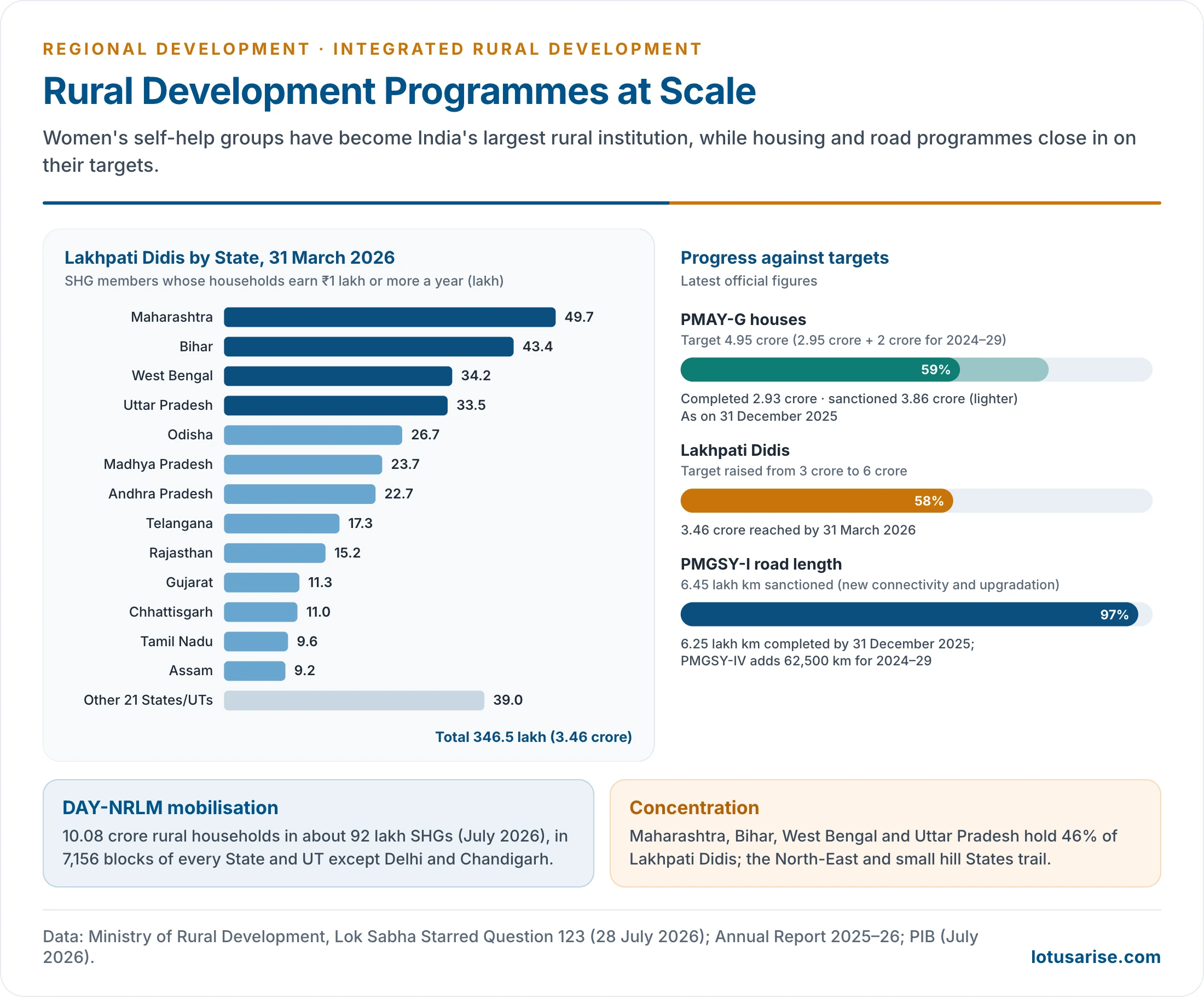
- Scale (July 2026): about 10.08 crore rural households mobilised into about 92 lakh SHGs. SHGs have accessed over ₹11 lakh crore of bank credit since 2013–14.
- Lakhpati Didi initiative: SHG members whose households earn at least ₹1 lakh a year sustained over four seasons or business cycles.
- 3.46 crore members had reached this level by 31 March 2026, against a target revised from 3 crore to 6 crore.
- Skills:
- Deen Dayal Upadhyaya Grameen Kaushalya Yojana (DDU-GKY, 25 September 2014) gives placement-linked training to rural youth, to diversify the incomes of poor rural families and meet the career aspirations of the young;
- Rural Self Employment Training Institutes (RSETIs) train youth for self-employment.
| Basis | IRDP (1978–80) | SGSY (1999) | DAY-NRLM (2011) |
|---|---|---|---|
| Unit of support | Individual family | SHG and individual swarozgari | Institutions of the poor: SHG, VO, CLF |
| Main instrument | Subsidy + one-time bank loan | Revolving fund, credit-linked subsidy | Community funds, repeated bank linkage |
| Approach | Supply-driven targets | Key activities and clusters | Demand-driven, State mission plans |
| Role of women | 40% of beneficiaries | 50% of groups to be women’s | Women-only SHGs, universal coverage of poor households |
| Support structure | DRDA, block staff | DRDA, banks, NGOs | Dedicated State and district mission staff, community cadres |
| Main weakness | Leakage, unviable assets | Weak groups, subsidy dependence | Uneven enterprise income, credit concentration in southern States |
The Wider Rural Development Package
Wage Employment: From MGNREGA to VB-G RAM G
- The National Rural Employment Guarantee Act was passed on 7 September 2005 and renamed after Mahatma Gandhi in 2009. It applied from February 2006 in 200 districts, from 2007–08 in 130 more, and in every rural district from 1 April 2008.
- It guaranteed 100 days of unskilled manual work a year to every rural household that asked for it. The Centre paid all unskilled wages.
- It became the largest rural safety net and a major builder of water and land assets.
- In its last year, 2025–26 (to 2 December 2025), it gave work to 4.65 crore households and generated about 162 crore person-days. Women did 56.7% of the work and SC/ST workers 36.4%.
- Its weaknesses were delayed wage payments, low average days per household (well below 100), uneven demand across States and poor quality of some assets.
- Viksit Bharat–Guarantee for Rozgar and Ajeevika Mission (Gramin) Act, 2025 (VB-G RAM G): passed by Parliament in December 2025 (assent 20 December 2025). It repealed MGNREGA and came into force across rural India on 1 July 2026.
- It guarantees 125 days of wage employment a year to every rural household that volunteers for unskilled manual work, with unemployment allowance and compensation for delayed wages.
- States notify a 60-day pause in a year, covering peak sowing and harvesting, when no works run.
- Works must come from Viksit Gram Panchayat Plans prepared by gram panchayats, aggregated into a national rural infrastructure stack. Four domains: water security, core rural infrastructure, livelihood infrastructure, and works against extreme weather.
- Funding: a centrally sponsored scheme with normative State allocations, shared 60:40 (Centre:State), 90:10 for the North-Eastern and Himalayan States, and fully central for UTs without a legislature. States bear any spending above their allocation.
- Debate: supporters see more days and planned, durable assets. Critics point to the shift of cost and risk to poorer States and a capped allocation in place of an open-ended, demand-driven right.
Housing, Roads and Social Assistance
| Scheme | Launch | Ministry | Present status (latest official data) |
|---|---|---|---|
| Pradhan Mantri Awaas Yojana–Gramin (PMAY-G) | 1 April 2016 (from IAY) | Rural Development | Rural arm of Housing for All: affordable, safe pucca houses for BPL rural households, first by 2022. Target raised from 2.95 crore to 4.95 crore houses (2 crore added for 2024–29); 3.86 crore sanctioned, 2.93 crore completed (December 2025) |
| Pradhan Mantri Gram Sadak Yojana (PMGSY) | 25 December 2000 | Rural Development | All-weather access to unconnected habitations, run with State governments. 7.88 lakh km of rural roads built; PMGSY-IV (September 2024) to link 25,000 habitations by 62,500 km in 2024–29 |
| National Social Assistance Programme (NSAP) | 15 August 1995 | Rural Development | Pensions for BPL elderly, widows and persons with disabilities, and family benefit; about 3 crore beneficiaries (about 2.2 crore elderly, 80 lakh widows, 10 lakh disabled). At its start: ₹75 a month at age 65 and above, ₹5,000 family benefit on natural death and ₹10,000 on accidental death, and maternity benefit for the first two births to BPL women above 19 |
| DDU-GKY | 2014 | Rural Development | Placement-linked skilling under DAY-NRLM; over 17 lakh trained, 11 lakh placed (2025) |
| Shyama Prasad Mukherji Rurban Mission | 2016 | Rural Development | Integrated, project-based infrastructure with economic activity and skills in 300 rural clusters as growth centres; central funding ended in March 2023 |
- Rural sanitation: the Central Rural Sanitation Programme (1986) followed the water decade of the 1980s. It became the Total Sanitation Campaign (1999), Nirmal Bharat Abhiyan (2012) and Swachh Bharat Mission–Gramin (2014).
- Aims: raise rural quality of life, speed up coverage, create demand through awareness and health education, and cover schools and anganwadis.
- Methods: low-cost technology, ending open defecation, converting dry latrines to pour-flush and eliminating manual scavenging.
- PURA and viable village complexes: the idea of Provision of Urban Amenities in Rural Areas (PURA), put forward by A. P. J. Abdul Kalam in his Vision 2020, was to group villages into a viable complex joined by roads, power, telecom and knowledge connectivity, with a market town as its core.
- PURA ran as pilots from 2004 and in a public-private mode from 2012. Its cluster idea passed to the Rurban Mission.
- It is the spatial integration of IRD in action: the cluster gives the threshold population that a school, hospital or market needs.
Evaluation and Way Forward
Achievements
- Rural poverty has fallen sharply. The rural multidimensional poverty headcount fell from 32.59% in 2015–16 to 19.28% in 2019–21 (National MPI 2023).
- Women’s collectives now reach most poor rural households. They have become channels for credit, insurance, nutrition, sanitation and local governance.
- Physical integration: all-weather roads, pucca houses, electricity and piped water have linked villages to markets and services.
- The delivery system has moved from DRDA files to digital platforms: geo-tagging, direct benefit transfer and dashboards.
Persistent Gaps
- Regional unevenness: SHG bank credit is concentrated in the southern States, and four States (Maharashtra, Bihar, West Bengal and Uttar Pradesh) hold over 45% of all Lakhpati Didis, while the hill and North-Eastern States lag.
- Sectoral silos: each ministry still runs its own scheme with its own plan, staff and portal. Integration happens on paper more than on the ground.
- Weak non-farm diversification: most enterprises are small, low-return and local, and agricultural distress still drives migration.
- Asset quality and maintenance of works built under wage programmes.
- Limited role of panchayats in actual allocation, despite the rhetoric of bottom-up planning.
Way Forward
- Area plus household: plan at the cluster or block scale for infrastructure and markets, and target households for assets and skills.
- Convergence through one local plan: the Gram Panchayat Development Plan and the Viksit Gram Panchayat Plan as the single frame for wage works, housing, roads, water and livelihoods.
- Natural resource base: link wage works and livelihoods to watershed management and to irrigation and command area development, so that assets raise farm incomes.
- Enterprise and market linkages: producer groups, FPOs, e-commerce and value chains for SHG products.
- Outcome monitoring: measure incomes, assets and multidimensional poverty, not funds spent and houses counted.
Previous Year Questions
2013Discuss the objective of ‘Vision 2020’ in creation of viable village complex in India for ‘Inclusive Rural Development’ programme.2007Discuss the policies and programmes of Integrated Rural Development Programmes in India.1990What is meant by integrated rural development planning? What are its components? What has been the extent of its success in relation to its objectives.



Thank you for such a quality content