

- An industrial region is an area where manufacturing concentrates because geographical, economic and political conditions favour it.
- Industries cluster in a few selected regions that offer multiple locational advantages at once.
- Industrial regions are unevenly distributed across the world, because the localisation of industry depends on resources, markets and supporting infrastructure.
- The factors behind concentration in a region include:
- the nature and size of the market;
- labour availability, usually where the working population is large;
- the cost and availability of land;
- proximity to raw materials and energy;
- a dense transport and communication network, with access to water bodies;
- banking, credit and capital;
- favourable terrain and climate.
- The map of industrial regions has changed over two centuries:
- from coalfield regions of the North Atlantic;
- to the East Asian manufacturing core;
- and now to new regions shaped by global value chains, technology and policy.
Evolution of Industrial Regions

From Cottage Industry to the Industrial Revolution
- Cottage industries were the first form of manufacturing: households and artisans produced goods at a small scale for local markets.
- The Industrial Revolution marked a major shift to:
- mass production in factories;
- economies of scale, which reduced the average cost of production;
- profit maximisation through rising output.
- It began in northern England in the 18th century.
- Manchester’s cotton mills drew on the port of Liverpool, which imported raw cotton from America and India.
- Early factories sat on or near coalfields for steam power. They were linked to ports by rivers and canals.
- Britain’s industrial regions (Lancashire, Yorkshire, the Midlands, the North-East, Clydeside, South Wales) became densely populated and urbanised around the coal belts.
- Railways and the steamship in the 19th century cut transport costs and widened markets. This underpinned Britain’s global industrial dominance.
Diffusion to Secondary Hearths
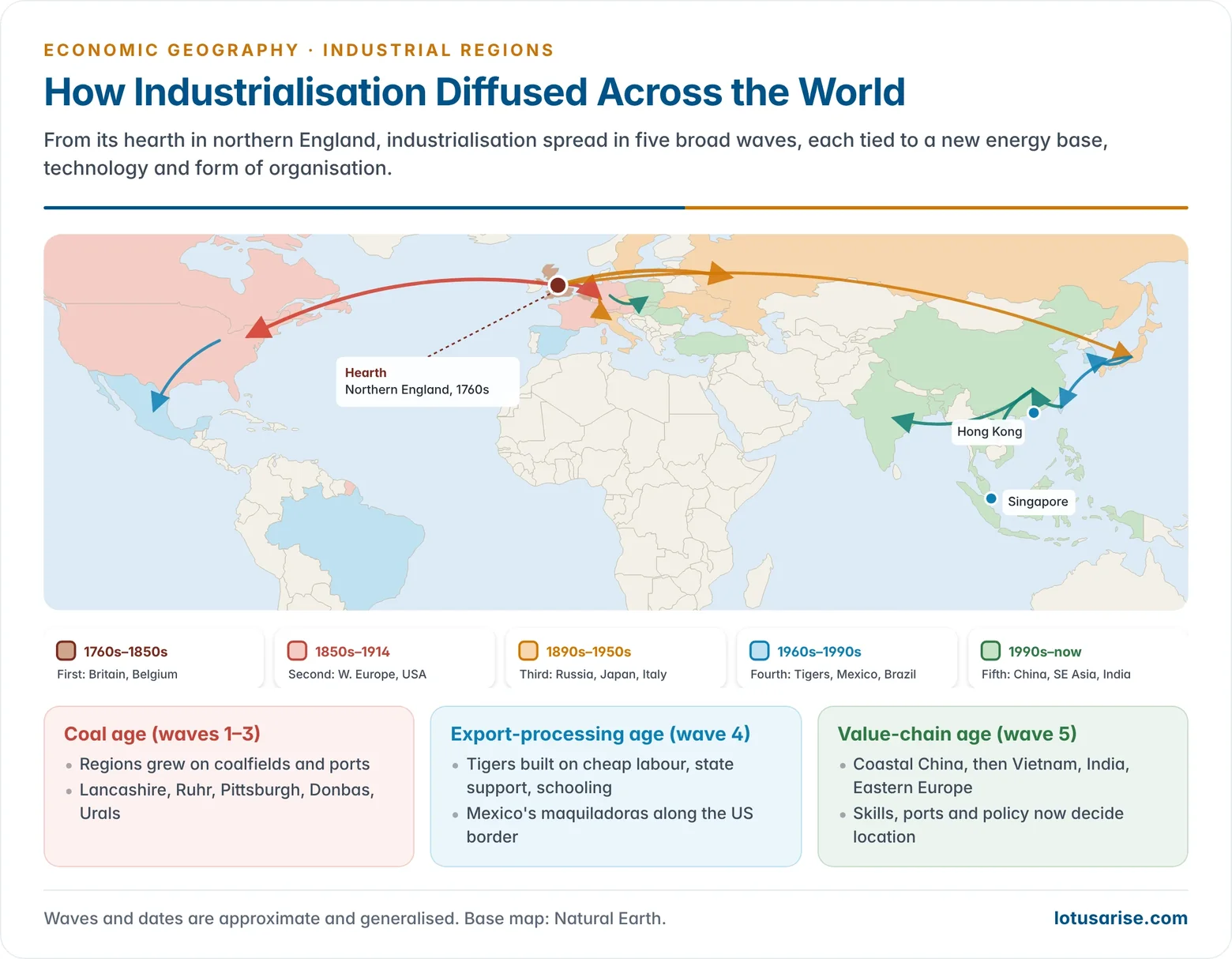
- Industrialisation spread from Britain to continental Europe, then to North America, Russia–Ukraine and Japan.
- These secondary hearths shared three features:
- proximity to coal, the dominant energy source of the time;
- access to ports by railway or waterway;
- capital from European investors and local merchants.
| Wave | Period | Hearths | Typical base |
|---|---|---|---|
| First | 1760s–1850s | Northern England, Scotland, Belgium | Coal, iron, cotton, steam |
| Second | 1850s–1914 | Rhine–Ruhr, northern France, north-eastern USA, Great Lakes | Coal–steel, railways, chemicals, electricity |
| Third | 1890s–1950s | Russia (Moscow, Urals, Donbas), Japan, northern Italy | State-led heavy industry |
| Fourth | 1960s–1990s | Four Asian Tigers, Mexico, Brazil | Export processing, electronics, cars |
| Fifth | 1990s–present | Coastal China, then Southeast Asia, India, Eastern Europe | Global value chains, digital and green industries |
- Over time these regions became vital nodes of the global economy. They shaped patterns of urbanisation, migration and resource use.
From Fordism to Post-Fordism
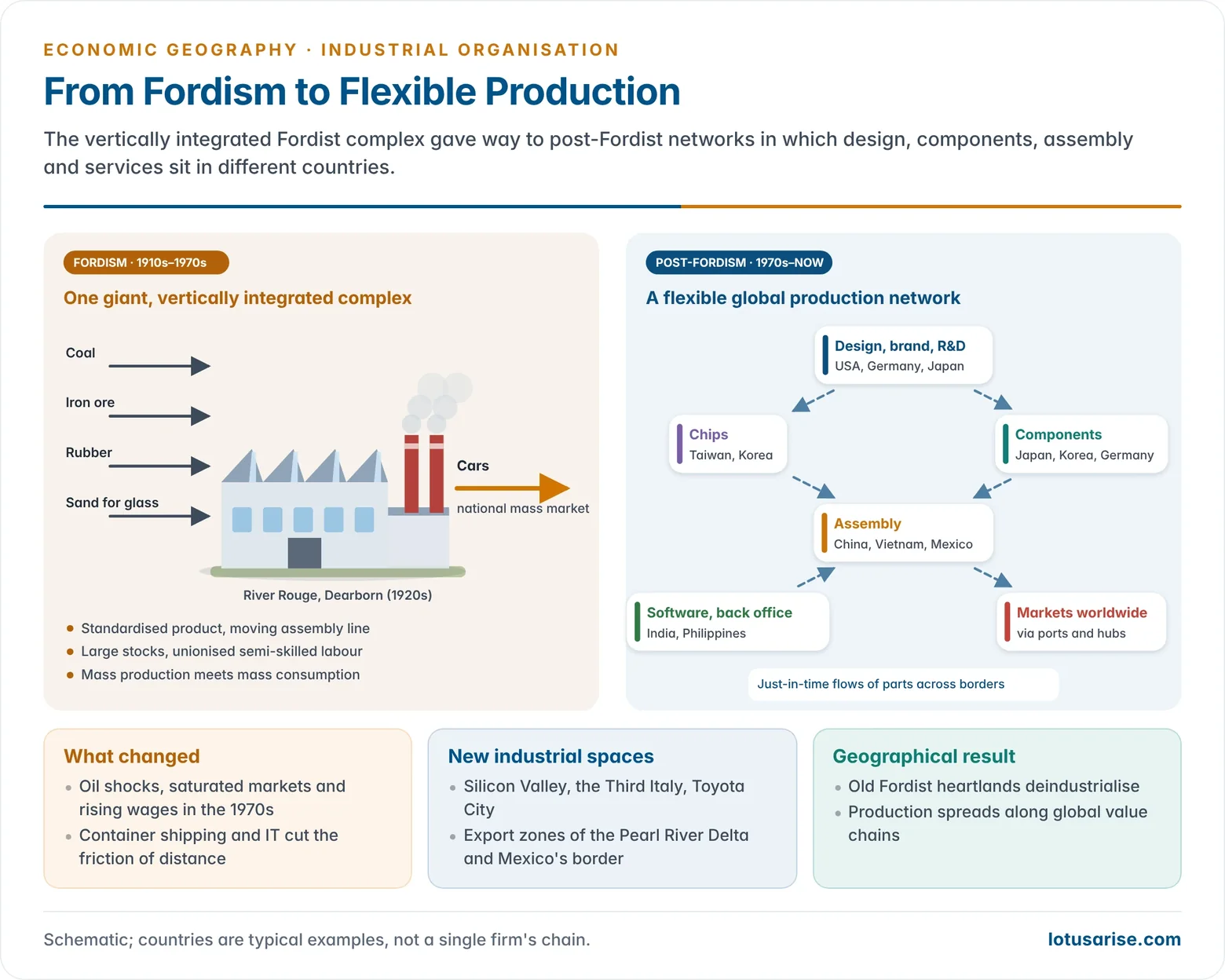
- Fordism is named after Henry Ford, whose moving assembly line at Highland Park, Detroit (1913) defined 20th-century manufacturing.
- Assembly-line techniques sharply cut labour time and cost.
- Standardised mass production made goods cheap enough for ordinary consumers.
- Vertical integration: coal, rubber, glass and steel were processed inside huge, centralised complexes such as Ford’s River Rouge.
- Relatively high wages and leisure time turned workers into consumers. The result was a circle of mass production and mass consumption.
- Fordist regions were large, centralised and unionised. Examples are Detroit, the Ruhr, Turin and the Midlands.
- From the 1970s, rising costs, oil shocks, saturated markets and cheaper transport undermined the centralised model. This led to post-Fordism, or flexible production:
- Fragmented production: parts are made in many places.
- Just-in-time assembly, pioneered by Toyota.
- Small batches, customised to demand.
- Networks of suppliers and subcontractors, with contractual, part-time and outsourced work.
- Technologies: automation and robotics in production; computer-based management in transactions; satellites and the internet in circulation.
| Aspect | Fordism | Post-Fordism (flexible production) |
|---|---|---|
| Production | Standardised mass production | Flexible, small-batch, customised |
| Organisation | Vertically integrated giant plant | Networks of suppliers, outsourcing |
| Inventory | Large stocks (“just-in-case”) | Just-in-time |
| Labour | Semi-skilled, unionised, long-term jobs | Multi-skilled core plus flexible, contract labour |
| Geography | Concentrated industrial heartlands | Dispersed global production, new industrial spaces |
| Examples | Detroit, Ruhr, Turin | Toyota City, Silicon Valley, Third Italy, Shenzhen |
- Flexible production regions emerged:
- new industrial spaces such as Silicon Valley and Route 128;
- the Third Italy (Emilia-Romagna’s small-firm craft districts);
- science parks such as Hsinchu and Bengaluru.
Globalisation and the Shifting Location of Industry
- Globalisation is the rapid, largely unrestricted flow of information, goods, capital, services, ideas and people. It has produced a more integrated world economy than ever before.
- It works through economic, political and cultural dimensions. A change in one induces changes in the others.
- Trade is its backbone. Local self-sufficiency gives way to global interdependence.
- By the 1980s, industrial restructuring was under way. Industrial investment was redistributed globally as the friction of distance fell, thanks to:
- container shipping (from 1956) and air freight;
- satellites and the internet.
- Deindustrialisation and reindustrialisation were two outcomes:
- Deindustrialisation is the decline of manufacturing employment in old regions, often with job losses and urban decay, part of the wider global shift in manufacturing.
- Reindustrialisation is the growth of new industrial activity in regions that had lost their traditional base. It can come through high-tech start-ups, services that support industry, or new plants on brownfield land.
- The service sector grew rapidly after the Second World War, alongside manufacturing.
- Outsourcing hires outside firms for work once done in-house.
- Offshoring moves production or services to another country.
- Business process outsourcing (BPO) moved back-office functions, such as customer support, accounting and data processing, to India and the Philippines.
- Value chains: a classic example is the Barbie doll:
- plastics and hair come from Taiwan and Japan;
- assembly is in the Philippines, Indonesia and China;
- moulds, design and marketing come from the United States.
- Transnational corporations (TNCs) run these networks of branch plants, suppliers and logistics hubs.
- Foreign direct investment (FDI) builds or buys factories, warehouses and research centres abroad.
- FDI is geographically uneven. Developed economies remain the main sources, while developing Asia is the largest recipient region.
- Productive FDI fell 11% in 2024 for the second year running. India, the Gulf and Southeast Asia gained greenfield projects (UNCTAD, 2025).
- Proximity matters: US firms favour Mexico and Latin America, while Japanese, Korean and Chinese firms favour Asia.
Distribution of Major Industrial Regions
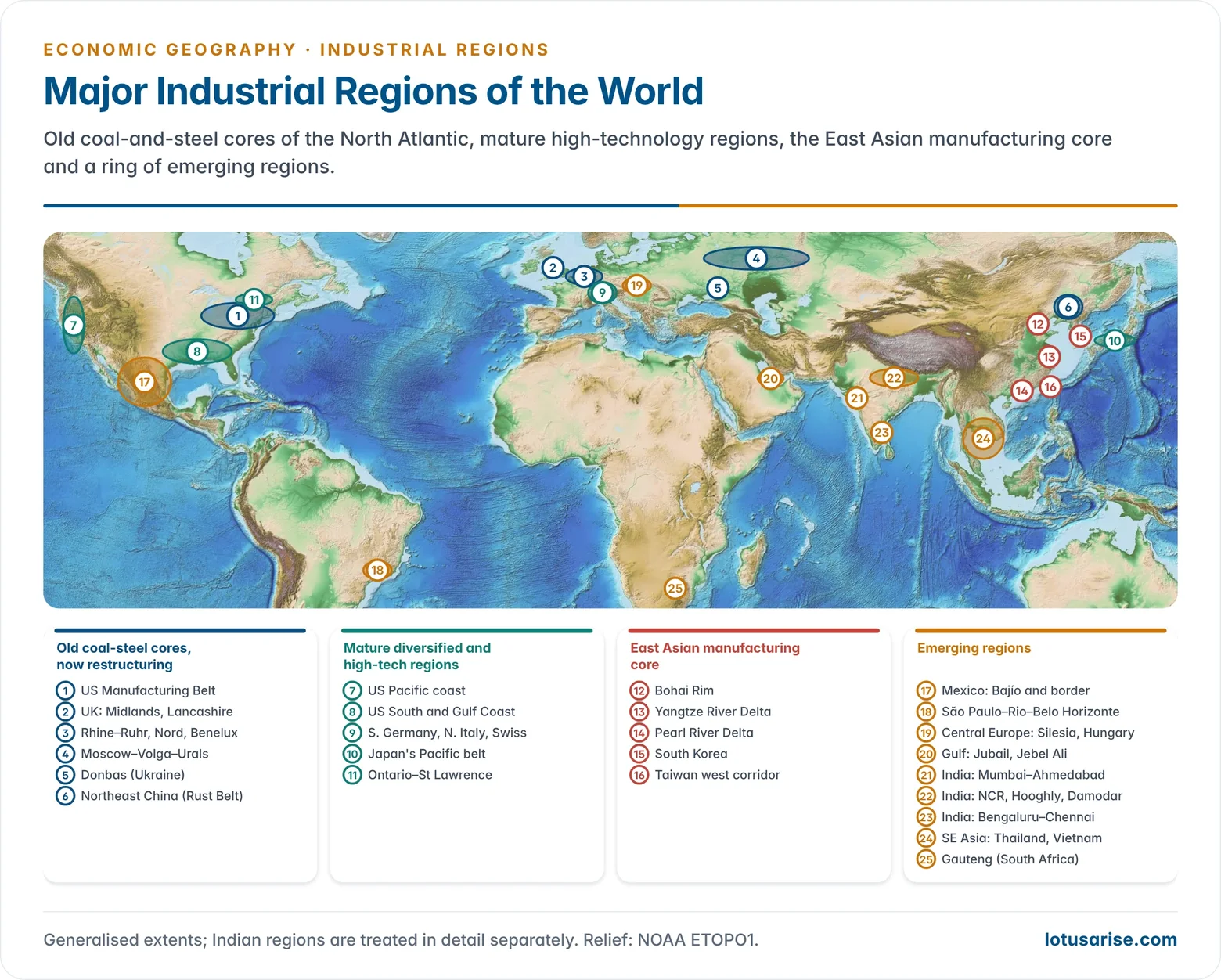
- The world’s industrial regions fall into a historic North Atlantic core, a dominant East Asian core, and emerging regions in South and Southeast Asia, Latin America, Eastern Europe, the Gulf and parts of Africa.
North America
| Region | Core centres | Base | Present status |
|---|---|---|---|
| New England | Boston, Lowell, Hartford | Water power, ports; textiles, shoes, shipbuilding (the first US industrial region) | High-tech, defence electronics, education, biotechnology (Route 128) |
| New York–Mid-Atlantic | New York, Philadelphia, Baltimore | Ports, markets, capital; clothing, steel (Sparrows Point), chemicals | Finance, pharmaceuticals, services |
| Pittsburgh–Lake Erie | Pittsburgh, Cleveland, Youngstown | Appalachian coking coal, Mesabi ore by lake; “Steel City” | Rust Belt decline; Pittsburgh reborn in health, robotics, universities |
| Great Lakes (Midwest) | Detroit, Chicago, Toledo, Gary | Lake transport, steel; automobiles, meat packing, machinery | Auto restructuring, EV and battery investment |
| Southern and Gulf Coast | Houston, Atlanta, Birmingham, Charlotte | Oil, gas, cheap land and labour; petrochemicals, textiles, aerospace | Sun Belt growth; new “battery belt” from Georgia to Kentucky |
| Pacific Coast | Seattle, San Francisco Bay, Los Angeles | Aerospace, electronics, films, refining | Silicon Valley, Boeing (Seattle), Hollywood |
| Ontario–St Lawrence (Canada) | Toronto, Hamilton, Windsor, Montreal | Hydropower, lakes, US market; steel, automobiles, aircraft | Canada’s industrial heartland |
| Prairie and Pacific Canada | Calgary, Edmonton, Vancouver | Oil sands, potash, forests, grain | Resource processing; year-round port at Vancouver |
Europe
| Region | Core centres | Base and industries |
|---|---|---|
| UK: Midlands, Lancashire, Yorkshire, North-East, Lower Scotland, South Wales, London Basin | Birmingham, Manchester, Leeds, Sheffield, Newcastle, Glasgow, Cardiff, London | Coal, iron, ports; engineering, cotton and wool, steel, shipbuilding. Today: services, high-value cars, aerospace, finance |
| Rhine–Ruhr (Germany) | Essen, Dortmund, Duisburg, Düsseldorf | Ruhr coal, Rhine waterway; steel, chemicals, engineering. Restructured into services and green technology |
| Saar–Lorraine | Saarbrücken; Metz, Nancy | Saar coal, Lorraine minette ore; steel, glass, ceramics |
| Southern Germany | Stuttgart, Munich, Frankfurt | Automobiles, machinery, electronics, chemicals |
| Northern and eastern Germany | Hamburg, Berlin, Leipzig, Dresden | Shipbuilding, port industries, electrical goods, “Silicon Saxony” chips |
| France: Nord, Paris | Lille, Paris | Coal, textiles; market-oriented, fashion, perfume, aerospace (Toulouse in the south) |
| Northern Italy (Po valley) | Milan, Turin, Genoa | Hydropower, labour; textiles, automobiles (Fiat), fashion, machinery |
| Benelux | Rotterdam–Europoort, Antwerp, Brussels | Break-of-bulk ports; refining, petrochemicals, diamonds |
| Swiss Plateau | Zurich, Basel, Geneva | Precision engineering, watches, pharmaceuticals |
| Southern Scandinavia | Gothenburg, Stockholm | High-grade Swedish ore, forests, hydropower; steel, paper, cars, telecom |
| Silesia (Poland–Czechia) | Katowice, Ostrava | Coal, iron, zinc; steel, chemicals. Now an auto and battery hub |
Russia and the CIS
- Moscow–Tula: Russia’s largest market and capital region, with textiles, engineering, electronics, defence goods, and nearby lignite and iron.
- Urals (Magnitogorsk, Chelyabinsk, Yekaterinburg): rich minerals; steel and heavy engineering. Its inland position kept it safe from invasion in the Second World War.
- Volga (Samara, Nizhny Novgorod): automobiles (Tolyatti, GAZ), oil refining, chemicals.
- Kuzbass (Siberia): huge coal deposits, metallurgy and chemicals; it supplies the Urals and central Russia.
- Donbas (Ukraine): coal, steel and chemicals. Its ageing mines and pollution were compounded by war since 2014, and production has collapsed.
- St Petersburg, the Caucasus and Central Asia: shipbuilding, oil (Baku), cotton textiles (Tashkent).
East Asia
| Country | Regions | Core and industries |
|---|---|---|
| Japan | Keihin (Tokyo–Yokohama), Chukyo (Nagoya), Hanshin (Osaka–Kobe), Kitakyushu | The Pacific industrial belt on reclaimed coastal land: cars (Toyota City), shipbuilding (Nagasaki), steel, electronics. Built on imported raw materials |
| China | Northeast (Liaoning–Jilin–Heilongjiang) | Anshan, Shenyang, Dalian, Changchun, Harbin. The first heavy-industry base, now the “Rust Belt” |
| China | Bohai Rim | Beijing, Tianjin, Tangshan. Steel, cars, petrochemicals |
| China | Yangtze River Delta | Shanghai, Suzhou, Hangzhou, Nanjing. Cars, electronics, chips, chemicals, finance |
| China | Pearl River Delta (Greater Bay Area) | Guangzhou, Shenzhen, Dongguan, Hong Kong. Electronics, telecom, EVs, export assembly |
| China | Inland | Chongqing, Chengdu, Wuhan, Zhengzhou. Laptops, phones, cars; growing under the “Go West” policy |
| South Korea | Seoul–Incheon, Ulsan–Busan–Pohang, Daegu–Gumi | Semiconductors, cars, shipbuilding, steel (POSCO) |
| Taiwan | Western corridor | Hsinchu, Taichung, Tainan, Kaohsiung. Semiconductors (TSMC), electronics, petrochemicals |
South and Southeast Asia
- India: the main industrial regions of India are:
- the Hooghly (Kolkata) region: jute, engineering, chemicals;
- Mumbai–Pune: textiles historically, now autos, chemicals and pharmaceuticals;
- Ahmedabad–Vadodara: textiles, petrochemicals, pharmaceuticals;
- the Chota Nagpur (Damodar valley) belt: iron and steel, heavy engineering;
- Bengaluru–Chennai–Coimbatore: IT, aerospace, cars, electronics, textiles;
- the National Capital Region (Gurugram–Manesar–Noida): cars, phones, consumer goods.
- Southeast Asia:
- Singapore (Jurong, refining and electronics);
- Malaysia (Penang electronics, the Klang valley);
- Thailand’s Eastern Seaboard (cars: the “Detroit of Asia”);
- Vietnam (Hanoi–Bac Ninh electronics, Ho Chi Minh City–Binh Duong garments and furniture);
- Indonesia (Jakarta–Bekasi; nickel processing in Sulawesi).
- Other centres: Dhaka–Chattogram (garments) and Karachi (textiles).
Latin America and Other Regions
- Brazil: São Paulo produces close to a third of Brazil’s GDP. It began on coffee wealth and diversified into cars (the ABC region), steel, chemicals, aircraft (São José dos Campos) and finance. Rio de Janeiro–Belo Horizonte adds steel and mining.
- Mexico: northern border maquiladoras (Tijuana, Ciudad Juárez), Monterrey steel, and the Bajío auto cluster (Guanajuato, Querétaro).
- Argentina: the Buenos Aires–Rosario belt (food processing, cars).
- Gulf: Jubail and Yanbu (Saudi petrochemicals), Jebel Ali (UAE), Ras Laffan (Qatar).
- Africa: Gauteng (Johannesburg–Pretoria) in South Africa, and Tangier in Morocco (Renault and Stellantis plants; one of Africa’s leading car exporters).
- Australia: Sydney–Wollongong–Newcastle (steel, engineering), Melbourne.
New Industrial Regions and Emerging Trends
The Pacific Rim and the Four Asian Tigers
- Flexible production let new regions grow wherever labour was cheaper, laws were favourable, capital flowed easily and a skilled or semi-skilled workforce was available.
- East Asia became the fastest-industrialising region of the late 20th century. A broad arc of industrialisation swept the Pacific Rim from South Korea to Singapore, and “Pacific Rim” became almost a synonym for manufacturing.
- At the start of the 20th century, Japan was the only industrial power in East Asia.
- In the 1960s–70s the Four Tigers (Four Asian Dragons) emerged as newly industrialising countries (NICs): South Korea, Taiwan, Hong Kong and Singapore. Three things drove them:
- labour-intensive industries relocating from Japan and the West;
- state protection and promotion of industries through subsidies, tariffs and cheap credit;
- heavy investment in education and training.
- South Korea: went from a poor rice economy to a powerhouse in cars, ships, steel and semiconductors, led by chaebols (Samsung, Hyundai).
- Its core is Seoul, with about 9.3 million people in the city and over 26 million in the Capital Area, half the country.
- Taiwan: state-led high technology (personal computers, telecom equipment, chips). It now leads the world in advanced chip foundries.
- Singapore: grew from an entrepôt for rubber, timber and oil at the tip of the Malay Peninsula into an electronics, refining and biomedical hub.
- It now has about 6.1 million people (2025) and specialises in quaternary services.
- Hong Kong: a 1950s success in textiles and light manufacturing, then electrical goods. As a port, finance centre and break-of-bulk point, it became China’s gateway to the world.
China: the “Workshop of the World”
- Reform and opening (1978) and the Special Economic Zones (Shenzhen, Zhuhai, Shantou, Xiamen, from 1980) launched export-led industrialisation.
- Under state planning the Northeast was the heavy-industry heartland. The Shanghai–Chang Jiang (Yangtze) district, with Shanghai and Wuhan, became the second great region.
- Coastal provinces (Guangdong, Jiangsu, Zhejiang) boomed. The Northeast declined into China’s Rust Belt, with state firms sold, shut or under-used.
- China is now the largest exporter of goods and holds about 29% of world manufacturing value added. Its demand drives world markets for iron ore, coal and copper.
- Current trends: rising wages and the policy of moving industry inland; upgrading to EVs, batteries, solar and chips; and “China plus one” relocation to Vietnam, India and Mexico.
Other NICs, BRICS and India
- The Asian financial crisis (1997–98) and the global recession (2008–09) hit the NICs hard. Reforms brought recovery.
- Newer production nodes include Mexico, Brazil, South Africa, Malaysia, Thailand, Vietnam and Türkiye. Brazil, Russia, India and China have pulled economic gravity away from the West.
- India: on IMF estimates, India became the world’s fourth-largest economy in nominal GDP in 2025, level with Japan. Its industrial output, however, remains modest for its size.
- Eastern district (Kolkata): engineering, chemicals, jute and cotton, and steel from Chota Nagpur minerals.
- Western district (Mumbai): cotton textiles (historically on cheap hydroelectric power from the Western Ghats), chemicals, petrochemicals.
- Southern district (Chennai): light engineering, cars, textiles, with skilled labour and port access.
- Drivers: a large domestic market, abundant labour, a planning tradition and, above all, software and IT services, with Bengaluru as the hub.
- Location: India sits roughly midway between Europe and the Pacific Rim on major trade routes.
Emerging Trends in the Geography of Industrial Regions
- China plus one and near-shoring:
- Vietnam (electronics in Bac Ninh–Thai Nguyen);
- India (iPhone assembly in Tamil Nadu and Karnataka);
- Mexico (the Bajío and the border belt);
- Eastern Europe (cars and batteries in Hungary and Poland).
- Green industrial clusters:
- battery gigafactories and EV plants: the US “battery belt”, Debrecen in Hungary, Gujarat and Karnataka in India;
- green-hydrogen and green-steel hubs (northern Sweden, Odisha, Gujarat);
- solar manufacturing clusters.
- Semiconductor regions are being rebuilt in the USA, Japan, Europe and India.
- Knowledge regions: clusters built on universities and research and development (Silicon Valley, Cambridge, Bengaluru, Shenzhen) matter more than raw materials.
- Rust-belt renewal: Pittsburgh, the Ruhr and Bilbao show that old regions can reinvent themselves. Others (Detroit, the Donbas) show how hard that is.
- Industrial corridors and parks: India’s Delhi–Mumbai Industrial Corridor, Ethiopia’s Hawassa park and Morocco’s Tangier Med zone show states building regions by design.
| Feature | Old industrial regions | New industrial regions |
|---|---|---|
| Location factor | Coal, ore, water, rail | Skills, ports, policy, value chains |
| Industries | Steel, textiles, shipbuilding, heavy engineering | Electronics, cars, chips, batteries, services |
| Organisation | Fordist, vertically integrated | Flexible, networked, global |
| Examples | Ruhr, Midlands, Pittsburgh, Donbas, Liaoning | Pearl River Delta, Hsinchu, Bajío, Bac Ninh, Bengaluru |
| Problems | Decline, pollution, unemployment | Congestion, wage pressure, dependence on foreign demand |
Previous Year Questions
2012Answer the following: Locational significance of Rotterdam in European economy.1996Write short note: Globalization of trade and industry.1991Examine the world patterns of industrial development and explain the problems of industrial development at national levels.





 History Optional PYQ Master Pack: Topic-wise Model Answers (1985–2025) by LotusArise IAS
 History Optional Mains Master Kit 2027 Complete Self-Study System — Notes, Mapping & Premium Articles by LotusArise IAS