- Cave and spring deposits are the depositional side of karst: calcium carbonate (or silica) that groundwater dissolved at one place is precipitated again inside caves or where water emerges at the surface.
- Inside caves they form speleothems (stalactites, stalagmites, flowstone); at springs they form travertine, tufa and sinter; within soils the same chemistry builds kankar (calcrete).
- They are the constructive counterpart of the solutional karst landforms.
- Their layered growth makes them archives of past climate; a stalagmite from Mawmluh Cave, Meghalaya, defines the base of the current geological age.
Caves: The Setting for Deposition

Solution and Speleogenesis
- Caves or caverns are large subsurface voids, the most significant landform of groundwater erosion (chiefly solution, aided by abrasion by underground streams) in soluble rock.
- Largest in pure, massive, thickly bedded and well-jointed limestone and dolomite.
- Chemistry: rain and soil water absorb CO₂ to form carbonic acid, which converts calcium carbonate into soluble calcium bicarbonate: CaCO₃ + H₂O + CO₂ ⇌ Ca(HCO₃)₂.
- Water widens bedding planes, joints and fractures into conduits; linked conduits grow into chambers.
- Rate depends on CO₂ content of the water, water throughput and the purity and jointing of the rock.
- Speleogenesis is the overall process of cave origin and enlargement; horizontal passages linking chambers are galleries.
- Vertical or inclined shafts linking sink holes to caves are ponors (Serbian) or avens (French).
Phreatic and Vadose Caves
| Setting | Position | Flow | Typical passage |
|---|---|---|---|
| Phreatic | Below water table | Slow, under hydrostatic pressure, fills conduit | Rounded tubes, looping profiles |
| Epiphreatic | At or just below water table | Fluctuating, fastest solution | Main horizontal cave levels |
| Vadose | Above water table | Free, gravity-driven streams | Canyon-like, graded trenches, shafts |
- A cave often begins phreatic and becomes vadose when uplift or valley incision lowers the water table.
- Only then is it air-filled, and only air-filled caves can grow dripstone.
Theories of Cave Origin
- Cave origin is the most debated question in karst geomorphology; theories differ over where (above, at or below the water table) and how (solution or abrasion) caves form.
| Theory | Proponent | Zone of formation | Core idea |
|---|---|---|---|
| Corrasion theory | Albert de Lapparent, Emmanuel de Martonne, Édouard-Alfred Martel, Clyde A. Malott | Vadose | Underground streams abrade limestone |
| Two-cycle theory | William Morris Davis (1930), supported by J Harlen Bretz (1942) | Phreatic, then vadose | Solution below water table; uplift drains cave; deposition follows |
| Water-table theory | Allyn C. Swinnerton (1932) | At water table | Lateral flow along the water table dissolves passages |
| Static water zone theory | J. H. Gardner | Above water table | Static water dissolves rock; valley deepening then drains it |
| Invasion theory | Clyde A. Malott | Vadose | Surface streams sink and cut their own subterranean courses |
- Two-cycle mechanism (Davis):
- First cycle: slow, all-round phreatic solution below the water table.
- Second cycle: uplift lowers the water table; the cave turns vadose and dry, and speleothems begin to form.
- B. C. Moneymaker (1941) took a middle view: caves begin below the water table but develop above it.
- Current view: Derek Ford and Ralph Ewers (1978) reconciled the debate in a four-state model.
- Fissure frequency decides the outcome: few fissures give deep-looping phreatic caves; many fissures give ideal water-table caves.
- Most large caves develop at or near the water table, with vadose trenching later.
- Some caves are hypogene, dissolved from below by sulphuric acid from rising H₂S-rich water; Carlsbad Caverns, USA, is the classic case.
- Kentucky’s Mammoth Cave is the world’s longest known cave system; Carlsbad Caverns is known for its vast chambers.
Caves of India
| Cave | Location | Notable feature |
|---|---|---|
| Krem Liat Prah | Shnongrim Ridge, East Jaintia Hills, Meghalaya | Longest natural cave in South Asia (more than 30 km surveyed) |
| Mawmluh | Near Sohra, East Khasi Hills, Meghalaya | About 7 km; Meghalayan GSSP stalagmite |
| Belum | Nandyal district, Andhra Pradesh | About 3.2 km; a plains cave entered through collapse dolines |
| Borra | Ananthagiri hills, Araku Valley, Andhra Pradesh | About 80 m deep; Gosthani River; tall columns |
| Kotumsar | Kanger Valley National Park, Bastar, Chhattisgarh | Kanger limestone; blind cave fish |
| Guptadham | Rohtas plateau, Bihar | Galleried cave |
- Guptadham shows structural control: it is dissolved in Vindhyan (Rohtas) limestone beneath a protective capping of quartzitic sandstone.
- Its horizontal galleries open into amphitheatre-like halls where tunnels cross.
- Meghalaya holds India’s densest cave systems: thick, well-jointed limestone meets extreme monsoon rainfall.
- Krem Puri, also in Meghalaya, is among the world’s longest sandstone caves.
- In August 2025, Mawmluh, Arwah, Mawsmai and Krem Puri were placed on UNESCO’s Tentative List as the Meghalayan Age Caves.
Cave Deposits (Speleothems)
The Chemistry of Deposition
- Speleothems (Greek spelaion, cave + thema, deposit) are secondary mineral deposits formed in air-filled caves, mostly of calcite, occasionally aragonite.
- Degassing, not evaporation, is the main trigger:
- Seepage water carries soil CO₂ at high partial pressure; cave air holds far less.
- On entering the cave, water loses CO₂; the reaction runs in reverse and calcite precipitates.
- Evaporation matters only near cave entrances and in dry, ventilated passages.
- Deposition is thus the mirror image of the solution that made the cave.
- All dripping-water deposits are collectively called dripstone.
Speleothems vs Speleogens
- Speleothems are added rock: new mineral precipitated in the cave.
- Speleogens are removed rock: forms sculpted into the bedrock by differential solution, with no new deposit.
- Examples are scallops, wall flutes, pockets and pendants; they form more readily where bedrock is chemically non-uniform.
- Scallop size is inversely related to past flow velocity, so speleogens record former cave streams.
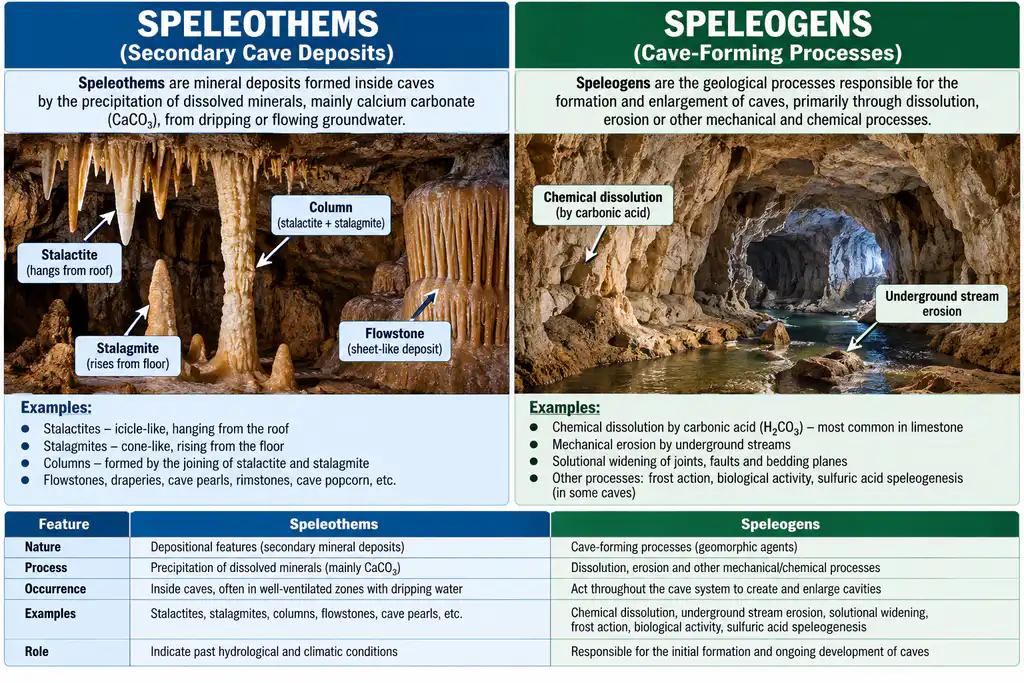
Major Speleothem Types
Dripstones
- Stalactites: icicle-like pendants hanging from the ceiling, broad at the base and tapering downward.
- Each drop leaves a thin ring of calcite around a central feeding canal, so they grow in length and girth.
- Soda straws: thin, hollow tubes, the first stage of a stalactite before the canal clogs and water runs down the outside.
- Stalagmites: mounds or columns rising from the floor beneath drips.
- Drops splash on impact, so stalagmites are thicker, blunter and rounder-topped than stalactites.
- Several closely spaced drip centres build compound stalagmites.
- Columns (pillars): a stalactite and stalagmite meet and fuse, linking floor and ceiling.
- Ceiling geometry controls form:
- Flat or evenly arched ceilings give uniform, vertical stalactites.
- Inclined ceilings let water run along the surface, giving elongated, inclined forms that grade into draperies.
Flowing-Water Forms
- Flowstone: sheet-like, layered coatings on walls and floors where water flows as a thin film, including seepage from stalagmites.
- Draperies (curtains): thin, wavy sheets hanging from inclined ceilings; colour banding gives “cave bacon”.
- Rimstone dams (gours): calcite builds up on the lip of flowing water, damming stepped pools.
Erratic and Pool Forms
- Helictites: twisted, branching growths that defy gravity.
- Water moves by capillary action through very fine canals, and crystal growth, not dripping, sets direction.
- Heligmites are their floor-based equivalents; globulites are globular helictites.
- Cave pearls: concentrically layered spheres in shallow, agitated pools.
- Dripping water keeps a nucleus (often a sand grain) rolling, so calcite coats it evenly.
- Moonmilk: a soft, white, paste-like deposit, unlike hard crystalline forms, linked to fine precipitation and microbial activity.
| Group | Water supply | Forms |
|---|---|---|
| Dripstone | Drips from a point | Stalactite, soda straw, stalagmite, column |
| Flowstone | Thin film or sheet flow | Flowstone, drapery, rimstone |
| Erratic | Capillary seepage | Helictite, heligmite, globulite |
| Pool | Standing or agitated water | Cave pearl, pool spar |
Speleothems as Climate Archives
- Stalagmites grow in annual to decadal layers and can be precisely dated by uranium–thorium (U–Th) methods.
- Their oxygen isotope ratios track changes in rainfall and monsoon strength; carbon isotopes track vegetation.
- India’s key contribution: a Mawmluh Cave stalagmite records a 200-year megadrought about 4,200 years ago.
- In June 2018 it was ratified as the GSSP of the Meghalayan Age, the youngest of three ages of the Holocene (after the Greenlandian and Northgrippian).
- The same drought is linked to the decline of Indus (Harappan), Mesopotamian and Yangtze valley societies.
- The International Union of Geological Sciences listed Mawmluh as a geological heritage site in 2022.
- Nearby limestone quarrying for cement is a conservation concern for Meghalaya’s caves.
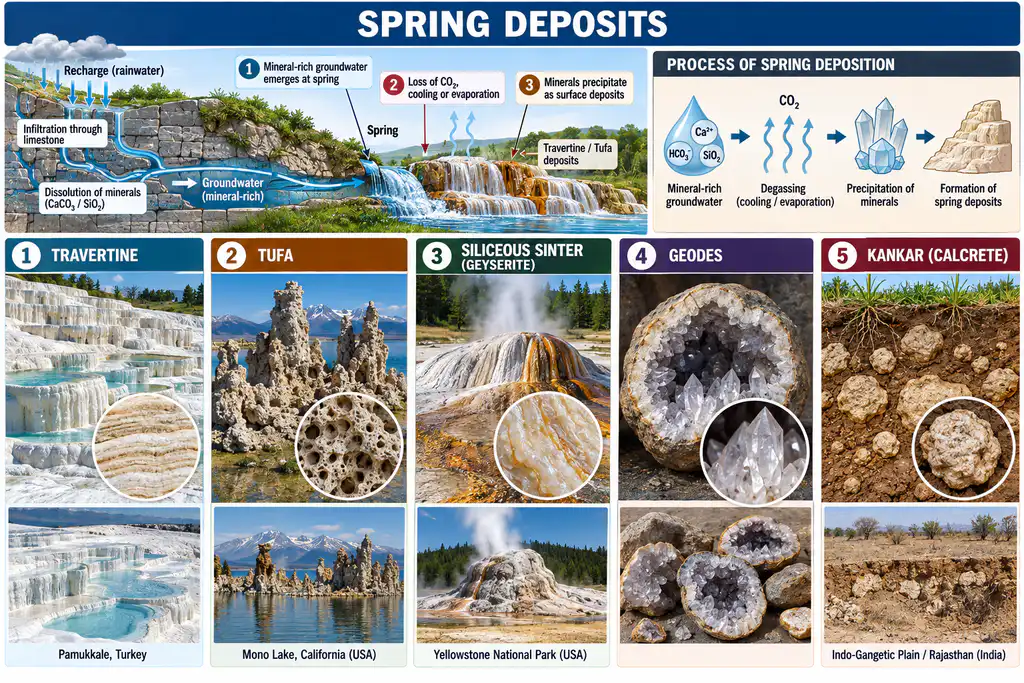
Spring Deposits
- Water emerging at springs is often saturated with dissolved minerals, mostly calcium carbonate, sometimes silica.
- At the surface it loses CO₂, cools or evaporates, and can no longer hold its load, so minerals precipitate around and downstream of the outlet.
Travertine, Tufa and Sinter
| Deposit | Composition | Water | Texture | Examples |
|---|---|---|---|---|
| Travertine | CaCO₃ | Warm to hot (thermogene) | Dense, crystalline, banded | Pamukkale (Türkiye); Mammoth Hot Springs, Yellowstone |
| Tufa (calc-tufa) | CaCO₃ | Cold, ambient (meteogene) | Porous, spongy, plant moulds | Mono Lake towers (USA); Plitvice barriers (Croatia) |
| Siliceous sinter (geyserite) | Opaline silica | Hot, geothermal | Layered, glassy crusts | Geyser vents, Yellowstone and Iceland |
- Travertine: precipitates rapidly where water degasses fast, at hot springs or over cascades.
- Successive layers build stepped terraces; banded travertine also forms in caves.
- Tufa: forms around plant stems, mosses and algal mats, which act as nuclei, leaving a vuggy, cellular texture.
- Softer tufa also accumulates at cave mouths, where evaporation helps.
- Mono Lake towers grew underwater at spring inlets and were exposed as the lake fell.
- Sinter: the silica counterpart of travertine, from geothermal water circulating through volcanic rock.
- It lines and seals geyser plumbing, helping pressure build.
Kankar (Calcrete)
- Hard, nodular to massive CaCO₃ that forms within soil or loose sediment by the same chemistry.
- Carbonate-rich water rises and evaporates in dry seasons, cementing grains into nodules and later a continuous hardpan.
- Best developed in semi-arid climates with a marked dry season.
- Widespread in the older alluvium (bhangar) of the Indo-Gangetic plain and in Rajasthan; traditionally quarried for lime and road metal.
Geodes
- Hollow or partly hollow rock masses whose cavities are lined with inward-growing crystals (quartz, chalcedony, calcite).
- The cavity is a gas bubble in lava or a solution void in limestone or shale; mineral-rich groundwater lines it slowly.
Hot Springs and Geysers
- Hot springs discharge heated groundwater continuously; geysers are hot springs that spout water and steam intermittently.
- The word comes from Geysir, a spring in Iceland; the Icelandic word means “gusher”.
- They belong to the waning, minor phase of vulcanicity, with fumaroles.
Mechanism
- A geyser needs three conditions:
- Magmatic heat close to the surface.
- Abundant groundwater.
- Constricted plumbing (the geyser tube), often sealed by sinter.
- Water deep in the tube is superheated under the weight of the column above.
- When some flashes to steam, pressure drops, the rest boils explosively, and the column erupts; the tube then refills.
Types
| Basis | Type | Feature | Example |
|---|---|---|---|
| Vent form | Fountain (pool) type | Erupts through an open pool; no cone | Great Fountain, Yellowstone |
| Vent form | Cone (nozzle) type | Narrow vent; sinter builds a geyser cone | Old Faithful, Yellowstone |
| Periodicity | Regular intermittent | Fairly predictable intervals | Old Faithful (roughly every 1–2 hours); Strokkur (every 5–8 minutes) |
| Periodicity | Irregular intermittent | Unpredictable intervals | Steamboat, Yellowstone (tallest active geyser) |
| Periodicity | Continuous | No pause; effectively a boiling hot spring | Excelsior, Yellowstone (now largely dormant) |
- Intermittent geysers are also grouped by eruption length: long-period geysers play for up to an hour; feeble geysers only briefly.
Distribution
- Yellowstone (USA) holds about half the world’s geysers across several basins, such as Norris and the Upper and Lower Geyser Basins.
- Other major fields:
- Valley of Geysers, Kamchatka (Russia), the second-largest concentration.
- El Tatio (Chile).
- Taupō Volcanic Zone, New Zealand, with Whakarewarewa near Rotorua.
- Haukadalur, Iceland, home of Geysir and Strokkur.
- India has hot springs rather than major geyser fields:
- Manikaran (Parvati valley, Himachal Pradesh), Tattapani (Chhattisgarh), Bakreshwar (West Bengal) and Rajgir (Bihar).
- Puga valley (Ladakh) carries borax and sulphur encrustations around its vents.
- At Puga, ONGC has completed two wells for India’s first demonstration geothermal power project; the ONGC–Ladakh collaboration was renewed for five years in 2026.