Define Speleothem. Discuss the various forms and features of speleothem.

“Define Speleothem. Discuss the various forms and features of speleothem.” (2022)

  • A speleothem (from the Greek spelaion, “cave,” and thema, “deposit”) is a secondary mineral deposit formed inside a cave by the precipitation of dissolved minerals — chiefly calcium carbonate (calcite), though also aragonite, gypsum, and silica in some settings — from percolating groundwater, and is the depositional counterpart to the solutional (erosional) landforms of karst topography.
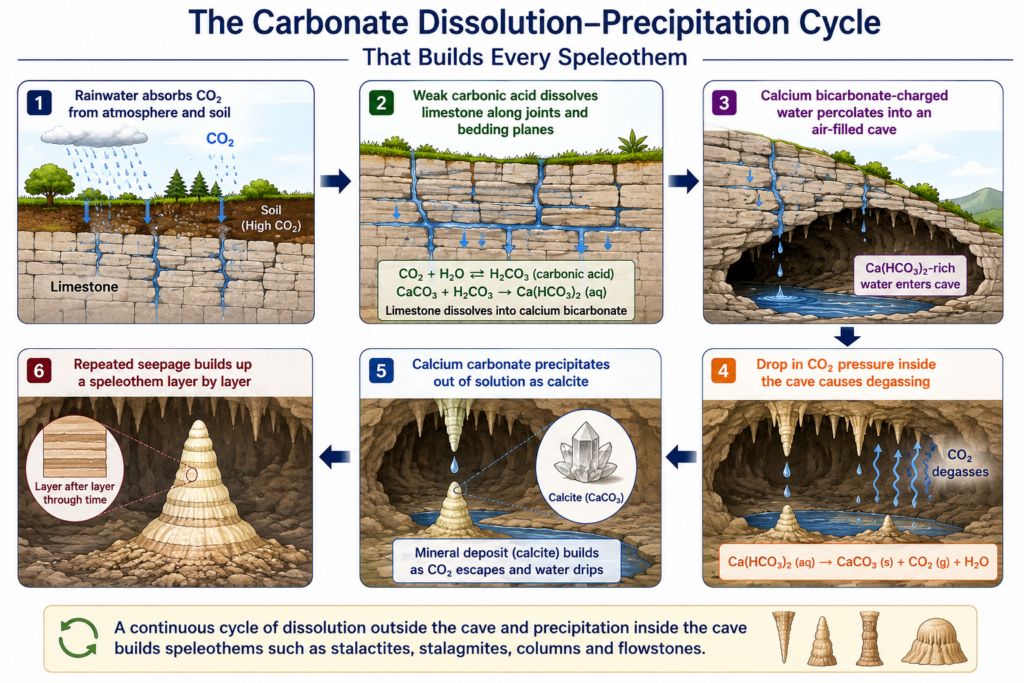
  • Speleothems form wherever slightly acidic rainwater, having absorbed carbon dioxide from the atmosphere and soil to form weak carbonic acid, dissolves limestone bedrock on its way underground; once this mineral-charged water enters an air-filled cave, a drop in CO₂ pressure and slow evaporation forces calcium carbonate back out of solution, and it crystallises layer upon layer at the point of seepage.
  • The thesis argued here: speleothems are not a single landform but a family of depositional forms distinguished chiefly by where and how the mineral-laden water reaches the cave surface — dripping from a ceiling, seeping through a wall, flowing across a floor, or trickling down a slope — and this genetic classification (drip-fed, flow-fed, and pool-fed forms) is what best organises the bewildering variety of shapes speleothems take, from icicle-like stalactites to sheet-like flowstone.
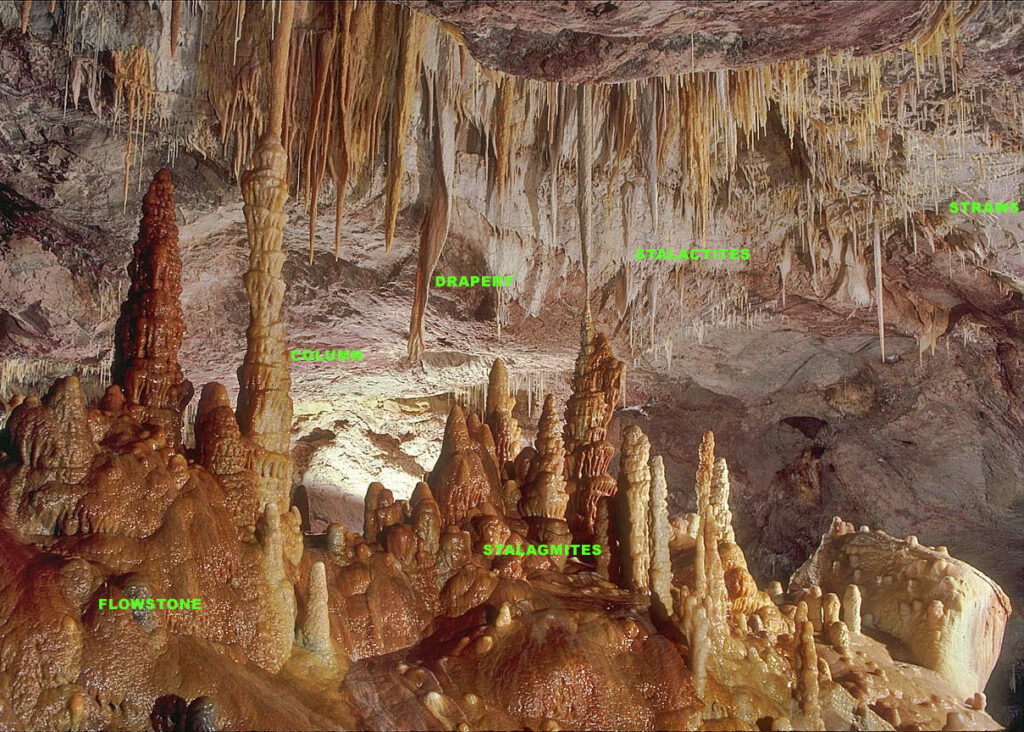
Cave labeled with the six most common types of speleothems: flowstone, columns, drapery, stalagmites, stalactites and straws

The Genetic Mechanism: From Dissolution to Deposition

  • The controlling chemical reaction is reversible: CaCO₃ + H₂O + CO₂ ⇌ Ca²⁺ + 2HCO₃⁻ — dissolution proceeds left to right in CO₂-rich soil water outside the cave, and precipitation proceeds right to left once that water enters the lower-CO₂ atmosphere of an open cave chamber.
    • “A speleothem is, in effect, a stalled chemical reaction — mineral matter caught in the act of coming back out of solution, one microscopically thin lamina at a time.”
  • Because deposition is so slow (typically a fraction of a millimetre to a few millimetres per year), speleothems build up concentric growth layers or laminae, analogous to tree rings, that record subtle year-to-year changes in the drip water’s chemistry and the climate above the cave.
  • The rate and location of dripping, seeping, or flowing water is the master control on form: a steady drip at a fixed ceiling point builds a stalactite and its matching floor stalagmite, a sheet of water flowing down a wall or sloping floor builds flowstone, and water under air pressure forced through a tiny capillary builds the gravity-defying helictite.

Depositional Forms Fed by Dripping Water

  • Stalactites are icicle-shaped speleothems that hang from a cave ceiling, formed where water drips slowly from a single point; a thin, hollow tube called a soda straw is the earliest growth form, and it thickens into a solid, tapering stalactite once the central capillary becomes blocked and water begins flowing down the outer surface as well.
  • Stalagmites are the complementary floor-based counterpart, built up directly beneath a dripping stalactite by mineral matter deposited from water splashing onto the cave floor; stalagmites are typically broader, blunter, and more rounded than stalactites because splash disperses the deposit over a wider area rather than concentrating it at a single drip tip.
  • When a stalactite and the stalagmite growing beneath it eventually meet, they fuse into a continuous floor-to-ceiling cave pillar (also termed a column), one of the most visually striking speleothem forms and a marker of a cave passage that has remained stable and actively dripping for a very long period.
  • Halagmite (also spelt hologmite in some regional usage) refers to an irregular, deformed stalagmite whose growth axis has been diverted sideways or made asymmetric by an airflow current or an uneven drip source, distinguishing it from the vertically symmetric “normal” stalagmite.
  • Helictites are among the most unusual speleothem forms: thin, twisted, worm-like growths that defy gravity by curving, branching, and spiralling in seemingly random directions, because their growth is driven not by simple gravitational dripping but by water forced outward through a narrow central capillary under capillary and hydrostatic pressure, so that the crystal grows in whatever direction that pressure pushes it, including sideways and upward.

Depositional Forms Fed by Flowing Water and Standing Pools

  • Flowstone (also called drip stone in its broad usage) is a sheet-like deposit formed where a thin film of water flows continuously over a sloping cave wall or floor rather than dripping from a single point, building up smooth, layered, wavy sheets of calcite that can coat large sections of a cave passage.
  • Drapes or curtains form where water trickles down a sloping or overhanging ceiling surface along a line rather than a point, depositing a thin, wavy, translucent sheet of calcite that hangs like a curtain of folded cloth; when the calcite contains banded impurities (often iron oxide), these curtains display alternating light and dark stripes and are popularly called cave bacon.
  • Cave pearls form in shallow, agitated pools fed by dripping water, where a sand grain or other nucleus is continuously rotated by the turbulence of falling drops and coated in successive, perfectly concentric layers of calcite — a process directly analogous to the formation of a natural pearl in an oyster.
  • Rimstone dams (or gours) develop where flowing water over a gently sloping floor deposits calcite along its leading edge, building up small terraced dams that pond water behind them into a staircase of shallow pools, most spectacularly seen at very large scale in surface travertine terraces.

Tufa, Travertine, and Terra Rossa: Speleothems at the Cave Mouth and Beyond

  • Tufa is a porous, spongy variety of calcium carbonate deposited where calcite-saturated spring or stream water emerges at or near the surface and precipitates rapidly around mosses, algae, and other vegetation, which decay away and leave behind a light, cellular rock structure.
  • Travertine is the denser, more compact, and often banded counterpart to tufa, typically precipitated from hot or mineral-rich spring water with faster degassing; large travertine terraces at cave entrances and spring mouths (the Pamukkale terraces of Turkey being the type example globally) are essentially surface-scale rimstone dams.
  • Terra rossa (“red earth”) is not itself a carbonate speleothem but the associated residual soil left behind after limestone is dissolved away, its characteristic red-brown colour coming from insoluble iron and aluminium oxides concentrated as the more soluble calcium carbonate is progressively removed — its presence at a cave mouth or on a karst surface is a diagnostic indicator of long-continued limestone dissolution feeding the very process that builds speleothems below ground.

Indian and Global Occurrences

  • India’s most celebrated speleothem-bearing cave system is the Borra Caves in the Araku Valley of Andhra Pradesh, carved in Cambrian-age limestone of the Eastern Ghats, where dramatic stalactites, stalagmites, and pillars have been fancifully named for their resemblance to natural and mythological forms (a Shivalinga-like formation among them).
  • Other significant Indian karst-cave localities with well-developed speleothems include the Vindhyan limestone caves of Bihar and Madhya Pradesh (notably around Pachmarhi), the Gupt Godavari caves near Chitrakoot in Uttar Pradesh, limestone caves of the Bastar plateau in Chhattisgarh, and cave systems within the Jammu & Kashmir Himalaya.
  • Globally, speleothems reach their most spectacular development in Carlsbad Caverns and Mammoth Cave (USA), the Postojna and Škocjan caves (Slovenia), and Jeita Grotto (Lebanon), all developed in thick, pure limestone successions with long, climatically stable histories of groundwater circulation.
  • Beyond their scenic and touristic value, speleothems have become one of the most important palaeoclimate archives available to earth scientists: because stalagmite growth layers can be dated with high precision using uranium-thorium radiometric dating, and their oxygen-isotope and trace-element composition responds systematically to past rainfall and temperature, stalagmite records are now routinely used to reconstruct monsoon strength, past rainfall seasonality, and abrupt climate shifts over the last several hundred thousand years — a scientific application that has made caves like those of peninsular India valuable proxies for reconstructing the long-term history of the Indian monsoon.
  • A speleothem, defined broadly, is any secondary mineral deposit built up inside a cave by the precipitation of dissolved carbonate from percolating groundwater, and its many named forms are best understood as variations on a single chemical process operating under different hydrological conditions of drip, seepage, flow, or ponding.
  • From the humble soda straw to the fused floor-to-ceiling pillar, from the gravity-defying helictite to the terraced rimstone dam, each speleothem form is a direct fingerprint of exactly how water reached that point in the cave — making the classification of speleothems as much a study of cave hydrology as of mineralogy.
  • Their continuing relevance extends well beyond aesthetics: as slow-growing, precisely dateable archives of past rainfall and temperature, speleothems today occupy a central place in reconstructing the Quaternary climate record, giving this classical karst depositional landform a genuinely contemporary scientific significance.