

- Environmental Impact Assessment (EIA) is the study that forecasts what a proposed industrial or infrastructure project will do to the environment, while the decision to build it can still change.
- It gives planners one instrument for pursuing development and environmental protection together.
- The United Nations Environment Programme (UNEP) describes it as a way of identifying a project’s environmental, social and economic impacts before the decision is made. Four aims follow from this:
- predict impacts early in planning and design;
- find ways of reducing the harm;
- shape the project to suit its local setting;
- place the predictions and the options before decision-makers.
- In India the idea works through prior environmental clearance (EC) under the Environment (Protection) Act, 1986. Analysts predict the impacts with checklists, matrices, networks and overlays, chosen to suit each project.
Origin and Legal Framework
How EIA reached India
- Formal EIA began with the US National Environmental Policy Act (NEPA) of 1969, signed on 1 January 1970, and then spread to other countries and to lenders.
- Development projects in India were long undertaken with little thought for their environmental consequences.
- The scale of the damage made both government and the public anxious about these impacts, and EIA was brought in as the means of assessing them.
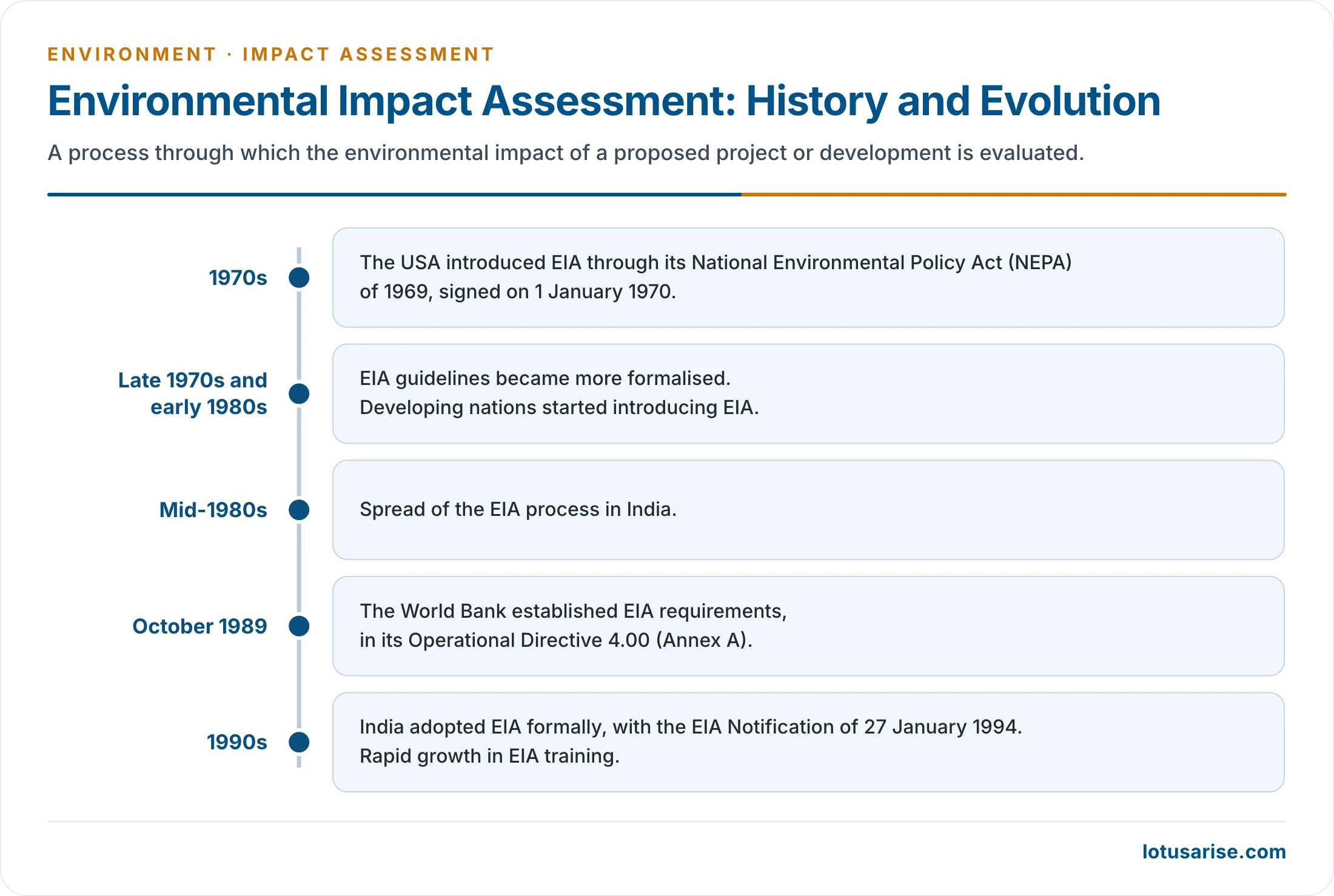
- The World Bank’s EIA requirement dates from October 1989, when its Operational Directive 4.00 (Annex A) was issued. India’s formal adoption is the 1994 Notification.
| Year | Step | Effect |
|---|---|---|
| 1976–77 | Planning Commission asks the Department of Science and Technology to examine river-valley projects from the environmental angle | Start of India’s experience with appraisal |
| 1978 | EIA introduced for river-valley projects | Later extended to other development sectors |
| 1986 | Environment (Protection) Act | Legal base for every later notification |
| 27 January 1994 | First EIA Notification | Prior clearance compulsory for 29 categories; appraisal held at the Centre |
| 1997 | Public hearing added | Local people gain a formal voice |
| 14 September 2006 | Present EIA Notification replaces that of 1994 | Categories A and B; clearance decentralised to the States |
- The 1994 and 2006 Notifications both rest on the Environment (Protection) Act, 1986. The same Act has produced other related notifications, such as those on the Coastal Regulation Zone.
- Who says yes: environmental clearance, the formal go-ahead, was given by the Impact Assessment Agency in the Ministry of Environment and Forests. The Ministry became the Ministry of Environment, Forest and Climate Change (MoEFCC) in 2014.
- Unlike the 1994 regime, the 2006 Notification shifts part of the burden of clearance on to the State, according to the size or capacity of the project.
- What needs clearance: mining, thermal power, river-valley projects, infrastructure (roads and highways, ports, harbours and airports) and industry.
- The total was 29 categories in 1994 and is usually quoted as more than 30 now. The Schedule as amended to March 2025 lists 39 items under eight heads, and a listed project gets its EC only after meeting the EIA requirements.
- Older accounts of the 2006 list also name very small electroplating and foundry units. The present Schedule reaches small metal units through its metallurgical item, which covers melting processes.
- The three pillars of EIA practice: risk assessment, environmental management and post-project monitoring.
What is assessed
- Air environment:
- present and predicted ambient air quality;
- weather data such as wind speed, wind direction and humidity;
- the likely quantity of emissions and their effect on the area;
- pollution control needs and air quality standards.
- Noise: present and predicted noise levels, and ways of cutting noise pollution.
- Water environment:
- quantity and quality of surface and ground water in the zone;
- the proposed project’s effect on these resources.
- Biological environment:
- flora and fauna of the impact zone;
- likely damage from effluents, emissions and landscaping;
- predicted biological stress.
- Land environment:
- soil characteristics, land use and drainage pattern, and the likely adverse impact on them;
- the effect on historical monuments and heritage sites.
Process and Institutions
Steps in the EIA process
- The steps are cyclical: findings at one stage often send the proponent back to an earlier one.
- Screening: the plan is checked for its scale of investment, its location and type of development, and whether it needs statutory clearance.
- Scoping: potential impacts, the zone of impact, the scope for mitigation and the need for monitoring are set out.
- Baseline data: the existing environmental status of the study area is recorded.
- Impact prediction: positive and negative, reversible and irreversible, temporary and permanent impacts are forecast. This requires the assessor to know the project well.
- Alternatives: options of location and process technology are identified for every project and their environmental attributes compared.
- Mitigation and the EIA report: the report lists steps to prevent, reduce or bypass each impact, or else the compensation for probable damage.
- The chosen option gets a mitigation plan and an Environmental Management Plan (EMP), which guides the proponent towards environmental improvement.
- Public hearing: once the report is ready, local people and environmental groups near the site are informed and consulted.
- Decision: the assessment authority and its experts consult the project head and the consultant, and decide in the light of the EIA and the EMP.
- Monitoring: each phase of implementation is watched against the EMP.
- Risk assessment: inventory analysis, hazard probability and a hazard index also form part of the procedure.
Preparing the EIA report
- The report is built in five steps:
- baseline data from primary and secondary sources;
- impact prediction from past experience and mathematical modelling;
- evaluation of the impacts against the net costs and benefits;
- environmental management plans that hold impacts to the minimum;
- a costed estimate of the monitoring plan and the mitigation measures.
- Environmental Management Plan: sets out prevention, control and mitigation for each environmental component, along with a rehabilitation and resettlement plan.
Appraisal and monitoring
- Appraisal: an Appraisal Committee set up by the Ministry first scrutinises the project on the data given by its authorities.
- The Ministry may also consult investors and experts on specific issues.
- Clearance is then granted subject to stipulated safeguards.
- Time limit: under the 1994 regime, a decision came within 90 days of complete information. The 2006 Notification allows 105 days from the final EIA report: 60 for appraisal and 45 for the decision.
- Monitoring of cleared projects: six regional offices once did this, at Shillong, Bhubaneswar, Chandigarh, Bengaluru, Lucknow and Bhopal.
- The Ministry now lists 19 integrated regional offices, in place since October 2020: 11 regional offices (Bengaluru, Bhopal, Bhubaneswar, Chandigarh, Chennai, Dehradun, Gandhinagar, Lucknow, Nagpur, Ranchi, Shillong) and 8 sub-offices (Raipur, Guwahati, Hyderabad, Jaipur, Jammu, Kolkata, Shimla, Vijayawada).
- Proponents submit half-yearly compliance reports. A 2016 audit by the Comptroller and Auditor General found shortfalls in this monitoring and in technical staff.
EIA of coasts
- Coastal States and Union Territories prepare Coastal Zone Management Plans (CZMPs) under the Coastal Regulation Zone (CRZ) rules.
- The rules date from the 1991 notification. They were replaced in 2011 and again on 18 January 2019, and plans drawn up under the 2011 text must be revised to match.
- CZMPs rest on identifying and categorising coastal areas for different activities. They then go to the Ministry for approval, and the Ministry forms a task force to examine them.
- Progress is uneven: a Ministry reply of December 2023 listed approved 2019 plans for Odisha, Karnataka and Maharashtra. Ten coastal districts of Keralam (Kerala) followed in 2024.
Single-window clearance and PARIVESH
- Single-window clearance joins environmental clearance and forest clearance.
- Where a project needs both EC and approval under the Forest (Conservation) Act, 1980, both proposals go to the Ministry’s divisions at the same time and are processed together for clearance or rejection.
- A project that diverts no forest land is processed for EC alone.
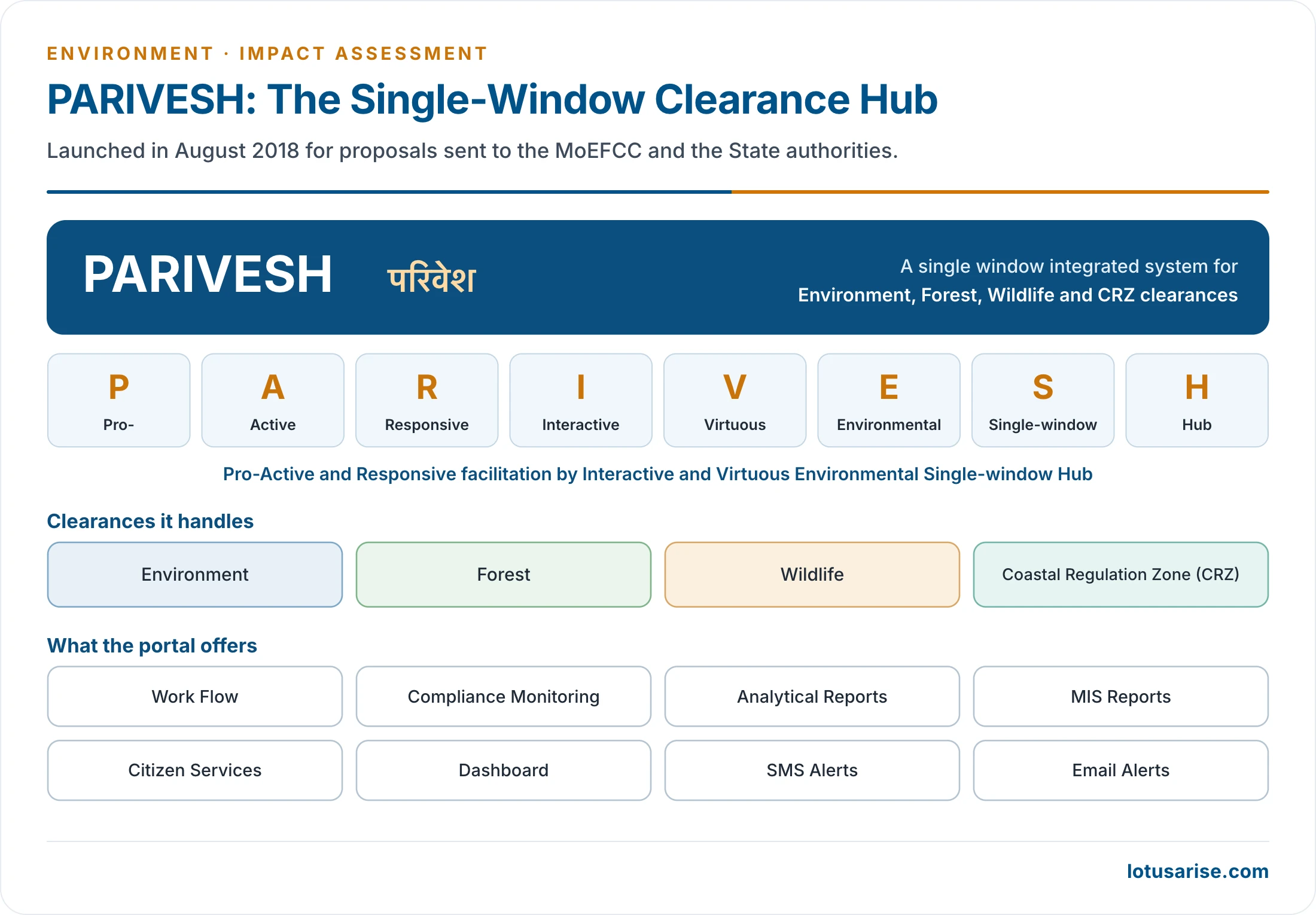
- PARIVESH (Pro-Active and Responsive facilitation by Interactive and Virtuous Environmental Single-window Hub), launched in August 2018, is the online hub for Environment, Forest, Wildlife and Coastal Regulation Zone clearances.
- This single-window system was framed in the spirit of the Prime Minister’s Digital India initiative and of “Minimum Government and Maximum Governance”.
- It is a workflow-based web application for submitting, monitoring and managing proposals sent to the MoEFCC and to the State Environment Impact Assessment Authorities (SEIAAs).
- It handles clearances from Central, State and district-level authorities.
- The Ministry designed and hosts it, with technical support from the National Informatics Centre.
- It offers single registration and sign-in, one unique ID for all clearances a project needs, and one window for all applications.
- An upgraded PARIVESH 2.0 was in use by 2023.
Stakeholders
- EIA applies to public and private projects alike. There are six main players:
- the project proponent;
- the environmental consultant, who prepares the EIA on the proponent’s behalf;
- the Pollution Control Board, State or Central;
- the public, which has a right to be heard;
- the Impact Assessment Agency;
- the regional centre of the MoEFCC.
Expert committees
- The Expert Appraisal Committee (EAC) works at the Centre and the State Expert Appraisal Committee (SEAC) at State level.
| Point | Older composition | Appendix VI of the 2006 Notification |
|---|---|---|
| Fields | Ecosystem management; air and water pollution control; water resource management; flora and fauna; land-use planning; social sciences and rehabilitation; project appraisal; ecology; environmental health; subject specialists; NGO representatives | Environmental quality; sectoral project management; EIA process; risk assessment; life science; forestry and wildlife; environmental economics; public administration |
| Chair | An outstanding, experienced ecologist, environmentalist or technical professional with managerial experience in the field | An eminent person with experience in environmental policy, or in management or public administration across development sectors |
| Secretary | Representative of the Impact Assessment Agency as Member-Secretary | Ministry representative assists as Secretary |
| Size | Not more than 15 | Not more than 15 regular members; the chair may co-opt an expert for a meeting |
| Capacity and term | Members serve in their individual capacities, unless nominated as representatives | At most two terms of three years; members below 70 years of age |
Related tools for siting and control
- Older controls still sit around EIA in the industrial belts:
- Environmental guidelines for siting industry, and district zoning with suitability maps developed with German support. These streamlined site clearance.
- Environmental Statements, which are mandatory, and environmental audits for highly polluting industries.
- Minimal National Standards (MINAS) for highly polluting industries.
- Critically polluted areas carry extra weight in appraisal, because the General Condition sends nearby Category B projects to the Centre.
- An older list counted 24, among them Singrauli, Korba, Vapi, Ankleshwar, Greater Kochi, Visakhapatnam, Haora, Durgapur, Dhanbad, Pali and Patancheru.
- On the Central Pollution Control Board’s index, 43 of 88 clusters were critical in 2009–10 and 38 of 100 in 2017–18.
The 2006 Notification and After
Salient features
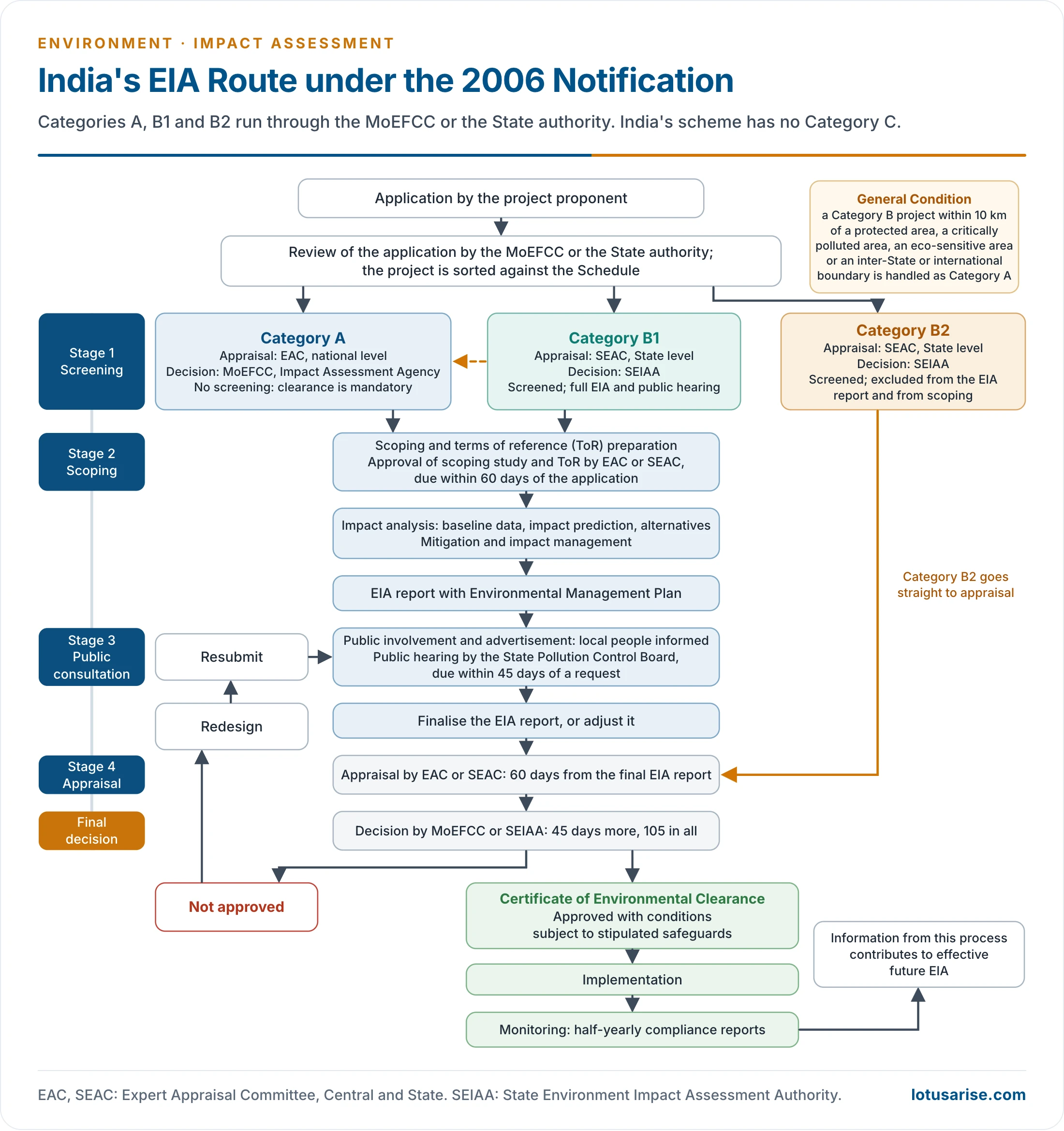
- The Notification decentralised clearance by sorting projects into two categories.
| Category | Appraised by | Decided by | Screening | EIA and hearing |
|---|---|---|---|---|
| A | EAC, national level | MoEFCC, the Impact Assessment Agency | None; clearance is mandatory | Full EIA and public hearing |
| B1 | SEAC, State level | SEIAA | Yes | Full EIA and public hearing |
| B2 | SEAC, State level | SEIAA | Yes | Excluded from the EIA report and from scoping |
- The EIA cycle has four stages: screening, scoping, public consultation and appraisal. The final decision follows.
- Terms of reference are due within 60 days of the application.
- The hearing, held by the State Pollution Control Board, is due within 45 days of a request.
- General Condition: a Category B project is handled as Category A if it lies within 10 km of a protected area, a critically polluted area, an eco-sensitive area or an inter-State or international boundary.
- Validity of clearance: since 2022 the term has been 10 years for most projects, 13 for river-valley projects and 15 for nuclear projects.
Changes and disputes since 2006
| Date | Step | Effect |
|---|---|---|
| 2016 | District-level authorities | Small minor-mineral leases and some building projects handled lower down |
| 14 March 2017 | One-time window for projects running without EC | Six months to apply, with damage assessment and remediation |
| 23 March 2020 (published 11 April) | Draft EIA Notification, 2020 | About 17 lakh comments; no final text issued, and the 2006 Notification stays in force |
| 7 July 2021 | Office memorandum on violation cases | Standing route to clearance on payment of penalties |
| 29 January 2025 | Building and area-development entries revised | Part struck down on 5 August 2025 (below) |
| 29 August 2025 | Environment Audit Rules, 2025 in force | Certified auditors assigned to projects at random |
| 8 September 2025 | Office memorandum on atomic, critical and strategic minerals | Mining of these minerals exempted from public consultation, under the strategic clause of the Notification |
- Building projects: on 5 August 2025 the Supreme Court, in Vanashakti v. Union of India, struck down the note that had freed industrial sheds, schools, colleges and hostels from EC.
- In CREDAI v. Union of India (12 September 2025), a different bench kept State authorities in charge of project-level appraisal of real estate projects.
- The mineral exemption:
- The Ministry relies on the clause exempting projects of defence, security or other strategic concern.
- Critics argue that it weakens the legal requirement of public consultation, and local protests continued into 2026.
- Clearance after the fact: prior clearance is the core of EIA, and the long dispute was over whether it can be given afterwards.
- 16 May 2025: a two-judge bench struck down the 2017 notification and the 2021 memorandum.
- 18 November 2025: a three-judge bench recalled that judgment by 2:1, with Justice Ujjal Bhuyan dissenting.
- 29 July 2026: a bench led by Chief Justice Surya Kant decided the reheard case.
- It upheld the 2017 notification as valid delegated legislation for a limited, time-bound window.
- It quashed the 2021 memorandum prospectively as an administrative order creating a perpetual regime.
- Clearances already granted remain valid unless individually challenged, pending applications run their course, and no fresh applications can be made under either instrument.
- Any future scheme must come as a narrowly tailored statutory notification.
- Indian cases where EIA was contested:
- Sethusamudram Ship Channel: the 2004 EIA by the National Environmental Engineering Research Institute accepted an alignment. The dispute over Ram Setu then took the project to the Supreme Court, and a committee under R. K. Pachauri (2008) examined an alternative route.
- Great Nicobar: on 16 February 2026 a special bench of the National Green Tribunal (NGT) declined to interfere with the 2022 clearance, citing strategic importance and the conditions attached. Critics call the ecological cost unacceptable, and in June 2026 the Environment Minister rejected the charge that the baseline data were inadequate.
- Char Dham highway: the works were divided into 53 parts, each under 100 km, so no EIA was required. This is the problem of salami slicing.
Importance of EIA
- It links environment with development, in the cause of safe and sustainable growth.
- It offers a cost-effective way of removing or reducing a project’s adverse effects.
- It lets decision-makers weigh the effects well before implementation.
- It builds mitigation into the development plan.
- It keeps a plan within the ecosystem’s capacity for assimilation and regeneration.
- Its geographical value is that impacts are spatial and cumulative. A dam, mine or port alters land use, drainage and settlement across a whole basin or coast.
- Fragile settings raise the stakes: the South Lhonak flood of October 2023 destroyed the Teesta III dam at Chungthang in Sikkim, a hazard no single-project assessment had to weigh at basin scale.
Shortcomings of the EIA process
- Applicability: several projects with significant impacts escape because they are missing from the Schedule or fall below its investment thresholds.
- Expert committees and standards: study teams often lack environmentalists, wildlife experts, anthropologists and social scientists.
- Public hearing:
- Comments arrive late in the process, which breeds conflict at the clearance stage.
- Many projects with large environmental and social impacts stay outside the mandatory hearing.
- Data collectors give little respect to the indigenous knowledge of local people.
- Quality: the quality of EIA reports is among the largest concerns about the clearance process.
- One-season baselines cannot capture seasonal ecology. Assessment of biodiversity is especially thin.
- Credibility: fraudulent studies have surfaced, with wrong data, or the same facts used for two quite different places.
- The consultant is paid by the proponent, which is a built-in conflict of interest.
- Secrecy: EMPs are often kept confidential for political and administrative reasons, more so for strategic industries such as nuclear energy.
- Details of how mitigation measures work in practice often go unreported.
- Emergency preparedness plans get little discussion and seldom reach the communities at risk.
- Scale: assessment is done project by project, so cumulative and basin-level effects escape, as the dams and mining of Himalayan valleys show. Regional planning has no statutory strategic assessment to draw on.
Recommendations to improve EIA
- Institutions:
- an independent EIA authority;
- sector-wide EIAs;
- a centralised baseline data bank;
- all project information, from notification to clearance, shared with local communities and the public.
- Applicability:
- clearance for every project likely to alter an ecosystem significantly, without exception;
- no industrial activity in ecologically sensitive areas.
- Public hearing: extended to all hitherto exempt categories that have environmental impacts.
- Quality:
- a shift of focus from using natural resources to conserving them;
- proper assessment of a project area’s biological diversity and of the impacts on it;
- adverse impacts stated in a separate chapter, instead of being buried in technical detail;
- preparation of the EIA fully independent of the proponent.
- Grant of clearance: an express statement that site clearance implies no commitment to full clearance.
- Expert committees: present committees replaced by reputed experts drawn from various stakeholder groups.
- Monitoring and compliance:
- automatic withdrawal of clearance when its conditions are violated;
- stricter punishment for non-compliance;
- attention beyond the moment of grant, where the Notification now stops.
- Redressal:
- more members with an environmental background in the NGT;
- citizens able to approach the authority over any violation or non-compliance.
- Capacity building: NGOs, civil society and local communities trained to use the Notification in decisions on projects.
- The Supreme Court asked for a national regulator in Lafarge Umiam Mining v. Union of India (2011), and none has been set up.
- Social impact assessment, which goes deeper into displacement and livelihoods, is the usual companion to reform of this kind.
Previous Year Questions
- No direct PYQ has been asked on this sub-topic yet.

thank you
thanku so mcuh sir
Sir… Is it sufficient for prelims…?
Sorried for doubt but please answer because for environment section I relied only in this material.