- A plant community is a group of plant populations of different species that grow together in one habitat and interact with one another and with their physical environment. It is more than a chance collection: its members are ecologically related and it has a recognisable composition and structure.
- Plants are the primary producers of the biosphere. They trap solar energy through photosynthesis and pass it, as chemical energy, through every trophic level of the ecosystem, so they link its biotic and abiotic components.
- Communities are not static. Each one belongs to a broad ecological class fixed by water, light and temperature, has a layered structure, and is constantly replaced by another in a directional sequence called succession, until a relatively stable climax is reached.
Plant Communities

Plant community, vegetation and flora
- Plant community: the social grouping of plant species in a habitat, with the individual plant as its basic unit. It has three basic characteristics:
- it contains plants of two or more species;
- the species are ecologically related and able to live together in the same habitat;
- it is well organised, with a composition and structure produced by continuous interaction among species, and between species and their environment, over time.
- Ecological community: a group of populations of different species, plants as well as animals, living in the same area and interacting with one another.
- Vegetation: the assemblage of plant communities of a region. Its character depends not only on which species are present but on their relative proportions.
- Flora: the list of species of an area, irrespective of their abundance.
- Two habitats with the same flora can carry different vegetation: where grasses dominate and sal trees are scattered, the vegetation is grassland; where sal trees are dense and grasses sparse, it is sal forest.
- Conversely, habitats with different floras can carry similar vegetation, such as tropical rainforest on different continents.
Units and attributes of a community
- Association: a community of definite floristic composition with two or more dominant species, for example a sal–teak–bamboo community.
- Consociation: a community dominated by a single species, such as a pure chir pine stand.
- Formation: the largest unit, a group of communities sharing the same physiognomy (life form) under a similar climate, such as tropical rainforest or temperate grassland. Formations grouped with their animals make up a biome.
- Attributes used to describe a community:
- Physiognomy: its general appearance (forest, scrub, grassland), set by the dominant life forms.
- Dominance: the species that control the community by size, number or cover.
- Density, frequency and cover: how many individuals there are, how evenly they are spread, and how much ground they shade.
- Stratification: the vertical layering of the community.
- Periodicity (phenology): seasonal rhythm of leafing, flowering and fruiting.
- Species diversity: the number of species and the evenness of their abundance.
Concepts of the community
- Organismic concept: Frederic Clements (1916) treated the community as a superorganism. Its species are tightly bound, it is born, grows and matures through succession, and it has sharp boundaries.
- Individualistic concept: Henry Gleason (1926) argued that every species responds individually to its environment. A community is only the chance overlap of species with similar tolerances, so boundaries are blurred.
- Continuum concept: John Curtis and Robert McIntosh (1951) and Robert Whittaker showed by gradient analysis that species change gradually along environmental gradients of moisture, altitude or temperature. Communities are points on a continuum, not discrete units.
- The modern view is closest to the continuum: sharp boundaries occur mainly where an environmental factor itself changes abruptly, as at a soil or rock boundary.
Ecotone and edge effect
- Ecotone: a transition zone between two or more communities, such as the forest–grassland margin, the treeline, the mangrove belt between land and sea, or the reed belt round a lake.
- It contains species of both neighbouring communities plus some confined to the edge, so its diversity and density are often higher.
- Ecocline: a broad, gradual transition in which communities change along a gradient without a clear boundary.
- Edge effect: the tendency for variety and density of organisms to increase at community junctions. Aldo Leopold (1933) described it from game populations.
- Edges also expose interiors to wind, light, weeds and predators, so habitat fragmentation turns a natural asset into a threat.
- Indian examples: the Terai belt between the Bhabar forests and the Gangetic plain; the shola–grassland junctions of the Nilgiris; the Sundarbans where mangrove, estuary and sea meet.
Ecological Classification of Plants
- Plants are grouped by the factor that most limits them: water, light, temperature and life form. Each class carries a set of adaptations to that factor, and the classes help explain the world pattern of plant distribution.
Classification by water requirement
- Eugenius Warming (1895), the Danish founder of plant ecology, treated water as the most important factor and divided plant communities into hydrophytes, xerophytes, halophytes and mesophytes. Tropophytes were added later for plants that switch between the wet and dry states with the seasons.
Hydrophytes
- Hydrophytes grow in water or in permanently waterlogged soil. Their problem is too little oxygen and support, not too little water.
- Types:
- Submerged: rooted under water, as Hydrilla, Vallisneria and Potamogeton; or free and submerged, as Utricularia and Ceratophyllum.
- Free-floating: water hyacinth (Eichhornia), Pistia, Lemna and Azolla.
- Rooted with floating leaves: lotus (Nelumbo), water lily (Nymphaea) and water chestnut (Trapa).
- Amphibious (emergent): rooted in mud with shoots in the air, as Typha, Phragmites, Sagittaria and wild rice.
- Adaptations:
- Aerenchyma (air-filled tissue) for buoyancy and internal aeration.
- Poorly developed roots, xylem and mechanical tissue, since water supports the plant and is absorbed through the whole surface.
- Thin or no cuticle; finely dissected submerged leaves; stomata on the upper surface of floating leaves.
- Heterophylly, different submerged and aerial leaves, and rapid vegetative reproduction, which makes water hyacinth a serious invader of Indian lakes and reservoirs.
Mesophytes
- Mesophytes grow where water and air are both moderate: well-drained, moist soils in a humid climate.
- Adaptations: well-developed, branched roots; broad, thin leaves; moderate cuticle; stomata mainly on the lower leaf surface; well-developed conducting and supporting tissue.
- Most crops, garden plants and the trees of moist deciduous and temperate broadleaf forests are mesophytes.
Xerophytes
- Xerophytes grow in physically or physiologically dry habitats: hot and cold deserts, rock surfaces, sand dunes, and soils that are cold or saline so that water cannot be absorbed.
- Three strategies:
- Drought escapers (ephemerals): annuals that complete their life cycle in a few weeks after rain and survive the drought as seeds, as do many herbs and grasses of the Thar.
- Drought evaders (succulents): store water in fleshy stems or leaves: Opuntia, cactus-like euphorbias, Aloe and Agave.
- Drought endurers (non-succulent perennials): tolerate desiccation with deep roots and reduced leaves: khejri (Prosopis cineraria), ker (Capparis decidua), Calotropis and Ziziphus.
- Adaptations:
- Extensive or very deep roots reaching groundwater.
- Reduced leaves, spines (Opuntia), leafless green stems or flattened phylloclades.
- Thick cuticle, wax, hairs, sunken stomata (Nerium), rolled leaves.
- CAM photosynthesis: stomata open at night to cut water loss.
Halophytes
- Halophytes grow in saline soil or salt water, which is physiologically dry: high salt makes water hard to absorb.
- Adaptations:
- Succulence, which dilutes absorbed salt (Salicornia, Suaeda).
- Salt glands that excrete salt (Avicennia) and salt exclusion at the roots (Rhizophora).
- Pneumatophores, roots growing upward out of the anoxic mud to breathe (Avicennia, Sonneratia); stilt (prop) roots for support (Rhizophora).
- Vivipary: seeds germinate on the parent tree, so seedlings drop ready to root in soft mud (Rhizophora).
- Indian examples: mangroves of the Sundarbans, Bhitarkanika and Pichavaram; Suaeda and Salicornia flats of the Rann of Kachchh and the Chilika margins.
Tropophytes
- Tropophytes behave as mesophytes in the favourable season and as xerophytes in the unfavourable one, usually by shedding leaves.
- India’s monsoon deciduous forests, with teak, palash, mahua and shisham, shed leaves in the dry summer. Temperate deciduous trees shed them in winter, when frozen soil causes physiological drought.
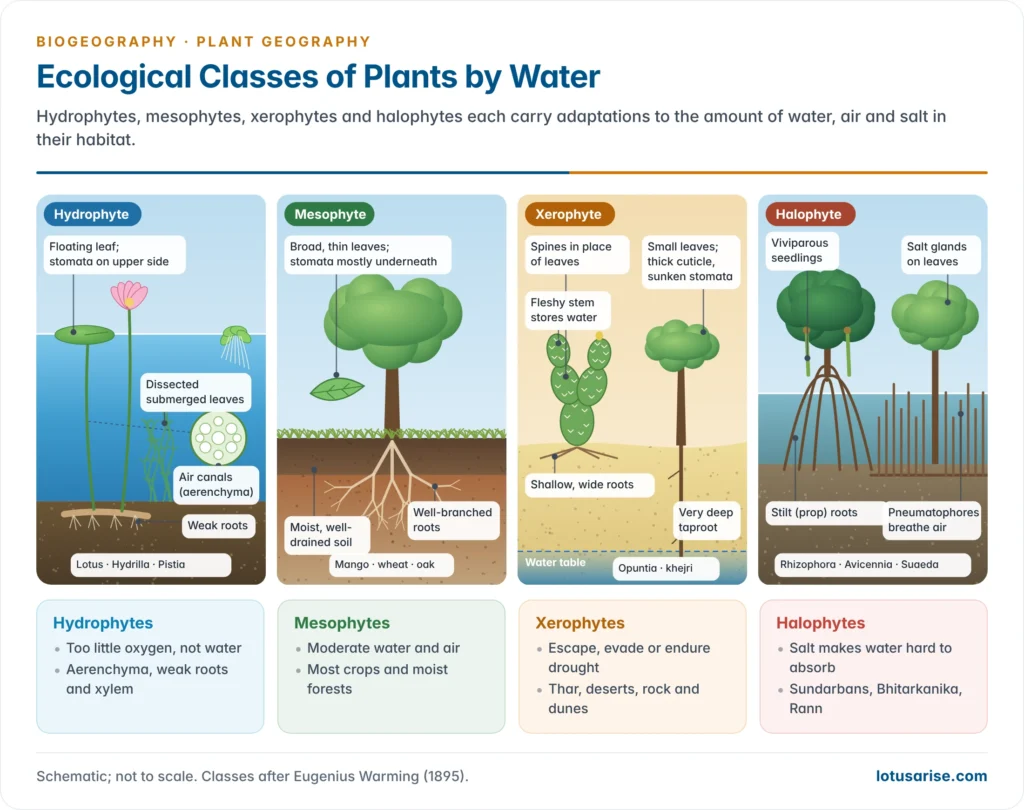
| Basis | Hydrophyte | Mesophyte | Xerophyte | Halophyte |
|---|---|---|---|---|
| Habitat | Water, waterlogged soil | Moist, well-drained soil | Deserts, rocks, dunes | Saline soil, tidal mud |
| Root system | Weak or absent | Well developed | Very deep or wide | Stilt roots, pneumatophores |
| Leaves | Thin, dissected or floating | Broad, thin | Reduced, spines, succulent | Thick, succulent, salt glands |
| Cuticle and stomata | Thin; stomata on top or absent | Moderate; stomata below | Thick; sunken stomata | Thick; salt excretion |
| Special tissue | Aerenchyma | Normal | Water-storage tissue | Water storage; vivipary |
| Examples | Lotus, Hydrilla, Eichhornia | Mango, wheat, oak | Khejri, Opuntia, Calotropis | Rhizophora, Avicennia, Suaeda |
Classification by light
- Heliophytes (sun plants): need full sunlight. They have small, thick leaves and a high light requirement. Teak, sal, chir pine and most grasses are light demanders that regenerate only in openings.
- Sciophytes (shade plants): grow in low light under a canopy. They have broad, thin, dark-green leaves rich in chlorophyll: ferns, mosses, Oxalis, many forest herbs and young shade-tolerant trees.
- Facultative plants grow in either: they are shade-tolerant when young and light-demanding when mature.
- Plants also respond to day length (photoperiodism): short-day plants such as rice flower as days shorten, long-day plants such as wheat as they lengthen, and day-neutral plants regardless.
Classification by temperature
- Alphonse de Candolle (1874) grouped plants by the heat they need. His groups were the basis of Köppen’s climate classification.
| Group | Temperature need | Vegetation |
|---|---|---|
| Megatherms | High temperature all year | Equatorial rainforest |
| Xerophiles | Heat with prolonged drought | Hot-desert vegetation |
| Mesotherms | Moderate heat, a warm and a cool season | Tropical deciduous, subtropical and Mediterranean |
| Microtherms | Low temperature, short summer | Mixed and coniferous forests of cold temperate lands |
| Hekistotherms | Very low temperature | Tundra and alpine plants |
Raunkiaer’s life forms
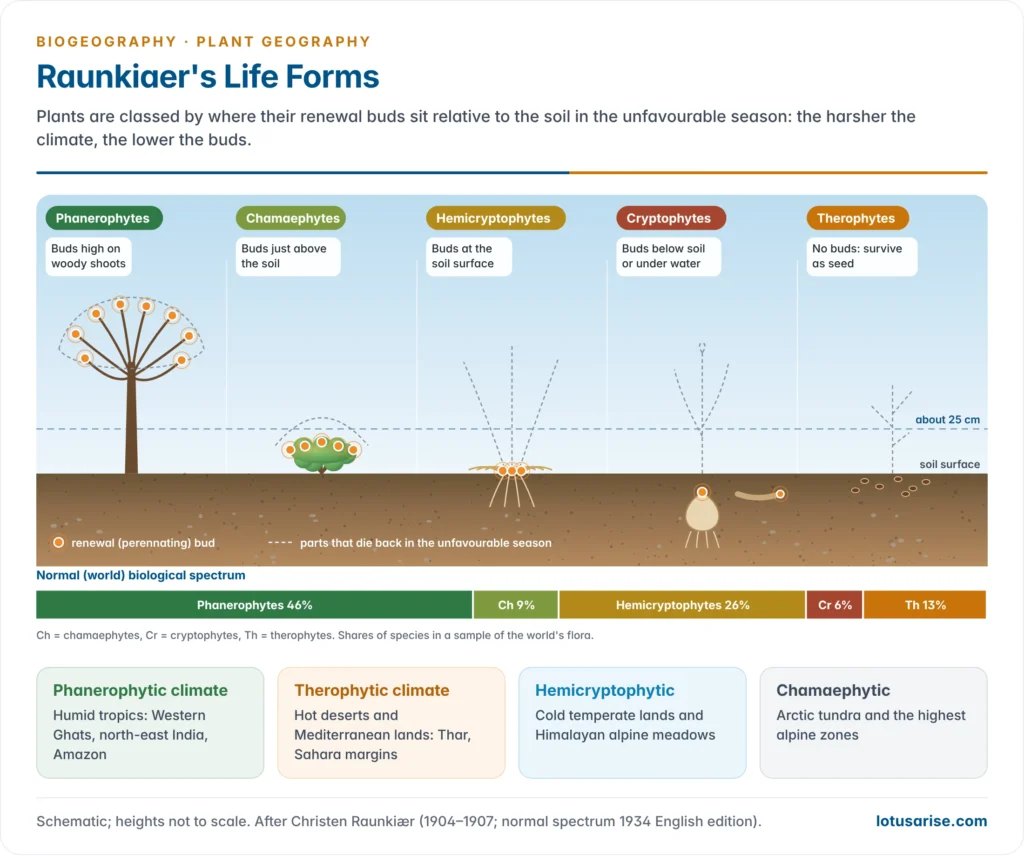
- Christen Raunkiær, a Danish botanist, classified plants (1904–1907) by how they survive the unfavourable season: the position of their perennating (renewal) buds relative to the soil surface. The higher and more exposed the buds, the milder the climate the plant needs.
| Life form | Position of renewal buds | Examples |
|---|---|---|
| Phanerophytes | High in the air, above about 25 cm, on woody shoots | Trees, shrubs, lianas, epiphytes |
| Chamaephytes | At or just above the soil, below about 25 cm | Dwarf shrubs, cushion plants, bilberry |
| Hemicryptophytes | At the soil surface, protected by litter or snow | Tussock grasses, rosette herbs, dandelion |
| Cryptophytes | Below the soil (geophytes) or under water or mud (helophytes, hydrophytes) | Bulbs, corms, rhizomes, lotus |
| Therophytes | No bud: survive as seed | Annual herbs and grasses, desert ephemerals |
- Biological spectrum: the percentage of each life form in a flora. Raunkiær’s normal spectrum for the world’s flora is phanerophytes 46%, chamaephytes 9%, hemicryptophytes 26%, cryptophytes 6% and therophytes 13%.
- A region’s departure from the normal spectrum defines its phytoclimate:
- Phanerophytic in the humid tropics, such as the Western Ghats and north-east India.
- Therophytic in hot deserts and Mediterranean lands, such as the Thar.
- Hemicryptophytic in cold temperate regions and the Himalayan alpine meadows.
- Chamaephytic in arctic and high-alpine areas.
Structure of Plant Communities
Vertical stratification
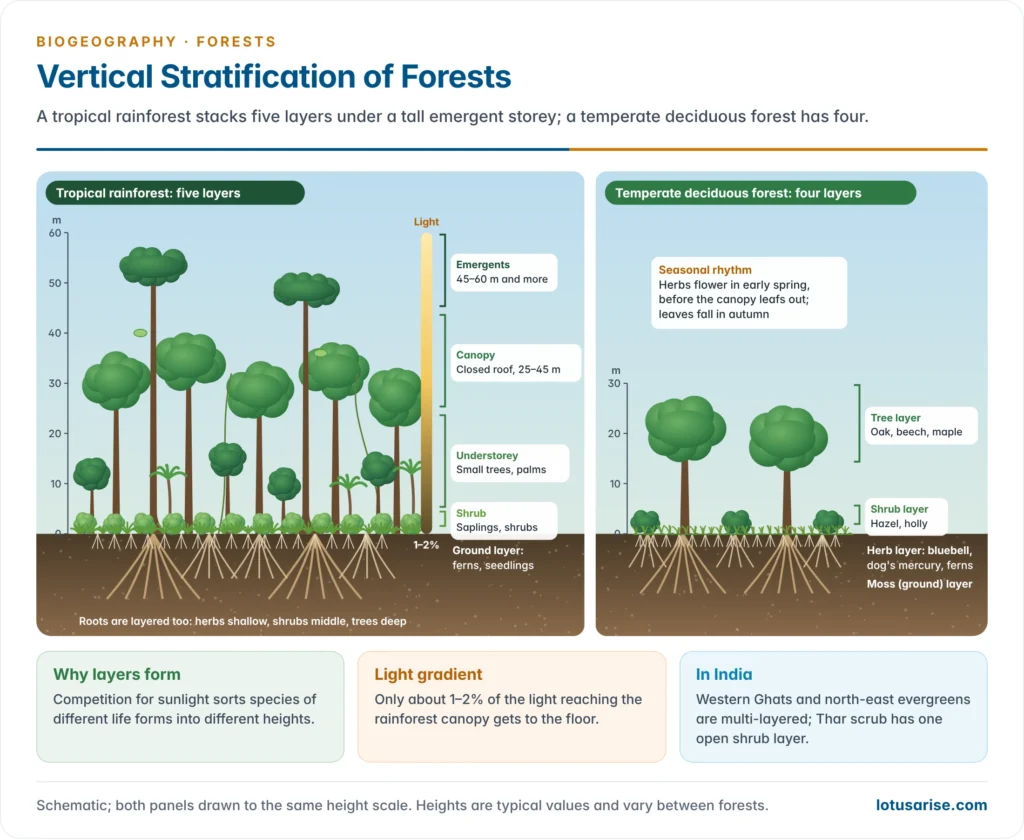
- Stratification is the arrangement of a community in vertical layers, from the canopy to the ground and on into the soil.
- It results from competition for sunlight, the energy source of photosynthesis. Through adaptation, competition and natural selection, species of different life forms come to occupy different heights, each using the light left by the layer above.
- Temperate deciduous forest has four main layers:
- Dominant (tree) layer: the crowns of the tallest trees, such as oak and beech, which form the canopy. A co-dominant layer of slightly shorter trees often lies just below it.
- Shrub layer: hazel, holly and young trees.
- Herb (field) layer: bluebell, dog’s mercury and ferns, which flower in spring before the canopy closes.
- Ground (moss) layer: mosses and litter on the forest floor.
- Tropical rainforest is the most layered community, with five strata:
- Emergents: isolated giants of 45–60 m or more, such as dipterocarps.
- Canopy: a closed roof of crowns at about 25–45 m, laced with lianas and epiphytes.
- Understorey: shade-tolerant small trees and palms.
- Shrub layer: saplings and shrubs.
- Ground layer: ferns, fungi and seedlings in deep shade, as little as 1–2% of the sunlight reaching the canopy.
- Below ground, roots are also stratified: shallow grass and herb roots, middle shrub roots, and deep tree roots. This lets several species share water and nutrients.
- Indian examples: the Western Ghats evergreen forests and those of the north-east show several tree layers with dense epiphytes. Sal forests have a tree, shrub and grass layer. Thorn scrub of the Thar has little more than one open shrub layer above grass.
- Stratification increases with rainfall, temperature and soil depth. It is best developed in the climax forests of the humid tropics and weakest in deserts and tundra.
Plant Succession
Meaning of succession
- Succession (biotic or ecological succession) is the directional, sequential replacement of one community by another in the same habitat over time, until a community in equilibrium with the climate develops.
- Henry Chandler Cowles (1899) demonstrated it on the sand dunes of Lake Michigan, where dunes of increasing age carry a sequence of communities.
- Frederic Clements (1916) gave the classical theory.
- Sere: the whole sequence of communities from the first colonists to the climax. Each intermediate community is a seral stage.
- Pioneer community: the first colonists of a bare site, usually small, fast-growing, short-lived species with wide tolerance.
- Climax community: the final, relatively stable, self-perpetuating community in equilibrium with the regional climate. Because climate controls it, it is also called the climatic climax.
- Succession acts on the whole community. Animals follow the plants, and soil develops with the vegetation: soil formation and succession advance together.
Causes of succession
- Initial (initiating) causes create a bare area or destroy the existing community.
- Climatic: glaciation, drought, storms, fire caused by lightning.
- Topographic: erosion, deposition, landslides, volcanic eruption, emergence of new land.
- Biotic: grazing, disease, human clearing.
- Continuing (ecesic) causes shift populations from one stage to the next: migration, ecesis, aggregation, competition and reaction.
- Stabilising causes bring the sequence to rest. Climate is the main one, which is why the climax is called climatic.
Stages of succession
- Clements (1916) recognised six processes, which also serve as the stages of every sere:
- Nudation: formation of a bare area by a topographic, climatic or biotic cause.
- Migration (invasion): arrival of seeds, spores and propagules by wind, water and animals.
- Ecesis: successful germination, growth and establishment of the migrants. Only a few survive the harsh conditions.
- Competition and coaction: as numbers grow, individuals compete for space, light, water and nutrients.
- Intraspecific competition is between members of one species: the fittest survive and the weaker are eliminated, but the species is preserved.
- Interspecific competition is between species: the most aggressive becomes dominant, or a balance is kept where they are equally strong.
- Reaction: the community modifies its own habitat: it adds humus, deepens soil, raises moisture and shade. The changed site then favours new invaders and drives the next stage. Reaction is the motor of autogenic succession.
- Stabilisation: the community reaches equilibrium with the climate and becomes the climax.
Characteristics of succession
- Succession is orderly and directional, and so predictable in a given climate.
- It results from the community modifying its own environment (reaction), within limits set by climate.
- It ends in a stable climax with the greatest biomass and the most complex structure the site can support.
- Trends from pioneer to climax, summarised by Eugene Odum (1969):
| Attribute | Early (pioneer) stages | Mature (climax) stage |
|---|---|---|
| Production / respiration | Production exceeds respiration (P/R > 1) | Production about equals respiration (P/R ≈ 1) |
| Biomass and organic matter | Small | Large |
| Species diversity | Low | High |
| Structure and stratification | Simple, few layers | Complex, many layers |
| Life history | Small, short-lived, rapid breeders (r-selected) | Large, long-lived (K-selected) |
| Food chains | Short, linear, grazing-based | Complex webs, detritus-based |
| Nutrient cycling | Open, nutrients lost | Closed, nutrients conserved |
| Niche | Broad | Narrow, specialised |
| Stability | Low | High |
| Soil | Thin, immature | Deep, with developed horizons |
- Diversity often peaks just before the climax, where early and late species overlap, and falls slightly when a few dominants take over.
Types of succession
| Basis | Types |
|---|---|
| Nature of the bare area | Primary (never vegetated before) and secondary (vegetation removed, soil left) |
| Cause of change | Autogenic (driven by the community’s own reaction) and allogenic (driven by outside forces: silting, fire, climate change) |
| Nutrition | Autotrophic (green plants dominate early; organic matter builds up) and heterotrophic (decomposers dominate, as in a rotting log; organic matter declines) |
| Direction | Progressive (towards greater biomass and complexity) and retrogressive (towards simpler communities, under grazing, pollution or invasive species) |
| Starting moisture | Hydrarch (from water), xerarch (from a dry site) and mesarch (from a moist site) |
- Seres named after their habitat:
- Hydrosere: begins in fresh water (ponds, lakes, swamps).
- Xerosere: begins on a dry site. Its forms are the lithosere on bare rock and the psammosere on sand.
- Halosere: begins in saline water or soil: salt marshes and mangrove flats.
- Serule: a micro-succession of decomposers on a fallen log, dung or a dead animal.
Primary and secondary succession
| Feature | Primary succession | Secondary succession |
|---|---|---|
| Starting site | Never vegetated: bare rock, new lava, dunes, deltas, glacial moraine | Previously vegetated, now cleared |
| Soil | Absent; must be formed | Already present and mature |
| Propagules | Must arrive from outside | Seeds, roots and stumps survive in the soil |
| Pioneers | Lichens, mosses, algae | Annual weeds and grasses |
| Speed | Very slow: centuries to millennia | Fast: decades |
| Examples | Lava of Krakatau (1883), Barren Island, Himalayan glacier forelands | Abandoned jhum fields, burnt or felled forest, fallow farmland |
Hydrosere
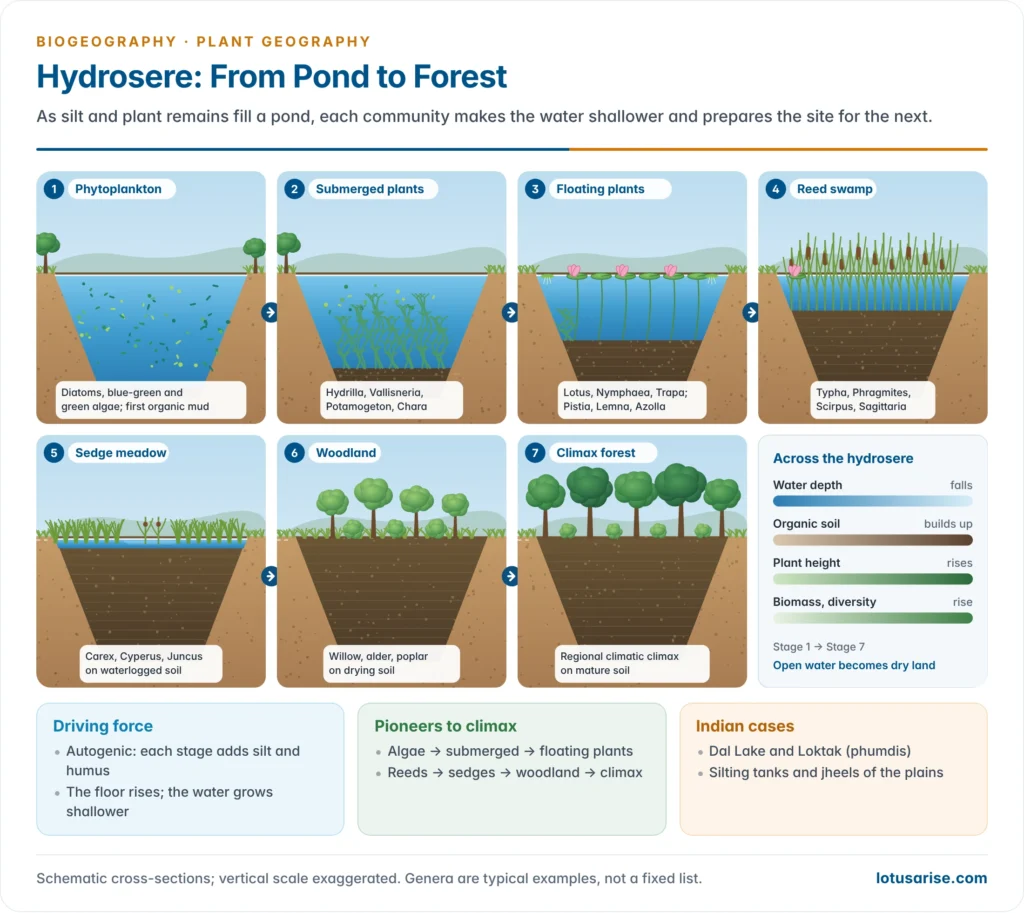
- A hydrosere develops in a pond or lake that is slowly filled by silt and plant remains until it becomes dry land carrying forest. Each stage raises the floor and makes the water shallower for the next.
- Stages:
- Phytoplankton stage: blue-green algae, green algae and diatoms are the pioneers. Their dead remains form the first organic mud on the floor.
- Rooted submerged stage: where the water is a few metres deep, submerged plants such as Hydrilla, Vallisneria, Potamogeton and Chara root in the mud. They trap silt and raise the floor.
- Floating stage: in shallower water, rooted floating-leaved plants (lotus, Nymphaea, Trapa) and free floaters (Pistia, Lemna, Azolla) spread. Their leaves shade out the submerged plants.
- Reed-swamp (amphibious) stage: at about 1 m depth and less, emergent plants (Typha, Phragmites, Scirpus, Sagittaria) form dense stands, transpire heavily and build up the floor rapidly.
- Sedge-meadow (marsh-meadow) stage: the waterlogged soil carries sedges and rushes (Carex, Cyperus, Juncus), which dry the soil further.
- Woodland stage: moisture-loving shrubs and trees such as willow (Salix), alder (Alnus) and poplar invade the drying soil and add humus.
- Climax forest stage: the site becomes dry land with the regional climax: a tropical moist deciduous forest in much of India, or a temperate deciduous forest in mid-latitudes.
- Indian examples: shallowing and weed choking of Dal Lake, the floating phumdis of Loktak Lake, and siltation of tanks and jheels across the Gangetic plain are hydroseres speeded up by eutrophication.
Xerosere
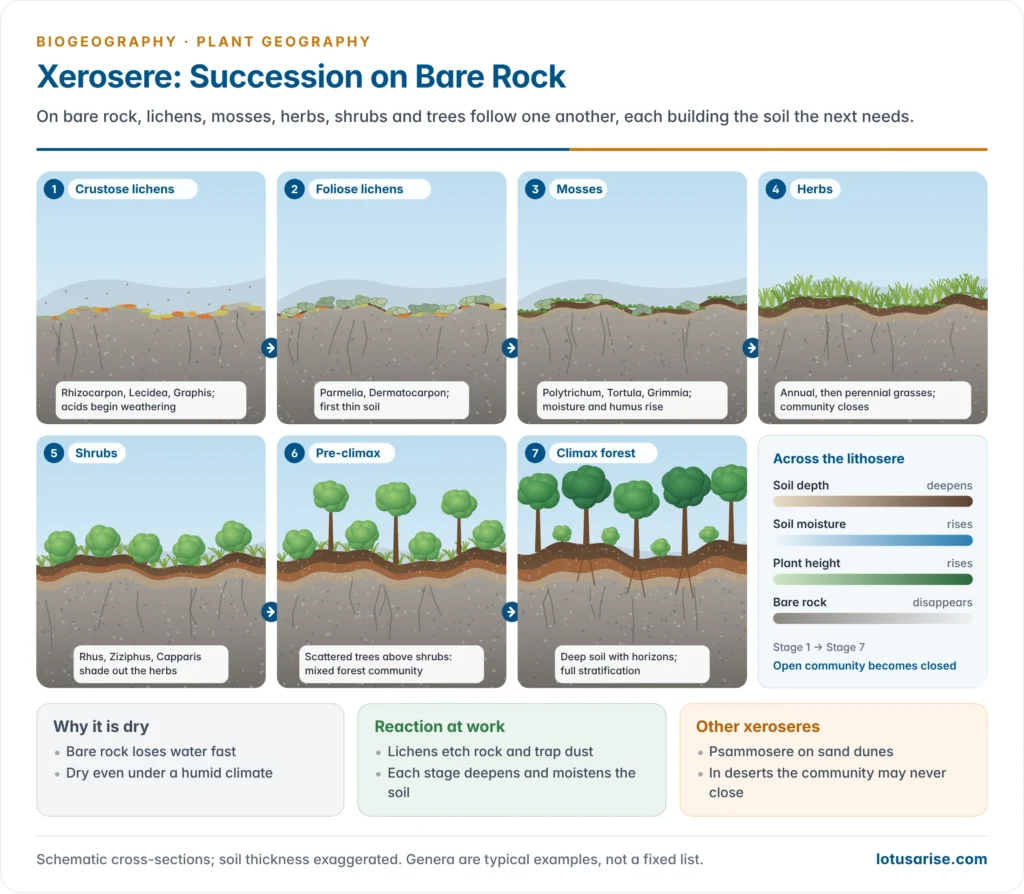
- A xerosere begins on a dry habitat: the site is dry because the bare rock or sand loses water quickly, even where the climate is humid.
- Lithosere (on bare rock):
- Crustose lichen stage: crustose lichens (Rhizocarpon, Lecidea, Graphis) cling to the bare rock and tolerate heat, cold and drought. Their acids attack the minerals, starting weathering, and wind-blown dust collects round them.
- Foliose lichen stage: leafy lichens (Parmelia, Dermatocarpon) overgrow the crusts, trap more dust and hold water. The first thin soil appears and micro-organisms colonise it.
- Moss stage: mosses (Polytrichum, Tortula, Grimmia) spread as mats, cut evaporation, raise soil moisture and add organic matter. Mites, ants and spiders appear.
- Herb stage: annual and then perennial grasses and herbs cover the site. The open community becomes a closed community. Shade lowers ground temperature and keeps the soil moist. Intraspecific and interspecific competition begin.
- Shrub stage: shrubs such as Rhus, Ziziphus and Capparis shade out the herbs and deepen the soil.
- Pre-climax (forest) stage: seeds of trees arrive from nearby, and scattered trees rise above the shrubs: a mixed forest community.
- Climax forest stage: tall trees close the canopy; roots penetrate deep, the soil reaches its full depth with developed horizons, and stratification is complete: a mature ecosystem.
- Psammosere (on sand): Cowles traced marram grass binding loose dunes, then cottonwood, pines and oaks on older dunes. Along the Indian coast, Spinifex and Ipomoea pes-caprae bind fore-dunes before casuarina and scrub follow.
- In a dry climate, the community may never close: much of a desert dune remains open, with a xerophytic shrub or grass climax.
Secondary succession
- Secondary succession occurs where existing vegetation is destroyed but the soil remains.
- Natural causes: lava flows, prolonged drought, lightning fires, cyclones, floods, landslides.
- Human causes: felling, burning, overgrazing, land-use change, abandoned fields.
- It is much faster than primary succession, because mature soil, seeds, roots and stumps survive.
- Jhum fallows of north-east India: forest is slashed and burnt, cropped for a few years and abandoned. The fallow passes through weeds, then bamboo and shrubs, and then secondary forest.
- With a long fallow of 20 years or more, the forest recovers. Where the cycle has shrunk to a few years, succession is arrested at a weed or bamboo stage, and soil fertility falls; this is a form of deforestation.
- Central Himalaya: after lopping, fire or felling, chir pine (Pinus roxburghii), a light-demanding early-successional tree, invades banj oak (Quercus leucotrichophora) forest. The oak, the late-successional dominant, returns only if disturbance stops.
Mechanisms of replacement
- Joseph Connell and Ralph Slatyer (1977) proposed three models of how one stage replaces another:
- Facilitation: early species make the site suitable for later ones, as lichens make soil for mosses. This is the Clements model and fits primary succession.
- Tolerance: later species tolerate the low resources left by earlier ones and simply outlive them; early species neither help nor hinder.
- Inhibition: early occupants hold the site and block later species until they die or are disturbed. This explains why weeds or invasive shrubs can stall succession for decades.
Climax and its types
- Climax: the terminal, self-perpetuating community of a sere, in dynamic equilibrium with climate and habitat. Its species reproduce under their own shade, so it persists until disturbed.
- Types of climax:
- Climatic climax: controlled by the regional climate; the community found on average, well-drained soils.
- Edaphic climax: held by a soil factor, such as waterlogging, salinity or shallow rock: mangroves, swamp forests, Prosopis–Capparis scrub on salt-affected land.
- Topographic (physiographic) climax: held by relief: steep slopes, aspect or a frost hollow.
- Biotic climax (disclimax): held by grazing, burning or cutting. The plagioclimax is the human-deflected form: when disturbance continues, the normal sere is deflected into a plagiosere that persists as long as the disturbance lasts, as in grazed hill grasslands.
- Fire climax: maintained by recurrent fire, such as many savannas and chir pine forests.
- Sub-, pre- and post-climax:
- Subclimax: a seral stage that persists for a long time because it is held just short of the climax, for example by repeated fire.
- Preclimax: in Clements’ usage, a community less mesic than the climax (grassland or dry scrub where local conditions are drier); it is also used for the stage immediately before the climax, the mixed forest community.
- Postclimax: a community more mesic than the climax, such as riverine forest in a grassland region.
- Retrogression: where a disturbed community recovers but the factor returns or worsens, succession may run backwards to simpler stages.
Climax theories
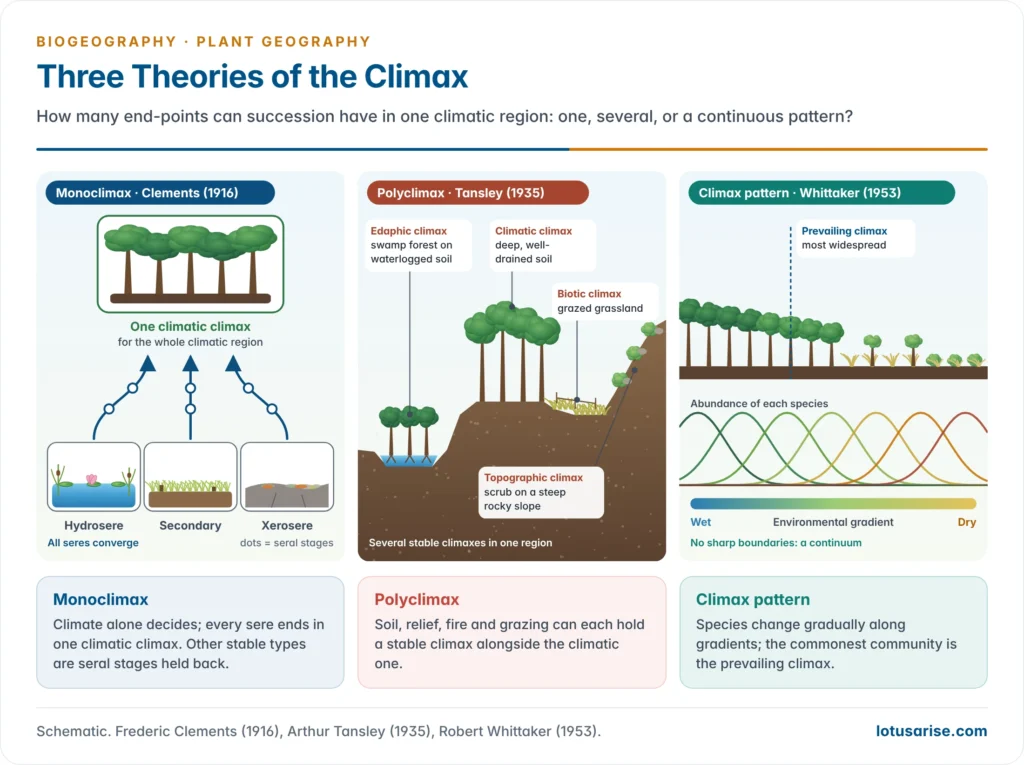
- Monoclimax theory: Frederic Clements (1916) held that each climatic region has only one true climax, the climatic climax. Every sere, wet or dry, rock or lake, converges on it given enough time. All other stable communities are seral stages held back by local factors.
- Polyclimax theory: Arthur Tansley (1935), with later support from Rexford Daubenmire, argued that a region can carry several climaxes, each controlled by climate, soil, topography, fire or animals. Edaphic and topographic climaxes are true climaxes, not unfinished seres.
- Climax pattern hypothesis: Robert Whittaker (1953) saw the climax as a continuous pattern of populations that changes gradually along environmental gradients. The commonest community in an area is the prevailing climax, but no single climax is “correct”.
| Basis | Monoclimax | Polyclimax | Climax pattern |
|---|---|---|---|
| Proponent | Frederic Clements (1916) | Arthur Tansley (1935) | Robert Whittaker (1953) |
| Number of climaxes | One per climatic region | Several in a region | A continuum; one prevailing type |
| Main control | Climate only | Climate plus soil, relief, fire, biota | Whole set of environmental gradients |
| View of community | Superorganism with sharp limits | Discrete units, each in equilibrium | Individual species on gradients |
| Other stable communities | Seral stages held back | Separate climaxes | Parts of one pattern |
- Current view:
- Most ecologists favour a dynamic, non-equilibrium view. Disturbance by fire, floods, storms, pests and humans is part of the system, and many landscapes are mosaics of patches at different seral stages.
- The climax is a statistical tendency, not a fixed end-point.
- Climate change is now shifting the climax itself, as treelines rise in the Himalaya.
Succession in India
- Sundarbans: new mud islands (chars) are colonised by pioneers, wild rice (Porteresia coarctata) and Avicennia, followed by Sonneratia, Excoecaria and Ceriops, and finally by sundari (Heritiera fomes) on higher, less saline ground. Reduced freshwater flow and rising salinity now favour salt-tolerant early species over sundari.
- Keoladeo National Park, Bharatpur: grazing was banned from October 1982. Without buffaloes the grass Paspalum distichum overgrew the shallow wetlands, choking the open water and the tubers on which wintering cranes fed: allogenic succession steered by management.
- Kaziranga: annual Brahmaputra floods and managed burning keep the tall wet grasslands as an edaphic and fire subclimax. Without them, woodland encroaches and rhino habitat shrinks.
- Western Ghats and Nilgiris: the shola–grassland mosaic was long treated as a biotic climax produced by fire. Frost and fire maintain the grassland, but each patch is now seen as a stable state in its own right. Exotic wattle, pine and eucalyptus are invading the grasslands.
- Invasive species: a 2023 national assessment found invasive plants in about two-thirds of India’s natural areas. Lantana camara feeds a fire cycle that inhibits native regeneration and arrests succession in dry deciduous forests of central and southern India.
- Primary succession is under way on the lava flows of Barren Island in the Andamans and on moraines exposed by retreating Himalayan glaciers, where lichens and mosses colonise bare debris.
Significance of the study of succession
- It explains why vegetation is where it is and predicts how it will recover after disturbance.
- It guides forest management: shifting cultivation cycles, grazing control, fire management and the choice of species for restoration, which works best when planting copies natural succession, for example by using mangrove pioneers on new mudflats.
- It underpins wetland and grassland conservation, where managers often have to hold succession back to keep a valued seral stage.
- It helps judge how communities will respond to climate change and invasive species.
Previous Year Questions
2022Plants and animals that exist in a particular ecosystem are those that have been successful in adjusting to their habitat and environmental conditions. Elucidate with examples.2017Give a classification of plants based on the amount of water requirement.2015Explain the characteristics of ecological succession.1993Write short note: biotic succession.