

Proofs for the Existence of God and their Critique (Indian and Western).
Official Syllabus: Paper II, Section B, Unit 2
Before studying any single proof for God — Anselm’s, Aquinas’, Paley’s, Kant’s or Udayana’s — we must ask a prior question: what would it even mean to prove God? God is said to be infinite, beyond the senses and the ground of everything; a proof works with finite concepts and finite experience. Can such tools reach such an object? This article explains why philosophers seek proofs at all, what kinds of proof there are (direct, deductive, inductive), the great division between a priori and a posteriori arguments, the map of all the classical Western and Indian arguments, the Indian way of asking the question through pramāṇas (valid means of knowledge), whether proofs are needed for a religion to grow or even to survive, and the strong challenge of those — existentialists, fideists and “reformed” thinkers — who say that faith neither needs nor can have a proof.
In simple words
A child says, “My mother loves me.” Nobody asks the child for a proof — the child simply lives in that love. But a stranger may doubt it, and a philosopher may ask what evidence would settle it: her behaviour? her words? a definition of “mother”? Belief in God is similar. The believer usually lives in it without proof; the doubter asks for evidence; the philosopher asks whether any evidence could settle a question about a being who cannot be seen. That last question is the subject of this article.
Context & Problem
Why Should Anyone Try to Prove God?
- Who needs a proof? For the religious person, God’s existence poses no problem — it is self-proved in daily worship and experience. The atheist is hardly worried about whether God exists. So who is keen to prove it?
- Human nature wants reasons. It is part of human nature to want logical confirmation of one’s beliefs, even when those beliefs have a psychological basis (fear, hope, love, tradition). This element in us has driven philosophers to look for proofs of the God who is the base of religious faith.
- The charge of blind faith. A belief that cannot be supported by any argument is treated as blind faith. Since philosophers were also busy rejecting the arguments for God, believers felt it necessary to back up their faith with logic, so that faith would not lose its standing.
- Proofs as pleas. Hence the remark of one thinker: all proofs that God exists are pleas put forward to justify one’s faith and the particular way in which one feels one must grasp the highest principle. On this view, a “proof” is less a laboratory demonstration and more a reasoned confession.
- An unequal struggle. God’s existence is infinite, so it cannot be fully captured by a limited intelligence. Yet the human mind refuses to give up this unequal struggle — it keeps trying to understand what it cannot fully grasp.
God Is Not an Object among Objects
- Extra-sensory. God is not an object of sensory experience. Those who demand a sensory proof forget that God is fundamentally different from a physical object.
- Different levels of proof. The kind of argument offered varies with the level of reality concerned:
- A mental idea cannot be exhibited in the same manner as a material object — you can show someone a chair, but not your idea of justice.
- Arguments that proceed from feelings (awe, dependence, guilt) do not present objects at all; they express an activity of the person.
- So the question is not trivial. Asking for a proof of God is not like asking for a proof that there is milk in the fridge. We must first decide what kind of proof is even possible.
In simple words
You cannot prove that a song is beautiful by weighing the CD. Beauty is real, but it is known through listening, not through a weighing scale. Many religious thinkers say God is like that: real, but known through a different faculty than the one that checks the weight and colour of things. The debate about proofs is partly a debate about which faculty — reason, senses, conscience, scripture or experience — can reach God.
What Is a Proof? Three Kinds
A proof is a demonstration that something is — here, that God exists. Three types are usually distinguished:
- Direct proof. Showing the thing itself to the senses — “here is the table”. This cannot be used for God, because God is not a material object that can be experienced directly.
- Inductive proof. Reasoning from experience to a general conclusion — from observed effects, order or morality to their cause. It is a posteriori (after experience). It supports its conclusion with evidence, but never with complete certainty; the conclusion is only probable. The cosmological arguments of Aquinas are of this type (Article 3).
- Deductive proof. Reasoning from premises to a conclusion that follows necessarily, as in a syllogism or in mathematics. It is a priori (before experience) in the sense that it rests on reason and the analysis of concepts. Its certainty is complete, but its home ground is logic and mathematics — the model Descartes admired. The ontological argument of Anselm is of this type (Article 2).
- So only two routes remain. Since direct proof is ruled out, only inductive and deductive arguments can be used — and each has its own difficulty, as the next section shows.
Core Doctrine
1. Why Neither Deduction nor Induction Easily Reaches God
(a) The limit of deduction
- Necessity is only logical. In a syllogism or a mathematical proof the conclusion follows necessarily from the premises — but this necessity is logical, not factual.
- Mathematics works with definitions. Mathematical reasoning is purely a priori: it consists in the consistent use of defined symbols. It does not by itself refer to any actual state of affairs. Its necessity belongs to tautologies or the consistent use of words.
- What a deduction of God would show. If we could prove God deductively, the conclusion would hold for “God” as a word or a stipulated definition. It would not, by itself, establish the fact that a personal Being exists. (“A unicorn has one horn” is necessarily true — but it does not put a unicorn in the zoo.)
(b) The limit of induction
- Induction moves from observables to observables. It starts from what can be observed and ends with conclusions about what can be observed (from smoke seen to fire that could be seen).
- God is not observable even in principle. A God worthy of worship must be infinite and of surpassing excellence. But any observable object is limited to a certain span of space and time.
- An observable God would be an idol. A God who could be sensed like a mountain would not be the infinite God of religion — he would be one more finite thing, an idol.
- The finite-to-infinite gap. Even if we could start from the observable world, how could finite data support a conclusion about an infinite God? The cosmological proof argues from the contingency of the world to a necessary Being (Article 4); the design proof argues from finite order to an infinite Designer (Article 5). In both, the conclusion seems far bigger than the evidence.
- Aquinas’ way out: analogy. St. Thomas Aquinas saw this difficulty. He proposed the analogy of being (analogia entis): what we know of excellence in finite things can be said of God analogically — not in exactly the same sense, nor in a totally different sense, but in a proportionate sense. Many competent thinkers feel that this device shows the difficulty of proving an infinite God from finite premises more than it solves it.
In simple words
Suppose you have only ever seen small ponds, and someone tells you there is an ocean. Watching ponds will never show you the ocean; at most it lets you imagine “water, but endless”. Inductive proofs of God are like reasoning from ponds to the ocean: they point in a direction, but the conclusion is of a different size from the evidence.
2. A Priori and A Posteriori Arguments
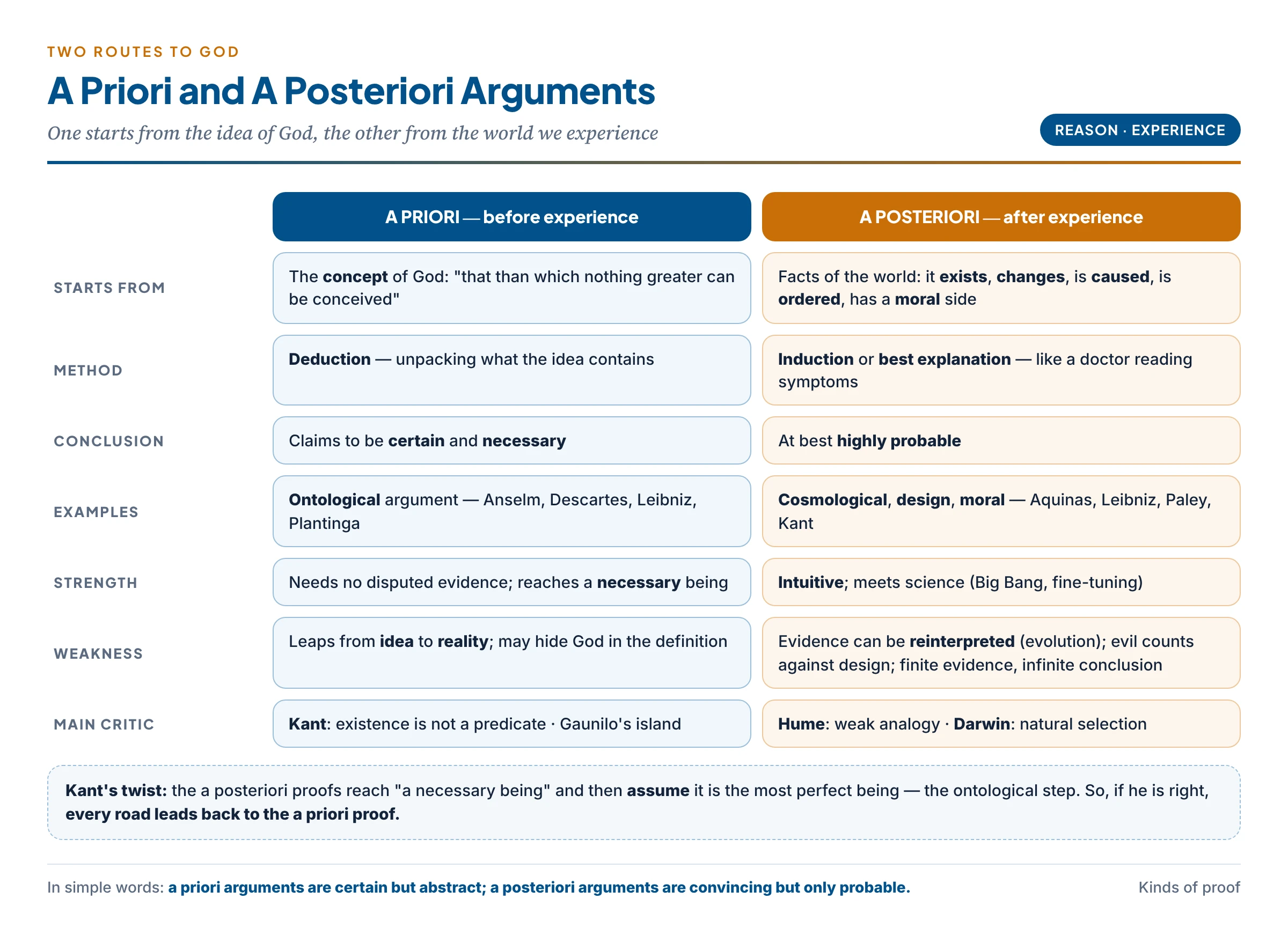
- A priori arguments are derived independently of experience, from pure reason and the analysis of concepts. They aim at necessary truths. The classic example is the ontological argument of Anselm and Descartes: God is “that than which nothing greater can be conceived“; a being that existed only in the mind would not be the greatest; so God exists in reality (Article 2).
- A posteriori arguments are derived from experience of the world — its existence, change, causation, order and moral character. Examples:
- Cosmological — the world is caused or contingent, so there is a First Cause or Necessary Being (Aquinas, Leibniz, the Kalām argument: “the universe began to exist; whatever begins to exist has a cause”).
- Teleological — the complexity and order of nature point to an intelligent designer (Paley: a watch implies a watchmaker).
- Moral — objective moral law points to a moral lawgiver (Kant, Newman, Rashdall).
- Logical form. A priori proofs are deductive: if the premises are true, the conclusion is certain. A posteriori proofs are inductive or abductive — they offer the best explanation of the evidence (an “inference to the best explanation“, as a doctor infers a disease from symptoms). Their conclusion is probable, not certain.
| Point | A priori arguments | A posteriori arguments |
|---|---|---|
| Starting point | The concept or definition of God | Facts of experience: existence, motion, causation, order, morality |
| Method | Deduction; analysis of meaning | Induction or inference to the best explanation |
| Strength of conclusion | Claims necessity and certainty | At best high probability |
| Main example | Ontological argument (Anselm, Descartes, Leibniz, Plantinga) | Cosmological, teleological, moral arguments (Aquinas, Leibniz, Paley, Kant) |
| Main strength | Independent of disputed empirical data; gives a necessary being | Intuitive, rooted in the observable world; can engage science (Big Bang, fine-tuning) |
| Main weakness | Seems to jump from concept to reality; may assume God in the definition (circular); Kant: “existence is not a predicate” | Depends on evidence that can be reinterpreted (evolution, multiverse); the problem of evil counts against a designer; finite evidence, infinite conclusion |
| Typical critic | Gaunilo, Kant, Hume, Russell | Hume, Kant, Darwin, Russell |
Which kind should be preferred? Both sides have serious defenders.
- For the a posteriori route.
- It is grounded in observable reality, so it is more convincing to most people.
- It fits the method of science and engages modern cosmology and physics (the beginning of the universe; the fine-tuning of physical constants).
- The ontological argument often strikes people as too abstract — a play of words.
- Kant’s objection that existence is not a predicate seems to defeat purely conceptual proofs.
- For the a priori route.
- Only an a priori argument can reach a necessary being; evidence from a changing world gives only a probable, perhaps contingent, cause.
- Empirical arguments are hostage to the next scientific theory — Darwin weakened the design argument overnight.
- Kant himself argued that the a posteriori proofs secretly depend on the a priori one: the cosmological proof reaches a “necessary being” and then assumes that this being is the most perfect being — which is the ontological step. If he is right, the a posteriori proofs are only as strong as the a priori proof.
- A balanced view. A posteriori arguments are more persuasive; a priori arguments are more ambitious. Neither has conclusively proved or disproved God. Many philosophers now treat them as a cumulative case — several arguments, each weak alone, together raising probability (Swinburne; see Article 10) — while many believers hold that faith plays a part no argument can replace.
3. The Ontological Argument as “the Nerve” of the Others
An influential reading holds that the ontological argument is the nerve of all the others, and that the other arguments progressively fill its empty content:
- Ontological. Its contention is that existence is the very essence (ontos) of the idea of God — from the mere analysis of the idea of a perfect being we deduce existence. Being a priori, it cannot by itself establish a fact. To remove this defect, other arguments were offered.
- Cosmological. It holds that the world is contingent and that the contingent implies a necessary ground. The idea of the “necessary” implies its existence — so it repeats the ontological argument with an extra step. But contingency is the most abstract quality of worldly things and can hardly be called something we sense.
- Teleological. It adds the experienced quality of order and harmony in the world. It too assumes that harmony is contingent and concludes to a necessary designer — whose idea, again, implies his existence.
- Moral. It adds the contingency of moral existence, the most vividly felt experience of human beings.
- Result. The empty content of the ontological argument is progressively filled by the cosmological, teleological and moral arguments — but all, in the end, rest on the ontological claim that the idea of God carries its own existence.
In simple words
Think of the steel frame of a building and the building itself. The ontological argument is the frame: “the most perfect being must exist” — strong but bare. The cosmological argument adds “and he is the ground of this changing world”; the design argument adds “and he is the intelligence behind its order”; the moral argument adds “and he is the source of the moral law”. Each adds walls and rooms; but if the frame breaks, the building cannot stand.
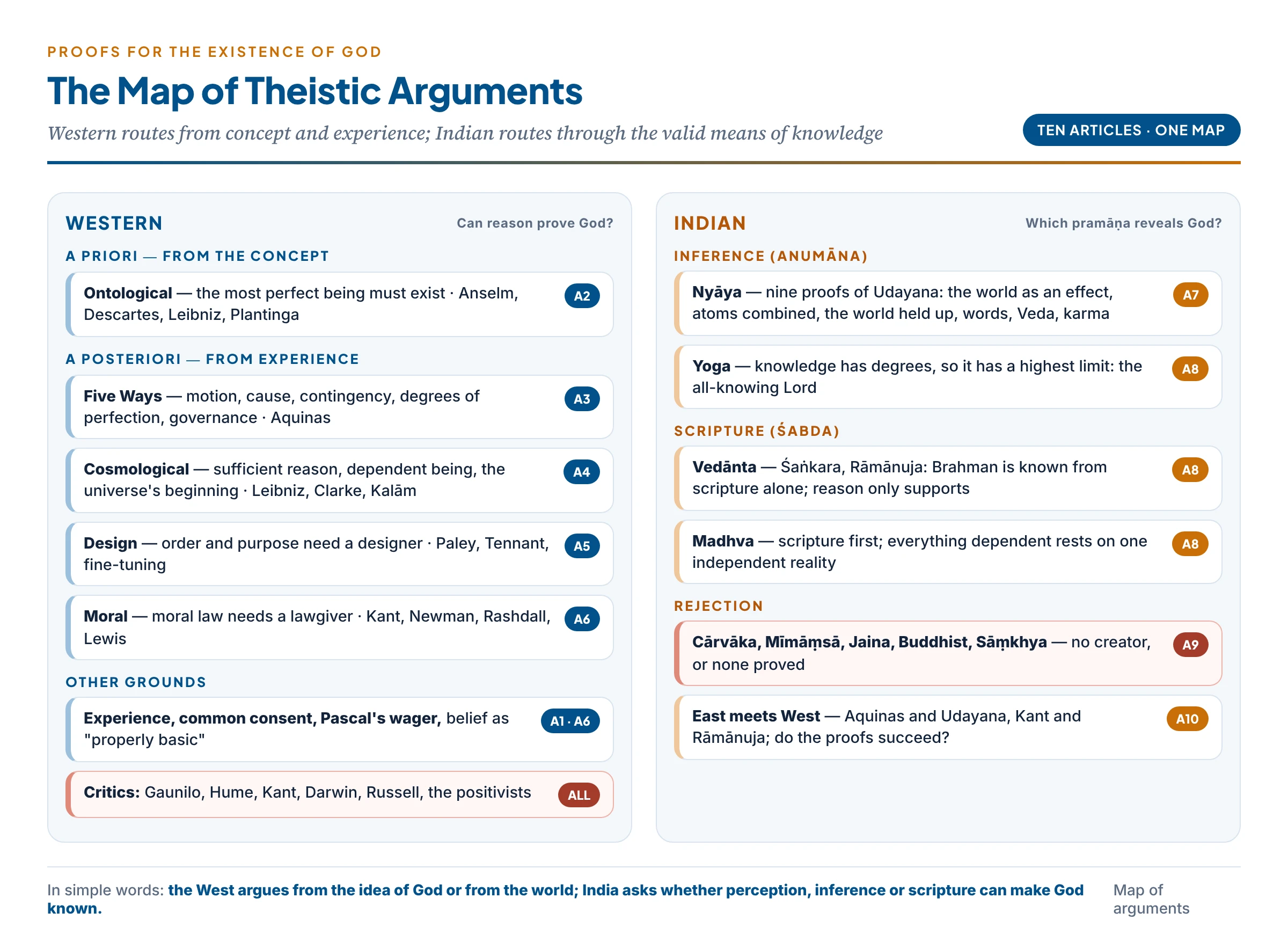
4. The Map of Theistic Arguments
Western arguments
- Ontological (a priori) — Anselm, Descartes, Spinoza, Leibniz, Hegel; modern modal versions by Hartshorne, Malcolm and Plantinga (Article 2).
- Cosmological (a posteriori) —
- From degrees of perfection — Aquinas’ fourth way (Article 3).
- Teleological (design) — Aquinas’ fifth way, Paley’s watch, Tennant’s wider teleology, fine-tuning (Article 5).
- Moral — Kant’s postulate, Newman’s conscience, Rashdall, Sorley, C.S. Lewis (Article 6).
- Other grounds — religious experience, common consent of mankind, Pascal’s wager, and the claim that belief in God is properly basic (Article 6 and below).
Indian arguments
- Nyāya — Udayana’s nine inferences: from the world as an effect, the combination of atoms, the support of the world, the conventions of language and craft, the authority of the Veda, scripture, Vedic sentences, the number that forms the first dyad, and the unseen moral force adṛṣṭa (Article 7).
- Yoga — from the degrees of knowledge to an unsurpassed, omniscient Lord; God as teacher of the ancient seers (Article 8).
- Vedānta — Śaṅkara, Rāmānuja and Madhva: God (Brahman) is known through scripture; reason only supports; Madhva’s argument from the dependence of all things on one independent reality (Article 8).
- Critics — Cārvāka, Mīmāṃsā, Jaina, Buddhist and Sāṃkhya thinkers who reject a creator God (Article 9).
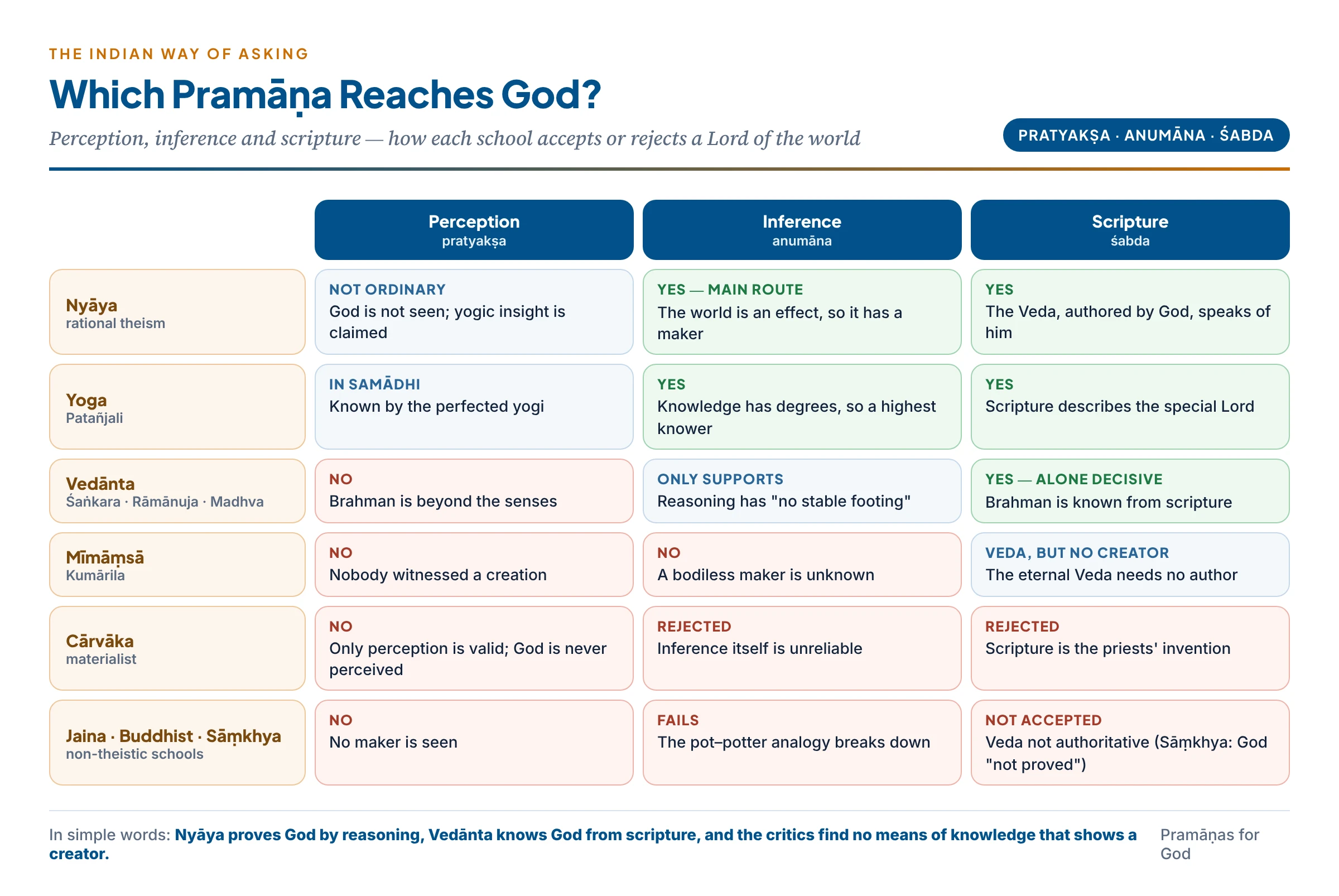
5. The Indian Way of Asking: Which Pramāṇa Reaches God?
Indian philosophy does not ask “Is there a proof?” in the abstract. It asks: by which valid means of knowledge (pramāṇa) can God be known — perception (pratyakṣa), inference (anumāna) or verbal testimony (śabda, scripture)?
- Perception (pratyakṣa). Ordinary perception cannot reach God — God has no colour, shape or sound. Some theists speak of yogic perception (the direct insight of perfected yogis), but critics such as Rāmānuja reply that even yogic perception only clarifies what has already been experienced.
- Inference (anumāna). Nyāya builds its whole theism on inference: “the earth and the like have a maker, because they are effects, like a pot” (Article 7). Yoga infers an omniscient Lord from the gradation of knowledge.
- Verbal testimony (śabda). The Vedāntins — Śaṅkara, Rāmānuja and Madhva — hold that Brahman is known only from scripture (śāstra-yoni): inference can at most support what scripture reveals. The Brahmasūtra says of reasoning that it has “no stable footing” (tarka-apratiṣṭhāna) — one clever argument is overturned by a cleverer one.
- Rejection by non-apprehension. Cārvāka accepts only perception; since God is never perceived, there is no ground to accept him. Mīmāṃsā accepts the Veda but finds in it no creator; Kumārila asks who could have witnessed creation (Article 9).
- The Kant parallel. Like Kant, the Vedāntins deny that speculative reason can establish God; unlike Kant, they rest belief not on moral reason but on revelation (Article 10).
Indian Connect — Indian Connect — the same question in two vocabularies
- The Western contrast “reason vs faith” becomes in India “anumāna vs śabda“.
- Nyāya is India’s natural theology (God proved by inference); Vedānta is closer to revealed theology (God known from scripture).
- Cārvāka’s demand for perception mirrors the empiricist and positivist demand for sense-verification.
- The Brahmasūtra’s warning that reasoning has “no stable footing” anticipates Kant’s verdict that reason, left to itself, falls into illusion when it reaches beyond experience.
6. Is a Proof Necessary for the Growth of a Religion?
Reasons for saying yes
- Apologetics. A religion spreading among educated people must answer the charge of blind faith; proofs give it rational respectability.
- Theology needs a foundation. Doctrines about God’s attributes, creation and providence presuppose that God exists; natural theology lays that foundation.
- Dialogue. Arguments create common ground with unbelievers and with other religions — Udayana debated Buddhists, Aquinas engaged Muslim and Jewish philosophers.
- Protecting the believer. Proofs answer doubts that arise inside the believer’s mind, and so strengthen commitment.
Reasons for saying no
- Religions grew without proofs. Most religions spread through prophets, saints, experience, ritual, community and moral example, long before philosophers built proofs.
- Non-theistic religions — Buddhism, Jainism — grew vast without any proof of God at all.
- Proofs rarely convert. People seldom become believers by reading Anselm; at most, proofs remove obstacles.
- Faith is not a conclusion. For many religious thinkers, faith is trust and commitment, not the acceptance of the conclusion of an argument.
- So. Proofs help the intellectual life of a religion — its theology, apologetics and dialogue — but are neither necessary nor sufficient for its growth.
7. Is God’s Existence a Necessary Condition for the Survival of Religion?
The case that God is necessary
- Theistic religions depend on God. Christianity, Islam, Judaism and theistic Hinduism make God the supreme being and moral lawgiver; God is central to worship, prayer, ritual and doctrine.
- Divine command. On the divine command view, moral and religious duties are derived from God’s will; without God they lose their basis.
- Religion as response to the divine. Rudolf Otto describes religious experience as an encounter with the numinous — the awe-inspiring and fascinating mystery. William James treats religious experiences (visions, conversions) as testimony that God is central to religion.
- Meaning, salvation and afterlife. Without God, many argue, religion loses its promise of salvation, purpose and cosmic justice.
- Pascal’s wager treats belief in God as practically necessary for religious life (Article 6).
The case that God is not necessary
- Non-theistic religions exist. Buddhism, Jainism, Confucianism, and schools such as classical Sāṃkhya and, at the highest level, Advaita Vedānta do not require a personal creator. Buddhism centres on dhamma, nirvāṇa and ethical living.
- Secular and humanistic “religions”. Humanism and the Ethical Culture movements keep ritual, community and morality without belief in God.
- Durkheim. Religion is above all about the sacred and social cohesion, not about a divine person.
- Tillich. Religion is ultimate concern — what concerns us unconditionally — not necessarily belief in a particular being.
- Freud and Marx. Religion is a psychological need (Freud) or a social institution shaped by economic forces (Marx); on these views its survival does not depend on God’s existence at all.
- So. If religion is defined as belief in a supreme being, God is necessary; if religion is about ethics, community and meaning, it can survive without God (the full treatment belongs to Religion without God).
Critical Evaluation
The Existentialist Objection: the World Does Not Contain God
- Buber and Tillich. Powerful twentieth-century religious thinkers — the Jewish theologian Martin Buber and the Protestant Paul Tillich — argued that the world of daily observation and science is finite and therefore, by definition, does not contain God.
- Consequence. No amount of observation of this world can yield a conclusion about God, either deductively or inductively. God is met in an I–Thou encounter (Buber) or as the ground of being (Tillich), not as an item found by research.
- Existentialists generally add that mere observation of a finite world can never prove the infinite.
Kierkegaard’s Dilemma
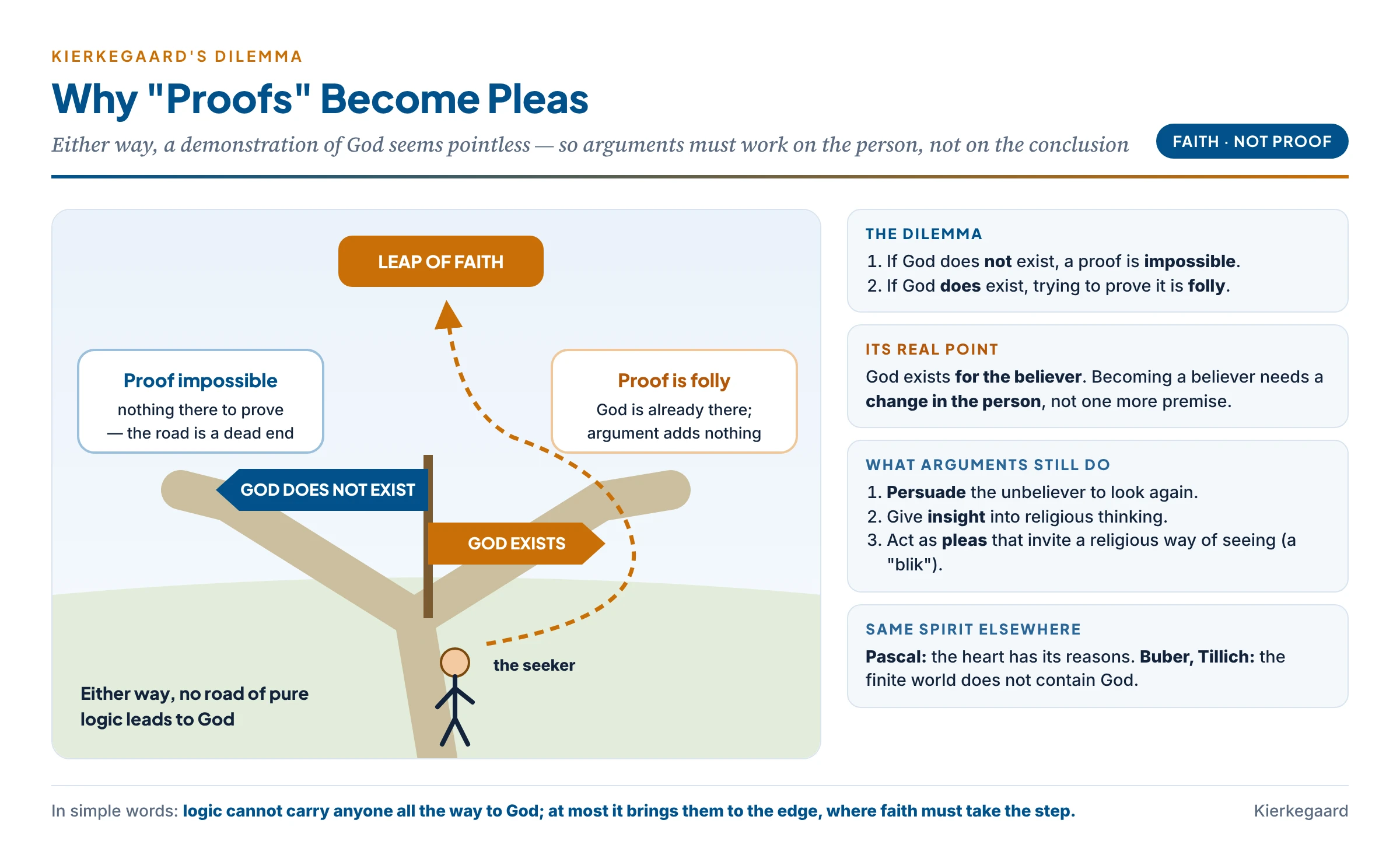
- The dilemma. Søren Kierkegaard stated it sharply: if God does not exist, it would be impossible to prove it; and if God does exist, it would be folly to try.
- Its real strength. God exists for the believer. To become a believer a change in the person is required — a leap of faith, not a step of logic. The unbelieving eye cannot discuss God as the believer knows him.
- Do the arguments then do nothing? They do not establish God’s reality directly, but they work indirectly:
- They persuade the unbeliever to change his viewpoint.
- They help philosophers gain insight into the nature and aims of religious thinking.
- Proofs as pleas for bliks. So the so-called proofs are really pleas for evoking and invoking religious “bliks” — R.M. Hare’s word for a basic, unfalsifiable way of seeing the world — and religious attitudes.
Why There Can Be No Experimental Proof
- Mount Carmel. The Hebrew Bible tells how the prophet Elijah challenged the priests of Baal on Mount Carmel: whichever God sent fire on the altar would be the true God. Here was an attempt at an observable experiment for God.
- “O taste and see.” The Psalms say: “O taste and see that the Lord is good.” — inviting experience.
- Why this does not settle the matter. Proving the invisible things of God through the created things of the world does not do full justice to the religious situation: the believer’s God is not one more force to be tested like electricity, and a God who could be summoned for a test would be under the tester’s control.
Common confusion
Who challenged the priests of Baal on Mount Carmel — Joshua? No. Some notes say “Joshua on Mt. Carmel tried to establish the existence of Yahweh by an observable experiment.” In the biblical story the challenger is the prophet Elijah, who asked God to send fire on the altar to show that he, and not Baal, was God. Joshua belongs to an earlier period (the entry into Canaan). The philosophical point is unchanged: an “experimental proof” of God does not fit the religious relation to God.
The Fideist and the “Reformed” Challenge
- Fideism (from fides, faith) holds that religious belief rests on faith, not on reason, and is none the worse for that.
- Pascal — “The heart has its reasons, which reason does not know.” The God of the philosophers is not “the God of Abraham, Isaac and Jacob”. Reason cannot reach the infinite; it is wiser to wager on God (Article 6).
- Kierkegaard — faith is a passionate leap, and an “objective” proof would destroy the risk that makes faith what it is.
- Wittgensteinian thinkers — religious belief is part of a form of life with its own grammar; testing it like a scientific hypothesis is a confusion.
- Reformed epistemology (Alvin Plantinga, Nicholas Wolterstorff, William Alston), named after the Reformed tradition of John Calvin:
- The evidentialist objection says: belief in God is rational only if supported by good arguments; there are no good arguments; so belief in God is irrational.
- Plantinga rejects the first premise. Many rational beliefs are properly basic — held without argument: that other minds exist, that the world existed five minutes ago, that I had coffee this morning.
- Belief in God can be properly basic too, formed directly in experiences of nature, guilt, gratitude or prayer (Calvin’s “sense of the divine”). The theist has the right to start from belief in God.
- Theists who question the relevance of proofs. Some believers say they are not irrational for lacking a proof, because proofs are neither necessary nor sufficient for religious life: not necessary, because faith is born of experience and commitment; not sufficient, because a person may accept every premise of Aquinas and still not trust, love or worship God.
- Criticism of fideism. If faith needs no reasons, how can we tell true faith from any faith — in astrology, or a cult? Reformed epistemologists reply that properly basic beliefs remain defeasible — open to defeat by strong counter-evidence such as the problem of evil.
The Sceptic’s Side
- Hume. No matter of fact can be demonstrated a priori; and a posteriori arguments for God rest on weak analogies and stretch causation beyond experience (Articles 4 and 5).
- Kant. Theoretical reason cannot prove God: the ontological proof fails, and the cosmological and design proofs depend on it. God may be postulated by practical (moral) reason, not known (Article 6).
- Logical positivists (Ayer). “God exists” is neither a tautology nor empirically verifiable, so it is literally meaningless — neither true nor false.
- The atheist and the strong agnostic. An atheist regards the proofs as faith dressed as reason; a strong agnostic holds that neither a priori nor a posteriori arguments can ever establish God’s existence conclusively — or his non-existence.
Critics and Defenders
Criticism — Critics of proving God
- Kierkegaard: a proof is impossible if God does not exist and folly if he does.
- Buber and Tillich: the finite world of observation does not contain God.
- Hume and Kant: reason cannot reach beyond experience; the proofs lean on weak analogy and on the ontological fallacy.
- Positivists: “God exists” is unverifiable, so meaningless.
- The logical point: deduction proves only a word; induction from observables can reach only an observable — an idol.
Defence — Defenders of proofs (or of reasonable faith)
- Aquinas: finite things reveal God by analogy; the world needs a first cause.
- Rationalists (Anselm, Descartes, Leibniz): the concept of a perfect being contains existence.
- Swinburne: several probable arguments form a strong cumulative case.
- Plantinga: belief in God can be rational without argument — properly basic.
- Udayana: God is established by sound inference with careful replies to every objection.
Cross-Tradition Comparison
Western and Indian Approaches to Proving God
| Point | Western philosophy of religion | Indian philosophy |
|---|---|---|
| Main question | Can reason prove God? | Which pramāṇa makes God known? |
| Rational theism | Aquinas, Leibniz, Paley (natural theology) | Nyāya (Udayana), Yoga (degrees of knowledge) |
| A priori proof | Ontological argument | No classical ontological argument |
| Revealed knowledge | Revealed theology (scripture, church) | Śabda: Vedānta’s “Brahman known from scripture alone” |
| Limits of reason | Hume, Kant | Brahmasūtra’s “reasoning has no stable footing”; Rāmānuja, Madhva |
| Empiricist rejection | Hume, positivists | Cārvāka (only perception) |
| Atheist critique of creator | Hume, Russell, Mackie | Mīmāṃsā, Jaina, Buddhist, Sāṃkhya |
| Faith and experience | Pascal, Kierkegaard, James | Bhakti and direct realisation (anubhava) |
- Kierkegaard and Śaṅkara. Both hold that the highest truth is not reached by argument; but Kierkegaard turns to passionate faith, Śaṅkara to śruti completed by direct realisation of Brahman.
- Kant and Rāmānuja. Both deny that speculative inference proves God; Kant postulates God from morality, Rāmānuja accepts God from scripture.
- Plantinga and the Vedāntins. Both say the believer is entitled to start from belief — Plantinga from properly basic belief, the Vedāntin from the self-validating Veda.
Indian Connect — Indian Connect — non-theistic religions as living evidence
- Buddhism and Jainism are full religions — with path, community, ethics and liberation — without a creator God. They are the strongest real-world reply to the claim that God’s existence is necessary for religion to survive.
- Sāṃkhya holds that God “is not proved” — not that God is disproved — a careful agnostic stance (Article 9).
- Advaita accepts Īśvara at the level of the empirical world but treats the impersonal Brahman as the final truth — so even its theism is not the last word.
Synthesis (Siddhānta)
- What a proof can do. Direct proof of God is impossible; deductive proof alone reaches only the concept; inductive proof reaches only probability and faces the finite-to-infinite gap. So no argument has conclusively proved — or disproved — God.
- A priori and a posteriori. A priori arguments promise necessity but seem to leap from idea to reality; a posteriori arguments are persuasive but probabilistic and exposed to science and to the problem of evil. Kant’s insight that the a posteriori proofs lean on the a priori one makes the ontological argument the real test case.
- What proofs are for. They are best seen as pleas and clarifications: they show that belief in God is not absurd, sharpen our idea of what “God” means, answer objections, and invite the unbeliever to look again. They support the intellectual life of a religion, though religions neither grow nor survive mainly by proofs.
- Indian contribution. By asking which pramāṇa reaches God, Indian thought distinguishes clearly between rational theism (Nyāya), revealed theism (Vedānta) and empiricist atheism (Cārvāka) — and shows, through Buddhism and Jainism, that religion is possible without God.
- Contemporary relevance.
- Science and religion. Debates on the Big Bang, the fine-tuning of physical constants and evolution keep the a posteriori arguments alive (Articles 4 and 5).
- Rationality of belief. Reformed epistemology has changed the question from “Is there a proof?” to “Is belief reasonable without one?”
- Pluralist societies. In a plural society, arguments that can be shared publicly — rather than claims from one scripture — matter for dialogue between believers and non-believers.
“If God does not exist it would be impossible to prove it; and if he does exist it would be folly to attempt it.” — Kierkegaard
Previous Year Questions
- 2022Discuss the main points of distinction between a-priori and a-posteriori arguments for the existence of God. Which one according to you should be preferred over the other? Give reasons and justifications for your answer.
- 2015Is existence of God a necessary condition for the survival of religion? Explain.
- 2012Can God’s existence be proved with cogent and convincing rational arguments?
- 2011Why is a proof for the existence of God necessary for the growth of a religion? Discuss.