

Forms of Government: Monarchy; Theocracy and Democracy.
Official Syllabus: Paper II, Section A, Unit 4
Democracy is the most praised and the most argued-about form of government in the modern world. Almost every state today calls itself a democracy, yet the word is claimed by liberal republics, socialist “people’s democracies” and even military regimes that hold managed elections. This article explains what democracy means (from the Greek dēmos and kratos), how the idea evolved from the Athenian assembly through the social contract and Rousseau’s popular sovereignty to modern liberal democracy, and the main forms of democratic government — direct and indirect, parliamentary and presidential, procedural and substantive — together with theories of representation and electoral systems. It ends with the question of why democracy is called an “essentially contested concept” and whether democratic governments live up to the principles they claim to follow. The theories of democracy (liberal, elitist, pluralist, participatory, deliberative, Marxist) follow in Articles 7 and 8; its critics and paradoxes in Article 9; and its working in practice, including India today, in Article 10.
In simple words
Think of a residents’ welfare association in a housing society. In a small society, all residents can meet in the park and decide together whether to repaint the building — that is direct democracy. In a big society of two thousand flats, residents elect a committee that decides for them and must face them again at the next annual meeting — that is representative democracy. Either way, the final authority belongs to the residents themselves, not to the builder, the richest owner or the society’s priest. That one idea — final authority rests with the people — is the heart of democracy.
Context & Problem
Meaning: Dēmos and Kratos
- Etymology. Dēmos means “the people” (originally also the local village districts of Attica) and kratos means “power” or “rule”. Democracy therefore means “rule by the people” or “power of the people”.
- First recorded use. The word first appears in the Greek historian Herodotus (5th century BC), who used it in the sense of “rule by the people”, and it described the system that grew up in Athens after 508/507 BC.
- More than a voting machine. Democracy is not only a method of choosing rulers. It is also a moral ideal of collective self-determination (a people governing itself), human dignity (each person counts) and equality (no one is born to rule).
- Majority with respect for the minority. In a democracy public decisions are taken with the approval of the majority, but with due regard for the opinion of the minority. A majority that silences the minority destroys the very equality on which its own right to decide rests.
- Democracy in a plural society. In a multicultural society, democracy also requires that minorities enjoy full freedom to preserve their cultural traits — language, religion, customs.
- Two basic modes. Democracy can be direct (the people decide themselves) or indirect (the people choose representatives who decide).
Classic Definitions
| Thinker | Definition | What it stresses |
|---|---|---|
| Abraham Lincoln (Gettysburg Address, 1863) | “Government of the people, by the people, for the people” | Source, agency and purpose of power all lie with the people |
| J. R. Seeley | “A government in which everyone has a share“ | Participation |
| James Bryce | Rule in which power is vested “not in any particular class or classes, but in the members of the community as a whole“ | No ruling class by birth or wealth |
| Joseph Schumpeter | An institutional arrangement in which leaders acquire power through a competitive struggle for the people’s vote | Procedure, competition (see Article 7) |
| B. R. Ambedkar (Poona, 1952) | “A form and a method of government whereby revolutionary changes in the economic and social life of people are brought about without bloodshed“ | Peaceful social transformation |
In simple words
Lincoln’s three little words work like a cricket club. The club belongs of its members (they own it), is run by its members (they elect the captain and committee), and exists for its members (to give them good cricket). A club owned by a sponsor, run by the sponsor’s manager, for the sponsor’s profit, may still be well run — but it is not a members’ club. Democracy is the members’ club of politics.
Four Senses of “Democracy”
- A form of government — who makes decisions and how (elections, legislature, executive accountable to the people).
- A form of state — where sovereignty finally rests with the people (popular sovereignty), as in the Preamble’s “We, the people of India”.
- A form of society — a social order without hereditary privilege, in which people treat each other as equals (Tocqueville’s “equality of conditions”; Ambedkar’s social democracy).
- A way of life — habits of discussion, tolerance and cooperation in every sphere, from family to factory (John Dewey; see Article 8).
Why the Problem Matters
- Legitimacy. Kings claimed authority from God or birth; theocracies from revelation (Articles 2–5). Democracy answers the question “why should anyone obey the government?” with “because the people have authorised it and can remove it”.
- Peaceful change. It offers a way to change rulers without bloodshed — the point of Ambedkar’s definition and of Karl Popper’s later defence.
- The puzzle. Yet “the people” is many, not one. How can millions rule? Through what institutions? And what if the majority oppresses the minority? The rest of this article shows how these questions shaped the forms of democracy.
Core Doctrine
Evolution I: Classical Athenian Democracy
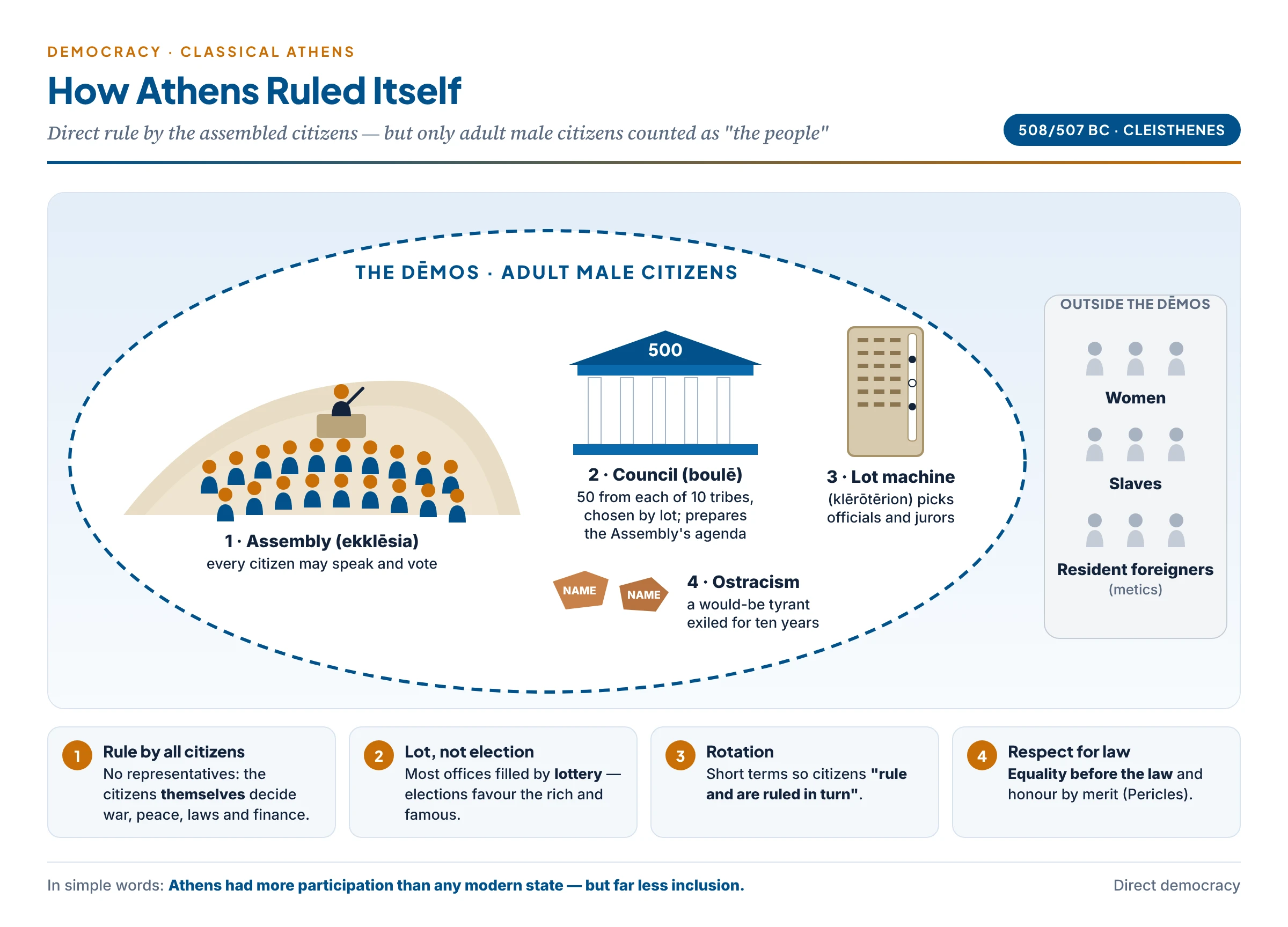
- Cleisthenes’ reforms (508/507 BC) reorganised Athenians into ten new tribes cutting across clan loyalties, and made the local districts (dēmoi) the basic units of citizenship.
- The Assembly (ekklēsia) — every adult male citizen could attend, speak and vote, usually on the hill called the Pnyx. It decided war and peace, laws, finance and the election of generals.
- The Council of Five Hundred (boulē) — 50 citizens from each tribe, chosen by lot for one year, prepared the agenda of the Assembly.
- Selection by lot. Most offices and the huge popular juries were filled by lottery, often using a stone allotment machine (klērōtērion). Lot was thought more democratic than election, because elections favour the rich, famous and eloquent.
- Short terms and rotation — so that citizens could “rule and be ruled in turn”, in Aristotle’s phrase.
- Ostracism — once a year citizens could write a name on a pottery shard (ostrakon); the man with the most votes, if enough votes were cast, was exiled for ten years. It was a way of removing a would-be tyrant without violence.
- Pericles’ Funeral Oration (as reported by the historian Thucydides) gives the Athenian ideal: the constitution is called a democracy because power is in the hands not of a minority but of the whole people; there is equality before the law, and public honour goes by merit, not class; poverty is no bar to public service.
- Two marks of classical democracy:
- Equal participation of all freemen in the common affairs of the city.
- General respect for law and the established procedures of the community.
- Its limits. “All freemen” was a tiny fraction of the people — women, slaves and resident foreigners (metics) were excluded. Athenian democracy was direct, but not inclusive.
Common confusion
Was Athens a democracy of “all the people”? No. Athens was a direct democracy, but its dēmos meant adult male citizens of Athenian parents only. Women, slaves and resident foreigners — the majority of the population — had no vote. Modern democracy is indirect but far more inclusive (universal adult franchise). Both “more democratic” claims are true in different senses: Athens had more participation, modern states have more inclusion.
Indian Connect — Republics of ancient India
- The Ṛgveda speaks of two popular bodies, the sabhā and the samiti, which advised and sometimes chose the chief.
- In the age of the Buddha there were gaṇa-saṅghas — republics ruled by assemblies of clan heads, such as the Licchavis of Vaiśālī in the Vajji confederacy. The Buddha praised the Vajjis for meeting often and deciding in concord.
- The Buddhist saṅgha followed careful procedures: a fixed quorum, a motion proclaimed before the assembly, and voting with wooden tickets (śalākā) collected by an appointed officer when consensus failed.
- Like Athens, these were assemblies of a privileged few (clan heads, monks), not of all the people — but they show that rule by discussion and vote is not a purely Western idea.
Evolution II: The Social Contract — Consent as the Basis of Power
- The new question. After the decline of the Greek city, Europe was ruled by kings and churches (Articles 2–5). The social contract thinkers of the 17th century asked: what makes political power legitimate?
- Their answer: consent. Political authority is legitimate only if it rests on the consent of the people who are to obey it. This laid the foundation for all later democratic theories.
- Thomas Hobbes (1651) — people in a frightening state of nature agree to give up their rights to a sovereign for the sake of peace. He used consent to justify an absolute ruler, but the key move — power comes from the people’s agreement, not from God — was revolutionary.
- John Locke (1689) — people set up government to protect their natural rights to life, liberty and property:
- Government is a trust; rulers are trustees who may be removed if they betray it.
- Within society, decisions are taken by majority rule.
- Government is limited — it cannot take property without consent (“no taxation without representation”).
- The people keep a right of revolution against tyranny.
- Why it matters. Locke’s ideas passed into the American Declaration of Independence (1776) and the French Declaration of the Rights of Man (1789), and into the liberal-democratic constitutions that followed.
Rousseau’s Popular Sovereignty
- Jean-Jacques Rousseau (The Social Contract, 1762) made the people themselves the sovereign — not merely the source of a government’s authority, but its permanent holder.
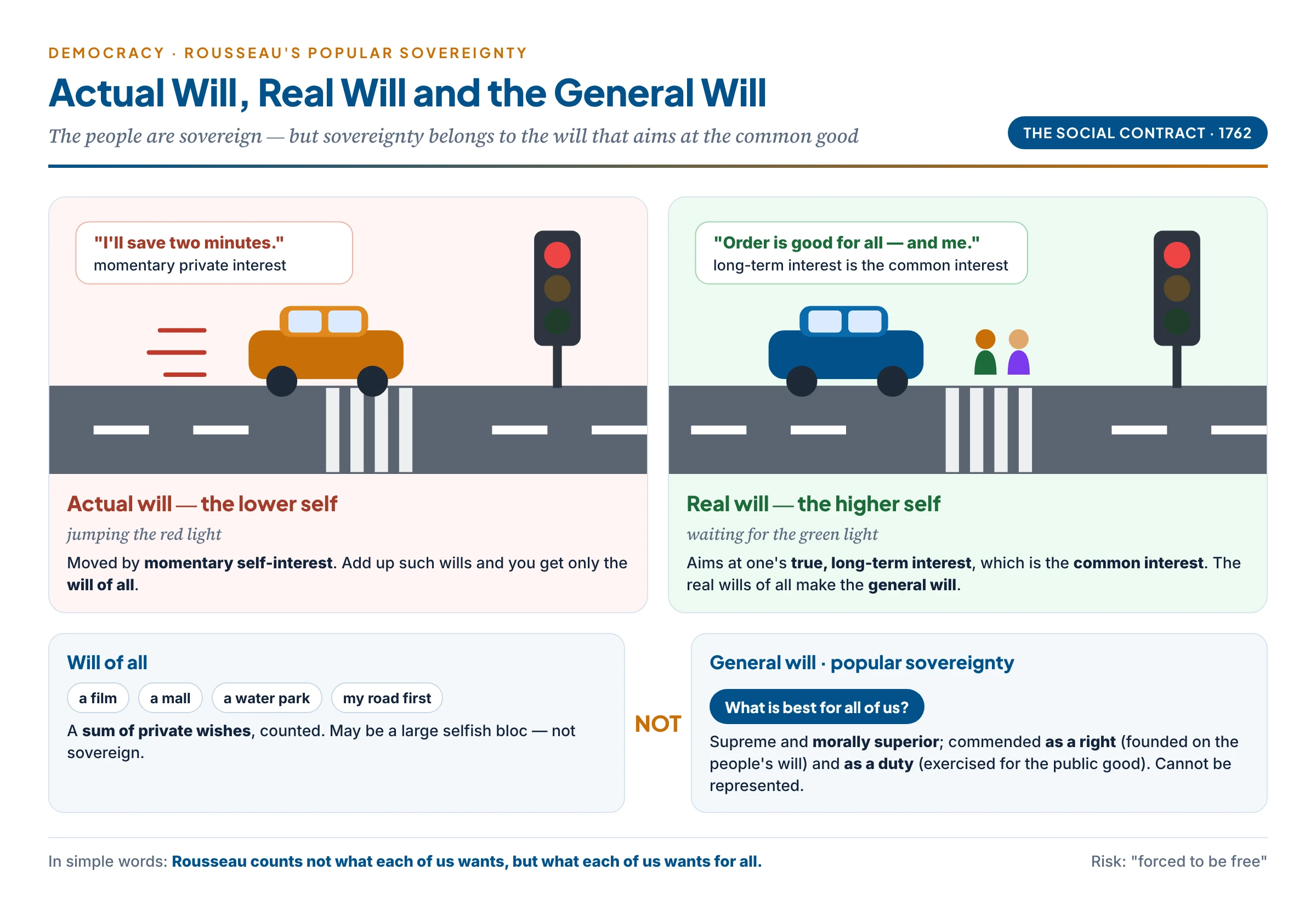
- Two kinds of will in each person:
- Actual will — the will of a person moved by momentary self-interest; it represents the lower self. Example: jumping a red light at a crossing to save two minutes.
- Real will — the will directed to a person’s real and long-term interest, which coincides with the common interest of the community; it represents the higher self. Example: waiting for the green light, because orderly traffic is good for everyone, including oneself.
- General will (volonté générale) — the sum of the real wills of all members, always aimed at the common good. It is different from the will of all (volonté de tous), which is merely the sum of private wishes.
- Popular sovereignty means the supreme authority of the general will in society. Since it expresses the higher self, it is also morally superior to any private will.
- Rousseau commended popular sovereignty for two reasons:
- As a right — political authority should be founded on the will of the people.
- As a duty — that authority should be exercised for the public good.
- Sovereignty cannot be represented. For Rousseau, sovereignty is the general will, and a will cannot be handed over to someone else. Hence his famous jibe at England: the English people think they are free, but are free only during the election of members of Parliament; once the members are elected, the people are slaves again. True democracy is direct law-making by the assembled citizens.
- “Forced to be free.” Whoever refuses to obey the general will may be compelled to obey it — which, says Rousseau, means only that he will be forced to be free, because he is being made to follow his own real will.
In simple words
Imagine a class voting on a picnic. If each student votes only for what he personally likes — one wants a film, one a mall, one a water park — and we simply count, we get the will of all. If each student instead asks “what would be best for our class as a whole?” and votes on that, the answer they reach is the general will. Rousseau trusts the second kind of vote, not the first.
- Criticisms of Rousseau’s theory:
- Suitable only for a small, uniform community — a city like Geneva, not a nation of millions.
- No clear line between “will” and “reason” — the general will sounds like what reason says is good, not what people actually want.
- A dangerous “higher” will. The idea of a superior real will belongs to idealist theory and has often been used to support absolutism: a party or leader claims to know the people’s “real” will better than the people do. The historian J. L. Talmon called this “totalitarian democracy”.
- No protection for minorities — once the general will is declared, dissent looks like selfishness.
- His lasting contribution. The idea that the people are sovereign, that laws should express a common good, and that citizens should participate, not merely vote, inspired the French Revolution, later participatory democrats and the developmental view of democracy (Articles 7 and 8).
Common confusion
Is the general will just the majority vote? No. The general will aims at the common good; a majority vote may express only the largest bloc of private interests (the will of all). Rousseau thought a vote reveals the general will only when citizens are well informed, vote on the common good, and are not split into factions. A 51% vote of selfish interests is, for him, not the general will.
Liberal Democracy: Meaning and Features
- Meaning. Liberal democracy is a system of government based on the principles of liberalism and democracy together:
- Liberalism seeks rules and procedures that secure the liberty of the individual — rights, limited government, rule of law.
- Democracy seeks a government formed and controlled by the consent of the people.
- Procedure first. Liberal democracy gives more weight to procedures and institutional arrangements than to particular outcomes. A result is legitimate if it was reached by fair rules.
- Six distinguishing features:
- Popular sovereignty and constitutionalism — power comes from the people and is limited by a constitution.
- More than one political party, freely competing for power.
- Political offices not confined to any privileged class — open to every citizen.
- Periodic elections based on universal adult franchise.
- Protection of civil liberties and freedom of the press.
- Independence of the judiciary and the bureaucracy from the party in power.
- Further marks often added: rule of law, rights of minorities, peaceful transfer of power, a free civil society of associations.
Does Liberal Democracy Need Deeper Principles of Social Cohesion?
Liberal democracy strongly affirms individual rights: each person may hold his own religion, values and plan of life. But a society is more than a crowd of rights-holders. What holds it together?
- The worry. If citizens share nothing except procedures, they may treat politics as a market of private interests, distrust each other, and fall apart along lines of religion, caste or class.
- Böckenförde’s dilemma. The German judge Ernst-Wolfgang Böckenförde (1964) put it sharply: the liberal, secularised state lives by preconditions that it cannot itself guarantee. It needs citizens with a shared moral sense and a sense of community, but if it tried to force such values on them, it would stop being liberal.
- The communitarian answer. Michael Sandel and Charles Taylor argue that the liberal “unencumbered self” is a myth; people are formed by communities, and democracy needs a shared idea of the common good and civic virtue.
- The civic-republican answer. Democracy needs active citizens with public spirit, not only private rights-holders (Rousseau, Arendt; see Article 8).
- Rawls’ liberal answer. In Political Liberalism (1993) John Rawls says citizens need not share a whole philosophy of life. They can reach an overlapping consensus — people of different religions and worldviews each support the same basic principles of justice for their own reasons — and argue in public on the basis of public reason.
- Constitutional patriotism. Jürgen Habermas suggests loyalty not to a race or religion but to the democratic constitution and its values.
- The Indian answer — fraternity and constitutional morality. Ambedkar insisted that liberty and equality cannot survive without fraternity — “a sense of common brotherhood of all Indians”. He also warned that constitutional morality — respect for the forms and limits of the constitution — “is not a natural sentiment. It has to be cultivated.”
- Conclusion. Most thinkers agree that liberal democracy does need some deeper bond — but a thin, inclusive one (fraternity, civic trust, constitutional values, toleration), not a thick religious or national identity that would crush the very rights it is meant to balance.
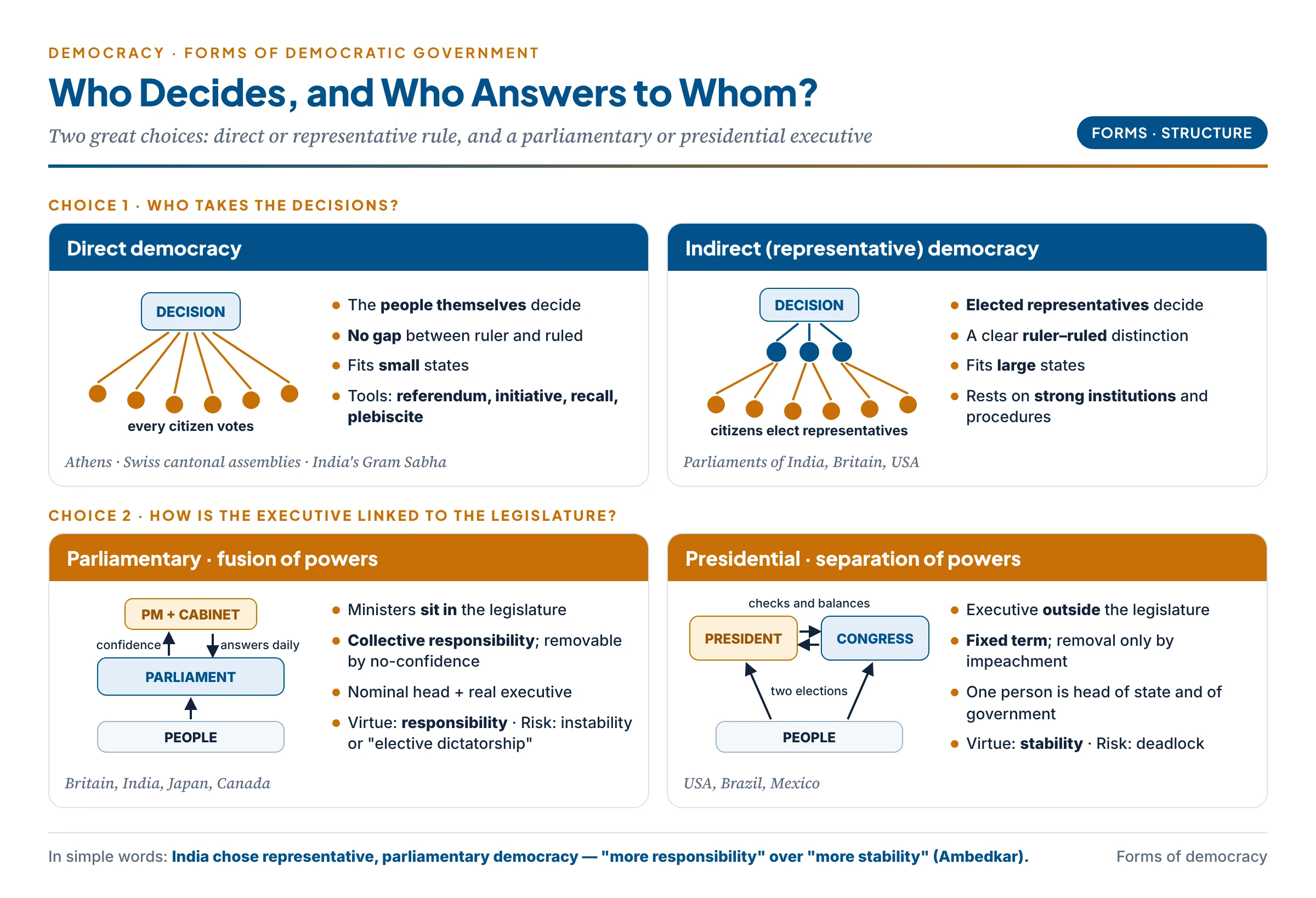
Direct and Indirect Democracy
| Point | Direct democracy | Indirect (representative) democracy |
|---|---|---|
| Who decides | The people themselves take all decisions | Elected representatives take decisions |
| Ruler and ruled | No difference between ruler and ruled | A clear difference between ruler and ruled |
| Size | Suitable for small states (city-states, cantons) | Suitable for large states |
| Typical devices | Referendum, initiative, recall, plebiscite | Strong institutions and procedures — legislature, parties, elections, courts |
| Example | Athenian assembly; Swiss Landsgemeinde (open-air cantonal assemblies still held in Appenzell Innerrhoden and Glarus) | Parliaments of India, Britain, USA |
- Devices of direct democracy in modern states:
- Referendum — the people vote on a law or constitutional change already passed or proposed (Switzerland holds them several times a year; Australia and Ireland need them for constitutional amendment).
- Initiative — a set number of citizens can propose a law.
- Recall — voters can remove an elected official before the end of his term.
- Plebiscite — a vote on a question of sovereignty or a major political choice (for example, the Brexit referendum of 2016).
- Why most states are indirect. Size, complexity of laws, the time citizens can give, and the need for expertise and deliberation. Representative democracy is the efficient form for large nation-states and can protect minority rights against sudden majority passions.
Indian Connect — Direct democracy at the village level
India’s Constitution keeps a space of direct democracy in the Gram Sabha — all registered voters of a village panchayat, who meet to approve plans, select beneficiaries and conduct social audits (73rd Amendment, 1992). Laws such as the PESA Act, 1996 give the Gram Sabha in Scheduled Areas a say over land, forests and minor minerals. In this sense, India is a representative democracy with direct democracy at its base — close to Gandhi’s vision of self-governing villages.
In simple words
Direct democracy is like a WhatsApp family group where every member votes on where to go for the holiday. Representative democracy is like asking two cousins to plan the trip for all forty relatives — and replacing them next year if the trip was a disaster. The first gives everyone a voice; the second is the only way to plan a trip for forty people without endless arguments.
Theories of Representation
- The question. When the people elect a representative, whose judgment should he follow — his own, or his voters’?
- Trustee theory — Edmund Burke. In his Speech to the Electors of Bristol (1774) Burke said: “Your representative owes you, not his industry only, but his judgment; and he betrays, instead of serving you, if he sacrifices it to your opinion.” Parliament is “a deliberative assembly of one nation, with one interest, that of the whole”.
- Delegate theory. The representative is a messenger who must carry out the instructions of his constituents. (Socialist “people’s democracies” made deputies recallable for disobeying instructions — Article 8.)
- Mandate theory. Voters choose a party programme (manifesto); the winning party has a mandate to carry it out, and members follow the party line.
- Resemblance (microcosmic) theory. A legislature should mirror society — women, minorities, castes, regions — in proportion. This supports reservation of seats and proportional representation.
- J. S. Mill (Considerations on Representative Government, 1861) called representative government the ideally best form, because it combines participation (which educates citizens) with competence (skilled deliberation by elected members). He wanted Parliament to be a “Congress of Opinions” that watches and controls the government, rather than doing the detailed work of administration itself. (His proposals of proportional representation and plural voting are discussed in Article 9.)
Electoral Systems
| System | How it works | Where used | Strength / weakness |
|---|---|---|---|
| First-past-the-post (simple plurality) | The candidate with the most votes in a constituency wins, even without a majority | Lok Sabha and state assemblies in India; UK; USA | Simple, gives stable governments; but a party can win a majority of seats on a minority of votes |
| Absolute majority (two-round) | A winner needs more than half the votes; if no one gets it, the top candidates go to a second ballot | Election of the French President | Winner has majority backing; costs two elections |
| Alternative (preferential) vote | Voters rank candidates; the last candidate is eliminated round by round and his votes transferred until someone has a majority | Australian House of Representatives | Majority winner in one ballot; still not proportional |
| Proportional representation — list system | Parties get seats in proportion to their votes; members taken from party lists | Netherlands, Israel, much of Europe | Fair to small parties; may produce unstable coalitions |
| Proportional representation — single transferable vote | Voters rank candidates in multi-member seats; surplus and eliminated votes transferred (devised by Thomas Hare, praised by Mill) | India’s Rajya Sabha, President and Vice-President; Ireland | Proportional and candidate-centred; complex counting |
| Mixed member | Some members chosen by first-past-the-post, others by party lists to correct the overall result | Germany, New Zealand | Combines local link with proportionality |
Parliamentary and Presidential Democracy
Parliamentary democracy — its nature:
- Fusion of executive and legislature. Ministers are members of the legislature and stay in office only while they keep its confidence.
- Nominal and real executive. A nominal head (monarch or President) and a real executive (Prime Minister and Cabinet). In India the President acts on the aid and advice of the Council of Ministers (Article 74).
- Collective responsibility. The Council of Ministers is collectively responsible to the lower house; the government “sinks or swims together”.
- Leadership of the Prime Minister — once called “first among equals”, today usually far more powerful than other ministers.
- Recognised opposition — a “government in waiting” (shadow cabinet in Britain; Leader of the Opposition in India).
- Dissolution — the lower house can be dissolved before its term ends, and fresh elections called.
- Party discipline — the whip; in India the anti-defection law (Tenth Schedule, added in 1985) disqualifies members who defect.
- The Westminster model — the British prototype, adopted with changes by India, Canada, Australia and many others.
Parliamentary democracy — its functions:
- Representation — giving the people’s diverse interests a voice.
- Legislation — making, amending and repealing laws.
- Executive accountability — question hour, debates, committees, motions of no-confidence.
- Financial control — no tax without its consent; passing the budget; audit through public accounts committees.
- Deliberation — national debate on public issues.
- Legitimation — lending consent and authority to government decisions.
- Recruitment and training of leaders.
- Redress of grievances of citizens and regions.
- Educating public opinion — Walter Bagehot listed the House of Commons’ functions as elective (choosing the government), expressive (voicing the people’s mind), teaching, informing and only then legislative.
Evaluation of parliamentary democracy:
- Strengths:
- Responsible and responsive — the government can be questioned every day and removed at any time.
- Harmony between legislature and executive; laws pass smoothly.
- Flexible — a failing leader can be replaced without waiting for a fixed term.
- Represents diversity — coalitions can bring many groups into government.
- Weaknesses:
- Executive dominance — with a big majority and strict whips, Parliament may become a rubber stamp. Lord Hailsham (1976) called this an “elective dictatorship”.
- Instability under fragile coalitions (France’s Fourth Republic, Italy, India in 1989–99).
- Party domination of the individual member; the anti-defection law limits free voting.
- Decline of deliberation — short sessions, bills passed without debate.
Presidential democracy (the United States model):
- A directly or indirectly elected President who is both head of state and head of government.
- Separation of powers — the President and ministers are not members of the legislature.
- Fixed term — the President cannot be removed by a vote of no-confidence, only by impeachment for serious wrongdoing.
- Checks and balances — presidential veto, Senate approval of appointments and treaties, judicial review.
| Point | Parliamentary | Presidential |
|---|---|---|
| Executive | Dual (nominal head + Prime Minister) | Single (President) |
| Relation with legislature | Fusion; ministers sit in it | Separation; ministers outside it |
| Responsibility | Collective responsibility to the lower house | President responsible to the people and the Constitution |
| Tenure | Depends on confidence of the house | Fixed term |
| Removal | No-confidence motion | Impeachment only |
| Main virtue | Responsibility | Stability |
| Main risk | Instability or executive dominance | Deadlock between President and Congress |
| Examples | UK, India, Japan, Canada | USA, Brazil, Mexico |
Indian Connect — Why India chose the parliamentary form
Introducing the Draft Constitution in the Constituent Assembly (4 November 1948), Ambedkar explained that a democratic executive must have two qualities — stability and responsibility — and that no system gives both equally. The presidential system gives more stability; the parliamentary system gives more responsibility, because a minister faces daily scrutiny through questions, motions and debates and not only a periodic election. The Draft Constitution, he said, preferred more responsibility to more stability. India’s experience of British parliamentary practice also made the choice natural.
Unitary and Federal Democracies
- Unitary — all power legally rests with the central government, which may create or abolish local bodies (UK, France, Japan).
- Federal — power is divided by the constitution between the centre and the states, with a written constitution, an independent judiciary as umpire and usually a second chamber for the states (USA, Canada, Australia).
- India — a federation with a strong centre, often described as “quasi-federal” or a “holding-together” federation; the Supreme Court has held federalism to be a basic feature of the Constitution (S. R. Bommai, 1994).
Procedural and Substantive Democracy
- Procedural democracy. Champions of liberal democracy would never compromise the procedure for any other gain. Democracy means fair rules — free elections, majority decision, rights to speak and organise. If the rules are followed, the result is legitimate, whatever it is.
- Substantive democracy. Others argue that the goal of democracy is people’s welfare and dignity, and this must take precedence over procedure. They support necessary adjustments and institutions to achieve the substantive goal: real economic, social, gender and cultural equality, not only the vote.
- Common ground. Both need an independent judiciary and bureaucracy and accountability of rulers; they differ on whether outcomes can override procedures.
- Related pairs: thin vs thick democracy; formal vs substantive democracy; minimal (electoral) vs liberal democracy.
In simple words
A cricket match can be judged in two ways. Procedure: were the rules followed, the umpires fair, the toss honest? Then the result stands, even if the weaker team won. Substance: did both teams have proper pitches to practise on, bats, training and food? If one team was starving, the “fair” match was not really fair. Procedural democracy looks at the rules of the game; substantive democracy also asks whether all players had a real chance to play.
Democracy as an “Essentially Contested Concept”
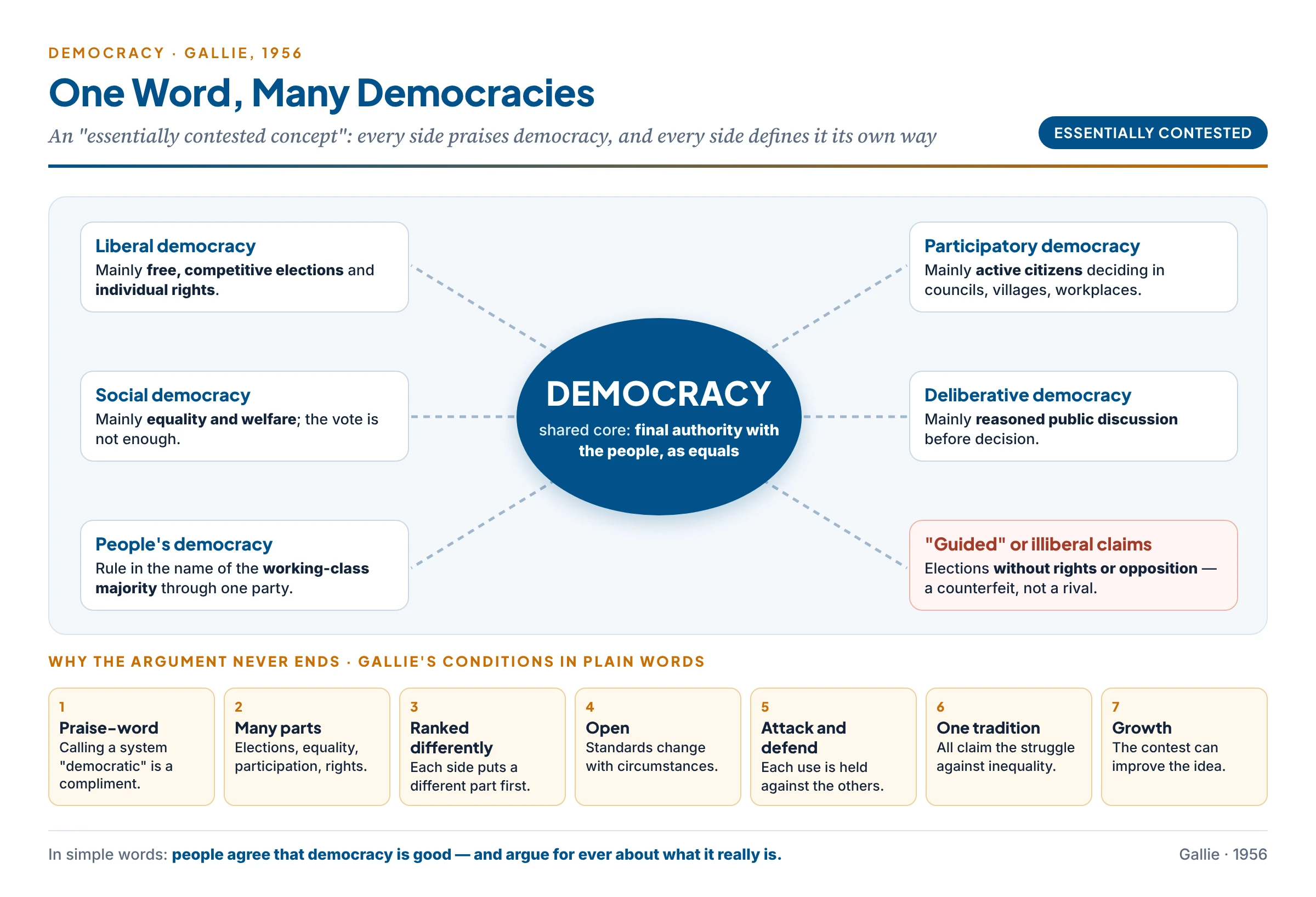
- W. B. Gallie (1956) used democracy as a prime example of an essentially contested concept — a concept whose proper use involves endless disputes, not because people are confused, but because of the nature of the concept itself.
- Gallie’s conditions (in plain words):
- Appraisive — the word praises something; calling a system “democratic” is a compliment. (Gallie said democracy had become “the appraisive political concept par excellence”.)
- Internally complex — it has many parts: majority choice, equality, active participation, rights.
- Variously describable — rival groups rank these parts differently: one says democracy is mainly free elections, another mainly equality, another mainly participation.
- Open — what counts as democratic achievement changes with circumstances and cannot be fixed in advance.
- Used aggressively and defensively — each side knows its use is challenged and defends it against the others.
- An original exemplar — all sides claim to continue the same tradition (for democracy, the long tradition of struggles against inequality, such as the French Revolution).
- Progressive competition — the argument between rival uses may help develop the concept further.
- The many democracies. Liberal democracy (rights and competitive elections), social democracy (welfare and equality), people’s democracy (rule in the name of the working class), participatory and deliberative democracy, “guided” democracy (Sukarno’s Indonesia) and today’s “illiberal” democracy — all claim the same word.
- Why it matters:
- It explains why the debate never ends and why every regime wants the label.
- It warns us not to define democracy so narrowly that we win the argument by definition.
- It suggests a core that the rivals share — the people’s equal right to share in collective decisions — even while they dispute its best form.
- Criticism. Some argue that “contested” does not mean “anything goes”: a regime with no free elections, no opposition and no rights is not a contested case of democracy but a counterfeit of it.
The Principles of the Political Philosophy of Democracy — and the Claims of Democratic Governments
Democratic governments claim to promote the principles of democracy. What are these principles, and does practice match the claim?
- Principles:
- Popular sovereignty — final authority rests with the people.
- Political equality — one person, one vote, one value.
- Liberty — freedom of speech, association, dissent and conscience.
- Majority rule with minority rights.
- Rule of law and constitutionalism — rulers are under the law.
- Consent and accountability — government by consent, answerable to the people and removable by them.
- Fraternity and tolerance — equal respect among citizens of different faiths and groups.
- Justice and welfare — social and economic conditions in which every citizen can use these rights.
- Where the claim holds: regular elections, peaceful changes of government, courts that strike down unconstitutional laws, rights of expression, expansion of the franchise to all adults.
- Where it falls short:
- Governments elected on a minority of votes (first-past-the-post).
- Money power and lobbies giving the rich more influence than the poor.
- Elites and dynasties dominating parties (see Article 7).
- Majoritarian pressure on minorities and dissenters (Articles 9 and 10).
- Formal equality with real inequality — Ambedkar’s “life of contradictions” (Article 8).
- Verdict. Democratic governments promote the principles partly: the procedures are largely in place, while the substance — real equality, fraternity, minority security — remains an unfinished task. The gap is itself something democracy allows citizens to expose and correct.
Critical Evaluation
Criticisms of the Classical and Modern Forms
- Of direct democracy:
- Impractical in large and complex states.
- Open to demagogues — the Athenian assembly condemned Socrates (399 BC) and voted for the disastrous Sicilian expedition (415 BC).
- Referendums reduce complex questions to “yes” or “no” and may be used by leaders to bypass parliaments.
- Of Rousseau’s model: small-state bias, confusion of will with reason, and the danger of “forced to be free” — the general will can become a cover for absolutism.
- Of representative democracy:
- Rousseau’s charge — citizens are free only on election day.
- Elitist findings — representatives form a political class far from the voters (Article 7).
- Distortion — first-past-the-post can turn a minority of votes into a majority of seats.
- Of liberal democracy:
- Marxists — formal political equality hides economic inequality; it is “bourgeois democracy” (Article 8).
- Communitarians — it has no shared moral bond and breeds atomised individuals.
- Substantive democrats — procedure without welfare is hollow.
- Of parliamentary democracy: executive dominance (“elective dictatorship”), instability under coalitions, weakening of debate.
- Of the concept itself: if democracy is “essentially contested”, it may seem to have no fixed meaning at all.
Critics and Defenders
Criticism — Critics
- Plato — rule of the ignorant many; democracy slides into tyranny (Article 9).
- Rousseau — representation turns citizens into slaves between elections.
- Talmon — the “general will” opens the road to totalitarian democracy.
- Marx — liberal democracy is the political form of capitalist class rule.
- Schumpeter and the elitists — “rule by the people” never happens; elites rule.
- Hailsham — a parliamentary majority can become an elective dictatorship.
Defence — Defenders and strengths
- Pericles and Aristotle — the many, sharing their judgment, often decide better than a few; “ruling and being ruled in turn” makes good citizens.
- Locke — government by consent and trust protects natural rights.
- Mill — representative government educates citizens and checks rulers.
- Burke — representatives exercising judgment can serve the whole nation.
- Ambedkar — democracy is the only method of revolutionary change without bloodshed; parliamentary government secures daily responsibility.
- Popper — democracy is the one system that lets the people remove bad rulers without violence.
Cross-Tradition Comparison
| Idea | Western tradition | Indian tradition |
|---|---|---|
| Popular assemblies | Athenian ekklēsia and boulē | Vedic sabhā and samiti; assemblies of the gaṇa-saṅghas (Licchavis, Vajjis) |
| Procedure | Vote by show of hands, lot, ostracism | Buddhist saṅgha: quorum, formal motion, voting by śalākā tickets |
| Consent as basis of rule | Social contract (Hobbes, Locke, Rousseau) | Mahāsammata — the first king “chosen by the many” in the Buddhist Aggañña Sutta (Article 2) |
| Common good | Rousseau’s general will | Lokasaṅgraha (welfare of the world) and the king’s duty to the people’s happiness in Kauṭilya |
| Self-rule from below | Swiss communes, Tocqueville’s townships | Gandhi’s Gram Swaraj; the constitutional Gram Sabha |
| Peaceful change | Popper’s removal of rulers without bloodshed | Ambedkar’s definition — revolutionary change without bloodshed |
Indian Connect — Key takeaways
- India had traditions of collective deliberation — sabhā, samiti, gaṇa-saṅgha, saṅgha — long before modern democracy, though, like Athens, they were confined to privileged groups.
- The Constitution of 1950 joined Western liberal-democratic institutions (parliamentary government, rights, universal adult franchise from the very first election of 1951–52) with an Indian concern for social democracy — Ambedkar’s liberty, equality and fraternity.
- The voting age was lowered from 21 to 18 by the 61st Amendment (1988), widening the dēmos further.
Synthesis (Siddhānta)
- One idea, many forms. At its core democracy is the principle that final authority belongs to the people as equals. Athens gave it the form of a direct assembly; Locke gave it consent and limited government; Rousseau gave it popular sovereignty; liberal democracy combined it with rights and representation; modern states built it into parliamentary or presidential systems.
- Each form answers a problem and creates another. Direct democracy gives participation but not inclusion or expertise; representation gives scale and skill but distance; procedure gives fairness but may ignore welfare; substance gives welfare but may override procedure.
- Why the concept stays contested. Because democracy is an ideal of equality that is never fully achieved, rival groups keep arguing about which part matters most. The contest is not a weakness but a sign that the ideal is alive.
- Contemporary relevance.
- Debates on simultaneous elections, electoral reforms and proportional representation in India are debates about forms of democracy.
- The worldwide concern about “democratic backsliding” and illiberal democracy shows why procedures and rights both matter.
- Digital technology revives ideas of direct and participatory democracy (online petitions, participatory budgeting), while also creating new dangers (Article 10).
- Ambedkar’s reminder remains the test: democracy must deliver social and economic change, peacefully, or it loses its meaning.
“A democracy is more than a form of government; it is primarily a mode of associated living, of conjoint communicated experience.” — John Dewey
Previous Year Questions
- 2018What is meant by liberal democracy? Does it require deeper principles for social cohesion to balance its own strong affirmation of individual rights?
- 2015Evaluate the nature and functions of parliamentary democracy.
- 2013What is meant by democracy? What are various forms of democratic governments?
- 2008Democratic government claims to be promoting the principles of political philosophy of democracy.
- 2004Critically examine – The concept of democracy an essentially contested concept.