

Forms of Government: Monarchy; Theocracy and Democracy.
Official Syllabus: Paper II, Section A, Unit 4
Monarchy is the oldest and, for most of human history, the most common form of government: supreme political authority vested in one person, usually for life and usually passed down within a family. Before democracy became the normal standard of legitimacy, most of the great political philosophers — Plato, Aristotle, Aquinas, Bodin and Hobbes in the West, and the authors of the Mahābhārata, the Manusmṛti, the Buddhist Aggañña Sutta and Kauṭilya’s Arthaśāstra in India — asked a common question: why should one person rule, and what makes that rule good rather than tyrannical? This article explains what monarchy means, its main kinds (absolute, constitutional, elective, enlightened despotism), the classical justifications for it in both traditions, the special case of a monarch who is “above politics“, and the first steps of its evaluation. The Divine Right of Kings, the full critique by Locke, Paine, Rousseau and Kant, and the questions of freedom, ethics and blending with democracy are developed in Article 3.
In simple words
Think of a big joint family that has one karta (head). Everyone brings problems to him; he decides quickly; quarrels end because his word is final; and when he dies the role passes to the eldest son. If the karta is wise and fair, the family runs smoothly. If he is greedy or cruel, nobody can remove him. Monarchy is this arrangement on the scale of a whole country — its strength is unity and quick decisions, its danger is that everything depends on one person’s character.
Context & Problem
Meaning of Monarchy
- Etymology. From Greek monos (“alone, single”) and archein (“to rule”) — rule by one.
- Definition. A system in which supreme political authority is vested in a single individual, the monarch (king, queen, emperor, sultan, emir), typically legitimised by hereditary lineage, dynastic succession or divine appointment.
- Classic features of monarchy as a form of government:
- Hereditary rule by one person — the crown passes within a royal family, usually to the eldest son or child (primogeniture).
- Belief in a divine or sacred basis of royal power — the king is God’s chosen, anointed or descended from gods (developed as the Divine Right of Kings, Article 3).
- Supreme power is vested in the ruler — either real (the king actually governs) or symbolic (power is exercised in the king’s name by others).
- The monarch is superior to the subjects — the people are subjects (owing obedience), not citizens (co-authors of the law).
- “Whatever the monarch does is right in itself” — in its absolute form, the will of the king is the source of law and is not questioned.
- Rule for life — the monarch does not face periodic re-selection.
Monarchy as a Form of Government and as a Form of State
- As a form of government — when the monarch actually rules: makes laws, commands the army, appoints and dismisses ministers, decides policy. This is absolute or executive monarchy.
- As a form of state / headship of state — when the monarch is only the head of state while real government is carried on by elected bodies. This is constitutional monarchy: the state is a monarchy in form, but the government is a parliamentary democracy.
- This distinction is the key to understanding why monarchy still exists in many of the world’s most free and democratic countries.
Common confusion
Is a constitutional monarchy a separate “form of government” alongside democracy? Not really. In Britain, Japan, Sweden or Spain the government is a parliamentary democracy — the Prime Minister and Cabinet, answerable to an elected legislature, take all real decisions. The monarchy there is a form of headship of state: a hereditary, ceremonial office sitting on top of a democratic government. Calling such countries “monarchies” describes their head of state, not who actually governs.
The Philosophical Problem
- Why one? Every political community needs a final decision-maker. Is that best placed in one person, a few, or the many?
- Why this one? If one should rule, what gives this particular person the right — wisdom, virtue, birth, God’s choice, the people’s choice, or a contract?
- How to stop the one from becoming a tyrant? The rule of one can be the best government (a wise, just king) or the worst (a tyrant). Almost every defender of monarchy also gives a theory of its corruption.
- These three questions organise the classical theories below.
Core Doctrine
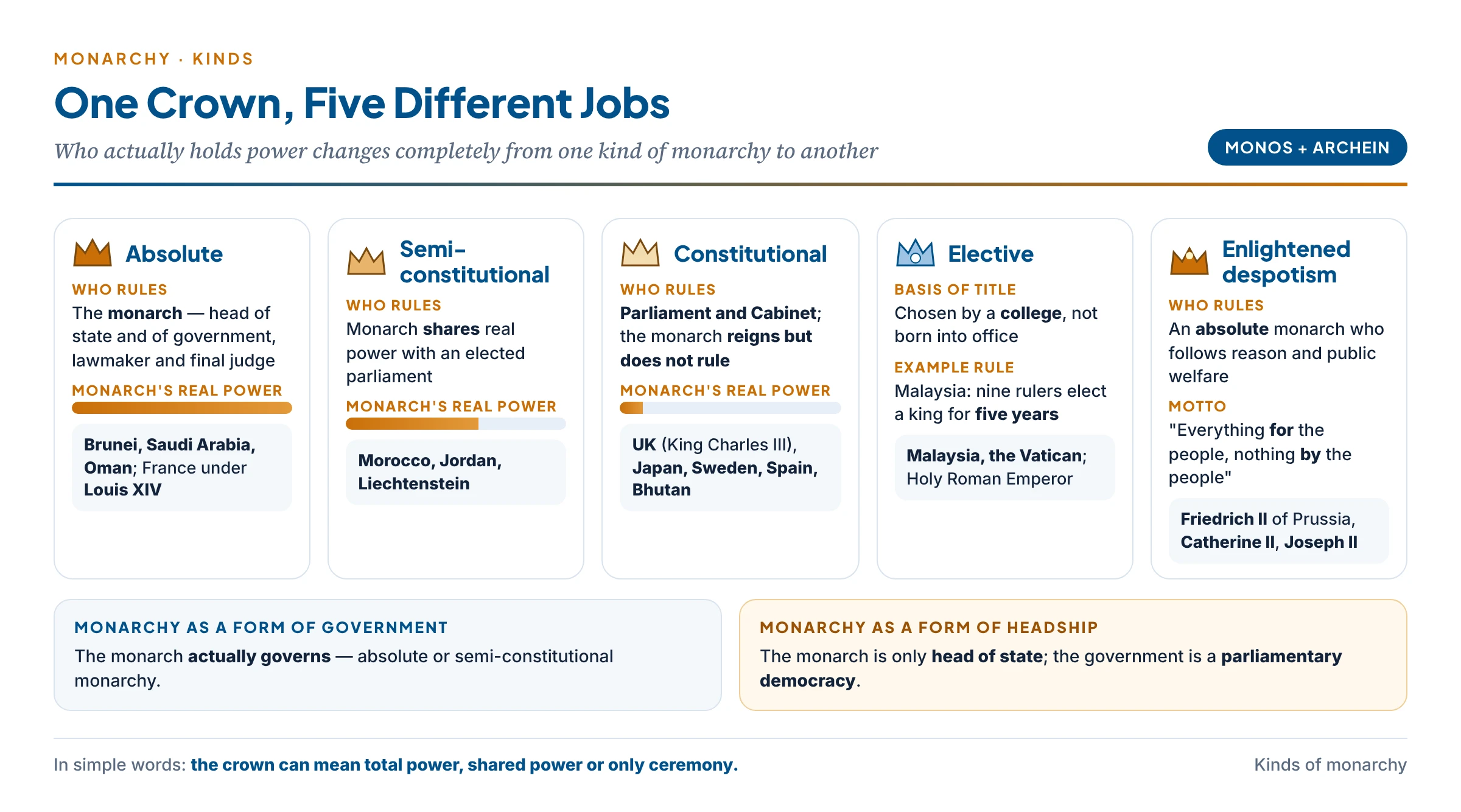
Kinds of Monarchy
1. Absolute Monarchy
- Supreme power is vested in the monarch without legal limits from a constitution, parliament or courts.
- The monarch is head of state and head of government at once — king, chief executive, chief legislator and final judge.
- Historical examples: France under Louis XIV (reigned 1643–1715), Prussia, Tsarist Russia, the Mughal and Ottoman empires.
- Present examples: Brunei (the Sultan is also Prime Minister), Saudi Arabia, Oman, Eswatini, and the Vatican City (an absolute elective monarchy of the Pope).
Common confusion
Did Louis XIV really say “L’État, c’est moi” (“I am the State”)? The phrase is widely attributed to him and perfectly sums up absolute monarchy, but historians regard it as apocryphal — there is no reliable record of him saying it. On his deathbed he is reported to have said something closer to the opposite: “I am going, but the State will always remain.” Use the phrase as a description of the idea, not as a proven quotation.
2. Constitutional (Limited) Monarchy
- Supreme power is vested in the monarch only symbolically; in practice it is exercised by other bodies — Parliament, the Cabinet, the courts — under a written or unwritten constitution.
- “The monarch reigns but does not rule.”
- Examples: the United Kingdom (King Charles III since September 2022, after Queen Elizabeth II), Japan (the Emperor is “the symbol of the State and of the unity of the people” under the 1947 Constitution), Sweden, Norway, Denmark, the Netherlands, Belgium, Spain, Bhutan (since the 2008 Constitution) and Thailand.
- Semi-constitutional monarchies — the king keeps real powers alongside a parliament: Morocco, Jordan, Liechtenstein.
3. Elective Monarchy
- The monarch is chosen, not born into the office, though usually from a limited group.
- Malaysia — the Yang di-Pertuan Agong is elected for a five-year term by the Conference of Rulers from among the nine hereditary state rulers, in a fixed rotation confirmed by secret ballot (Sultan Ibrahim of Johor since January 2024).
- The Vatican — the Pope is elected for life by the College of Cardinals.
- Historical: the Holy Roman Emperor (chosen by the prince-electors), the Polish–Lithuanian kings, and in Indian tradition the Buddhist ideal of the Mahāsammata (“Great Elect”, below).
4. Hereditary Monarchy
- Succession by birth within a royal family — the normal form. Most absolute and constitutional monarchies are hereditary.
5. Enlightened Despotism (Enlightened Absolutism)
- An 18th-century form in which absolute monarchs accepted the Enlightenment ideals of reason, toleration and public welfare, but kept full power — “everything for the people, nothing by the people“.
- Friedrich II (the Great) of Prussia called himself “the first servant of the state“; he allowed religious toleration and reformed law and administration.
- Catherine II of Russia and Joseph II of Austria are the other standard examples.
- Philosophical point: benevolence without accountability — the people are well treated but do not govern themselves.
At a glance:
| Kind | Who really rules | Basis of title | Example |
|---|---|---|---|
| Absolute | The monarch | Birth / divine right | Brunei, Saudi Arabia, Louis XIV’s France |
| Constitutional | Elected Parliament and Cabinet | Birth, under a constitution | UK, Japan, Sweden, Spain, Bhutan |
| Semi-constitutional | Monarch and Parliament share power | Birth | Morocco, Jordan, Liechtenstein |
| Elective | Varies | Choice by a college | Malaysia, the Vatican, Holy Roman Empire |
| Enlightened despotism | The monarch, in the name of reason | Birth | Friedrich II, Catherine II, Joseph II |
Plato: The Rule of the Philosopher-King
- Governance is an art (technē). Just as medicine needs a trained doctor and navigation a trained pilot, ruling needs expert knowledge — knowledge of justice and of the Form of the Good (To Agathon), the highest object of knowledge.
- Who has this knowledge? Only the philosopher, trained for decades in mathematics and dialectic, who has climbed from opinion to true knowledge.
- The famous claim in the Republic:
“Until philosophers are kings, or the kings and princes of this world have the spirit and power of philosophy, and political greatness and wisdom meet in one … cities will never have rest from their evils — no, nor the human race.” — Plato
- Navigator and crew. Plato compares the city to a ship: the passengers would not hand the steering to whoever shouts loudest, but to a trained navigator. Political power, likewise, must go to those who have wisdom, not to the popular or the powerful. (The full ship-of-state parable and Plato’s attack on democracy are in Article 9.)
- Rejection of democracy. Democracy raises untrained opinion (doxa) above knowledge (epistēmē); it slides into mob rule, demagoguery and finally tyranny.
- Safeguards against corruption — the “communism” of the guardians. Plato’s rulers have no private property and no private family, eat in common and live modestly, so that they have no personal interest that could compete with the good of the city.
- Rule by one or by a few. The philosopher-rulers may be one (kingship) or several (aristocracy, “rule of the best”); what matters is wisdom, not number. In the Statesman Plato adds that, where no true statesman is available, the rule of one under law is the best of the actual forms and the rule of one without law — tyranny — the worst.
Common confusion
Is Plato’s philosopher-king a hereditary monarch? No. Plato’s ruler earns power by merit and knowledge, after a long education and testing; birth gives no right to rule, and children of rulers who lack the right nature are moved down to other classes. Plato defends the rule of wisdom, which may be one person or a small group of guardians. Traditional hereditary monarchy, which gives power to whoever is born first in the royal family, is the opposite of Plato’s principle.
In simple words
You would never choose a heart surgeon by a show of hands among the patients in the waiting room — you would choose the one who has studied and practised surgery. Plato says ruling a city is at least as difficult as surgery, so the ruler must be chosen for knowledge, not popularity. That is his argument for the philosopher-king.
Aristotle: Kingship versus Tyranny
- Two criteria for classifying constitutions:
- Who rules? — one, few or many.
- In whose interest? — the common good (a “right” or “true” form) or the private interest of the rulers (a “deviant” or “perverted” form).
- Kingship (basileia) — the right form of the rule of one: a single ruler of pre-eminent virtue governing over willing subjects, according to law, for the common good of the city.
- Tyranny (tyrannis) — the perverted counterpart: one person ruling over unwilling subjects, without law, for private wealth, pleasure and arbitrary power. Kings are guarded by citizens; tyrants by foreign mercenaries who protect them against the citizens.
- Five kinds of kingship described by Aristotle:
- Spartan kingship — a hereditary, life-long generalship, limited by law, with religious duties.
- Barbarian kingship — hereditary and legal but despotic in character, accepted by subjects used to such rule.
- Elective dictatorship (aisymnēteia) — an “elective tyranny”: a ruler chosen by the people for a period or a task (the people of Mytilene elected Pittacus to resist the exiles).
- Heroic kingship — the kings of the heroic age, benefactors of the people, ruling willing subjects as generals, judges and leaders of sacrifice.
- Absolute kingship (pambasileia) — one ruler sovereign over everything, as a master rules a household.
- When is absolute kingship justified? Only when one person so surpasses all others in virtue that he is “like a god among men“. Such a person cannot justly be made an equal subject; the natural course is for all to obey him gladly. But Aristotle thinks such individuals are extremely rare.
- Rule of law over rule of a man. Aristotle’s settled preference is for law, which is “reason without desire”:
“He who bids the law rule may be deemed to bid God and Reason alone rule, but he who bids man rule adds an element of the beast.” — Aristotle
- His practical conclusion: monarchy belongs to early, simple societies; in developed cities where many are roughly equal, it is unjust to give permanent power to one equal over others. The best practicable constitution is the polity — a mixture of oligarchy and democracy resting on a strong middle class (see Article 1).
Thomas Aquinas: Kingship Best, Tyranny Worst
In On Kingship (De Regno, addressed to the King of Cyprus), Thomas Aquinas gives the most systematic medieval defence of monarchy.
- The end of government is peace — the unity of the community. A ruler’s first duty is to keep the many united in peace.
- What is itself one produces unity best. Just as the hottest thing is the best cause of heat, one ruler is the most effective cause of unity. Several rulers must first agree among themselves before they can rule at all — like several men who cannot pull a ship in one direction unless joined.
- Nature points to the rule of one. In the body the heart moves all members; in the soul reason presides; among bees there is one “king bee”; and the whole universe is governed by one God. Art should imitate nature.
- Experience. Cities ruled by many are torn by dissension; peoples under one king enjoy peace, justice and prosperity.
- But tyranny is the worst government. The corruption of the best is the worst. A united force for evil does more harm than a divided one, so tyranny is worse than oligarchy, and oligarchy worse than democracy; among unjust governments, democracy is the most tolerable.
- Safeguards. The king should be chosen from those unlikely to become tyrants, and his power “tempered” so that he cannot easily fall into tyranny. Elsewhere Aquinas praises a mixed regime — one ruler, a few chosen for virtue, and the people having a share in electing them.
- Subordination to the spiritual end. The king’s work serves the earthly good of the people, but man’s final end is eternal blessedness, so the king is subject to divine law and to the priesthood in spiritual matters.
In simple words
A school bus needs one driver. Two drivers with two steering wheels, each turning the bus their own way, would crash it. Aquinas argues that a country is like that bus: peace needs one directing will. But he immediately adds the warning that a drunk driver is far more dangerous than a quarrelling committee — the rule of one is best when good and worst when bad.
Jean Bodin: Sovereignty and the “Royal Monarchy”
- Bodin (Six Books of the Commonwealth, 1576) defined sovereignty as “absolute and perpetual power” over a commonwealth (see SP Unit 02, Article 2).
- Sovereignty can lie in one, a few or many, but Bodin judged monarchy the best and most natural form — sovereignty is indivisible, and it is most securely held by one person, just as a family has one father and the world one God.
- Three kinds of monarchy in Bodin:
- Royal (legitimate) monarchy — the king obeys the laws of God and nature and respects the liberty and property of subjects. This is the best state.
- Lordly (seigneurial) monarchy — the ruler owns persons and goods by right of conquest, like a master over slaves.
- Tyrannical monarchy — the ruler tramples the laws of nature, treating free subjects as slaves and their goods as his own.
- Limits. The sovereign is above human law but below divine and natural law, the fundamental laws of the kingdom (such as succession) and the subjects’ property (no taxation without consent).
Thomas Hobbes: The Secular, Contractarian Case for Absolute Monarchy
Hobbes (Leviathan, 1651), writing during and after the English Civil War, defended absolute sovereignty — and preferred monarchy — on purely secular, rational and contractarian grounds, without any appeal to divine right.
- The state of nature. Without a common power, human beings — equal, competitive, distrustful and eager for glory — live in a condition of “war of every man against every man” (bellum omnium contra omnes). There is no industry, no culture, no society, and the life of man is “solitary, poor, nasty, brutish, and short“.
- The covenant. To escape the fear of violent death, rational individuals agree with one another to transfer all their natural rights (except the right to defend their own lives) to a single sovereign — one man or an assembly — whose sword keeps the peace.
- Indivisible sovereignty. If power is divided between King and Parliament (as in England before the Civil War), conflict is certain — “a kingdom divided in itself cannot stand”. The sovereign must hold all powers: legislation, judgment, war, taxation, censorship.
- Why monarchy is the best seat of sovereignty (Hobbes compares monarchy with aristocracy and democracy):
- Private and public interest coincide. The riches, power and honour of a monarch come from the riches, strength and reputation of his subjects; a poor or weak people cannot make a strong king.
- Better counsel. A monarch can take advice from whom he wishes, when he wishes, and in secret; an assembly hears only orators, in public.
- Constancy. A monarch’s resolutions are subject only to the inconstancy of one human nature; an assembly’s change with attendance and passing majorities.
- Unity of will. A monarch cannot disagree with himself; an assembly can split into factions — which leads to civil war.
- Favourites are fewer. A monarch may enrich favourites, but an assembly has many more members with friends and relations to reward.
- The one weakness Hobbes admits is succession — the risk of an infant heir or a disputed throne.
- Liberty under the sovereign. The subject’s liberty lies “in the silence of the law” — in all matters the sovereign has not regulated. And because the covenant exists to protect life, a subject may resist an attempt to kill him.
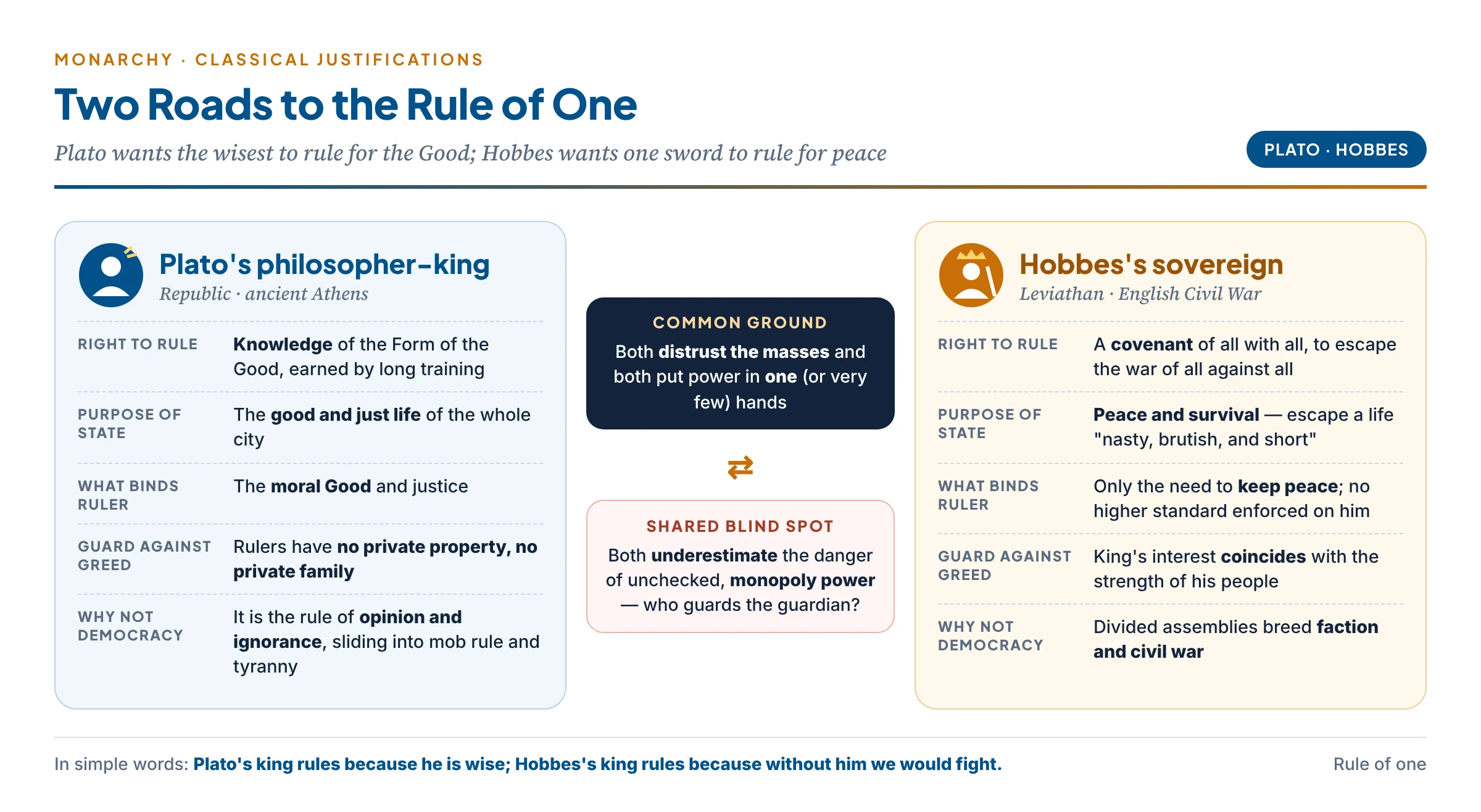
Plato and Hobbes Compared
Both defend the rule of one (or of a very few), and both reject democracy — but for opposite reasons.
| Point | Plato’s philosopher-king | Hobbes’s absolute sovereign |
|---|---|---|
| Kind of philosophy | Idealist, teleological — the state exists for the good life | Materialist, mechanistic — the state exists for survival and peace |
| Basis of the right to rule | Knowledge of the Form of the Good | Covenant (contract) of all with all |
| What binds the ruler | The moral Good and justice | Only the need to keep peace; no higher moral standard enforceable against him |
| Guard against corruption | Guardians’ communism — no private property or family | Coincidence of the king’s private interest with the strength of the realm |
| Why democracy is rejected | It is the rule of ignorance (doxa), leading to anarchy and demagoguery | Divided assemblies breed faction and civil war |
| Main weakness | No reliable way to find or keep a true philosopher; who guards the guardians? | Underestimates the danger of unchecked monopoly power — Locke’s “lions” (Article 3) |
- Common ground: both distrust the masses, and both underestimate the danger of concentrated, unaccountable power. Plato seeks moral perfection through reason; Hobbes seeks physical safety through a united coercive force.
In simple words
Plato’s king is like the wisest elder of a village — obeyed because he knows best. Hobbes’s king is like a night watchman with a big stick — obeyed not because he is wise, but because without him everyone would rob everyone else. Both want one person in charge; they disagree about why.
Monarchy above Politics: Bagehot and the Constitutional Monarch
The modern justification of monarchy is not that the king rules well, but that he does not rule at all — he stands above party politics.
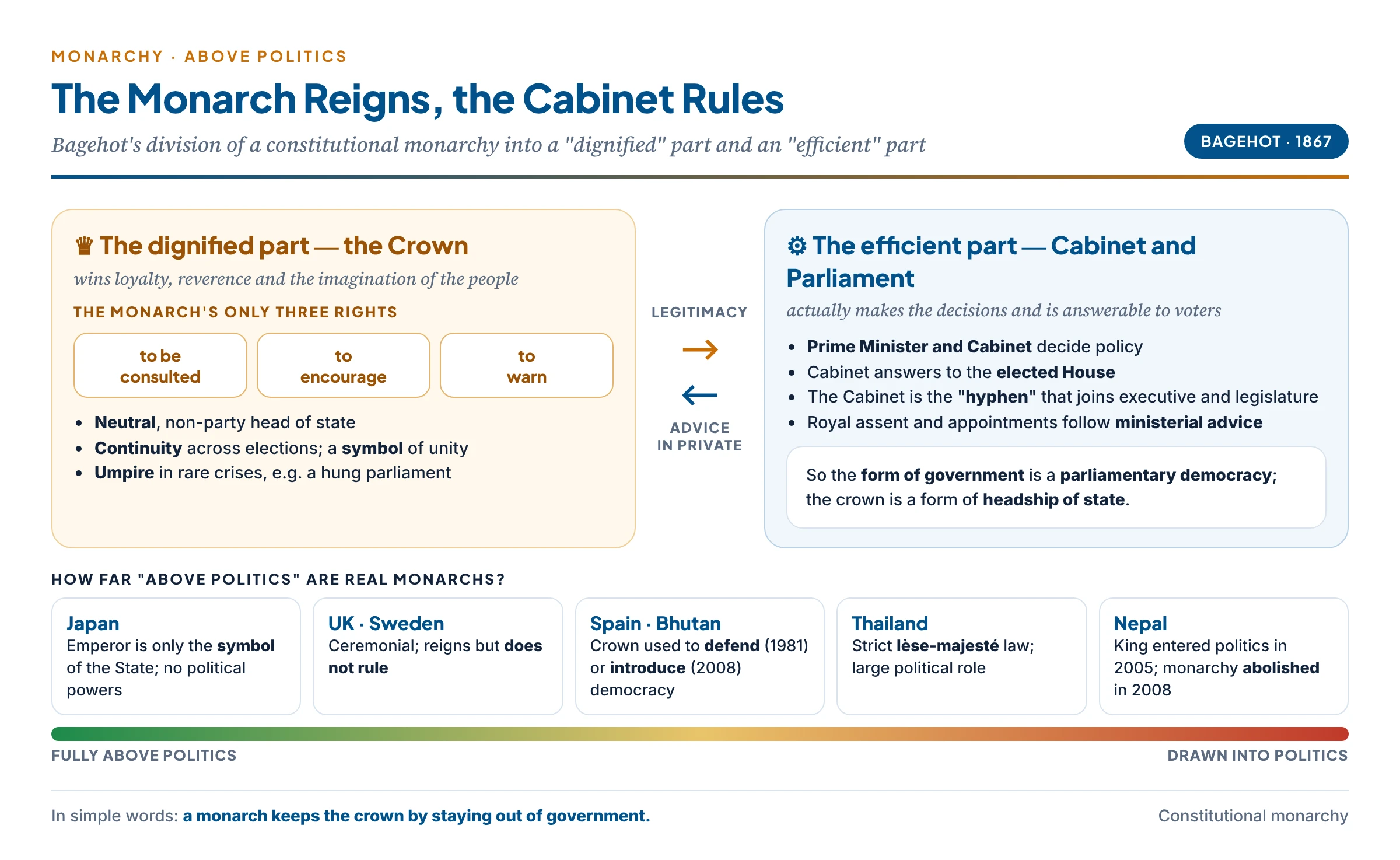
- Walter Bagehot, The English Constitution (1867), divided the constitution into two parts:
- The “dignified” parts — the Crown (and the House of Lords), which win the loyalty, reverence and imagination of ordinary people and give government its legitimacy and continuity.
- The “efficient” parts — the Cabinet and the House of Commons, which actually govern. The Cabinet is the “hyphen” that joins the executive to the legislature.
- The monarch’s three rights. Under a constitutional monarchy, the sovereign has “the right to be consulted, the right to encourage, the right to warn” — and no more. Ministers decide; the monarch advises privately.
- Functions claimed for a monarch above politics:
- A neutral, non-partisan head of state, accepted by supporters of all parties.
- Continuity across elections and changes of government.
- A symbol of national unity and of the state’s history.
- A constitutional umpire in rare crises (e.g. inviting a leader to form a government in a hung parliament).
- Soft power and ceremonial roles.
- Is it then a “systematic form of government”? Once the monarch is fully above politics, monarchy ceases to be a form of government in the strict sense; the system of government is parliamentary democracy, and the crown is an institution of headship within it. Monarchy remains “systematic” only in the sense of a settled, rule-governed place in the constitution — hereditary succession, fixed conventions of royal assent and appointment.
- How “above politics” are monarchs in practice?
- United Kingdom / Japan / Sweden — almost purely ceremonial; the Japanese Emperor has no political powers at all.
- Thailand — the monarchy is protected by a strict lèse-majesté law (Article 112 of its criminal law) and has historically played a large political role, so it is not simply above politics.
- Bhutan — democracy came from the throne: the fourth king pushed through the 2008 Constitution and the first parliamentary elections; the Constitution even provides that the king can be made to abdicate by a two-thirds vote of Parliament confirmed in a national referendum.
- Nepal — the monarchy was drawn into politics (royal takeover of 2005) and was abolished in 2008; a monarch who enters politics can lose the throne.
- Spain — King Juan Carlos used the crown’s authority to defeat the attempted military coup of February 1981.
- The paradox: a monarch’s authority depends on staying out of politics, so the more neutral he is, the more useful — and the less “monarchical” in the old sense.
Blending Monarchy with Democracy — the Constitutional Solution
- The idea is old. Polybius praised Rome’s mixed constitution (consuls as the monarchic element, the Senate as the aristocratic, the assemblies as the democratic); Aquinas recommended one ruler, a few virtuous men and a popular share in choosing them; Montesquieu admired the English balance of King, Lords and Commons.
- Constitutional monarchy is that blend today. It tries to keep monarchy’s merits — unity, continuity, a neutral symbol — while removing its defects — arbitrary power, no accountability — by giving all real power to elected, accountable bodies.
- What the blend gains: a head of state who is not a party politician; a stable frame for changing governments; a check on would-be dictators (Spain 1981).
- What it keeps of monarchy’s defects: an unelected, hereditary office; privilege by birth; cost; in some countries strict lèse-majesté laws.
- Where it fails: if the monarch re-enters politics, the blend breaks down (Nepal 2005–2008). The full evaluation is in Article 3.
Indian Connect — The Indian President and the “dignified” part
India chose a republic, not a monarchy, but its parliamentary system copies the British division of roles. The President is the constitutional head; under Article 74 he acts on the aid and advice of the Council of Ministers headed by the Prime Minister (the 42nd and 44th Amendments made this binding, with a power to return advice once for reconsideration). Like Bagehot’s monarch, the President is a “dignified” part: a symbol of the nation who is consulted, can warn and can ask for reconsideration, while the “efficient” part — the Cabinet answerable to the Lok Sabha — governs. The difference is that the President is elected for five years, not born to office.
Significance and Merits Claimed for Monarchy
- Efficiency of a benevolent monarch — a wise and good ruler can govern very effectively (Plato’s philosopher-king is the ideal case).
- Quick decision-making — no long debates or coalition bargaining; especially useful in emergencies and war.
- Stability of government — rule for life and clear succession avoid the uncertainty of frequent elections.
- A binding force that unites the nation — the crown is a common symbol above region, party and class.
- Long-term outlook — a dynasty thinks in generations, not election cycles.
- Continuity and tradition — a living link with a nation’s history.
These merits are weighed against the criticisms in Article 3.
Monarchy and Individual Freedom — a First Look
- In absolute monarchy, freedom exists only at the pleasure of the ruler — subjects have duties but no rights they can enforce against him.
- In enlightened despotism, rulers granted real freedoms (Friedrich II’s religious toleration), but these were gifts, revocable at will.
- In constitutional monarchy, freedom rests on the constitution, courts and Parliament, not on the crown — which is why countries like Norway, Denmark and Sweden are both monarchies and among the freest societies.
- The detailed answer — Hobbes’s “silence of the law”, Montesquieu’s honour and intermediate powers, Kant on freedom of argument — is in Article 3.
Indian Theories of Kingship
Why Kings? — Mātsya-nyāya and the Origin of Kingship
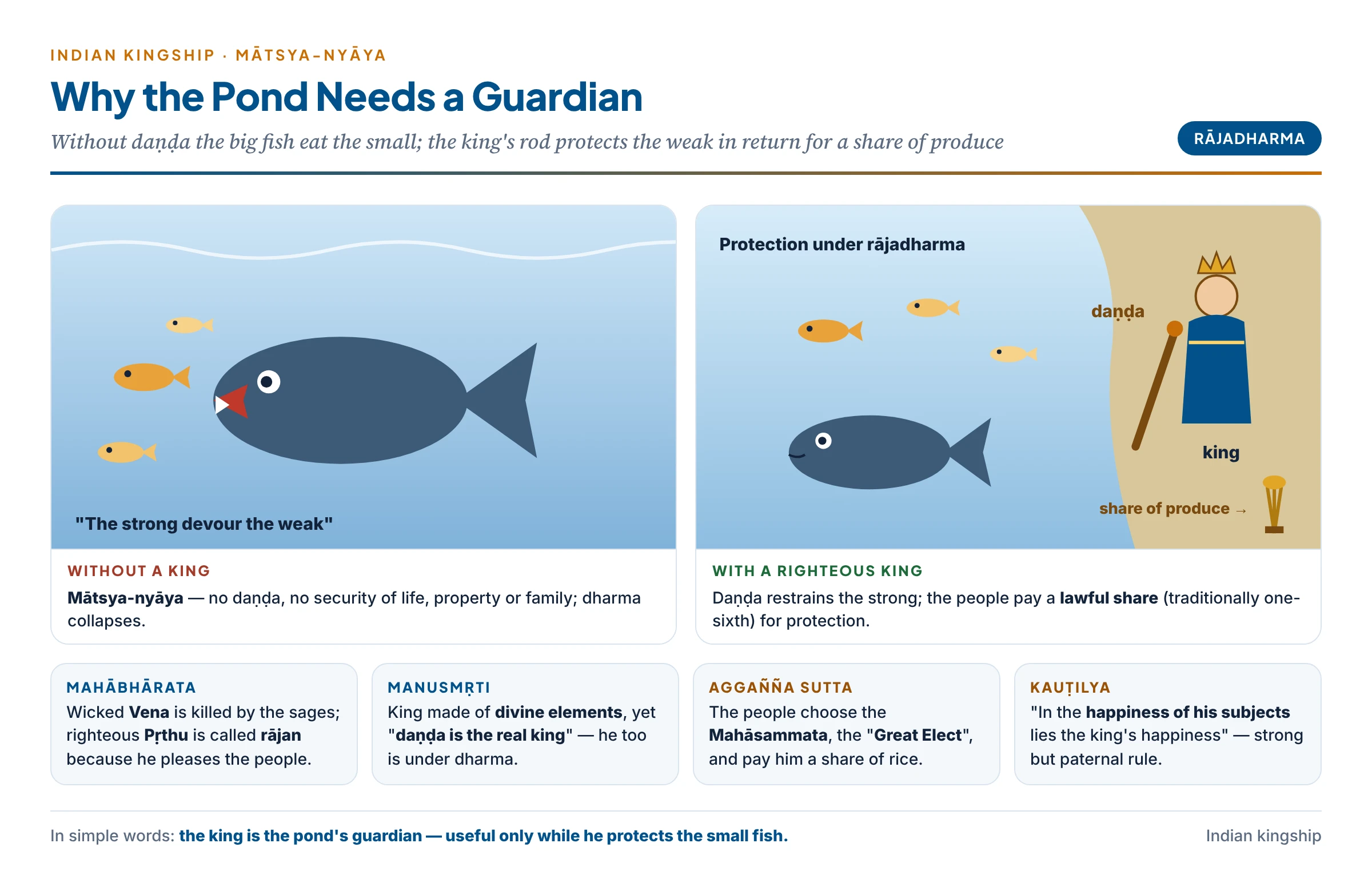
- Mātsya-nyāya (“the law of the fishes”). Without a king and his rod of punishment (daṇḍa), “the big fish eat the small“: the strong devour the weak, property and family are insecure, and dharma collapses. This is the Indian equivalent of Hobbes’s state of nature.
- The Mahābhārata (Śānti Parva) gives two famous accounts:
- Original kingless harmony and its decline. At first there was no king and no punishment; people protected one another by dharma alone. Gradually delusion, greed and lust crept in, dharma decayed, and the gods asked for a ruler to restore order. A science of government (daṇḍanīti) was composed for the king.
- Vena and Pṛthu. Vena was a wicked, arrogant king who forbade sacrifices and oppressed the people; the sages killed him with consecrated blades of grass. From his body they produced Pṛthu, a righteous king who swore to protect the people and uphold dharma. Because he pleased (rañjayati) the people, he was called rājan — “the king is one who pleases the people”.
- The contract element. Another Śānti Parva account says the people, suffering under mātsya-nyāya, went to Manu and offered him a share of their cattle, gold and grain if he would protect them — kingship as an exchange of protection for taxes.
In simple words
Picture a pond with no rules: the big fish simply eat the small ones. Now put a guard at the pond who punishes any fish that eats another. The small fish are safe — and they gladly give the guard a share of their food in return. That guard is the king; his stick is daṇḍa; the share of food is tax. This is the Indian answer to “why do we need a king?”
The Divine King under Dharma — Manusmṛti and Rājadharma
- Divine origin. The Manusmṛti says the Lord created the king from eternal particles of the guardian deities (Indra, Vāyu, Yama, Sūrya, Agni, Varuṇa, Candra and Kubera), so he surpasses all beings in splendour; even a child-king must not be despised, for “he is a great deity in human form”.
- Daṇḍa as the true king. Yet Manu also says that punishment (daṇḍa) is the real king, governing all creatures; a king who punishes unjustly destroys himself and his family.
- Rājadharma — the king’s duty. The king is below dharma, not above it. His duties: protect the people (prajāpālana), uphold the order of varṇa and āśrama, punish the wicked, collect only the lawful share (traditionally one-sixth of produce) and spend it for the people’s welfare.
- The coronation (rājasūya, abhiṣeka) rituals of the Vedic tradition made the king take an oath to protect the people and the law — a sacred, but conditional, office.
- The right to resist a wicked king. The Mahābhārata says a king who does not protect his people should be killed “like a mad dog” — kingship is a trust, not a property.
The Buddhist Theory: Mahāsammata, the “Great Elect”
- The Aggañña Sutta (Dīgha Nikāya) tells how human society degenerated from an original golden age: people began hoarding rice, private fields appeared, then theft, lying and violence.
- The election of a king. The people assembled and chose the most handsome, gracious and capable among them to censure those who deserved censure and banish those who deserved banishment. In return they paid him a share of their rice.
- Three titles follow from this story:
- Mahāsammata — “the Great Elect“, chosen by the whole people.
- Khattiya (kṣatriya) — “lord of the fields“.
- Rājā — “one who pleases others by dhamma“.
- Significance: this is one of the world’s earliest social-contract and elective theories of kingship — the king’s power comes from the people’s choice and payment, not from the gods, and his task is justice. It also undercuts the claim that kṣatriyas are a divinely superior birth-group.
Kauṭilya: Strong but Paternal Monarchy
- Kauṭilya (Arthaśāstra) was a champion of a strong monarchy and a stable, expanding state; the king (svāmī) is the first and most important of the seven limbs (saptāṅga) of the state (see SP Unit 02, Article 5).
- Paternal and benevolent. The king must be a rājarṣi (royal sage), disciplined in mind and senses, following a strict daily timetable of work. His happiness lies in his subjects’ happiness:
“In the happiness of his subjects lies the king’s happiness; in their welfare his welfare. Whatever pleases himself he shall not consider good, but whatever pleases his subjects he shall consider good.” — Kauṭilya, Arthaśāstra
- Religion separated from statecraft. Kauṭilya treats politics as a secular science of acquisition and protection. Among the sources of law, the king’s edict (rājaśāsana) prevails over custom and even over sacred law (dharma) where they conflict and the edict is just. Religion is used, sometimes cynically, as an instrument of state.
- Unity of the four sciences. The king must master philosophy (ānvīkṣikī), the Vedas (trayī), economics (vārttā) and the science of punishment (daṇḍanīti); of these, daṇḍanīti holds the others in place.
Indian Connect — Kingship in Indian thought — sacred, but conditional
Indian theories combine two ideas that Western thought often separated: the king is sacred (made of divine elements, crowned in Vedic ritual) and yet accountable (below dharma, liable to be killed if he becomes a Vena, chosen by the people in the Buddhist story, bound to his subjects’ welfare in Kauṭilya). Indian kingship was therefore never a pure “divine right” in the European sense — the king’s divinity depended on his righteousness.
Critical Evaluation
Purva-paksha: The Main Objections (in brief)
- Birth is not merit. Hereditary succession gives power to whoever is born first, not to the wise — the opposite of Plato’s own principle (Paine’s “ass for a lion”, Article 3).
- No accountability. A monarch who cannot be removed except by revolt may become a tyrant; Aristotle and Aquinas both admit that the best form, corrupted, becomes the worst.
- Subjects, not citizens. Monarchy treats people as subjects with duties but few rights; it violates political equality and the idea of self-government (Rousseau, Kant).
- Discretionary rule. Absolute monarchy places the ruler’s will above the rule of law and constitutionalism (Locke: no impartial judge between king and subject).
- Against social progress. A hereditary, tradition-bound office tends to protect old privileges.
- The Hobbesian gamble. Hobbes trades the war of all against all for the risk of one all-powerful master — Locke’s objection that this is like escaping “polecats or foxes” by being “devoured by lions” (Article 3).
Siddhānta-side Replies
- Constitutional monarchy answers most objections. Where the crown is purely symbolic, birth decides only who performs ceremonies, not who governs; accountability and rights rest on Parliament and courts.
- The ideal of the just king in both traditions is limited — by law (Aristotle), divine and natural law (Bodin, Aquinas), dharma (Manu, the Mahābhārata) or the people’s choice (Mahāsammata).
- Stability and neutrality have real value: in divided societies a head of state above party can be a unifying force (Spain 1981, Bhutan 2008).
- Even Hobbes’s absolutism has a liberal core: the sovereign exists for the subjects’ safety, and the subjects keep the right to defend their own lives.
Critics and Defenders
Criticism — Critics of monarchy
- Aristotle — absolute kingship over equals is unjust; rule of law is better than rule of a man.
- Locke — absolute monarchy is inconsistent with civil society; consent and trust are the basis of government.
- Paine — hereditary succession is “an insult and an imposition on posterity”.
- Rousseau — sovereignty belongs to the general will and cannot be transferred to a king.
- Kant — paternal government treats citizens as children and is “the greatest conceivable despotism”.
- Lord Acton — “power tends to corrupt, and absolute power corrupts absolutely”.
Defence — Defenders and strengths
- Plato — rule by the wise is the only cure for the evils of cities.
- Aquinas — unity of peace is best produced by one; nature and experience favour kingship.
- Bodin — indivisible sovereignty is most secure in a royal monarchy that respects law and property.
- Hobbes — monarchy gives unity of will, constancy, better counsel and an interest identical with the people’s.
- Bagehot — a monarch above politics gives continuity, reverence and a neutral head of state.
- Indian tradition — the king as protector against mātsya-nyāya, bound by rājadharma and the welfare of subjects.
Cross-Tradition Comparison
Western and Indian Justifications of Kingship
| Theme | Western thought | Indian thought |
|---|---|---|
| Rule of wisdom | Plato’s philosopher-king, trained in knowledge of the Good | Kauṭilya’s rājarṣi, disciplined in the four sciences |
| Why a ruler is needed | Hobbes’s state of nature — war of all against all | Mātsya-nyāya — big fish eat the small |
| Kingship by agreement | Hobbes’s covenant; later Locke’s trust | Mahāsammata chosen and paid by the people; the people’s offer to Manu |
| Sacred kingship | Divine Right of Kings (Filmer, James I — Article 3) | King made of divine elements (Manu), but below dharma |
| Removing a bad king | Aquinas: tempered power, cautious resistance; Locke: right of revolution | Sages kill Vena; the Mahābhārata permits killing a king who fails to protect |
| Law above the king | Aristotle’s rule of law; Bodin’s divine and natural law | Dharma and daṇḍa — “punishment is the real king” |
| Monarch above politics | Bagehot’s “dignified” Crown | Indian President under Article 74 (in a republic) |
Indian Connect — Key takeaways
- Both traditions see kingship as a remedy for disorder — the state of nature in the West, mātsya-nyāya in India.
- Both make the good king subject to a higher law — natural law in Aquinas and Bodin, dharma in Manu and the epics.
- The Buddhist Mahāsammata anticipates the European social-contract idea by many centuries, and is more democratic than Hobbes: the king is chosen to do justice, not to receive unlimited power.
- Kauṭilya is closer to Hobbes and Machiavelli — a secular, power-centred monarchy — but tempers it with a paternal duty to the subjects’ welfare.
Synthesis (Siddhānta)
- What monarchy got right. Every political community needs unity, a final decision-maker, continuity and a symbol of the whole. The classical defenders of monarchy — Plato, Aquinas, Hobbes, Kauṭilya — understood this better than many enthusiasts of pure majority rule.
- What it got wrong. It made the quality of government depend on one person’s character and on the accident of birth, and it left no peaceful way to remove a bad ruler. Even its defenders admitted that the best form, corrupted, becomes the worst — tyranny.
- The modern resolution. Monarchy has survived where it has stepped out of government and become a dignified, symbolic headship within a constitutional democracy. In that form it can still serve unity and continuity, but only because power, accountability and rights have passed to elected institutions.
- Ethically, the rule of one can be justified only so far as it serves the common good and remains under a higher law — the shared insight of Aristotle’s kingship, Aquinas’s tempered monarchy, Bodin’s royal monarchy, Manu’s rājadharma and the Buddhist Great Elect.
- Contemporary relevance.
- About forty-three countries still have a monarch as head of state (including the fifteen Commonwealth realms of King Charles III), ranging from absolute (Saudi Arabia, Brunei) to purely symbolic (Japan, Sweden).
- Debates over republicanism (Barbados became a republic in 2021), lèse-majesté laws and the cost of royal households keep the ethical questions alive.
- Bhutan shows a rare path in which a monarch introduced democracy himself.
“The Sovereign has, under a constitutional monarchy such as ours, three rights — the right to be consulted, the right to encourage, the right to warn.” — Walter Bagehot
Previous Year Questions
- 2023If monarchs are above politics, can monarchy be a systematic form of government? Discuss.
- 2021Does monarchy as a form of government leave room for individual freedom? Explain.
- 2017Discuss whether a blending of monarchy with democracy is conceivable to avoid their undesirable defects for making the governance better for citizens and state.
- 2009Define monarchy. Is it ethically justified?