

Forms of Government: Monarchy; Theocracy and Democracy.
Official Syllabus: Paper II, Section A, Unit 4
Article 2 set out what monarchy is and the classical case for it: Plato’s wise ruler, Aristotle’s virtuous king, Aquinas’ single helmsman, Hobbes’ peace-keeping sovereign. This article looks at the strongest religious defence of monarchy and at the attacks that brought it down. In the sixteenth and seventeenth centuries kings claimed to rule by Divine Right: their power came straight from God, so no parliament, people or pope could judge them. Filmer, James I and Bossuet built the theory. Locke, Paine, Rousseau and Kant demolished it. The article then takes up the questions UPSC keeps asking about monarchy: whether monarchy and theocracy are necessarily related, whether monarchy leaves room for individual freedom, whether it is ethically justified, whether it can be blended with democracy, and how monarchy, democracy and dictatorship resemble and differ from one another.
In simple words
A school principal says: “The management appointed me, so only the management can question me. Teachers and students cannot.” That is the logic of Divine Right: the king’s “management” is God, so only God can judge him. Now suppose the teachers reply: “You run this school for us, and we can ask you to explain yourself.” That is the logic of Locke: rulers hold power on trust from the people, and the people can take it back.
Context & Problem
Why the Question of Royal Authority Became Urgent
- Collapse of a single Church. After the Reformation (Luther, 1517), Catholics and Protestants each claimed God’s support. Kings needed a basis of authority that did not depend on the Pope.
- Wars of religion and civil war. France (the Wars of Religion, 1562–98) and England (the Civil War, 1642–51) showed how fragile order was. Many thinkers concluded that one unquestionable ruler was the only cure for chaos.
- Resistance theories. Some Protestant and Catholic writers argued that a tyrant may be resisted or even killed. These writers were known as the Monarchomachs, “fighters against monarchs”. Jesuits such as Bellarmine and Suárez held that the Pope could release subjects from obedience to a heretic king. Divine Right was the kings’ answer to both.
- The core question. Where does a king’s authority come from: God directly, the Church, the people, or force? And is the king accountable to anyone on earth?
In simple words
Think of three ways a captain can claim command of a ship. “The owner appointed me” is Divine Right. “The crew agreed to follow me” is consent, the social contract. “I have the guns” is force, or dictatorship. Most of this article is about the clash between the first two answers.
Core Doctrine
The Divine Right of Kings: Meaning and Four Propositions
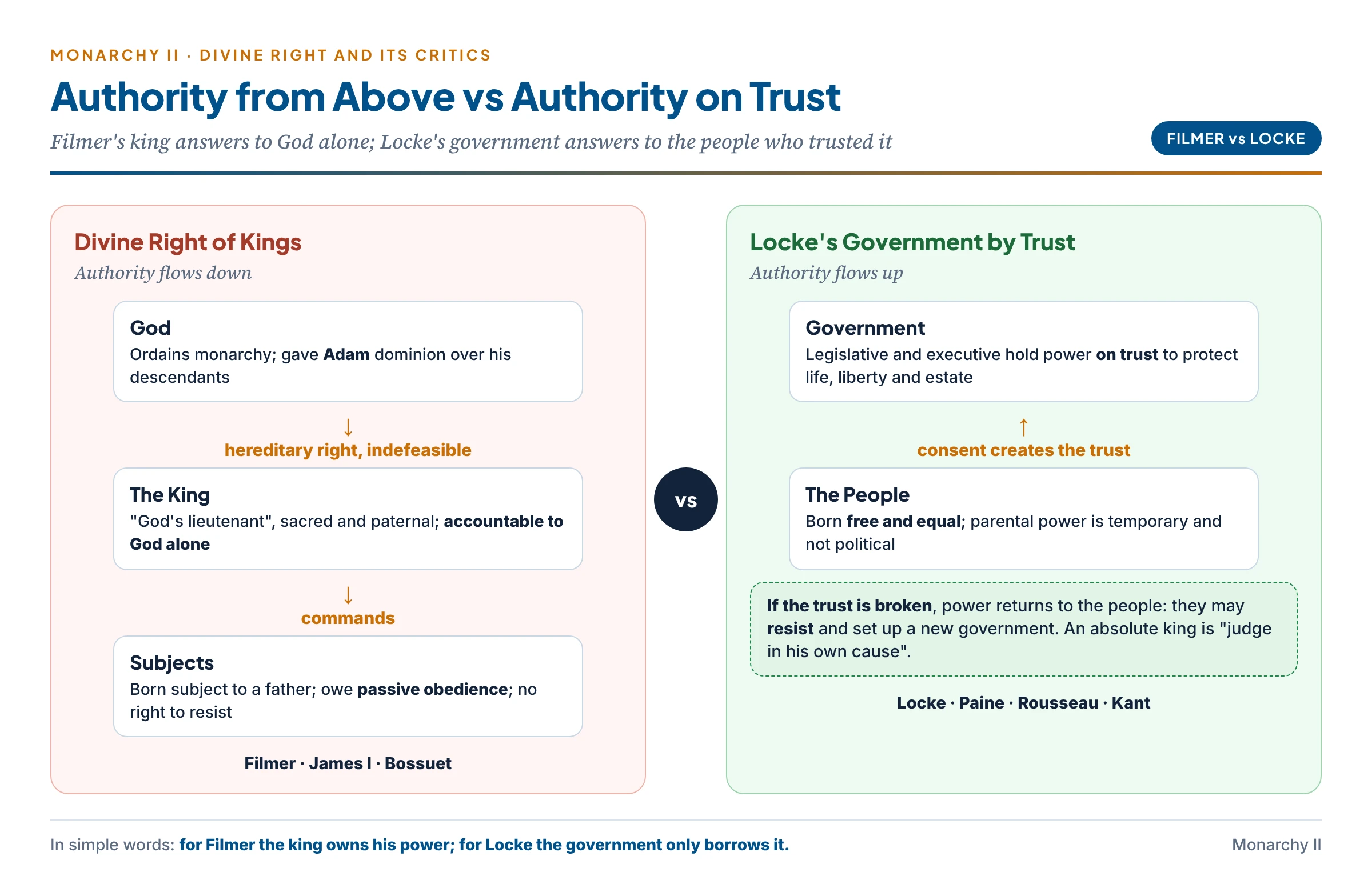
- Meaning. The Divine Right of Kings is the doctrine that a lawful king receives his authority directly from God, not from the people or the Church. He is therefore answerable to God alone.
- The four propositions. The historian J. N. Figgis summed up the theory in four propositions:
- Monarchy is a divinely ordained institution. God wills that states be ruled by kings.
- Hereditary right is indefeasible. The right passes by birth to the lawful heir and cannot be cancelled by parliament, usurpation or conquest.
- Kings are accountable to God alone. No court, assembly or pope can judge a king.
- Non-resistance and passive obedience are enjoined by God. Even a bad king must not be actively resisted. Subjects may refuse to commit sin, but they must accept the punishment.
- What it is not. It is not the claim that the king is a priest, and not the claim that the Church rules. It sanctifies a lay ruler. This point matters for the question of monarchy and theocracy, taken up below.
James I: “Kings Are Justly Called Gods”
- James VI of Scotland and I of England (reigned in England 1603–25) wrote The True Law of Free Monarchies (1598). “Free” here means a monarchy free of any control by parliament or people.
- Main claims:
- The king is above the law. He makes the law; parliament only advises.
- The king is like a father to his people and the head of the body politic. A head is not cut off because it is unwell.
- Even a wicked king is sent by God, perhaps as a punishment for the people’s sins. Rebellion is never lawful.
- The 1610 speech to Parliament. James told Parliament that kings are “God’s lieutenants upon earth” who “sit upon God’s throne“, and that even God himself calls them gods. Just as it is blasphemy to dispute what God may do, it is sedition for subjects to dispute what a king may do.
- What followed. His son Charles I pressed the same claims, fought Parliament and was executed in 1649. The Glorious Revolution (1688) and the Bill of Rights (1689) then placed the English crown under Parliament. In practice, this ended Divine Right in England.
Filmer’s Patriarcha: The King as Father
- Sir Robert Filmer gave the theory its most systematic argument in Patriarcha. The argument is called patriarchalism: political power is paternal power.
- The argument:
- God gave Adam absolute dominion over the world and over his children and descendants.
- That dominion was political: Adam was the first king, and the first fathers of families were kings.
- Present-day kings inherit Adam’s fatherly authority by God’s providence, as the nearest heirs of the first fathers.
- So the king is accountable to God alone, never to subjects, parliaments or laws. To rebel against the king is to rebel against God, just as a child who strikes his father sins against nature.
- Natural subjection. Filmer denied that men are born free and equal. Everyone is born subject to a father, so the idea of a free people choosing its ruler is a dangerous fiction.
- Why it mattered. Patriarcha became the ideological weapon of the royalists in the Exclusion Crisis (1679–81). That is why Locke wrote a whole treatise against it.
Common confusion
Did Filmer write Patriarcha in 1680? No. Filmer died in 1653. He wrote Patriarcha decades earlier, probably in the late 1620s to 1640s, and it circulated in manuscript. It was published only in 1680, when royalists revived it during the Exclusion Crisis. Locke’s First Treatise (published in 1689) is a line-by-line reply to that published text. So the correct statement is: “Patriarcha, published in 1680.”
Bossuet: Royal Authority Is Sacred, Paternal, Absolute and Subject to Reason
- Jacques-Bénigne Bossuet (1627–1704), bishop and tutor to the son of Louis XIV, wrote Politics Drawn from the Very Words of Holy Scripture (published in 1709). It is the classic French statement of Divine Right.
- Four characteristics of royal authority:
- Sacred. The king is God’s minister and lieutenant. The royal throne “is not the throne of a man, but the throne of God himself”. To attack the king’s person is sacrilege.
- Paternal. The king is the father of his people; his true character is goodness. He must care for the weak.
- Absolute. The prince answers to no one for his decrees. Without absolute power he could neither do good nor punish evil.
- Subject to reason. The king must govern wisely, by knowledge and counsel, not by whim.
- Absolute is not arbitrary. Bossuet insisted that absolute government (no human superior) is different from arbitrary government (rule by caprice). The king is bound by God’s law and by justice. He is subject to the law’s direction, though not to its penalties.
- The image. “Behold an immense people united in a single person… you see the image of God in the king.”
In simple words
Bossuet’s king is like a head of a family who cannot be taken to court by his children. He must still be a good father, because God is watching. The weakness is plain: if the father is cruel, the children have no remedy except prayer.
Why the Divine Right Theory Arose: Its Hidden Purpose
- Against the Pope. Medieval popes claimed the power to depose kings (Gregory VII against Emperor Henry IV, who did penance at Canossa in 1077). Divine Right said God gave the king his crown directly, with no papal middleman. National kingship thus became independent of Rome. England’s Act of Supremacy (1534) under Henry VIII made the king head of the English Church.
- Against civil war. If the people may judge the king, every faction will claim to be “the people”. An unquestionable hereditary ruler seemed the only guarantee of peace.
- Against the resistance theorists. Divine Right answered the Monarchomachs and the Jesuits who justified tyrannicide.
- Its positive side. It helped build the sovereign national state and taught obedience to law in an age of anarchy.
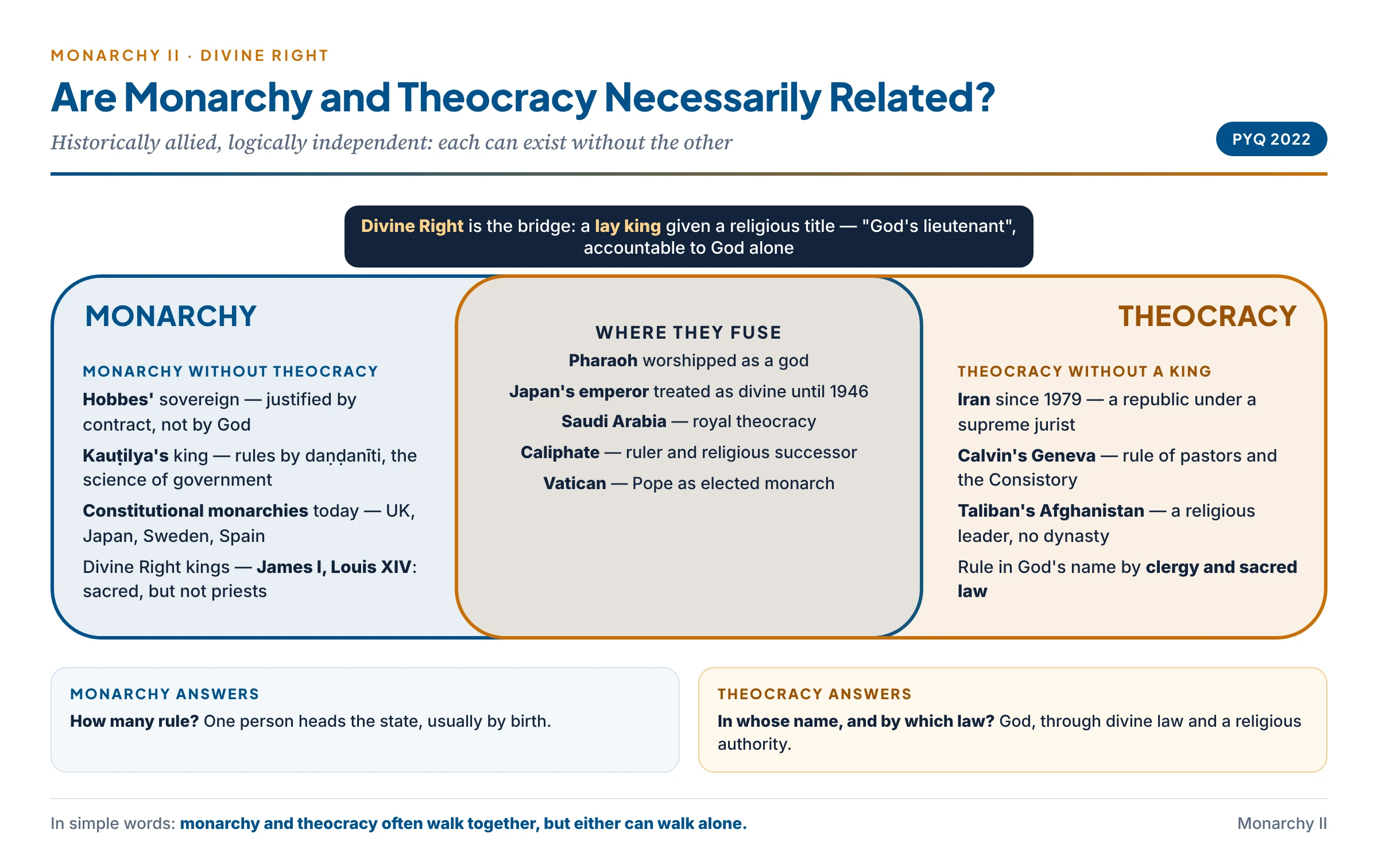
Are Monarchy and Theocracy Necessarily Related?
- The two ideas defined.
- Monarchy answers the question “how many rule?” One person heads the state.
- Theocracy answers the question “in whose name, and by which law?” God rules through divine law and, in practice, through a priesthood or religious authority (see Article 4).
- Where Divine Right brings them close. Divine Right gives the monarch a religious title: anointed, sacred, God’s lieutenant. So it looks theocratic. Both share the claim that political authority comes from above, not from the people, and both deny the people the right to judge the ruler.
- Why they are not necessarily related:
- Different rulers. In Divine Right monarchy the ruler is a layman, the king. In theocracy the ruler is the clergy or a divinely guided religious leader. James I did not rule as a priest, and he did not rule by the Bible’s legal code.
- Historical rivalry. Divine Right was developed against the theocratic claims of the Papacy. The long contest between popes and kings, the Investiture Controversy (1075–1122), shows the two powers fighting, not merging.
- Secular monarchies exist. Hobbes defended absolute monarchy on purely secular, contractual grounds. Kauṭilya’s king rules by daṇḍanīti (the science of government), not by priestly law. Today’s constitutional monarchies (UK, Japan, Sweden, Spain) are secular democracies.
- Theocracies without kings exist. Iran since 1979 is a theocratic republic, with an elected president under a supreme jurist. Calvin’s Geneva had no king. The Taliban’s Afghanistan is ruled by a religious leader, not a dynasty.
- Where they do overlap. Some systems combine both:
- Sacred kingship. The Egyptian pharaoh was worshipped as a god. The Japanese emperor was treated as divine until his “Humanity Declaration” of 1 January 1946.
- Royal theocracy. Saudi Arabia has a hereditary king, and its Basic Law (1992) names the Qur’an and Sunnah as its constitution.
- Ruler and religious head in one. The Caliphate combined both roles. The Pope is both an elected absolute monarch of the Vatican City State and the head of the Church.
- Conclusion. Monarchy and theocracy are historically allied but logically independent. Divine Right is the bridge between them: it borrows religious language to support a lay king. Where the king also controls religious law (Saudi Arabia) or is himself the religious head (the Vatican), they fuse. Where the king is secular (Hobbes, the modern UK) or the theocrat has no crown (Iran), they come apart.
Indian Connect — King, Dharma and Purohita: Sacred but Not Theocratic
- The king below dharma. In Indian thought the king (rājā) is the protector of dharma, not its author. Rājadharma binds him. The Manusmṛti gives the king a divine aura, describing him as formed from the essence of the gods and saying even a child-king must not be despised. Yet it still subjects him to dharma and to punishment (daṇḍa) as the real ruler.
- The priest advises, the king rules. The purohita (royal priest) performed rituals and counselled, but did not govern. The brahma–kṣatra relation was a partnership of spiritual and temporal power, much like the Western “two swords”, not rule by priests.
- Kauṭilya’s secular statecraft. The Arthaśāstra makes daṇḍanīti the decisive science of government and judges policy by welfare and power, not by scripture. “In the happiness of the subjects lies the king’s happiness.”
- Resistance allowed. The Mahābhārata tells how the sages killed the wicked king Vena. Indian kingship was conditional, unlike Western Divine Right’s demand for non-resistance.
Critical Evaluation
Locke’s Refutation of Filmer and of Absolute Monarchy
John Locke‘s Two Treatises of Government (published in 1689) is the decisive answer. The First Treatise attacks Filmer. The Second Treatise builds the alternative: government by consent and trust.
- Against Filmer’s patriarchalism:
- Men are born free and equal. In the state of nature no one is naturally subject to another. God’s grant in Genesis was to mankind in common, not to Adam alone.
- Parental power is not political power. A father’s authority over his children is temporary, lasting only until they reach the age of reason. It is shared with the mother (it is “parental”, not just “paternal”), and it is for the child’s good. It gives no power of life and death and none over adults.
- Adam’s dominion was not kingship. Power over land and animals is not power over free men.
- The heir cannot be found. Even if Adam had been a king, no one can trace which present ruler is his rightful heir. On Filmer’s own logic, every existing king might be a usurper.
- Against absolute monarchy (and Hobbes):
- No impartial judge. People leave the state of nature because they lack a common, impartial judge. An absolute monarch remains judge in his own cause in any dispute with his subjects, so absolute monarchy is inconsistent with civil society itself. It is “no form of civil government at all”.
- The famous image. To trust an absolute ruler in order to escape petty violence is “to think that men are so foolish that they take care to avoid what mischiefs may be done them by polecats or foxes, but are content, nay think it safety, to be devoured by lions.”
- Government as a trust. The legislative and executive hold power as a fiduciary trust for the protection of life, liberty and estate (property).
- Right of resistance. When rulers break the trust, power reverts to the people, who may resist and set up a new government. This is the right of revolution, the very thing Divine Right forbade.
Paine: Hereditary Succession as an Insult to Posterity
- Thomas Paine‘s Common Sense (1776) was the pamphlet that pushed the American colonies toward independence. It attacked monarchy as such, not just bad kings.
- On monarchy: it makes one man superior to the rest by an accident of birth. Paine called this degrading to human beings, who are equal by creation.
- On hereditary succession: “To the evil of monarchy we have added that of hereditary succession; and as the first is a degradation and lessening of ourselves, so the second, claimed as a matter of right, is an insult and an imposition on posterity. For all men being originally equals, no one by birth could have a right to set up his own family in perpetual preference to all others forever.”
- Nature’s verdict. If hereditary right were natural, nature would not so often ridicule it by giving mankind “an ass for a lion”, a fool or a child in place of a wise ruler.
- The origin of kings. Paine argued that most royal lines began with “the principal ruffian of some restless gang”, meaning conquest and plunder, later disguised as sacred right.
Rousseau: Force Does Not Make Right
- “Man is born free, and everywhere he is in chains.” The opening of The Social Contract (1762) denies that anyone is born to rule or to obey.
- Force is not right. “To yield to force is an act of necessity, not of will.” If might made right, the right would vanish the moment a stronger force appeared. So the strongest king has no duty of obedience owed to him merely because he is strong.
- No natural authority. The family is the only natural society, and even there the bond ends when children grow up. This is the same blow Locke struck at Filmer.
- Sovereignty is inalienable. Sovereignty belongs to the general will of the people and cannot be handed over to a king. A people that promises simply to obey “dissolves itself by that act”. Government is only the people’s agent and can be changed when the people wish.
Kant: Against Paternal Government
- Paternal government as despotism. In his essay On the Common Saying: “That May Be Correct in Theory, but It Is of No Use in Practice” (1793), Kant wrote that a government built on benevolence, “like that of a father towards his children”, treats subjects as immature children who cannot judge what is good for them. Such a paternal government is “the greatest conceivable despotism“, because it takes away the freedom of its subjects completely.
- Subjects or citizens? Kant’s contrast is between a subject (Untertan), who obeys like a ward, and a citizen (Bürger), who co-authors the law. In What Is Enlightenment? (1784) he mocks guardians who first make their “domestic cattle” dumb and then warn them of the dangers of walking alone.
- The republican constitution. In Perpetual Peace (1795), the only rightful constitution is republican, founded on three principles:
- Freedom of all members of society, as human beings.
- Dependence of all on a single common legislation, as subjects.
- Equality of all, as citizens.
- Monarchy is not ruled out by name. Kant could accept a monarch who governs in a republican spirit, ruling as if the people had given the law to themselves. What he rejects is hereditary privilege and paternalism.
Common confusion
Is Kant’s “paternal government is the greatest despotism” from Perpetual Peace? Many notes put everything Kant said against monarchy under Perpetual Peace. The attack on paternal government as “the greatest conceivable despotism” comes from his 1793 essay on theory and practice. The image of rulers keeping people like domestic cattle comes from What Is Enlightenment? (1784). Perpetual Peace (1795) gives the three principles of the republican constitution (freedom, dependence on a common law, equality as citizens) and links republics to peace.
The General Critical Estimate of Monarchy
- Discretionary rule. Power depends on the ruler’s will, against the rule of law and constitutionalism.
- Slide into authoritarianism. Unchecked rule tends to become authoritarian, so the liberty of individuals is always at risk.
- Against equality and reason. Divine Right makes one family sacred by birth, which violates both equality and rationality. No one can verify a claim that God chose this king.
- Subject, not citizen. People are subjects who owe obedience, not citizens who share in power.
- Duties without rights. Subjects have duties to the king but no enforceable rights against him.
- Against social progress. Hereditary rule tends to protect existing privileges and resist reform.
- Lord Acton’s warning. “Power tends to corrupt, and absolute power corrupts absolutely.” (letter of 1887). Even a good king’s heir may be a tyrant.
In simple words
A family business where the eldest son always becomes chairman, whatever his ability, can do well if the son happens to be talented. But shareholders have no way to remove a bad chairman. Critics of monarchy say a country should not run on luck of birth.
Does Monarchy Leave Room for Individual Freedom?
The answer depends on which monarchy is meant.
- Absolute monarchy: freedom by permission.
- Liberty exists only at the ruler’s pleasure. It is a gift, not a right, and can be withdrawn.
- Hobbes admits that the “liberty of subjects” lies only in the silence of the law: what the sovereign has not regulated, you may do.
- Divine Right’s demand for passive obedience leaves no right of dissent.
- Enlightened monarchy: freedom granted from above.
- The Prussian king Friedrich II, “the Great” (reigned 1740–86) allowed wide religious toleration (“everyone must get to heaven in his own way”) and freer debate.
- Kant described this bargain with the motto he attributed to Friedrich II: “Argue as much as you like, and about whatever you like, but obey!” There is freedom of thought and public reason, but no political freedom.
- Limited monarchy: freedom through intermediate powers.
- Montesquieu distinguished monarchy (rule by one according to fixed laws, checked by intermediate bodies such as the nobility and courts, its spirit being honour) from despotism (rule by one according to whim, its spirit being fear).
- Where law, courts and independent bodies stand between the crown and the citizen, real liberty can survive.
- Constitutional monarchy: full freedom.
- Today’s constitutional monarchies are among the freest countries in the world. In the Economist Intelligence Unit’s Democracy Index 2024, Norway ranked first and Sweden third, with Denmark, the Netherlands, Luxembourg and Japan also classed as full democracies. All are monarchies.
- Here the freedom comes from the constitution, elections and courts, not from the crown. The monarch has no power to take it away.
- Conclusion. Monarchy as such does not guarantee freedom. Absolute and Divine Right monarchy leave freedom at the ruler’s mercy. Freedom becomes secure only when monarchy is limited by law and subordinated to democracy, and by then the monarch is no longer really governing.
Is Monarchy Ethically Justified?
- Definition first. Monarchy is the form of government in which supreme authority is vested in one person, usually for life and usually by hereditary succession (see Article 2).
- Arguments for its ethical justification:
- Stability and continuity. A monarch above party politics gives a country a permanent centre. Elections change governments, but the head of state remains.
- Unity and identity. The crown can be a symbol of the nation that all groups share, a binding force in divided societies.
- Impartiality. A hereditary head owes nothing to any party, so he or she can act as a neutral umpire.
- Efficiency in crises. One ruler can decide quickly in emergencies.
- Benevolent rule. A good king trained from birth for service, Plato’s ideal or Kauṭilya’s welfare king, can rule for the common good.
- Tradition and prescription. Burke argued that inherited institutions carry the wisdom of generations. Hegel saw the constitutional monarch as the moment of final decision: the king only “dots the i” on decisions others have prepared.
- Arguments against:
- Birth is not merit. No one deserves supreme office by birth (Paine). This violates equality of opportunity, the principle that offices should be open to all.
- No accountability. Absolute power without accountability tends to corrupt (Acton) and leaves subjects without remedy (Locke).
- Treats adults as children. Paternal rule denies autonomy (Kant).
- Legitimacy without consent. Authority not based on the consent of the governed is, for modern ethics, not fully legitimate (Rousseau, Locke).
- Privilege and cost. It entrenches a privileged family and its wealth, and it requires public money.
- The unverifiable religious claim. Divine Right cannot be checked. It rests on faith, not on public reasons that all citizens can share.
- Balanced view. Absolute and Divine Right monarchy fail the ethical test: they deny equality, autonomy and consent. Constitutional monarchy can be ethically defended. Its powers are symbolic, it rests on the continuing consent of the people (shown in referendums and parliamentary support), and it is valued for stability and unity. Its ethical justification is therefore borrowed from democracy.
Critics and Defenders
Criticism — Critics of monarchy and Divine Right
- Locke: men are born free and equal; parental power is not political; an absolute ruler is judge in his own cause; government is a trust that can be revoked.
- Paine: hereditary succession insults posterity; nature gives “an ass for a lion”.
- Rousseau: force does not make right; sovereignty is inalienable.
- Kant: paternal government is the greatest despotism; only a republican constitution is rightful.
- Acton and Mill: absolute power corrupts; a good despot makes the people passive and unfit for freedom.
- Montesquieu: rule by one without fixed laws and intermediate powers is despotism.
Defence — Defenders and strengths
- Filmer, James I, Bossuet: royal authority is sacred and paternal; resistance brings chaos; the king is bound by God’s law and by reason.
- Hobbes: one indivisible sovereign is the only sure guard against civil war.
- Burke: inherited institutions carry practical wisdom; the hereditary principle guards against the turbulence of constant change.
- Hegel: a constitutional monarch gives the state a single personal point of final decision.
- Bagehot: the crown is the “dignified” part of the constitution that wins loyalty, while the cabinet does the work.
- Modern evidence: constitutional monarchies are among the most stable and free democracies.
Monarchy in the Democratic Age
Can Monarchy Be Blended with Democracy? The Mixed Constitution
- The old idea. Every pure form has a typical defect. Monarchy decays into tyranny, aristocracy into oligarchy, and democracy into mob rule (Aristotle’s scheme; see Article 1). The remedy proposed since antiquity is to mix them:
- Polybius praised Rome for its mixed constitution: the consuls were the monarchic element, the Senate the aristocratic, and the popular assemblies the democratic. Each checked the others, so the cycle of decline was slowed.
- Cicero made the same case in On the Commonwealth.
- Aquinas held that the best regime is one where one rules by virtue, a few share power under him, and all have a share because all can elect and be elected.
- Montesquieu admired the English constitution as a balance of king, lords and commons, with powers separated to protect liberty.
- The British solution: “the King-in-Parliament”. Sovereignty lies in the Crown, Lords and Commons acting together. Over time power drained to the elected Commons and the cabinet.
Constitutional Monarchy as the Blend: “The King Reigns but Does Not Rule”
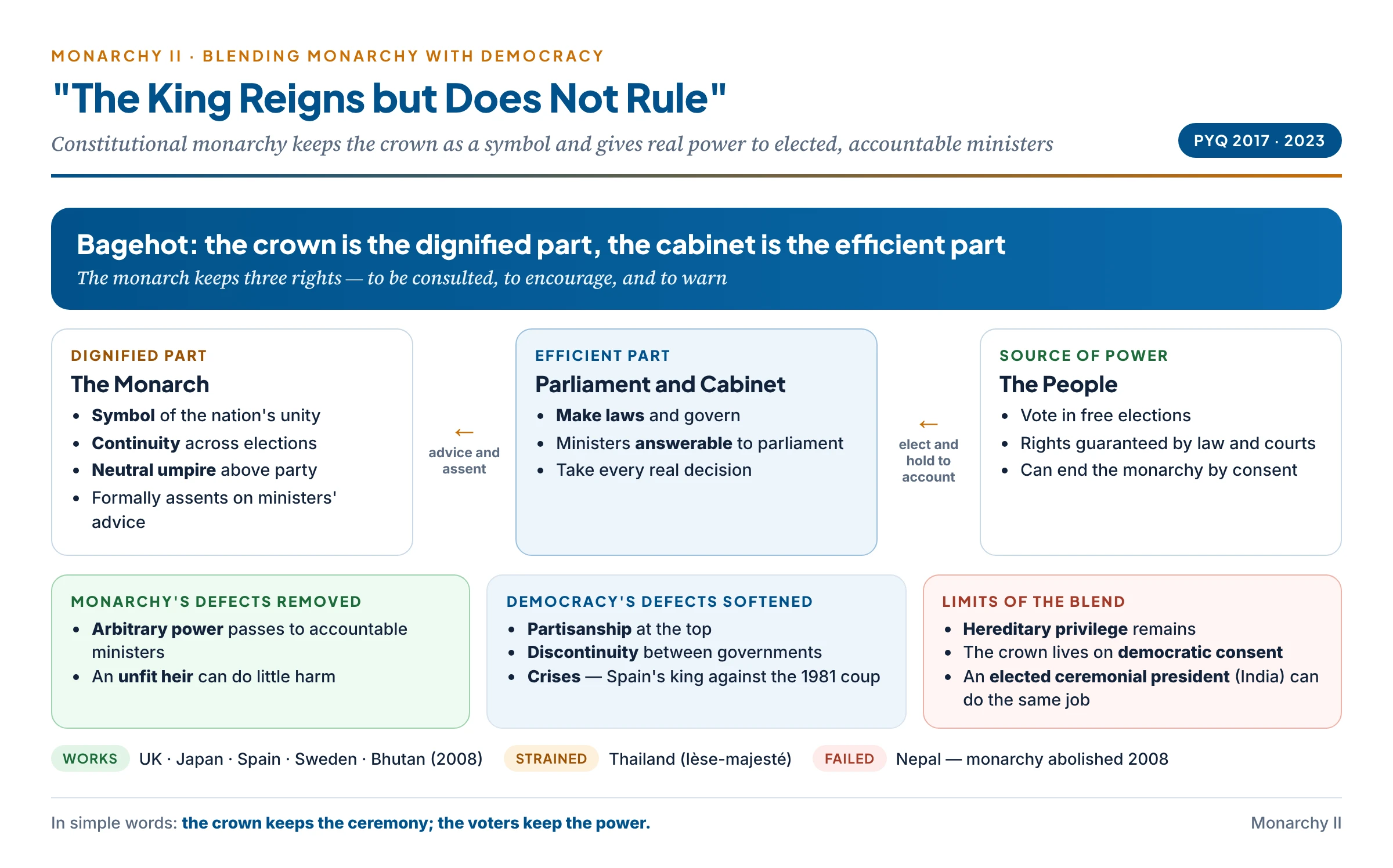
- The formula. The French statesman Adolphe Thiers put it as “the king reigns but does not govern“. The monarch is head of state. The elected government, answerable to parliament, actually governs.
- Bagehot’s division. In The English Constitution (1867), the monarchy is the dignified part, which wins reverence and loyalty. The cabinet is the efficient part, which does the work. The monarch keeps only three rights: to be consulted, to encourage, and to warn.
- Defects of monarchy avoided:
- Arbitrary power. It is removed, because ministers responsible to parliament take every real decision.
- Rule by an unfit heir. It is made harmless, because a weak monarch cannot damage policy.
- Defects of democracy softened:
- Partisanship at the top. The head of state is above party, a neutral symbol for all citizens, including the losers of an election.
- Discontinuity. The crown gives continuity through changes of government.
- Constitutional crises. A monarch can be a neutral umpire when no party has a majority. In Spain, King Juan Carlos helped defeat the military coup attempt of 23 February 1981 by ordering the army to support the democratic constitution.
- Cases:
- United Kingdom. The model case; King Charles III has reigned since 2022.
- Japan. The 1947 constitution makes the emperor “the symbol of the State and of the unity of the people“, with no powers related to government.
- Bhutan. The monarchy itself introduced democracy. The Fourth King began the process, and the 2008 constitution and first parliamentary elections followed. The constitution even sets a retirement age for the king and a procedure by which parliament can make him abdicate.
- Thailand. The blend is strained. The king retains great informal influence, and strict lèse-majesté law (Article 112 of the Thai penal law) punishes criticism of the monarchy with long prison terms. The monarch is not fully “above politics”.
- Nepal. The blend failed. After royal takeovers of power (2002–05) and a people’s movement (2006), the Constituent Assembly abolished the monarchy on 28 May 2008.
- Limits of the blend:
- Hereditary privilege remains. The highest office is still closed to all but one family, so the principle of equality is compromised in symbol if not in power.
- The crown depends on democracy’s goodwill. Once the monarchy depends on democratic consent, the democratic element is clearly supreme. Italy (1946) and Greece (1974) ended their monarchies by referendum, and Australia (1999) kept its monarchy by referendum.
- An elected ceremonial head can do the same job. A non-executive elected president, as in India, Germany or Ireland, gives continuity and neutrality without heredity.
- Verdict. A blend is conceivable and real. Constitutional monarchy combines the symbolic unity and continuity of monarchy with the accountability and rights of democracy. It works best where the monarch is genuinely powerless and popular. The better governance comes from the democratic part. The monarchic part adds legitimacy, ceremony and stability only so long as it stays out of politics.
Indian Connect — The Indian Choice: a President Who “Represents but Does Not Rule”
- The Westminster blend without a king. India copied the parliamentary system but replaced the hereditary monarch with an indirectly elected President.
- Ambedkar’s comparison. In the Constituent Assembly (4 November 1948), Ambedkar said the President “occupies the same position as the King under the English Constitution. He is the head of the State but not of the Executive. He represents the Nation but does not rule the Nation.”
- Article 74. The President acts on the aid and advice of the Council of Ministers. The 42nd Amendment (1976) made the advice binding; the 44th Amendment (1978) allows the President to send it back once for reconsideration.
- Ending princely rule. About 560 princely states were integrated between 1947 and 1949. The 26th Amendment (1971) abolished the rulers’ privy purses and privileges, ending even the symbolic survival of monarchy in India.
- Rāmarājya is not monarchy. Gandhi’s ideal of Rāmarājya used the image of a righteous king, but he explained it as a moral sovereignty of the people: self-rule based on truth and non-violence, not rule by a crowned dynasty.
Monarchy, Democracy and Dictatorship: What They Share and Where They Part
The 2026 paper asked whether monarchy and democracy, though “antagonistic”, share features with dictatorship. Article 1 places dictatorship among the forms of government. Here the question is argued in full.
- What all three share as forms of the state:
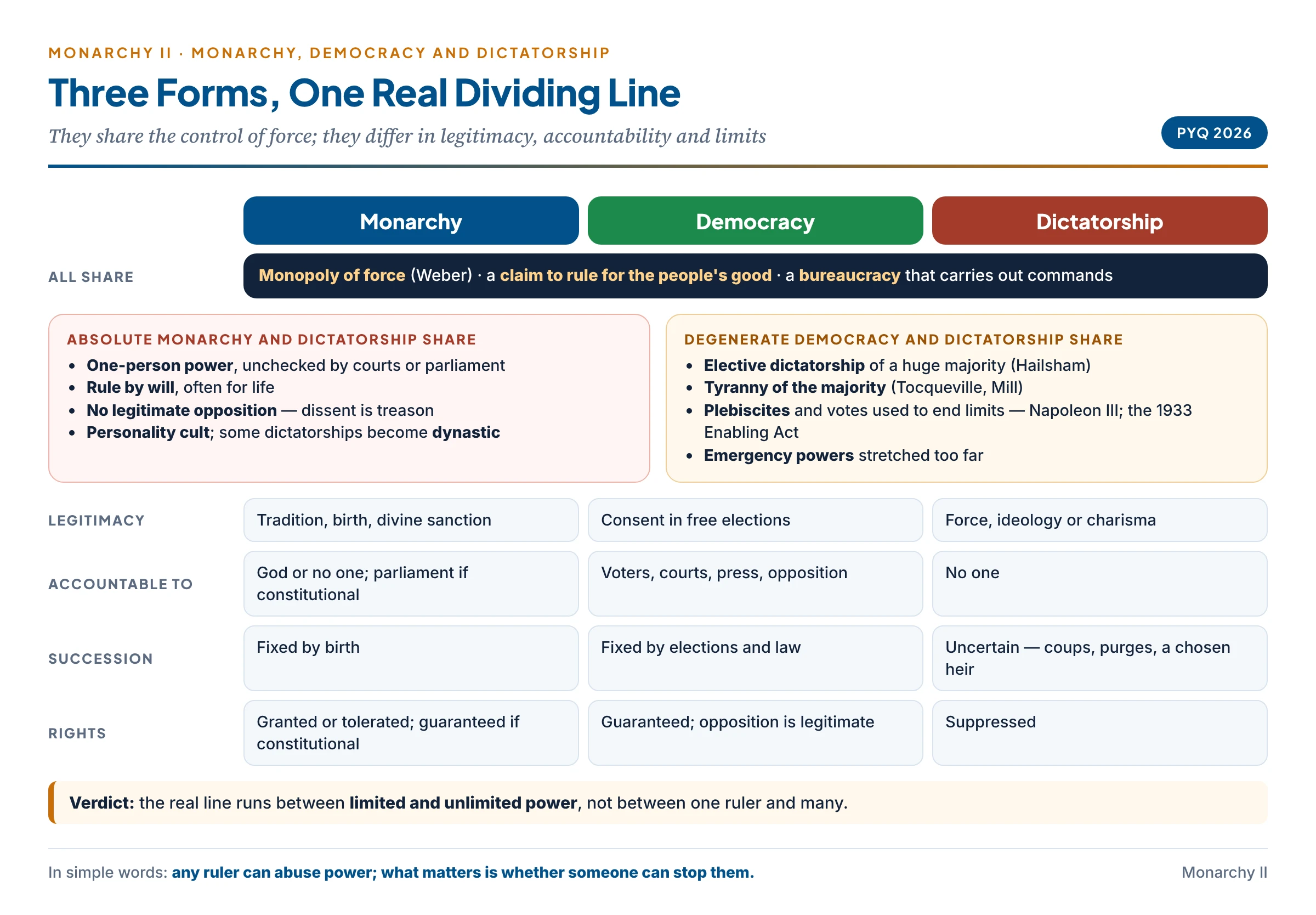
- Monopoly of coercion. Every state, as Max Weber put it, claims a monopoly of the legitimate use of physical force in its territory. Kings, elected governments and dictators all command police, courts, prisons and armies.
- A claim to rule for the people’s good. Kings rule as “fathers”, democrats in the name of the people, and dictators as “saviours of the nation”.
- Bureaucracy and command. All govern through hierarchies of officials who obey orders.
- What absolute monarchy shares with dictatorship:
- Concentration of power in one person, unchecked by independent courts or legislatures.
- Rule by will, often for life, without regular accountability.
- No legitimate opposition. Dissent is treason or sedition.
- Personality cult and ritual. The sacred king and the “great leader” are both glorified. Divine Right’s “image of God” finds a secular echo in the dictator’s portraits.
- Dynastic succession. Some dictatorships turn hereditary, so a dictatorship can become a monarchy in all but name.
- What democracy can share with dictatorship, in its degenerate forms:
- Elective dictatorship. Lord Hailsham (1976) warned that a government with a large majority in a parliament it controls can act almost without check. It is elected, but it rules like a dictator between elections.
- Tyranny of the majority. Tocqueville and Mill feared that a majority can oppress minorities as harshly as any despot (see Article 9).
- Plebiscitary or Caesarist rule. Napoleon III used plebiscites to become emperor (1851–52). The Nazis entered government through elections, and the Enabling Act (1933) then voted dictatorship into law. A popular mandate can be used to destroy the very limits that make it democratic.
- Emergency powers. The ancient Roman dictator was a constitutional office for six months in a crisis. Modern constitutions also contain emergency powers, as in India’s Emergency of 1975–77, after which the 44th Amendment tightened the safeguards.
- Illiberal democracy. Regimes that hold elections but curb the press, courts and opposition have been called “illiberal democracies” or “competitive authoritarian” systems.
Where they part — the decisive differences:
| Point | Monarchy | Democracy | Dictatorship |
|---|---|---|---|
| Source of legitimacy | Tradition, heredity, divine sanction | Consent of the people, expressed in free elections | Force, emergency, ideology or charisma |
| Weber’s type of authority | Traditional | Legal-rational | Usually charismatic or simply coercive |
| Accountability | To God or to no one (absolute); to parliament (constitutional) | To voters, courts, press, opposition | To no one |
| Succession | Fixed by birth | Fixed by elections and law | Uncertain; coups, purges or a chosen heir |
| Rights and dissent | Granted or tolerated (absolute); guaranteed (constitutional) | Guaranteed; opposition is legitimate | Suppressed; opposition is treason |
| Limits on power | Custom, religion, sometimes a constitution | Constitution, separation of powers, rule of law | Few or none |
- Verdict. The statement is partly true. Absolute monarchy and dictatorship share the concentration of unaccountable power. Democracy shares it only when it degenerates into majoritarian or plebiscitary rule. But the three are not the same. Constitutional monarchy and liberal democracy rest on law and consent, which dictatorship lacks. The real line runs between limited and unlimited power, not between one ruler and many.
In simple words
A referee, a team captain chosen by the team and a bully who grabs the ball all “control the game”. The referee holds power by tradition and rules (monarchy), the captain by the team’s vote (democracy), and the bully by force (dictatorship). Any of them can abuse power. The real question is whether someone can stop them when they do.
Is Democracy Better than a Benevolent Dictatorship? (in brief)
- The case for the benevolent ruler is the old case for good monarchy: efficiency, long-term planning and rule by the wise.
- Why democracy is still preferred:
- No guarantee of benevolence. There is no reliable way to find a good dictator, or to keep him good.
- The succession problem. The good ruler dies, and the heir may be a tyrant.
- The feedback problem. Without free speech and elections the ruler does not learn of failures. Amartya Sen notes that famines do not occur in functioning democracies with a free press.
- The education problem. Mill argued that even a good despot makes the people passive and unfit for self-government.
- Self-rule has intrinsic value. Citizens are treated as adults, not wards (Kant).
- Article 9 treats this debate fully, along with meritocracy and the critics of democracy.
Cross-Tradition Comparison
Divine Right, Rājadharma and the Mandate of Heaven
| Point | Western Divine Right (James I, Filmer, Bossuet) | Indian Rājadharma (Manu, Mahābhārata, Kauṭilya) | Chinese Mandate of Heaven (Mencius) |
|---|---|---|---|
| Source of authority | God, directly, by hereditary right | Gods and dharma; social necessity (to end mātsya-nyāya, the law of the fishes) | Heaven, conferred on a virtuous ruler |
| Is authority conditional? | No; hereditary right is indefeasible | Yes; the king must uphold dharma and protect the people | Yes; Heaven withdraws the mandate from a tyrant |
| Right of resistance | None; passive obedience | Allowed against a wicked king (the story of Vena) | Allowed; overthrowing a tyrant is not regicide |
| Role of priests | Bishops support the crown; no clerical rule | Purohita advises; does not govern | Scholars advise; no clerical rule |
| Accountable to | God alone | Dharma, sages, the people’s welfare | Heaven, shown in the people’s welfare |
Indian Connect — Key takeaways
- Indian and Chinese kingship were more conditional than European Divine Right. Both made the ruler’s title depend on righteous rule and allowed resistance to tyranny.
- Sacred does not mean theocratic. In all three traditions the ruler was a lay king with religious backing, not a priest. This supports the conclusion that monarchy and theocracy are related but not identical.
- The Buddhist Mahāsammata (the “great elect” chosen by the people in the Aggañña Sutta; see Article 2) is an Indian anticipation of consent, closer to Locke than to Filmer.
Filmer and Locke Compared
| Point | Filmer | Locke |
|---|---|---|
| Human condition at birth | Born subject to a father | Born free and equal |
| Nature of political power | Paternal, inherited from Adam | Created by consent for limited ends |
| Who judges the ruler? | God alone | The people, when the trust is broken |
| Resistance | Never lawful | Lawful against tyranny |
| Best government | Absolute hereditary monarchy | Limited government with a supreme legislature |
Synthesis (Siddhānta)
- What Divine Right got right. In an age of religious war it saw that the state needs a single, final authority and that order is a precondition of every other good. It helped free national governments from papal control.
- What it got wrong. It grounded authority on a claim that cannot be checked (God’s choice), on birth rather than merit or consent, and it left people without remedy against tyranny. Locke, Paine, Rousseau and Kant replaced it with consent, trust, inalienable sovereignty and the dignity of the citizen.
- Monarchy and theocracy. They are allied but separable. Divine Right borrowed religion’s authority for a lay ruler. Theocracy proper is rule in God’s name by religious authority (Articles 4–5).
- Monarchy and freedom. Freedom under a king is real only when the king is bound by law. Under constitutional monarchy freedom flourishes because the crown has no power over it.
- The modern resolution. The successful blend keeps monarchy as a symbol and democracy as the substance. The difference between good and bad government lies less in the number of rulers than in whether their power is limited and accountable.
- Contemporary relevance:
- About forty-three sovereign states still have monarchs; fifteen of them are Commonwealth realms sharing King Charles III. A few, such as Saudi Arabia, Brunei, Oman and Eswatini, remain absolute or near-absolute.
- Debates on lèse-majesté (Thailand), on republicanism (Australia, Jamaica, Barbados, which became a republic in 2021), and on the cost and role of royal families continue.
- The warning about elective dictatorship and plebiscitary rule shows that the old fear of one-man rule now applies to democracies as well.
“Power tends to corrupt, and absolute power corrupts absolutely.” — Lord Acton
Previous Year Questions
- 2026“The two antagonistic state structures – monarchy and democracy, both share some common features with dictatorship”. Do you agree with this view? Give reasons and justifications for your answer.
- 2022Are monarchy and theocracy necessarily related? Discuss with reference to the theory of ‘Divine Right’.
- 2021Does monarchy as a form of government leave room for individual freedom? Explain.
- 2017Discuss whether a blending of monarchy with democracy is conceivable to avoid their undesirable defects for making the governance better for citizens and state.
- 2013Is a democratic government better than a benevolent dictatorship? Give reasons for your answer.
- 2009Define monarchy. Is it ethically justified?