

Forms of Government: Monarchy; Theocracy and Democracy.
Official Syllabus: Paper II, Section A, Unit 4
Theocracy is the form of government in which God is held to be the real ruler of the state, divine law is the law of the land, and political power is exercised by priests, jurists or a divinely guided leader who claim to speak for God. It answers the oldest question of politics — why should anyone obey? — with the strongest possible reply: because God commands it. This article explains what theocracy means and where the word comes from, its defining features, its kinds (royal and clerical theocracy, and the related forms it is often confused with), its great historical forms — ancient Israel, Augustine’s two cities, the medieval two swords, the Caliphate, Calvin’s Geneva, Tibet, Iran’s Vilāyat-e Faqīh, Saudi Arabia, the Vatican and the Taliban’s Afghanistan — the case made for theocracy, whether ancient India was theocratic, and whether theocracy is an outdated ideology. The detailed critique — can theocracy be a valid form of government at all? — follows in Article 5.
In simple words
Imagine a school where the rule-book is believed to have been written by the founder, who is no longer alive, and nobody may change a single word of it. The founder is still called the “real principal”. Day-to-day decisions are taken by a group of senior teachers who alone are trained to read and explain the founder’s book. When a student objects to a rule, the reply is: “This is not our rule — it is the founder’s.” That school is a small theocracy: the “absent ruler” is God, the rule-book is scripture, and the senior teachers are the priests or jurists.
Context & Problem
What Is Theocracy? The Word and Its Origin
- Etymology: from Greek theos (God) and kratos (rule, power) — “rule by God“.
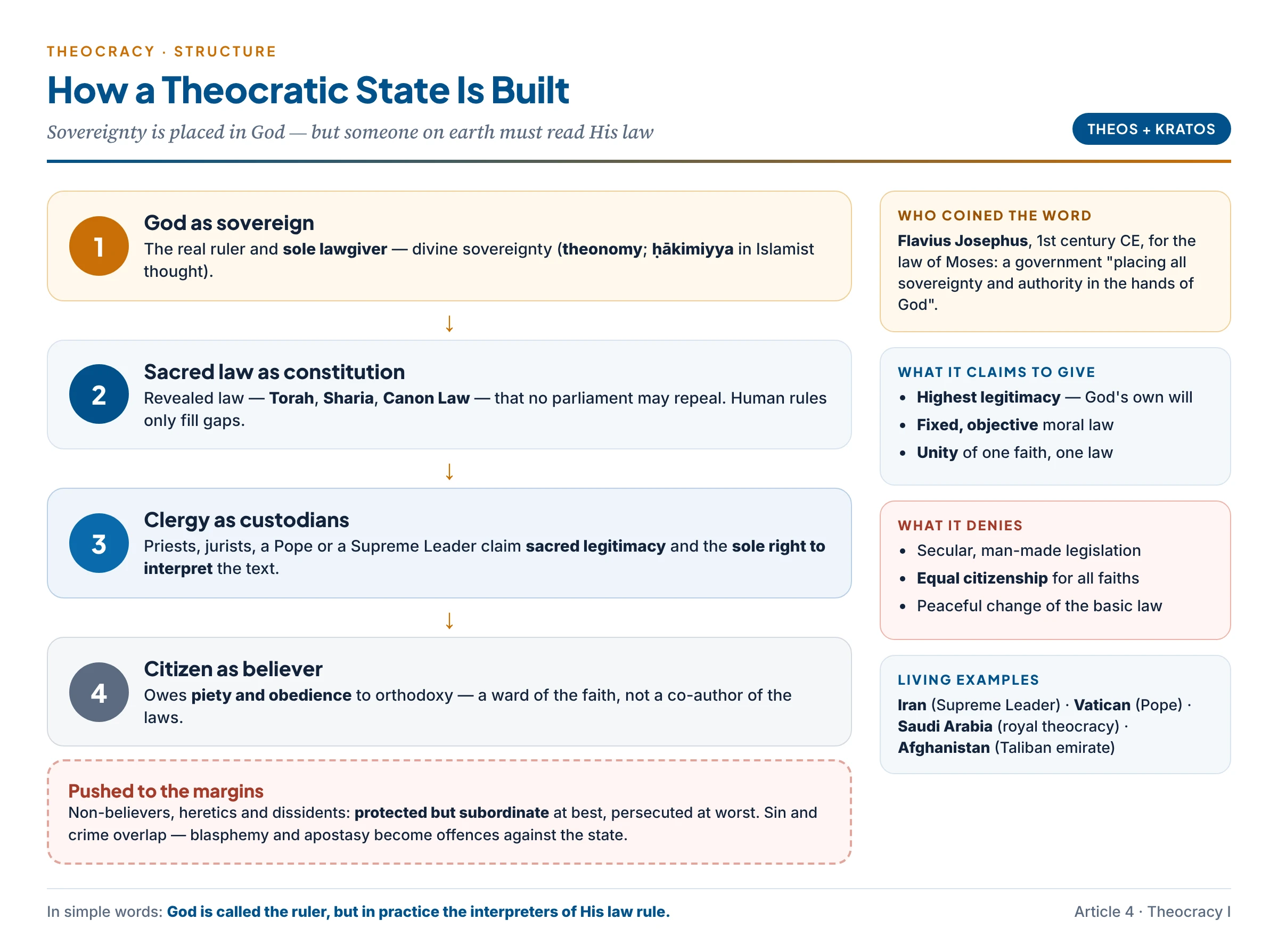
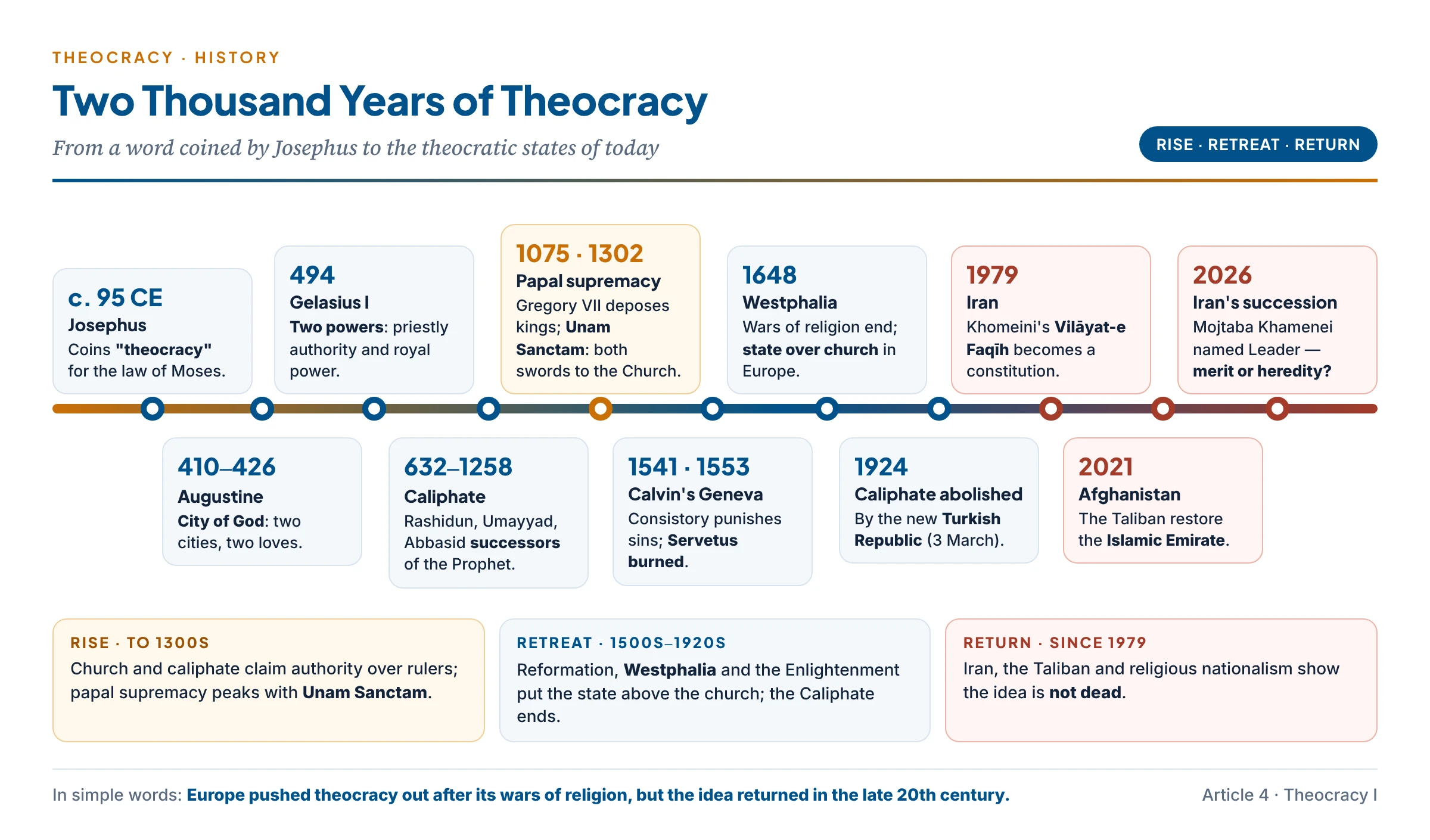
- Who coined it: the Jewish historian Flavius Josephus (1st century CE), in his defence of Judaism, Against Apion. Explaining how the laws of Moses organised the Jewish people, he wrote that Moses set up a government which, “by a strained expression, may be termed a theocracy, placing all sovereignty and authority in the hands of God”.
- Why he needed a new word. The Greeks classified constitutions by the number of human rulers — monarchy (one), aristocracy or oligarchy (few), democracy (many). Josephus found that none of these words fitted a people who believed that their true ruler was not human at all. So theocracy is, from the start, a fourth answer to the question “who rules?” — not one, few or many, but God.
- Basic definition: a theocracy is a state in which:
- God (or the ultimate transcendent authority) is recognised as the supreme ruler and the sole sovereign lawgiver;
- the law of the state is identical with divine revelation — the Torah (Judaism), the Sharia (Islam), Canon Law (the Catholic Church);
- political authority is exercised directly by a priesthood, a clerical hierarchy or a divinely guided leader who claims to be God’s representative on earth.
In simple words
In an ordinary state, if you ask “who made this law?”, the answer is “Parliament” or “the King”. In a theocracy the answer is “God made it; we only apply it“. That one difference changes everything — the law can no longer be voted out, and the people who interpret it gain enormous power.
The Problem Theocracy Answers
- The problem of legitimacy. Every government needs a reason why its commands are binding. Monarchy points to birth or divine appointment, democracy to the consent of the people. Theocracy points to the highest authority conceivable — God’s own will.
- The problem of moral order. If laws come from human beings, they may be arbitrary, selfish or changeable. Theocracy claims to rest society on unchanging, perfect and just divine law.
- The problem of unity. A people sharing one faith, one law and one moral code seems to its defenders far more united than one held together only by interests or fear.
- Where it belongs in the syllabus. Theocracy is studied with monarchy and democracy because the three represent three different locations of sovereignty: in one human ruler, in God, and in the people (see the comparison matrix in Article 1).
Core Doctrine
The Defining Features of a Theocratic State
- Divine sovereignty (theonomy). Sovereignty belongs to God alone. In Christian thought this is called theonomy (rule by God’s law); in modern Islamist thought, ḥākimiyya (God’s exclusive sovereignty) — a term made central by Abul Ala Maududi in South Asia and Sayyid Qutb in Egypt. Maududi even called his ideal a “theo-democracy“: the people may elect rulers, but only to carry out a law they cannot change.
- Unalterable sacred law. The basic law is revealed, so it cannot be repealed by any human body. Human legislation is allowed only to fill gaps or to apply the sacred law to new cases. This means a denial of secular positive legislation as the source of law.
- Clerical custodianship. Because God does not personally govern, someone must interpret His law — a priesthood, a body of jurists (ulama, fuqahā’), a Pope, a Dalai Lama or a Supreme Leader. They claim sacred legitimacy and a monopoly of interpretation (a “hermeneutic monopoly” — only they may decide what the text means).
- The citizen as believer. The ideal member of the state is a believer owing piety and obedience to orthodoxy, not an autonomous citizen who co-authors the laws.
- Unequal status for outsiders. Non-believers, heretics and dissidents cannot be full members in the same way; at best they are protected but subordinate groups, at worst they are persecuted. (Why this is a fatal flaw is discussed in Article 5.)
- Religion and state fused. There is no separate secular sphere: crimes and sins overlap, and religious offences (blasphemy, apostasy) can become crimes against the state.
Theocracy in the Wider Modern Sense
- Narrow (classical) sense: government by divine guidance or by officials regarded as divinely guided — e.g. the rule of the Pope over the Papal States, the Caliphate.
- Wider modern sense: any rule based on the principles of one particular religion, where religious law shapes the constitution and religious authorities hold decisive power, even if there are also elections and a parliament.
- Opposite of the secular state. Theocracy stands against the idea that the state should be neutral among religions and should draw its laws from human reason and public consent.
- Historical turning point. The Enlightenment (17th–18th centuries) and the earlier Peace of Westphalia (1648), which ended Europe’s wars of religion, marked the end of theocracy in most Western countries: rulers stopped claiming to enforce the one true faith, and the church gradually lost political power.
Kinds of Theocracy
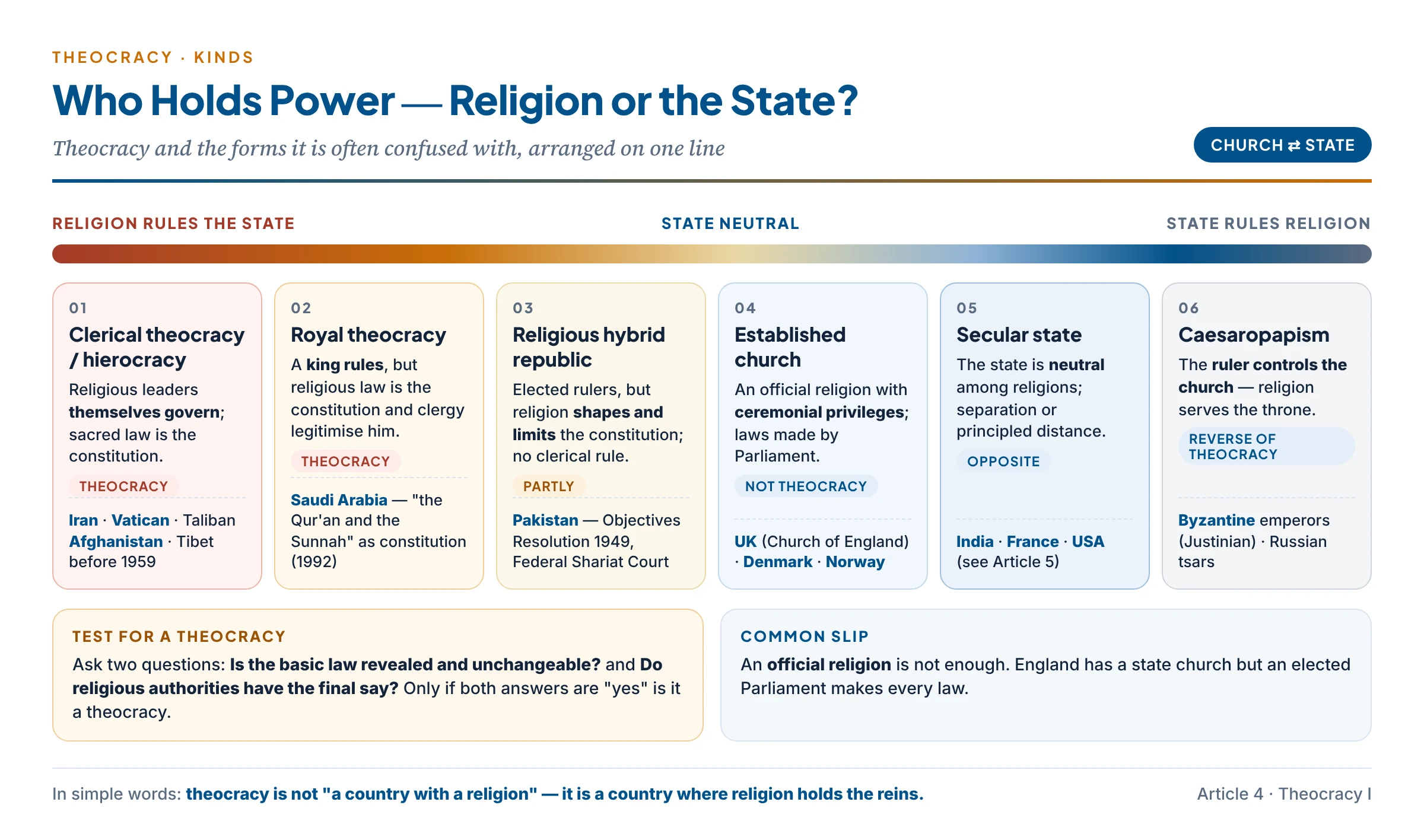
1. Royal theocracy — a country ruled by a monarch on the principles of a particular religion; the king governs, but religious law is the constitution and the clergy confer legitimacy.
- Saudi Arabia is the standard example. It is ruled by the House of Saud. Its Basic Law of Governance (1992) declares in its first article that the constitution of the kingdom is “the Holy Qur’an and the Sunnah” (the Prophet’s traditions), and law is based on the Sharia. The alliance between the royal family and the religious establishment goes back to the 18th-century pact between Muhammad ibn Saud and the preacher Muhammad ibn Abd al-Wahhab.
- Recent change: since 2016 the powers of the religious police (the Committee for the Promotion of Virtue and Prevention of Vice) were sharply curtailed — showing that even a royal theocracy can be reshaped by the ruler, which itself shows who really holds power.
2. General (clerical) theocracy — a country ruled on the principles of a particular religion by religious leaders themselves.
- Iran — ruled since the 1979 revolution by a Supreme Leader who must be a senior Shia jurist (details below).
- The Vatican (Holy See / Vatican City State) — the Pope, elected by the cardinals, holds full legislative, executive and judicial power; it is both an elective absolute monarchy and a theocracy. (The present Pope, Leo XIV, was elected in May 2025.)
- Afghanistan under the Taliban — the “Islamic Emirate“, restored in August 2021, ruled by a supreme religious leader (amir) whose decrees are presented as Sharia.
- Tibet before 1959 — the Dalai Lama was both the spiritual head and the head of government (from the 17th century until the Chinese takeover and his flight to India in 1959).
- Ancient Israel in the age of the Judges — the classic model behind Josephus’ word.
Related forms often confused with theocracy:
| Form | Who holds power | Relation of religion and state | Example |
|---|---|---|---|
| Theocracy | God’s law, applied by clergy or a divinely guided ruler | Religion is the state’s law | Iran, the Vatican, Taliban Afghanistan |
| Hierocracy | Priests as a class rule directly | Priesthood governs; a sub-type of theocracy | Medieval Papal States; Tibet’s lama government |
| Royal theocracy | A king, legitimised by and bound to religious law | King rules, religious law is constitution | Saudi Arabia |
| Caesaropapism | The secular ruler controls the church | Religion serves the ruler — the reverse of theocracy | Byzantine emperors (Justinian); Russian tsars |
| State religion with secular government | Elected secular government | An established church with ceremonial privileges, but laws made by Parliament | United Kingdom (Church of England), Denmark, Norway |
| Religious hybrid republic | Elected government within religious limits | Religion shapes the constitution; no clerical rule | Pakistan (“Islamic Republic”; Objectives Resolution 1949; Federal Shariat Court) |
Common confusion
Is every country with an official religion a theocracy? No. England has an established church — the monarch is its Supreme Governor and bishops sit in the House of Lords — yet laws are made by an elected Parliament, courts apply secular law, and citizens of every faith and none are equal. An official religion is a symbolic link; theocracy requires that religious law and religious authorities actually govern. Equally, a ruler who controls the church (caesaropapism) is the opposite of theocracy, not an example of it.
Historical Forms of Theocracy
1. Ancient Israel — the model.
- In the period of the Judges Israel had no king; God was regarded as the king and the law of Moses as the constitution.
- When the people demanded a human king “like all the nations”, the prophet Samuel was told that they had “rejected Me from being king over them” (the First Book of Samuel). The story shows the classic tension between divine kingship and human monarchy — a theme that returns in the Divine Right debate (Article 3).
2. St. Augustine’s Two Cities.
- Context: after Rome was sacked by the Goths in 410, pagans blamed Christianity for the fall. Augustine (354–430), Bishop of Hippo, replied in The City of God.
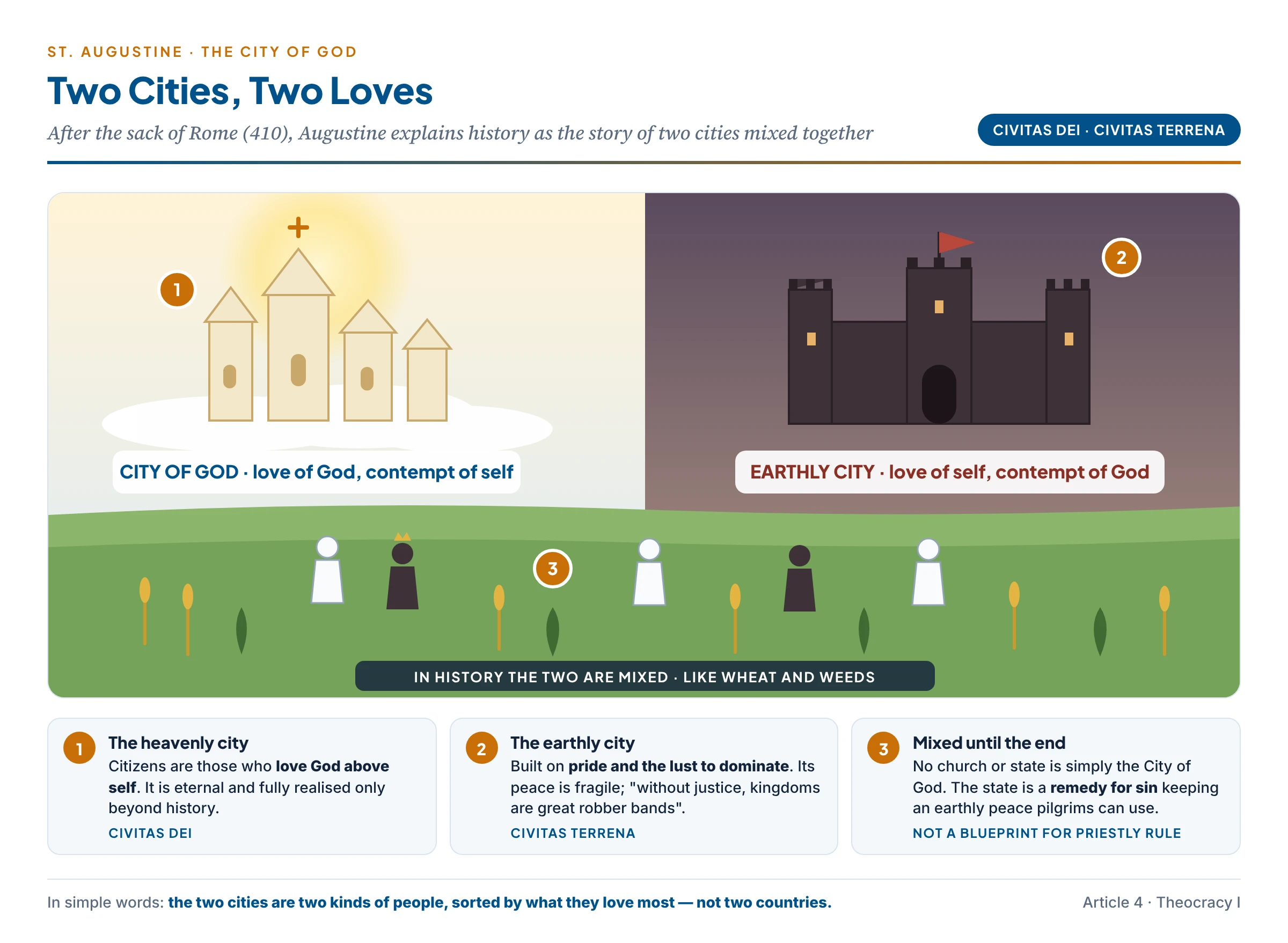
- The two cities are two loves: “Two cities have been formed by two loves: the earthly by the love of self, even to the contempt of God; the heavenly by the love of God, even to the contempt of self.”
- The City of God (civitas Dei) — the community of those who love God; it is eternal and fully realised only beyond history.
- The Earthly City (civitas terrena) — driven by pride, the lust for domination (libido dominandi) and self-love; its peace is fragile.
- The two are mixed in history. No visible institution is simply the City of God — not even the church contains only the saved. The earthly state is a remedy for sin: it keeps an earthly peace that the pilgrims of the heavenly city can use.
- His famous warning: “Remove justice, and what are kingdoms but great robber bands?” — the pirate tells Alexander the Great that he is called a robber for doing with one ship what Alexander does with a navy.
- Influence: later medieval writers read Augustine to mean that the church (the heavenly city on earth) stands above the state — the root of medieval political theology.
In simple words
Think of two clubs whose members live mixed together in the same town, shop in the same market and obey the same traffic police. You cannot tell from the outside who belongs to which club, because membership depends on what each person loves most. That is Augustine’s picture: the two cities are not two countries but two kinds of people living side by side until the end of time.
Common confusion
Was Augustine a theocrat? Not in the strict sense. Augustine did not identify the City of God with the church or with any state, and he did not ask priests to govern. He saw the state as a necessary, imperfect remedy for human sinfulness. It was later medieval thinkers and popes who used his two cities to argue that the church must rule over kings. (Augustine did, however, accept that the state could use force against heretics — a point his critics stress.)
3. The Two Swords — Church against Empire.
- Gelasius I (494). Pope Gelasius wrote to the Byzantine emperor Anastasius that “two there are” by which the world is chiefly ruled: the sacred authority of priests and the royal power. Each has its own sphere; priests are weightier because they answer for kings at the divine judgement. This is the origin of the “two powers” or “two swords” idea — originally a theory of two cooperating authorities, not of papal rule over kings.
- Gregory VII (1075). In the investiture contest with Emperor Henry IV, Gregory’s Dictatus Papae claimed that the Pope may depose emperors and release subjects from their oath of loyalty. Henry was excommunicated and stood barefoot in the snow at Canossa (1077) to seek pardon.
- Boniface VIII (1302). The bull Unam Sanctam, issued during his quarrel with King Philip IV of France, declared that both swords — spiritual and temporal — belong to the Church: the spiritual sword is wielded by the Church, the temporal sword for the Church, by kings at the priest’s direction; it is “altogether necessary for salvation for every human creature to be subject to the Roman Pontiff”.
- The weapon of excommunication. Princes remained subject to papal discipline; excommunication could free their subjects from obedience.
- The reply: writers such as Marsilius of Padua (Defensor Pacis, 1324) and later the Reformation argued the reverse — the church has no coercive power; political authority comes from the community.
Common confusion
Did the two-swords doctrine begin with Gregory VII and Boniface VIII? Many notes say so, but the idea of two powers goes back to Pope Gelasius I in 494, who taught that the priestly and royal powers are distinct and cooperating. Gregory VII and Boniface VIII transformed it into a hierocratic claim — that both swords belong to the Church and kings hold theirs only on the Church’s behalf. So: Gelasius = two powers side by side; Boniface = both powers in the Pope’s hands.
4. The Caliphate.
- Meaning: the khalīfa is the “successor” (or deputy) of the Prophet Muhammad as leader of the Muslim community (umma) — successor in political and legal leadership, not in prophecy.
- History: the Rashidun (the first four “rightly guided” caliphs, 632–661), the Umayyads (Damascus), the Abbasids (Baghdad), and finally the Ottoman sultans. The Caliphate was abolished on 3 March 1924 by the Grand National Assembly of the new Turkish Republic under Mustafa Kemal Atatürk.
- Was it a theocracy? Partly. The caliph enforced the Sharia, but the law itself was developed by independent jurists (ulama), not by the caliph; in practice many caliphates were dynastic monarchies with religious legitimacy — closer to royal theocracy.
- A violent modern imitation: the so-called “Islamic State” (ISIS) proclaimed a caliphate in 2014 over parts of Iraq and Syria; it lost its last territory in 2019. It showed how the theocratic idea can be used to justify mass violence.
5. John Calvin’s Geneva (16th century).
- Calvin (1509–1564) reorganised the city of Geneva through the Ecclesiastical Ordinances (1541).
- The Consistory — a body of pastors and elders — supervised the morals of every citizen. Moral sins were prosecuted as civil offences: blasphemy, adultery, missing church, dancing, gambling, even naming children after saints.
- The burning of Michael Servetus (1553). Servetus, a Spanish physician who denied the doctrine of the Trinity, was tried for heresy and burned at the stake — the most famous proof of the lethal side of theocratic conformity. It provoked Sebastian Castellio’s protest: “To kill a man is not to defend a doctrine, it is to kill a man.“
- Note: Geneva’s civil magistrates formally held power, so Geneva is often described as a “Protestant theocracy” in the wider sense — church discipline enforced by the state.
- Echo in the New World: the Puritan Massachusetts Bay Colony (17th century) allowed only church members to vote and punished religious dissenters such as Anne Hutchinson and Roger Williams (who went on to found Rhode Island on religious liberty).
6. Iran’s Vilāyat-e Faqīh — the Guardianship of the Jurist.
- The doctrine: in his lectures at Najaf (1970), Ayatollah Ruhollah Khomeini argued that in Shia Islam the rightful ruler is the Twelfth Imam, who is in occultation (hidden by God since the 9th century). Until he returns, the community must be governed by the most just and learned jurist (faqīh), who has the Prophet’s and Imams’ authority to govern.
- The 1979 constitution turned this into a state: Article 5 says that during the occultation the leadership of the community belongs to a just, pious and capable faqīh. The Supreme Leader commands the armed forces, appoints the head of the judiciary and half of the Guardian Council.
- A “theocratic republic” (hybrid): Iran has an elected President and an elected parliament (Majlis), but:
- the Guardian Council (twelve members — six clerics chosen by the Leader, six jurists) can veto any law it finds contrary to Islam or the constitution, and vets all candidates for elections;
- the Supreme Leader is chosen by the Assembly of Experts (88 elected clerics), and popular elections remain subordinate to his overarching authority.
- Leaders so far: Khomeini (1979–1989), Ali Khamenei (1989–2026), and, after Ali Khamenei was killed in US–Israeli strikes on 28 February 2026, his son Mojtaba Khamenei, named Supreme Leader by the Assembly of Experts on 8 March 2026. The succession was widely debated because the system claims to choose its leader for religious learning and merit, not heredity — a live illustration of how a theocracy can slide back toward dynastic monarchy.
The Case for Theocracy — Justifications
A fair study must first state the theocrat’s case at its strongest (the replies follow in Article 5).
- Religion as a binding force. A common faith gives a society shared values, rituals and loyalties; laws rooted in that faith feel like one’s own, not alien commands.
- Objective morality. Religious morality is said to be more objective than secular morality, which changes with fashion, majority votes or the interests of the powerful. Divine law offers fixed standards of right and wrong.
- Perfect and just law. If God is all-knowing and all-good, His law must be wiser and juster than any human legislation. Obeying it is obeying justice itself.
- Highest legitimacy. No human authority can match the authority of God; a government that applies God’s law has the strongest claim to be obeyed.
- A moral, not merely material, order. The state’s purpose is not only security or prosperity but the salvation and moral perfection of its members; theocracy takes the soul seriously.
- Community of believers. The umma, the people of the covenant or the Christian commonwealth is a community of shared meaning, not a crowd of competing individuals.
- Protection against relativism and consumerism. Defenders argue that theocracy grounds human dignity in divine sanctity and shields society from hedonistic consumerism, moral relativism and the breakdown of family and community.
- Restraint on rulers. In classical Islamic and medieval Christian theory, even kings stood under divine law; the ulama or the church could check the ruler — a form of higher law before modern constitutions.
In simple words
A defender of theocracy says: “Speed limits voted by a committee can be changed whenever the committee changes its mind. But if the rule against cheating is God’s rule, nobody can vote it away.” The attraction is stability and moral certainty. The worry (Article 5) is: who decides what God’s rule actually says?
Theocracy and the Divine Right of Kings
- The Divine Right of Kings (James I, Filmer, Bossuet) also invokes God, but it makes a lay king God’s lieutenant; it does not hand power to priests. Monarchy and theocracy therefore overlap (sacred kingship, royal theocracy) but are not necessarily related: kings often fought popes, and many monarchies were secular. The full discussion is in Article 3.
Was Ancient India Theocratic?
Short answer: ancient Indian kingship was sacral (surrounded by religion), but not theocratic (ruled by priests or by revealed law alone).
- The king below dharma, not below the priest. The Upaniṣads say that dharma is the “ruler of the ruler” (kṣatrasya kṣatram) — nothing is higher than dharma. The king’s duty (rājadharma) is to protect the people and uphold dharma; but he, not the priest, governs.
- The purohita advises, he does not rule. The royal priest (purohita) was honoured, conducted rituals and gave counsel; Kauṭilya even says the king should follow him “as a pupil his teacher”. Yet the purohita held no sovereign power; he was one of the king’s ministers.
- Brahma and kṣatra in partnership. The texts speak of an alliance of priestly power (brahma) and ruling power (kṣatra) — two cooperating forces, closer to Gelasius’ two powers than to papal supremacy.
- Kauṭilya’s secular statecraft. The Arthaśāstra treats politics as a science of its own (daṇḍanīti, the science of government), supported by reasoning (ānvīkṣikī). Among the sources of law it lists dharma, vyavahāra (transactions and evidence), caritra (custom) and rājaśāsana (royal edict), and holds that where a sacred text conflicts with a reasoned rule of justice (nyāya), the reasoned rule prevails. Religion is to be used and respected, not obeyed blindly.
- Plurality and tolerance. India never had a single church or a single scripture binding everyone. Aśoka (3rd century BCE) taught respect for all sects in his rock edicts (“he who honours his own sect and condemns others injures his own sect”). Akbar held inter-faith debates in the Ibādat Khāna (1575), followed Sulh-i-kul (“peace with all”) and formulated the Dīn-i Ilāhī. The Sikh mīrī–pīrī doctrine of Guru Hargobind joined temporal and spiritual authority, but within the Sikh community, not as a state theocracy.
- The limit of the argument. Religion did shape law (Dharmaśāstras, caste duties) and rulers patronised particular faiths; some kingdoms were close to sacral states. But there was no clerical government and no single revealed code enforced by a priestly class.
Indian Connect — Indian Connect — sacral but not theocratic
- Rājadharma binds the king to protect people and uphold dharma; the priest blesses, the king rules.
- Kauṭilya separates the art of government from theology — a reason why many scholars see the Arthaśāstra as one of the earliest secular treatises on the state.
- This tradition of plurality and principled distance later shaped India’s secular Constitution (Article 5 of these notes).
Critical Evaluation
Is Theocracy an Outdated Ideology?
The case that theocracy is outdated:
- History has moved on. After Westphalia (1648), the Enlightenment and the liberal revolutions, almost every state founded its authority on the people, not on God. The Caliphate ended in 1924; the Papal States were absorbed by Italy in 1870, leaving the Pope only the Vatican (Lateran Treaty, 1929).
- Modern societies are plural. Citizens of many faiths and none cannot share one revealed law; a modern state must be neutral to treat them as equals.
- Modern values reject it. Popular sovereignty, human rights, equality of women and minorities, freedom of conscience — the language of the UN Charter and of almost every constitution — cannot be reconciled with clerical rule.
- Secularisation. Sociologists long argued that modernisation — science, urbanisation, education — steadily weakens religion’s hold over public life (the secularisation thesis).
- Few examples, and troubled ones. Only a handful of theocracies survive (Iran, the Vatican, Saudi Arabia, Afghanistan), and those that are large states face mass protest, isolation or economic crisis.
The case that theocracy is not outdated:
- Resurgence. The Iranian revolution (1979), the return of the Taliban (2021), the proclamation of an ISIS “caliphate” (2014) and the rise of religious nationalism in many regions show that the idea still mobilises millions.
- Desecularisation. Peter Berger, once a leading secularisation theorist, concluded (The Desecularization of the World, 1999) that the modern world is “as furiously religious as it ever was“, with the exception of Western Europe and educated elites.
- The deeper need it answers. Hunger for meaning, moral certainty and community — which theocracy promises — has not disappeared; liberal democracies themselves debate whether they lack shared values (the “social cohesion” question, Article 6).
- Religion in law. Many democracies keep religious personal laws, blasphemy laws or established churches; the line between religion and state is contested, not settled.
Balanced view: as a form of government for modern, plural states, theocracy is largely discredited — it survives in very few places and conflicts with the basic principles of modern constitutionalism. But as an ideology — the claim that politics should be governed by sacred law — it is not dead; it keeps returning wherever secular states fail to provide justice, identity or dignity. So it is outdated in principle, but not in practice.
The Main Objections (in brief — see Article 5)
- The hermeneutic problem — God does not sit on the bench; in reality theocracy is the rule of fallible men interpreting ancient texts.
- The moral problem — compelled faith is not faith; virtue under coercion becomes hypocrisy (Kant).
- The political problem — a closed society with no peaceful way to change rulers or laws (Popper, Mill).
- The rights problem — unequal citizenship for non-believers, women and dissenters.
Critics and Defenders
Criticism — Critics
- Spinoza (Theological-Political Treatise, 1670): the Hebrew theocracy worked only for a small people at one moment of history; in practice priests’ rule bred faction and superstition; the state must allow freedom to philosophise.
- Locke (A Letter Concerning Toleration, 1689): the magistrate’s business is civil interests — life, liberty, property; belief cannot be compelled by force.
- Marsilius of Padua: the church has no coercive authority; power comes from the community.
- Castellio against Calvin: killing a heretic defends no truth.
- Modern liberals and human-rights bodies: theocracy denies equal citizenship, freedom of conscience and the rights of women and minorities.
Defence — Defenders and strengths
- Classical theory (medieval Christian, Islamic jurists): God’s law binds the ruler too — a higher law that restrains tyranny.
- Communitarian argument: shared faith gives identity, meaning and solidarity that liberal individualism lacks.
- Moral realism: if there is an objective moral order, laws should reflect it, not majority whim.
- Maududi’s “theo-democracy”: people can elect and remove rulers within the limits of divine law.
- The Vatican shows a theocracy can be peaceful and voluntary — though it governs a tiny, consenting community, not a nation.
Cross-Tradition Comparison
| Point | Western / Islamic theocracy | Indian tradition |
|---|---|---|
| Supreme authority | God, speaking through revelation | Dharma — an impersonal moral order |
| Who interprets | Pope, ulama, Supreme Leader | Many śāstras, schools and customs; no single church |
| Who governs | Clergy or a divinely guided ruler | The king (kṣatriya), advised by the purohita |
| Model of church and state | From Gelasius’ two powers to Boniface’s papal supremacy | Brahma–kṣatra partnership; Kauṭilya’s autonomy of politics |
| Treatment of other faiths | Often subordinate status or persecution | Mostly coexistence and patronage of many sects (Aśoka, Akbar) |
| Modern outcome | Secularism by separation (laïcité, the “wall”) | Secularism by principled distance (Article 5) |
| Thinker | Augustine | Kauṭilya |
|---|---|---|
| View of the state | A remedy for sin, keeping earthly peace | An instrument of order, welfare and power |
| Religion’s role | The heavenly city is higher than every earthly state | Religion is to be respected and used, but politics has its own science |
| Danger warned against | Kingdoms without justice are “great robber bands” | Mātsya-nyāya — the big fish eating the small — without a strong king |
Indian Connect — Key takeaways
- Indian political thought sacralised kingship without clericalising it — the priest never became the ruler.
- Dharma, unlike revealed law, was plural and interpretive, which made a single theocratic code hard to impose.
- The tradition of tolerance (Aśoka, Akbar) gave India a native resource for secularism that does not depend on the Western model of separation.
Synthesis (Siddhānta)
- What theocracy is. A government that locates sovereignty in God, makes revelation the constitution, and gives interpreters of revelation — priests, jurists, a supreme guide — the final say. It is the fourth answer to “who rules?”, beyond one, few and many.
- What history shows. From Josephus’ Israel to Augustine’s two cities, the papal two swords, the Caliphate, Calvin’s Geneva and modern Iran, theocracy has repeatedly promised moral order but in practice placed human power behind a divine mask. Its pure forms are rare; most real cases are hybrids — royal theocracies, theocratic republics, sacral monarchies.
- What India shows. A deeply religious civilisation can still keep government in lay hands and religion plural — “sacral but not theocratic”.
- Is it outdated? As a form of government for plural modern states, yes in principle; as a political ideology, no — it revives wherever secular states fail on justice, identity or dignity.
- Contemporary relevance.
- Iran’s 2026 succession shows the tension inside a theocracy between clerical merit and dynastic inheritance.
- Afghanistan’s restrictions on women’s education show the human cost of an unchecked monopoly of interpretation.
- Religious nationalism in many countries tests whether democracies can respect religion’s public role without sliding into theocracy.
- The question for the next article: if theocracy is so attractive to some and so dangerous to others, can it ever be a valid form of government?
“Two cities have been formed by two loves: the earthly by the love of self, even to the contempt of God; the heavenly by the love of God, even to the contempt of self.” — St. Augustine
Previous Year Questions
- 2025Can Theocracy be accepted as a valid form of Government? Give reasons and justification in support of your answer.
- 2022Are monarchy and theocracy necessarily related? Discuss with reference to the theory of ‘Divine Right’.
- 2019Discuss the status of theocracy in the modern secular state.
- 2009Is theocracy an outdated ideology? Discuss.