

Forms of Government: Monarchy; Theocracy and Democracy.
Official Syllabus: Paper II, Section A, Unit 4
A theocracy claims the highest authority any government can claim: it says that God himself is the ruler, that the law of the land is divine law, and that the men who govern are only God’s servants. Article 4 explained what theocracy is and how it appeared in history — from the Caliphate and Calvin’s Geneva to the Vatican and Iran’s Guardianship of the Jurist. This article asks the harder question: can such a government be valid? It sets out the main philosophical objections — the hermeneutic problem (whose reading of God’s word?), the Euthyphro dilemma, Kant’s idea of moral autonomy, Spinoza’s freedom to philosophise, Locke’s case for toleration, Mill’s and Popper’s defence of an open society, and the human-rights critique — then gives the theocrat’s own defence and the replies to it. It closes with the place of theocracy in the modern secular state, the senses in which democracy is better than theocracy, and the Indian model of secularism.
In simple words
Imagine a cricket match in which one team’s captain says, “The rulebook was written by God, and only I can tell you what it means.” Every close decision now goes his way, and anyone who argues is not just disagreeing with a captain — he is “disobeying God”. The rulebook may be perfect, but the captain who reads it is a human being. This is the heart of the case against theocracy: God never sits in the umpire’s chair; fallible people do, and they claim God’s authority for their own decisions.
Context & Problem
What Theocracy Claims (a quick recap)
- Meaning. Theocracy (Greek theos, God + kratos, rule) — “rule by God”. The term was coined by the Jewish historian Flavius Josephus in the 1st century CE (see Article 4).
- Three marks of a theocracy:
- God is the sovereign — the supreme ruler and the only true lawgiver (divine sovereignty, called theonomy in Christian thought and ḥākimiyya in modern Islamist thought).
- Law is revelation — the law of the state is the sacred law (Torah, Sharia, canon law), not law made by human legislatures.
- Clergy or a divinely guided leader rules — priests, jurists or a holy ruler govern as God’s representatives.
- Kinds. Royal theocracy — a king rules by religious law (Saudi Arabia). General or clerical theocracy — clergy or a religious leader governs (Iran’s Supreme Leader, the Pope in the Vatican, the Taliban’s “Islamic Emirate” in Afghanistan).
- Opposed to the secular state. Theocracy stands against the secular state, in which the state has no official religion and treats all citizens alike whatever their faith. The Enlightenment of the 17th–18th centuries ended theocracy in most Western countries.
Why the Question of “Validity” Arises
- Two kinds of claim. A theocracy claims to be legitimate (rightful) not because the people consented but because God willed it. Philosophy must ask whether this claim can be checked and whether a government built on it can meet the standards we expect of any just government.
- Not a dead question. The question was asked in 2025 and 2019 because theocratic and semi-theocratic states still exist (Iran, Saudi Arabia, the Vatican, Afghanistan), and religious nationalism has grown in many countries.
- Our tests. To judge any form of government we can ask seven questions:
- Legitimacy — does power rest on the consent of the governed?
- Rule of law — are rulers bound by law, and can the law be changed by lawful means?
- Rights — are freedom of conscience, speech and equality protected for everyone?
- Accountability — can rulers be questioned, criticised and removed?
- Peaceful change — can a bad ruler be replaced without bloodshed?
- Pluralism — can people of different faiths and none live as equals?
- Correctability — can the government admit and correct its mistakes?
In simple words
Think of these seven tests as a fitness check-up for a government. A body may look strong, but the doctor still checks pulse, blood pressure and reflexes. In the same way, a government may look orderly and pious, but we still ask: Did the people agree to it? Can it be questioned? Can it be changed? Can a person of another faith live freely under it?
Core Doctrine: The Philosophical Case against Theocracy
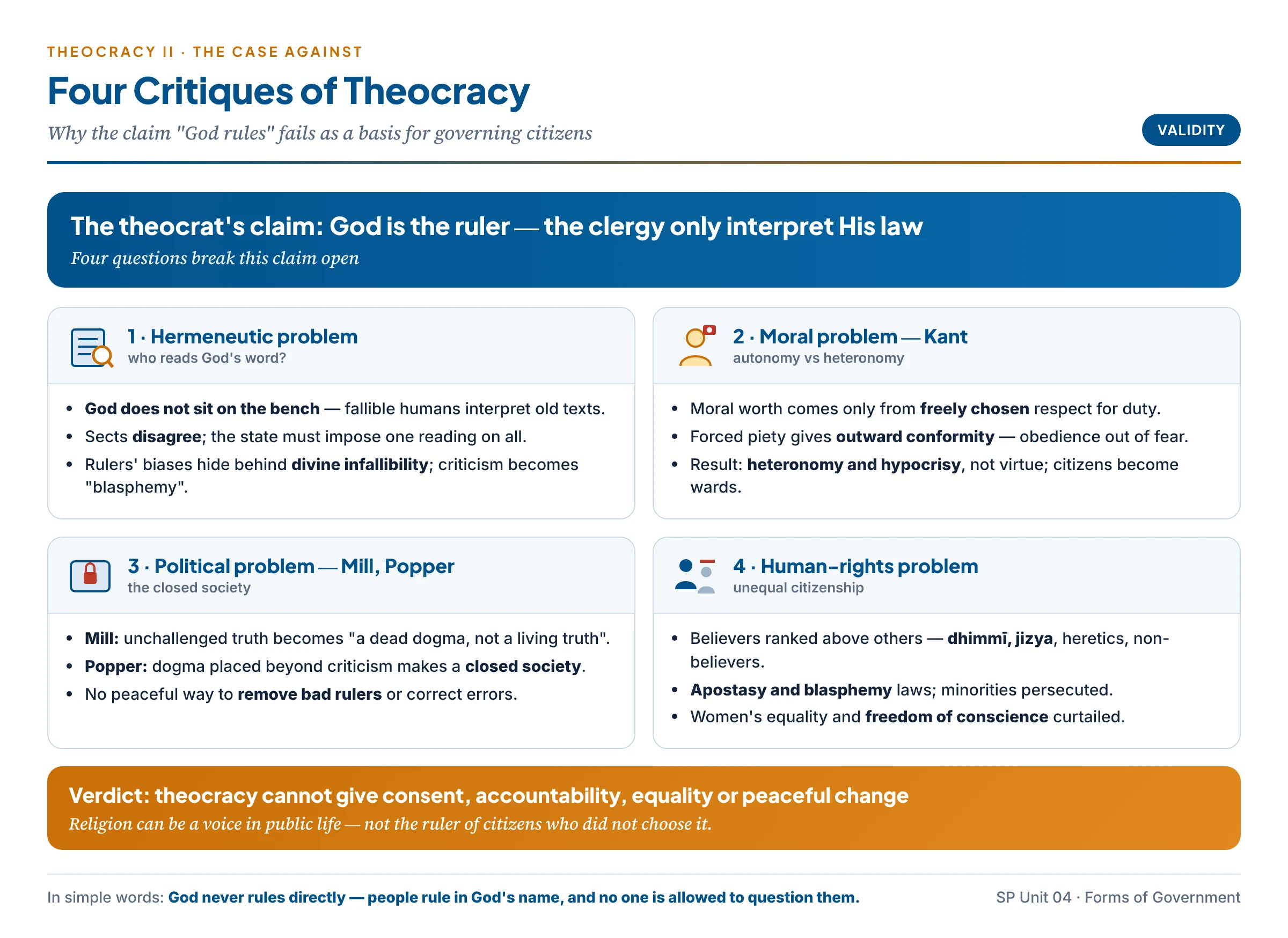
1. The Hermeneutic Problem: “God Does Not Sit on the Bench”
Hermeneutics means the art of interpreting texts. The first and deepest objection to theocracy is about interpretation.
- God does not govern directly. God does not draft decrees, sit in court or sign orders. In practice a theocracy is always the rule of human beings who interpret ancient sacred texts.
- Every text needs a reader. Scriptures were written centuries ago, in old languages, for other conditions. They must be read, explained and applied to new questions — banking, medicine, the internet, women’s work. Each step is a human judgement.
- Readers disagree. Within every religion there are many sects and schools (Sunni and Shia; Catholic, Protestant and Orthodox; many schools of law). Each claims to read God correctly. A theocracy must pick one reading and impose it on all.
- The hidden danger. When human decisions are labelled “God’s commands”, the rulers’ own biases, prejudices and economic interests are hidden behind a shield of divine infallibility (the claim that one cannot be wrong). Criticism of the ruler becomes “blasphemy” — an insult to God.
- Hence the logical problem. Either the clergy’s interpretation can be checked — then human reason, not God, is the final judge — or it cannot be checked — then we have unlimited human power with a religious label.
In simple words
A family follows “Grandfather’s rules”, but Grandfather died long ago. Now the eldest uncle decides what Grandfather “really meant” — and somehow Grandfather always seems to agree with the uncle. The rules are Grandfather’s in name, but the power is the uncle’s. This is the hermeneutic problem in one line.
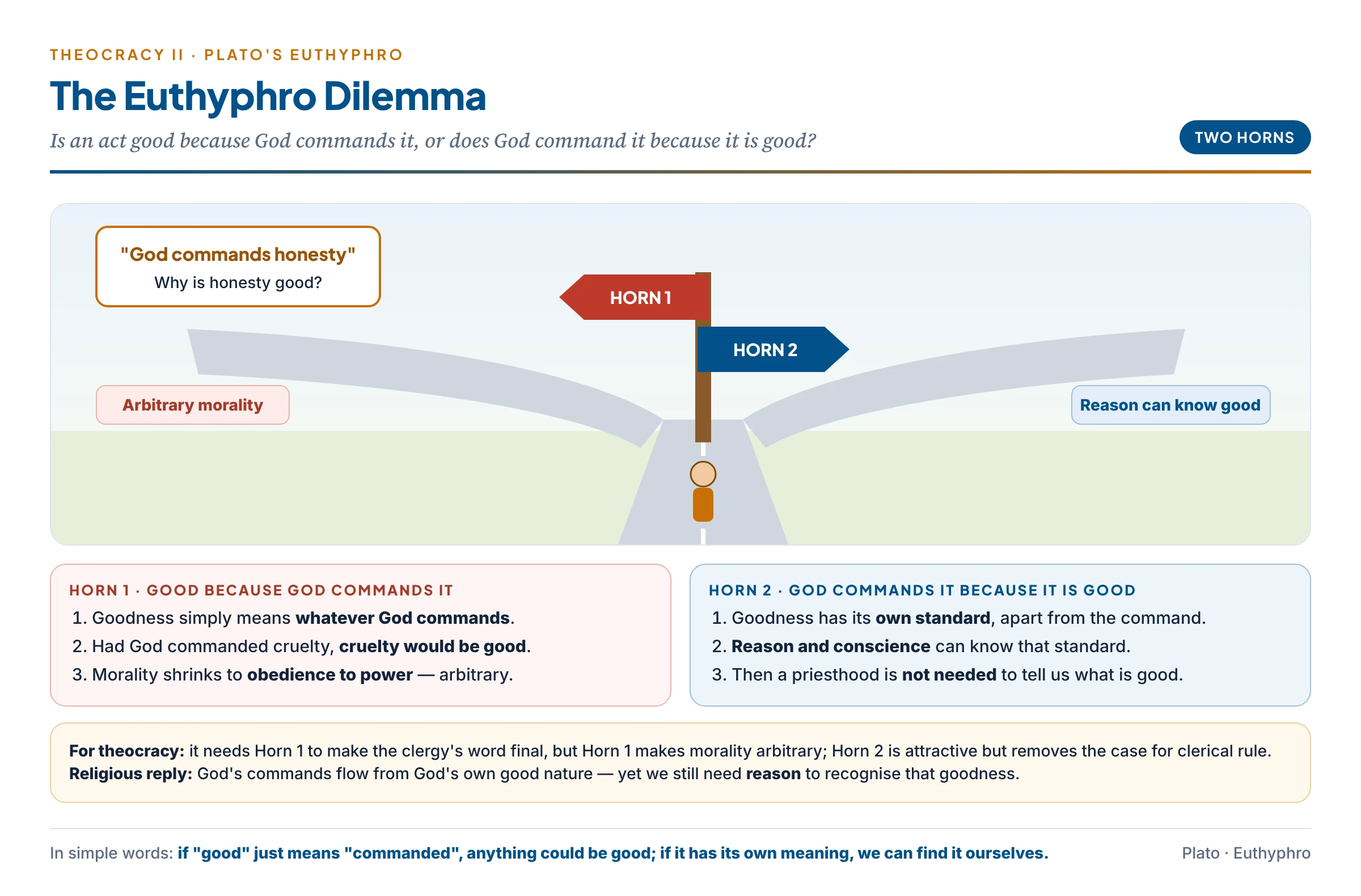
2. The Euthyphro Dilemma: Is It Good Because God Commands It?
- Source. In Plato’s dialogue Euthyphro, Socrates asks: “Is the pious loved by the gods because it is pious, or is it pious because it is loved by the gods?” Applied to law, the question becomes: is an act good because God commands it, or does God command it because it is good?
- Horn one — good because commanded. Then goodness is arbitrary: had God commanded cruelty, cruelty would be good. Morality becomes mere obedience to power.
- Horn two — commanded because good. Then goodness has a standard independent of the command. Human beings can, in principle, know that standard by reason and conscience — and then we do not need a priesthood to tell us what is good. The rulers’ special authority disappears.
- Why it matters for theocracy. Theocracy needs the first horn (to make the clergy’s word final) but cannot accept its consequence (that morality is arbitrary). The second horn is morally attractive but removes the case for clerical rule. Either way, the theocrat’s claim is weakened.
- The usual reply. Religious thinkers (Aquinas and many Muslim and Jewish thinkers) answer that God’s commands flow from God’s own good nature — neither arbitrary nor external. Critics reply that we still need reason to recognise this goodness, so a role for human moral judgement remains.
3. Kant: Theocracy Destroys Moral Autonomy
- Autonomy and heteronomy. For Immanuel Kant, an action has moral worth only when done out of respect for the moral law that a rational person gives to himself (autonomy, “self-law”). An action done because of fear, reward or outside pressure is heteronomous (“law from another”) and has no moral worth, however correct it looks.
- What coercion produces. When a state uses police, censorship and punishment to force religious conduct — prayer, fasting, dress — it can produce outward conformity, but not virtue. People obey out of fear of earthly punishment or eternal torment; the result is heteronomy and hypocrisy.
- Kant on “clericalism”. In Religion within the Bounds of Mere Reason (1793), Kant attacks clericalism (Pfaffentum, “priestcraft”): a church in which statutory rules and rituals enforced by clergy replace the moral religion of the heart. True religion, for Kant, is recognising our duties as divine commands — but known through our own practical reason, not imposed from outside.
- In political terms. A just state, for Kant, treats people as free and equal citizens who are co-authors of their laws (his republican constitution). A theocracy treats them as wards to be guided to salvation — what Kant elsewhere calls paternal government, “the greatest conceivable despotism”.
In simple words
A student who does not cheat only because a CCTV camera is watching is obedient, not honest. Take the camera away and the cheating starts. Kant says a theocracy fills society with cameras — religious police, informers, punishments — and so produces obedient people, not good people.
4. Spinoza: Freedom to Philosophise and the Hebrew Theocracy
- The book. Baruch Spinoza published the Theological-Political Treatise anonymously in 1670, when Dutch Calvinist preachers were pressing the state to enforce orthodoxy. Its subtitle states its aim: the freedom to philosophise can be granted without harm to piety and peace — and cannot be denied without destroying them.
- Faith and philosophy are separate. Scripture, for Spinoza, teaches a simple moral message — love God and your neighbour through justice and charity — and demands obedience, not philosophical truth. So free thinking cannot harm true faith, and the clergy have no special claim to intellectual authority.
- The lesson of the Hebrew state. Spinoza studied the ancient Hebrew theocracy. Under Moses, civil law and religion were one and the state was stable. When priests gained the right to interpret divine law, each sought glory for himself, issued new decrees, and religion declined into superstition while the state fell into strife. His conclusion: clerical power over the state is disastrous.
- His model. The civil sovereign controls the outward practice of religion (public order), but inward faith and thought belong to the individual: “everyone should be granted the right to think what he wants and to say what he thinks” — limited only by the need to stop sedition.
- Limits. Spinoza’s toleration is prudential (based on peace and stability) rather than a theory of rights, and it gives the sovereign wide power over public worship.
5. Locke: A Letter Concerning Toleration (1689)
- Two separate jobs. John Locke argued that the state and the church have different purposes:
- The magistrate (the government) exists to protect civil interests — life, liberty, health, and possessions.
- The church is a free and voluntary society of people who join to worship God in the way they think acceptable to him.
- Belief cannot be forced. Locke’s central argument: “The care of souls cannot belong to the civil magistrate, because his power consists only in outward force; but true and saving religion consists in the inward persuasion of the mind.” Force can make a person say words or perform rituals, but it cannot make him believe. A forced faith is worthless even to God.
- No sure guide. Rulers are no more likely than others to know the true religion. If each ruler forced his own religion, people’s salvation would depend on where they were born.
- Toleration as peace. Most religious wars, Locke said, came not from diversity but from the refusal to tolerate it.
In simple words
You can force a friend to sit through your favourite song, but you cannot force him to love it. If he says “I love it” only because you threatened him, his words mean nothing — to you or to anyone. Locke says faith is like that love: it lives inside the mind, and outward force can only produce empty words.
- Other voices of the same century:
- Pierre Bayle (Philosophical Commentary, 1686) — even a mistaken conscience must be respected; persecution is always wrong.
- Thomas Hobbes (Leviathan, 1651) — took the opposite route: the civil sovereign must control the church to prevent clerical rivalry (he called clerical power over the state the “kingdom of darkness”). Hobbes rejected theocracy by putting religion under the state, not by freeing it.
Common confusion
Did Locke ask the state to tolerate everyone? No. Locke’s toleration had limits. He would not tolerate atheists, because he thought promises and oaths “can have no hold” on a person who does not believe in God, and he refused toleration to any church whose members owed allegiance to a foreign prince (in his time, this meant Roman Catholics). Modern secular states go further than Locke — they protect the believer and the non-believer equally.
“The care of souls cannot belong to the civil magistrate… true and saving religion consists in the inward persuasion of the mind.” — John Locke
6. Mill and Popper: Theocracy as a Closed Society
- J.S. Mill, On Liberty (1859). Truth grows only in an open marketplace of ideas, where every opinion can be challenged:
- A silenced opinion may be true; to silence it is to claim infallibility.
- Even if false, it may contain part of the truth.
- Even a true belief, if never challenged, becomes “a dead dogma, not a living truth” — held as prejudice, without understanding.
- Mill applied to theocracy. When religious dogma becomes criminal law, all three losses follow at once — intellectual stagnation and social despotism.
- Karl Popper, The Open Society and Its Enemies (1945). Popper contrasts:
- Closed society — tribal, ruled by unquestionable taboos and dogma; criticism is treated as treason or sin.
- Open society — individuals make decisions, criticism is welcome, and bad rulers can be removed without bloodshed.
- Popper applied to theocracy. A theocracy is the clearest example of a closed society: its foundations are declared beyond criticism, so it cannot learn from its mistakes, and it has no peaceful method for changing its rulers when they fail.
7. The Human-Rights Critique: Unequal Citizenship
A theocratic state, by its very structure, cannot give equal citizenship to everyone.
- Ranked citizens. Followers of the state religion (and of its official sect) have full status; other believers, dissenters and non-believers become second-class. In classical Islamic law, non-Muslim “protected peoples” (dhimmī) paid a special poll-tax (jizya) and faced legal disabilities.
- Laws against belief and speech. Apostasy (leaving the faith) and blasphemy (insulting religion) are treated as crimes, sometimes punishable by death. Pakistan, an Islamic republic rather than a full theocracy, shows the danger: its blasphemy laws (strengthened in the 1980s) are widely misused against minorities and in personal disputes.
- No pluralism. Ways of life that the official religion condemns are criminalised — for example, homosexuality is a crime in many theocratic states.
- Women. Gender equality suffers when sacred law is read in a patriarchal way. In Iran, the “morality police” (Gasht-e Ershad) enforce the compulsory hijab; the death of Mahsa Amini in their custody in September 2022 set off nationwide protests under the slogan “Woman, Life, Freedom”. In Afghanistan, after the Taliban returned in August 2021, girls were barred from secondary school (March 2022) and women from university (December 2022).
- Minorities. Religious and ethnic minorities face persecution — for example, the Bahá’ís in Iran are denied higher education and official recognition, and Kurdish and Sunni minorities complain of discrimination.
- Rule of law and popular sovereignty. Because the law is “God’s”, it cannot be amended by the people; sovereignty does not belong to the people at all. Rulers are judged by God, not by voters or courts.
- Conservatism. Theocracy tends to produce a conservative society that resists progressive social reform, because reform looks like rebellion against revealed law. Religious police enforcing morality are a sign of this.
Critical Evaluation
The Theocrat’s Defence
The case for theocracy must be stated fairly. Its defenders give these arguments:
- Perfect law. Divine law is perfect, just and unchanging, while human law is selfish, partial and always shifting.
- Highest legitimacy. Authority derived from God is higher and more secure than authority derived from fickle majorities.
- Objective morality. Religious morality is more objective than secular morality, which slides into moral relativism (“everything is a matter of opinion”).
- Human dignity. Dignity is grounded in the sanctity of human beings as God’s creatures, not in their market value; theocracy protects society from hedonistic consumerism, pornography, alcohol and the breakdown of family.
- Social unity. Religion is a binding force: a shared faith gives a people a common identity, purpose and solidarity.
- Community. Communitarian thinkers argue that people are not isolated individuals; their identity is formed by traditions, and religious tradition can rightly shape public life.
- Popular support. Some theocracies hold elections (Iran has an elected president and parliament), so they claim to be “religious democracies”.
Replies to the Defence
- On perfect law: even if the divine law is perfect, its interpretation is human — the hermeneutic problem returns.
- On legitimacy: the claim that God authorised this ruler cannot be checked. Every rival sect makes the same claim.
- On objectivity: the Euthyphro dilemma shows that if morality is objective, it can be known by reason too; religions themselves disagree on many moral questions, so religion does not end moral disagreement.
- On dignity: dignity includes freedom of conscience; a state that punishes apostasy denies the very thing that makes faith dignified — free choice.
- On unity: unity built on one faith becomes exclusion of those who do not share it. In a plural society it produces conflict, not harmony.
- On community: a religious community can shape the lives of its willing members — the Vatican is, in effect, a voluntary community of clergy — without using state coercion on everyone.
- On elections: in Iran, candidates are vetted by the unelected Guardian Council, and the Supreme Leader stands above elected bodies. Elections inside fixed religious limits are not full popular sovereignty.
Can Theocracy Be Accepted as a Valid Form of Government?
Applying the seven tests from the start of this article:
| Test | Theocracy | Comment |
|---|---|---|
| Legitimacy by consent | ✕ | Rests on a divine mandate that cannot be verified |
| Rule of law | Partly | Rulers bound by sacred law, but the people cannot amend it |
| Equal rights | ✕ | Ranked citizenship; apostasy and blasphemy laws |
| Accountability | ✕ | Rulers answer to God, not to the governed |
| Peaceful change | ✕ | No regular method to remove clerical rulers |
| Pluralism | ✕ | One faith privileged; dissent becomes heresy |
| Correctability | ✕ | Claims infallibility, so cannot admit error |
- Verdict. As a form of state government for a modern, plural society, theocracy fails most tests of validity. It may provide order and moral seriousness, but it cannot give equal citizenship, freedom of conscience or peaceful change.
- What survives. The values religions teach — compassion, justice, care for the poor, self-restraint — remain valuable in public life. They can enter politics as arguments citizens offer to one another, not as commands the state enforces. Religion can be a voice in public life without being the ruler.
- A narrow exception. A theocratic structure may be acceptable for a voluntary religious community whose members freely join and can freely leave — a monastery, a religious order, or the Vatican’s tiny city-state of clergy. The objection is to theocracy imposed on citizens who did not choose it.
Critics and Defenders
Criticism — Critics of theocracy
- Hermeneutic objection — God does not rule; fallible interpreters do, behind a shield of infallibility.
- Euthyphro — either morality is arbitrary or it is knowable by reason without clergy.
- Kant — coercion produces heteronomy and hypocrisy, not virtue.
- Spinoza — clerical power over the state destroyed the Hebrew commonwealth; thought must be free.
- Locke — force cannot produce belief; the state’s job is civil interests.
- Mill and Popper — dogma made law kills truth and blocks peaceful change.
- Human-rights critique — unequal citizenship, persecution of minorities and women.
Defence — Defenders and what they get right
- Divine law is held to be just and unchanging; it resists the passing fashions of majorities.
- Objective morality gives a firm answer to relativism.
- Religion binds a society together and gives it shared purpose.
- Dignity rooted in sanctity resists consumerism and the treatment of people as commodities.
- Communitarians rightly note that identity is shaped by tradition, so religion cannot be pushed wholly out of public life.
- Fair point: secular states also commit grave wrongs; secularism alone does not guarantee justice.
Theocracy in the Modern Secular State
What a Secular State Is
- Meaning. A secular state is one in which:
- The state has no official religion and is not run by religious authorities.
- Citizenship and rights do not depend on a person’s religion.
- Every person has freedom of conscience — to believe, to change belief, or to believe nothing.
- Three different things. The political thinker Rajeev Bhargava points out that a secular state must be distinguished not only from theocracy (rule by priests through divine law) but also from a state with an established religion (a state formally allied with one religion, though not ruled by priests).
Common confusion
Is a country with an established church, like the United Kingdom, a theocracy? No. In England the Church of England is the established church, the monarch is its Supreme Governor and some bishops sit in the House of Lords. But law is made by an elected Parliament, religious freedom is protected, and clergy do not govern. The UK has an established religion, not a theocracy. Denmark and Norway (until 2012) are similar. A theocracy requires that religious authority actually rules and religious law is the law of the state.
Three Models of Secularism
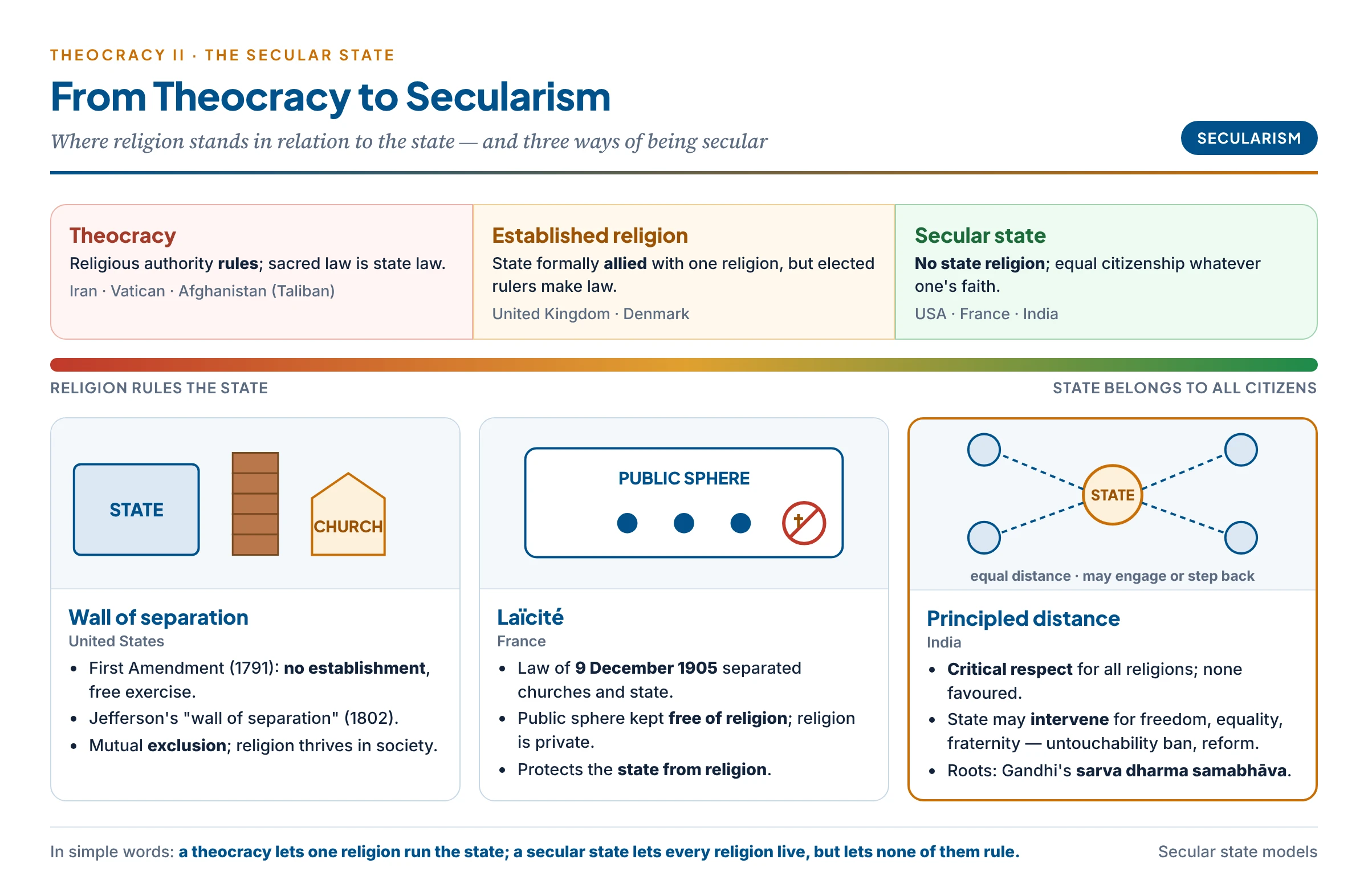
| Model | Core idea | Example | Attitude to religion |
|---|---|---|---|
| Wall of separation (United States) | The state neither establishes nor hinders religion (First Amendment, 1791); Jefferson’s phrase “a wall of separation between church and state” (1802) | No state funding of religious worship; religion thrives in society | Neutral — mutual exclusion of state and church |
| Laïcité (France) | The Law of 9 December 1905 separated churches and state; the public sphere is kept free of religion | Bans on conspicuous religious symbols in state schools (2004) | Protects the state from religion; religion is private |
| Principled distance (India) | The state keeps a flexible distance from all religions — it may engage or keep away depending on what advances freedom, equality and fraternity | Banning untouchability, reforming personal laws, aiding minority schools without preference | Critical respect for all religions |
- Sarva dharma samabhāva. Gandhi’s ideal — equal respect for all religions — is the moral root of the Indian model. Bhargava adds that Indian secularism is unique in attending to both inter-religious domination (one community over another) and intra-religious oppression (caste or gender oppression within a religion).
So What Is the Status of Theocracy in a Secular State?
- No place as a form of government. A secular constitution excludes theocracy by definition: no religion can capture state power, and no religious law can override the constitution.
- But religion keeps a public role. Secularism is not atheism. Religious communities run schools, hospitals and charities; religious citizens argue in public debates; festivals are public holidays.
- Personal laws. In some secular states, including India, religious personal laws (marriage, inheritance) survive, subject to constitutional rights — for example, the Supreme Court struck down instant triple talāq in Shayara Bano v Union of India (2017).
- Theocratic islands within a secular world. A theocratic state like the Vatican (recognised as a sovereign city-state by the Lateran Treaty of 1929) is accepted by secular states in international law; the secular principle governs states internally, not their relations.
- New pressures. The rise of religious nationalism in many countries — the demand that the nation be defined by one religion — challenges secularism from within, even where full theocracy is not proposed. The so-called “desecularisation of the world” (the sociologist Peter Berger‘s later thesis) shows that religion has not faded from politics as earlier theorists expected.
Indian Connect — Aśoka, Akbar and the Indian Tradition of Tolerance
- Aśoka’s Rock Edict XII (3rd century BCE) asks people to honour other sects: a person who praises his own sect and condemns others out of devotion harms his own sect. Concord (samavāya) among sects is the goal.
- Akbar’s sulh-i-kul (“peace with all”), his debates in the Ibādat Khāna and his abolition of the jizya (1564) gave a Mughal model of a state above sects.
- These traditions show that the Indian idea of a state respecting all faiths is older than the modern Constitution.
Cross-Tradition Comparison
In What Sense Is Democracy Better than Theocracy?
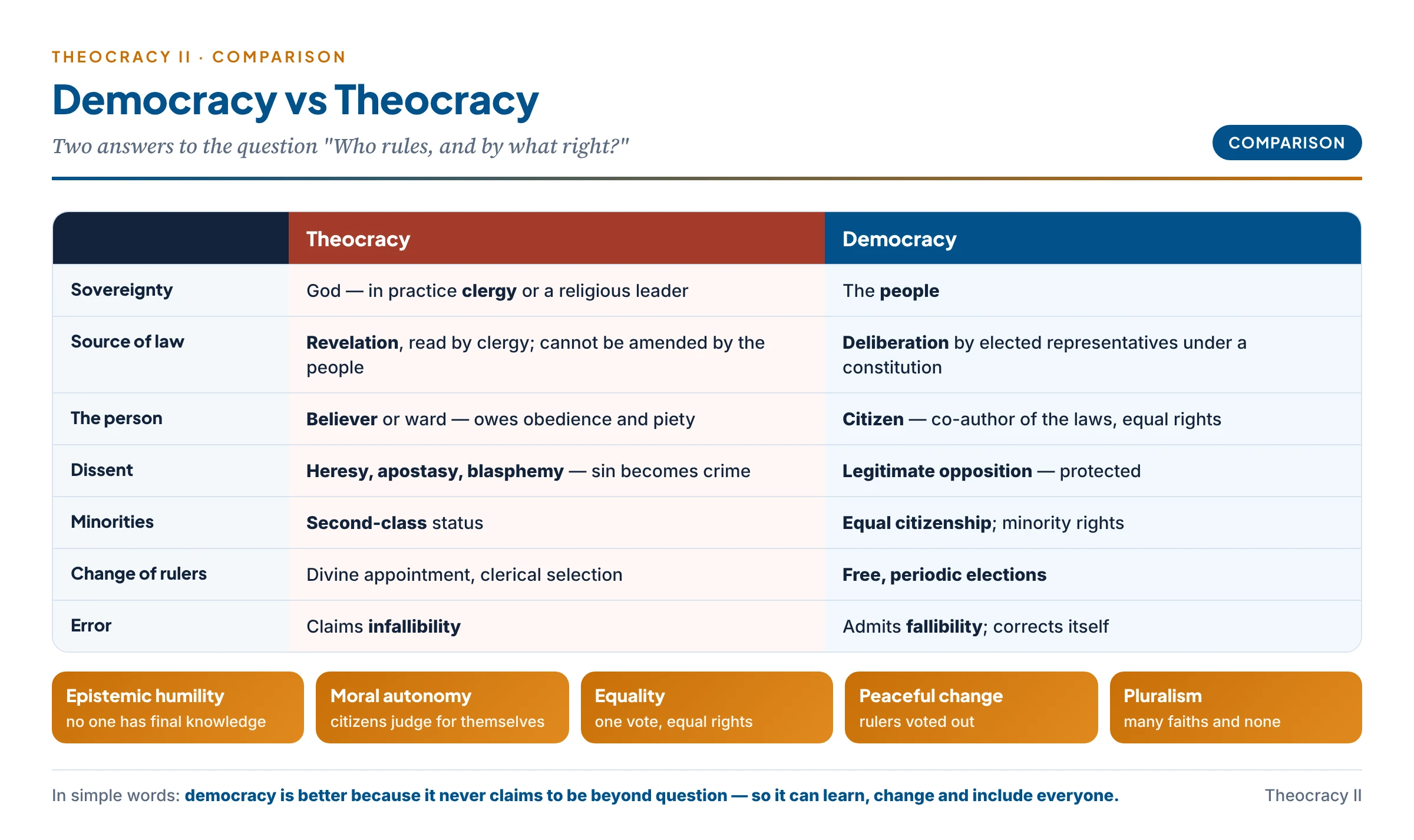
| Point | Theocracy | Democracy |
|---|---|---|
| Sovereignty | God (in practice, clergy or religious leader) | The people |
| Source of law | Revelation, interpreted by clergy | Deliberation by elected representatives under a constitution |
| Status of the person | Believer or ward, owing obedience and piety | Citizen, co-author of the laws, with equal rights |
| Dissent | Heresy, apostasy, blasphemy — sin becomes crime | Legitimate opposition — protected |
| Minorities | Second-class status | Equal citizenship; minority rights protected |
| Change of rulers | Divine appointment, clerical selection | Free, periodic elections |
| Error | Claims infallibility | Admits fallibility; can correct itself |
Democracy is better in five senses:
- Epistemic humility — democracy accepts that no one has final knowledge of what is right, so it keeps every decision open to criticism and revision. Theocracy claims certainty it cannot prove.
- Moral autonomy — democracy treats people as adults who can judge for themselves (Kant). Theocracy treats them as wards.
- Equality — every citizen has one vote and equal rights, whatever his or her faith.
- Peaceful change — bad rulers can be voted out; in a theocracy, removing rulers often needs revolution.
- Pluralism — democracy can host many faiths and none in one political community.
Public reason (John Rawls). In a democracy, citizens who hold different religious and philosophical doctrines can still agree on basic political principles — an overlapping consensus. When they argue about basic laws, they should give reasons that others could accept as free and equal citizens (public reason), not reasons that only their own faith accepts. A theocracy rests entirely on reasons only one faith accepts.
But fairness requires two qualifications:
- Democracy can become majoritarian — a religious majority may use elections to impose its faith. Democracy is better than theocracy only when it is constitutional and secular, with protected rights.
- Theocracy’s concern for virtue and community points to something liberal democracies can neglect — the need for shared values to hold a society together.
Indian Secularism: Constitution, Courts and Thinkers
- The Constitution:
- Preamble — the word “secular” was added by the 42nd Amendment (1976), though the Constitution was secular in substance from 1950.
- Article 14 (equality before law), Article 15 (no discrimination on grounds of religion).
- Article 25 — freedom of conscience and the right to profess, practise and propagate religion, subject to public order, morality and health; the state may regulate secular activities linked with religion and carry out social reform.
- Article 26 — freedom of religious denominations to manage their own affairs.
- Article 27 — no tax to promote a particular religion.
- Article 28 — no religious instruction in wholly state-funded institutions.
- The courts:
- Kesavananda Bharati v State of Kerala (1973) — the doctrine of the basic structure; secularism was listed among the basic features by judges in the case.
- S.R. Bommai v Union of India (1994) — a nine-judge bench held that secularism is a basic feature of the Constitution; it is a positive concept of equal treatment of all religions, and a state government that acts against secularism can be dismissed under Article 356. The Court said religion and politics must not be mixed in the running of the state.
- The thinkers (2019 question):
- Gandhi — sarva dharma samabhāva, equal respect for all religions. He held that politics must be guided by religion in the sense of morality (“those who say that religion has nothing to do with politics do not know what religion means”), yet he wanted no state religion: “If I were a dictator, religion and State would be separate… religion is my personal affair. The State has nothing to do with it.” His secularism was spiritual and communitarian — aimed at harmony between communities.
- Nehru — a modern, rational secularism: the state protects all religions but favours none, and religion is kept out of public policy; secularism also meant opposing caste and gender oppression sanctioned by religion.
- Ambedkar — a rational, rights-based secularism. Religion in India, he observed, claims to govern “every aspect of life, from birth to death”; the state must therefore be free to reform religion where it denies equality. Secular state, for him, did not mean a state that ignores religion, but one that gives no religion privilege and does not let religion block social justice. He wanted religion limited to belief and worship, and he made untouchability a crime (Article 17).
- The difference. Gandhi and Ambedkar both rejected a theocratic state, but Gandhi built secularism on religion (all religions are true paths; the state respects them equally), while Ambedkar built it on reason and justice (the state must stand above religion and reform it where it oppresses).
Indian Connect — Why India is not a theocracy — and was not one in the past
- Ancient India: the king was bound by dharma and advised by a purohita, but priests did not rule; Kauṭilya placed statecraft (daṇḍanīti) on its own footing (see Article 4).
- Modern India: the Constitution makes every citizen equal regardless of religion and puts constitutional morality above religious law.
- Lesson: a deeply religious society can still have a secular state — religion flourishes in society, while the state belongs to all.
Common confusion
Does secularism in India mean that the state keeps completely away from religion? No. Unlike the American “wall”, Indian secularism allows the state to intervene in religion — to abolish untouchability, open temples to all castes, reform personal laws and fund minority educational institutions. What it forbids is favouring one religion or letting religion capture the state. That is why it is called principled distance, not strict separation.
Is Theocracy an Outdated Ideology?
(The historical side of this question — the decline after Westphalia and the Enlightenment, and the revival after 1979 — is set out in Article 4. Here is the philosophical side.)
- Outdated as a theory of legitimate government — yes. The philosophical case against it (hermeneutic, Kantian, Lockean, Millian, human-rights) has not been answered, and the modern idea of the citizen as an equal co-author of law cannot fit inside it.
- Not outdated as a political force. Iran (1979), Afghanistan (2021), the ISIS “caliphate” (2014–2019) and the rise of religious nationalism show that theocratic ideas still move millions of people, often as a reaction to corrupt secular rulers, foreign domination and the spiritual emptiness of consumer society.
- The deeper lesson. Theocracy survives because it answers real needs — meaning, identity, moral order. Secular democracies defeat it not by mocking religion but by meeting those needs through justice, dignity and genuine respect for faith.
Synthesis (Siddhānta)
- The central flaw. Theocracy confuses the authority of God with the authority of those who speak for God. Once the hermeneutic problem is seen, the claim to divine sovereignty becomes the claim of fallible human beings to unlimited and unchallengeable power.
- Moral and political failure. It cannot produce virtue (Kant), cannot produce belief (Locke), cannot keep truth alive (Mill), cannot change rulers peacefully (Popper), and cannot treat all citizens as equals (human rights).
- What it gets right. Societies need shared values, moral seriousness and a sense of the sacred; a purely procedural, consumerist politics can leave people empty. These needs are real.
- The resolution. Religion’s moral wisdom can enter public life through the free arguments of citizens, while the state remains secular — belonging to people of all faiths and none. India’s model of principled distance and critical respect, rooted in Aśoka, Akbar, Gandhi and Ambedkar, shows that a deeply religious people can build a secular, democratic state.
- Contemporary relevance:
- Women-led protests in Iran and the bans on girls’ education in Afghanistan show the human cost of theocratic rule today.
- Blasphemy and apostasy laws remain the sharpest test of whether a state respects freedom of conscience.
- The growth of religious nationalism in many democracies makes the defence of constitutional secularism a live task, not a closed chapter.
“If I were a dictator, religion and State would be separate… The State has nothing to do with it.” — Mahatma Gandhi
Previous Year Questions
- 2025Can Theocracy be accepted as a valid form of Government? Give reasons and justification in support of your answer.
- 2019Discuss the status of theocracy in the modern secular state.
- 2019Examine whether there is any difference between the views of Mahatma Gandhi and Dr. Babasaheb Ambedkar on the philosophical foundations of secular democracy.
- 2014In what sense is democracy better form of government than the theocracy?
- 2009Is theocracy an outdated ideology? Discuss.