

Forms of Government: Monarchy; Theocracy and Democracy.
Official Syllabus: Paper II, Section A, Unit 4
Democracy is the most widely praised form of government today, yet from its very birth in Athens it has had powerful critics. Plato thought it was the rule of ignorance over knowledge; Aristotle called it the rule of the poor for their own benefit; Tocqueville and J.S. Mill feared a new tyranny of the majority; modern writers ask whether giving equal weight to every opinion makes good decisions impossible, and whether rule by the meritorious, the expert or even a benevolent dictator would serve people better. Philosophers have also found paradoxes inside the very idea of democracy — puzzles in which democratic principles seem to contradict themselves. This article covers Plato’s critique (the ship of state, the doctor and the pastry-cook, the great beast, the democratic man), Aristotle, Tocqueville and Mill on majority tyranny, the standard charges against democracy and the replies to them, the debate on equal weight to every opinion, meritocracy, epistocracy and “beyond democracy”, democracy versus the benevolent dictator, and the paradoxes of democracy — Wollheim’s, Popper’s, the voter’s paradox, Condorcet’s cycle and Arrow’s theorem.
In simple words
A family of five has to decide how to treat a sick grandfather. One member is a doctor. Should every member’s opinion count equally on the medicine? Most would say no — listen to the doctor. But should the doctor alone decide whether grandfather is moved to a hospital in another city, away from the family he loves? Most would say no again — that affects everyone, and everyone has a stake. The whole debate about democracy’s critics is about this difference: questions where expertise matters, and questions where everyone’s interests and values matter.
Context & Problem
Why Democracy Has Always Had Critics
- Born under suspicion. Athenian democracy (from 508/7 BC) was admired for its freedom but blamed for its mistakes — the disastrous Sicilian expedition (415 BC) and, above all, the trial and death of Socrates (399 BC) by a jury of 501 citizens. Plato’s whole political philosophy can be read as a reaction to that verdict.
- Rejected for two thousand years. From antiquity until the eighteenth century, most philosophers ranked democracy low — as the rule of the unwise many. Even the American founders preferred the word “republic“.
- Revived critiques in the modern age. When democracy spread in the nineteenth and twentieth centuries, new criticisms arose: majority tyranny (Tocqueville, Mill), mass psychology (Le Bon), class rule (Marx), elite rule behind a democratic face (Pareto, Mosca, Michels, Schumpeter — see Article 7), and today the epistocrats, who argue that the ignorant should have less political power.
- Four families of criticism:
- Epistemic — democracy produces bad decisions because most voters lack knowledge (Plato, epistocrats).
- Moral–liberal — majority rule can crush individuals and minorities (Tocqueville, Mill).
- Practical — democracy is slow, costly, divided and short-sighted (Hobbes; modern critics).
- Logical — democratic principles seem to contradict themselves (the paradoxes).
The Standard Charges against Democracy
- Mobocracy (ochlocracy) — democracy tends to become rule by the mob.
- Emotion and demagogues — decisions are swayed by emotions and misled by clever speakers who flatter the crowd.
- Numbers over quality — heads are counted, not weighed; excellence is ignored.
- Slow and costly — decisions are made by persuasion, negotiation and accommodation, so the process is lengthy and wastes time and public money.
- Sectarian interests — narrow group interests dominate rational decision-making, as in vote-bank politics.
- Minorities at the mercy of the majority — minority rights may depend on the majority’s goodwill, as the long struggle of the civil rights movement in the USA showed.
- Class rule in disguise — Marx argued that democracy under capitalism harbours capitalism and keeps the working majority powerless (see Article 8).
Core Doctrine
Plato’s Critique of Democracy
The starting point: ruling is a skill. For Plato, governing a city is an art (technē), like medicine or navigation. An art requires knowledge (epistēmē) — ultimately knowledge of the Form of the Good — not mere opinion (doxa). Democracy hands power to opinion. Plato’s arguments:
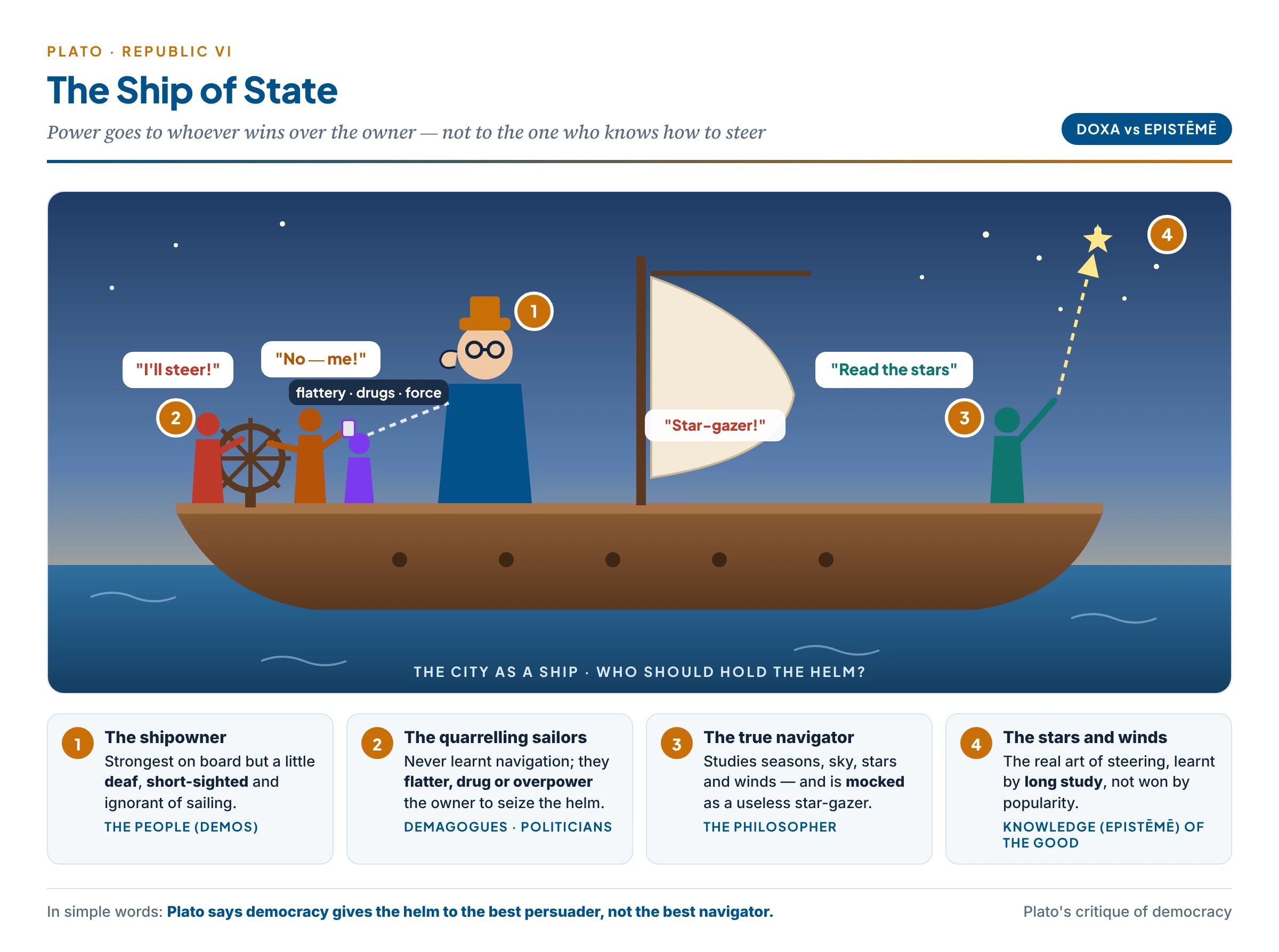
- The ship of state (Republic, Book VI).
- The shipowner is bigger and stronger than everyone on board, but a little deaf, short-sighted and knows little of sailing — he stands for the people (demos).
- The sailors quarrel over who should steer. None has learnt navigation, and they even claim it cannot be taught. They flatter, drug or overpower the owner and take the helm — they stand for demagogues and politicians.
- The true navigator, who studies the seasons, the sky, the stars and the winds, is mocked as a useless “star-gazer” and a babbler — he stands for the philosopher.
- Lesson: in a democracy the person with real knowledge is despised, and power goes to whoever is best at winning over the crowd.
- The great beast (Republic, Book VI). The sophists who teach politicians are like a keeper who studies the moods of a huge, strong beast — what pleases it, what angers it — and calls whatever pleases it “good”. Democratic leadership becomes the science of pleasing the crowd, not of knowing what is good.
- The doctor and the pastry-cook (Gorgias). If a doctor and a pastry-cook competed before a jury of children to decide who knows best about food, the doctor — who prescribes bitter medicine and diets — would lose to the cook, who offers sweets. Democratic politics rewards flattery (giving people what they like) over true care (giving them what is good). This is why Socrates, the “doctor” of Athens, was condemned.
- False equality. Democracy is “a charming form of government, full of variety and disorder, and dispensing a sort of equality to equals and unequals alike“. It treats the wise and the foolish as equal, and even fills offices by lot.
- Excess of freedom. In the democratic city everyone does as he likes. Freedom spreads everywhere: fathers fear their sons, teachers fear their pupils, the old imitate the young, and even horses and donkeys walk the streets as if they were free citizens. Respect for law and authority dissolves into anarchy.
- The democratic man (Republic, Book VIII). The individual who matches this city treats all desires as equal. He lives from day to day — drinking one day, dieting the next, dabbling in politics, then philosophy — with no order or priority in his soul. He has freedom without direction.
- From democracy to tyranny. “Excess of liberty, whether in states or individuals, seems only to pass into excess of slavery.” The rich and poor quarrel; the people choose a champion to protect them; the champion tastes power, removes rivals, keeps a bodyguard and becomes a tyrant. Democracy is the last stop before the worst form of government (see Article 1 for Plato’s five constitutions).
Plato’s alternative: rule by philosopher-kings (or a few philosophers), trained for decades, living without private property or family so that they cannot be corrupted. In his later work, the Laws, Plato settled for a mixed constitution combining monarchy and democracy — a sign that he too saw the danger of unchecked power.
In simple words
Think of choosing a pilot for an aeroplane by popular vote among the passengers, after each candidate gives a speech. The most charming speaker might win, not the most skilled pilot. Plato says democracy picks rulers this way — by charm, not by competence — and the city pays for it, just as the passengers would.
Replies to Plato
- Aristotle’s “wisdom of the multitude”. Many ordinary people, each with a little wisdom, can judge better together than one expert alone — just as a feast to which many contribute is better than a dinner provided by one host. The user of a house judges it better than the builder, and the guest judges a meal better than the cook. As the proverb says, the wearer knows where the shoe pinches — the people know where policy hurts them.
- Experts on means, people on ends. A navigator knows how to sail, but the passengers decide where they are going. Many political questions — what kind of society to live in, what to value — are questions of ends, on which there are no experts.
- Popper’s reply: the wrong question. Plato asked “Who should rule?” — and answered “the wisest”. Karl Popper (The Open Society and Its Enemies, 1945) said the real question is: “How can we so organize political institutions that bad or incompetent rulers can be prevented from doing too much damage?” Democracy’s great merit is that it lets us remove rulers without bloodshed.
- Who guards the guardians? Plato assumes the philosopher-rulers will stay wise and good. History shows that unchecked power corrupts, and no test can guarantee virtue.
- Condorcet’s jury theorem. The French thinker Condorcet (1785) showed that if each voter is even slightly more likely to be right than wrong on a yes-or-no question, and voters judge independently, then a large majority is very likely to be right — and more likely the larger the group. (The conditions are demanding — voters are often not independent or well informed — but the theorem shows that crowds can be wise.)
- Diversity can beat brilliance. A large, varied group often solves problems better than a small group of the most able experts, because it brings more perspectives and information.
- Plato’s own remedy is dangerous. His ideal state uses a “noble lie” (a myth told to citizens to keep them content in their class) and strict censorship — exactly the manipulation he blamed on demagogues.
Aristotle’s Critique
- Democracy as a deviant form. In Aristotle’s sixfold scheme (see Article 1), polity is the good rule of the many, and democracy is its corrupt form — rule by the poor in their own interest, not the common good.
- Extreme democracy. In its worst form, decrees of the assembly replace settled law, and demagogues flatter the people as courtiers flatter a tyrant. Such a democracy is itself “a kind of tyranny”.
- Freedom misunderstood. Democrats think freedom means “living as one likes“; Aristotle thinks living under a good constitution is not slavery but salvation.
- But not a total rejection. Aristotle defends the collective judgment of the many (above) and favours a mixed regime with a strong middle class.
Hobbes on Assemblies
- Thomas Hobbes (Leviathan, 1651) preferred monarchy because large assemblies breed faction, envy, rhetoric and inconstancy; orators inflame passions, and no one feels responsible for the outcome. Divided sovereignty, he believed, leads to civil war (see Article 2).
Tocqueville: The Tyranny of the Majority
- Alexis de Tocqueville (Democracy in America, 1835 and 1840) admired American democracy but saw a new danger in it.
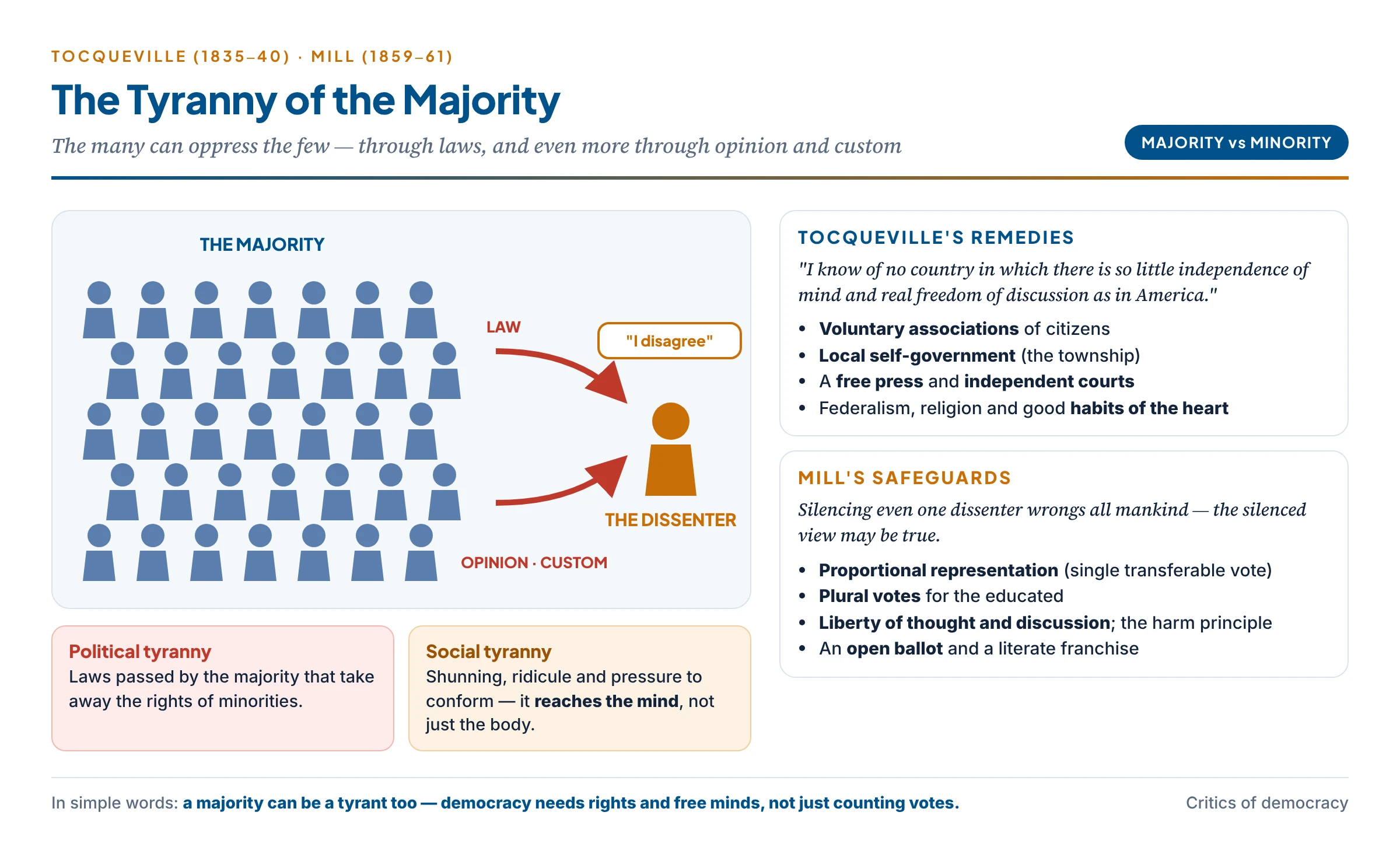
- Equality of conditions makes every opinion count equally — and so the majority’s opinion gains enormous moral power. Dissenters are not jailed; they are shunned.
- More despotic than kings. “I know of no country in which there is so little independence of mind and real freedom of discussion as in America.” An absolute monarch could only punish the body; the majority’s pressure reaches the mind.
- Soft despotism. Tocqueville feared a “tutelary power” — a mild, all-providing state that keeps citizens in perpetual childhood, until the nation becomes “a flock of timid and industrious animals of which the government is the shepherd”.
- His remedies: voluntary associations, local self-government (the New England township), a free press, an independent judiciary, federalism, religion and good mores (habits of the heart).
J.S. Mill: Social Tyranny and Its Safeguards
- Tyranny through opinion. In On Liberty (1859), Mill warned that the tyranny of the majority works not only through laws but through public opinion and custom — a “social tyranny more formidable than many kinds of political oppression“, because it penetrates the details of life and enslaves the soul itself.
- The value of the lone dissenter. “If all mankind minus one were of one opinion, … mankind would be no more justified in silencing that one person, than he, if he had the power, would be justified in silencing mankind.” A silenced opinion may be true; even a false one keeps truth from becoming dead dogma.
- The two dangers of representative democracy (Considerations on Representative Government, 1861): low intelligence in the governing body and class legislation by a numerical majority.
- Mill’s safeguards:
- Proportional representation — Thomas Hare’s single transferable vote, so that minorities are represented in proportion to their numbers.
- Plural voting — extra votes for the educated and those with more responsible occupations (but every adult gets at least one vote, including women, whose suffrage Mill championed).
- Open (public) ballot — Mill opposed the secret ballot, holding that voting is a public trust to be exercised in public.
- Basic literacy for the franchise — reading, writing and simple arithmetic.
- Expert drafting — a small commission of skilled lawmakers to draft laws, which Parliament would accept or reject.
- Protection of dissent and individuality — the harm principle: society may interfere with a person’s liberty only to prevent harm to others (see SP Unit 01 on liberty).
Other Critics of “Mass” Democracy
- Thomas Carlyle — democracy is the rule of the mediocre; society needs heroes and great men.
- Friedrich Nietzsche — democracy is the political form of herd morality, levelling down the exceptional individual.
- Gustave Le Bon (The Crowd, 1895) — in a crowd, individuals lose reason and responsibility and become suggestible and impulsive.
- José Ortega y Gasset (The Revolt of the Masses, 1930) — the “mass man“, satisfied with himself, imposes his mediocrity on public life.
- The elitists (Pareto, Mosca, Michels, Schumpeter) — every society is ruled by a minority anyway (see Article 7).
- Marx — “pure” democracy is bourgeois democracy (see Article 8).
The Charges Examined
| Charge | What critics say | The democratic reply |
|---|---|---|
| Mobocracy | Crowds rule by passion | Constitutions, courts, rights and representation filter raw passion |
| Demagogues | Clever speakers mislead voters | A free press, opposition and regular elections expose and remove them; dictatorships have worse demagogues with no remedy |
| Numbers over quality | Heads are counted, not weighed | Democracy counts interests and dignity, not intelligence; experts still advise |
| Slow and costly | Endless debate wastes time and money | Deliberation prevents costly blunders; decisions made by consent are more stable and better obeyed |
| Sectarian interests | Vote banks and lobbies capture policy | A fault of practice, curable by reforms; in other systems a small group captures everything |
| Minorities at risk | The majority can oppress | Constitutional rights, judicial review, federalism, PR (see Article 10) |
| Class rule | Democracy serves capitalists | Democracies have built welfare states, labour rights and redistribution through the ballot |
Does Equal Weight to Every Opinion Make Democracy Inefficient?
The case that it does:
- Knowledge is unequal. On economics, defence or public health, an expert’s opinion is far better informed than an average voter’s. Counting them equally seems to throw knowledge away.
- Rational ignorance. Anthony Downs (An Economic Theory of Democracy, 1957) argued that since one vote almost never decides an election, it is rational for voters not to spend time becoming informed.
- Hobbits and hooligans. Jason Brennan (Against Democracy, 2016) sorts citizens into hobbits (apathetic and uninformed), hooligans (passionate partisans who treat politics like supporting a sports team and ignore contrary evidence) and vulcans (rare, rational, open-minded). Most voters, he says, are hobbits or hooligans.
- Majorities are not truth. A majority can be wrong — a majority once believed the earth was flat. Truth is not decided by vote.
- Inefficiency. Equal voice means many must be persuaded, so action is slow.
The replies:
- What is equal is standing, not wisdom. “One person, one vote” does not claim that all opinions are equally correct. It claims that all persons are of equal dignity and have an equal claim to shape the rules they must live under. It is a principle of respect, not of knowledge.
- Everyone is the best judge of their own interests. The person whose shoe pinches knows it best. Governments that ignore some groups’ voices end up neglecting their interests — as history’s disenfranchised groups (women, workers, colonised peoples) learnt.
- No experts on values. Many political questions — the balance between liberty and security, what is fair — are moral questions. Here no class of experts has special authority.
- Many minds together. By the jury theorem and the value of diversity, large groups can pool scattered knowledge.
- Opinions are filtered, not merely counted. Democracy is not a raw opinion poll. Voters choose representatives, who deliberate with expert advice in committees, under courts and constitutions. Experts advise; the people decide.
- Self-correction. Democracies make mistakes, but a free press and elections let them detect and correct them — the main reason why, as Amartya Sen showed, functioning democracies with a free press do not suffer famines (see Article 10).
- Efficient for whom? Dictatorships decide fast, but often wrongly and for the few. Efficiency without legitimacy and accountability is not good government.
- Churchill’s verdict. “No one pretends that democracy is perfect or all-wise. Indeed it has been said that democracy is the worst form of Government except for all those other forms that have been tried from time to time.” (House of Commons, 1947)
In simple words
A housing society decides whether to build a swimming pool or a children’s park. An engineer knows more about drainage and costs, and the society should listen to her on those facts. But whether the residents value a pool or a park more is not an engineering question — it depends on what each family wants. Equal votes are for the second kind of question; expert advice is for the first. Good democracy uses both.
Common confusion
Did Churchill call democracy the best form of government? No. Speaking in the House of Commons in 1947, Churchill called democracy “the worst form of Government except for all those other forms that have been tried” — and he introduced it with “it has been said“, treating it as a saying, not his own invention. The point is comparative: democracy is full of faults, but every alternative tried so far has been worse.
Meritocracy and “Beyond Democracy”
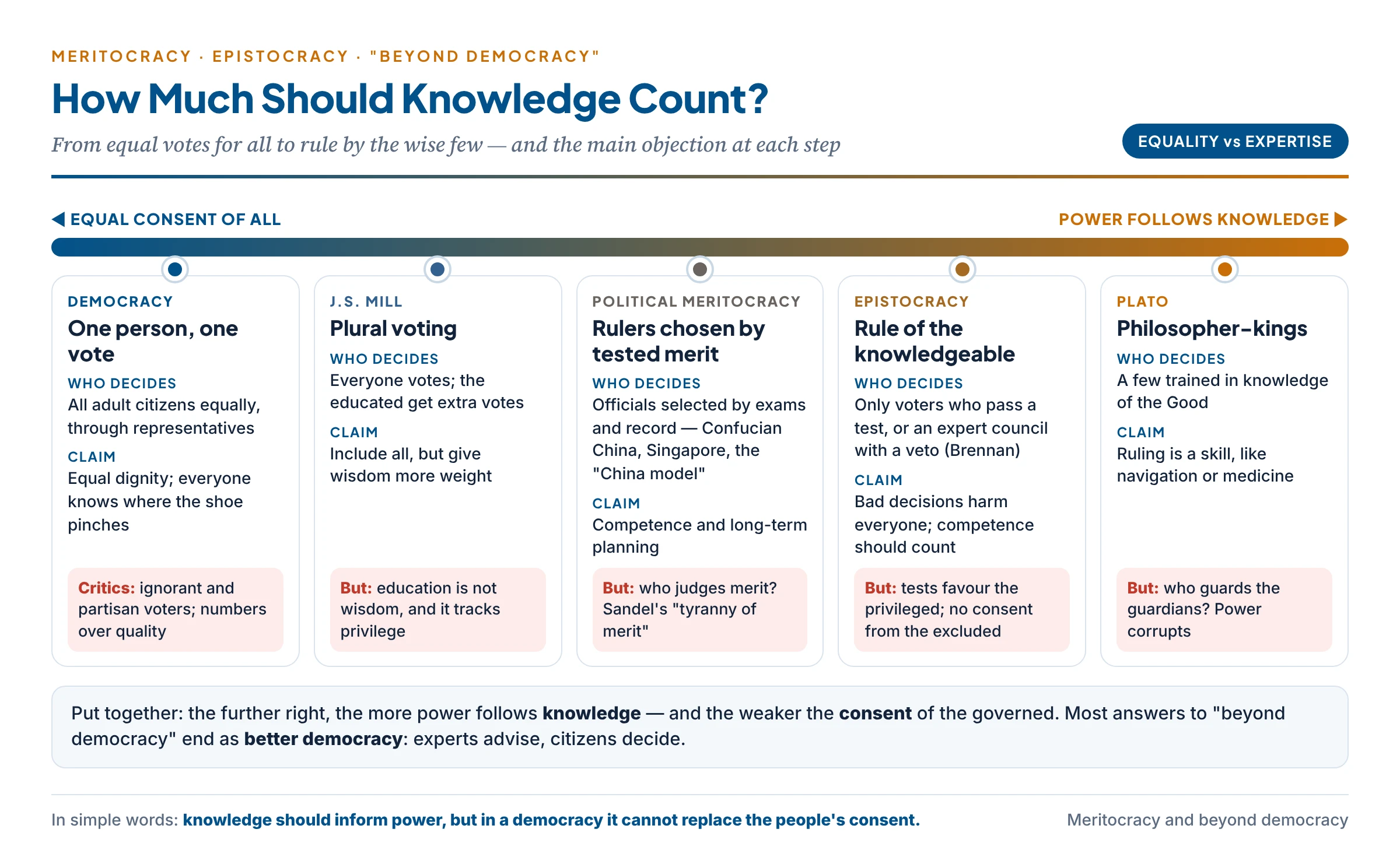
Meaning. Meritocracy is a system of occupational and social hierarchy in which each person gets a position according to his or her merit — qualifications, competence and character — rather than birth, wealth or connections. It rests on the belief that there is only a limited pool of talent among the nation’s children, and that talent should not be wasted.
- Origin of the word. The British sociologist Michael Young coined it in The Rise of the Meritocracy (1958) — as a satire. His imaginary Britain of 2033 sorts people by IQ plus effort; the new elite, believing it deserves its position, becomes arrogant, and the “unmeritorious” lose all self-respect. The book ends with a revolt.
- Political meritocracy — rule by those selected for ability and virtue:
- Plato’s guardians — chosen and trained over decades.
- Confucian China — officials recruited through imperial civil-service examinations for over a thousand years.
- Singapore — a highly educated, carefully selected governing elite under Lee Kuan Yew.
- The “China model” — the thinker Daniel Bell defends a system of democracy at the bottom, experimentation in the middle and meritocracy at the top, where leaders rise through tested performance rather than elections.
- Epistocracy — “rule of the knowledgeable”. Brennan proposes options such as restricted suffrage (only those who pass a voter-competence test may vote), plural voting for the knowledgeable (Mill’s old idea), an epistocratic veto (an expert council that can block democratic decisions) or weighting votes by political knowledge.
Arguments for meritocracy:
- Competence — complex modern problems need skilled rulers.
- Fairness — positions are earned, not inherited.
- Long-term planning — leaders are not driven by the next election.
- Use of talent — society gains when its ablest serve it.
Arguments against:
- Who judges merit? Any test of political wisdom is itself contested; whoever designs the test holds the real power. Reasonable citizens can always object that no one has been shown, beyond doubt, to be wise enough to rule them.
- Merit is shaped by privilege. Test scores reflect family income, schooling and opportunity. A meritocracy can become an inherited aristocracy in disguise.
- The tyranny of merit. Michael Sandel (The Tyranny of Merit, 2020) argues that meritocracy breeds hubris among winners (“we deserve our success”) and humiliation among losers (“we deserve our failure”), poisoning social solidarity.
- Knowledge is not virtue. The educated can be as selfish or biased as anyone; experts have failed spectacularly too.
- Legitimacy and consent. People obey willingly laws they had a voice in making; rule by experts lacks this consent.
- Young’s own warning. Late in life Young complained that politicians had adopted his satirical word as an ideal.
Is there anything “beyond democracy”?
- Gandhi’s Rāmarājya and swaraj — an ideal of enlightened anarchy in which each person rules himself, so that “in the ideal State there is no political power because there is no State”. Until then, the State that governs least is best. This goes beyond democracy by deepening self-rule, not by rejecting it.
- Marx’s communism — the state “withers away” in a classless society (see Article 8).
- Technocracy — rule by experts and data; criticised as rule without accountability.
- Deliberative and sortition-based innovations — citizens’ assemblies chosen by lot, such as Ireland’s Citizens’ Assembly (2016–18), whose recommendations on abortion led to the 2018 referendum.
- Conclusion: most answers to “beyond democracy” turn out to be better democracy — more deliberative, more participatory, more educated — combining expert knowledge with popular consent, rather than replacing the people with an elite.
Indian Connect — Merit, the franchise and the Indian Constitution
- Universal adult franchise from day one. In 1950, when only about 18% of Indians were literate, the Constitution gave every adult the vote. Ambedkar and the Constituent Assembly rejected literacy and property tests, trusting the common citizen’s judgment — a direct rejection of the epistocratic argument.
- Education tests for local elections. In Rajbala v State of Haryana (2015) the Supreme Court upheld a Haryana law requiring minimum educational qualifications to contest panchayat elections. Critics said it would shut out a large share of poor, Dalit and women candidates; Rajasthan, which had passed a similar law in 2015, repealed it in 2019.
- Merit and equity. In Neil Aurelio Nunes v Union of India (2022) the Supreme Court said that high scores in an examination are not a proxy for merit, which must be understood in its social context — the Indian form of the debate on whether “merit” is fair.
Common confusion
Did Michael Young, who coined “meritocracy”, recommend it? No. The Rise of the Meritocracy (1958) is a satire — a warning. Young showed how a society that ranks people by “merit” can become as rigid and cruel as an aristocracy of birth, because the winners think they deserve everything and the losers are left with no dignity. Many notes present the word as if it named an ideal; its inventor meant the opposite.
Is Democracy Better than a Benevolent Dictatorship?
The case for the benevolent dictator:
- Speed and decisiveness — no opposition, no endless debate; useful in crises.
- Long-term vision — no electoral cycle; reforms can be pushed through.
- Historical examples often cited — Lee Kuan Yew’s Singapore, Atatürk’s Turkey; and Plato’s philosopher-king as the ideal.
The case for democracy:
- Benevolence is not guaranteed. A dictator may start good and end bad; nothing stops him. “Power tends to corrupt and absolute power corrupts absolutely” (Lord Acton, 1887).
- The succession problem. Even if one ruler is good, there is no assurance about the next; dictatorships often end in crisis or violence.
- No feedback. Without a free press and elections, a dictator does not learn what is going wrong until it is too late — Sen’s famine argument.
- Mill’s argument. In Considerations on Representative Government, Mill said that “a good despotism is an altogether false ideal“: even a wise despot makes citizens passive, so they never develop their own intelligence and moral capacities. The people become a “flock” rather than citizens.
- Intrinsic value. Self-government expresses human dignity and autonomy; being well governed by another is not the same as governing oneself.
- Popper’s test — only democracy lets citizens remove bad rulers without bloodshed.
| Point | Benevolent dictatorship | Democracy |
|---|---|---|
| Decisions | Fast | Slow but debated |
| Quality check | The ruler’s own wisdom | Press, opposition, courts, voters |
| If the ruler goes bad | No peaceful remedy | Removed at the next election |
| Succession | Uncertain, often violent | Regular and peaceful |
| Citizens | Passive subjects | Active participants |
| Legitimacy | Performance only | Consent and performance |
The Paradoxes of Democracy
A paradox is an argument in which acceptable principles seem to lead to a contradiction. Working democracy sometimes has to satisfy conditions that pull against each other.
- Liberty versus equality. Liberals and Marxists both point out that it is hard to realise liberty and equality fully at the same time: free markets produce inequality; enforcing equality limits liberty (see SP Unit 01 for the full debate).
- The voter’s paradox (paradox of voting). An individual’s vote has an almost negligible effect on the result in a huge electorate, yet as a taxpayer each citizen pays a substantial amount towards financing elections and spends time voting. By a simple cost–benefit calculation, voting looks irrational (Downs). Yet millions vote — out of a sense of civic duty, identity and expression, which the cost–benefit view leaves out.
- Minority rule through first-past-the-post. Under the first-past-the-post system, a party can win a majority of seats with a minority of votes — often around a third — especially when many parties compete and vote shares decline. “Majority rule” then becomes rule by the largest minority.
- Wollheim’s paradox (1962).
- The puzzle: Ravi believes the city ought to build a metro line, and votes for it. The majority votes for a highway instead. As a sincere democrat, Ravi now believes the city ought to build the highway, because the majority chose it. So Ravi seems to believe at once that the metro ought to be built and that the highway (which rules out the metro) ought to be built — a contradiction.
- Wollheim’s solution: the two “oughts” are of different kinds. The first is a direct judgment — the metro is good on its own merits. The second is an oblique judgment — the highway ought to be built because it was chosen by a fair procedure. A direct and an oblique judgment can conflict in content without being contradictory, just as a referee can believe a goal should have been allowed yet accept the official decision.
- Popper’s paradoxes of freedom, tolerance and democracy.
- Freedom: unlimited freedom lets the strong bully the weak, destroying freedom.
- Tolerance: “unlimited tolerance must lead to the disappearance of tolerance” — a society that tolerates the intolerant may be taken over by them.
- Democracy: the majority may vote to abolish democracy or hand power to a tyrant. In Weimar Germany the Nazis became the largest party through elections, Hitler was appointed Chancellor in 1933, and the Reichstag itself passed the Enabling Act, ending democracy by its own procedures. Hence the idea of a “militant democracy” that protects its own foundations — Germany’s Basic Law allows anti-constitutional parties to be banned.
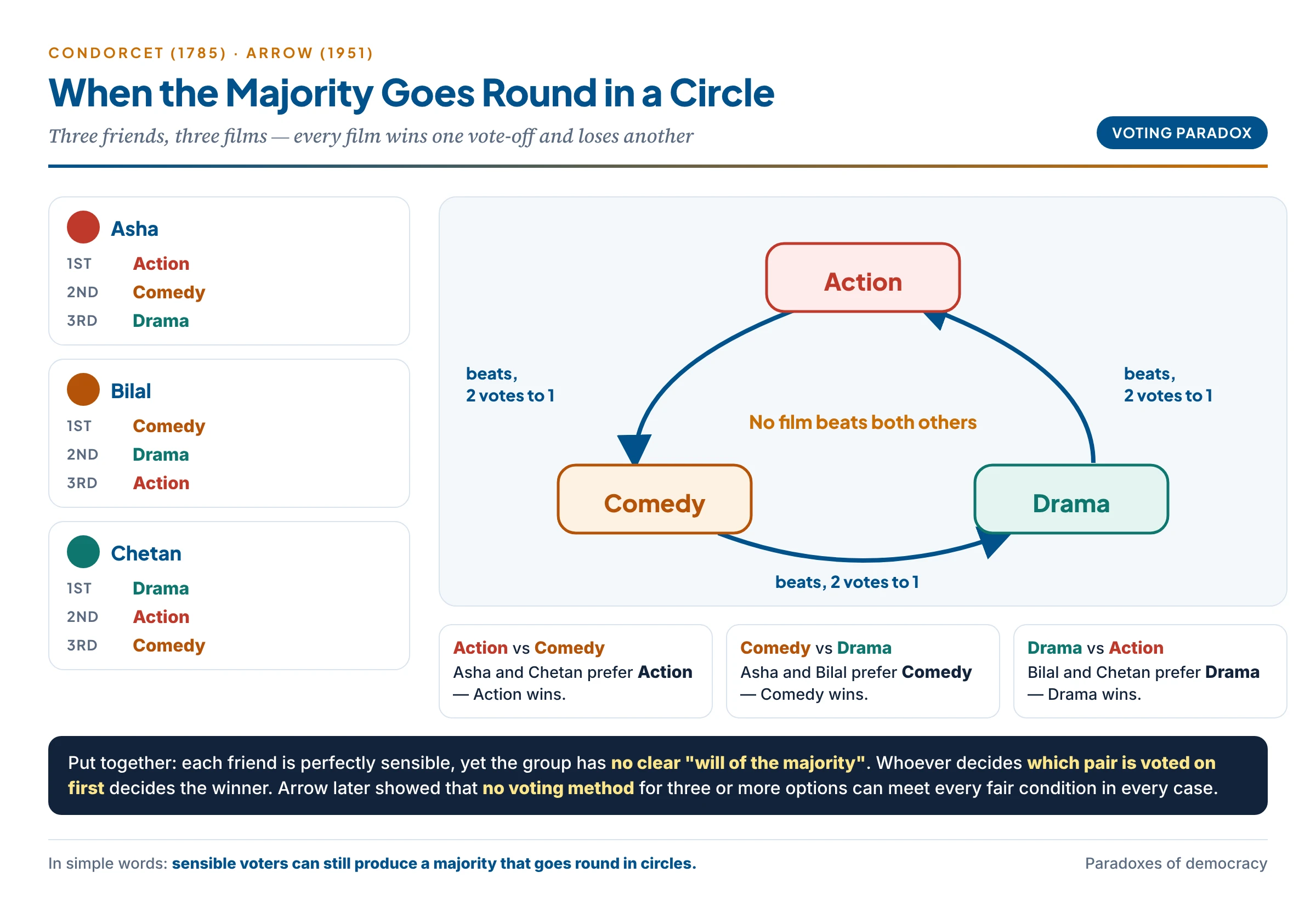
- Condorcet’s voting paradox. Majorities can go round in a circle. Three friends — Asha, Bilal and Chetan — choose a film:
- Asha ranks Action first, Comedy second, Drama third.
- Bilal ranks Comedy first, Drama second, Action third.
- Chetan ranks Drama first, Action second, Comedy third.
- Put to pairwise votes, two of the three prefer Action to Comedy, two prefer Comedy to Drama — and two prefer Drama to Action. Each film beats one and loses to another. There is no “will of the majority” at all; the result depends on which vote is taken first, so whoever sets the agenda controls the outcome.
- Arrow’s impossibility theorem (1951). The economist Kenneth Arrow generalised Condorcet’s puzzle. When there are three or more options, no method of turning individual rankings into a group ranking can always satisfy a few obviously fair conditions together: it should work for any pattern of preferences; if everyone prefers one option to another, so should the group; the group’s choice between two options should not change because of a third, irrelevant option; and no single person should decide for everyone. Every voting system must give up one of these somewhere. (Arrow won the Nobel Prize in economics in 1972, partly for this work.)
- “Forced to be free.” Rousseau said that whoever refuses to obey the general will “shall be forced to be free“. Democracy’s highest ideal of freedom seems to justify compulsion (see Article 6).
- The paradox of representation. A representative should follow the people’s wishes, yet he is chosen to use his own judgment (Burke’s trustee) — he is expected to be both a delegate and a leader (see Article 6).
- The counter-majoritarian difficulty. In constitutional democracies, unelected judges can strike down laws passed by elected majorities — the American scholar Alexander Bickel (1962) called this the “counter-majoritarian difficulty”. Democracy protects itself by limiting democracy.
- An essentially contested concept. Everyone claims to be democratic — liberal, socialist, “people’s” and “guided” democracies — and the word’s meaning is itself fought over (see Article 6).
What the paradoxes show. The paradoxes do not prove that democracy is incoherent. They show that democracy is not simply majority rule — it is a system of majority decision limited by rights, fair procedures, deliberation and constitutional design. Deliberation reduces voting cycles; constitutions protect democracy from voting itself away; and Wollheim’s two kinds of “ought” explain how a democrat can accept a decision he disagrees with.
In simple words
At a family dinner, everyone agrees to “go with the majority”. Then the majority votes to stop taking votes and let the eldest uncle decide everything from now on. Should the family obey? If yes, majority rule has abolished majority rule; if no, they are disobeying the majority. This is Popper’s paradox of democracy in miniature. The way out: majority rule is valid only within rules that keep future majorities possible — the right to vote again cannot itself be voted away.
Common confusion
Does Arrow’s impossibility theorem prove that democracy is impossible? No. It proves something narrower: when there are three or more options, no voting rule can satisfy all of a short list of fair conditions in every possible case. Real democracies still choose reasonable rules (plurality, run-offs, preferential voting) that work well in most cases, and discussion often brings preferences closer so that cycles do not arise. The theorem warns that procedures shape outcomes — so the design of voting rules and agendas matters — but it does not show that democracy cannot work.
Indian Connect — Indian answers to democracy’s paradoxes
- Democracy cannot vote itself away. In Kesavananda Bharati (1973) the Supreme Court held that Parliament’s amending power cannot destroy the Constitution’s basic structure — which includes democracy, free and fair elections and judicial review. After the Emergency (1975–77), the 44th Amendment (1978) made it harder to suspend rights. This is India’s answer to Popper’s paradox.
- Judicial review and the counter-majoritarian difficulty. Indian courts strike down laws and even constitutional amendments — as in Indira Gandhi v Raj Narain (1975), which struck down an amendment shielding the Prime Minister’s election from judicial scrutiny — protecting democracy against temporary majorities.
Critical Evaluation
How Strong Is the Case against Democracy?
What the critics get right:
- Voter knowledge is often low, and emotion, identity and propaganda do sway elections.
- Majorities can oppress minorities and dissenters, through law and through social pressure.
- Procedures shape outcomes — agenda-setting and electoral systems can produce “majorities” that do not reflect what most people want.
- Democracy can destroy itself if its foundations are not protected.
Where the critics go wrong:
- They compare real democracy with ideal alternatives. Plato compares Athens with an imaginary city of philosopher-kings; the fair comparison is between real democracies and real dictatorships, monarchies and theocracies.
- They ignore error-correction. Democracy’s great strength is not that it never errs but that it can admit and correct errors peacefully.
- They treat politics as only technical. Many political choices are about values and interests, where everyone has standing.
- They forget legitimacy. Even a well-run system lacks authority if the governed have no say.
- The remedies are democratic. Tocqueville’s associations, Mill’s proportional representation, constitutional rights, deliberation and education all reform democracy rather than abolish it.
Critics and Defenders
Criticism — Critics of democracy
- Plato — rule of opinion over knowledge; flattery over care; excess freedom ends in tyranny.
- Aristotle — rule of the poor for themselves; decrees replace law; demagogues flatter.
- Hobbes — assemblies breed faction, rhetoric and civil war.
- Tocqueville and Mill — tyranny of the majority, conformity, soft despotism.
- Le Bon, Nietzsche, Ortega — the crowd, the herd, the mass man.
- Epistocrats (Brennan) — ignorant, partisan voters; power should follow knowledge.
- The paradoxes — voting cycles, minority rule, self-abolition, Wollheim’s puzzle.
Defence — Defenders and replies
- Aristotle himself — the collective wisdom of the many; the user judges best.
- Condorcet — large groups can be very reliable.
- Popper — the real question is how to remove bad rulers without bloodshed.
- Mill — participation educates citizens; despotism, even good, makes them passive.
- Sen — democracy and a free press prevent famines; public reasoning improves policy.
- Churchill — worst form except all the others.
- Constitutional design — rights, courts, PR and deliberation answer the paradoxes.
Cross-Tradition Comparison
Rule by the Wise in Western and Indian Thought
| Thinker / tradition | Who should rule? | Check on the ruler | Attitude to the many |
|---|---|---|---|
| Plato | Philosopher-kings with knowledge of the Good | Education and a communal life without property | Distrusted — rule of opinion |
| Kauṭilya | A king trained in the sciences (ānvīkṣikī, daṇḍanīti), self-controlled — a rājarṣi (sage-king) | Discipline (vinaya), ministers, the welfare of subjects | Their happiness is the king’s happiness |
| Manusmṛti / Dharmaśāstra | A king under dharma, advised by the learned | Dharma above the king | Subjects to be protected, not consulted |
| Buddhist saṅgha | The assembly of monks | Rules of procedure; decision by majority vote (yebhuyyasikā), using voting tickets (śalākā) | Trusted within the community |
| Mill | Elected representatives guided by the educated | PR, plural voting, free discussion | Educated through participation |
| Gandhi | Each person ruling himself — swaraj | Self-restraint, truth and non-violence | Faith in the ordinary villager |
Indian Connect — Key takeaways
- India knew both sides of the debate. The ideal of the trained, self-controlled king (Kauṭilya’s rājarṣi) parallels Plato’s philosopher-king, while the gaṇa-saṅghas and the Buddhist saṅgha practised discussion and majority voting.
- Gandhi’s critique of Western democracy. In Hind Swaraj (1909), Gandhi criticised the British Parliament as dominated by party discipline and the press, and argued that real self-rule (swaraj) means self-control and decentralised village democracy, not just elections — a critique from within the democratic ideal.
- Ambedkar’s faith in the voter. Against the argument that illiterate citizens could not vote wisely, Ambedkar and the Constituent Assembly chose universal adult franchise, while warning that democracy needs constitutional morality to survive (see Article 10).
Western Critics Compared
| Critic | Main worry | Proposed remedy |
|---|---|---|
| Plato | Ignorance rules | Philosopher-kings |
| Aristotle | The poor rule for themselves | Polity; mixed regime; middle class |
| Hobbes | Faction and civil war | Absolute monarchy |
| Tocqueville | Majority conformity, soft despotism | Associations, local government, free press |
| Mill | Social tyranny; low competence | PR, plural voting, liberty of thought |
| Marx | Class rule behind formal equality | Socialist democracy |
| Schumpeter | No common good; voter irrationality | Competition among elites |
| Brennan | Ignorant, partisan voters | Epistocracy |
Synthesis (Siddhānta)
- The core insight of the critics. Democracy is not automatically wise or just. Ignorance, demagogy, majority tyranny and logical puzzles are real dangers, and Plato’s question — does power follow knowledge? — never goes away.
- The core insight of the defenders. Democracy is the only system that treats every citizen as an equal participant, protects interests by giving everyone a voice, and corrects its own errors peacefully. Its legitimacy rests on consent, which no expert or benevolent ruler can supply.
- The resolution. The best response to the critics is a constitutional, deliberative democracy: majority decisions limited by rights; experts who advise and people who decide; education, a free press and civil society to raise the quality of public opinion; and institutions that stop democracy from abolishing itself.
- Contemporary relevance.
- Populism and misinformation revive Plato’s fear of the demagogue and Le Bon’s crowd.
- Epistocracy and the “China model” are live challenges to the claim that democracy delivers the best results.
- Citizens’ assemblies and deliberative polls are attempts to answer the “equal weight to every opinion” objection by improving opinions, not silencing them.
- Electoral design — first-past-the-post versus proportional systems — is still debated because of the paradox of minority rule.
“Democracy is the worst form of Government except for all those other forms that have been tried from time to time.” — Winston Churchill (1947)
“Unlimited tolerance must lead to the disappearance of tolerance.” — Karl Popper
Previous Year Questions
- 2025Comment on Plato’s critique of Democracy.
- 2013Is a democratic government better than a benevolent dictatorship? Give reasons for your answer.
- 2012Democracy, committed to treating everybody equally, is ineffective as a system of government.
- 2007Critically examine – democracy that gives equal weight to everyone’s opinion is inefficient in determining the right or wrong thing to do.
- 2006Critically examine – democracy which treats everybody’s opinion equally is inefficient in determining the right thing to do.
- 2002Do you think that democracy is the best form of government? Is there any scope of “beyond democracy”? In this context, analyze the notion of meritocracy.
- 2001Critically examine – “The idea of democracy is paradoxical.”