

Forms of Government: Monarchy; Theocracy and Democracy.
Official Syllabus: Paper II, Section A, Unit 4
The earlier articles of this unit studied what democracy means and what its theorists hope it will be. This article asks the harder, practical question: how does democracy actually work, where does it fall short, and how can it be repaired? A democracy promises that the people rule, that every citizen counts equally, and that liberty is protected. In practice, decisions are taken by majorities — sometimes very thin ones — while minorities must live with the result; elections can be won on a third of the votes; public opinion can be shaped by propaganda; citizens sometimes feel that obeying the law means betraying their conscience; and poor countries ask whether democracy helps or hinders development. This article covers the practical strengths of democracy, majority rule and minority rights, whether majority rule is really reflected in today’s governments, liberty and equality as democracy’s distinctive features, the challenges a democratic state faces and the remedies, propaganda and the “manufacture of consent”, civil disobedience in a democracy, the relationship between democracy and development, and the state of Indian democracy today.
In simple words
Think of a housing society that decides everything by vote. The majority wants the garden turned into a car park; the few families with small children want to keep it. If the society simply counts hands, the children lose their only playground every single time. A wise society adds a few rules: some things (like safety and basic dignity) cannot be voted away, everyone gets a fair hearing, the notice-board cannot be filled with false rumours before the vote, and the committee must explain its decisions. Democracy in practice is exactly this: majority rule, plus the rules that keep the majority fair.
Context & Problem
Why Study Democracy “In Practice”?
- The gap between ideal and reality. Political philosophy defines democracy as government of, by and for the people. Real democracies are run by parties, representatives, bureaucracies, media houses and money. The question is whether the ideal survives this machinery.
- The practical question set. UPSC repeatedly asks practical questions about democracy:
- Can democracy protect minorities from the majority?
- Is majority rule actually reflected in present-day governments?
- Are liberty and equality really its distinctive features?
- What challenges does a democratic state face, and how can they be overcome?
- Is propaganda a threat to it?
- May a citizen break the law in a democracy?
- Does democracy promote or hinder development?
- Why it matters now. Many international reports since the late 2010s speak of “democratic backsliding” — elected governments weakening the checks on their own power. At the same time, democracy remains the only form of government that most people across the world call legitimate.
Why Democracy at All? Its Practical Strengths
Before looking at the problems, it helps to list what democracy does well in practice:
- Popular sovereignty. Final authority rests with the people, not with a family, a priesthood or an army.
- Accountability. Rulers must face periodic elections, a free press, courts and an opposition; they can be removed peacefully.
- A safeguard for liberty. Free speech, free association and dissent are protected, and democracy opposes authoritarianism by design.
- Equality through “one person, one vote”. Every adult citizen’s vote counts the same, whatever his wealth, caste or education.
- Rights are constitutionally guaranteed. Fundamental rights are written into the constitution and enforced by courts.
- Best system for liberty, equality and justice. No other form of government even tries to realise all three together.
- A psychological basis for national integration. Shared participation creates a sense of common ownership of the state — as the Indian freedom movement gave millions of people, across caste and region, the experience of acting together as one people.
- Conducive to international peace. Rulers limited by popular will are less likely to drag nations into wars for the interests of a few. This is the idea behind Kant’s Perpetual Peace (1795) and the modern “democratic peace” thesis — established democracies rarely, if ever, go to war with one another.
In simple words
A shopkeeper who knows his customers can walk to the next shop behaves very differently from one who has a monopoly. Elections turn citizens into customers who can “walk away”. That single fact — that rulers can be sacked without bloodshed — explains most of democracy’s practical strengths.
Core Doctrine
Majority Rule and Minority Rights
The basic principle. Democracy requires that public decisions be taken with the approval of the majority, but with due regard for the opinion of the minority. In a multicultural society it further requires that minorities enjoy full freedom to preserve their cultural traits — language, religion, dress, ways of life.
Why majority rule is needed:
- Practical necessity. Unanimity is impossible in large societies; a decision rule is needed, and majority rule treats every vote equally.
- Political equality. Majority rule is the only rule that gives no voter’s preference more weight than another’s.
- Peaceful change. Today’s minority can become tomorrow’s majority, so losers accept defeat and wait for the next election.
The problem — permanent minorities:
- Majority rule works when majorities shift from issue to issue. It fails when society is divided along fixed lines — religion, language, race, caste — so that the same group always wins and the same group always loses.
- Ambedkar made this point sharply: a political majority (formed by opinion, open to change) is very different from a communal majority (fixed by birth). A political majority is not fixed — it is made and unmade by opinion; a communal majority is permanent and fixed in its attitude, and can turn into a permanent ruling class within a democracy (States and Minorities, 1947).
- Mill and Tocqueville warned of the “tyranny of the majority” — exercised not only through laws but through social pressure and conformity (see Article 9).
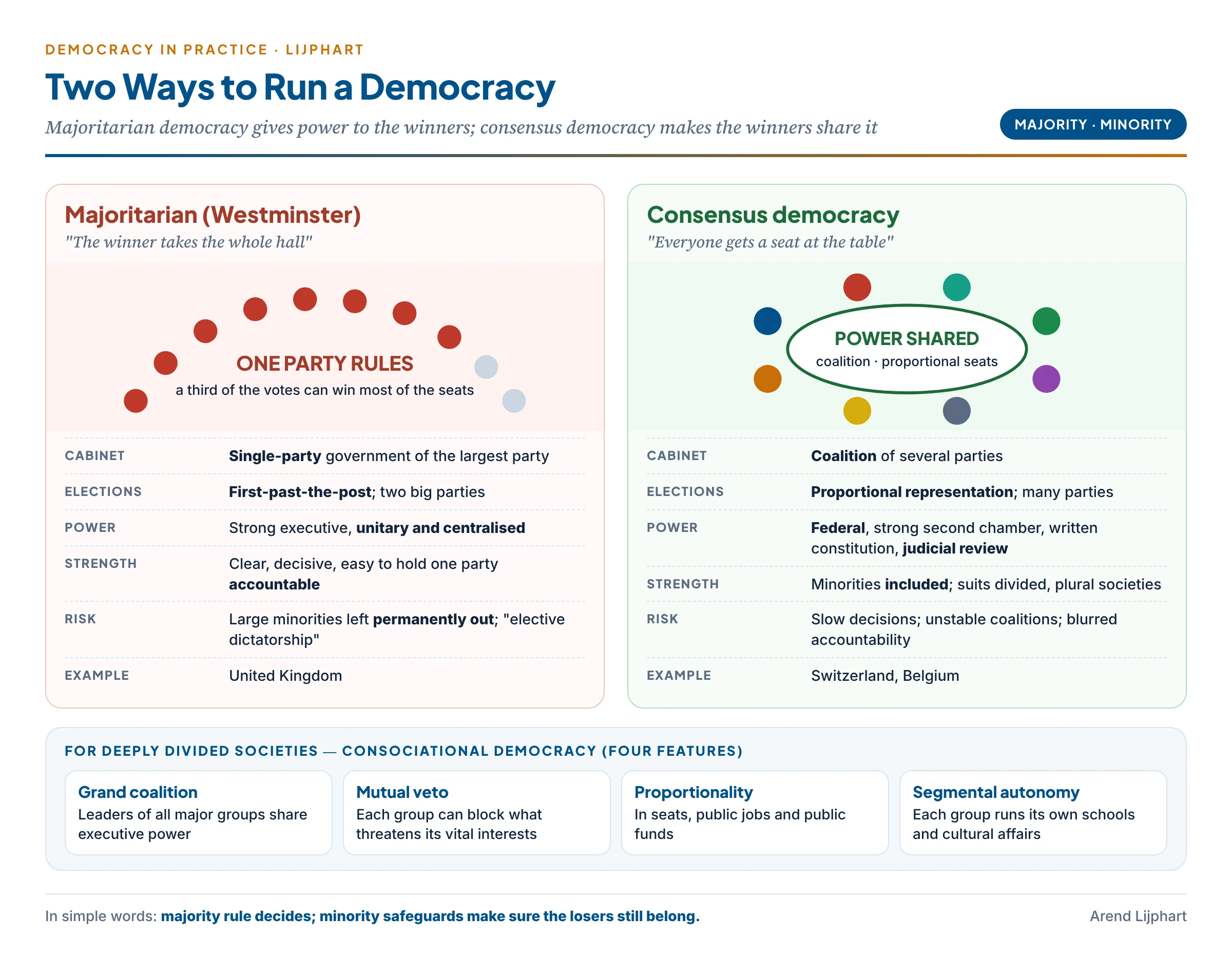
Two models of democracy — Arend Lijphart:
- Majoritarian (Westminster) democracy — power concentrated in the hands of the majority: a single-party cabinet, first-past-the-post elections, a two-party system, a dominant executive, unitary and centralised government. It is clear and decisive, but it can leave large minorities unrepresented.
- Consensus democracy — power shared and dispersed: coalition cabinets, proportional representation, many parties, federalism, strong second chambers, rigid constitutions with judicial review. It suits plural, divided societies (Switzerland, Belgium).
- Consociational democracy — Lijphart’s model for deeply divided societies, with four features:
- Grand coalition — leaders of all major groups share executive power.
- Mutual veto — each group can block decisions that threaten its vital interests.
- Proportionality — in representation, public jobs and public funds.
- Segmental autonomy — each group runs its own cultural and educational affairs.
- Lijphart even read Indian democracy as broadly consociational in its first decades — grand-coalition-style Congress governments, linguistic federalism, minority educational rights and reservations.
The liberal safeguards for minorities:
- A bill of rights placed beyond the reach of ordinary majorities.
- Judicial review — courts strike down laws that violate rights.
- Federalism and decentralisation — a national minority can be a regional majority.
- Proportional or reserved representation — so that minorities have a voice in the legislature.
- Minority institutions — the right to run schools, places of worship and cultural bodies.
- Group-differentiated rights — Will Kymlicka argues that liberal equality itself requires some special rights for national minorities and immigrant groups (self-government, polyethnic rights, special representation) — see SP Unit 03, Article 6.
- Independent commissions and a free press to expose discrimination.
Indian Connect — Minority safeguards in the Indian Constitution
- Articles 14–15 — equality before law and non-discrimination on grounds of religion, race, caste, sex or place of birth; Article 17 abolishes untouchability.
- Articles 25–28 — freedom of religion for all.
- Article 29 — any section of citizens may conserve its distinct language, script or culture; Article 30 — religious and linguistic minorities may establish and administer educational institutions of their choice.
- Reserved seats for Scheduled Castes and Scheduled Tribes in the Lok Sabha and state assemblies (Articles 330, 332), and reservations in public employment and education.
- The National Commission for Minorities (statutory since the National Commission for Minorities Act, 1992), and the national commissions for SCs and STs.
- Linguistic reorganisation of states (from 1956) turned many linguistic minorities into regional majorities.
How far do liberal democracies really safeguard minorities? — an evaluation:
- Successes:
- The US civil-rights movement used the courts (Brown v. Board of Education, 1954, ended legal school segregation) and the vote (Voting Rights Act, 1965) to dismantle legal discrimination.
- Canada, Switzerland and Belgium accommodate linguistic minorities through federalism and power-sharing.
- India has kept a vast diversity of religions, languages and castes inside one constitutional framework.
- Failures and limits:
- The same US democracy kept slavery and then Jim Crow segregation for generations — minority rights were at the disposal of the majority until the minority organised and the courts intervened.
- Sri Lanka’s Sinhala Only Act (1956) — a democratically elected government made Sinhala the sole official language, alienating the Tamil minority and feeding decades of conflict.
- Myanmar’s brief democratic opening did not protect the Rohingya, who had been stripped of citizenship by the 1982 citizenship law and were driven out in large numbers in 2017.
- Formal versus real protection — rights on paper may not reach minorities who lack money, education or representation; majoritarian moods can erode them through ordinary politics.
- Verdict. Liberal democracies safeguard minorities better than any other system — because minorities can organise, speak, vote and go to court — but not automatically. Protection depends on entrenched rights, independent courts, power-sharing institutions and a culture of fraternity. A democracy that is only “majority rule” is a democracy only in form.
In simple words
A cricket team picks its playing eleven by majority vote of the squad. If the squad is divided into two cliques and the larger clique always votes for its own players, the smaller clique never gets to play — though every vote was “fair”. A good team adds a selection rule (merit, rotation, a captain’s duty to be fair). Minority rights are democracy’s selection rules.
Is Majority Rule Meaningfully Reflected in Present-Day Democratic Governments?
Why it often is not:
- First-past-the-post (FPTP) distorts. The candidate with the most votes wins, even with far less than half. Parties can win a majority of seats on a minority of votes:
- United Kingdom, 2024 — Labour won 411 of 650 seats (63%) with 33.7% of the vote, the lowest vote share of any post-war majority government; Reform UK won 14.3% of the vote but only 5 seats.
- India, 2014 — the BJP won 282 of 543 seats with about 31% of the vote, the lowest vote share for a party winning a Lok Sabha majority on its own.
- Turnout. Where only 60–65% vote, a government elected with a third of the votes cast may represent barely a fifth of all adults.
- Indirect and counter-majoritarian institutions. The US Electoral College has twice since 2000 given the presidency to the candidate who lost the national popular vote (2000 and 2016).
- Coalition bargaining. Small parties holding the balance can extract policies the majority never voted for.
- Organised minorities and money. Lobbies, donors and well-organised interest groups shape policy between elections — the elitist and pluralist theorists’ point (see Article 7).
- Party discipline. Under India’s anti-defection law (Tenth Schedule), legislators vote as the party whip directs, so the “majority” in the House is often the will of a few party leaders.
- Executive dominance. In parliamentary systems with large majorities, the cabinet controls Parliament — what Lord Hailsham called an “elective dictatorship“.
Why it still is, in a meaningful sense:
- Governments that lose public support are voted out — India has seen repeated peaceful changes of government since 1977.
- FPTP produces stable governments and clear accountability; proportional systems (Germany, the Nordic countries) reflect votes far more exactly.
- Courts, federalism and second chambers ensure that the majority rules within limits.
- Conclusion: majority rule today is approximate rather than exact — it is the rule of the largest organised plurality, checked by institutions. Electoral reform (proportional or mixed systems), higher participation and transparency in party funding bring practice closer to the principle.
Liberty and Equality as Distinctive Features of Democracy
- Political liberty is the precondition of democracy: without freedom of speech, association, assembly and dissent, an election is only a ritual. People must be free to form opinions, organise parties and criticise rulers.
- Political equality is its defining principle: one person, one vote, one value, equal citizenship and equality before the law. Democracy is the only form of government in which the ruled and the rulers are, in principle, equals.
- Do they conflict? Tocqueville and Hayek feared that the democratic passion for equality would erode liberty; Marxists reply that liberty without economic equality is the liberty of the rich.
- Do they complement each other? Laski, Tawney and Rawls argue that liberty and equality need each other: “Without equality, liberty would produce the supremacy of the few over the many. Equality without liberty would kill individual initiative” (Ambedkar).
- Fraternity binds them: Ambedkar insisted that liberty, equality and fraternity form a “union of trinity” — to divorce one from the other “is to defeat the very purpose of democracy”.
- Verdict. Liberty and equality are distinctive of democracy because no other form of government makes both its founding principles; but democracy also needs fraternity, rule of law and justice to make them real. (Full treatment: SP Unit 01, Article 9.)
Challenges Faced by a Democratic State
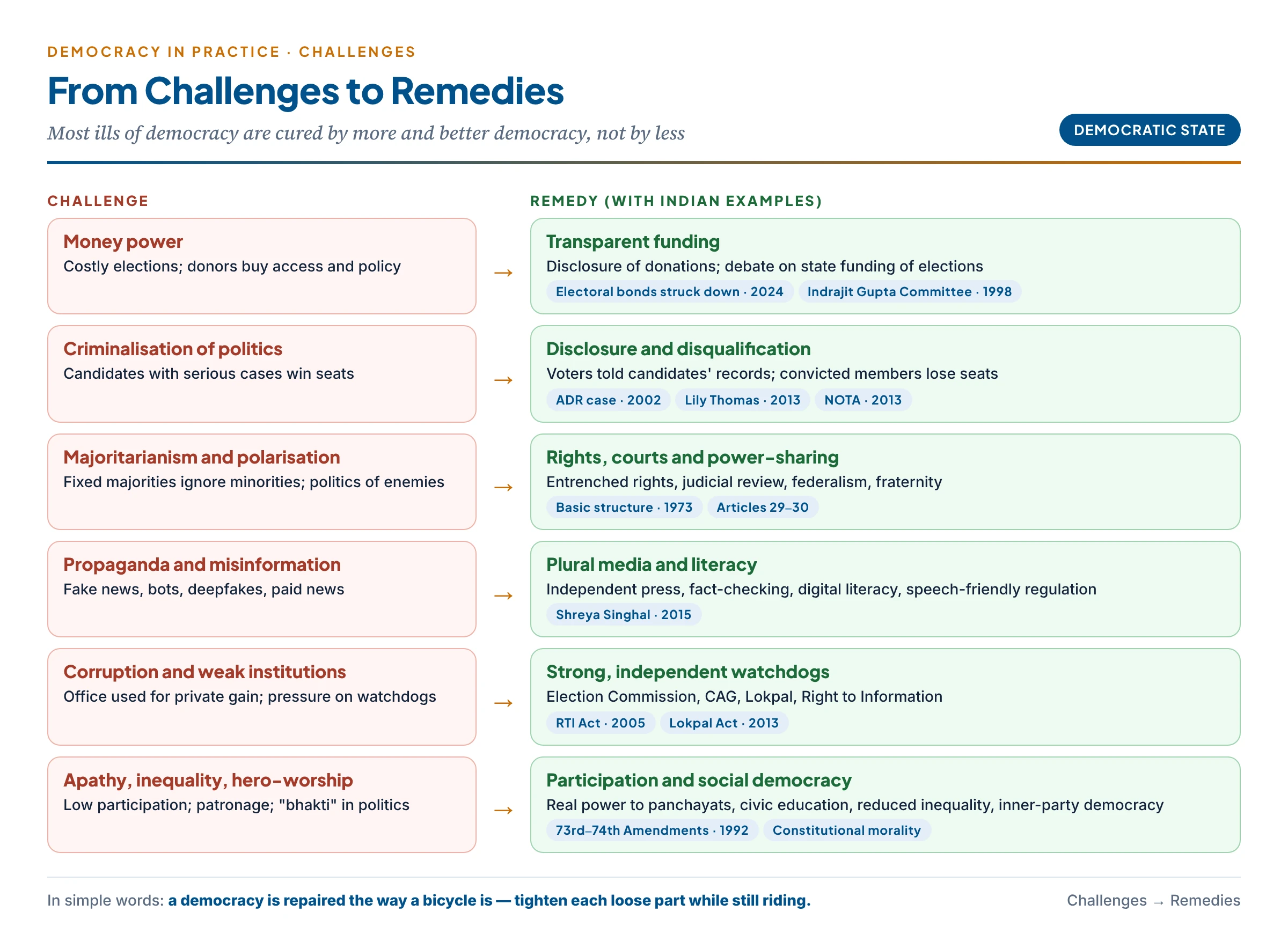
- Majoritarianism and polarisation. Treating an electoral majority as licence to ignore minorities; politics divided into hostile camps that no longer accept each other as legitimate.
- Populism and democratic backsliding. Elected leaders claim to embody “the real people” and weaken courts, media and opposition through legal means — democracy dying not by coups but by gradual erosion.
- Money power. Expensive elections make parties dependent on donors; opaque funding allows donors to buy access and policy.
- Criminalisation of politics. Candidates with serious criminal cases win elections — in 2024, 251 of 543 newly elected Lok Sabha members (46%) declared criminal cases against themselves, and 170 (31%) declared serious cases, according to an analysis of their own affidavits by the Association for Democratic Reforms (ADR); the share was 30% in 2009.
- Identity-based vote banks. Mobilisation by caste, religion and region rather than by policy and performance.
- Dynastic and personality politics. Parties run as family concerns or around one leader; little internal democracy.
- Misinformation and propaganda. Manipulation of public opinion through mass and social media (see the next section).
- Corruption. It converts public office into private gain and destroys trust (Unit 07).
- Weak institutions. Pressure on election bodies, investigating agencies, the civil service and the judiciary.
- Economic inequality and poverty. Unequal resources produce unequal political voice; poor citizens may sell votes or depend on patronage.
- Low participation and apathy. Especially among urban voters and the young; decline of local participation.
- Regionalism, separatism and terrorism. Threats to unity and to civil liberties (security laws can curtail freedoms).
Ways to overcome them:
- Electoral reforms.
- An independent, well-protected Election Commission and the model code of conduct.
- Disclosure of criminal antecedents, assets and education by candidates — Union of India v. Association for Democratic Reforms (2002); NOTA (“None of the Above”) — PUCL v. Union of India (27 September 2013), which held the right not to vote for any candidate, secretly, to be part of the voter’s freedom of expression; immediate disqualification of convicted legislators — Lily Thomas v. Union of India (2013).
- Transparent party funding — the Supreme Court struck down the Electoral Bond Scheme as unconstitutional in Association for Democratic Reforms v. Union of India (15 February 2024), holding that anonymous funding violated the voter’s right to information under Article 19(1)(a); state funding of elections was recommended by the Indrajit Gupta Committee (1998).
- Debating proportional or mixed electoral systems to reduce distortion.
- Strengthening institutions. Judicial independence, autonomous investigating agencies, the Comptroller and Auditor General, Lokpal (Lokpal and Lokayuktas Act, 2013), the Right to Information Act (2005).
- Inner-party democracy and a stronger anti-defection framework.
- Free and plural media, fact-checking and media literacy.
- Decentralisation — real powers and funds for Panchayati Raj and municipal bodies (73rd and 74th Amendments, 1992).
- Civic and constitutional education — “constitutional morality“, in Ambedkar’s phrase, must be cultivated; it is not natural.
- Social and economic democracy — reducing inequality so that political equality is real (Article 8).
- Deliberative forums — citizens’ assemblies, deliberative polls, public hearings (Article 8).
Common confusion
Is democracy simply “majority rule”? No. Majority rule is democracy’s decision method, not its whole meaning. A democracy that lets the majority do anything — strip a minority of rights, silence critics, or abolish future elections — destroys the very conditions (free speech, equal citizenship, the chance to become tomorrow’s majority) that make majority decisions legitimate. That is why constitutional democracies place certain rights beyond the reach of ordinary majorities, and why Ambedkar distinguished a changeable political majority from a fixed communal majority.
Propaganda as a Challenge to Democratic Government
What propaganda is.
- Propaganda is organised, deliberate persuasion that works by bypassing reason — through selection, repetition, emotion, half-truths and lies — to make people believe or do what the propagandist wants.
- Persuasion is not propaganda. Democracy runs on persuasion; the difference is that honest persuasion offers reasons and evidence that the listener can test, while propaganda tries to prevent testing.
- Plato’s “noble lie” in the Republic — a myth told by rulers to keep citizens content with their place — shows that the idea of governing through managed belief is as old as political philosophy.
The classic analyses:
- Walter Lippmann, Public Opinion (1922). Citizens act on “the pictures in our heads“, not on the world itself; these pictures are supplied by the press. Lippmann spoke of the “manufacture of consent” — leaders shaping what the public thinks it wants.
- Edward Bernays, Propaganda (1928) and the essay “The Engineering of Consent” (1947). The founder of public relations argued openly that “invisible governors” must shape mass opinion — the same techniques that sell soap can sell policies.
- Totalitarian propaganda. Goebbels’ Ministry of Propaganda in Nazi Germany and Stalinist propaganda showed how a regime can monopolise information. Hannah Arendt argued that totalitarian propaganda aims to make people unable to tell truth from falsehood, so that they believe nothing and everything.
- Herman and Chomsky, Manufacturing Consent (1988). Even in a free society, without censorship, news passes through five filters that favour the powerful:
- Ownership — big, profit-seeking media companies owned by wealthy interests.
- Advertising — advertisers, not readers, are the main source of income.
- Sourcing — reliance on government, business and “experts” for a steady flow of news.
- Flak — organised complaints, lawsuits and pressure that discipline journalists.
- Anti-communism (more broadly, a common enemy or fear) — an ideology used to rally opinion and silence dissent.
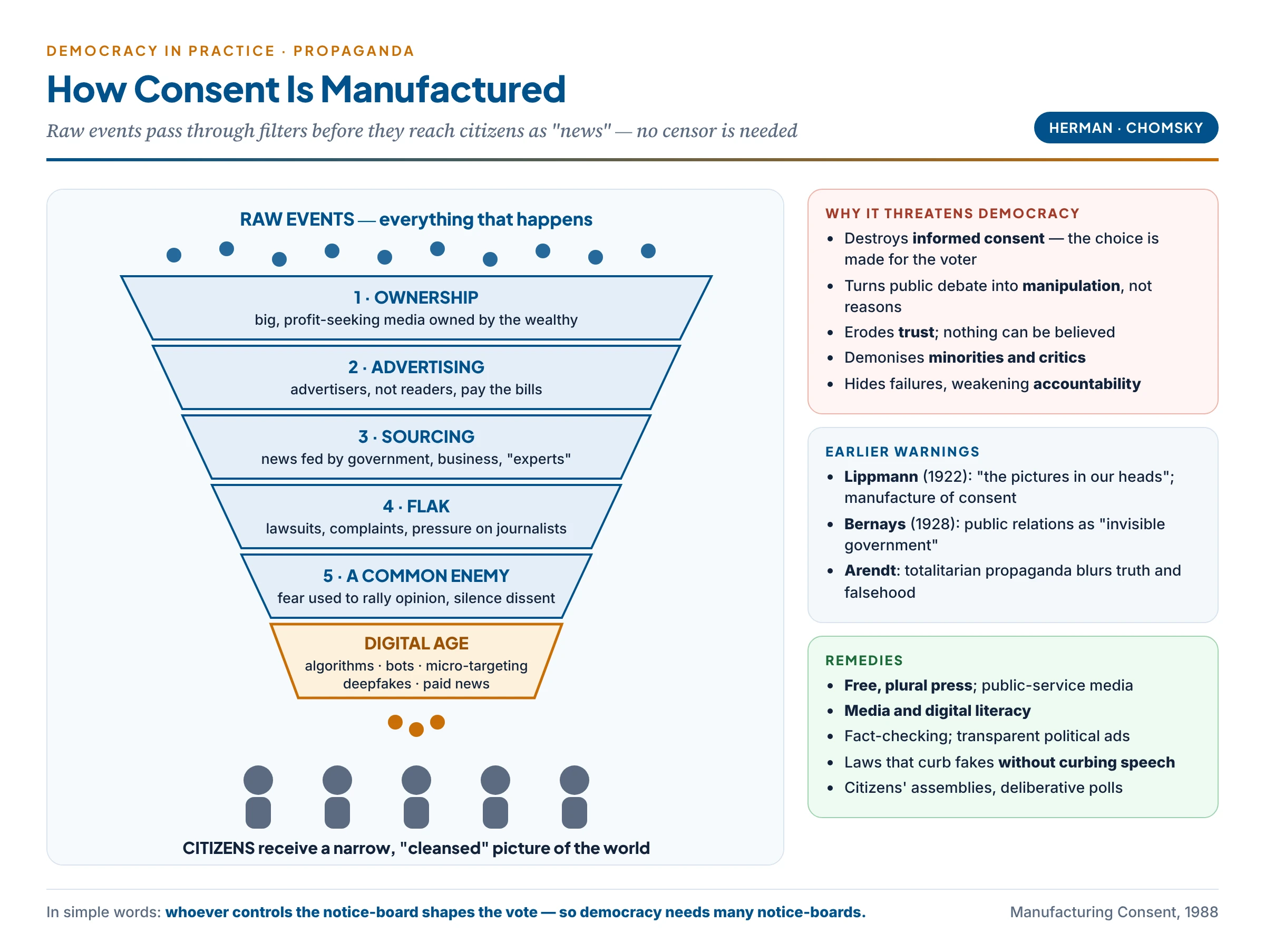
Propaganda in the digital age:
- Algorithms and echo chambers — social media feeds show people more of what they already believe, deepening polarisation.
- Bots, troll armies and coordinated campaigns — fake accounts manufacture the appearance of public opinion.
- Micro-targeting — the Cambridge Analytica scandal (2018) revealed that data harvested from tens of millions of Facebook users had been used for political profiling and targeted messaging.
- Deepfakes — AI-generated audio and video that make real people appear to say what they never said.
- Paid news and advertorials — paid political content disguised as independent reporting.
- State and party communication machinery — governments and parties of every kind invest heavily in managing their image.
Why propaganda threatens democracy:
- It destroys informed consent. Democracy’s legitimacy rests on citizens’ free and informed choice; propaganda manufactures the choice.
- It corrupts deliberation. Public debate becomes a contest of manipulation, not of reasons (Habermas’s “public sphere” is colonised — Article 8).
- It erodes trust — when nothing can be believed, citizens withdraw or turn to strongmen.
- It enables majoritarianism — demonising minorities and critics as enemies.
- It undermines accountability — failures can be hidden behind spin.
Remedies:
- A free, plural and independent press; protection of journalists; public-service broadcasting at arm’s length from government.
- Media and digital literacy — teaching citizens to check sources.
- Independent fact-checking and platform transparency about political advertising.
- Regulation that protects speech — India’s courts have guarded the balance: Shreya Singhal v. Union of India (2015) struck down the vague Section 66A of the IT Act; in 2024 the Bombay High Court struck down the 2023 amendment to the IT Rules that allowed a government fact-check unit to flag online content about the Union government as false. The Information Technology Rules, 2021 (on intermediaries and digital media ethics) and the Digital Personal Data Protection Act, 2023 form part of the current framework for platforms and data.
- Deliberative institutions — citizens’ assemblies and deliberative polls expose people to balanced information.
In simple words
If a school’s only notice-board is controlled by one group, it can decide what every student “knows” before the student council election. Propaganda is control of the notice-board. Democracy’s answer is many notice-boards, a rule that notices must be signed, and students who have learnt to ask “who put this up, and why?“
Civil Disobedience in a Democratic State
Meaning.
- John Rawls (A Theory of Justice, 1971) defined civil disobedience as “a public, nonviolent, conscientious yet political act contrary to law usually done with the aim of bringing about a change in the law or policies of the government“.
- Its marks: open (with fair notice, not secret), non-violent, conscientious (based on a sense of justice, not self-interest), political (addressed to the majority’s sense of justice), and done with willingness to accept the legal punishment — which shows fidelity to law even while breaking a particular law.
- Conscientious refusal is different: refusing to obey a law that offends one’s conscience, without necessarily seeking to change it (Rawls placed Thoreau’s tax refusal here).
The classic defenders:
- Henry David Thoreau, “Resistance to Civil Government” (1849) — he refused to pay a tax supporting slavery and the Mexican War: “Under a government which imprisons any unjustly, the true place for a just man is also a prison.”
- Mahatma Gandhi — satyagraha, “truth-force”: non-violent resistance to unjust laws, accepting suffering and punishment to convert the opponent rather than defeat him — the Salt March to Dandi (1930).
- Martin Luther King Jr., Letter from Birmingham Jail (1963) — following Augustine, “an unjust law is no law at all“; a just law squares with moral law, an unjust law degrades human personality; one who breaks an unjust law must do so “openly, lovingly, and with a willingness to accept the penalty”.
The case against — the duty to obey:
- Socrates in the Crito refused to escape from prison, arguing that having accepted the benefits of Athens’ laws all his life, he could not break them when they went against him.
- The rule-of-law argument — if everyone obeys only the laws he personally approves, law collapses into anarchy.
- Democratic argument — in a democracy the citizen helped make the law and has legal means to change it: elections, petitions, courts, protest.
- Ambedkar’s warning. In his closing speech to the Constituent Assembly on 25 November 1949, Ambedkar said that where constitutional methods are open, “there can be no justification for these unconstitutional methods. These methods are nothing but the Grammar of Anarchy and the sooner they are abandoned, the better for us.” He added that when there was no way left for constitutional methods, there had been “a great deal of justification” for them.
When is civil disobedience justified in a democracy? — Rawls’s conditions:
- The injustice is substantial and clear — especially serious violations of equal basic liberties.
- Normal political appeals have failed — legal means have been tried in good faith.
- It is limited so that it does not undermine the working of the constitution and respect for law as a whole (not every group can disobey at once).
- It is public, non-violent, and the disobedient accepts the penalty.
Does a citizen have a moral right to break a law?
- Yes, within limits. A democracy is a nearly just society, not a perfectly just one; majorities can pass unjust laws. Civil disobedience then acts as a final appeal to the majority’s sense of justice and a stabilising device that corrects injustice without revolution. Habermas called it a “litmus test” of the democratic constitutional state.
- But not as a routine political tactic. It must be the last resort, after legal remedies are exhausted, and must respect the rights of others.
- (For political obligation and its grounds — consent, gratitude, fair play — see SP Unit 03, Article 9.)
Common confusion
Did Ambedkar condemn civil disobedience as always wrong? No. Ambedkar’s “Grammar of Anarchy” remark was conditional. He said that when there was no way left for constitutional methods, as under colonial rule, there was “a great deal of justification” for civil disobedience, non-cooperation and satyagraha; what he rejected was their use after a democratic constitution had opened legal avenues of change. His point is close to Rawls’s second condition — exhaust the normal remedies first.
Democracy and Development: Does Democracy Promote or Hinder Development?
The arguments that democracy hinders development:
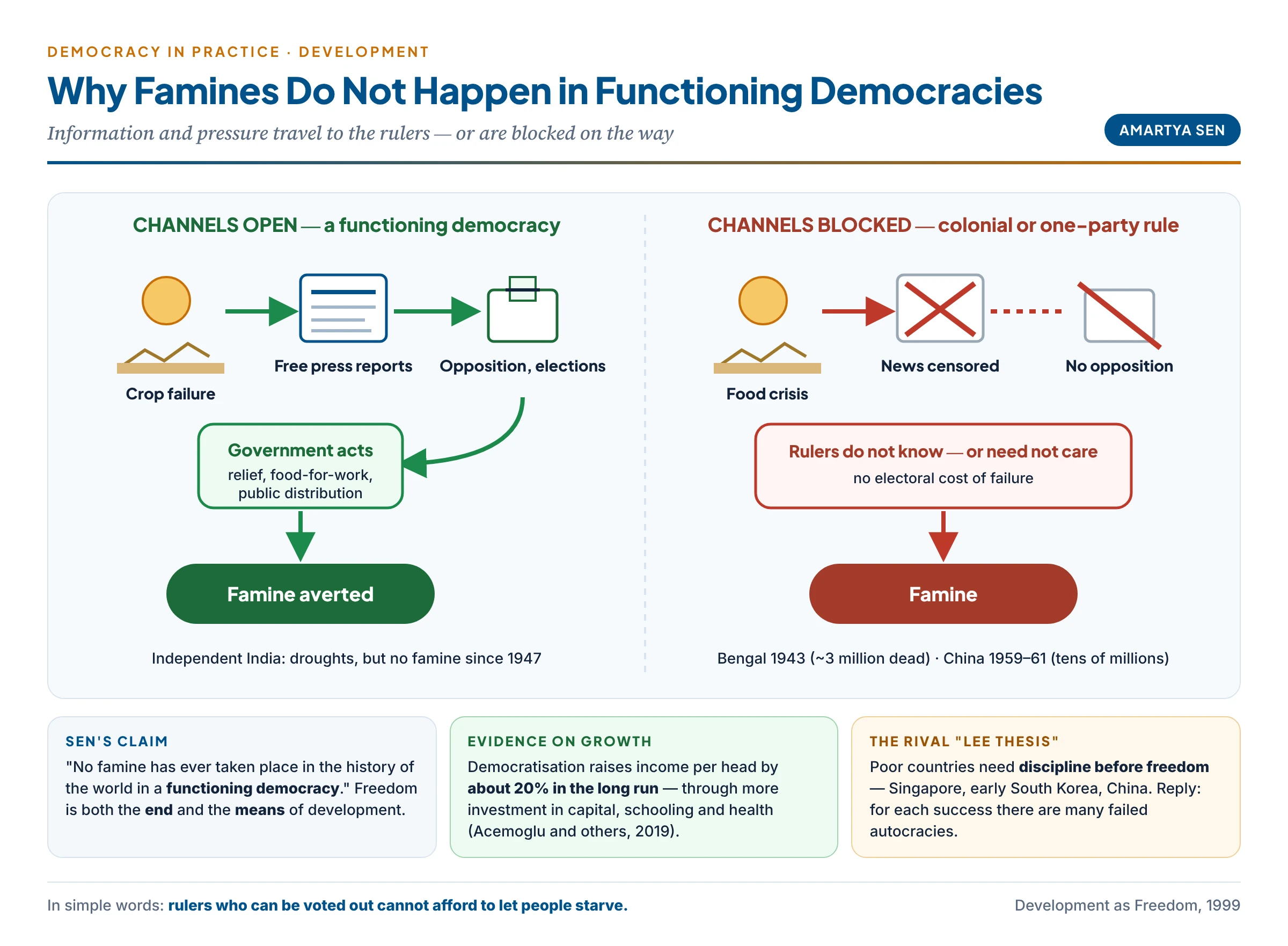
- The “Lee thesis” — named after Singapore’s Lee Kuan Yew: poor countries need discipline and strong government to grow; political freedoms come later. South Korea, Taiwan (in their early growth phases), Singapore and China grew fast under authoritarian rule.
- Short-termism — elected governments think only up to the next election and avoid painful reforms.
- Populism and subsidies — competitive politics pushes spending on handouts rather than investment.
- Slow decisions — consultation, courts, protests and coalition bargaining delay infrastructure and reform.
- Capture by interest groups — organised lobbies block change.
The arguments that democracy promotes development:
- Amartya Sen, Development as Freedom (1999). Freedom is both the end of development (constitutive role) and a principal means of it (instrumental role). Political freedoms, economic facilities, social opportunities, transparency guarantees and protective security reinforce one another.
- The famine argument. Sen observed: “No famine has ever taken place in the history of the world in a functioning democracy.” Governments that must win elections and face a free press and opposition have strong incentives to prevent famine. British-ruled Bengal in 1943 suffered a famine that killed about three million people; independent democratic India has had no famine of that kind. China’s famine during the Great Leap Forward (1959–61) killed tens of millions, while information was suppressed.
- Evidence on growth. A major study by Acemoglu, Naidu, Restrepo and Robinson, “Democracy Does Cause Growth” (Journal of Political Economy, 2019), found that democratisation raises GDP per capita by about 20% in the long run, mainly through greater investment in capital, schooling and health.
- Information and correction. Democracies have feedback loops — free media, courts, elections — that expose mistakes before they become catastrophes.
- Legitimacy and stability. Peaceful transfers of power avoid the succession crises and civil wars that wreck development in many autocracies.
- Development as human development, not only GDP — capabilities, health, education, dignity; on these, democracy is part of the definition of development itself.
- The selection problem — for every successful “benevolent” autocracy there are many failed and predatory ones (see Article 9 on the benevolent dictator).
Lipset’s modernisation hypothesis (1959) — the causal arrow also runs the other way: economic development (education, a middle class, urbanisation) makes democracy more likely to emerge and survive.
Verdict.
- Democracy does not guarantee rapid growth, and some autocracies grew fast; but on average democracy does not hinder and probably promotes long-run development, and it is far better at avoiding disasters.
- If development means expanding human freedoms and capabilities (Sen), democracy is not merely a means to development but part of what development is.
- India’s experience shows both sides: slow and noisy decision-making, but no famines, peaceful changes of government, and steady expansion of social programmes driven by electoral competition.
Common confusion
Did Sen claim that democracy abolishes all hunger? No. Sen’s claim is specifically about famines — sudden, mass starvation — in functioning democracies with free media and opposition. He himself stressed that democratic India has been far less successful against chronic undernourishment, illiteracy and ill-health, which do not create the same political pressure as a famine. Democracy gives citizens the means to demand action; whether those means are used depends on political participation and public reasoning.
Indian Democracy Today
Ambedkar’s three warnings (25 November 1949):
- Hold fast to constitutional methods — abandon “the bloody methods of revolution” and, where constitutional methods are open, civil disobedience (“the Grammar of Anarchy”).
- Do not lay your liberties at the feet of a great man — he quoted Mill and warned that “in politics, Bhakti or hero-worship is a sure road to degradation and to eventual dictatorship“.
- Do not be content with political democracy — make it a social democracy of liberty, equality and fraternity; otherwise India would enter “a life of contradictions“: “one man one vote and one vote one value” in politics, but inequality in social and economic life (see Article 8).
- He also noted that India had once known democracy — republics and the Buddhist Bhikṣu Saṅghas, which followed rules of motions, quorum, voting by ballot and censure — and warned that a new-born democracy could “retain its form but give place to dictatorship in fact”.
Strengths:
- Scale and participation. In the 2024 general election, about 64.2 crore (642 million) citizens voted out of an electorate of nearly 97 crore — the largest electoral exercise in history — including about 31.2 crore women.
- Peaceful transfers of power at the Centre and in the states since 1977; strong regional parties and federal diversity.
- An independent Election Commission and universal adult franchise from the very first election (1951–52).
- Judicial guardianship. Kesavananda Bharati (1973) — Parliament cannot amend the basic structure of the Constitution; Indira Gandhi v. Raj Narain (1975) — free and fair elections are part of the basic structure.
- Recovery from the Emergency (1975–77). Voters removed the government in 1977, and the 44th Amendment (1978) made emergency harder to impose (for example, replacing “internal disturbance” with “armed rebellion”) and protected Articles 20 and 21 even during an emergency.
- Grassroots democracy — over 2.5 lakh panchayats and reserved seats for women in local bodies; the 106th Amendment (2023) provides for one-third reservation for women in the Lok Sabha and state assemblies (to take effect after the next census and delimitation).
Concerns debated today: criminalisation and money power (above), polarisation, the quality of legislative debate, pressure on institutions and media, and inequality. Some international indices have downgraded India’s democratic rating since 2021 (for example, Freedom House’s “partly free” classification); the Government of India has rejected these assessments as “misleading, incorrect and misplaced”, pointing to free elections and a federal structure in which many states are ruled by opposition parties. The debate itself — in courts, media and Parliament — is a sign of a working democracy.
Indian Connect — Gandhi, Ambedkar and the Indian idea of democracy
- Gandhi saw true democracy as swaraj from below — self-governing villages in “oceanic circles” — and held that democracy is impossible without non-violence: “The spirit of democracy cannot be imposed from without. It has to come from within.”
- Ambedkar saw democracy as “a form and a method of government whereby revolutionary changes in the economic and social life of the people are brought about without bloodshed” — constitutional methods, social democracy, and constitutional morality.
- Both agreed that democracy is a moral way of life, not just elections; they differed on method — Gandhi’s satyagraha and decentralisation, Ambedkar’s constitutionalism and legal safeguards.
Critical Evaluation
Criticisms of Democracy as It Works
- Elitist critique (Pareto, Mosca, Michels, Schumpeter) — real power always lies with elites; elections merely choose among them (Article 7).
- Marxist critique — “bourgeois democracy” gives formal political equality while economic power stays with the owners of capital; money and media decide outcomes (Article 8).
- Epistemic critique (Plato to Brennan) — voters are ill-informed; numbers prevail over quality (Article 9).
- Communitarian critique — liberal democracy’s emphasis on individual rights weakens community and civic virtue.
- Populist critique — “the elites” and institutions block the people’s will; this critique is itself one of democracy’s main challenges.
- Empirical problems — low trust, polarisation, capture by money, criminalisation, misinformation.
Replies and Strengths
- Self-correction. Democracy is the only system that can correct its own mistakes peacefully — through elections, courts, press and protest.
- Popper’s test. The real question is not “who should rule?” but “how can we get rid of bad rulers without bloodshed?” — and only democracy answers it.
- The famine and growth evidence (Sen; Acemoglu and others) shows that democracy delivers in practice.
- Rights protection. Minorities, women and the poor have won more through democratic struggle than under any other form of rule.
- Remedies are democratic — most challenges are answered by more and better democracy (Dewey), not less.
Critics and Defenders
Criticism — Critics
- Elitists: elections only choose which elite governs; parties are oligarchies.
- Marxists: formal equality hides economic domination; propaganda manufactures consent.
- Epistocrats: equal weight for uninformed votes produces poor decisions.
- Majoritarianism: fixed majorities can oppress permanent minorities.
- Short-termism: elected governments avoid long-term reform; populism replaces policy.
- Practice in India: money power, criminalisation, vote-bank politics, hero-worship — Ambedkar’s own warnings.
Defence — Defenders and strengths
- Peaceful removal of rulers and peaceful correction of errors (Popper).
- No famine in a functioning democracy; democracy raises long-run income (Sen; Acemoglu and others).
- Rights and safeguards — bills of rights, judicial review, federalism, power-sharing (Lijphart).
- Civil disobedience as a democratic safety-valve that corrects injustice without revolution (Rawls, King).
- Legitimacy — consent makes obedience voluntary and stable.
- India’s record — vast, diverse and poor, yet democratic for over seven decades.
Cross-Tradition Comparison
Western and Indian Thinkers on Democracy in Practice
| Issue | Western view | Indian view |
|---|---|---|
| Majority and minority | Mill, Tocqueville: tyranny of the majority; Lijphart: power-sharing | Ambedkar: political vs communal majority; constitutional safeguards and reservations |
| Civil disobedience | Thoreau (conscience), Rawls (last resort, fidelity to law), King (unjust law is no law) | Gandhi’s satyagraha (truth-force, self-suffering); Ambedkar’s “Grammar of Anarchy” once constitutional means exist |
| Propaganda and opinion | Lippmann, Bernays, Herman and Chomsky; Habermas’s public sphere | Sen’s “public reasoning” and Indian argumentative tradition; free press as famine-preventer |
| Democracy and development | Lipset (development → democracy); Lee thesis (autocracy → growth) | Sen: development as freedom; Gandhi: swaraj and sarvodaya |
| Leaders and people | Mill: never “lay their liberties at the feet of even a great man” | Ambedkar: bhakti in politics leads to dictatorship |
| Ancient roots | Athenian assembly, lot and ostracism | Gaṇa-saṅghas (Licchavis), Buddhist Saṅgha procedure, sabhā and samiti |
Indian Connect — Key takeaways
- Indian thought adds fraternity (Ambedkar) and non-violent self-suffering (Gandhi) to the Western vocabulary of rights and procedures.
- The Buddhist Saṅgha’s rules of debate and ballot show that deliberative, rule-governed decision-making has deep Indian roots.
- Sen’s argumentative tradition — public reasoning from the Buddhist councils to Akbar’s debates — supports a deliberative reading of democracy.
Civil Disobedience: Rawls, King and Gandhi Compared
| Point | Rawls | King | Gandhi |
|---|---|---|---|
| Ground | The shared public sense of justice | Moral and divine law; an unjust law is no law | Truth (satya) and non-violence (ahiṃsā) |
| Aim | Change a law or policy within a nearly just society | End segregation; awaken the conscience of the nation | Convert the opponent; achieve swaraj |
| Method | Public, non-violent, accepting punishment | Non-violent direct action, accepting jail | Satyagraha, self-suffering, fasting, non-cooperation |
| Limits | Last resort; substantial injustice; not destabilising | After negotiation fails | Strict non-violence; readiness to suspend the movement (Chauri Chaura, 1922) |
Synthesis (Siddhānta)
- The core insight. Democracy in practice is majority rule within a framework of rights, kept honest by free information, independent institutions and an active citizenry. Where any of these fails — where majorities become permanent, consent is manufactured, money and crime capture politics — democracy keeps its form but loses its substance, exactly as Ambedkar feared.
- Minorities. Liberal democracies protect minorities better than any rival system, but only through entrenched rights, judicial review, power-sharing and fraternity — not through majority rule alone.
- Majority rule. Today it is the rule of the largest organised plurality, checked by institutions; electoral reform and participation can bring it closer to the ideal.
- Propaganda. The greatest modern threat is not censorship but manipulation; the answer is plural media, literacy and deliberation.
- Civil disobedience. Justified in a democracy only as a public, non-violent, last-resort appeal to the majority’s sense of justice, with acceptance of punishment — a safety-valve, not a routine tactic.
- Development. Democracy does not hinder development on balance; it prevents catastrophes, raises long-run growth and, in Sen’s sense, is part of development.
- Contemporary relevance.
- Electoral integrity — party funding, criminalisation, and the role of courts (electoral bonds, NOTA, disclosure).
- The information order — deepfakes, platform regulation and free speech.
- Majoritarianism versus constitutionalism — a debate across many democracies.
- Women’s political representation — the 106th Amendment.
- Democratic resilience — the shared global question of how democracies resist gradual erosion.
“Political democracy cannot last unless there lies at the base of it social democracy.” — B. R. Ambedkar
Previous Year Questions
- 2026Examine the relationship between democracy and development. Does democracy promote or hinder development?
- 2023Explain the challenges faced by a democratic state and the ways to overcome them.
- 2022Discuss propaganda as a challenge to democratic form of government.
- 2020How far do the liberal democracies safeguard the interests of minorities? Evaluate critically.
- 2018How far can liberty and equality be considered as distinctive features of democracy? Discuss.
- 2015Is civil disobedience in a democratic state justifiable? Discuss.
- 2013Is a democratic government able to represent the interest of minority groups?
- 2011In a Democracy does a citizen ever have the moral right to break a law? Discuss citizens right to civil disobedience.
- 2010Is majority rule meaningfully reflected in present-day democratic governments? Substantiate your answer with suitable example.