

Political Ideologies: Anarchism; Marxism and Socialism
Official Syllabus: Paper II, Section A, Unit 5
A political ideology is a connected set of ideas that tells people what is wrong with society, what a good society would look like, and how to get there. Anarchism, Marxism and socialism, the three ideologies in this unit, all grew up in the nineteenth century as answers to one shared problem: the industrial capitalist order and the liberal state that protected it. To understand them you first need two things: a clear idea of what an ideology is, and a working knowledge of liberalism, the ideology all three were reacting against and, as the 2026 paper pointed out, partly borrowing from.
In simple words
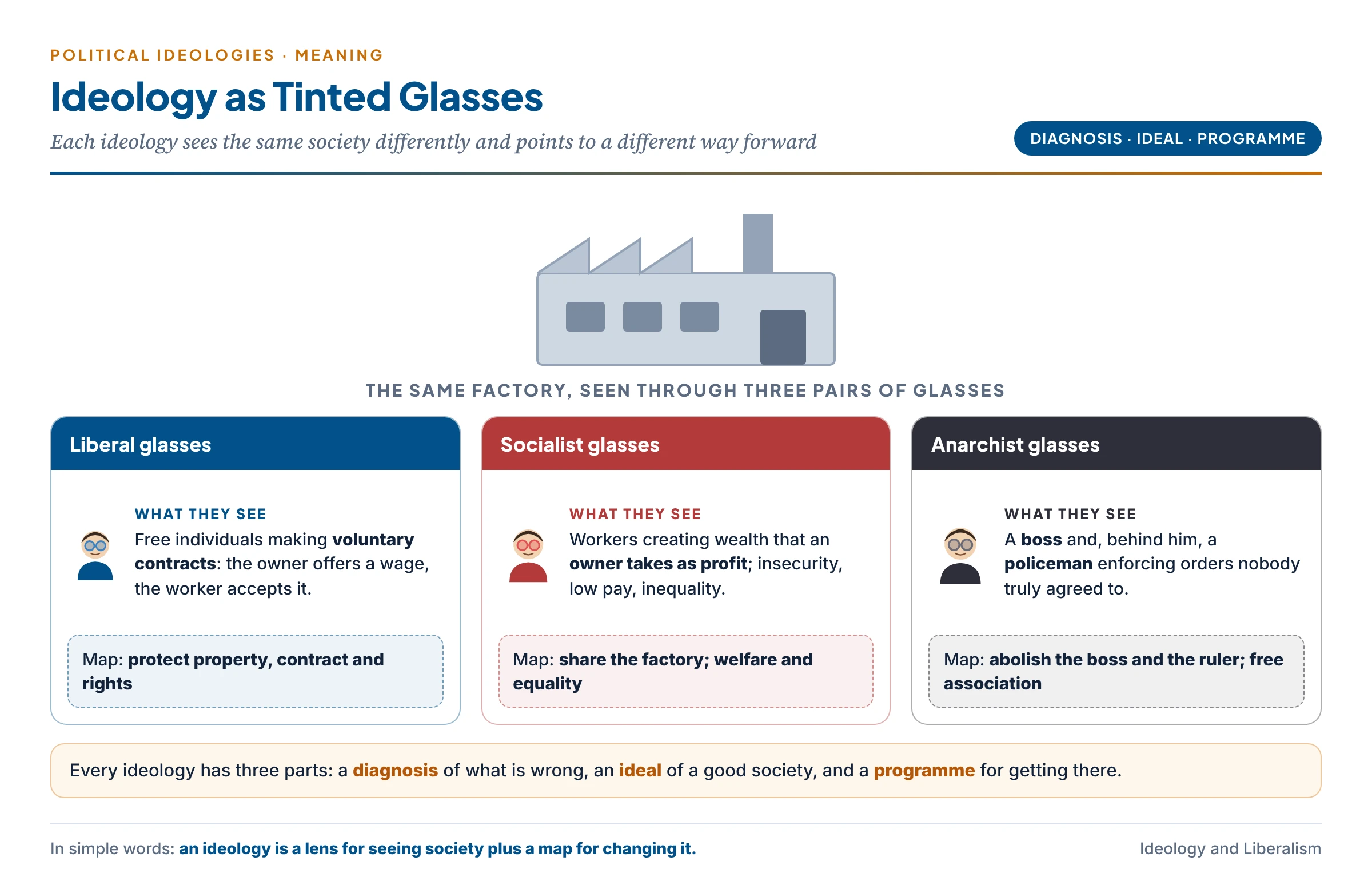
Think of an ideology as a pair of tinted glasses. A liberal, a socialist and an anarchist can stand on the same street and look at the same factory. The liberal sees free people making contracts. The socialist sees workers being exploited. The anarchist sees a boss and a policeman both giving orders nobody agreed to. Each pair of glasses also comes with a map showing where to go next: protect the contract, share the factory, or abolish the boss and the policeman.
Context & Problem
Where the Word Came From
- Destutt de Tracy, a French thinker of the 1790s, coined the word idéologie to mean a “science of ideas”: a study of how our ideas form from sensations.
- Napoleon used the word as an insult, calling such thinkers “ideologues” who had dreamy, impractical theories. From then on the word often carried a negative sense: ideas cut off from reality.
- Karl Marx gave the word its most famous critical meaning: ideology is “false consciousness”, a set of ideas that hides the real interests of the ruling class and makes an unjust order look natural.
- In the twentieth century the word became neutral: political scientists speak of “the ideologies” (liberalism, conservatism, socialism, anarchism, fascism) simply as competing systems of political belief.
Why Ideologies Arose in the Modern Age
- The French Revolution (1789) made people believe society could be consciously redesigned, not just accepted as God’s order.
- The Industrial Revolution created new classes (factory owners and wage workers), new cities and new poverty. Old ideas of kings, lords and church could not explain or justify the new world.
- Mass politics: newspapers, elections and parties needed simple, connected sets of ideas that ordinary people could rally behind.
- So ideologies became the “secular religions” of modern politics. They promise a better world on earth instead of heaven.
Core Doctrine
Meaning and Definition
- Working definition: a political ideology is a more or less coherent set of ideas that
- describes and explains the existing social order (a “world-view”);
- evaluates it as good or bad (a set of values);
- sets out an ideal future society (a vision);
- prescribes action to move from the present to the ideal (a programme).
- Andrew Heywood’s short formula is widely used: every ideology offers an account of the existing order, a model of the desired future, and an explanation of how political change can be brought about.
- Ideology vs philosophy: philosophy asks open questions and follows the argument wherever it leads; an ideology already has its answers and aims to mobilise people to act on them.
- Ideology vs theory: a theory explains (“why are workers poor?”); an ideology also commands (“workers must unite”).
In simple words
A doctor’s work has the same three parts. Diagnosis: “you have high blood sugar” (what is wrong). Healthy goal: “normal sugar, active life” (the ideal). Treatment: “diet, exercise, medicine” (the programme). An ideology is a diagnosis, goal and treatment for a whole society. Marxism’s diagnosis is exploitation, its goal a classless society, and its treatment revolution.
Features of an Ideology
- Coherence: its parts hang together. A socialist view of property fits its view of equality and of the state.
- Action-orientation: it is meant to change the world, not only describe it. As Marx put it: “The philosophers have only interpreted the world, in various ways; the point is to change it.”
- A view of human nature: liberals see people as rational and self-interested, socialists as social and cooperative, anarchists as naturally cooperative and able to govern themselves, conservatives as imperfect and in need of tradition.
- A view of the state: necessary evil (liberal), class instrument (Marxist), welfare agent (democratic socialist), unnecessary evil (anarchist), supreme end (fascist).
- Simplification: it reduces a complex world to a few key ideas (class, freedom, nation) so that ordinary people can grasp and use it.
- Emotional appeal: it uses symbols, slogans and heroes (“Workers of the world, unite!”, “Liberty, Equality, Fraternity”).
- A claim to truth: each ideology claims to see society as it really is, and treats its rivals as mistaken or deceived.
Functions of an Ideology
- Explanation: it makes sense of events. The Marxist explains a factory closure by “the crisis of capitalism”; the liberal by “market adjustment”.
- Evaluation: it gives standards to judge institutions as just or unjust.
- Orientation and identity: it tells people who they are (a worker, a citizen, a free individual) and who is on their side.
- Programme of action: it supplies a strategy: elections, reform, revolution, strikes or non-violent resistance.
- Legitimation: it justifies power. The ruling ideology makes the existing order look natural and fair.
- Mobilisation and integration: it binds a party or movement together and motivates sacrifice.
The Marxist Theory of Ideology: False Consciousness
- Ruling ideas are the ideas of the ruling class: “The ideas of the ruling class are in every epoch the ruling ideas” (The German Ideology). The class that owns the means of material production also controls the means of mental production: schools, press, church.
- Ideology belongs to the superstructure: law, religion, morality and philosophy rest on the economic base and serve it (explained fully in Article 4).
- False consciousness: workers come to believe ideas that work against their own interests, for example that poverty is their own fault, or that the market is natural and unchangeable.
- Religion, nationalism and liberal rights are Marx’s main examples:
- Religion consoles the oppressed and turns their eyes to heaven (“the opium of the people”).
- Nationalism tells workers that they share a common interest with their own capitalists against foreign workers.
- Liberal “rights of man” are presented as universal but, Marx says, protect the egoistic property-owner.
- Every theory represents the interest of a particular class. For Marx no social thought is neutral, and that includes economics and law.
- Later Marxists widened the idea. Gramsci explained how the ruling class rules by consent, through civil society. This is “hegemony” (Article 7). Althusser spoke of the school, the family and the media as “ideological state apparatuses”.
Karl Mannheim: Ideology and Utopia
- In Ideology and Utopia (1929), Mannheim argued that all political thought is shaped by the social position of the thinker. This is the “sociology of knowledge”.
- Ideology (in his special sense): ideas of ruling groups that defend the existing order and hide its faults.
- Utopia: ideas of rising or oppressed groups that point beyond the present order and aim to change it.
- Particular vs total ideology: a particular ideology is a specific lie or distortion by an opponent. A total ideology is the whole world-view of an age or class.
- His hope: “free-floating intellectuals”, less tied to any class, could combine perspectives and reach a more balanced view.
- Why it matters: Mannheim turned Marx’s weapon back on Marxism: if all thought is class-bound, Marxism too is an ideology, not pure science.
In simple words
Ask a landlord and a tenant what a “fair rent” is. Each answer is shaped by where the person stands. Mannheim says political ideas are like that: where you stand shapes what you see. Marx said the same about everyone else’s ideas; Mannheim said it applies to Marxists too.
Is Ideology Good or Bad? Three Attitudes
- Critical (negative) view:
- Marx: ideology is an illusion that serves class rule.
- Karl Popper (The Open Society and Its Enemies, 1945): total ideologies that claim to know the laws of history (“historicism”) lead to closed, totalitarian societies. Popper favoured “piecemeal social engineering”, small reforms tested by experience.
- Michael Oakeshott (“Rationalism in Politics”): ideologies are abridged, bookish summaries of a living tradition. Politics is a practical skill learnt by experience, like cooking, not by following a recipe book.
- Hannah Arendt: totalitarian regimes (Nazism, Stalinism) rested on an all-explaining ideology plus terror, which destroyed independent thought.
- Neutral view: ideologies are simply organised belief systems that every political community needs. Even “being non-ideological” is a position.
- Positive view: ideologies give meaning, direction and hope; movements for independence, workers’ rights and women’s rights were all ideological.
The “End of Ideology” Debate
- Daniel Bell, The End of Ideology (1960), with Edward Shils, Raymond Aron and S. M. Lipset: after fascism and Stalinism, and with the rise of the welfare state and mixed economy in the West, the great ideological battles were over. Politics would become a matter of technical management: how much tax, how much welfare.
- Francis Fukuyama, “The End of History?” (1989) and The End of History and the Last Man (1992): with the collapse of Soviet communism, liberal democracy plus market economy had won. It was the final form of human government, and no serious rival ideology remained.
- Criticisms:
- The “end of ideology” thesis was itself an ideology, the confident liberalism of the 1950s West.
- Ideologies returned: the New Left and student movements of the 1960s, neo-liberalism in the 1980s, religious fundamentalism, nationalism, ecologism, feminism, populism.
- Samuel Huntington (The Clash of Civilizations, 1996) argued that future conflicts would be cultural and civilisational (Western, Islamic, Hindu, Sinic and others), not ideological in the old sense.
- Post-modernists (Lyotard) rejected all “grand narratives” (Marxism, liberal progress) as claims to total truth. Foucault linked every form of knowledge to power.
- The 2008 financial crisis and rising inequality brought socialist and Marxist ideas back into public debate.
Common confusion
Did Fukuyama say that history and events would stop? No. He meant that the debate about the best form of government had reached its end point in liberal democracy. Wars, elections and crises would continue, but no rival ideology could claim to be a better system. He later admitted that identity politics and nationalism were stronger than he expected.
The Ideological Spectrum: Left and Right
- Origin: in the French National Assembly of 1789, supporters of the king sat on the right, and supporters of revolution and equality sat on the left.
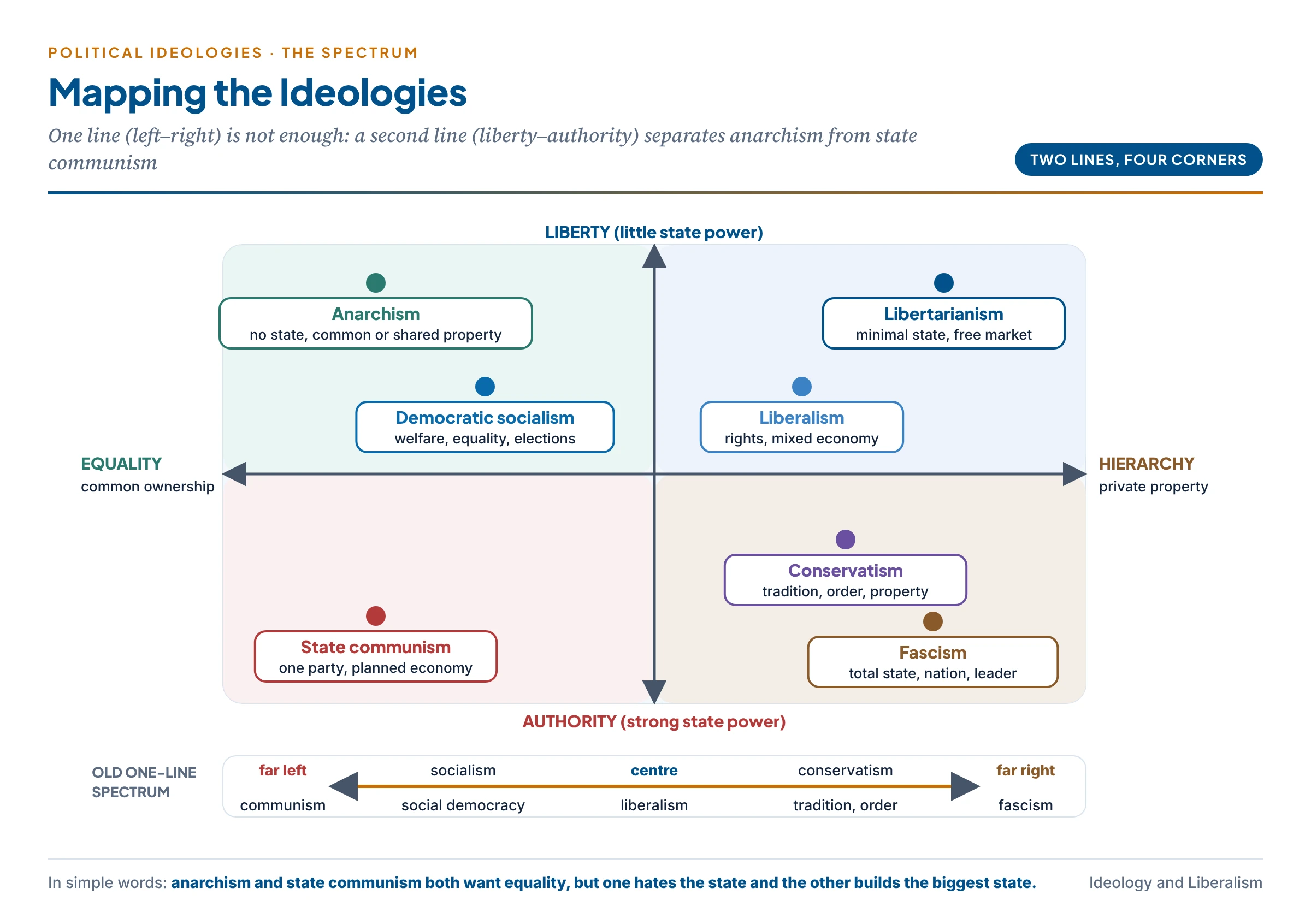
- The linear spectrum (from most equal and most collective to most hierarchical):
- Far left: communism / anarcho-communism (abolish private property; classless society).
- Left: socialism / democratic socialism (public ownership, welfare, equality).
- Centre: liberalism (individual rights, mixed economy).
- Right: conservatism (tradition, order, property).
- Far right: fascism (nation, hierarchy, leader).
- Limits of the line: it puts anarchism and Stalinist communism together on the left, though one hates the state and the other built the biggest state of all. So political scientists add a second line: authority vs liberty (how much power the state has).
- Two-line map (in words):
- Liberty and equality: anarchism (libertarian left).
- Authority and equality: Marxist-Leninist state socialism (authoritarian left).
- Liberty and market inequality: libertarianism (libertarian right).
- Authority and hierarchy: fascism (authoritarian right).
- Centre: liberal democracy and democratic socialism, mixing liberty with some equality.
- The “horseshoe” idea: some writers argue the far left and the far right look alike in practice (one-party rule, secret police). Critics answer that their values and aims remain opposite.
Main Ideologies at a Glance
| Ideology | Human nature | State | Core value | Key thinkers |
|---|---|---|---|---|
| Classical liberalism | Rational, self-interested | Necessary evil; minimal | Individual liberty, property | Locke, Smith, Bentham |
| Social liberalism | Social, capable of growth | Enabling, welfare | Liberty as opportunity | Green, Hobhouse, Keynes, Rawls |
| Democratic socialism | Social, cooperative | Welfare and redistribution | Equality, fraternity | Webbs, Bernstein, Laski, Nehru |
| Marxism | Creative producer, alienated | Class instrument; withers away | Classless emancipation | Marx, Engels, Lenin |
| Anarchism | Cooperative, self-governing | Abolished | Freedom from domination | Proudhon, Bakunin, Kropotkin |
| Conservatism | Imperfect, needs tradition | Guardian of order | Order, tradition | Burke, Oakeshott |
| Fascism | Cog in the national whole | Total; end in itself | Nation, leader, struggle | Mussolini, Gentile |
- Fascism and totalitarianism in brief: Mussolini’s formula, “Everything within the State, nothing outside the State, nothing against the State”; rejection of reason, liberal rights and class struggle in favour of the nation, struggle and obedience to the leader. Hannah Arendt (The Origins of Totalitarianism, 1951) showed that totalitarianism was a new form of rule: a total ideology, a system of terror and the atomisation of society into isolated individuals.
Liberalism: The Background to Anarchism and Socialism
Liberalism is not part of the syllabus line, but anarchism and socialism cannot be understood without it. Both began as critiques of liberal capitalism, and anarchism also pushed liberal freedom to its extreme.
Rise and core ideas:
- Liberalism grew with the rising middle class (merchants, manufacturers, professionals) against kings, feudal lords and church privilege, from the seventeenth century onwards.
- Core values:
- Individualism: the individual comes before society; society is a collection of rational, self-interested individuals.
- Liberty: first of all freedom of the person, of thought, speech, religion, property and contract.
- Reason: people can understand and run their own lives.
- Equality before law and equality of opportunity, but not equality of outcome.
- Consent: government is legitimate only if the governed agree to it (social contract).
- Limited government: constitutionalism, separation of powers, rule of law, rights, periodic elections.
- Locke: natural rights to life, liberty and property; the American Declaration’s “life, liberty and the pursuit of happiness”.
- The state is a necessary evil: necessary because people may harm each other, evil because it can become tyrannical. Lord Acton: “Power tends to corrupt, and absolute power corrupts absolutely.” Liberals also feared the “tyranny of the majority” (Tocqueville, Mill).
- The state is artificial, created by human agreement, a machine to protect rights, not a natural or divine body.
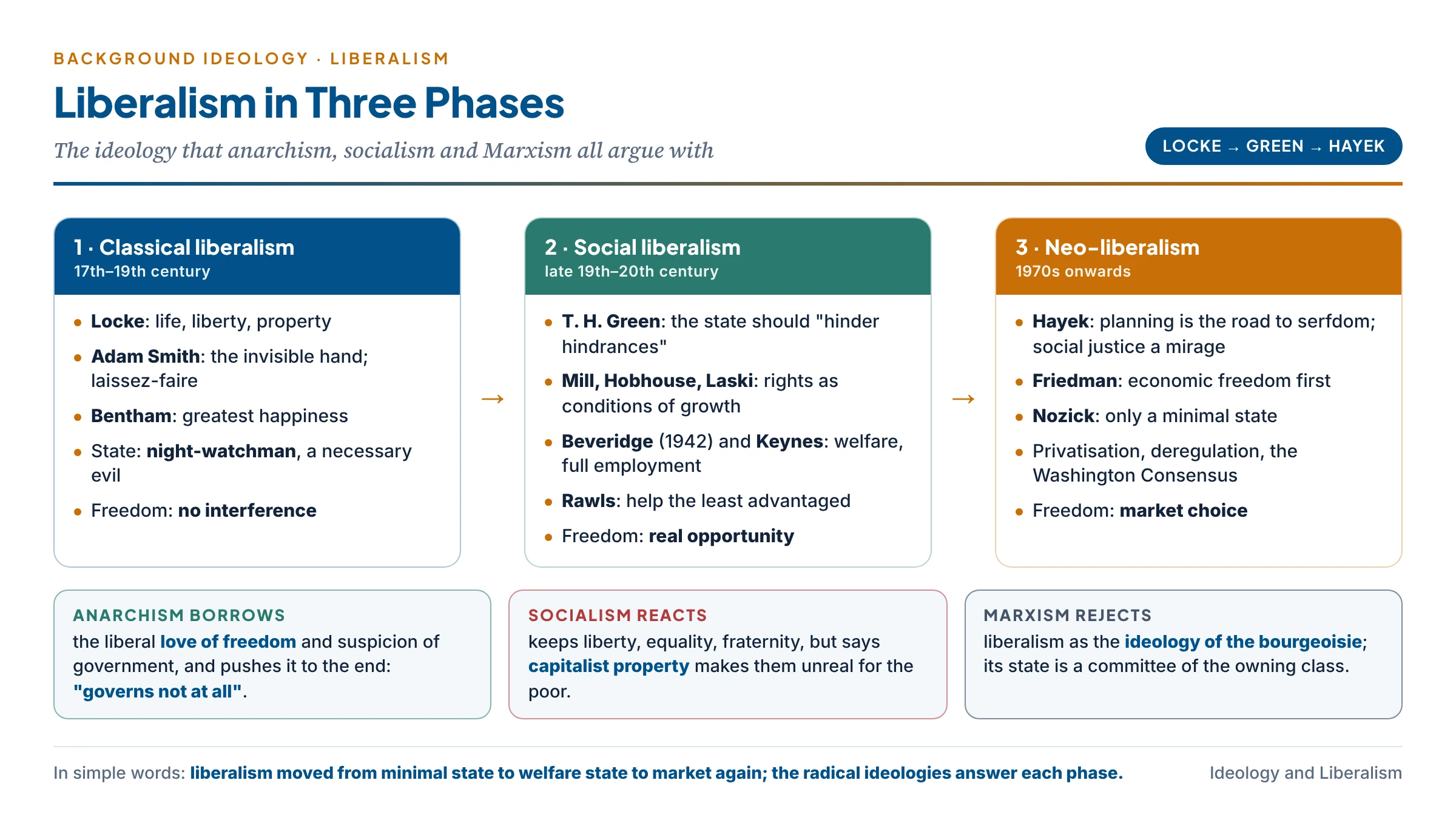
Phase 1 — Classical liberalism (seventeenth to nineteenth century):
- Adam Smith (The Wealth of Nations, 1776): the “invisible hand” of the market turns private self-interest into public benefit; the state should keep to defence, justice and a few public works. This is laissez-faire (let them do).
- Bentham: the greatest happiness of the greatest number; each to count for one.
- Herbert Spencer and William Sumner: “survival of the fittest” applied to society (Social Darwinism); state help to the poor only interferes with nature.
- The night-watchman state: the state’s job is to guard the house, not to run it.
- Possessive individualism (C. B. Macpherson’s term): the individual is seen as the owner of himself and his capacities, owing nothing to society for them.
Phase 2 — Social (positive) liberalism (late nineteenth to twentieth century):
- Unregulated capitalism produced slums, child labour, monopolies and mass unemployment. Freedom to sign a contract meant little to a starving worker.
- T. H. Green: freedom is a positive power to do something worth doing; the state should “hinder hindrances” to the good life (ignorance, disease, poverty).
- J. S. Mill: liberty is needed for the free development of individuality; Mill later moved towards cooperative forms of production.
- L. T. Hobhouse, Harold Laski: rights are the conditions of social life without which no one can be their best self.
- The Beveridge Report (1942) in Britain planned a welfare state against the “five giants”: Want, Disease, Ignorance, Squalor and Idleness.
- Keynes: in a slump, the state should create demand and employment by spending.
- Rawls (1971): inequalities are justified only if they benefit the least advantaged.
- Result: liberty and equality were now seen as compatible, and liberalism moved closer to democratic socialism.
Phase 3 — Neo-liberalism and libertarianism (1970s onwards):
- F. A. Hayek (The Road to Serfdom, 1944): central economic planning leads step by step to political tyranny; the market is a “spontaneous order” no planner could design; “social justice” is a mirage, because a market has no single distributor who could be just or unjust. Hayek also distrusted positive liberty as a door to state control.
- Milton Friedman (Capitalism and Freedom, 1962): economic freedom is a precondition of political freedom; only capitalism can protect individual liberty.
- Robert Nozick (Anarchy, State, and Utopia, 1974): only a minimal state is justified; taxation for redistribution is “on a par with forced labour”.
- Policies: privatisation, deregulation, tax cuts, free trade. This is the “Washington Consensus” (1989), a ten-point package for developing countries. Margaret Thatcher’s slogan “There is no alternative” (TINA).
- Critics: Amartya Sen and Joseph Stiglitz argued that markets without public support for health, education and social security fail the poor. The East Asian model (Japan, South Korea, Taiwan, later China) showed that an active developmental state could guide markets.
Liberal and Marxist Views of the State
| Point | Liberal view | Marxist view |
|---|---|---|
| Origin | Social contract among free individuals | Split of society into irreconcilable classes |
| Nature | Neutral umpire; represents the people | Instrument of the dominant class |
| Function | Protect rights; promote welfare | Protect property; keep the exploited down |
| Law and rights | Universal; protect everyone | Mainly protect property-owners |
| Future | Permanent, reformable | Will “wither away” after classes vanish |
How the Three Ideologies Relate to Liberalism
- Anarchism takes the liberal love of individual freedom to its limit. If government is a necessary evil, why not get rid of the evil altogether? Jefferson’s liberal motto was “That government is best which governs least”; the anarchist answers with Thoreau: “That government is best which governs not at all.”
- Socialism accepts liberal ideals of liberty, equality and fraternity but argues that capitalist property makes them unreal for the poor. It wants equality of condition, not only of opportunity.
- Marxism treats liberalism as the ideology of the bourgeoisie: its “rights of man” are the rights of the property-owner, and its state is “a committee for managing the common affairs of the whole bourgeoisie”.
- Anarchism also borrows from socialism: like socialists it attacks private property and capitalist exploitation, which is why many anarchists call themselves “libertarian socialists”. The anarchist Rudolf Rocker described modern anarchism as the “confluence” of the two great currents of modern European thought, socialism and liberalism. Article 2 tests this claim in detail.
In simple words
Picture liberalism as a house built to keep the king out. The anarchist says: “Good — now let us knock down the remaining walls too; we do not need any ruler.” The socialist says: “The house is fine, but the landlord owns all the rooms; let everyone share them.” The Marxist says: “This house was built by the landlord for the landlord; we must pull it down and build a new one.”
Critical Evaluation
Criticisms of Ideological Thinking
- Dogmatism: ideologies can turn into closed systems that explain away every fact. Popper’s charge is that Marxism made itself unfalsifiable by reinterpreting every failed prediction.
- Simplification: reducing all of society to class (Marxism), the individual (libertarianism) or the nation (fascism) ignores the many sides of human life: caste, gender, religion, ecology.
- Justifying violence: when the end (a classless society, a pure nation) is believed to be certain and perfect, any means may seem justified (Arendt, Camus).
- Hidden interests: Marx and Mannheim show that every ideology can be a mask for group interest, and that includes the ideology of the critic.
- Oakeshott: ideologies replace practical judgement with abstract formulas.
Defences of Ideology
- No politics without ideas: even “pragmatic” politics rests on assumptions about human nature, rights and the state.
- Ideologies inspire reform: abolition of slavery, universal suffrage, labour laws, decolonisation, women’s rights.
- Plural ideologies keep democracy alive: competition between them gives voters real choices.
- Ideologies can learn: liberalism absorbed welfare; socialism absorbed democracy; Marxism developed humanist and democratic strands.
Critics and Defenders
Criticism — Critics of ideology
- Marx: ideology is false consciousness serving the ruling class.
- Popper: total ideologies lead to closed, totalitarian societies; prefer piecemeal reform.
- Oakeshott: ideologies are recipe books that replace practical wisdom.
- Bell and Fukuyama: the great ideological contests have ended.
- Post-modernists: all grand narratives are claims to power.
Defence — Defenders and strengths
- Mannheim: utopian ideas of oppressed groups drive social change.
- Gramsci: a counter-hegemonic ideology lets the oppressed build their own vision.
- Heywood’s view: ideologies are unavoidable maps of the political world.
- History: independence, labour and feminist movements drew strength from ideology.
- Revival: after 2008 and in the age of inequality and climate crisis, ideological debate has returned.
Cross-Tradition Comparison
| Point | Western “ideology” | Indian traditions of political thought |
|---|---|---|
| Starting point | Individual rights or class interest | Dharma, the order that holds society together |
| Goal | Freedom, equality, emancipation on earth | Puruṣārthas: dharma, artha, kāma and mokṣa together |
| View of ruler | Agent of the people or of a class | Rājadharma: the king bound by duty and the people’s welfare (yogakṣema) |
| Method | Reform, revolution, party struggle | Persuasion, example, duty; in modern times satyāgraha |
| Modern Indian forms | — | Gandhism, Nehruvian socialism, Lohia and JP’s socialism, Ambedkarite social democracy |
Indian Connect — Indian takeaways
- The Indian Constitution is an ideological synthesis: liberal rights in Part III (Fundamental Rights), socialist goals in Part IV (Directive Principles such as Articles 38, 39 and 43), and Gandhian elements (Article 40 village panchayats, Article 43 cottage industries, Article 48 cow protection).
- Ambedkar insisted that the Constitution should not fix any one economic ideology: it laid down the aim of economic democracy and left the means to future elected governments. The Supreme Court repeated this point in 2024 (Article 9).
- Indian thinkers often blended ideologies rather than choosing one: Narendra Deva and Jayaprakash Narayan joined Marxism with Gandhian ethics; Nehru joined democracy with planning (Article 10).
- The Western habit of treating ideology as opposed to tradition is less sharp in India, where reformers like Vivekananda (daridra-nārāyaṇa sevā, service to God in the poor) drew social programmes out of religious ideals.
Synthesis (Siddhānta)
- An ideology is neither pure truth nor pure illusion. It is a practical map of society. Marx and Mannheim are right that every map is drawn from somewhere; Popper and Oakeshott are right that a map taken as the whole territory becomes dangerous.
- The healthiest use of ideology is critical and plural: ideologies should be held open to evidence and should compete peacefully in a democracy.
- Liberalism is the ideology that anarchism, Marxism and socialism argue with. Each of them accepts some liberal values (freedom, equality, reason) and attacks some liberal institutions (private property, the state, the market). That is why the three can be compared along two questions throughout this unit: what do they do with liberal freedom, and what do they do with capitalist property?
- Contemporary relevance: the “end of ideology” has not come. Debates over inequality, welfare, the gig economy, surveillance and climate change are once again debates between liberal, socialist, Marxist and anarchist answers.
Previous Year Questions
- 2026Analyze: “Anarchism is not an independent political ideology in itself, rather it is inspired by liberalism on the one hand and socialism on the other.”
- 2010Which type of individual according to you can contribute more to strengthen the state – a liberalist or a socialist?
- 2004Despite their self-proclaimed commitment to the ideal of individual freedom, this ideal is one of the most contentious issues between socialism and liberalism. Why? Discuss.