

Forms of Government: Monarchy; Theocracy and Democracy.
Official Syllabus: Paper II, Section A, Unit 4
Everyone agrees that democracy means “rule by the people”. The trouble starts when we ask how the people actually rule a country of millions. Liberal thinkers of the seventeenth to nineteenth centuries answered that the people rule by electing representatives and holding them to account — some valued this only as a protection against bad rulers, others as a school that develops citizens. In the twentieth century, social scientists looked at how real democracies work and gave two sobering answers. The elitist theory (Pareto, Mosca, Michels, Schumpeter) says that every society, democracy included, is ruled by a small organised minority; democracy only lets the people choose and replace their rulers. The pluralist theory (Robert Dahl) says that power is not held by one elite but is spread among many competing groups, and government is the broker among them — “rule by minorities” rather than by one minority. This article covers the liberal models (protective and developmental), the classical and competitive elite theories, the pluralist theory of polyarchy, the criticisms of both, and what they tell us about how far majority rule is really reflected in present-day democracies.
In simple words
Think of a big housing society. In theory, all residents decide everything. In practice, a small committee runs things — fixes the budget, hires the guards, chooses the painter. The residents’ real power is that every year they can vote the committee out. That is the elitist picture of democracy. Now imagine that the society also has a parents’ group, a senior citizens’ group, a shopkeepers’ group and a youth sports club, and the committee keeps bargaining with all of them so that no group is ignored for long. That is the pluralist picture. The liberal picture asks a prior question: how do we stop the committee from misusing its power (protective view), and how does taking part in the society’s affairs make residents better, more thoughtful people (developmental view)?
Context & Problem
Why So Many “Models” of Democracy?
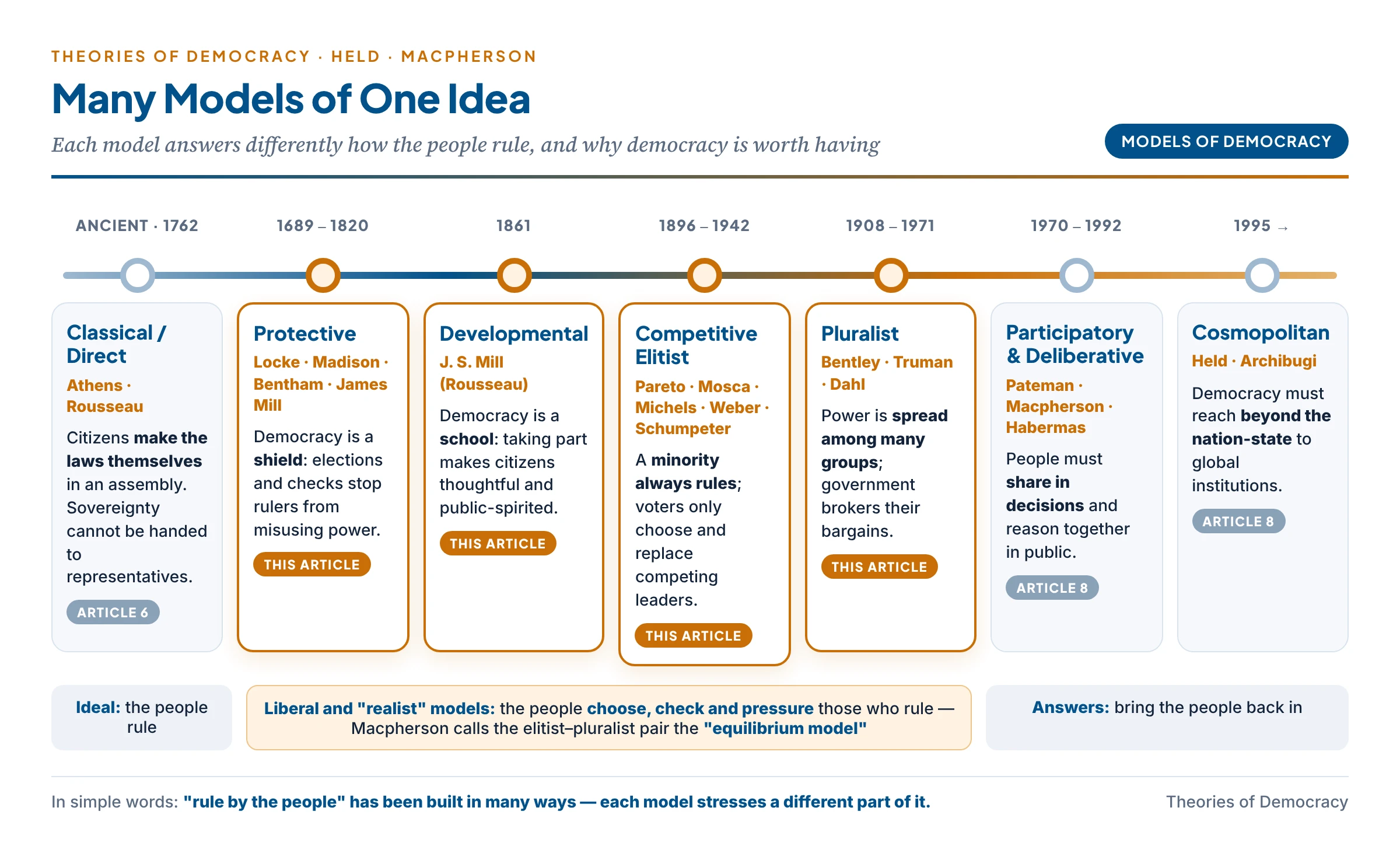
- One word, many designs. Democracy has meant very different things at different times — the Athenian assembly, the representative parliament, the competitive election, the bargaining of interest groups, the village assembly, the deliberating public. David Held in Models of Democracy (1987) showed that each answer is a model: a picture of how the people should rule and why.
- Two kinds of question.
- Normative — what democracy ought to be (the ideal of self-government, equality and freedom).
- Empirical — how democracy actually works (who really decides, how voters behave, where power lies).
- The broad story told by Held and by C. B. Macpherson (The Life and Times of Liberal Democracy, 1977):
- Classical / direct democracy — Athens and Rousseau; the people themselves make the laws (see Article 6).
- Protective democracy — Locke, Madison, Bentham and James Mill; democracy as a shield against rulers.
- Developmental democracy — J. S. Mill (and Rousseau before him); democracy as a means of developing human capacities.
- Competitive elitist democracy — Weber and Schumpeter; democracy as a competition between leaders for votes.
- Pluralist democracy — Truman and Dahl; democracy as bargaining among many groups. Macpherson called the elitist–pluralist picture together the “equilibrium model”.
- Participatory, deliberative and cosmopolitan democracy — the later answers to the weaknesses of the elitist and pluralist models (see Article 8).
- This article deals with models 2 to 5 — the liberal and the “realist” (elitist and pluralist) theories.
The Problem These Theories Answer
- The problem of scale. Athens had perhaps 30,000 to 50,000 citizens who could gather on a hill. A modern state has millions. The people cannot meet and decide; they must elect others. So the question becomes: what makes representative government democratic?
- The problem of trust. Rulers, like everyone, pursue their own interests. How can the people make sure that power is used for them and not against them?
- The problem of reality. Twentieth-century research on voting, parties and bureaucracies showed that ordinary citizens know little about politics, and that parties and governments are run by small groups of leaders. Is democracy then a myth? Or must we change our definition of democracy to fit the facts?
Core Doctrine
The Liberal (Representative) Theory of Democracy
- Core idea. Citizens elect representatives who make laws within constitutional limits; elections, rights and the rule of law keep the representatives answerable.
- Main thinkers. John Locke, James Madison, Jeremy Bentham, James Mill and J. S. Mill.
- Why it fits modern states.
- It is workable for large nation-states, where direct assembly is impossible.
- It protects minority rights against the passing whims of a majority, because representatives work within a constitution and courts.
- It separates ownership of power (the people) from its day-to-day exercise (representatives).
- Two strands. Macpherson and Held divide liberal democracy into a protective strand and a developmental strand. The difference lies in why democracy is valuable.
Protective Democracy: Democracy as a Shield
- Basic claim. Democracy is justified because it protects citizens — from the rulers, and from each other. Its value is instrumental: it is a means to security, liberty and property, not a good in itself.
- Locke. Government is a trust; the people consent to it to protect their life, liberty and estate (property). If the government breaks the trust, the people may resist and replace it. Locke’s government is a limited, majority-based government, though in his time the vote was confined to property-owners.
- Madison and the American founders.
- In Federalist No. 10 (1787), Madison warns against faction — a group, whether a majority or a minority, moved by an interest hostile to the rights of others or the common good.
- The causes of faction cannot be removed without destroying liberty, so we must control its effects.
- A pure democracy (citizens assembling in person) cannot stop a majority faction from oppressing others; a republic — government by elected representatives over a large territory — can. In an extended republic there are so many interests that no single faction easily becomes a majority.
- In Federalist No. 51 he adds checks and balances: “Ambition must be made to counteract ambition.” “If men were angels, no government would be necessary.”
- Bentham and James Mill (the utilitarian case).
- Every person seeks his own pleasure and avoids pain, and rulers are no exception. Left unchecked, they will pursue their own happiness at the people’s cost.
- The only remedy is to make the interest of the rulers identical with the interest of the ruled — by making rulers answerable to the governed.
- Hence the instruments of democracy: a wide franchise, frequent elections, the secret ballot, a free press, and the competition of parties. James Mill’s Essay on Government (1820) stated this argument clearly.
- The aim is the greatest happiness of the greatest number; democracy is the political machinery that makes government serve that aim.
- Limits of the protective view. It treats citizens as consumers who only want their private interests protected; it says nothing about citizens growing as persons through politics. And in practice its early defenders were happy to keep the poor, women and the propertyless out of the vote.
In simple words
A protective democrat thinks of the vote like a lock on your door. You do not love the lock for its own sake; you want it because without it someone might walk in and take your things. In the same way, elections and a free press keep rulers from walking off with your rights and your money.
Developmental Democracy: Democracy as a School
- Basic claim. Democracy is valuable not only because it protects interests but because taking part in public affairs develops human capacities — reason, judgement, moral sense, concern for others. Its value is partly intrinsic and educative.
- Rousseau is an early source: in the assembly a citizen learns to think of the common good, not only of himself (see Article 6 on the general will).
- J. S. Mill (Considerations on Representative Government, 1861) is the main developmental democrat.
- The ideally best form of government is one in which sovereignty rests with the whole community, and every citizen has a voice and, at least occasionally, an active part in government.
- A government is judged by two tests: how well it uses the existing good qualities of the people, and how far it improves those qualities — makes citizens more active, intelligent and public-spirited.
- A benevolent despot might give good laws, but he would produce a passive people; participation — in local government, juries, public debate — is the “school of public spirit”.
- Mill therefore supported extending the vote, including to women, and strong local self-government.
- Mill’s safeguards against the majority. Mill also feared the ignorant majority and the “tyranny of the majority”. He proposed proportional representation (Thomas Hare’s scheme), plural votes for the more educated, and protection of dissent (see Article 9).
- Why it matters. Developmental democracy answers the question “Why should ordinary people participate at all?” It becomes the basis of later participatory theory (Article 8).
Protective vs developmental democracy:
| Point | Protective democracy | Developmental democracy |
|---|---|---|
| Main thinkers | Locke, Madison, Bentham, James Mill | Rousseau, J. S. Mill |
| Value of democracy | Instrumental — protects interests | Instrumental and educative — develops capacities |
| Picture of the citizen | Self-interested; needs protection | Capable of growth; becomes public-spirited |
| Key devices | Elections, secret ballot, checks and balances, free press | Wide franchise, local government, public debate, juries |
| Main fear | Rulers misusing power; factions | A passive, ignorant citizenry; tyranny of the majority |
| Legacy | Constitutional liberal democracy | Participatory democracy |
The Liberal Theory: Features of Liberal Democracy
- Popular sovereignty and constitutionalism — the people are the source of power, but power is exercised within a written or unwritten constitution.
- More than one political party freely competing for power.
- Political offices not confined to any privileged class.
- Periodic elections on the basis of universal adult franchise.
- Civil liberties — freedom of speech, association and the press.
- Independence of the judiciary and of the civil service.
- Procedure first. Liberal democracy gives more weight to fair rules and institutions than to particular outcomes: liberalism supplies rules that secure individual liberty; democracy supplies government by the consent of the people.
Does Liberal Democracy Need Something Deeper to Hold Society Together?
- The worry. Liberal democracy strongly affirms individual rights and is neutral among ways of life. But a society of right-holders who agree only on procedures may lack the trust and solidarity that keep it together. This is the question asked in 2018 (full treatment in Article 6).
- What the liberal and realist theorists themselves said:
- Madison trusted institutions — checks and balances, an extended republic — rather than virtue. But even he thought a republic presupposes enough virtue among the people to choose good representatives.
- J. S. Mill argued that representative government needs citizens with public spirit, and a shared sense of nationality.
- The pluralists discovered that group bargaining works only because almost everyone accepts the “rules of the game” — a broad, often unspoken consensus on procedures, tolerance and fair play. Dahl spoke of a democratic creed shared by citizens and especially by political activists.
- Almond and Verba (The Civic Culture, 1963) found that stable democracies rest on a civic culture — a mix of participation, trust and loyalty.
- So the answer most theorists give: yes, procedures alone are not enough; liberal democracy depends on shared values — tolerance, trust, civic virtue, and, as Ambedkar put it, fraternity and constitutional morality.
The Elitist Theory of Democracy
- Starting point. The “contemporary” theories of democracy try to explain democracy in the light of sociological findings about how power really works.
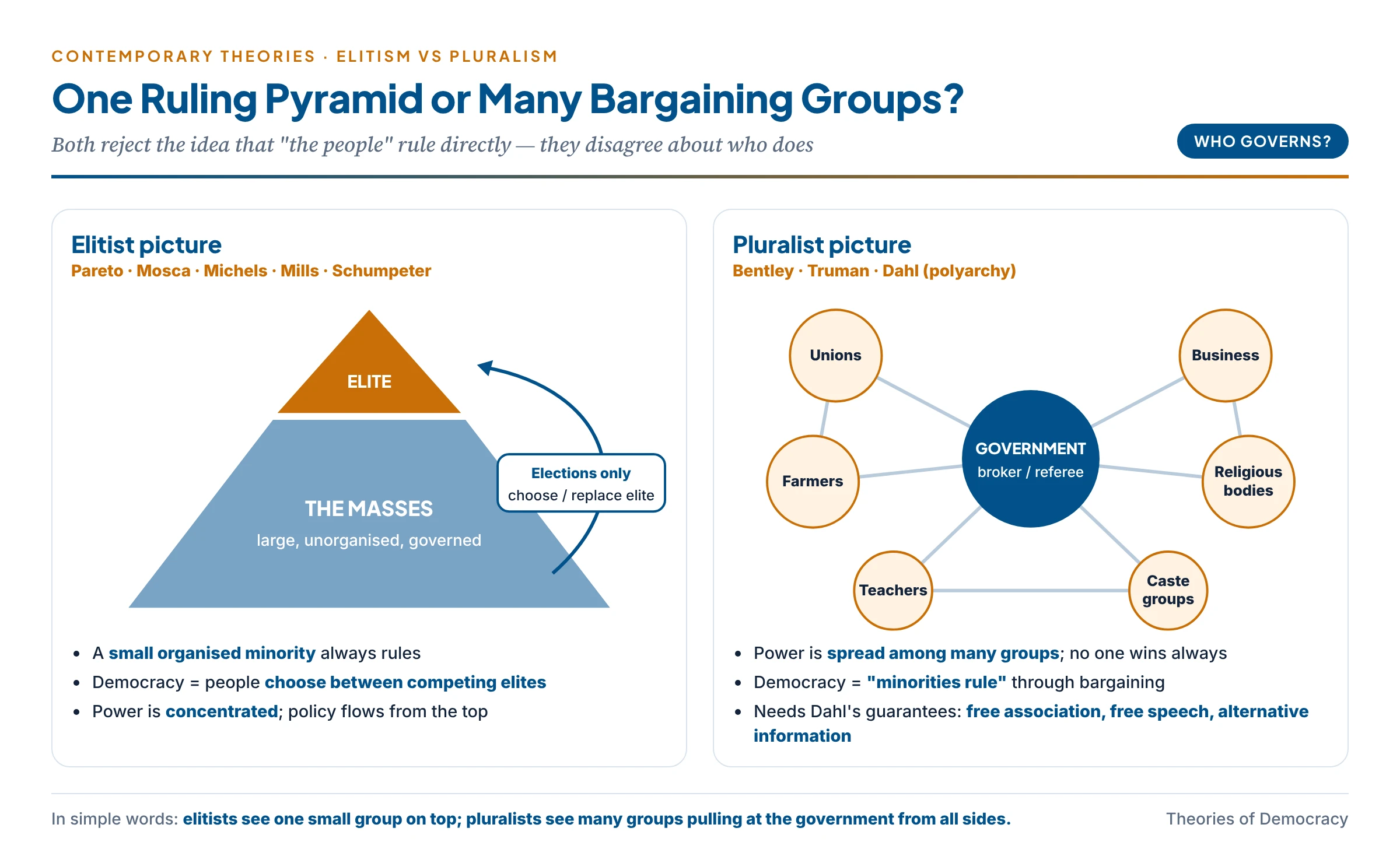
- Basic claim. Every society is divided into two groups:
- The elite — a small, organised minority that governs.
- The masses — the large, unorganised majority that is governed.
- Every form of government, including democracy, is in fact controlled by a small group. The majority never rules directly.
- What is special about democracy. Unlike other forms, in a democracy the people have:
- The right to choose their rulers from among competing elites.
- The right to replace one elite with another at the next election.
- Example often used. In the United States, political families such as the Bush and Kennedy families held office across generations; party machines, big donors and a professional political class dominate politics in most democracies.
- Two phases.
- Classical elite theory — Pareto, Mosca, Michels (late nineteenth and early twentieth century): critics of democracy who said elite rule is inevitable and the democratic ideal is an illusion.
- Democratic or competitive elitism — Max Weber and Joseph Schumpeter: accept that elites rule, but say democracy is still valuable as a method of choosing and removing elites peacefully.
Common confusion
Did Schumpeter “formulate” the elitist theory? Many notes say so, but the theory is older. Pareto, Mosca and Michels created the classical elite theory — that a minority always rules. Schumpeter (1942) took this idea and built a democratic version of it, called competitive or democratic elitism: elites rule, but they must compete for the people’s votes, and that competition is what democracy is.
Vilfredo Pareto: The Circulation of Elites
- Who. Italian economist and sociologist; Mind and Society (Trattato di sociologia generale, 1916).
- Elites by excellence. In every field there are people of the highest ability — the elite. The governing elite is the part of it that rules.
- Lions and foxes. Borrowing from Machiavelli, Pareto said rulers are of two types:
- Lions — rule by force, are conservative, value order and loyalty.
- Foxes — rule by cunning, persuasion and manipulation, are clever and inventive.
- Circulation of elites. No elite lasts. A ruling elite of lions grows soft or a ruling elite of foxes grows corrupt; a new elite rises from below and replaces it. “History is a graveyard of aristocracies.“
- For democracy. Elections and revolutions are only the ways one elite replaces another; the masses never truly rule.
Gaetano Mosca: The Ruling Class and the Political Formula
- Who. Italian political scientist; The Ruling Class (Elementi di scienza politica, 1896).
- Two classes in every society. A class that rules — always fewer in number, performing all political functions and enjoying the advantages of power — and a class that is ruled.
- Why the minority wins. A minority is organised; the majority is not. A hundred men acting together will defeat a thousand acting separately.
- The political formula. Every ruling class justifies its power by a moral or legal principle that the people accept — divine right, the will of the people, the dictatorship of the proletariat. Democracy’s “will of the people” is, for Mosca, one more political formula.
- Later softening. Mosca came to accept that representative government, which lets new groups enter the ruling class, is better than closed systems.
Robert Michels: The Iron Law of Oligarchy
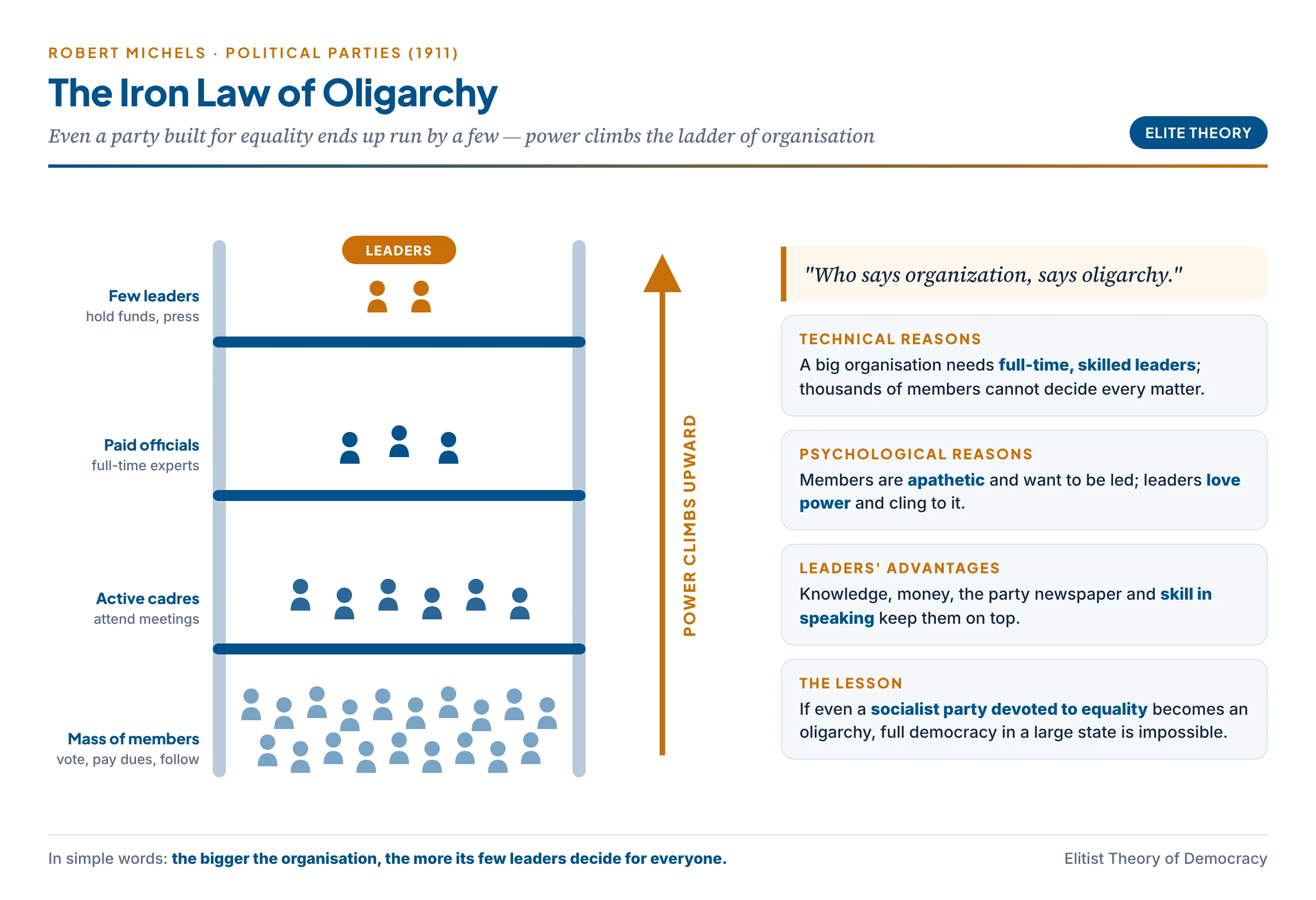
- Who. German-Italian sociologist; Political Parties (1911), a study of the German Social Democratic Party — a party committed to democracy and equality.
- The iron law. “It is organization which gives birth to the dominion of the elected over the electors… Who says organization, says oligarchy.” Every large organisation, however democratic its aims, ends up ruled by a small group of leaders.
- Why it happens.
- Technical reasons — a big organisation needs full-time, skilled leaders; members cannot all decide everything.
- Psychological reasons — the masses are apathetic, grateful to leaders and want to be led; leaders love power and cling to it.
- Leaders gain advantages — knowledge, control of funds and of the party newspaper, skill in speaking — that ordinary members lack.
- Lesson. If even a socialist party devoted to equality becomes an oligarchy, then democracy in the full sense is impossible in any large organisation, including the state.
Indian Connect — Inner-party democracy in India
- Michels’ law is often discussed in India as the problem of inner-party democracy: candidate selection and party posts are frequently decided by a small leadership.
- The Law Commission’s 170th Report (1999) recommended a law to regulate parties and ensure internal democracy, including regular organisational elections; the 255th Report (2015) repeated the call.
- The Election Commission asks a party seeking registration to provide for internal elections in its constitution, but the Supreme Court held (2002) that the Commission has no power to de-register a party for failing to follow its undertakings, except in narrow cases such as registration obtained by fraud.
- So the question Michels raised — can an organisation built for democracy remain democratic inside? — is a live issue for Indian democracy.
C. Wright Mills: The Power Elite
- Who. American sociologist; The Power Elite (1956).
- Claim. In the United States the major decisions are made by a small, interlocking group drawn from three institutional orders — the big corporations, the military and the top political executive. These men share backgrounds, schools and clubs, and move from one sector to another.
- For democracy. Parliament, parties and voters operate at the “middle levels” of power; the big decisions — war, the economy — are made above them.
Joseph Schumpeter: Democracy as a Competitive Struggle for Votes
- Who. Austrian-American economist; Capitalism, Socialism and Democracy (1942).
- His attack on the “classical doctrine”. The classical theory (eighteenth-century and Rousseauian) defined democracy as an arrangement in which the people themselves decide issues for the common good, by electing people who carry out their will. Schumpeter rejects every part of it:
- There is no common good on which all rational people would agree; different people want different things for good reasons.
- There is no general will — even if there were a common good, people would disagree about how to achieve it.
- Voters are not rational about politics. “The typical citizen drops down to a lower level of mental performance as soon as he enters the political field.” Politics is distant from daily life; voters are swayed by emotion, propaganda and advertising, much as consumers are.
- The “will of the people” is manufactured by leaders and parties, not discovered.
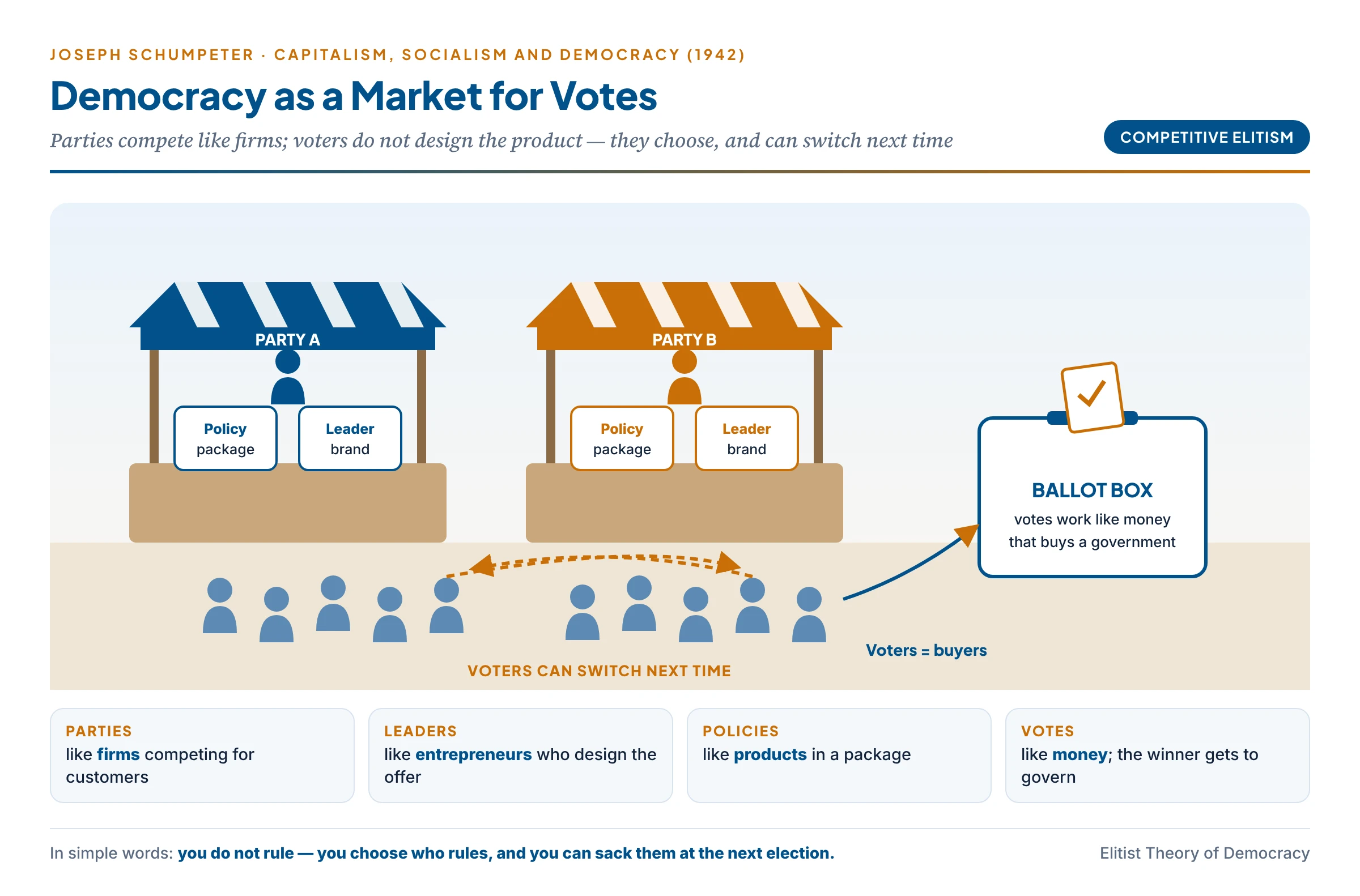
- His new definition. “The democratic method is that institutional arrangement for arriving at political decisions in which individuals acquire the power to decide by means of a competitive struggle for the people’s vote.”
- Democracy is a method, not an ideal or a way of life.
- The people’s role is to produce a government — to choose who will rule — not to rule themselves.
- Between elections citizens should leave politics to the leaders (“political back-seat driving” is to be avoided).
- Democracy as a market. Parties are like firms, leaders like entrepreneurs, policies like products and votes like money. Parties offer packages of promises; voters “buy” the package they like; competition keeps sellers responsive.
- Conditions for it to work. High-quality political leaders; a limited range of issues decided politically; a strong, independent bureaucracy; democratic self-control (tolerance of opponents, restraint); and acceptance of the results.
- Why it was attractive.
- Realistic — it fits what we actually see.
- It offers a clear test of whether a country is democratic: are there free, competitive elections?
- It is a sober answer to mass political ignorance and, after the experience of fascism, to the danger of demagogues who claim to embody the “will of the people”.
In simple words
Think of buying a phone. You do not design it; engineers in a few companies do. Your power is to choose between brands and to switch brands next time if you are unhappy. For Schumpeter, voting is exactly like this. Parties are the companies, their manifestos are the phones, and your vote is your money. Democracy does not mean you design the phone — it means the companies must compete for you.
The Pluralist Theory of Democracy (Polyarchy)
- Background. American political scientists — Arthur Bentley (The Process of Government, 1908) and David Truman (The Governmental Process, 1951) — studied politics as the activity of groups: trade unions, business associations, farmers, churches, professional bodies, ethnic groups.
- Robert Dahl gave the theory its classic form:
- A Preface to Democratic Theory (1956) — democracy in practice is “minorities rule“, not majority rule: policy results from the steady bargaining of many minorities.
- Who Governs? (1961) — a study of New Haven, a US city. Dahl found that different groups won on different issues (urban renewal, public education, party nominations); no single elite controlled all of them. Power was dispersed (“dispersed inequalities”).
- Polyarchy (1971) — because no real country fully achieves the democratic ideal, he called the real-world approximations polyarchies (“rule by many”).
- Core claims of pluralism.
- Democracy is a process of bargaining among relatively autonomous groups.
- Power is spread among many centres; no group wins all the time; today’s loser may win tomorrow.
- The role of government is to broker compromises among the dominant groups — it is a referee or arena, not a master.
- Public policy reflects the interests of the more organised and vocal groups at any time.
- Overlapping membership — a person may be a farmer, a Hindu, a woman and a trade unionist at once — softens conflict, because groups cross-cut each other.
- Potential groups — even unorganised interests matter, because leaders know they may organise if ignored.
- Dahl’s two dimensions of democratisation.
- Public contestation (liberalisation) — how far opponents can freely compete for power.
- Inclusiveness (participation) — how many people have the right to take part.
- A polyarchy is high on both. A regime with competition but a narrow franchise is a competitive oligarchy; one with wide voting but no real competition is an inclusive hegemony; one with neither is a closed hegemony.
- The institutional guarantees of polyarchy (Polyarchy, 1971) — what citizens need in order to form their preferences, express them, and have them counted equally:
- Freedom to form and join organisations.
- Freedom of expression.
- The right to vote.
- Eligibility for public office.
- The right of political leaders to compete for support and votes.
- Alternative sources of information.
- Free and fair elections.
- Institutions that make government policies depend on votes and other expressions of preference.
- More optimistic than elitism. Pluralists reject the elitists’ picture of a single ruling group making policy from above. They see a democracy of many centres of power where competition and bargaining protect freedom.
Common confusion
Does “pluralist democracy” mean a multi-party system? No. Pluralism here means that power is shared among many groups in society — unions, business, farmers, religious and caste bodies, professional associations — and that government bargains with them. A country can have a pluralist group life with two main parties (the USA) or many parties (India). Multi-party competition is one feature of polyarchy, but pluralism is a theory about where power lies in society.
Neo-Pluralism: Dahl and Lindblom Revise Their View
- Unequal groups. Later, Dahl and Charles Lindblom (Politics and Markets, 1977) admitted that groups are not equal. Business holds a privileged position: governments depend on business for investment, jobs and growth, so they listen to it without being asked.
- Dahl’s later warning. Large inequalities of wealth and corporate power can make political equality hollow; democracy may need some economic democracy. This shift is called neo-pluralism.
What These Theories Tell Us about the Forms of Democracy
- Classical (direct) democracy — the people decide (Athens, Rousseau; Article 6).
- Protective liberal democracy — representatives under checks and balances protect citizens’ interests.
- Developmental liberal democracy — representation plus wide participation that educates citizens.
- Competitive elitist democracy — voters choose among competing teams of leaders.
- Pluralist democracy (polyarchy) — government brokers among many organised groups; rights and free information keep the competition open.
- Later models — participatory, deliberative, radical, socialist and cosmopolitan democracy (Article 8).
- Why this variety matters. Each model picks out a different element of “rule by the people” as the essential one. That is a main reason democracy is called an “essentially contested concept” (W. B. Gallie, 1956; see Article 6): the elitist says the core is competitive elections, the pluralist says group bargaining, the developmental democrat says participation — and each uses the same word.
Is Majority Rule Meaningfully Reflected in Present-Day Democracies?
- The ideal. Decisions should follow the wishes of the majority, with due respect for minorities.
- Reasons to doubt it — evidence from the theories above:
- First-past-the-post (FPTP) gives majorities of seats on minorities of votes. In the UK in 2024, Labour won 411 of 650 seats with 33.7% of the vote. In India in 2014, the BJP won 282 of 543 seats with about 31% of the vote; in 2009 the Congress had won 206 seats with about 29%. In such cases a party commanding a parliamentary majority was voted for by a minority of voters — a feature of the electoral system, not of any party.
- Turnout. When a large share of voters stays home, the “majority” is a majority of those who voted, not of the people.
- Coalitions. In multi-party systems, governments are formed by bargaining after the election; small parties may gain power out of proportion to their votes.
- Elite control (Michels, Mills) — parties pick candidates and set the agenda; voters choose between options they did not shape.
- Group pressure (pluralists, neo-pluralists) — organised lobbies, big donors and business often shape policy more than unorganised majorities.
- Rational ignorance and propaganda (Schumpeter) — the majority’s “will” may itself be manufactured by advertising and media (see Article 10).
- Non-decisions — some issues never reach the agenda at all (see the “faces of power” below).
- Reasons for qualified optimism:
- Elections still allow the majority to remove a government — the core of Schumpeter’s and Popper’s defence.
- Proportional and mixed systems (Germany, New Zealand) bring seat shares closer to vote shares.
- Dahl’s polyarchy rests on the idea that democracy is “minorities rule”: the aim is not a single majority but continuous responsiveness to many groups.
- Referendums, local government and courts protecting rights give citizens other channels.
- Conclusion. Majority rule is reflected only imperfectly — mediated by electoral systems, parties, elites and organised groups. Present-day democracies are better described as systems of competitive, accountable minority rule than as pure majority rule. (Minority rights and remedies are treated in Article 10.)
In simple words
Imagine 100 students electing a class monitor from four candidates. A gets 34 votes, B 30, C 20 and D 16. A wins — but 66 students voted against A. Multiply this by 543 or 650 constituencies and you see how a party can win a majority of seats without a majority of votes. The election is fair by its rules, yet “majority rule” has become “rule by the largest minority”.
Critical Evaluation
Criticisms of the Liberal (Protective) Theory
- Possessive individualism (Macpherson). Liberal democracy grew out of a market society; it pictures the citizen as an owner of himself and his property, and protects property more than people. Its early form excluded the poor and women.
- Thin citizenship. Protective democracy reduces the citizen to a voter protecting private interests; it neglects community and participation.
- Majority still a danger. Checks and balances can block reform and protect privilege as easily as they protect minorities.
Criticisms of the Elitist Theory
- Far removed from the essence of democracy. If the people only choose their masters, democracy has lost its meaning as self-government. Schumpeter’s definition fits any regime with competitive elections, however unequal.
- Violates equality. Elitism accepts, and even praises, a permanent division between rulers and ruled — against the basic democratic value of political equality.
- Justifies apathy. Treating low participation as healthy turns a defect into a virtue; the passivity of the masses may be a product of exclusion, poverty and poor education, not of human nature.
- Ignores economic roots. In most cases domination and dependence in society are closely tied to economic disparities; elitism describes elite power but does not ask where it comes from or how to change it.
- Circular “iron law”. Michels’ evidence came from a few parties in one period; many organisations have developed checks — term limits, primaries, inner-party elections, recall.
- Voters are not so foolish. Later research shows that voters use shortcuts (party, record, trusted opinion) reasonably well, and judge governments by results.
Criticisms of the Pluralist Theory
- The heavenly chorus. E. E. Schattschneider (The Semisovereign People, 1960): “The flaw in the pluralist heaven is that the heavenly chorus sings with a strong upper-class accent.” Groups are not equal; the poor, the unorganised and the marginalised have little voice.
- The second face of power. Bachrach and Baratz (“Two Faces of Power”, 1962) argued that Dahl studied only visible decisions. Power is also exercised by keeping issues off the agenda — “non-decision-making”. If certain demands are never even discussed, the absence of conflict does not prove power is dispersed.
- The third face of power. Steven Lukes (Power: A Radical View, 1974) went further: the most effective power shapes people’s wants and beliefs so that they do not even see their real interests.
- Privileged position of business. As Lindblom himself later admitted, business interests enjoy structural advantages; pluralism is then a disguised elitism.
- Government is not a neutral referee. The state has its own interests and biases (bureaucracy, ruling parties); policy is not simply the sum of group pressures.
- Neglect of the public good. If policy is only the outcome of bargaining, there is no room for a common good above group interests.
Criticisms of Both (Elitist and Pluralist Together)
- Both theories reach conclusions far removed from the essence of democratic theory — the ideal of the people governing themselves as equals.
- Both tend to justify the domination and dependence that exist in society, rather than question them, though these are closely related to economic disparities.
- Both treat democracy mainly as a mechanism for maintaining equilibrium and stability in society, not as a means of emancipation — which is why Macpherson called them the equilibrium model.
- Elitism, in particular, violates equality, a basic tenet of democracy.
- These criticisms led to participatory, deliberative and radical theories (Article 8), which ask how ordinary people can share in power again.
Critics and Defenders
Criticism — Critics
- Macpherson: the liberal and equilibrium models serve a market society; they protect property and treat citizens as consumers.
- Participatory democrats (Pateman, Bachrach): elitism turns the citizen into a spectator and makes apathy look healthy; democracy needs participation.
- Schattschneider: the pluralist chorus sings with an upper-class accent.
- Bachrach–Baratz and Lukes: pluralists ignore agenda-setting and the shaping of wants.
- Marxists (Miliband): elites and pressure groups mask the rule of the capitalist class (Article 8).
Defence — Defenders and strengths
- Realism: the theories describe how large democracies really work; ideals must start from facts.
- Schumpeter and Popper: the decisive virtue of democracy is that the people can remove rulers without bloodshed — competitive elections do exactly that.
- Dahl: polyarchy’s guarantees — free association, free speech, alternative information — give a clear, measurable test of democracy, used today by indices such as V-Dem.
- Pluralists: dispersed power and cross-cutting groups protect liberty and prevent any single majority or minority from dominating.
- Neo-pluralists: the theory can correct itself — Dahl and Lindblom themselves admitted business privilege and called for economic democracy.
Cross-Tradition Comparison
Western Theories and Indian Parallels
| Theme | Western theory | Indian parallel |
|---|---|---|
| Rule by a few within a republic | Mosca, Michels: an organised minority always rules | The Licchavi gaṇa-saṅgha of Vaiśālī: Pāli sources speak of 7,707 rājas — heads of ruling clan families — sharing power; a republic of clan elites rather than of all residents |
| Protective idea | Locke, Bentham: rulers must be checked so that their interest matches the people’s | Kauṭilya: the king’s happiness lies in the happiness of his subjects; elaborate spies and audits to check officials; Mahāsammata in the Buddhist Aggañña Sutta — the ruler chosen by the people to protect them |
| Developmental idea | J. S. Mill: participation is the school of public spirit | Gandhi’s Gram Swaraj: self-rule in the village trains people in self-discipline and responsibility |
| Group pluralism | Truman, Dahl: many groups bargain with government | Rajni Kothari’s “Congress system” (1964): one dominant party containing many factions and interests, bargaining internally; caste associations acting as interest groups in democratic politics |
| Critique of party elites | Michels: organisation breeds oligarchy | M. N. Roy and J. P. Narayan: partyless democracy built on people’s committees, to stop parties from monopolising power (Article 8) |
Indian Connect — Key takeaways
- India’s ancient republics show that “rule by many” often meant rule by many leading families, close to the elitist picture.
- The Indian tradition’s strongest democratic idea is developmental and decentralised — Gandhi’s village republics — rather than protective.
- Modern Indian politics is often studied through pluralist lenses — dominant-party bargaining, caste and farmers’ associations — and through Michels’ law, in debates on inner-party democracy.
Synthesis (Siddhānta)
- What the liberal theories teach. Democracy must protect people from power (Locke, Madison, Bentham) and develop them through participation (Mill). The best working democracies try to do both: constitutional limits and rights, plus wide franchise, local government and free debate.
- What the realist theories teach. Elites and organised groups do dominate large democracies. Schumpeter and Dahl were right that free competition, alternative sources of information and the right to remove rulers make a real difference between democracies and dictatorships.
- What they miss. By redefining democracy to fit the facts, they risk lowering the ideal — accepting apathy, inequality and agenda control as normal. Democracy is not only a method of choosing rulers; it is also a promise of political equality and self-government.
- The balanced view. Present-day democracy is best understood as competitive, accountable rule by minorities, held in check by elections, rights and organised groups — and always open to being made more equal and more participatory. The elitist and pluralist theories describe the starting point; participatory and deliberative theories (Article 8) describe the direction of improvement.
- Contemporary relevance.
- Electoral systems — the gap between vote shares and seat shares under FPTP keeps the debate on proportional representation alive in the UK, India and elsewhere.
- Money and lobbying — campaign finance, corporate donations and lobbying are the modern form of the “upper-class accent”.
- Inner-party democracy — Michels’ law is debated wherever party leaders decide tickets and posts.
- Measuring democracy — Dahl’s polyarchy guarantees underlie today’s democracy indices, which track whether elections, free expression and alternative information are shrinking or growing.
“Who says organization, says oligarchy.” — Robert Michels
“The democratic method is that institutional arrangement for arriving at political decisions in which individuals acquire the power to decide by means of a competitive struggle for the people’s vote.” — Joseph Schumpeter
Previous Year Questions
- 2018What is meant by liberal democracy? Does it require deeper principles for social cohesion to balance its own strong affirmation of individual rights?
- 2013What is meant by democracy? What are various forms of democratic governments?
- 2010Is majority rule meaningfully reflected in present-day democratic governments? Substantiate your answer with suitable example.
- 2004Critically examine – The concept of democracy an essentially contested concept.