

Forms of Government: Monarchy; Theocracy and Democracy.
Official Syllabus: Paper II, Section A, Unit 4
The elitist and pluralist theories (Article 7) made democracy realistic but also thin: citizens vote once in a few years and then go home, while elites and organised groups run the show. The twentieth century answered this in two very different ways. One answer said democracy must be made deeper — citizens should participate in the decisions that shape their lives (participatory democracy), reason together before they decide (deliberative democracy), live democracy as a habit of everyday life (Dewey), act together in public (Arendt), be emancipated as full human beings (Macpherson’s radical democracy) and even control the global forces that now escape the nation-state (cosmopolitan democracy). The other answer, the Marxist critique, said liberal democracy can never be real while wealth is unequal: under capitalism it is bourgeois democracy, a democracy for the rich, and true democracy is possible only in a socialist or people’s democracy. Between the two stands a demand that India’s Constitution makers voiced most clearly — political democracy is hollow unless it is accompanied by social and economic democracy (Ambedkar’s “life of contradictions”). This article covers all these theories, compares liberal and socialist democracy, and examines whether democracy and socialism together produce a more equitable society.
In simple words
Think of a housing society. In the thin version, members elect a committee once a year and never attend a meeting again; a few active families take every decision. In the participatory version, members sit on sub-committees for water, security and the garden. In the deliberative version, before voting on a costly new lift, everyone hears the facts, argues, and many change their minds. And a Marxist would add: if three families own most of the flats and the rest are tenants who can be evicted, the “one flat, one vote” meeting is not really equal at all.
Context & Problem
Why New Theories of Democracy Were Needed
- The thin model. Schumpeter defined democracy as a competitive struggle for the people’s vote among elites; Dahl described it as bargaining among organised groups (Article 7). Both treated the ordinary citizen as a voter, not a participant.
- The “democratic deficit”. Low turnout, apathy, the power of money and lobbies, and the distance between citizens and big bureaucracies made many feel that democracy had become a ritual of elections.
- Two kinds of reply:
- Deepen democracy — more participation, better public reasoning, democracy as a way of life, democracy beyond the nation-state.
- Change the economic base — the Marxist and socialist view that political rights are hollow without economic equality.
- Many models, not one. Following David Held’s well-known survey Models of Democracy, political theory now speaks of a family of models — protective, developmental, competitive elitist, pluralist, participatory, deliberative, cosmopolitan — each with a different idea of what “rule by the people” means (the earlier models are in Article 7).
The Common Thread
- All the theories in this article reject the idea that democracy is only a procedure for choosing rulers.
- They see democracy as something substantive: the development of human capacities, the formation of a public through communication, or the emancipation of the masses from domination.
- They differ on the cure: more participation, better deliberation, or a change in the ownership of property.
In simple words
A cricket team that only “elects” a captain once a season and never discusses tactics is democratic in a thin sense. A team that holds a dressing-room discussion before every match, where the youngest player can question the captain, is democratic in a thick sense. The theories in this article all want the second kind of team — they only disagree about what stops it from happening.
Core Doctrine
Participatory Democracy
- Meaning. Participatory democracy makes people’s political participation the basic principle of democracy. Political participation means the active involvement of individuals and groups in the governmental processes that affect their lives — not just voting, but discussing, deciding, implementing and monitoring.
- Its sources.
- Rousseau — sovereignty belongs to the people and cannot be handed over to representatives; citizens must take part in making the laws they obey.
- J.S. Mill — participation in local government and juries is a school of public spirit; it educates citizens and enlarges their minds (the developmental argument, Article 7).
- G.D.H. Cole — democracy must extend to industry (guild socialism).
- Carole Pateman (Participation and Democratic Theory, 1970) is its leading modern voice.
- She attacked the elitist claim that low participation is healthy for stability.
- Her central point is the educative effect of participation: people learn to participate by participating, especially in their workplace.
- A democratic polity therefore needs a participatory society — democratic workplaces, schools and local bodies.
- Benjamin Barber (Strong Democracy, 1984) contrasted “thin” liberal democracy with “strong democracy“, in which citizens govern themselves in at least some public matters.
- C.B. Macpherson placed participatory democracy as the fourth and highest of his models of liberal democracy (see below).
How participation is achieved:
- Decentralisation of administration — power moved down to local bodies close to the people (in India, Panchayati Raj through the 73rd and 74th Constitutional Amendments of 1992, in force from 1993; the Gram Sabha of all adult villagers).
- Referendum — a direct popular vote on a law or constitutional change. In Australia no amendment to the Constitution can pass without a referendum that wins a national majority and a majority of states; Switzerland uses referendums and citizens’ initiatives regularly.
- Initiative and recall — citizens propose laws, or remove an elected representative before the term ends.
- Participatory budgeting — citizens decide part of the city budget (begun in Porto Alegre, Brazil, in 1989, now copied in many cities, including some Indian municipalities).
- Citizens’ assemblies — randomly selected citizens study and recommend on a hard issue (Ireland’s assemblies on abortion and marriage equality before its referendums of 2015 and 2018).
Why citizens’ participation is justified — three views:
| View | What participation does | Example |
|---|---|---|
| Instrumental | Promotes or defends the interests of the participants — those who take part get heard | Farmers in a Gram Sabha protect their claim to a canal |
| Developmental | Enhances the moral, social and political awareness of participants — they become better citizens | Mill’s “school of public spirit”; Pateman’s educative effect |
| Communitarian | Contributes to the common good — people learn to think as members of a community | Neighbours planning a park together |
- In socialist countries, participatory democracy was presented as an alternative to the elitist theory of the West — the claim was that workers’ councils and soviets let the masses rule directly.
In simple words
A school can choose its annual-day programme in two ways. The principal can decide and announce it, or a committee of students, teachers and parents can plan it. The second way takes longer, but the students who sat on the committee learn how to argue, compromise and organise — that learning by doing is exactly what Pateman means by the educative effect of participation.
The ladder of participation. Sherry Arnstein (1969) showed that not every “consultation” is real participation. She arranged participation as an eight-rung ladder:
- Rungs 1–2: Manipulation and Therapy — non-participation: citizens are “educated” or handled, not heard.
- Rungs 3–5: Informing, Consultation and Placation — tokenism: citizens may speak, but the powerful still decide.
- Rungs 6–8: Partnership, Delegated power and Citizen control — citizen power: citizens share or hold real decision-making power.
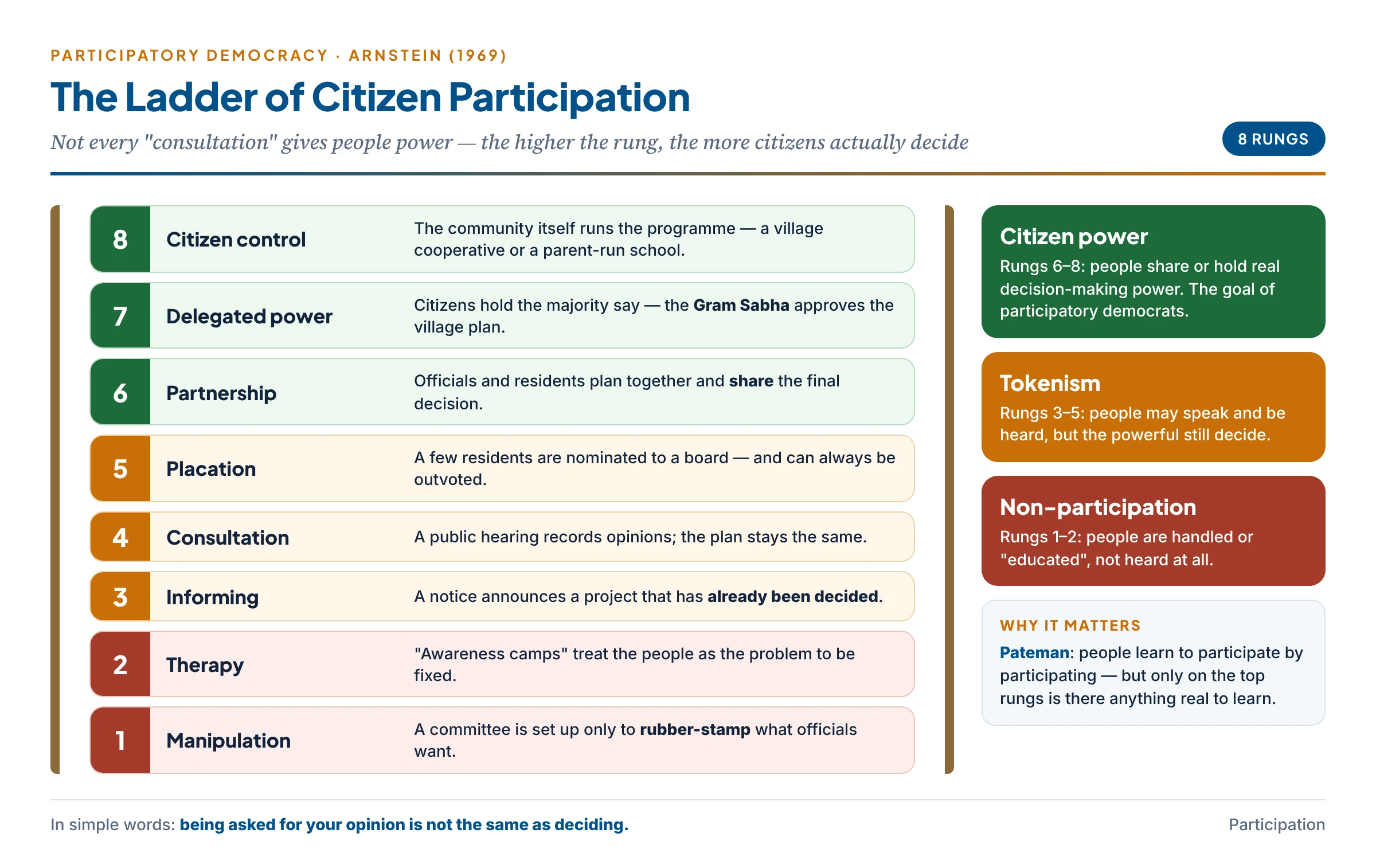
- Why it matters: many “public hearings” stop at the middle rungs. Participatory democrats want the top rungs.
Is participatory democracy feasible in a large modern state?
- The elitist objection (Schumpeter). Citizens lack the time, knowledge and interest to govern; mass participation in a country of millions would produce confusion or mob rule. Low participation, on this view, is a sign of satisfaction.
- The participatory reply.
- Participation is meant mainly at the local and workplace level, where people know the issues, while representation continues at the national level.
- Apathy is often the result of powerlessness, not its cause — give people real power and they participate.
- Modern tools (local bodies, digital consultation, citizens’ assemblies) make participation more practical than in Rousseau’s day.
- The balanced verdict. The advocates of participatory democracy can be too optimistic. People’s participation can reasonably be increased to a certain extent; beyond that, it may prove harmful — endless meetings, domination by the most vocal, delay, and capture of local bodies by local elites.
Indian Connect — Participation in Indian thought
- Gandhi — Grām Swarāj. For Gandhi, true democracy begins from the self-governing village. His picture of society was not a pyramid but “oceanic circles“: the individual at the centre, ready to sacrifice for the village, the village for the circle of villages, and so on — “the outermost circumference will not wield power to crush the inner circle”. Swarāj meant decentralised, self-reliant, non-violent self-rule.
- M.N. Roy — radical (partyless) democracy. Roy’s Radical Humanism placed the rational individual at the centre and proposed a partyless democracy built on organised local People’s Committees, through which citizens would exercise power directly instead of handing it to party machines.
- Jayaprakash Narayan — partyless democracy and Total Revolution. JP argued for a communitarian, partyless polity built from the village upward, and in 1974 called for Total Revolution — a transformation of politics, economy, society and culture.
- Ambedkar’s warning. Introducing the Draft Constitution (4 November 1948), Ambedkar rejected the village as the unit of the Constitution: “What is the village but a sink of localism, a den of ignorance, narrow-mindedness and communalism?” He preferred the individual as the unit, because in a caste society local majorities can crush the weakest.
- The compromise. Village panchayats entered the Constitution as a Directive Principle (Article 40), and became constitutional bodies only with the 73rd Amendment (1992), which also reserved seats for SCs, STs and women — a way to answer Ambedkar’s fear inside Gandhi’s ideal.
Arendt: Politics as Action in Public
- Hannah Arendt (The Human Condition, 1958) offered a civic republican idea of democracy.
- Action. She distinguished three human activities — labour (to stay alive), work (to make things) and action (to appear before others in speech and deed). Politics belongs to action: citizens show who they are by acting and speaking together in a public space.
- Freedom is public. For Arendt freedom is not a private choice of the will but the experience of acting with equals in public. A citizen who only votes and then retires to private life has lost what made the Greek polis valuable.
- Council system. In On Revolution (1963) she admired the councils that spring up in revolutions (the Paris Commune, the Russian soviets before the Bolsheviks controlled them, the Hungarian councils of 1956) as spaces of direct citizen action — and regretted that party systems swallowed them.
- Link to deliberation. Citizens should communicate with each other; the shared public world is created by this talk. This anticipates the deliberative theory.
Dewey: Democracy as a Way of Life
- John Dewey (Democracy and Education, 1916; The Public and Its Problems, 1927; “Creative Democracy — The Task Before Us”, 1939) is the chief proponent of democracy as a way of life.
- More than a form of government. “A democracy is more than a form of government; it is primarily a mode of associated living, of conjoint communicated experience.”
- Democratic method as scientific method. Dewey compared the democratic method with the scientific method: both rely on inquiry, communication and experimentation before arriving at a conclusion or a policy. Policies are hypotheses to be tested and revised, not dogmas.
- Liberal principles make rational attitudes possible. Free speech, free press and free association enable people to adopt the open, testing attitude of a scientist.
- Majority rule rightly understood. Majority rule is valuable not because numbers count, but because the majority is formed through free communication and free association among citizens — the process of discussion matters more than the head-count.
- Small groups. Small, face-to-face groups are conducive to the creation of a democratic public. Dewey worried that the modern “Great Society” of vast, impersonal forces had produced an “eclipse of the public”.
- Voluntary associations and local communities — clubs, unions, neighbourhoods, schools — help individuals to become democratic citizens.
- Democratise everything. He demanded democratisation at all levels — inside political parties, in industrial administration, and in universities and schools.
- More democracy. Dewey accepted the old saying that the cure for the ills of democracy is more democracy — but he insisted this means more democratic habits of communication and inquiry, not merely more voting machinery.
In simple words
A good science lab does not settle a question by the head scientist’s order or by a quick show of hands. It proposes an idea, tests it, shares the results openly and changes its mind when the evidence demands. Dewey wanted a whole society to behave like that lab — and he thought the habit begins in families, classrooms and neighbourhood groups.
Deliberative Democracy
- Meaning. Deliberation is a process of consultation — weighing reasons for and against — to arrive at a consensus or at least a reasoned decision. In deliberative democracy, a democratic decision is legitimate only if it is the outcome of authentic deliberation among free and equal citizens.
- Voting as fallback. If deliberation does not produce agreement, the deliberators may resort to voting — but the vote now comes after reasons have been exchanged and preferences tested.
- Two balances it must strike.
- Between personal freedom and popular rule — individuals keep their rights while the people decide together.
- Constant public accountability of politicians — leaders must give reasons for their decisions, not only win elections.
- Leading theorists: Jürgen Habermas, Joshua Cohen (“Deliberation and Democratic Legitimacy”, 1989), John Dryzek, John Rawls (public reason), James Fishkin (deliberative polling); in India, Amartya Sen‘s idea of democracy as public reasoning, and earlier Gandhi‘s practice of dialogue.
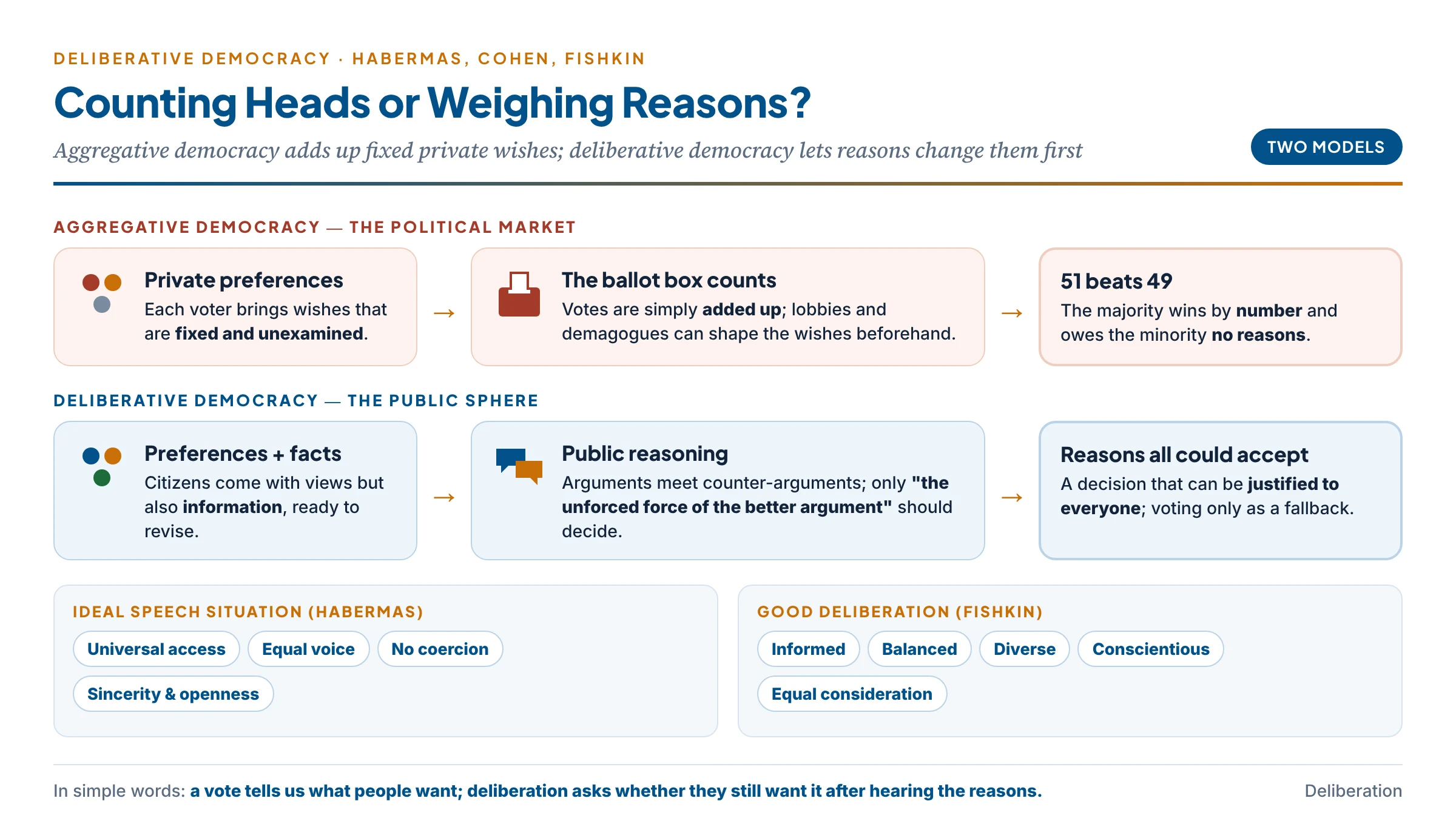
Aggregative vs deliberative democracy:
| Point | Aggregative (vote-counting) democracy | Deliberative democracy |
|---|---|---|
| What democracy is | A mechanism for adding up private preferences | A process of public reasoning among equals |
| Preferences | Taken as fixed and unexamined | Formed and transformed in discussion |
| Basis of legitimacy | The number of votes | The quality of reasons that all could accept |
| Majority and minority | A 51% majority can override a 49% minority without giving reasons | The majority must justify itself to the minority |
| Citizen’s role | Consumer choosing in a political market | Co-author of laws through argument |
| Danger | Manipulation by lobbies and demagogues; majority tyranny | Slowness; domination by the articulate |
Habermas — the public sphere and the force of the better argument:
- The public sphere (Öffentlichkeit). In The Structural Transformation of the Public Sphere (1962) Habermas traced how coffee-houses, salons and newspapers in eighteenth-century Europe created a space where private persons came together to discuss public matters and to check state power by reasoned public opinion. Mass media and commercial interests later weakened it.
- Communicative rationality. People can coordinate their actions not only by force or money (strategic action) but by reaching understanding through speech (communicative action).
- The ideal speech situation — the conditions an undistorted discussion would meet:
- Universal access — everyone affected can take part.
- Equal voice — each may raise any claim and question any claim.
- Freedom from coercion — no internal or external pressure decides the outcome.
- Sincerity and openness — participants mean what they say and are ready to revise their own preferences.
- “The unforced force of the better argument.” In such discussion, the only force that should decide is the strength of reasons.
- Discourse principle. In Between Facts and Norms (1992), Habermas argues that a law is legitimate only if all those affected could agree to it as participants in rational discourse. Law and democracy are linked: laws get their legitimacy from democratic processes of opinion- and will-formation in the public sphere, which then flow into parliaments and courts.
- Constitutional patriotism. Citizens of a diverse society can be held together by loyalty to shared democratic procedures and rights rather than by a common religion or ethnicity.
Rawls — public reason. In Political Liberalism (1993), Rawls asks citizens, when deciding basic political questions, to offer reasons that others could reasonably accept — not reasons that depend on their private religion or comprehensive doctrine. Deliberation then becomes a practice of mutual respect.
Fishkin — the qualities of good deliberation and the deliberative poll.
- James Fishkin lists conditions for a discussion of good quality:
- Information — arguments are well informed and supported by accurate factual claims.
- Substantive balance — arguments are balanced: each argument is met by contrary arguments.
- Diversity — the discussion is comprehensive: all major perspectives in society are represented.
- Conscientiousness — participants sincerely weigh the merits of arguments.
- Equal consideration — arguments are judged on their merits, whoever makes them (the discussion is substantive, not about status).
- Deliberative polling. A random sample of citizens is surveyed, given balanced briefing papers, discusses in small moderated groups, questions competing experts, and is surveyed again. The change in opinion shows what the public would think if it had a chance to think. It has been used in more than two dozen countries.
Sen — democracy as “government by discussion”.
- Amartya Sen takes the phrase “government by discussion” (associated with Mill and Bagehot) and argues that democracy is best understood as public reasoning, not only as balloting.
- Not only Western. In The Argumentative Indian (2005) and The Idea of Justice (2009), Sen points to traditions of public discussion in India — the Buddhist councils, Aśoka‘s rules for respectful debate between sects, Akbar‘s interfaith dialogues — to show that the roots of democracy are global.
- Instrumental value. Open discussion gives the vulnerable a voice that governments must hear (Article 10 on famines and democracy).
What deliberation achieves (the deliberative claims):
- Better decisions — errors are exposed before they are made.
- More legitimate decisions — even losers know their reasons were heard.
- Better citizens — individual preferences are not independent and fixed; they are formed in the political process, and deliberation teaches citizens to think of the collective good rather than only their individual good.
- Mutual respect among people who disagree.
- Democracy is not the rule of an elite over the people, and not the mere sum of private wants; it is a shared practice of reasoning.
Common confusion
Is the “ideal speech situation” Habermas’s description of how parliaments actually work? No. It is a regulative ideal — a standard against which real discussions can be measured and criticised. Habermas knows that real politics is full of money, power and spin. The ideal tells us what is distorted in it: who was excluded, who was coerced, whose voice was not heard. Critics who say “no real debate looks like this” are right about the facts but miss the purpose of the ideal.
Macpherson’s Radical Theory of Democracy
- C.B. Macpherson (The Political Theory of Possessive Individualism, 1962; The Real World of Democracy, 1965; The Life and Times of Liberal Democracy, 1977) is the best representative of the radical theory of democracy.
- Possessive individualism. Liberal theory since Hobbes and Locke pictured the individual as the owner of his own person and capacities, owing nothing to society, and society as a set of market relations among owners. Democracy built on this picture protects property, not the full development of human beings.
- Two meanings of power. A truly democratic society minimises extractive power and maximises developmental power for all.
- Extractive power — the power some have to use the capacities of others for their own benefit (what capitalism allows the owners of capital).
- Developmental power — each person’s ability to use and develop his or her own human capacities.
- Four models of liberal democracy (in The Life and Times of Liberal Democracy):
- Protective democracy (Bentham, James Mill) — democracy to protect citizens from rulers.
- Developmental democracy (J.S. Mill) — democracy to develop citizens’ capacities.
- Equilibrium democracy (Schumpeter, Dahl) — a market-like competition of elites giving stability.
- Participatory democracy — the model Macpherson hoped for, which needs less economic inequality and a change in how people see themselves (from consumers to developers of their capacities).
- Democracy as emancipation. For Macpherson democracy is a developmental process, a matter of the emancipation of humanity. Any system qualifies as a democracy, irrespective of the structure or procedures it adopts, if it does three things:
- It fulfils the aspirations of the masses.
- It enjoys the support of the masses.
- It strives for the emancipation of the masses.
- Three variants of democracy, each valid if it meets certain conditions (from The Real World of Democracy):
| Variant of democracy | Condition it must fulfil to count as genuinely democratic |
|---|---|
| Liberal democracy (the West) | It must become more humane — less dominated by market values and extractive power |
| Socialist democracy (the communist states) | It must grant full intra-party democracy and open up its bureaucratic institutions |
| Third World democracy (newly independent states with one dominant party or leader) | Its governments must be legitimised by mass enthusiasm and popular support |
In simple words
Imagine three schools. One is well run but treats students as customers who buy marks. One has a single strict management that claims to act for all students but allows no student union. One is new and poor but has the passionate support of every family in the village. Macpherson would say each could be democratic — if the first became more humane, the second let its students speak, and the third kept the real trust of its people.
Cosmopolitan Democracy
- The problem of globalisation. Decisions that shape citizens’ lives — trade rules, financial flows, climate change, pandemics, internet platforms — are increasingly made beyond the nation-state. Globalisation has undermined the sovereignty of states, so national democracy alone cannot control the forces that affect citizens.
- Global governance without democracy. Bodies such as the UN Security Council (where five permanent members hold a veto), the World Bank, the IMF and the WTO take decisions that affect billions but are not democratically accountable to them.
- David Held (Democracy and the Global Order, 1995) and Daniele Archibugi proposed cosmopolitan democracy:
- Cosmopolitan democratic law — basic rights that bind all states and protect all persons.
- Layers of democracy — local, national, regional and global — each dealing with the problems at its level.
- Regional parliaments on the model of the European Parliament, directly elected by citizens of many states.
- Reform of global institutions — a more representative Security Council, accountable economic bodies, and in the long run a global people’s assembly.
- Why it matters: democracy must follow power. If power has gone global, citizens’ voice must go global too.
The Marxist Critique of Liberal (“Pure”) Democracy
- The core claim. For Marx and the Marxists, the liberal democracy of capitalist countries is bourgeois democracy — democracy for the property-owning class. It is not false because elections are rigged, but because formal political equality sits on top of real economic inequality.
- “Pure democracy” is a myth. Lenin replied to Kautsky’s defence of “pure democracy” (The Proletarian Revolution and the Renegade Kautsky, 1918) that there is no democracy above classes: “‘Pure democracy’ is the mendacious phrase of a liberal who wants to fool the workers.” History knows only bourgeois democracy (which replaced feudalism) and proletarian democracy (which will replace bourgeois democracy).
The grounds on which Marxism criticises pure democracy:
- Formal equality hides economic inequality. The rich and the poor have one vote each, but the rich own the factories, the land, the media and the parties. Political equality without economic equality is a legal fiction.
- The state is a class instrument. “The executive of the modern state is but a committee for managing the common affairs of the whole bourgeoisie” (The Communist Manifesto, 1848). Whoever wins the election, the state protects private property and capital.
- Elections only choose the oppressors. Marx praised the Paris Commune because, “instead of deciding once in three or six years which member of the ruling class was to misrepresent the people in Parliament“, universal suffrage served the people organised in communes. Lenin sharpened this: deciding once every few years which member of the ruling class is to repress the people through parliament “is the real essence of bourgeois parliamentarism” (The State and Revolution, 1917).
- Rights are bourgeois rights. In On the Jewish Question (1843), Marx distinguished political emancipation (equal citizenship in the state) from human emancipation (freedom in real social life). The “rights of man” — property, security, liberty — are the rights of the egoistic individual separated from the community; they protect the market, not human fulfilment.
- Base and superstructure. Law, politics and ideas form a superstructure shaped by the economic base. As long as the base is capitalist, the political superstructure, however democratic in form, serves capital.
- Ideology and false consciousness. The ruling ideas of every age are the ideas of its ruling class. Workers are taught to accept the market order as natural, so they vote against their own class interest.
- Hegemony (Gramsci). Antonio Gramsci added that the ruling class rules less by force than by consent — through schools, churches, newspapers and culture that make its view common sense. Liberal democracy is the most effective form of this hegemony.
- Freedom of the press belongs to those who own presses. Lenin argued that freedom of the press and of assembly are hypocritical while printing plants, paper and halls belong to the rich.
- Parliament talks, capital decides. Real decisions on investment, jobs and prices are made in boardrooms, not in elected assemblies.
In simple words
Two people are invited to an “equal” debate. One is given a microphone, a stage, a team of writers and a TV channel; the other stands at the back of the hall without a microphone. Both have “equal freedom of speech”. The Marxist says liberal democracy is like this debate: the rules are equal, but the means of being heard are not.
Is the State an Agency of the Ruling Class?
- The Marxist thesis.
- Marx and Engels: the state arises from irreconcilable class antagonisms; it is the instrument by which the economically dominant class becomes politically dominant (Engels, The Origin of the Family, Private Property and the State, 1884).
- Lenin: “The state is a special organisation of force: it is an organisation of violence for the suppression of some class.“
- Hence a bourgeois state cannot be gradually reformed into socialism; it must be replaced, first by the dictatorship of the proletariat, and in the end the state itself withers away.
- Two Marxist versions.
- Instrumental view (Ralph Miliband, The State in Capitalist Society, 1969) — the state serves capital because its top personnel (ministers, judges, generals, senior officials) come from or are tied to the capitalist class.
- Structural view (Nicos Poulantzas) — even if the officials were workers, the state would still serve capital because it must keep the economy growing and depends on business investment and taxes.
- Relative autonomy. Both accept that the state can act against particular capitalists (factory laws, welfare, taxes) in order to preserve the system as a whole. Marx himself, in The Eighteenth Brumaire, described Louis Bonaparte’s state as standing above the classes for a time.
- Replies to the Marxist thesis.
- Liberal view — the state is a neutral umpire that protects the rights of all; universal suffrage gives the poor majority real power.
- Pluralist view — power is dispersed among many groups (unions, farmers, castes, professions, businesses); no single class controls the state (Article 7).
- Laski and the democratic socialists — the state is now often biased towards property, but democracy can transform it into an instrument of social welfare.
- The welfare state — public education, health care, labour laws, progressive taxes and social security in democracies were won through elections and unions, showing that the state can serve the working majority.
- The evidence of communist states — where the bourgeois state was smashed, a new ruling group (the party bureaucracy, the “new class”) emerged, so the problem of a ruling class was not solved by abolishing private property.
- Indian view. The Indian state is constitutionally a welfare state (Directive Principles, Articles 38 and 39); Gandhi wanted the state reduced and power returned to self-governing communities; Ambedkar wanted a strong constitutional state that uses law to break social domination.
People’s Democracy (Socialist Democracy)
- The Marxist ideal. According to Marx, the true idea of democracy can be realised only in a classless society or in a socialist state that represents the uniform interest of the working class. Liberal democracy, by fostering the capitalist economic system, serves the bourgeoisie — hence bourgeois democracy.
- Democracy for the majority. Marxists hold that democracy should promote the interest of the working class, which constitutes the majority. That is possible only under socialism; hence socialism is synonymous with true democracy. Lenin claimed that “proletarian democracy is a million times more democratic than any bourgeois democracy“.
- The Paris Commune as the model (1871). In The Civil War in France, Marx described the Commune’s features:
- Councillors chosen by universal suffrage, responsible and revocable at short terms.
- A working, not a parliamentary body — executive and legislative at the same time.
- Public officials paid workmen’s wages.
- The standing army replaced by the armed people.
- Features of people’s democracy:
- Collective ownership. Private ownership of the means of production is replaced by a commune system — collective ownership of everything, including the products of labour.
- Pyramidal structure of direct election. Local soviets (councils) elect higher councils, and so on up to the supreme body.
- Recall. Elected representatives can be removed for violating the instructions of their electors.
- Vanguard of the proletariat. The superiority of the Communist Party as the vanguard that leads the working class (Lenin).
- Democratic centralism. Free discussion inside the party until a decision is taken, then strict obedience to the decision; lower bodies obey higher bodies.
- Where it was tried. It was installed in the USSR after the Russian Revolution (1917) and in China after the Chinese Revolution (1949), and the term “people’s democracy” was used for the communist states of Eastern Europe after 1945.
Critical estimate of people’s democracy:
- Economic failure — in both the USSR and China the system failed to deliver prosperity, largely due to the abolition of incentives for better work and the rigidity of central planning (China changed course after 1978; the USSR collapsed in 1991).
- No safeguard for liberty. Despite being called a democracy, it fails to safeguard the liberty of individuals — no free press, no opposition, no independent courts.
- From vanguard to dictatorship. The rule of the vanguard of the proletariat often culminated in authoritarianism and dictatorship — Stalin’s purges, forced collectivisation and the Gulag — the very antithesis of democracy.
- Tautology. The very phrase “people’s democracy” is tautological — demos already means “people”; the extra word hides the absence of real popular choice.
Common confusion
Did Marx’s “dictatorship of the proletariat” mean rule by one dictator? No. In nineteenth-century usage “dictatorship” meant the rule of a class. Marx called every state a dictatorship of the ruling class — even a liberal republic is a “dictatorship of the bourgeoisie”. The “dictatorship of the proletariat” meant the rule of the working-class majority during the transition to communism, and Marx pointed to the democratic Paris Commune as its example. It was Lenin’s and Stalin’s practice — rule by a single party and then by a single leader — that turned the phrase into a dictatorship in the modern sense. Rosa Luxemburg, herself a Marxist, warned in 1918: “Freedom only for the supporters of the government, only for the members of one party … is no freedom at all. Freedom is always and exclusively freedom for the one who thinks differently.“
Liberal Democracy and Socialist Democracy Compared
| The issue | Liberal democracy | Socialist democracy |
|---|---|---|
| 1. Status of the major means of production | Under private ownership | Under public ownership |
| 2. Purpose of production | Primarily private profit | Fulfilment of social needs |
| 3. Status of rights | Primacy of civil and political rights | Primacy of socio-economic rights (work, food, health) |
| 4. Political parties | More than one party freely competing for power | Monopoly of one party representing the working class |
| 5. Method of election | Universal adult franchise; people free to contest | Approval of candidates nominated by the ruling party |
| 6. Main source of decision-making | The elected government | The party in power |
| 7. Character of bureaucracy and judiciary | Politically neutral | Committed to the party in power |
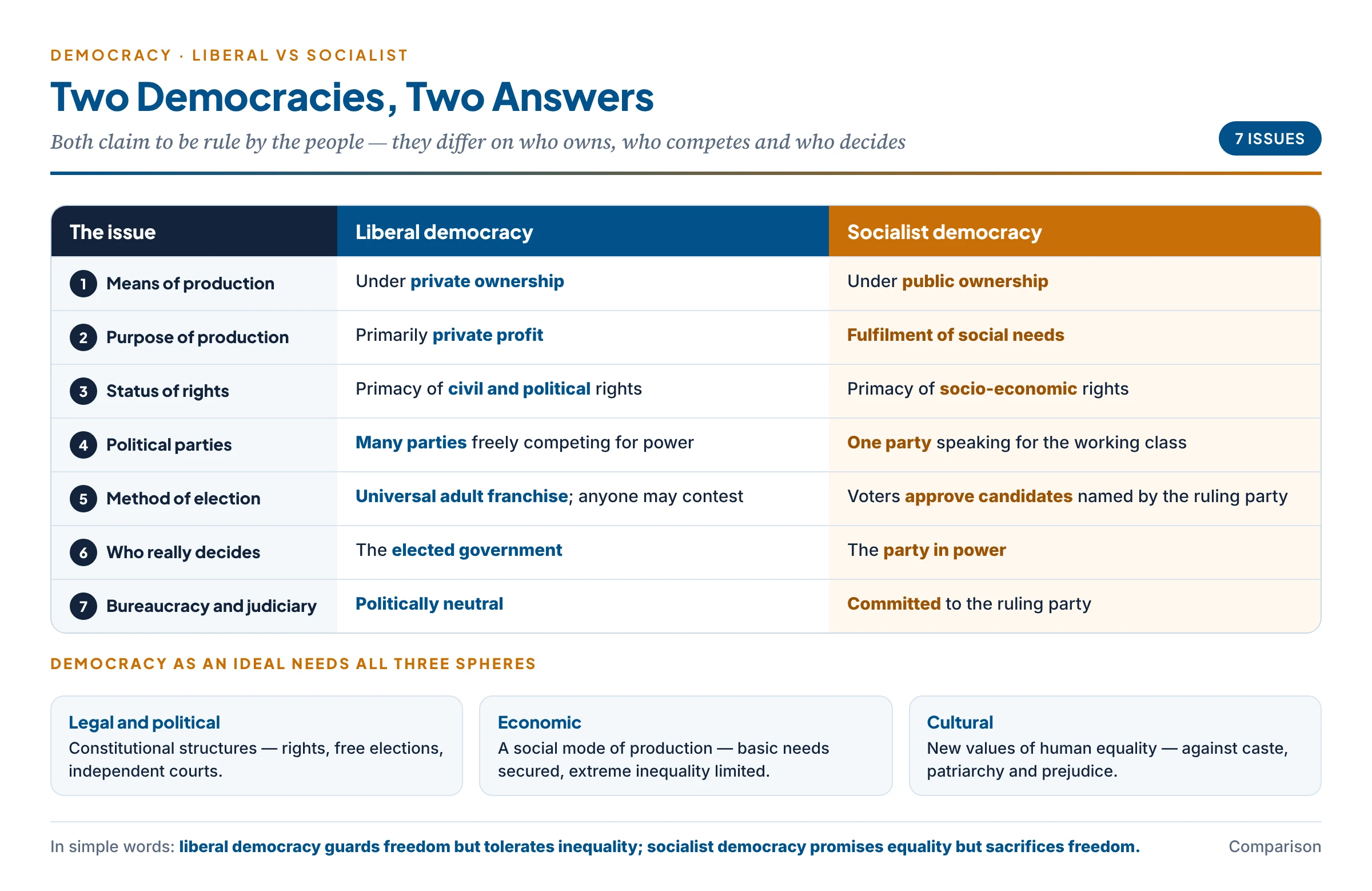
- In a nutshell, democracy as an ideal can be achieved neither through liberalism alone nor through socialism alone. It must be achieved in all spheres of life:
- In the legal and political sphere through constitutional structures — rights, free elections, independent courts.
- In the economic sphere through a socialist (social) mode of material production — at least public provision of basic needs and limits on extreme inequality.
- In the cultural sphere through the inculcation of new values of human equality — against caste, patriarchy and racial prejudice.
“Political Democracy Is Hollow without Economic Power”
- The thesis. Voting rights and civil liberties are empty if most citizens are poor, insecure and dependent on the rich for their livelihood. Political power then follows economic power.
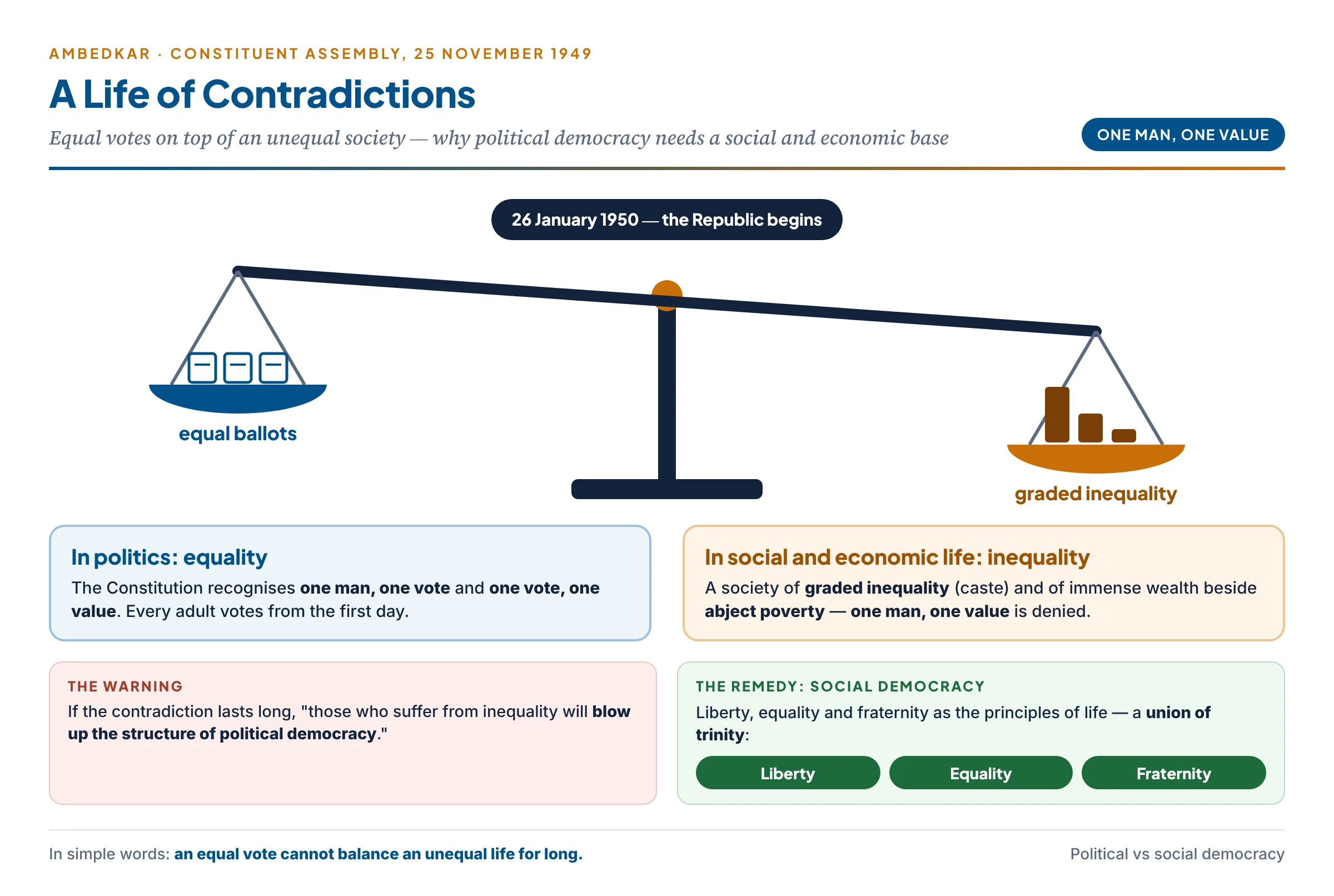
Ambedkar’s “life of contradictions” — from his last speech in the Constituent Assembly (25 November 1949):
“On the 26th of January 1950, we are going to enter into a life of contradictions. In politics we will have equality and in social and economic life we will have inequality. In politics we will be recognizing the principle of one man one vote and one vote one value. In our social and economic life, we shall, by reason of our social and economic structure, continue to deny the principle of one man one value.” — B.R. Ambedkar
- What follows from it:
- He warned that if this contradiction lasted long, “those who suffer from inequality will blow up the structure of political democracy“.
- Social democracy. “Political democracy cannot last unless there lies at the base of it social democracy.” Social democracy means “a way of life which recognizes liberty, equality and fraternity as the principles of life” — a union of trinity, not three separate items.
- Without equality, liberty produces the supremacy of the few over the many; without liberty, equality kills individual initiative; without fraternity, liberty and equality cannot become a natural course of things.
- Indian society, he noted, rested on graded inequality on the social plane and on great wealth beside abject poverty on the economic plane.
- Laski. “Political equality is never real unless it is accompanied by virtual economic equality; political power, otherwise, is bound to be the handmaid of economic power.” For Laski, liberty itself is a function of equality, and democracy must be extended to industry.
- R.H. Tawney (Equality, 1931) — a society that gives equal votes but very unequal life chances practises a “religion of inequality”; common public services (education, health) are the basis of real citizenship.
- Marx — the deepest version of the thesis: without changing the ownership of the means of production, political democracy is a form of class rule.
- Economic and industrial democracy. Proposals to give working people economic power:
- Industrial democracy — workers’ participation in management (G.D.H. Cole’s guild socialism; German co-determination, where workers elect members of company supervisory boards).
- Cooperatives — firms owned and run by their members (in India, dairy cooperatives such as Amul).
- Public provision of basic needs — education, health, housing, social security.
- Constitutional directives — in India, Article 38 (the state shall strive to promote a social order in which justice — social, economic and political — informs all institutions and to minimise inequalities of income), Article 39(b)–(c) (distribution of material resources to serve the common good; preventing concentration of wealth), Article 43A (workers’ participation in management, added in 1976).
- Counter-view. Liberals reply that political liberty has value of its own; that economic power must not be concentrated in the state either (Hayek, Friedman); and that political democracy is itself the tool by which the poor have won economic gains — so it is not “hollow” but incomplete.
Indian Connect — Ambedkar’s social democracy
- Ambedkar’s demand was not a Marxist revolution. In Buddha or Karl Marx he accepted the Marxist goal of ending exploitation but rejected violence and dictatorship as means; he wanted equality through constitutional methods, persuasion and the moral force of maitrī (fraternity, compassion).
- The Constitution answered his warning through universal adult franchise from the first day, Fundamental Rights (Articles 15, 17 — abolition of untouchability), reservations for SCs and STs, and the Directive Principles for economic justice.
- His phrase “one man, one value” is now the standard way of saying that democracy must be social and economic, not only political.
Does Democracy Combined with Socialism Lead to a More Equitable Society?
- Democratic socialism seeks socialist aims — equality, public welfare, social control of key industries — through democratic, peaceful and constitutional means: elections, parliaments, trade unions and gradual reform, not violent revolution.
- Its tradition.
- The Fabian Society (founded 1884; Sidney and Beatrice Webb, Bernard Shaw) — “the inevitability of gradualness”.
- Eduard Bernstein (Evolutionary Socialism, 1899) — socialism through reform within democracy.
- Laski, Tawney and the British Labour Party; the Scandinavian social democrats.
- Nehruvian socialism in India — planning, a mixed economy, a large public sector; the word “socialist” added to the Preamble in 1976.
- Arguments that the combination produces more equity:
- Democracy gives the poor majority votes, and socialism gives those votes an economic programme — public education, health care, progressive taxation, labour rights.
- The Nordic experience — Denmark, Norway, Sweden and Finland combine free elections, strong unions and universal welfare states, and they consistently have among the lowest income inequality and highest social mobility among rich democracies.
- It avoids the two failures — the inequality of unregulated capitalism and the tyranny of one-party communism.
- Arguments against:
- Efficiency — heavy state control can slow growth and innovation (India’s “licence-permit raj” before 1991).
- Liberty — Hayek (The Road to Serfdom) warned that central planning leads step by step to loss of freedom.
- Fiscal limits — generous welfare needs high taxes and a productive economy.
- The Marxist objection — reforms within capitalism soften inequality but do not end exploitation; capital can move abroad.
- Balanced view. The combination produces a more equitable society when democracy keeps the state accountable and the market productive, while social policy guarantees the basic capabilities of all — which is close to what Ambedkar called social democracy and Sen calls freedom as development (the ideologies themselves are covered in Unit 05).
Critical Evaluation
Criticisms of the Participatory and Deliberative Models
- Too demanding. Most citizens have jobs and families; they cannot attend endless meetings. Participation is dominated by those with time, education and confidence.
- Capture by local elites. Decentralisation can hand power to dominant castes, landlords or local strongmen (Ambedkar’s fear).
- Utopian idealism. Real politics is shaped by deep asymmetries of power, media monopolies, corporate wealth and emotional identity politics; the ideal speech situation is practically unreachable.
- Exclusion of the disadvantaged — Iris Marion Young. Deliberation that values only calm, dispassionate, “rational” argument marginalises groups whose ways of speaking rely on testimony, storytelling, protest and narrative. Young proposed a wider “communicative democracy” that also welcomes greeting, rhetoric and narrative.
- Deliberation can polarise. Like-minded groups that discuss only among themselves often become more extreme (group polarisation).
- Walter Lippmann’s doubt. Lippmann (The Phantom Public, 1925) argued that the “public” cannot know enough to govern; Dewey’s The Public and Its Problems was written partly as a reply.
Criticisms of Macpherson and Cosmopolitan Democracy
- Macpherson’s criteria are too loose. If any system that “enjoys mass support” and “strives for emancipation” counts as democratic, then one-party states and charismatic dictators can call themselves democratic. Procedures — free elections, free press, rights — are what protect the masses from those who claim to speak for them.
- Cosmopolitan democracy is distant. There is no global demos with a common language, media and identity; powerful states will not accept global majorities; and global institutions may become even more remote from citizens than national ones.
Criticisms of the Marxist Critique
- Economic determinism exaggerated. Politics and culture have their own force; the vote has changed economic policy in many democracies.
- The cure was worse than the disease. Abolishing “bourgeois” liberties in the USSR and China produced not more democracy but party dictatorship, purges and famines.
- Rights are not only bourgeois. Free speech, free association and fair trials have been the weapons of workers, Dalits, women and colonised peoples in their struggles.
- Inner Marxist critics. Kautsky defended parliamentary democracy against Lenin; Rosa Luxemburg warned that without free elections and free press “life dies out in every public institution”.
- What survives. The critique remains powerful as a warning: money in politics, media concentration and inequality really do distort democracy — which is why many non-Marxists now accept parts of it.
Critics and Defenders
Criticism — Critics
- Elitists (Schumpeter) — mass participation is impractical; apathy may even be stabilising.
- Iris Marion Young — rationalist deliberation excludes the voices of the marginalised.
- Lippmann — the ordinary public lacks the knowledge to govern.
- Liberals (Popper, Hayek) — people’s democracy destroys liberty; central planning leads to serfdom.
- Rosa Luxemburg and Kautsky — Lenin’s vanguard turns proletarian democracy into dictatorship.
- Ambedkar — village participation can entrench caste domination; violent revolution and dictatorship are unacceptable means.
- Realists — cosmopolitan democracy has no global demos to rest on.
Defence — Defenders and strengths
- Pateman, Barber — participation educates citizens; apathy is the product of powerlessness.
- Habermas, Cohen, Rawls — legitimacy needs reasons all could accept, not just numbers.
- Fishkin — deliberative polls show ordinary citizens change their views sensibly when informed.
- Dewey, Sen — democracy is public reasoning and a way of life; its cure is more democratic communication.
- Macpherson, Laski, Tawney, Ambedkar — political equality is hollow without social and economic equality.
- Marxists — money, media ownership and class power really distort “equal” democracy.
- Held — democracy must follow power, and power has become global.
Cross-Tradition Comparison
Western Models and Indian Thinkers
| Idea | Western exponents | Indian parallel | Key difference |
|---|---|---|---|
| Participation | Rousseau, Mill, Pateman, Barber | Gandhi‘s Grām Swarāj and oceanic circles; Panchayati Raj | Gandhi grounds participation in moral self-rule (swarāj) and non-violence, not only in interests |
| Partyless direct rule | Arendt’s councils; the Paris Commune | M.N. Roy‘s People’s Committees; JP‘s partyless democracy | Roy and JP reject parties as such; Arendt rejects their monopoly |
| Deliberation | Habermas, Cohen, Rawls, Fishkin | Sen‘s public reasoning; Aśoka’s and Akbar’s dialogues; the Buddhist saṅgha’s discussion before decisions | Sen stresses deliberation’s global roots |
| Democracy as a way of life | Dewey | Ambedkar‘s social democracy (liberty, equality, fraternity as a way of life) | Ambedkar’s main obstacle is caste, not the “eclipse of the public” |
| Economic democracy | Marx, Laski, Tawney, Macpherson | Ambedkar (“one man, one value”); Nehru’s socialism; Gandhi’s trusteeship | Gandhi wants change of heart and trusteeship, not class struggle |
Indian Connect — Key takeaways
- Indian thought adds the moral and social dimensions that Western models often treat as secondary: Gandhi’s self-rule and Ambedkar’s fraternity.
- The great Indian debate — Gandhi’s village vs Ambedkar’s individual — is the Indian form of the debate between participatory democracy and rights-based liberal democracy; the 73rd Amendment tried to combine them.
- Sen’s argument that public reasoning has deep non-Western roots answers the claim that deliberative democracy is a purely Western idea.
Synthesis (Siddhānta)
- One diagnosis, different cures. All the theories in this article agree that democracy reduced to periodic voting is thin. Participatory theorists want citizens to act, deliberative theorists want them to reason, Dewey wants democracy as a habit of life, Macpherson wants emancipation, Held wants democracy to reach global power, and Marxists want economic equality.
- What the debate teaches.
- Procedures are necessary but not sufficient. Free elections, rights and courts are indispensable safeguards (the lesson of people’s democracies), but they are not the whole of democracy (the lesson of the Marxist critique).
- Participation and deliberation complement representation, they do not replace it — local participation, citizens’ assemblies and deliberative forums alongside elected parliaments.
- Political democracy needs a social and economic base — basic capabilities, limits on extreme inequality, and the end of social hierarchy, as Ambedkar insisted.
- Contemporary relevance.
- Panchayati Raj and urban local bodies, social audits under rural employment schemes, and participatory budgeting are experiments in participatory democracy.
- Citizens’ assemblies (Ireland, France on climate) and deliberative polls show deliberation can work at scale.
- Inequality and money in politics keep the Marxist and Ambedkarite question alive in every democracy.
- Global problems — climate change, pandemics, digital platforms — strengthen the case for some form of cosmopolitan democracy.
“Political democracy cannot last unless there lies at the base of it social democracy.” — B.R. Ambedkar
Previous Year Questions
- 2026On what grounds does Marxism criticize pure democracy?
- 2016Is the State an agency for expressing the will of the ruling classes? Examine.
- 2013Does the combination of democracy and socialism lead to a more equitable society?
- 2005Political democracy is hollow unless accompanied with power in the area of economics.