

Forms of Government: Monarchy; Theocracy and Democracy.
Official Syllabus: Paper II, Section A, Unit 4
Every political community has to answer one question before all others: who should rule, and for whose good? The answer gives us the form of government — rule by one (monarchy, tyranny, dictatorship), by a few (aristocracy, oligarchy, theocracy by a priestly class) or by the many (polity, democracy). Political philosophy does not study these forms as mere administrative machinery. It studies them as institutional embodiments of justice, authority and human flourishing — each form carries a picture of who is fit to rule, what law is, and what the citizen is worth. This article lays the foundation for the whole unit: the difference between state and government, the classical classifications of Plato, Aristotle, Polybius and Montesquieu, the idea of the mixed constitution, modern classifications, the meaning and kinds of dictatorship and totalitarianism, the features that monarchy, democracy and dictatorship share, and a comparison of monarchy, theocracy and democracy that the later articles develop in detail.
In simple words
Think of a cricket team. Someone has to decide the batting order. It could be one captain who decides alone, a small selection committee of senior players, or the whole team voting in the dressing room. Each way has strengths and dangers: the captain is quick but may play favourites; the committee is expert but may protect its own friends; the team vote is fair but may pick the popular player over the best one. Forms of government are the same question asked about a whole country — who decides, and do they decide for the team or for themselves?
Context & Problem
State and Government: Not the Same Thing
- State — a permanent political community with four elements:
- Population — the people.
- Territory — a fixed area of land, water and air.
- Government — the organisation that makes, enforces and interprets the law.
- Sovereignty — supreme power inside the territory and independence outside it.
- Government — only one element of the state: its machinery or agency, the set of persons and institutions through which the will of the state is formed and carried out.
- Key differences:
| Basis | State | Government |
|---|---|---|
| Nature | Abstract, the whole political community | Concrete, the persons and offices that act for it |
| Permanence | Permanent; continues through changes of rulers | Temporary; governments come and go |
| Sovereignty | Possesses sovereignty | Exercises sovereignty on behalf of the state |
| Membership | All citizens are members | Only office-holders form the government |
| Uniformity | Every state has the same four elements | Governments differ in form — monarchy, democracy, dictatorship |
In simple words
A school is like the state: it has students (population), a campus (territory), its own authority to make rules (sovereignty) — and a principal with staff who actually run it (government). Principals change every few years; the school goes on. A new principal may run it strictly or democratically — that is a change in the form of government, not a new school.
- Why it matters for this unit: when we speak of “forms of government” we are classifying how the sovereign power of the state is organised and exercised — not whether a state exists. India in 1947 and India in 1950 was the same state; it changed its form of government from a dominion under the British Crown to a sovereign democratic republic.
Indian Connect — Kauṭilya’s seven elements and the modern four
- The modern theory counts four elements. Kauṭilya in the Arthaśāstra counts seven (saptāṅga): svāmī (ruler), amātya (ministers and officials), janapada (territory and people), durga (fortified capital), kośa (treasury), daṇḍa (army, coercive power) and mitra (ally).
- Government, in the modern sense, is spread over Kauṭilya’s svāmī, amātya, kośa and daṇḍa — the ruler with his administration, money and force. The full theory belongs to the Sovereignty unit.
Why Classify Forms of Government?
- To evaluate, not just describe. A classification tells us which forms are healthy and which are corrupt, and why.
- To explain change. Classical thinkers asked why one form decays into another — why kings become tyrants, why democracies collapse.
- To find the best practicable form. Every classification ends with a recommendation — philosopher-rule (Plato), polity (Aristotle), the mixed constitution (Polybius, Cicero), separation of powers (Montesquieu), liberal democracy (modern theory).
- Two basic questions run through all classifications:
- How many rule? — one, few or many (the quantitative test).
- In whose interest, and by what principle? — the common good or private interest; law or will; virtue, honour or fear (the qualitative test).
Core Doctrine
Plato: Five Constitutions and the Ladder of Decline
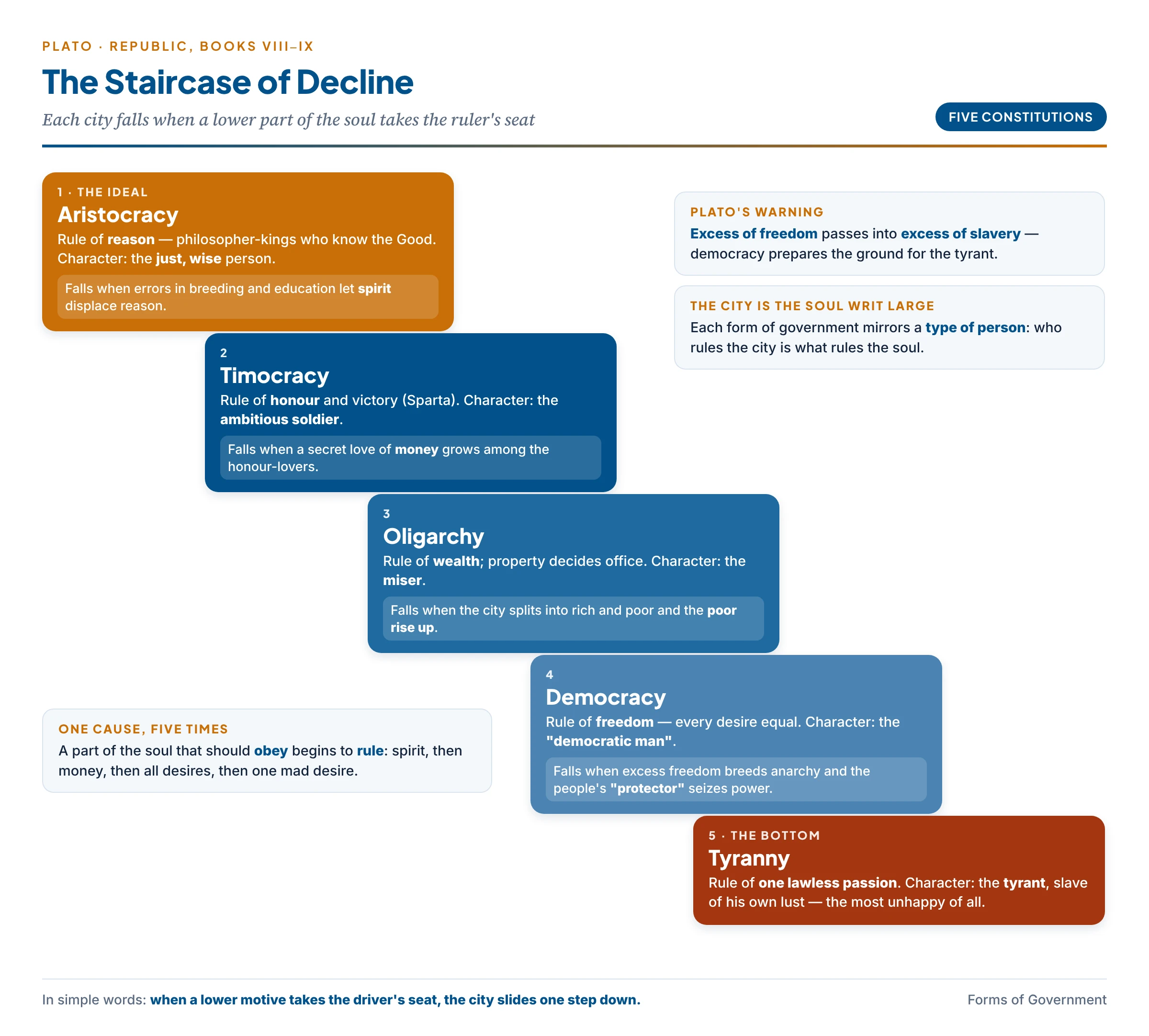
- Plato (427–347 BC), in the Republic, matches each form of government with a type of soul. A city is “the soul writ large”: the order of the rulers mirrors the order inside the citizen.
- The ideal: aristocracy (rule of the best) — rule by philosopher-kings, who know the Form of the Good. Reason rules, the spirited part (soldiers) obeys reason, appetite (producers) is kept in check. Plato also calls it kingship when one philosopher rules — what matters is knowledge, not number.
- The decline passes through four degenerate forms, each worse than the last:
| Stage | Form | What rules | The matching character | Why it falls |
|---|---|---|---|---|
| 1 | Aristocracy (philosopher-rule) | Reason and knowledge of the Good | The just, wise person | Rulers make errors in breeding and education; mixed “metals” create discord |
| 2 | Timocracy (rule of honour) | Spirit — love of honour, war and victory (Sparta, Crete as models) | The ambitious, honour-loving soldier | Secret love of money grows among the honour-lovers |
| 3 | Oligarchy (rule of the rich) | Appetite for wealth; property decides office | The miser who saves and craves | A city of two cities — rich and poor; the poor rise up |
| 4 | Democracy (rule of the many) | Freedom and equality for all desires | The “democratic man” who treats every desire as equal | Excess of freedom breeds anarchy; the people seek a champion |
| 5 | Tyranny (rule of the tyrant) | One lawless master passion | The tyrannical man, a slave of his own lust | Worst and most unhappy of all — the end of the decline |
- The cause of every decline is the same: a part of the soul that should obey begins to rule. When spirit displaces reason, we get timocracy; when appetite for money displaces spirit, oligarchy; when all appetites demand equal rights, democracy; when one mad appetite swallows the rest, tyranny.
- How democracy produces tyranny. The people choose a “protector” or champion against the rich. He tastes power, gathers a bodyguard, starts wars to stay indispensable, and ends as a tyrant. As Plato puts it, excessive freedom passes into excessive slavery.
In simple words
Think of a family business. The founder runs it with wisdom (aristocracy). Her children care most about the family’s name and prestige (timocracy). The grandchildren care only about profits (oligarchy). Their children say “everyone does what they like” (democracy) — no one keeps accounts. Finally one loud cousin grabs the keys and runs it for himself (tyranny). Each generation lets a lower motive take the driver’s seat.
Plato’s Critique of Democracy in Brief
- Rule of opinion, not knowledge. Democracy hands the art of ruling — a craft like navigation or medicine — to people who have opinion (doxa) rather than knowledge (epistēmē).
- Equality for equals and unequals alike. Plato calls democracy “a charming form of government, full of variety and disorder, dispensing a sort of equality to equals and unequals alike“.
- Flattery wins. Politicians, like sophists, learn the moods of the crowd (“the great beast”) and feed them, as a pastry-cook would beat a doctor before a jury of children.
- Freedom without limit dissolves authority — of parents, teachers, laws — and prepares the ground for tyranny.
- His motive was personal as well as philosophical: the Athenian democracy condemned Socrates to death in 399 BC.
- The full critique, the ship of state, and the replies of Aristotle and Popper are in Article 9.
Plato’s Statesman: Law-abiding and Lawless Rule
- In the later dialogue Statesman, Plato gives a sixfold scheme using a new test — does the ruler obey law?
- Rule of one: law-abiding monarchy; lawless tyranny.
- Rule of few: law-abiding aristocracy; lawless oligarchy.
- Rule of many: law-abiding democracy; lawless democracy.
- Above all six stands the true statesman who rules by knowledge without needing written laws — a rare, almost divine case.
- A surprising verdict: among law-abiding forms, monarchy is best and democracy worst; among lawless forms, democracy is the least bad, because power is spread so thinly that it can do neither great good nor great harm.
- This scheme prepares the way for Aristotle’s famous six forms.
Aristotle: Six Forms by Two Criteria
- Aristotle (384–322 BC), in the Politics, studied the constitutions of 158 Greek city-states and classified them by two criteria:
- Who rules — one, few or many.
- In whose interest — the common good (true or correct forms) or the private interest of the rulers (perverted or deviant forms).
| Number of rulers | True form (rule for the common good) | Perverted form (rule for the rulers’ own interest) |
|---|---|---|
| One | Kingship (basileia) — rule of one man of outstanding virtue | Tyranny (tyrannis) — rule of one for his own wealth and power |
| Few | Aristocracy — rule of the best, the virtuous few | Oligarchy — rule of the rich few for themselves |
| Many | Polity (politeia) — rule of the many, by law, for all | Democracy — rule of the poor many for themselves |
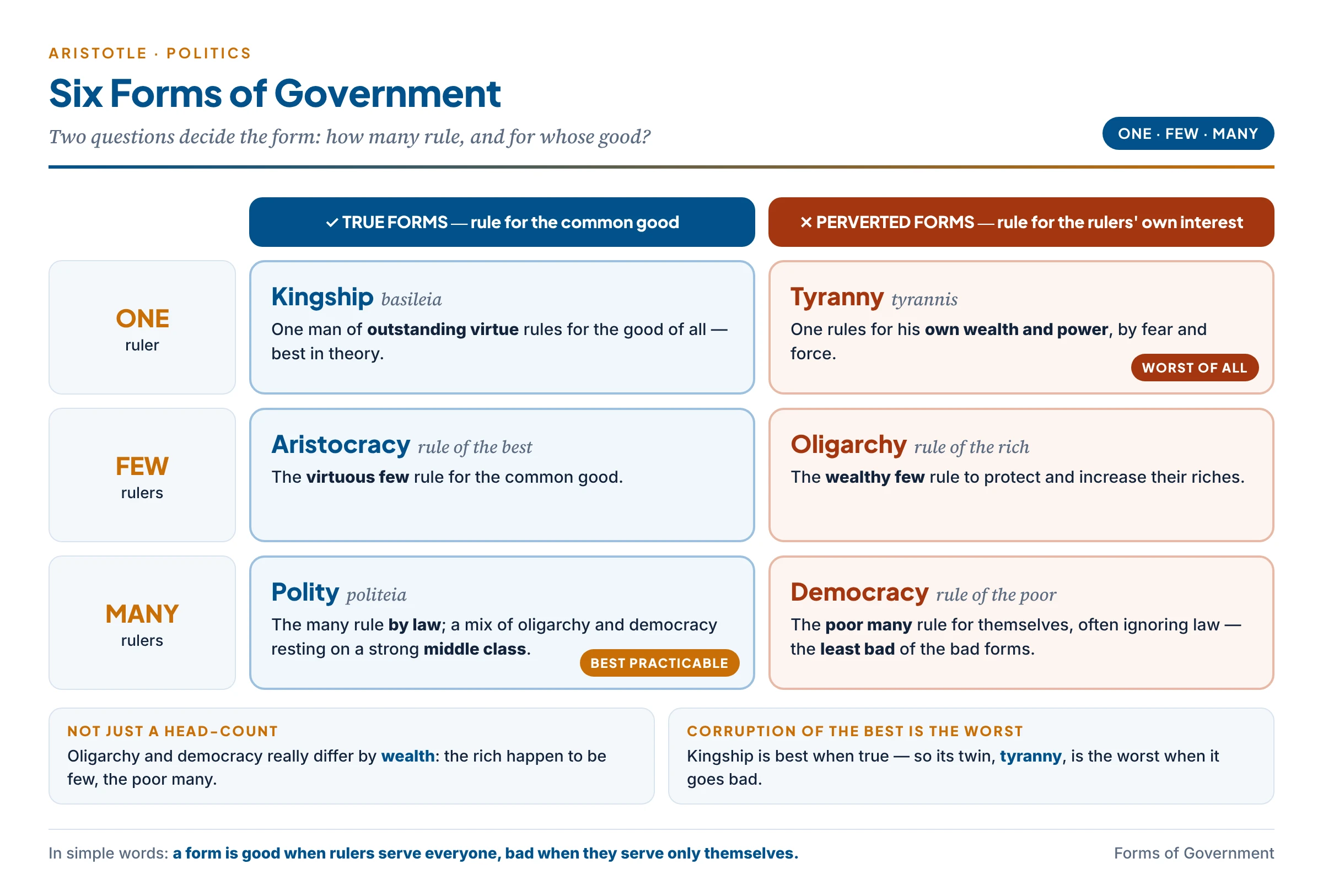
- Ranking. Kingship is best in theory, tyranny worst; the corruption of the best is the worst. Among the perverted forms, democracy is the most tolerable, tyranny the worst.
- Wealth, not number, is the real difference. Aristotle notes that oligarchy and democracy differ because the first is rule of the rich and the second of the poor — the rich happen to be few and the poor many. So his classification is social and economic, not merely arithmetical.
- Polity — the best practicable form. Ideal kingship and aristocracy need rare virtue. For ordinary cities, Aristotle recommends polity:
- A mixture of oligarchy and democracy — for example, election (an oligarchic device) combined with a modest property qualification low enough to admit most citizens, or some offices by lot (a democratic device) and others by election.
- Based on a large middle class, which is neither arrogant like the rich nor envious like the poor, and so keeps the city stable.
- Governed by law rather than by the passing will of any group: “the rule of law is preferable to that of any individual”.
- Wisdom of the many. Aristotle also gives a partial defence of popular rule: many ordinary people together may judge better than one expert, as a feast to which many contribute is better than a dinner given by one; and “the guest will judge better of a feast than the cook”.
Common confusion
Did Aristotle call democracy the good rule of the many? No. In Aristotle’s scheme the correct form of rule by the many is polity. Democracy is the perverted form — rule by the poor for their own benefit, often ignoring law. It is the “least bad” of the bad forms, but still a deviation. When modern writers praise “democracy”, they mean something closer to Aristotle’s polity: rule of the many, under law, for the common good.
Polybius: The Cycle of Constitutions (Anacyclosis)
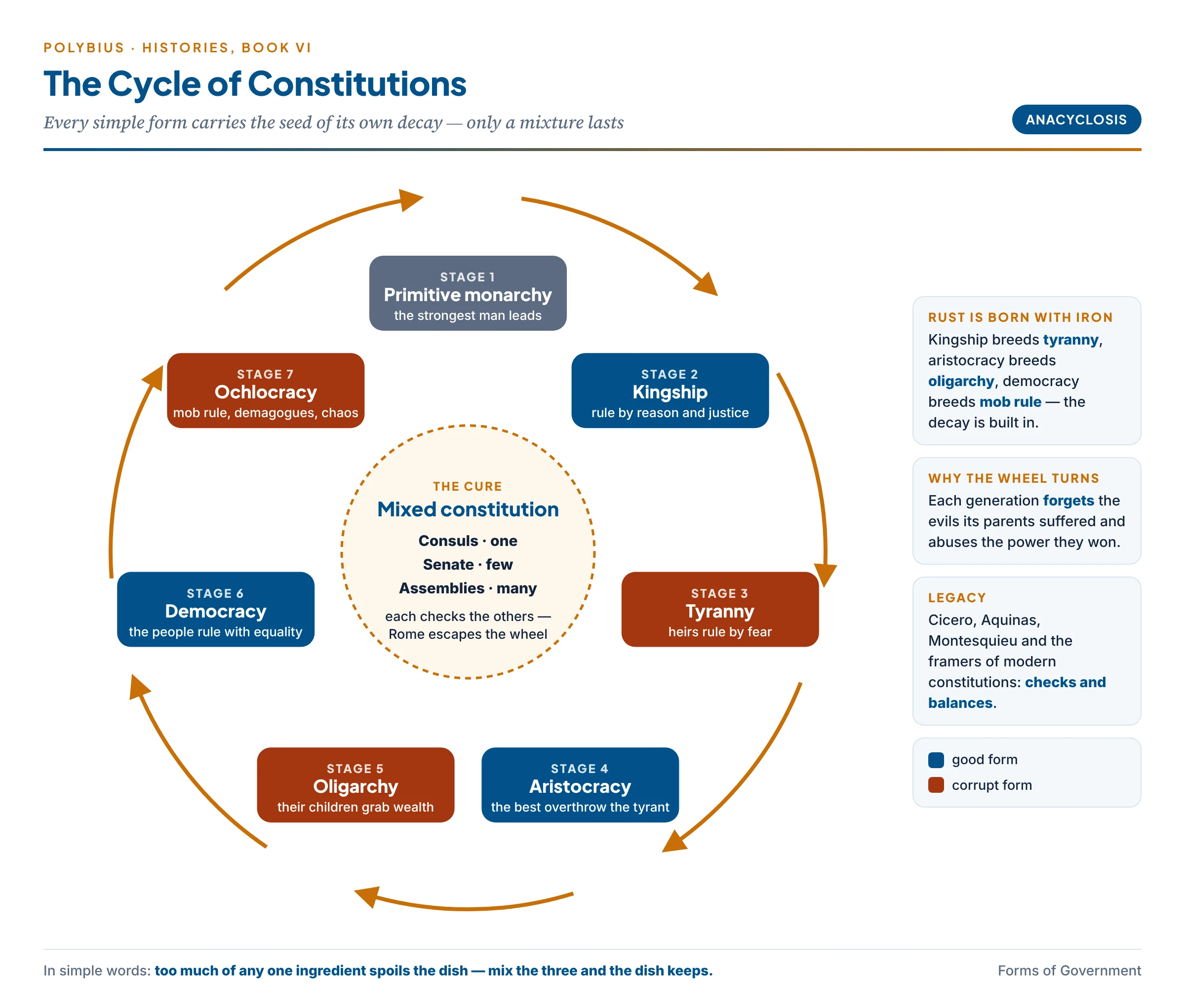
- Polybius (c. 200–118 BC), a Greek historian living in Rome, explained in Book VI of his Histories why Rome rose so fast. He combined Plato’s decline and Aristotle’s six forms into a natural cycle (anacyclosis):
- Primitive monarchy — after a disaster, people gather under the strongest man.
- Kingship — reason and justice replace mere strength; the ruler is accepted willingly.
- Tyranny — the king’s heirs, born to privilege, indulge themselves and rule by fear.
- Aristocracy — the best citizens overthrow the tyrant and rule for the common good.
- Oligarchy — their children, who never knew tyranny, grab wealth and power.
- Democracy — the people overthrow the oligarchs and rule with equality and free speech.
- Ochlocracy (mob rule) — later generations, used to freedom, follow demagogues, accept bribes and use violence; chaos returns, and a strong man restarts the cycle.
- Lesson: every simple form — of one, few or many — carries the seed of its own decay, as rust is born with iron and woodworm with timber.
- The cure: the mixed constitution. Rome lasted because it mixed all three:
- Consuls — the monarchical element (command, war, administration).
- Senate — the aristocratic element (finance, foreign policy).
- Popular assemblies and tribunes — the democratic element (laws, elections, final appeal).
- Each part checks the others, so none can slide into its corrupt form. This is the ancestor of the modern idea of checks and balances.
The Mixed Constitution after Polybius
- Cicero (De Re Publica): kingship, aristocracy and democracy each have merits, but a balanced blend of the three is best — the Roman Republic at its height.
- Aquinas: rule by one is best for unity and peace, but the best regime mixes one ruler chosen for virtue, a few wise men under him, and the people’s share in electing them.
- Machiavelli (Discourses on Livy): Rome’s liberty came from the conflict between nobles and people, contained within a mixed order.
- Britain’s “King-in-Parliament”: monarch (one), House of Lords (few), House of Commons (many) — praised in the eighteenth century as a living mixed constitution.
- Is blending monarchy and democracy conceivable? Yes — constitutional monarchy is exactly such a blend: the monarch gives continuity and a neutral head of state; elected representatives govern. The detailed case, with its benefits and defects, is in Article 3.
In simple words
A good recipe is not just sugar, or just salt, or just spice. Too much of any one spoils the dish. Polybius says the same of governments: rule by one becomes tyranny, rule by few becomes greed, rule by many becomes chaos. Mix them so each balances the others, and the dish keeps.
Montesquieu: Three Forms and Their “Principles”
- Montesquieu (1689–1755), in The Spirit of the Laws (1748), classified governments by their nature (who holds power) and their principle (the passion that keeps them going):
| Form | Nature | Principle | Corruption |
|---|---|---|---|
| Republic — democratic or aristocratic | The people, or a part of them, hold power | Virtue — love of country and of equality | Loss of virtue; each seeks private gain |
| Monarchy | One rules by fixed and established laws, through intermediate powers (nobility, courts) | Honour — love of rank, distinction, privilege | The king abolishes intermediate powers and rules by whim |
| Despotism | One rules by his own will and caprice, without law | Fear | Already corrupt by nature |
- Key move: Montesquieu separates monarchy (rule of one under law) from despotism (rule of one by will). A form is judged not just by number but by whether power is limited.
- Separation of powers. Liberty needs legislative, executive and judicial power in different hands, so that “power checks power”. This idea shaped the US Constitution (1787) and modern constitutionalism.
Modern Classifications
- By the relation of executive and legislature:
- Parliamentary — the executive (cabinet) comes from and is responsible to the legislature; a nominal head (monarch or president) and a real head (prime minister). Britain, India, Japan.
- Presidential — an elected president with a fixed term, separate from the legislature; checks and balances. USA, Brazil.
- Semi-presidential — a directly elected president shares power with a prime minister responsible to parliament. France.
- By the distribution of power between centre and regions: unitary (Britain, France, China) vs federal (USA, Switzerland, India — “a Union of States” with a strong centre).
- By the source of the head of state: monarchy (hereditary head) vs republic (elected or appointed head). India is a republic; Britain is a monarchy even though both are parliamentary democracies.
- By the extent of power and freedom: democratic, authoritarian and totalitarian regimes — today the most used classification.
- By the source of legitimacy (Max Weber’s three types of authority):
- Traditional — obeyed because “it has always been so”: hereditary monarchy.
- Charismatic — obeyed because of the extraordinary personal qualities of a leader: prophets, revolutionary leaders, many dictators.
- Legal-rational — obeyed because of rules made by correct procedures: modern constitutional democracy and bureaucracy.
- A current picture. The 2026 Democracy Report of the V-Dem Institute counted 92 autocracies and 87 democracies in the world at the end of 2025, with more people living under autocracy than under democracy. The old question of forms of government is not academic.
Indian Connect — Gaṇa and rājya: India’s republics
- Ancient India knew both rājya (kingdom, rule of one) and gaṇa or saṅgha (republic or oligarchy of clans, rule of many). The Vajji confederacy with its capital at Vaiśālī, the Licchavis, the Śākyas (the Buddha’s own clan) and the Mallas were governed by assemblies of clan heads meeting in a hall (santhāgāra), with discussion and voting.
- The Buddha, in the Mahāparinibbāna Sutta, praises the Vajjis’ “conditions of welfare”: they meet often and in large numbers, meet and disperse in concord, respect established laws, honour their elders, protect women and respect shrines. As long as they keep these, he says, they will prosper. He modelled the monastic saṅgha’s procedures — motions, discussion, voting by tickets (śalākā) — on these assemblies.
- The Mahābhārata‘s Śānti Parva warns that a gaṇa is destroyed by internal dissension, greed and leaks of counsel — the same danger of faction that Aristotle and Polybius saw.
- Kauṭilya advises the king to win over or divide the saṅghas, which he regards as hard to conquer because of their unity. So India’s classical thought, like Greek thought, contrasted rule of one with rule of many.
Dictatorship: Meaning and Kinds
- Origin. In the Roman Republic, a dictator was a lawful emergency magistrate, appointed for at most six months to meet a war or rebellion, after which he gave up power. The legendary Cincinnatus is said to have returned to his plough after saving Rome.
- Modern meaning. Dictatorship today means rule by one person or a small group with unlimited power, not bound by law, not accountable to the people, and not removable by peaceful, regular means.
- Main features:
- Concentration of power in one leader, a party, or a junta.
- Absence of free elections or elections without real choice.
- Suppression of opposition, press and independent courts.
- Rule by decree and by force; the secret police.
- Legitimacy claimed through ideology, nationalism, religion, or the leader’s personal charisma.
- Kinds:
- Military dictatorship — the army seizes power, often by a coup (Chile under Pinochet after 1973; Myanmar after 2021).
- One-party dictatorship — a single party monopolises power in the name of an ideology (the Soviet Union; Nazi Germany).
- Personal dictatorship — power rests on one individual and his family or clique.
- Theocratic dictatorship — rule by a clerical leader in the name of God (see Articles 4–5).
- Constitutional or emergency dictatorship — temporary, legally granted emergency powers, as in the Roman model; modern constitutions provide for emergencies (India’s Emergency of 1975–77 under Article 352 showed how such powers can be misused, and the 44th Amendment of 1978 tightened them).
- Autocracy (rule of one with unlimited power) and authoritarianism (rule that demands obedience and tolerates only limited pluralism) are the wider families to which dictatorships belong.
Totalitarianism: Something New
- Hannah Arendt, in The Origins of Totalitarianism (1951), argued that Nazism and Stalinism were not old tyranny in new clothes but a radically new form of government.
- Its marks:
- An all-explaining ideology — a single “key” to history (race for the Nazis, class for the Stalinists) that claims to know where history must go.
- Terror — not only against enemies but against the innocent, to make everyone afraid; secret police and concentration camps.
- Atomisation of society — families, unions, churches, clubs, every independent group is destroyed, so that isolated, lonely individuals face the state alone.
- Mass movements and propaganda that replace reality with a closed, self-confirming fiction.
- Mussolini’s formula sums up the ambition: “Everything in the State, nothing outside the State, nothing against the State.” Fascism added the leader principle (Führerprinzip): absolute obedience to the leader, who embodies the nation’s will.
- A common list of features (often taught as the “totalitarian syndrome”): an official ideology; a single mass party led by one man; terroristic police; monopoly of mass media; monopoly of weapons; and a centrally directed economy.
| Basis | Traditional despotism / authoritarianism | Totalitarianism |
|---|---|---|
| Aim | Obedience and keeping power | Total transformation of society and human nature |
| Private life | Left alone if one does not challenge the ruler | Every sphere — family, religion, art, science — controlled |
| Ideology | Weak or traditional (religion, custom) | All-embracing, “scientific” ideology |
| Society | Some independent groups survive (church, nobility, business) | All independent groups destroyed; individuals atomised |
| People | Kept passive, depoliticised | Mobilised in mass rallies and movements |
| Terror | Against opponents | Against everyone, even the loyal |
Common confusion
Are dictatorship, authoritarianism and totalitarianism the same? No. Dictatorship names who holds power — one person or a small group, unaccountable and above law. Authoritarianism is a regime that demands obedience but leaves society some room — a general may rule while churches, businesses and families carry on. Totalitarianism is the extreme case where the state seeks to control everything, including thought, through ideology and terror. Every totalitarian regime is a dictatorship, but most dictatorships are not totalitarian.
Do Monarchy, Democracy and Dictatorship Share Common Features?
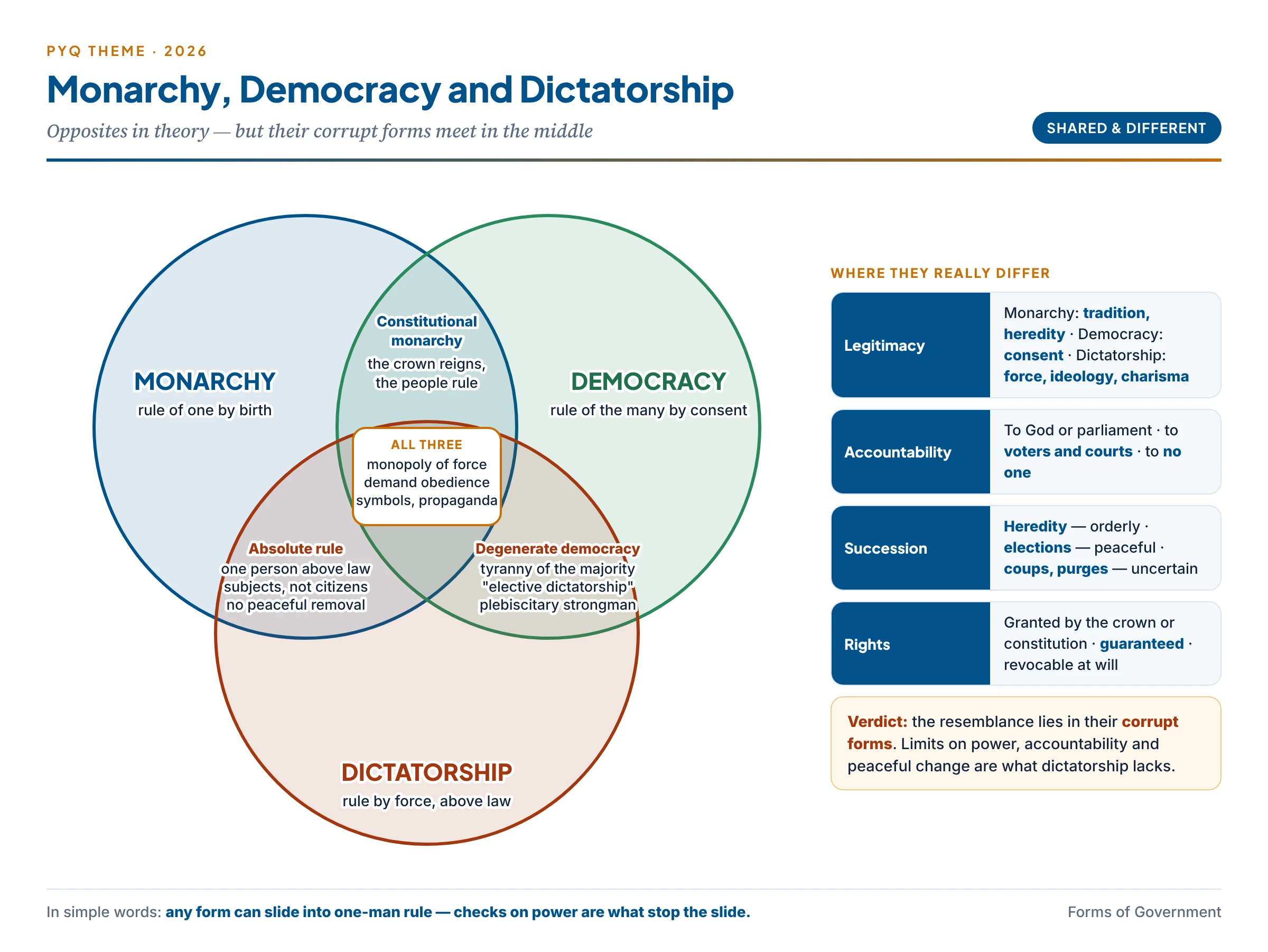
Monarchy and democracy look like opposites — one person by birth, all citizens by vote. Yet each can share some features of dictatorship.
- Where absolute monarchy resembles dictatorship:
- One-person rule with power above law — Louis XIV’s France, the despotism that Montesquieu describes.
- Subjects, not citizens — duties without rights, dissent treated as treason.
- Personality cult — the divine or semi-divine king, as the dictator’s portrait on every wall.
- No peaceful removal of a bad ruler.
- Where democracy can resemble dictatorship:
- Tyranny of the majority (Tocqueville, Mill) — a majority can crush minorities as harshly as any king.
- “Elective dictatorship” — the phrase Lord Hailsham used in 1976 for a British government with a large majority in a parliament it controls, checked only by elections every few years.
- Plebiscitary dictatorship (Caesarism or Bonapartism) — leaders who win power or approval by popular vote and then rule without limits; Napoleon III used plebiscites to become emperor; the Nazis came to power through elections and then passed the Enabling Act of 1933.
- Plato’s warning — democracy breeds the “protector of the people” who becomes the tyrant.
- Hero-worship — Ambedkar warned that devotion to a leader in politics is “a sure road to degradation and to eventual dictatorship”.
- What all three share as states: all claim a monopoly of legitimate force (Max Weber), demand obedience, and use propaganda and symbols to win loyalty. Hobbes even said that sovereign power is equally absolute whether it lies in one man or in an assembly.
- Where they differ — and the difference is decisive:
| Basis | Monarchy | Democracy | Dictatorship |
|---|---|---|---|
| Source of legitimacy | Tradition, heredity, sometimes divine right | Consent of the people, constitution | Force, ideology or the leader’s charisma |
| Accountability | To God or tradition (absolute); to parliament (constitutional) | To voters, courts, free press | To no one |
| Succession | Fixed by heredity — orderly | By regular elections — peaceful | Uncertain — coups, purges, struggles |
| Rights | Granted by the monarch (absolute) or by the constitution | Guaranteed and enforceable | Revocable at the ruler’s will |
| Rule of law | Absent (absolute) or present (constitutional) | Central | Rule by decree |
- Conclusion. The view is partly true: monarchy and democracy can degenerate into dictatorship-like rule, and all three share the coercive apparatus of the state. But a constitutional monarchy and a liberal democracy contain what dictatorship lacks — limits on power, accountability and peaceful change. The resemblance lies in their corrupt forms, as Aristotle and Polybius foresaw. The full argument is developed in Article 3.
Monarchy, Theocracy and Democracy at a Glance
The syllabus names three forms. Their core logic can be compared in one table; later articles take each in turn (monarchy — Articles 2–3; theocracy — Articles 4–5; democracy — Articles 6–10).
| Dimension | Monarchy (classical, absolute) | Theocracy | Democracy (constitutional) |
|---|---|---|---|
| Ultimate seat of sovereignty | The monarch | God — the divine will, sacred law, scripture | The people (popular sovereignty) |
| Source of legitimacy | Hereditary lineage, conquest, or a social covenant | Divine revelation and holy scripture | Popular consent, constitution, fundamental rights |
| Nature of law | The command of the king | Divine command as interpreted by the clergy | Product of public reason and elected assemblies |
| Status of the individual | Subject — obedience in return for protection | Believer or ward — owes piety and submission to orthodoxy | Citizen — equal co-author of the laws, with rights |
| How leaders change | Dynastic succession, assassination, war | Divine appointment, clerical selection | Free, fair, periodic, competitive elections |
| How dissent is treated | Treason, sedition | Heresy, apostasy, blasphemy — sin becomes crime | Legitimate opposition; minority rights protected |
| Typical corruption | Tyranny — exploitation for the ruler’s luxury | Religious totalitarianism — persecution in God’s name | Ochlocracy — mob rule, tyranny of the majority |
Is a Benevolent Dictatorship Better than Democracy?
- The case for it: quick decisions, long-term planning, freedom from vote-bank politics; examples often cited are rapid development under strong rulers; Plato’s philosopher-king is the ideal version.
- The case against it:
- No guarantee that the dictator will stay benevolent — “power tends to corrupt, and absolute power corrupts absolutely” (Lord Acton).
- No peaceful succession — the good ruler’s heir may be a Nero.
- No correction of mistakes — without a free press and opposition, the ruler does not learn of failures in time.
- Passive citizens — Mill argued that even a good despot makes people mentally passive and morally stunted, because they never exercise judgment.
- Self-rule has value in itself — being a co-author of the laws expresses human dignity.
- Verdict: a benevolent dictatorship may sometimes be efficient, but democracy is safer and more respectful of persons. The full debate, with Plato, Mill, Sen and Popper, is in Article 9.
Which Is the Best Form of Government?
- Classical answers: Plato — rule of the wise; Aristotle — polity, the best practicable; Polybius and Cicero — the mixed constitution; Montesquieu — any form with separated, limited powers.
- The modern answer: constitutional, liberal democracy — not because it is perfect, but because it allows peaceful change and self-correction. Churchill’s famous remark in the House of Commons (1947): “democracy is the worst form of government except for all those other forms that have been tried from time to time.”
- “Beyond democracy”? Proposals include meritocracy (rule by the most able, a term coined by Michael Young in 1958 as a satire), epistocracy (rule by the knowledgeable), Gandhi’s Rāmarājya of self-governing villages, and Marx’s withering away of the state. These are examined in Articles 8–9.
Critical Evaluation
Criticisms of the Classical Classifications
- Too mechanical. Classifying by number of rulers is simple but shallow: two “democracies” — Switzerland and a one-party “people’s democracy” — may differ more than a democracy and a constitutional monarchy.
- Built for city-states. Aristotle’s 158 constitutions were small Greek cities. They do not fit vast modern nation-states with parties, bureaucracies, federalism and mass media.
- Modern states are mixed. Britain is a monarchy and a democracy; India is a republic and a parliamentary democracy with federal features. Pure forms rarely exist.
- The cycle is not inevitable. Polybius’ cycle is too neat; history shows long-lasting democracies and sudden leaps, not a fixed wheel.
- Number hides class. Marxists argue that what matters is which class the state serves, not how many sit in office: a parliamentary democracy may still be a “dictatorship of the bourgeoisie”.
- Ignores legitimacy and ideology. Weber’s types of authority and Arendt’s totalitarianism show that the source and aim of power matter as much as its holders.
Replies and Defences
- Aristotle was never merely arithmetical. His second criterion — common good vs private interest — is moral, and he saw that oligarchy and democracy differ by wealth, not number. That is a social analysis, not a head-count.
- The deep questions remain. Who should rule? For whose good? Under law or above it? Every modern classification — democratic, authoritarian, totalitarian — still answers Aristotle’s two questions.
- Mixing was the classical answer. Polybius, Cicero and Aquinas already knew that pure forms decay and recommended mixed government; modern checks and balances are their heirs.
- The degeneration thesis is still useful. Democratic backsliding, elected leaders who dismantle courts and press, and “elective dictatorship” confirm the classical warning that every form can slide into its perverted twin.
Critics and Defenders
Criticism — Critics
- Mechanical numbering: one–few–many ignores parties, bureaucracy, federalism and the media of modern states.
- Small-city bias: classical schemes were built for Greek city-states.
- Fixed cycle unrealistic: Polybius’ wheel of constitutions does not match history.
- Class blindness (Marxists): the class character of the state matters more than the number of rulers.
- Legitimacy ignored: Weber and Arendt show that the source and aim of power define a regime.
Defence — Defenders and strengths
- Two criteria, not one: Aristotle judged by the common good and by wealth, not number alone.
- Timeless questions: who rules, for whose good, under law or not — still the core of every classification.
- Mixed constitution: the classical remedy became modern checks and balances.
- Degeneration warning: backsliding democracies and elected strongmen confirm it.
- Montesquieu’s insight: separating rule under law from rule by will remains the key test of free government.
Cross-Tradition Comparison
Greek and Indian Thinking on Forms of Rule
| Theme | Western (Plato, Aristotle, Polybius) | Indian (Mahābhārata, Kauṭilya, Buddhist texts) |
|---|---|---|
| Basic forms | One, few, many — kingship, aristocracy, polity and their corruptions | Rājya (kingdom) and gaṇa / saṅgha (republic of clans) |
| Why government exists | To make the good life possible (Aristotle: man is a political animal) | To end mātsya-nyāya — the “law of the fishes”, where the big devour the small |
| Standard of good rule | Common good, rule of law, virtue | Dharma; the king’s happiness lies in the happiness of his subjects (Kauṭilya) |
| Cause of decline | A lower part of the soul takes over; rulers seek private interest | Decline of dharma; for gaṇas, internal dissension and greed |
| Ruler and age | Polybius: the character of rulers turns the wheel of constitutions | Mahābhārata: “the king is the maker of the age” — a righteous king can bring back the golden age |
| Remedy | Mixed constitution; checks and balances; law | Rājadharma binding the king; council of ministers; the assembly’s concord in gaṇas |
Indian Connect — Key takeaways
- Both traditions saw that government exists to stop the strong from devouring the weak — Greek “justice” and Indian mātsya-nyāya answer the same fear.
- Both judged a ruler by a standard above him — the common good and law for Aristotle, dharma for Indian thinkers — so neither treated power as its own justification.
- Plato’s ladder of decline and the Indian idea of declining yugas both see political order as fragile; but the Mahābhārata‘s claim that “the king is the maker of the age” puts the responsibility squarely on rulers, much as Polybius did.
- India’s gaṇa-saṅghas show that rule by assembly, discussion and voting is not a purely Western inheritance — a point Ambedkar and Nehru made when India adopted parliamentary democracy.
Synthesis (Siddhānta)
- The core insight. Forms of government answer two questions — who rules and for whose good. Plato added the soul behind each form, Aristotle the common-good test, Polybius the cycle of decay, Montesquieu the test of law vs will, Weber the source of legitimacy, Arendt the new danger of total rule.
- No pure form is safe. Rule by one tends to tyranny, by few to oligarchy, by many to mob rule. The lasting solution is mixed and limited government — power divided, checked, and bound by law.
- Monarchy, theocracy and democracy differ above all in where they locate sovereignty — the king, God, or the people — and therefore in how they treat the individual: as subject, believer, or citizen.
- Contemporary relevance.
- Democratic backsliding and the rise of electoral autocracies make the classical “degeneration” thesis newly relevant.
- Constitutional monarchies (Britain, Japan, the Scandinavian states) show that old forms can be blended into democracy.
- India’s Constitution combines a republic, a parliamentary executive, federal structure and judicial review — a modern mixed constitution in all but name.
- Emergency powers remain the doorway through which lawful government can pass into dictatorship; constitutional safeguards are the lock.
“The rule of law is preferable to that of any individual.” — Aristotle
Previous Year Questions
- 2026“The two antagonistic state structures – monarchy and democracy, both share some common features with dictatorship”. Do you agree with this view? Give reasons and justifications for your answer.
- 2025Comment on Plato’s critique of Democracy.
- 2017Discuss whether a blending of monarchy with democracy is conceivable to avoid their undesirable defects for making the governance better for citizens and state.
- 2013Is a democratic government better than a benevolent dictatorship? Give reasons for your answer.
- 2002Do you think that democracy is the best form of government? Is there any scope of “beyond democracy”? In this context, analyze the notion of meritocracy.