

Individual and State: Rights; Duties and Accountability.
Official Syllabus: Paper II, Section A, Unit 3
Rights tell us what is due to a person; duties tell us what is owed; accountability asks who must answer — and to whom — when rights are abused or duties neglected. Accountability runs both ways: the state must answer to citizens for how it uses power, and citizens must answer to the law for how they use their rights. Behind it lies an older question: why should a citizen obey the state at all (political obligation)? — and its sharpest edge: when may a citizen disobey (civil disobedience)? This article covers the meaning and kinds of accountability, the difference between accountability and responsibility and whether accountability leads to moral perfection, the accountability of the state (rule of law, Locke’s trust, Kautilya, constitutional checks) and of citizens, whether rights make citizens accountable in the Indian scenario, the grounds of political obligation (consent, gratitude, fair play, Green, utility) and the anarchist challenge, and the ethics of civil disobedience in Thoreau, Gandhi, Rawls and Martin Luther King — with Ambedkar’s warning about the “grammar of anarchy”.
In simple words
A school prefect who can punish other students must explain his decisions to the principal and to the class; the students, in turn, must answer for breaking school rules. And if the principal makes a plainly unfair rule — say, punishing a whole class for one student’s mischief — students may protest openly and peacefully, accepting the consequences. Accountability, obligation and civil disobedience are all here in one school.
Context & Problem
Meaning of Accountability
- Definition. Accountability is answerability before law for the misuse of rights and the negligence of duty. To be accountable is to be obliged to explain and justify one’s conduct to someone who can judge and sanction it.
- Elements.
- Answerability — the duty to give an account (information and justification).
- Enforceability — the possibility of sanctions (punishment, removal, loss of office).
- A forum — someone to whom the account is given: court, legislature, voters, superior officer, public.
- Beyond administration. In political philosophy accountability is not merely bureaucratic oversight; it is a normative contract between the governed and those who govern.
Accountability and Responsibility
- Accountability is legal in nature and brings direct punishment — a fine, a prison term, removal from office.
- Responsibility is moral in nature and brings indirect punishment — guilt, shame, loss of respect, the law of karma.
- Accountability may not necessarily make a person a better human being; responsibility — the inner acceptance of one’s duties — leads towards moral perfection.
Core Doctrine
Kinds of Accountability
| Kind | Meaning | Example |
|---|---|---|
| Political accountability | Duty of rulers and representatives to justify their actions before the public | Ministers answering questions in Parliament; elections |
| Administrative accountability | Duty of each government official to explain his conduct to a senior official | Departmental inquiries; annual performance appraisals |
| Legal accountability | Answerability before courts for illegal acts | Judicial review of executive action; criminal trials of officials |
| Financial accountability | Proper use of public money | Audit by the Comptroller and Auditor General (Article 148) |
| Social accountability | Answerability directly to citizens and communities | Social audits under MGNREGA; citizens’ report cards |
| Moral accountability | The individual must use his free will to choose between good and evil because he is accountable for his actions | Conscience; answering to God or to one’s own reason |
Accountability of the State to the Individual
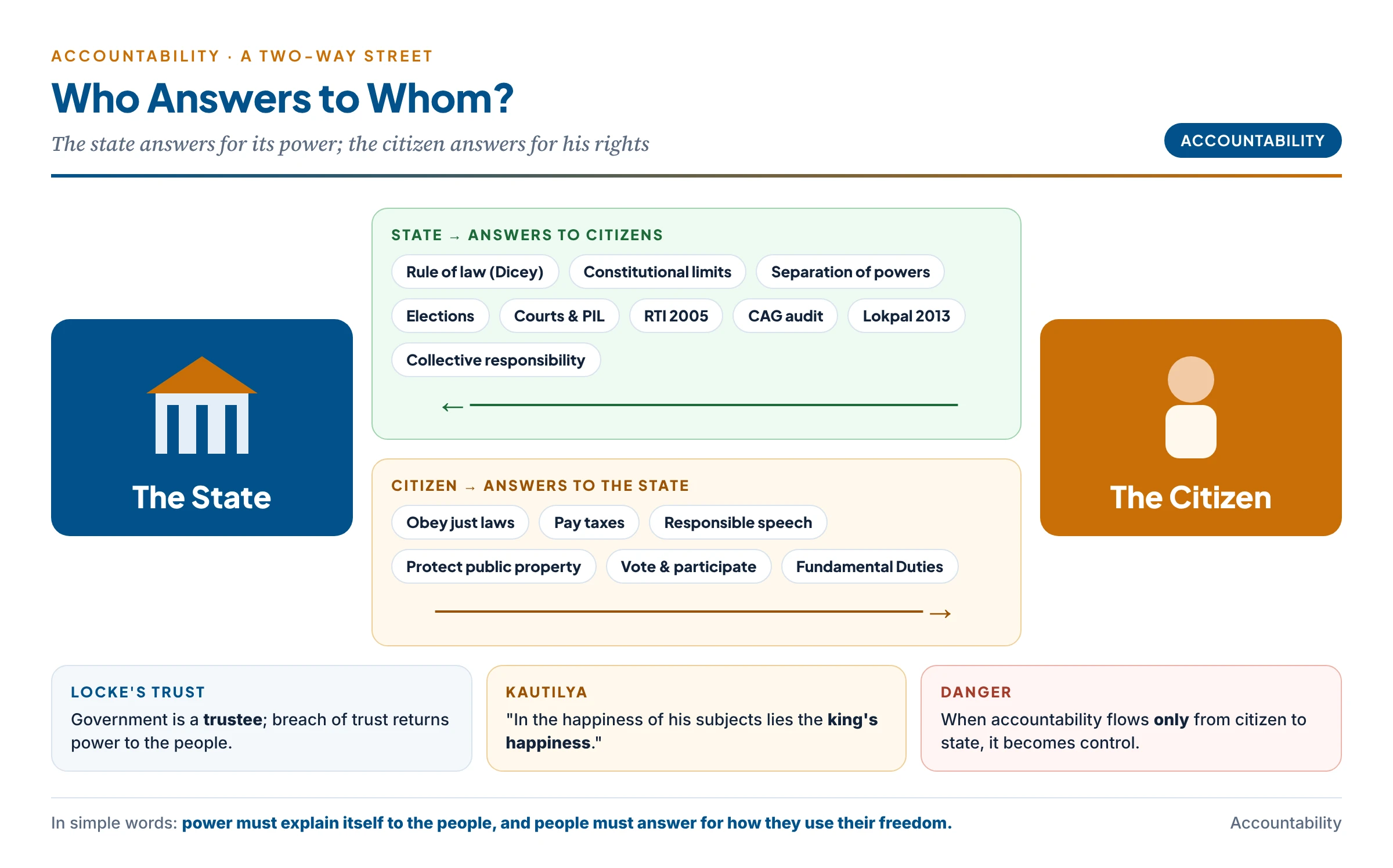
- Rule of law (A. V. Dicey). No one is punished except for a breach of law proved in ordinary courts; no one is above the law; rights are secured by courts. It means the absence of arbitrary power.
- Constitutionalism. An accountable state is limited by the rights of citizens guaranteed by the constitution; power is granted, defined and limited by law.
- Separation of powers (Locke, Montesquieu). Legislature, executive and judiciary check one another; “power should be a check to power”.
- Locke’s fiduciary trust. Political power is held as a trust for the people’s life, liberty and estate. The government is a trustee, not a master; if it breaches the trust through arbitrary usurpation, power reverts to the people.
- Kautilya’s accountable king. The king’s authority is justified only by the welfare of his subjects: “In the happiness of his subjects lies his happiness; in their welfare his welfare.” (prajā-sukhe sukhaṃ rājñaḥ, prajānāṃ ca hite hitam) Kautilya also warned that it is as hard to detect officials misappropriating revenue as to know when fish in water drink it — and prescribed audits, spies and punishments.
- Transparency and deliberation (Habermas, Sen). Power must justify itself in public reason; Sen notes that famines do not occur in functioning democracies with a free press, because governments must answer for them.
- Parliamentary democracy. The parliamentary form is considered most accountable because of collective responsibility — the Council of Ministers is collectively responsible to the Lok Sabha (Article 75(3)) and can be removed by a no-confidence vote.
Accountability of the Individual to the State
- Civic duty — compliance with just laws.
- Fiscal responsibility — paying taxes.
- Responsible use of rights — free speech without incitement to violence or defamation; protest without destroying public property.
- Democratic vigilance — active public participation, as J. S. Mill urged; voting, informed criticism, serving on juries and local bodies.
- Ethical loyalty, not blind jingoism — Tagore warned against worshipping the nation; a citizen’s loyalty is to the moral community, and criticism of the state can itself be a duty.
- Protest as accountability. If the government falters from right judgement, it is the moral obligation of the individual to raise protest; Gandhi suggested the method of civil disobedience for such situations.
In simple words
A shop’s CCTV camera stops some people from stealing — that is accountability. A person who would not steal even with the camera switched off has responsibility. The camera can make people behave; only conscience makes them good.
Does Accountability Necessarily Contribute to Moral Perfection?
- No — the case against.
- Accountability works through sanctions — fear of punishment. Kant called action from fear heteronomy; it has no moral worth.
- Plato’s Ring of Gyges (Republic) — a shepherd who finds a ring making him invisible begins to steal and kill; Glaucon argues that people are just only because they are watched. External accountability produces conformity, not virtue.
- People may learn to game accountability — meeting targets on paper, avoiding blame — without becoming better.
- Responsibility, not accountability, leads to moral perfection — it is internal, chosen and self-directed.
- Yes, partly — the case for.
- Aristotle — we become just by doing just acts; laws train citizens through habit until virtue becomes second nature. Accountability can be the scaffolding of virtue.
- Self-accountability — when one holds oneself to account (Gandhi’s daily self-examination, the Buddhist practice of reflection), accountability becomes responsibility.
- Public life — accountability prevents abuse of power, protecting others’ chances of a good life.
- Balanced view. Accountability does not necessarily produce moral perfection; it secures right conduct, which may grow into right character when it is internalised as responsibility.
Common confusion
Are “accountability” and “responsibility” just two words for the same thing? No. Accountability is answerability to someone else who can judge and sanction — it is external and usually legal. Responsibility is the inner acceptance of one’s duty — it is moral and self-imposed. A corrupt official can be fully accountable (audited, punished) without feeling any responsibility; a good citizen can act responsibly when no one is checking. The two meet when people hold themselves to account.
Do Rights Make Citizens Accountable to the State? The Indian Scenario
- Yes — rights carry accountability.
- Reasonable restrictions. Article 19(2)–(6) limits freedoms on grounds such as public order, decency, morality, defamation and incitement to an offence; misuse of speech (hate speech, defamation) makes a citizen accountable in court.
- Fundamental Duties. Article 51A reminds citizens that enjoyment of rights goes with duties — to respect the Constitution, protect public property, protect the environment.
- Digital rights and responsibilities. Rules on online platforms, and the Digital Personal Data Protection Act (2023), place duties on users and companies alike.
- Electoral accountability. Citizens who exercise the vote share responsibility for the government they choose.
- Equally — rights make the state accountable to citizens.
- Right to Information Act (2005) — citizens can demand records from public authorities.
- Public interest litigation and the writ jurisdiction (Articles 32 and 226) — any citizen can approach courts against unlawful state action.
- Voters’ right to know — candidates must disclose criminal records, assets and education (Union of India v. Association for Democratic Reforms, 2002); the NOTA option (PUCL, 2013); and in February 2024 the Supreme Court struck down the electoral bonds scheme as violating voters’ right to information.
- Lokpal and Lokayuktas Act (2013), the Whistle Blowers Protection Act (2014), social audits and citizens’ charters.
- Concerns. Amendments to the RTI Act (2019) changing the tenure and terms of information commissioners, vacancies in information commissions, and the use of broad laws against critics have raised fears that accountability is flowing one way — from citizens to the state.
- Conclusion. Rights do make citizens accountable — for their responsible use — but their deeper purpose is to make the state accountable to citizens. In a democracy accountability must run both ways.
Political Obligation: Why Obey the State?
- The problem. Why is a citizen morally bound to obey the laws of his state — even laws he disagrees with?
Theories of political obligation
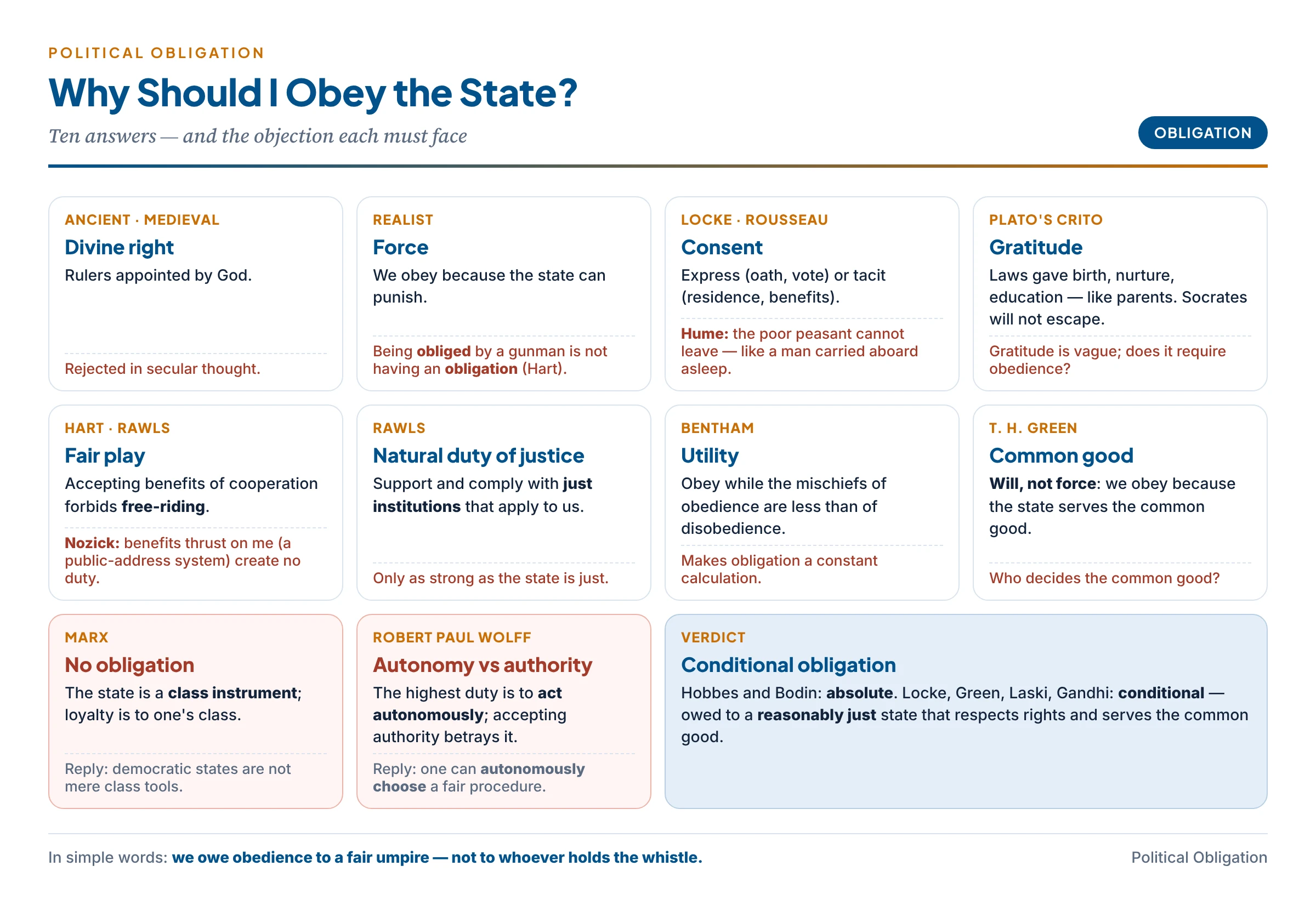
- Divine right — rulers are appointed by God; obedience is a religious duty. Rejected in modern thought.
- Force — we obey because the state can punish. But being obliged (by a gunman) is not having an obligation (H. L. A. Hart).
- Consent (Locke, Rousseau) — we are bound because we have consented, expressly (oath, vote) or tacitly (residence, enjoying the state’s benefits). Hume’s objection: a poor peasant who knows no foreign language cannot really leave his country, so his staying is no more consent than that of a man carried aboard a ship while asleep who chooses not to jump into the sea.
- Gratitude (Plato’s Crito) — Socrates refuses to escape from prison: the laws gave him birth, nurture and education, like parents; he has lived in Athens by choice and accepted its benefits. To flee would be to destroy the laws.
- Fair play (Hart, 1955; Rawls) — when people take part in a mutually beneficial cooperative scheme, those who accept its benefits have an obligation not to free-ride on others’ obedience. Nozick’s objection: a neighbourhood that sets up a public-address system cannot oblige me to take my turn running it just because I hear the broadcasts.
- Natural duty of justice (Rawls) — we have a duty to support and comply with just institutions that apply to us, whether or not we consented.
- Utilitarian (Bentham) — obey so long as the probable mischiefs of obedience are less than the probable mischiefs of disobedience.
- Idealist (Green) — will, not force, is the basis of the state; we obey because we recognise that the state serves the common good; obedience ends where the state clearly betrays it.
- Marxist — there is no moral obligation to a class state; the worker’s loyalty is to his class and to the revolution.
- Philosophical anarchism (Robert Paul Wolff, In Defense of Anarchism, 1970) — the highest duty of mankind is to act autonomously, deciding for oneself what is right; to accept the authority of the state — to obey because it commands — is inconsistent with that duty. Every state is therefore illegitimate in principle (though one may still obey a law when one independently judges it right).
In simple words
A housing society hires a guard, cleans the stairs and keeps the lights on. A resident who enjoys all this but refuses to pay maintenance is a free-rider — that is the fair-play argument. But if a neighbour starts playing music for the whole building and then sends you a bill, you owe nothing — you never asked for it. That is Nozick’s objection.
Replies to Wolff
- Autonomy can be exercised through authority — a rational person can autonomously choose to accept the decisions of a fair democratic procedure, as one accepts a referee’s decisions.
- Coordination needs authority — traffic rules, currency and taxation require common rules that individuals cannot each decide for themselves.
- Joseph Raz’s “service conception” — authority is legitimate when following it helps people act better on the reasons that apply to them anyway.
- Democracy — when citizens take part in making laws, obeying them is a form of self-legislation (Rousseau, Kant).
- Is political obligation absolute or conditional?
- Absolute — Hobbes (while the sovereign protects), Bodin; disobedience leads back to the war of all against all.
- Conditional — Locke (right of revolution when trust is breached), Green (common good), Laski (earned loyalty), Gandhi (morality and truth). Most modern thinkers hold obligation to be conditional on the state being reasonably just.
Civil Disobedience: When Disobedience Becomes a Duty
Definition (Rawls, A Theory of Justice, 1971)
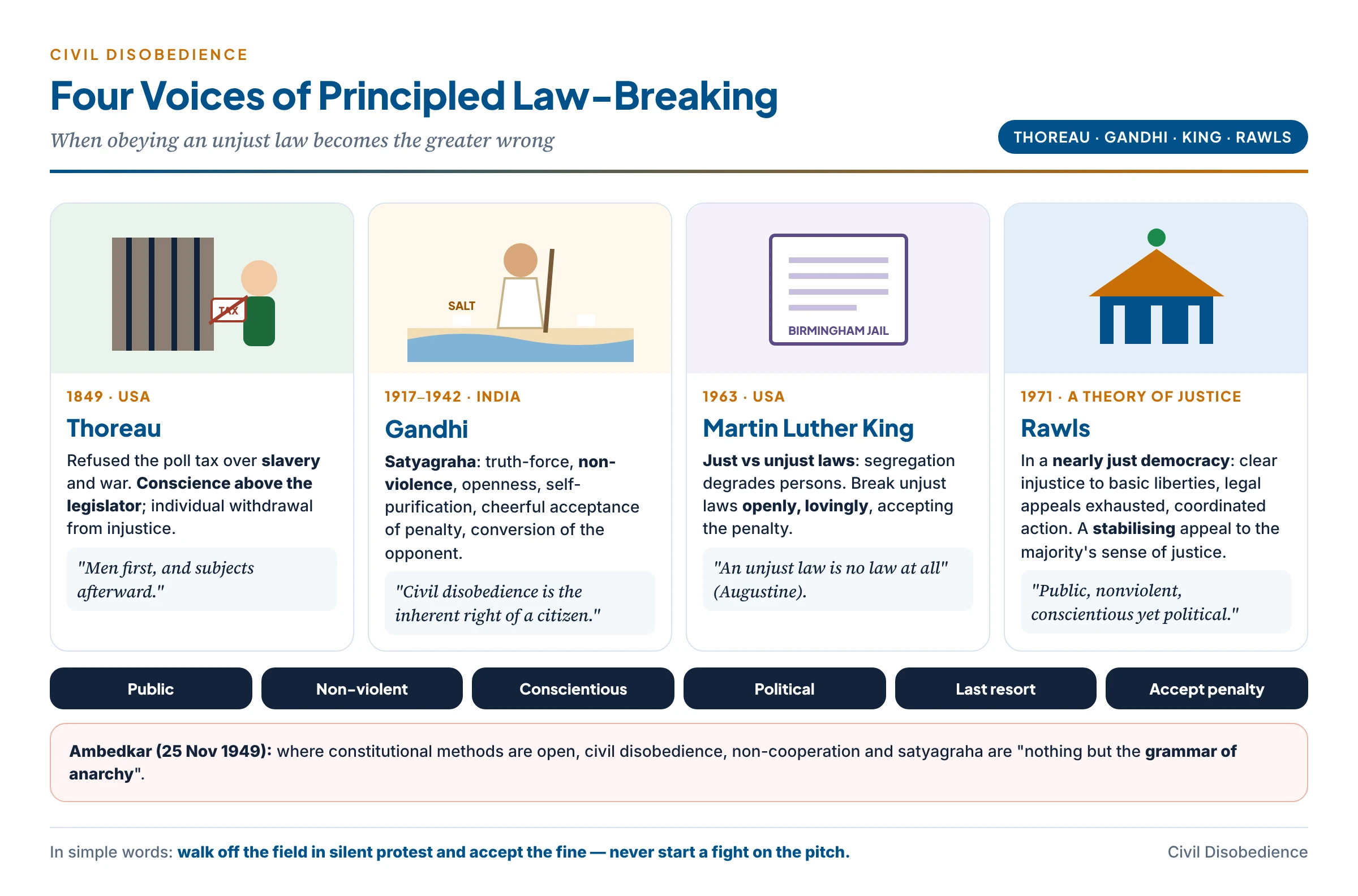
“A public, nonviolent, conscientious yet political act contrary to law usually done with the aim of bringing about a change in the law or policies of the government.” — John Rawls
Features
- Public — done openly, with notice, not secretly.
- Non-violent — no harm to persons; violence would contradict the appeal to conscience.
- Conscientious — based on sincere moral conviction, not self-interest.
- Political — appeals to the community’s shared sense of justice, not to private morality alone.
- Illegal — actually breaks a law (unlike lawful protest).
- Acceptance of penalty — willingness to accept the legal consequences shows fidelity to law as a whole.
Distinguished from
- Lawful protest — demonstrations and petitions within the law.
- Conscientious refusal — refusing to obey a law on personal moral grounds (a pacifist refusing military service) without aiming to change the law publicly.
- Revolution and rebellion — aim to overthrow the whole system, often with violence.
Henry David Thoreau: The Priority of Conscience
- Context. In 1846 Thoreau refused to pay a poll tax to a government that supported slavery and waged the Mexican War; he spent a night in jail and wrote “Resistance to Civil Government” (1849), later known as Civil Disobedience.
- Core ideas.
- “That government is best which governs least” — and, Thoreau adds, “that government is best which governs not at all” when people are ready for it.
- Conscience above legislation: “Must the citizen ever for a moment, or in the least degree, resign his conscience to the legislator? Why has every man a conscience, then? I think that we should be men first, and subjects afterward.”
- Withdraw cooperation from injustice: “Under a government which imprisons any unjustly, the true place for a just man is also a prison.”
- A minority of one can be right; one need not wait for a majority.
- Character. Individualistic and conscience-based — a refusal to be complicit in evil.
Gandhi: Satyagraha
- Truth-force. Satyagraha — “holding on to truth” — is the force of soul against the force of arms. An unjust law is an untruth (asatya) and an act of violence (hiṃsā); obeying it makes the citizen a partner in the state’s wrong.
“Civil disobedience is the inherent right of a citizen. He dare not give it up without ceasing to be a man.” — Mahatma Gandhi
- Conditions of genuine satyagraha.
- Strict non-violence (ahiṃsā) in thought, word and deed.
- Truthfulness and openness — no secrecy or deceit; the authorities are informed in advance.
- Willing acceptance of penalty, cheerfully, without bitterness or retaliation.
- Self-purification and discipline before disobedience — only those who have been law-abiding earn the right to break an unjust law.
- Exhaustion of other means — petitions and negotiation come first.
- Aim of conversion, not defeat — to awaken the opponent’s conscience, not to humiliate him.
- Practice. Champaran (1917), non-cooperation (1920–22), the Salt March (1930), Quit India (1942). When Chauri Chaura (1922) turned violent, Gandhi called off the movement.
- Character. Spiritual and collective — moral purification of the individual and the nation.
Martin Luther King Jr: Just and Unjust Laws
- “Letter from Birmingham Jail” (1963), written after his arrest during the campaign against racial segregation.
- Just and unjust laws. “One has a moral responsibility to disobey unjust laws.” Following Augustine (“an unjust law is no law at all”) and Aquinas, King held that a just law squares with the moral law; an unjust law degrades human personality — segregation laws were unjust.
- How to disobey. “One who breaks an unjust law must do so openly, lovingly, and with a willingness to accept the penalty” — this expresses “the highest respect for law”.
- Gandhi’s influence. King called Gandhi’s method the guiding light of the civil-rights movement.
Rawls: Civil Disobedience in a Nearly Just Democracy
- Setting. A nearly just constitutional democracy, where the majority generally accepts principles of justice but some laws seriously violate them.
- Conditions of justification.
- Substantial and clear injustice — especially violations of equal basic liberties or fair equality of opportunity.
- Normal legal appeals have been tried and have failed.
- Coordination — dissenters should limit their action so that it does not threaten the rule of law or the constitution itself.
- Role. Civil disobedience is a stabilising device: it appeals to the majority’s sense of justice and helps keep a democracy faithful to its own principles.
- Ronald Dworkin distinguished integrity-based (refusing to do wrong oneself), justice-based (opposing an unjust policy) and policy-based (opposing an unwise policy) civil disobedience; the first two have the strongest claim.
Is Civil Disobedience Justifiable in a Democratic State?
Arguments for
- Majorities can be unjust — democracy can produce laws that oppress minorities (segregation in a democratic USA).
- Legal channels may be blocked or slow — courts and elections may not correct grave injustice in time.
- Conscience — a citizen is first a moral agent (Thoreau, Gandhi).
- History — votes for women, civil rights, and India’s freedom struggle were won partly through civil disobedience.
- Rawls — in a nearly just democracy, civil disobedience stabilises rather than threatens the constitution.
Arguments against
- Democracy provides legal means — vote, speech, courts, petitions; breaking the law disrespects equal citizens who abide by majority decisions.
- Rule of law — if everyone disobeys laws they think unjust, law collapses.
- Who decides what is unjust? Opponents of civil-rights laws also claimed conscience.
- Slide into violence and disorder.
- Ambedkar’s warning (25 November 1949). “We must abandon the bloody methods of revolution. It means that we must abandon the method of civil disobedience, non-cooperation and satyagraha. When there was no way left for constitutional methods for achieving economic and social objectives, there was a great deal of justification for unconstitutional methods. But where constitutional methods are open, there can be no justification for these unconstitutional methods. These methods are nothing but the Grammar of Anarchy.”
Indian experience and law
- Movements. The Chipko movement, the JP movement (1974), the anti-corruption movement (2011) and the farmers’ protests (2020–21) used non-violent mass protest; the 2021 repeal of the farm laws showed its force.
- Courts on protest. The right to protest peacefully flows from Article 19(1)(a) and (b); but in Ramlila Maidan (2012) the Court balanced it with public order, and in Amit Sahni (2020, the Shaheen Bagh case) held that public ways cannot be occupied indefinitely.
Balanced view
- In a democracy, civil disobedience is justified only as a last resort, against serious and clear injustice, when legal channels have failed, and only if it is public, non-violent and accepts the penalty.
- Under these conditions it is not an attack on the rule of law but its conscience-keeper; without them, Ambedkar’s warning of a “grammar of anarchy” applies.
In simple words
A referee in a cricket match makes a clearly wrong decision again and again, and the appeals process ignores it. A captain who walks his team off the field in silent protest, accepting the fine, is not destroying cricket — he is reminding everyone what fair play means. A captain who starts a fight on the pitch is destroying it. That is the line between civil disobedience and anarchy.
Critical Evaluation
Accountability and Obligation Assessed
- Accountability — essential to prevent abuse of power; but external accountability alone breeds compliance, not virtue, and accountability that flows only from citizens to the state becomes control.
- Political obligation — no single theory works alone: consent is often fictional, gratitude is vague, fair play fails for unchosen benefits; together, with Green’s common good and Rawls’s natural duty, they support a conditional obligation to a reasonably just state.
- Civil disobedience — morally powerful but risky; its strength lies in its discipline.
Critics and Defenders
Criticism — Critics
- Hume: consent is a fiction — the peasant cannot leave.
- Nozick: benefits thrust upon us do not create obligations of fair play.
- Wolff: state authority is inconsistent with autonomy.
- Ambedkar: where constitutional methods are open, satyagraha is the grammar of anarchy.
- Rule-of-law critics: civil disobedience invites everyone to decide which laws to obey.
Defence — Defenders and strengths
- Locke and Dicey: power is a trust; no one is above the law.
- Green: obedience rests on will and the common good, not on fear.
- Thoreau and Gandhi: conscience and non-violent resistance keep the state honest.
- King: breaking unjust laws openly and lovingly shows the highest respect for law.
- Rawls: civil disobedience stabilises a nearly just democracy.
Cross-Tradition Comparison
| Theme | Western view | Indian view |
|---|---|---|
| Accountable ruler | Locke’s trustee; rule of law (Dicey) | Kautilya’s king whose happiness lies in the subjects’ happiness; rājadharma |
| Ground of obedience | Consent, fair play, common good | Dharma — the king and subjects both bound by dharma |
| Right to resist | Locke’s right of revolution | Texts permit deposing a king who abandons dharma (the story of Vena in the Purāṇas) |
| Method of resistance | Thoreau’s refusal; King’s open disobedience | Gandhi’s satyagraha — non-violent, self-suffering, aimed at conversion |
| Accountability vs responsibility | Kant: duty from respect for law, not fear | Gītā’s niṣkāma karma; Gandhi’s self-examination |
Indian Connect — Indian Connect
- Kautilya on accountability. The Arthaśāstra lists forty ways in which officials embezzle, prescribes audits, inspectors and spies, and punishes corrupt officers — an early theory of administrative and financial accountability.
- Gandhi and Ambedkar on disobedience. Gandhi made civil disobedience a moral right and duty against colonial rule; Ambedkar, building a constitutional democracy, warned that once constitutional methods exist, satyagraha becomes the grammar of anarchy. Together they define the conditions — injustice, blocked channels, non-violence — under which protest is legitimate.
- Tagore’s caution. Tagore warned that the nation-state, worshipped as an idol, can destroy moral responsibility; true loyalty is to humanity and conscience.
Synthesis (Siddhānta)
- Accountability runs both ways. The state answers to citizens through the rule of law, constitutional limits, elections, courts and transparency; citizens answer for the responsible use of their rights.
- Accountability secures right conduct; responsibility builds character. The ideal is accountability internalised as responsibility.
- Political obligation is real but conditional — owed to a reasonably just state that respects rights and serves the common good.
- Civil disobedience is the conscience of democracy — justified as a last resort, against serious injustice, when it is public, non-violent and accepts the penalty.
- Contemporary relevance.
- RTI, electoral transparency and digital governance are today’s tests of state accountability.
- Online speech and misinformation test citizens’ accountability for their rights.
- Peaceful mass protests — from farmers’ movements to climate activism — keep alive the debate between Gandhi and Ambedkar.
- Conclusion. The relationship between individual and state rests on a mutual account: the state must answer for its power, the citizen for his rights; obedience is owed to a just state, and principled, non-violent disobedience is owed to justice itself.
“Under a government which imprisons any unjustly, the true place for a just man is also a prison.” — Henry David Thoreau
Previous Year Questions
- 2023Do you agree that duty and accountability must be given priority over rights for the better functioning of a State? Justify your answer.
- 2019Do rights make citizens accountable to the state? Argue in the context of the present Indian scenario.
- 2015Is civil disobedience in a democratic state justifiable? Discuss.
- 2011In a Democracy does a citizen ever have the moral right to break a law? Discuss citizens right to civil disobedience.
- 2010Does accountability necessarily contribute to moral perfection? Offer your views.
- 2007Critically examine – ‘Acceptance of the authority of the state is inconsistent with the highest duty of mankind, “the duty to act autonomously“‘ (Robert Paul Wolff).