

Individual and State: Rights; Duties and Accountability.
Official Syllabus: Paper II, Section A, Unit 3
Are rights and duties two sides of the same coin, or two different coins? Liberal thought put rights first — the individual’s claims against the state and others. Gandhi, socialists and idealists put duty first — rights, they said, are earned by duties well done. Philosophers ask two separate questions here: a logical one (does every right imply a duty, and every duty a right?) and a moral one (which should come first in a good society?). This article answers both: the correlativity thesis (Hohfeld, Salmond), Laski’s fourfold relation of rights and duties, whether there can be rights without duties or duties without rights, the claim that duties (obligation) and rights (entitlement) have no necessary connection, the priority debate between liberals and Gandhi (including his letter to Julian Huxley), and whether duty and accountability should be given priority over rights for the better functioning of the state.
In simple words
In a classroom, a student has a right to be taught; the teacher has a duty to teach. The teacher has a right to be paid; the school has a duty to pay. The student also has a duty to listen and not disturb others, who have a right to learn in peace. Pull out any one duty and somebody’s right collapses. That web of rights and duties is what this article is about.
Context & Problem
- Two languages of morality. The modern West speaks mainly in rights; classical India, Confucian China and much of Africa spoke mainly in duties (dharma, ritual propriety, communal obligation).
- Two questions.
- Logical question — is the connection between rights and duties necessary? Can one exist without the other?
- Moral and political question — which should be prior in a well-ordered society, especially with regard to accountability?
- Why it matters today. Citizens demand rights from the state; governments urge citizens to perform duties. Too much stress on rights breeds a culture of claims; too much stress on duties breeds obedience and can silence protest.
Core Doctrine
The Correlativity Thesis: Rights and Duties as Two Sides of a Coin
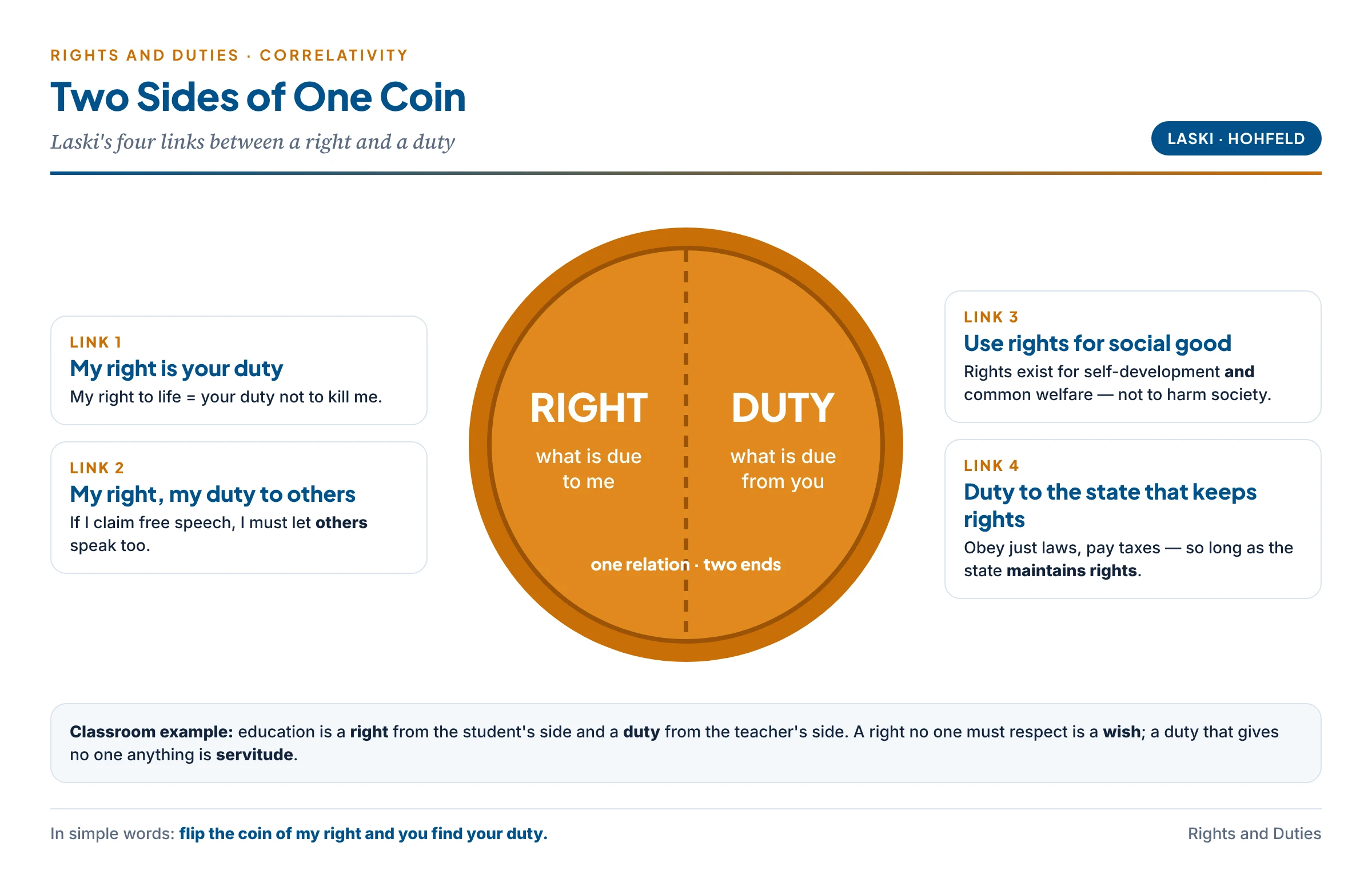
- Statement. Every right of one person implies a corresponding duty in another person (or the state), and every duty implies a right in someone. Rights and duties are jural correlatives.
- Hohfeld and Salmond. The jurists Salmond and Hohfeld analysed legal relations so that a claim-right always pairs with a duty: if A has a right that B pay him ₹100, B has a duty to pay A ₹100. The right and the duty are the same relation seen from two ends.
- Everyday examples.
- Education is a right from the student’s side; imparting it is a duty from the teacher’s side.
- My right to life means every other person and the state have a duty not to kill me — and the state a duty to protect me.
- My right to free speech means others have a duty not to silence me.
- Rights without duties are empty; duties without rights are oppressive. A right that no one is bound to respect is a wish; a duty that gives no one anything — like the duties of a slave — is mere burden.
“Rights without duties are like men without shadows.” — a saying often used to express the correlativity of rights and duties
Laski’s Fourfold Relation of Rights and Duties
Harold Laski, who defined rights as the conditions of social life needed for a person to be “himself at his best”, tied rights to duties in four ways:
- My right is your duty. My right to life imposes on you the duty to respect my life.
- My right implies my duty to respect the same right in others. If I claim free speech, I must allow others to speak.
- I must use my rights for the social good. Rights are given for self-development and for the common welfare; using them to harm society destroys their basis.
- I have a duty to the state that maintains my rights. Since the state secures rights, citizens owe it support — obeying just laws, paying taxes — so long as it performs this function.
Ethical Correlativity (Green and the Idealists)
- Rights exist for the common good. For Green, a right is a power recognised by society because it serves the common good. If I claim a right, I must accept the reason that grounds it — and that reason applies equally to others.
- Self-contradiction of selfish claims. One cannot logically claim a right for oneself while denying the duty to respect the same right in others — that would deny the very ground of one’s own claim.
In simple words
A cricket team that demands the right to bat but refuses to field cannot expect the other team to keep playing. The right to bat exists only inside a game in which both sides take turns at every duty. Rights work the same way inside a society.
Can There Be Rights without Duties?
The answer depends on which duty we mean.
(a) Duties in others — the correlative duty
- For claim-rights, there is always a correlative duty in someone else — that is what makes them claims.
- But Hohfeld showed that a liberty (privilege) carries no correlative duty: my liberty to look for a job or pick up a coin on a public road does not oblige anyone to help me; it only means no one can complain if I do. So some “rights” exist without corresponding duties in others.
(b) Duties in the holder — the reciprocal duty
- Rights of those who cannot perform duties. Infants, persons with severe mental disability, people in a coma, animals and future generations have rights (or at least moral claims) but cannot perform reciprocal duties. Their rights do not depend on their duties.
- Rights of citizens are not conditional on their duties. Under the Indian Constitution, Fundamental Rights are not suspended because a citizen fails a Fundamental Duty: a person accused of a crime keeps his Article 21 right to a fair trial; a citizen who does not vote still has the right to free speech.
- But morally, a citizen who claims every right while performing no duty is a free-rider on others’ duties; a society of such citizens cannot sustain rights.
Examples
- A newborn child has a right to life, care and nutrition, with no duties of its own — but parents and the state have duties towards it.
- A prisoner who broke the law still keeps rights to dignity, food and legal defence (D. K. Basu, 1997).
- A tax evader does not lose his right to vote — but he weakens the state that secures everyone’s rights.
- Animals — the Indian Supreme Court has recognised that animals have a right to live with dignity (Animal Welfare Board of India v. A. Nagaraja, 2014) though they bear no duties.
Can There Be Duties without Rights?
- Imperfect duties — charity, generosity, gratitude. I have a duty to help the poor, but no particular poor person has a right to demand my help (Mill, Kant).
- Duties to oneself — to develop one’s talents, preserve one’s health; no one else holds a corresponding right.
- Duties concerning nature and animals — Kant held that we have duties regarding animals (cruelty corrupts our humanity) though not, strictly, to them.
- Religious and spiritual duties — prayer, fasting, ṛṇa to ancestors.
- Duties of the dutiful — a soldier’s duty of courage, a doctor’s duty to stay at the post in an epidemic, exceed any right that others can claim.
In simple words
A beggar at a temple has no right to demand ₹10 from you, yet many feel they ought to give something. A newborn baby has every right to care, yet owes nobody anything. These two everyday cases show that duties and rights do not always come in neat pairs.
- Moral lesson. Morality is wider than rights. A world in which people did only what others had a right to demand of them would be cold and poor.

Common confusion
If a newborn has rights but no duties, does that disprove the correlativity of rights and duties? No — it disproves only a different claim. Correlativity says that every claim-right of A implies a duty in someone else (parents, state). The newborn’s right to care is matched by its parents’ and the state’s duty — so correlativity holds. What the newborn shows is that rights do not depend on the right-holder performing reciprocal duties. Many debates go wrong by mixing these two senses of “rights imply duties”.
“Duties Are Obligation, Rights Are Entitlement — So There Is No Necessary Connection?”
- The claim. Duties are of the nature of obligation (what I must do); rights are of the nature of entitlement (what is due to me). Since the two are different in nature, there is no necessary connection between them.
- What is true in it.
- Obligation and entitlement are conceptually different — one binds, the other empowers.
- Some rights (Hohfeld’s liberties) carry no correlative duties; some duties (imperfect duties, duties to oneself) carry no correlative rights.
- A right-holder need not perform any reciprocal duty to keep basic rights (infants, prisoners).
- What is false in it.
- An entitlement is always an entitlement against someone — to be entitled to payment is precisely for someone else to be obliged to pay. For claim-rights the connection is necessary, not accidental: they are the same relation viewed from two ends.
- A right that no one has any duty to respect gives no protection; it collapses into a hope.
- Socially, rights survive only where people accept duties — to respect others, obey just laws and support institutions.
- Conclusion. The statement is partly right but overstated. There is a necessary logical connection between claim-rights and the duties of others, and a strong moral and social connection between enjoying rights and performing duties; the connection is looser only for liberties, imperfect duties and the rights of those who cannot bear duties.
Which Is Prior — Rights or Duties?
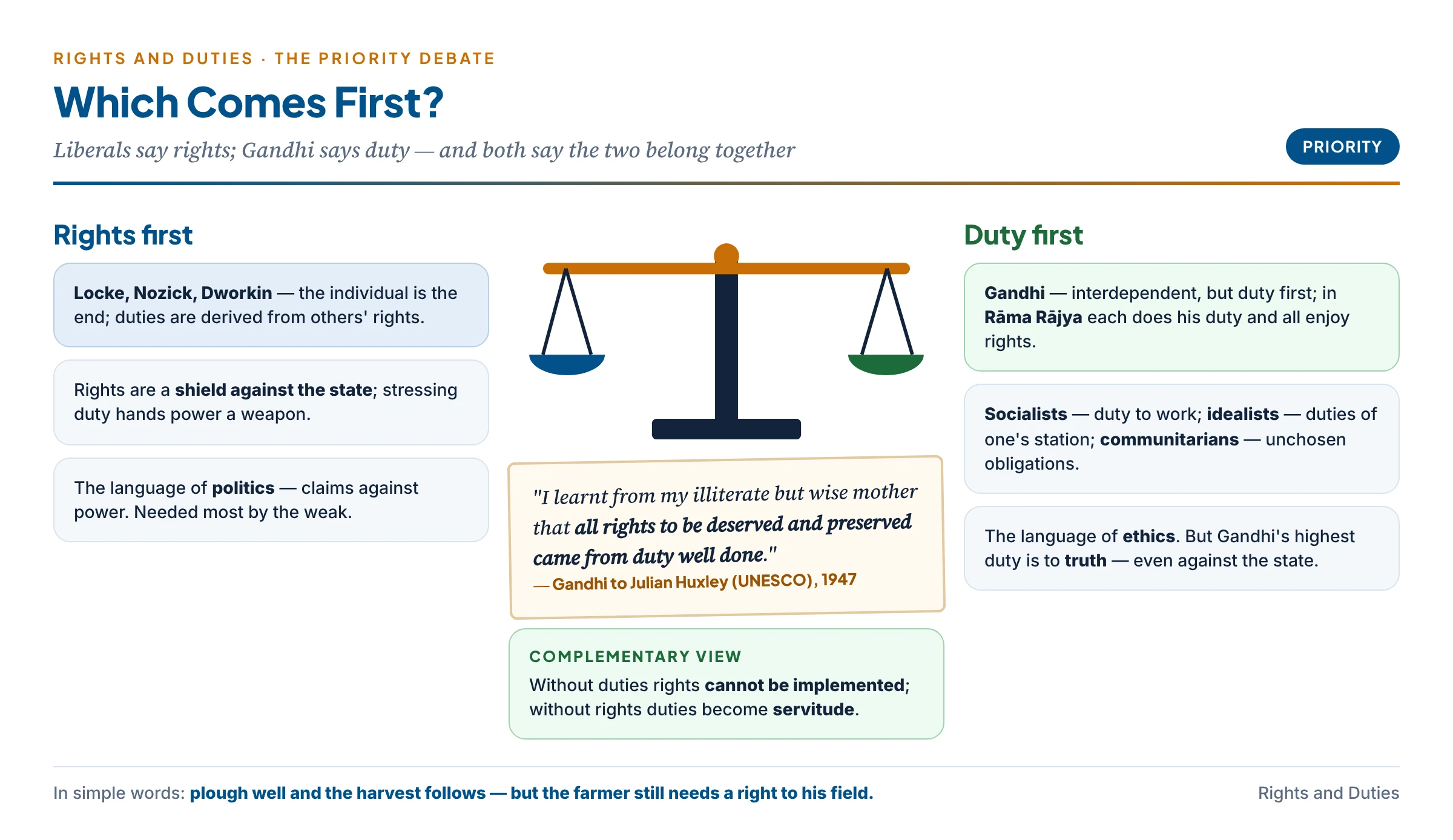
1. Rights first — the liberal view (Locke, Nozick, Dworkin)
- The individual is the end of political life; rights express his dignity and freedom; duties are derived — they exist to respect others’ rights.
- Rights protect the individual against the state; giving priority to duties hands the state a weapon.
- Politics of rights — the language of claims against power.
2. Duties first — socialist, idealist and Gandhian views
- Socialists — rights are meaningless unless everyone performs the duty of work and contributes to society; socialist constitutions stressed duties.
- Idealists (Hegel, Bradley, Bosanquet) — the individual finds himself in the duties of his station; rights flow from membership of the ethical community.
- Communitarians — we are born into obligations to family and community that we never chose.
- Ethics of duty — the language of responsibility.
3. Rights and duties as complementary
- In the absence of duties, rights cannot be implemented; in the absence of rights, duties become oppression.
- Focus on rights corresponds to an inclination towards politics; focus on duties towards ethics. If our politics could be founded on ethics, conflicts would be resolved more peacefully and effectively.
Gandhi: Rights Flow from Duties Well Done
- Interdependent, but duty first. Gandhi firmly believed that rights and duties depend on each other, but he gave priority to duty. In his ideal society of Rāma Rājya, every individual gives priority to his duty; in the process, everyone gets the opportunity to enjoy his rights too.
- The letter to Julian Huxley (1947). When UNESCO consulted thinkers on a universal declaration of human rights, Gandhi replied:
“I learnt from my illiterate but wise mother that all rights to be deserved and preserved came from duty well done. Thus the very right to live accrues to us only when we do the duty of citizenship of the world.” — Mahatma Gandhi
- Rights as fruit, duty as root. “The true source of rights is duty. If we all discharge our duties, rights will not be far to seek. If leaving duties unperformed we run after rights, they will escape us like a will-o’-the-wisp.”
- Examples Gandhi gave. If the worker does his duty and the employer his duty of trusteeship, both will get their due; if citizens do their duty to the community, the right to protection follows naturally.
In simple words
A farmer who ploughs, sows and waters does not need to shout for a harvest — it comes. Gandhi saw rights the same way: do your duty well and the right follows like the harvest; chase the harvest without ploughing and you will get nothing.
- Not a doctrine of obedience. Gandhi’s highest duty was to truth (satya); when the state demanded what conscience forbade, the duty of satyagraha — non-violent resistance — came first. Duty, for Gandhi, sometimes means disobeying the state.
| Issue | Rawls (liberal) | Gandhi |
|---|---|---|
| Nature of morality | Reciprocal regard among free and equal persons | An absolute value — truth and non-violence |
| Individual | Rational agent seeking primary goods | Seeker of truth, serving the welfare of all |
| Rights and duties | Interdependent | Priority of duty over rights |
| Well-being | Fair share of material goods | Minimum needs plus spiritual well-being |
| Basis of help to the worst-off | Minimising the worst risk (difference principle) | The moral urge for service — sarvodaya |
Which Is Prior in the Context of Accountability?
- Accountability links rights and duties. To be accountable is to answer for how one has used one’s rights and performed one’s duties.
- For the state: its duty to protect rights comes first, and it is accountable to citizens for that duty; here the citizens’ rights set the standard — rights are prior.
- For the citizen: rights carry the duty to use them responsibly; a citizen who abuses free speech to incite violence is accountable before law. Here duty and accountability discipline the use of rights.
- Balanced view. Logically, rights and duties are correlative; in the context of accountability, the state’s duties are prior to its powers, and the citizen’s duties are the condition of the responsible use of his rights. Neither side can claim priority without the other.
Should Duty and Accountability Be Given Priority over Rights for the Better Functioning of a State?
Arguments for
- Civic responsibility. Laws, public health, cleanliness and tax collection work only if citizens accept duties; a pandemic showed how much depends on individual compliance.
- Social cohesion. A culture of endless claims fragments society; duties build trust and fraternity.
- Indian ethos and Gandhi. Duty-first ethics (dharma, Gandhi’s Rāma Rājya) produces self-disciplined citizens who need less coercion.
- Accountability of officials. For public servants and governments, duty and accountability must come first — their power exists only to serve.
- Constitutional backing. Article 51A and the courts’ view that duties guide the reasonableness of restrictions on rights.
Arguments against
- Authoritarian misuse. Regimes that preach duty often use it to suppress protest and demand blind obedience; the Fundamental Duties were added during the Emergency (1976), when rights were suspended.
- Rights protect the weak. Dalits, women, minorities and the poor need rights to claim justice from a state and society that have often failed in their duties to them.
- Rights create accountability. The Right to Information, judicial review and free speech are the very tools that make governments accountable — weakening rights weakens accountability.
- Duties of citizens are not the same as duties of the state. The state’s duty is the citizen’s right; giving “duty” priority can quietly shift burdens from the powerful to the powerless.
Conclusion
- For the state and its officials, duty and accountability must indeed come first — power is a trust.
- For citizens, rights and duties should be complementary: rights are not conditional on duties, but responsible use of rights and performance of civic duties make the state work better.
- The best-functioning state is one where citizens claim their rights and perform their duties, and governments answer for both.
Critical Evaluation
Strengths and Weaknesses of Each Priority
- Rights first — strength: protects individuals and minorities; weakness: may breed selfishness and neglect of community.
- Duties first — strength: builds character and cohesion; weakness: can serve hierarchy and authoritarianism (caste duties, obedience to rulers).
- Correlativity — strength: shows logical interdependence; weakness: overlooks liberties, imperfect duties and rights of those who cannot bear duties.
Critics and Defenders
Criticism — Critics
- Liberals against Gandhi: duty-first ethics can justify obedience and social hierarchy.
- Against strict correlativity: liberties carry no duties; imperfect duties carry no rights.
- Against “no rights without duties”: infants, animals and future generations have claims without duties.
- Against duty-first constitutions: Article 51A, born in the Emergency, was seen as stressing obedience.
- Against rights-first culture: communitarians call it a culture of claims without responsibility.
Defence — Defenders and strengths
- Hohfeld and Salmond: every claim-right is the other face of a duty.
- Laski: four links tie rights to duties and to the common good.
- Green: rights exist for the common good and bind the claimant to respect others’ rights.
- Gandhi: rights to be deserved and preserved come from duty well done — but duty includes resisting injustice.
- Indian Constitution: enforceable rights (Part III) beside civic duties (Part IVA), read together by the courts.
Cross-Tradition Comparison
| Tradition | Starting point | Relation of rights and duties |
|---|---|---|
| Liberal West (Locke, Dworkin) | Rights of the individual | Duties derived from others’ rights |
| Socialist | Duty to work and contribute | Rights in return for contribution |
| Idealist (Hegel, Green) | Membership of the ethical community | Rights and duties both serve the common good |
| Indian dharma | Duties of station and the three debts | Rights implicit as the other side of duties |
| Buddhist (Sigālovāda Sutta) | Reciprocal duties | Each one’s duty is another’s due |
| Gandhi | Duty to truth and to all | Rights as the fruit of duty well done |
| UDHR (Article 29) | Rights of everyone | “Everyone has duties to the community” |
Indian Connect — Indian Connect
- Gandhi and the UDHR. Gandhi’s 1947 letter influenced the debate that led to Article 29 of the Universal Declaration, which speaks of everyone’s duties to the community.
- Courts on balance. The Supreme Court has said that “the true source of right is duty” (Ramlila Maidan, 2012) and that Fundamental Duties guide the reasonableness of restrictions on rights — while never making the enjoyment of Fundamental Rights conditional on performing duties.
- Ambedkar’s caution. Ambedkar warned that in Indian society duty had long been used to keep the lower castes in their “place”; for him, rights were the first need of the oppressed, and duties had to be equal for all.
Synthesis (Siddhānta)
- Logically, claim-rights and duties are correlative — two ends of one relation — though liberties and imperfect duties stand alone.
- Morally, rights and duties are complementary: rights without duties become selfish and unstable; duties without rights become servitude.
- Politically, the state’s duties come first — power is a trust held for rights-holders; citizens’ rights are not conditional on their duties, but their duties make rights sustainable.
- Gandhi’s insight — rights grow from duty well done — is a powerful ethic of citizenship, provided duty includes the duty to resist injustice and is owed equally by all.
- Contemporary relevance.
- Free speech and responsibility online — rights to expression with duties not to spread hate or falsehood.
- Environmental rights and duties — the right to a clean environment and the duty to protect it (Articles 21 and 51A(g)).
- Public health — the right to health and the duty to follow measures that protect others.
- Conclusion. Rights and duties are not rivals but partners. The question is not which to choose, but how to keep them in balance — so that rights do not become selfish and duties do not become oppressive.
“The true source of rights is duty.” — Mahatma Gandhi
Previous Year Questions
- 2025“Duties are of the nature of obligation while Rights are of the nature of entitlement. Therefore there is no necessary connection between the two.” Do you agree with this statement? Give reasons and justification for your answer.
- 2023Do you agree that duty and accountability must be given priority over rights for the better functioning of a State? Justify your answer.
- 2017Out of rights and duties which one is prior to the other? Discuss in the context of accountability.
- 2012Can we dissociate rights of citizens from their duties.
- 2011Can citizens have rights without duties? Discuss with examples.
- 2009“Rights and duties are complementary.” Explain.
- 2008Do rights necessarily imply corresponding obligations? To whom does one primarily owe obligations – individuals or state? Discuss.