- Culture is the learned, shared and transmitted way of life of a group: its ideas, institutions and material creations. It is the main force through which people transform the earth’s surface into cultural landscapes.
- The world shows immense cultural diversity. Groups large and small occupy distinct areas and leave observable imprints on them: settlement forms, house types, field patterns, language, worship and economic behaviour.
- Cultural geography studies these imprints spatially. It describes cultures as they appear on the ground and traces their origin, formation, persistence and diffusion.
- It builds on the geography of population, race, religion and language. It leads on to cultural regions, world culture realms and the effects of globalisation on culture.
Culture: Meaning and Nature

Meaning of Culture
- Etymology: the English word comes from the Latin cultura, from colere, “to till or cultivate”. The idea is the cultivation and refinement of human life, as a field is cultivated.
- The Sanskrit equivalent sanskriti carries the same sense of refinement.
- There is no single agreed definition. Alfred L. Kroeber and Clyde Kluckhohn (1952) reviewed 164 definitions. Three short descriptions recur:
- “the total way of life of a people”;
- “learned and shared behaviour“;
- “a people’s design for living“.
- Edward Burnett Tylor (Primitive Culture, 1871) gave the classic definition: culture is the complex whole of knowledge, belief, art, morals, law, custom and every other capability and habit acquired by people as members of society.
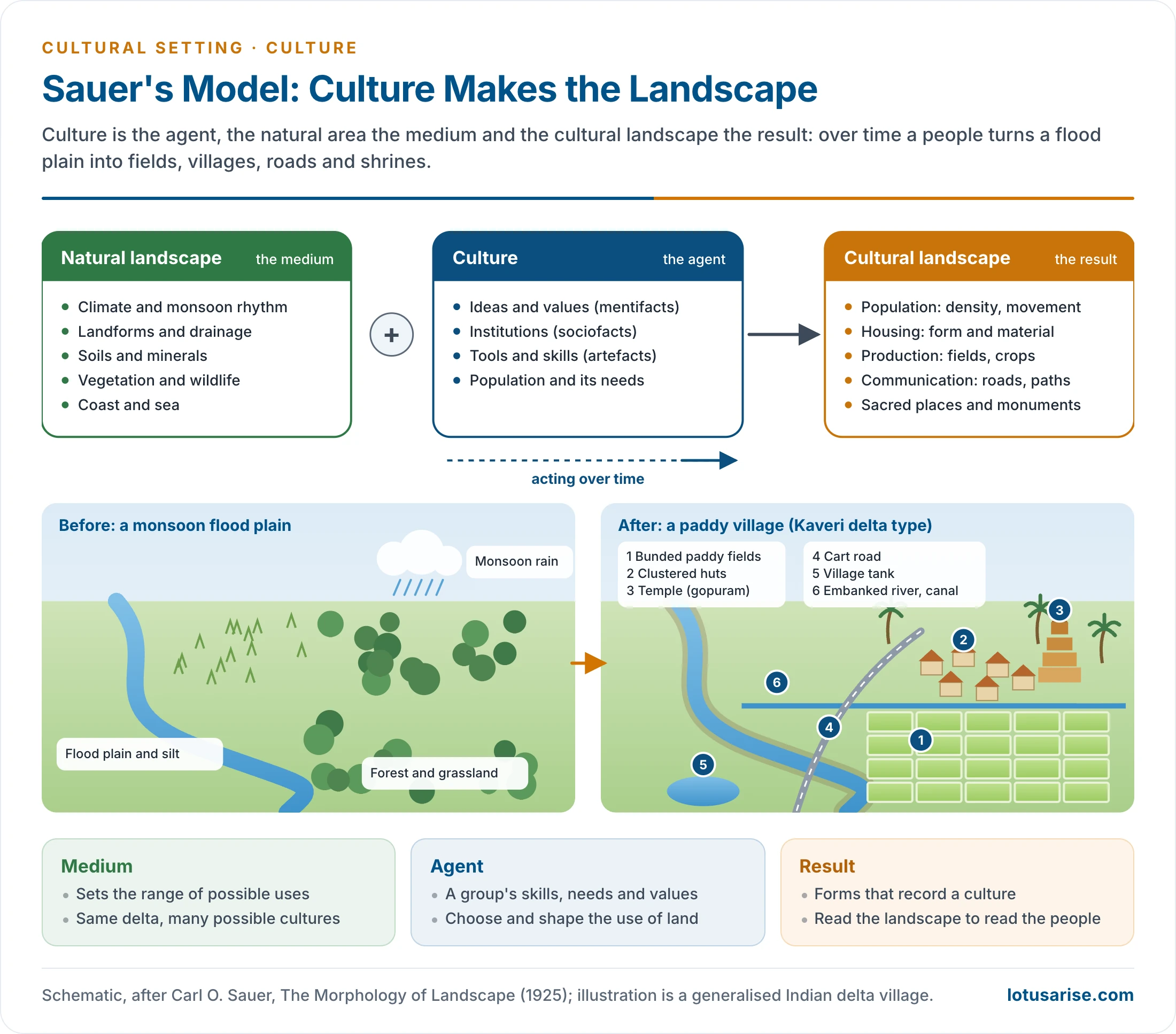
- Carl O. Sauer (The Morphology of Landscape, 1925) gave the geographer’s view: “Culture is the agent, the natural area is the medium, the cultural landscape the result.”
- A group works on its natural area over time. Fields, villages, roads and shrines are the forms its culture leaves behind.
- Melville J. Herskovits called culture the man-made part of the environment.
- In short, culture covers all learned behaviour, values, beliefs, norms and material creations shared by a society and passed on across generations.
Characteristics of Culture
- Learned, not inherited: acquired through socialisation, not carried in genes.
- Shared: a single person’s habit becomes culture only when most members of a group share it.
- Symbolic: it rests on language and symbols, which let ideas be stored and passed on.
- Transmitted across generations, so it accumulates.
- Adaptive: it lets groups adjust to their environment, from the snow house of the Inuit to the stilt houses of Assam’s flood plains.
- Integrated: its parts are interlinked, so a change in one part affects the others.
- Dynamic: it changes through invention, contact and diffusion and globalisation.
Types of Culture
Material and Non-material Culture
- Culture is commonly divided into two overlapping and interdependent categories.
- Non-material culture covers the intangible side of life: learned behaviour and mental constructs.
- It includes thoughts, beliefs, values, attitudes and emotions, and also social norms, traditions and institutions.
- It is built up through continuous learning and social interaction.
- Material culture covers the tangible creations of people, collectively called artefacts (literally “things made by human skill”).
- It includes tools and technology, farm practices and implements, houses and settlements, clothing and crafts, and industrial systems.
- It is visible, concrete and measurable. It reflects the technological and economic level of a society and forms most of the visible cultural landscape.
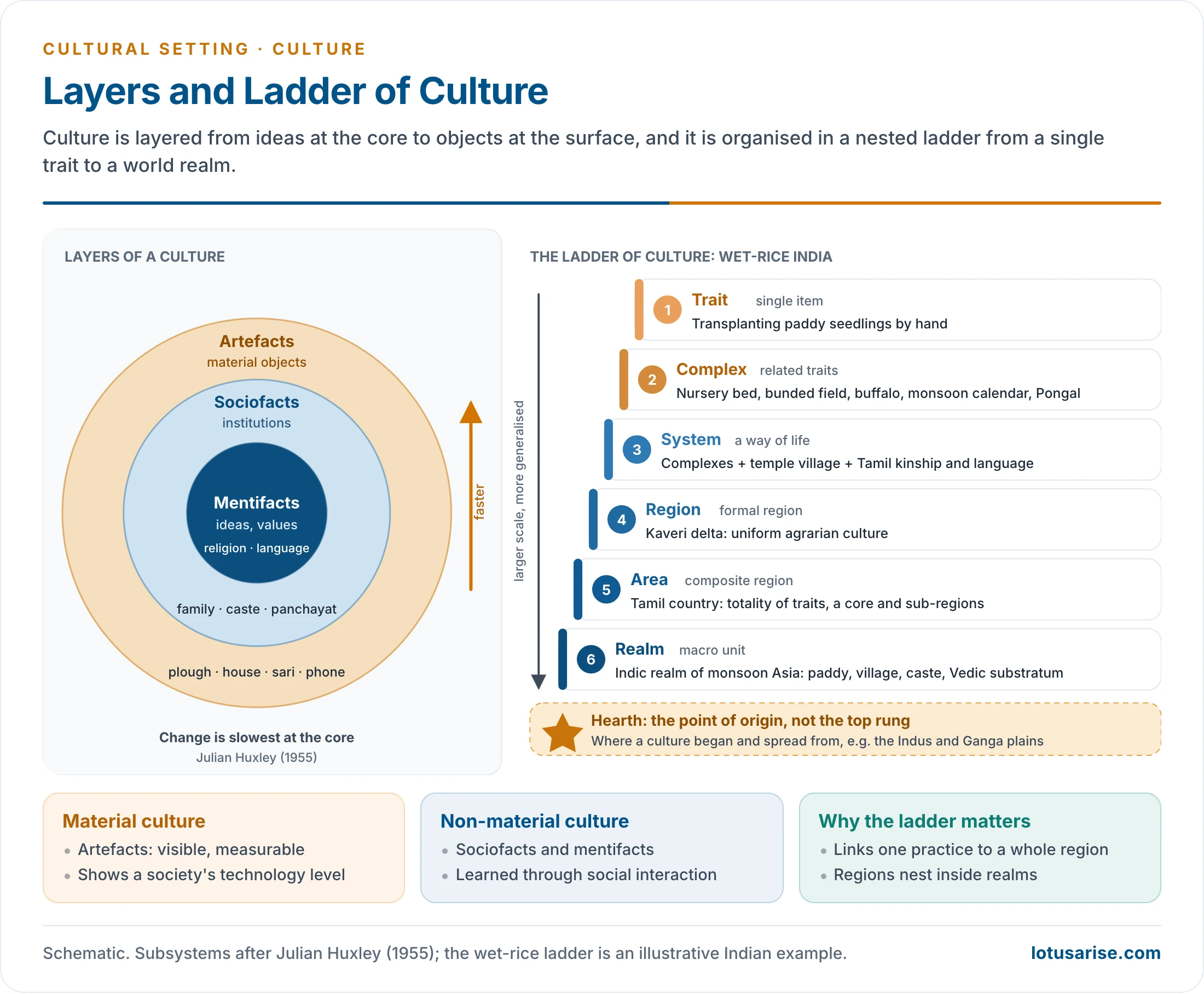
- Julian Huxley (1955) divided culture into three subsystems, which refine this two-way split:
- Mentifacts: the ideas and values at the core of a culture: language, religion, beliefs, ideologies, myths, art and music.
- Sociofacts: institutions and social organisation, with their norms and group behaviour: family, kinship, marriage systems, caste, the village community, the state.
- Artefacts: material objects made to meet material needs.
- Mentifacts change slowest; artefacts change fastest. People adopt a new tractor long before they change their kinship rules.
| Subsystem | Nature | Examples | Pace of change |
|---|---|---|---|
| Mentifacts | Ideas, beliefs, values | Language, religion, folklore | Slowest |
| Sociofacts | Institutions, organisation | Family, caste, panchayat, state | Intermediate |
| Artefacts | Material objects | Plough, house, sari, smartphone | Fastest |
- Other common distinctions:
- Folk culture belongs to small, rural, homogeneous groups. Popular culture belongs to large, urban, heterogeneous societies and spreads through mass media. Their contrast is a globalisation theme.
- A subculture is a group within a larger culture with distinct traits of its own, such as a tribal community or an occupational caste.
Culture and the Geographical Environment
- Geography studies material and non-material culture from a spatial perspective. It asks how culture interacts with its physical setting.
- Culture is closely tied to the environment, because societies continually adapt to their surroundings:
- Food habits follow climate and crops: rice and fish in Bengal and Keralam (Kerala), wheat in Punjab, millets in the dry Deccan.
- Clothing differs between deserts, mountains and coasts: loose cotton in the plains, wool in Ladakh.
- House types respond to rainfall, temperature and terrain: steep sloping roofs in Keralam and the North-East, flat mud roofs in Rajasthan and Ladakh, round bhunga huts in Kutch.
- Cultural evolution proceeds through adaptation to the environment, through living in harmony with nature, and at times through domination of it.
- The environment sets possibilities, not commands: groups in similar settings often develop different cultures. This is the debate over determinism and possibilism.
- Distinct cultural systems therefore grow out of distinct geographical settings, which produces regional cultural diversity.
Aspects of Culture
- Tylor’s definition is still widely used because it joins the material and non-material sides of culture. It points to three aspects.
Material or Physical Aspects
- These are the concrete, tangible creations of people, the visible expressions of culture in space.
- Tools and instruments; methods of house building and settlement forms; clothing, footwear and devices; techniques of production and livelihood.
- They are called cultural objects, the material evidence of human creativity and adaptation.
- They include everything people have made from the earliest times to the present, and so record the evolution of technology and economy.
Hidden or Symbolic Aspects
- These are the intangible means of communication and symbolic expression that a person learns as a member of society.
- Language, dialects and scripts; alphabets and other codes; myths, folklore and beliefs.
- Religious symbols: the swastika, the cross, the crescent, the khanda.
- Natural symbols: the sun, moon, sacred trees (the peepal), rivers and rocks.
- Symbols carry deep shared meanings of identity, belief and worldview. Culture must be read through these hidden meanings as well as through visible objects.
Acquired Aspects
- These are the learned behaviours, habits and capabilities acquired as members of society.
- Norms and values; knowledge and education; art, morality and belief; law and institutional practice.
- They show that culture is acquired socially, not biologically, which makes it dynamic.
| Aspect | What it covers | Indian example |
|---|---|---|
| Material | Tools, houses, dress, techniques | Bullock cart, kutcha house, handloom |
| Hidden (symbolic) | Language, script, myth, symbols | Devanagari script, peepal tree, rangoli |
| Acquired | Norms, values, knowledge, law | Joint-family norms, festival customs |
Culture and Civilisation
Meaning of Civilisation
- Culture and civilisation are closely related, but the origin and meaning of civilisation as a concept remain much debated.
- The word comes from the Latin civis, “citizen”, and points to an organised, urban, state-based social life.
- Robert M. MacIver and Charles H. Page (Society, 1949) defined civilisation as the whole mechanism and organisation that people have devised to control the conditions of their life.
- It includes systems of social organisation, techniques and the material instruments used to shape life.
- Civilisation is usually seen as a more complex stage of cultural development, with an advanced economy, organised polity and structured society.
- Colonial bias: during the colonial period Europeans often labelled other societies “uncivilised” or “barbaric”. Modern scholarship rejects this ranking.
- There is no inherent difference in worth between “civilised” and other cultures. Some only show greater complexity of organisation.
Characteristics of Civilisation
- V. Gordon Childe (The Urban Revolution, 1950) listed ten criteria of the first civilisations, drawn from Mesopotamia, Egypt and the Indus. They are often grouped into two sets.
- Primary (economic and social organisation):
- Cities of large size and density.
- Full-time specialists: craftsmen, merchants, priests, officials.
- Concentration of surplus, collected as tax or tribute.
- A ruling class and class structure.
- State organisation based on residence rather than kinship.
- Secondary (achievements):
- Monumental public buildings.
- Long-distance trade.
- Standardised art and architecture.
- Writing.
- Exact sciences: arithmetic, geometry, astronomy and the calendar.
- The Harappan civilisation (mature phase c. 2600–1900 BCE) meets most of them: planned cities, a granary-and-citadel order, standard weights and bricks, an undeciphered script and trade with Mesopotamia.
Difference between Culture and Civilisation
- The distinction is not absolute, and the two terms overlap. MacIver summed it up: culture is what we are, civilisation is what we have.
- The most basic contrast: culture relates to human control over nature and the expression of values; civilisation refers to the techniques and systems that regulate behaviour and organise society.
| Basis | Culture | Civilisation |
|---|---|---|
| Nature | Ends: values, beliefs, art, ways of life | Means: technology, organisation, institutions |
| Measurement | No precise standard | Can be measured by efficiency |
| Direction | Not always progressive; can decline or revive | Generally cumulative and advancing |
| Transfer | Absorbed slowly; changes in the borrowing | Borrowed readily without much change |
| Scope | Every human group has culture | Linked to cities, states and writing |
Hierarchy of Culture
Cultural Trait, Complex and System
- The physical environment and human response to it produce cultural traits and complexes across space.
- Cultural trait: the smallest unit of culture, a single item of behaviour or a single object.
- Examples: the method of sowing seed or transplanting paddy, a particular food habit, wearing a turban, a harvest song, a particular plough.
- Culture is not a heap of isolated traits. Traits are interrelated and function together.
- Cultural complex: a group of related traits that function together around one activity.
- Example: the wet-rice complex of monsoon Asia combines nursery beds, transplanting, bunded fields, the buffalo, the monsoon calendar and harvest festivals such as Pongal, Bihu and Nabanna.
- Cultural system: a set of interlocking complexes that share a common base and give a group its overall identity.
- Example: the agrarian culture system of the Kaveri delta joins the wet-rice complex, temple-centred village life, the Tamil language and its kinship rules.
- No element can be understood alone. Cultural parts are interdependent and spatially linked.
- Religious belief, for instance, shapes diet (the taboo on beef or pork, the prohibition of alcohol, vegetarianism among Jains), dress, house plans and settlement morphology, such as temple- or mosque-centred villages.
Spatial Expression of Culture
- The spread of traits and complexes over the earth produces regional patterns at several scales.
- Cultural region: an area whose people share common cultural traits.
- Formal region: marked by measurable uniformity of one or more traits, such as language or religion.
- Functional region: organised by interaction around a node, such as a city’s market area or a pilgrimage centre’s field, and often expressed in economic or political organisation.
- Vernacular region: based on people’s perception and sense of identity, such as “North India”, “South India” or the Braj country.
- Regions form, persist and blur at their edges over time, which makes cultural regions hard to delimit.
- Cultural area: a broader, composite formal region defined by the totality of cultural traits, not by one trait.
- It has a core or nucleus where the culture first matured, and contains sub-cultural regions.
- Its boundaries are less precise and more subjective. Delimiting it depends on field understanding as much as on statistics.
- Indian examples are the Awadh, Bundelkhand, Braj, Bhojpuri, Mithila (Maithili) and Magadh culture areas of the Ganga plain.
- Cultural realm: the largest unit, a macro-region in which several culture complexes are shared by most of the population.
- It is a broad zone of cultural unity, set apart by the composition, arrangement and integration of its traits.
- It is defined by dominant characteristics such as a major religion or language family. The Occidental, Islamic, Indic and East Asian culture realms are examples.
- Cultural hearth: the source area where a culture first developed and from which it spread outward.
- Hearths are centres of innovation and diffusion and long-lived repositories of tradition.
- Primary hearths: Mesopotamia (Tigris–Euphrates, Iraq), the Nile valley (Egypt), the Indus valley (South Asia) and the Huang He (Yellow River) valley (China).
- Secondary hearths include the Maya (Central America), Aztec (Mexico) and Inca (Andes) civilisations, and the Bantu hearth of West–Central Africa.
The Ladder of Culture
- The hierarchy is a nested structure, rising in scale and generality: trait → complex → system → region → area → realm.
- The hearth stands apart from this ladder. It is the point of origin from which a culture spreads, not its highest level.
- The ladder links micro-level practices (traits), their integration into complexes and systems, and their spatial expression in regions, areas and realms.
Diffusion of Culture
Hearth and Diffusion
- Cultural elements usually originate in a hearth and spread through migration, trade, conquest, missions and communication. Diffusion is a central process of cultural change.
- Religions such as Buddhism, Christianity and Islam began in small hearths and later spread across continents.
- Buddhism arose in the middle Ganga plain. Today most Buddhists live outside India, in East and Southeast Asia.
- Bhojpuri language and culture, from western Bihar and eastern Uttar Pradesh, travelled with indentured labourers from the 1830s to Mauritius, Fiji, Suriname, Guyana and Trinidad and Tobago.
- Diffusion also spreads farming practices, fashions and industrial and technological innovations.
- Torsten Hägerstrand (Innovationsförloppet ur korologisk synpunkt, 1953; English translation Innovation Diffusion as a Spatial Process, 1967) turned the study of diffusion into a measurable spatial science.
Types of Diffusion
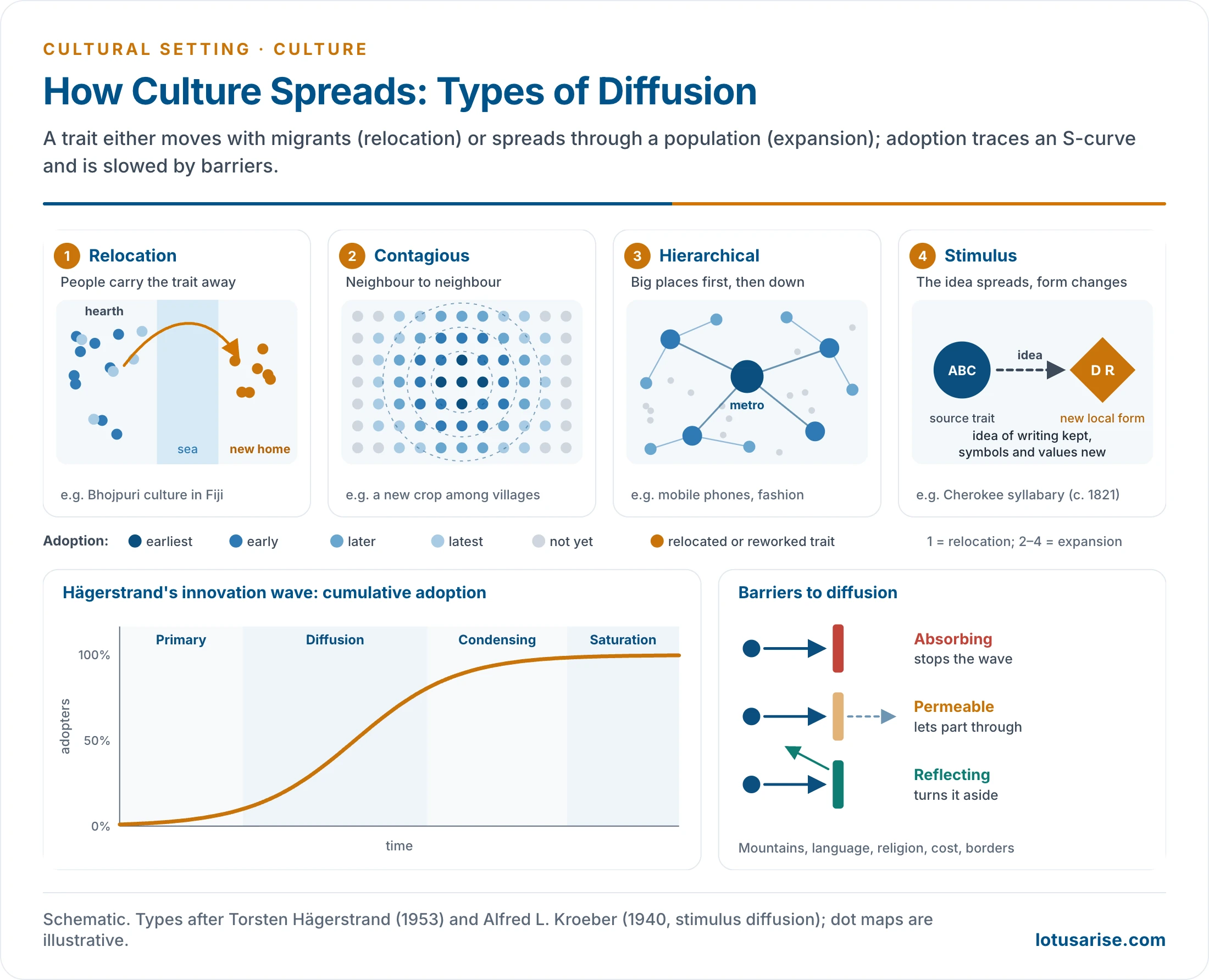
- Relocation diffusion: people carry a trait as they migrate. The trait appears in a new, often distant place, while it may weaken at the source.
- Examples: Bhojpuri culture in Mauritius and Fiji; Sikh gurdwaras in Canada and the UK; Parsi culture brought from Persia to Gujarat.
- Expansion diffusion: the trait spreads outward through a population, and the number of adopters grows while the trait stays strong in the hearth. It takes three forms:
- Contagious diffusion: spread from person to person and place to place, like an epidemic. Distance is the controlling factor.
- Examples: the spread of a new crop variety from village to village, or of a rumour or a folk song.
- Hierarchical diffusion: spread down a hierarchy of places or people, from large cities to smaller towns, or from elites to the masses. It skips the countryside in between.
- Examples: mobile phones and the internet, fashion trends, and earlier the spread of English education through the colonial port cities.
- Reverse hierarchical diffusion runs upward, as when a folk music style or a rural festival becomes urban fashion.
- Stimulus diffusion: the underlying idea spreads, but the trait itself is reworked by the receiving culture. Alfred L. Kroeber (1940) named the process.
- Examples: Sequoyah’s Cherokee syllabary (about 1821), inspired by English writing but built on new principles; the vegetarian menus of global fast-food chains in India.
- Contagious diffusion: spread from person to person and place to place, like an epidemic. Distance is the controlling factor.
| Type | What moves | Controlling factor | Example |
|---|---|---|---|
| Relocation | People carrying the trait | Migration | Bhojpuri culture in Fiji |
| Contagious | The trait, place to place | Distance | New crop variety among villages |
| Hierarchical | The trait, down the urban or social ladder | Size and status of places | Mobile phones, fashion |
| Stimulus | The idea, reworked locally | Cultural filtering | Cherokee syllabary; local fast-food menus |
Hägerstrand’s Model of Spatial Diffusion
- Hägerstrand studied the spread of farm innovations such as pasture subsidies and tuberculosis control of cattle in central Sweden. He showed that adoption follows regular spatial rules.
- Neighbourhood effect: people adopt an innovation after face-to-face contact with earlier adopters, so adoption clusters near the first adopters.
- Distance decay: the chance of adoption falls with distance from the innovation centre.
- Four stages of an innovation wave:
- Primary stage: adoption begins in a few centres, with sharp contrasts between them and remote areas.
- Diffusion stage: new centres appear and the innovation spreads rapidly from them.
- Condensing stage: adoption becomes similar everywhere, as gaps fill.
- Saturation stage: growth slows and stops at a ceiling.
- Over time, cumulative adoption traces an S-shaped (logistic) curve: slow start, rapid middle, flattening top.
- Barriers slow or stop diffusion:
- Absorbing barriers stop it completely.
- Permeable barriers let part of it through.
- Reflecting barriers deflect it elsewhere.
- Barriers may be physical (mountains, deserts, seas), cultural (language, religion, taboos), economic (cost) or political (borders, bans).
- Indian example: the high-yielding wheat and rice varieties of the Green Revolution (from 1966). They spread first in irrigated, well-connected districts of Punjab, Haryana and western Uttar Pradesh. Their spread to rain-fed eastern and central India was slow, because of economic and environmental barriers: smallholdings, poor irrigation and weak credit.
Factors Affecting Innovation Diffusion
- Distance from the hearth, and the cost and time of overcoming it.
- Position in the settlement hierarchy: large, well-connected places adopt first.
- Information networks: personal contacts, extension workers, media and the internet.
- Receptivity of the receiving culture: its values, literacy, risk-taking and the fit between the innovation and existing practice.
- Economic capacity: the ability to pay for and use the innovation.
- Barriers: physical, linguistic, religious, political and legal.
- The innovation itself: its relative advantage, simplicity and visibility.
- Today digital networks compress distance. Many innovations, such as UPI payments in India, spread hierarchically and contagiously at once, from metros to small towns within a few years.
- Diffusion is only one route of cultural change. Acculturation, assimilation, syncretism and revival follow when cultures meet, and globalisation now speeds up all of them.
Previous Year Questions
1990Write short note on Diffusion of innovation in agricultural technology.2012Write about factors affecting innovation diffusion.2021Explain the processes of contagion and hierarchical diffusion in addressing regional imbalances.2022“Culture is a dynamic concept”. Elucidate with example