

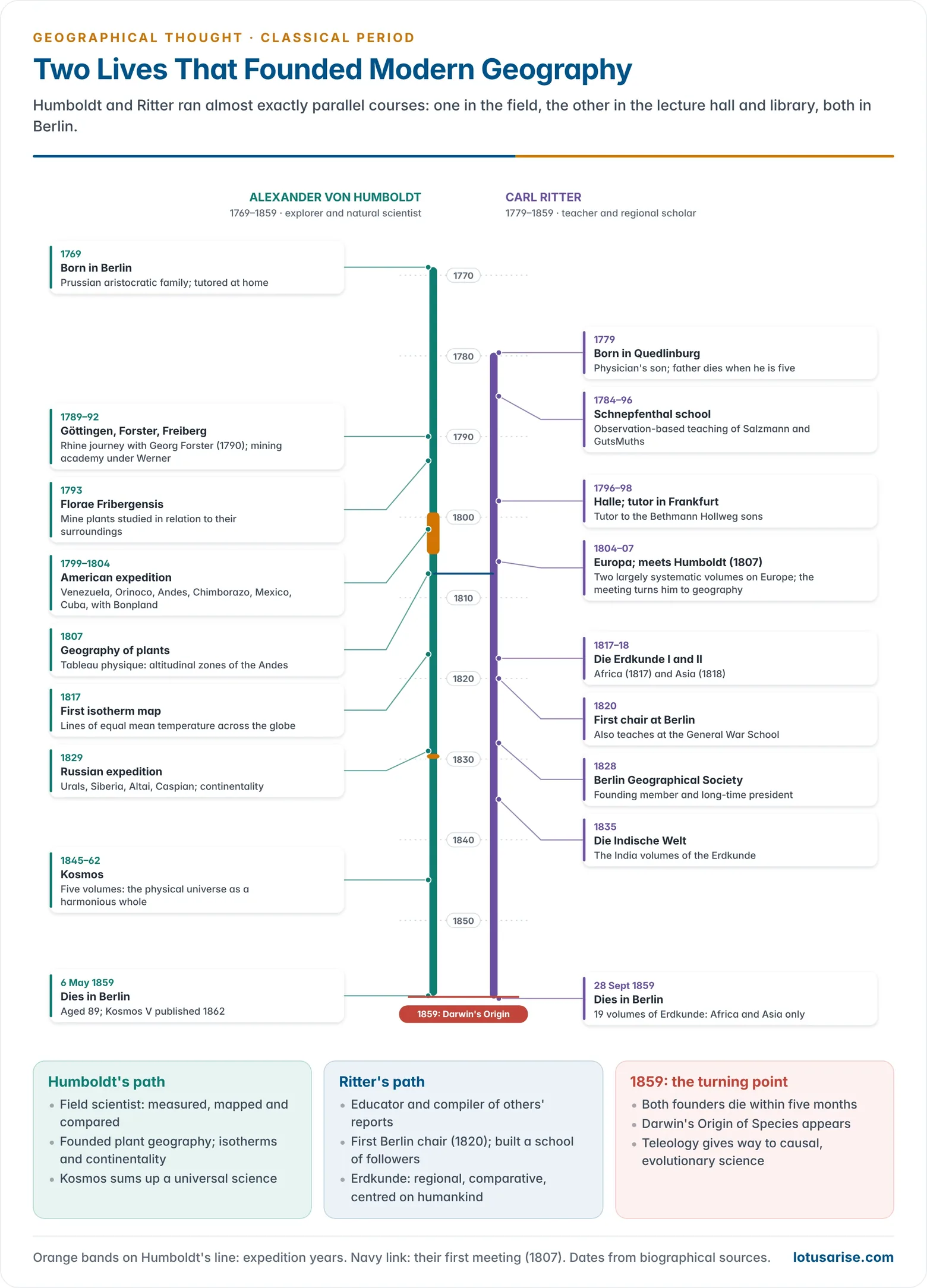
- Alexander von Humboldt (1769–1859) and Carl Ritter (1779–1859) open the classical period of modern geography. Between them they turned a loose body of travel reports and gazetteer facts into an organised, explanatory science of the earth.
- Both were German, both worked in Berlin, and both died in 1859, the year Charles Darwin published On the Origin of Species.
- They are jointly called the founders of modern geography. Humboldt is usually linked with systematic geography and Ritter with regional geography, a contrast that is useful but overstated.
The Classical Period: Setting and Shared Foundations

- Inheritance: the two built on the philosophical groundwork of Bernhard Varenius and Immanuel Kant, who had placed geography among the sciences as the study of things side by side in space, and on the comparative field method of Johann Reinhold and Georg Forster, who had sailed with James Cook (1772–75).
- Why “classical”: their ideas dominated the founding decades of the subject. Their deaths in 1859 close the period, after which the impact of Darwinism and materialist science reshaped the discipline.
Alexander von Humboldt (1769–1859)
Life and Training
- Born in Berlin into the Prussian aristocracy, he studied at Göttingen and at the Freiberg Mining Academy (1791–92) under the geologist Abraham Gottlob Werner, then served as a mining official (1792–96).
- A journey down the Rhine with Georg Forster (1790) first taught him to see natural phenomena in relation to each other.
- From Goethe’s circle at Jena he took the idea of nature as an organic, harmonious whole.
- An inheritance in 1796 freed him for scientific travel.
The Great Expeditions
The American Expedition (1799–1804)
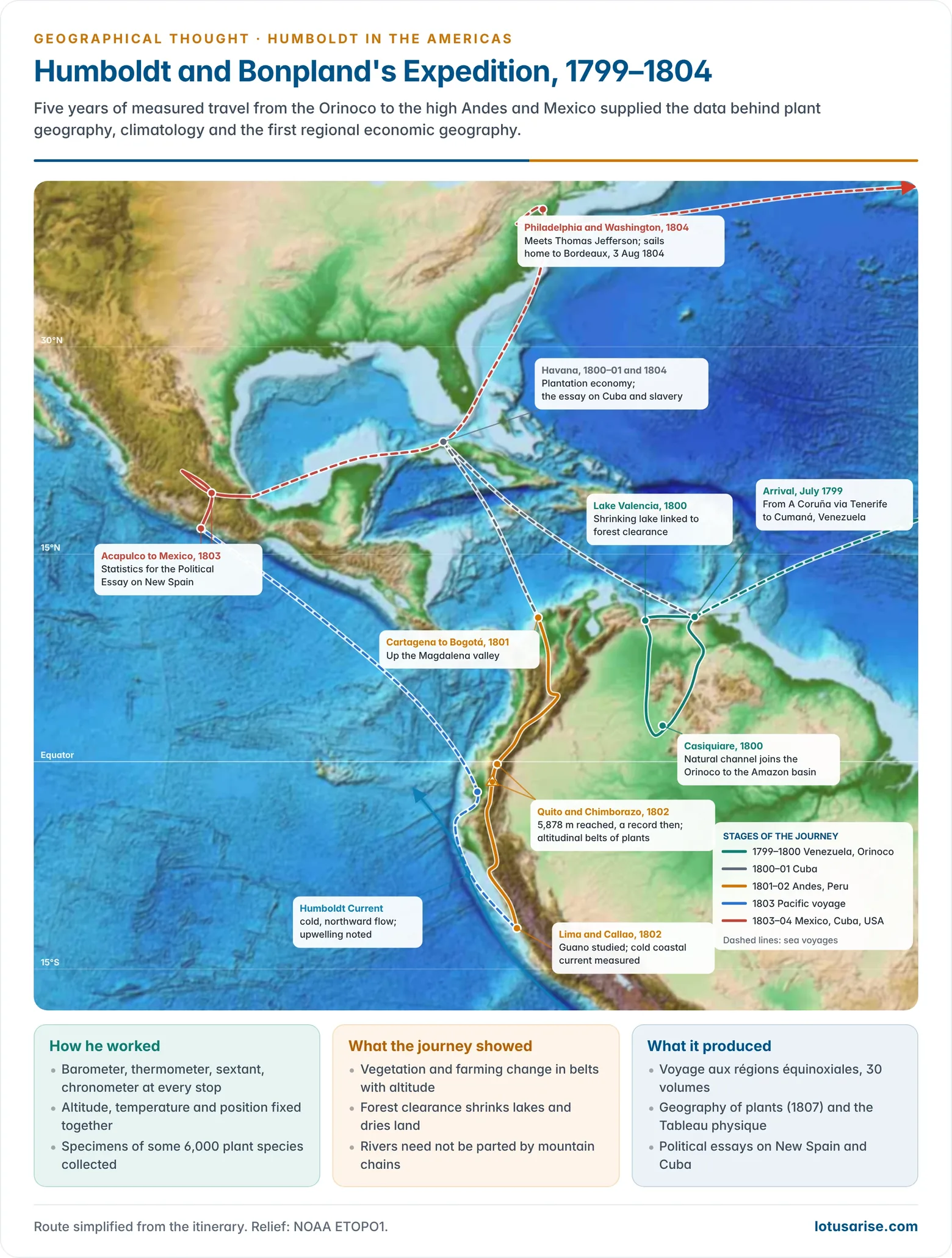
- With the French botanist Aimé Bonpland and the best instruments of the day, Humboldt spent five years in Spanish America.
- Venezuela (1799–1800): at Lake Valencia he linked the shrinking of the lake to the clearing of forests in its basin, and he traced the Casiquiare channel, which joins the Orinoco to the Amazon system and disproved the idea that every river basin is walled off by a mountain chain.
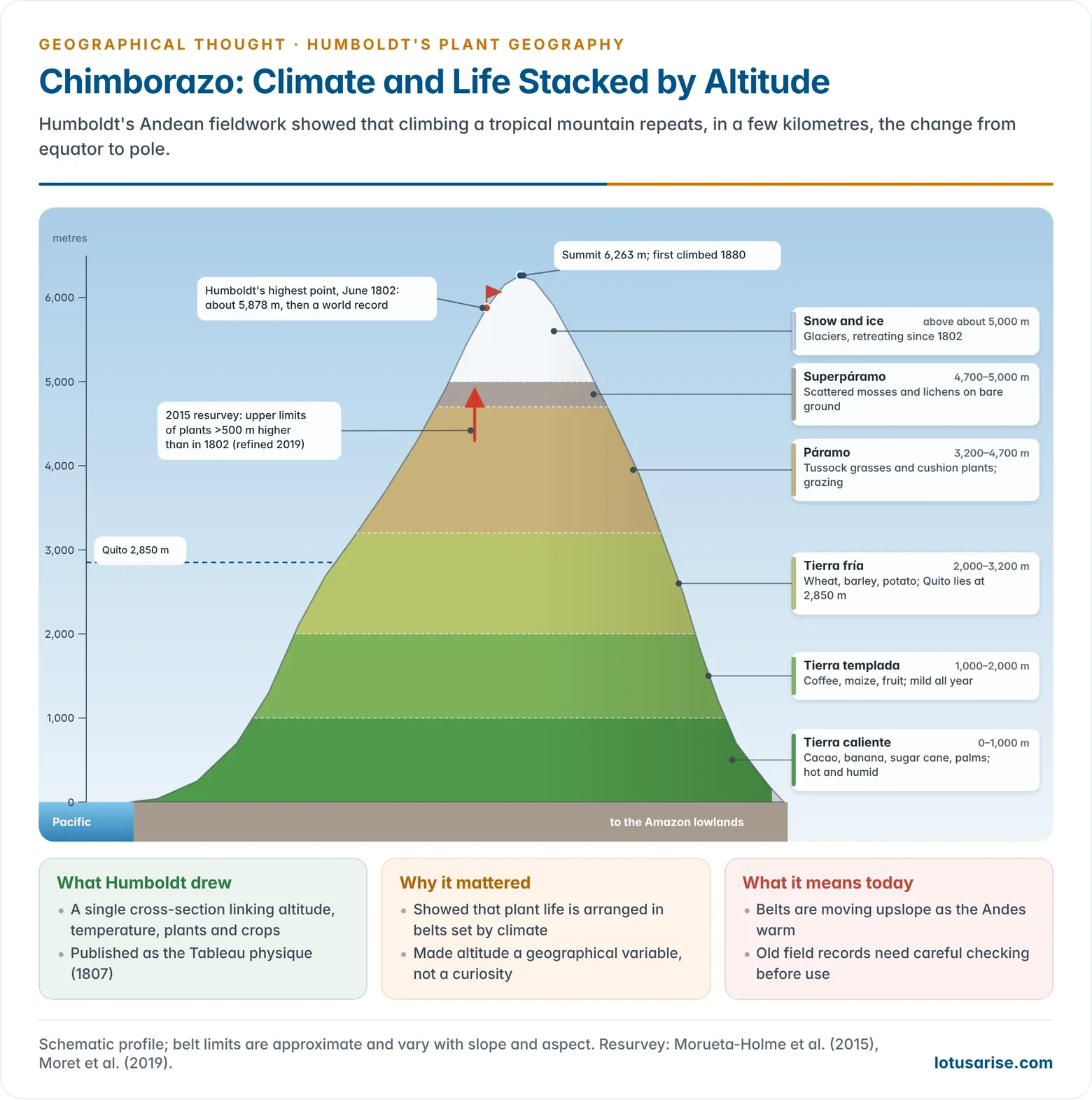
- The Andes (1801–02): he fixed position, altitude and temperature at hundreds of points. On Chimborazo in June 1802 his party reached about 5,878 m, then a world altitude record, and he studied the mountain’s altitudinal belts of vegetation. Off Peru he measured the cold coastal current now named after him.
- Mexico and Cuba (1803–04): he gathered population, mining and trade statistics in New Spain (Mexico) and Cuba.
The Russian Expedition (1829)
- He crossed the Urals into Siberia as far as the Altai, returning by the Caspian Sea. His readings showed that places on the same latitude grow more extreme inland, and on his advice Russia set up magnetic and meteorological stations across northern Asia.
Major Works
| Work | Year | Significance |
|---|---|---|
| Florae Fribergensis | 1793 | Plants studied in relation to their environment |
| Essai sur la géographie des plantes (with the Tableau physique) | 1807 | Founding text of plant geography; altitudinal zones of the Andes |
| Ansichten der Natur (Views of Nature) | 1808 | Essays such as “Steppes and Deserts”; comparative description |
| Essai politique sur le royaume de la Nouvelle-Espagne | 1808–11 | Among the first regional economic geographies |
| Voyage aux régions équinoxiales du Nouveau Continent | 1805 onwards | The 30-volume expedition report, with the Relation historique |
| “Des lignes isothermes” | 1817 | First map of isotherms |
| Essai politique sur l’île de Cuba | 1826 | Regional study with a critique of slavery |
| Kosmos (5 vols) | 1845–62 | His synthesis of the physical universe |
- Kosmos grew from public lectures in Berlin (1827–28) and was planned as “the work of my life”, though its treatment of plants, animals and humankind was never written.
- Its aims were to define physical description of the world as a distinct field, give an empirical portrait of nature, show its effect on feeling and imagination, and trace the history of the idea of the cosmos.
Geographical Concepts and Method
Unity of Nature
- Humboldt saw nature as “a unity in diversity of phenomena”: a harmony of living and non-living things bound by causal ties. The task of science was to discover that unity without losing sight of the parts.
- Unlike Ritter’s, his unity was aesthetic and scientific, not religious. Kosmos explains order in nature without appeal to a Creator.
- Zusammenhang: tracing how things on the earth’s surface depend on one another is the root of geography’s concern with areal association.
Geography’s Place among the Sciences
- Three kinds of knowledge:
- Systematic sciences (botany, zoology, geology) group objects by their kind.
- Historical sciences trace the development of things through time.
- Geography (Erdbeschreibung, physical description of the earth) studies things as they exist together in space and influence one another.
- This follows Kant’s distinction between logical and physical classification. It gave geography a distinct field: the spatial arrangement and interrelation of objects that the systematic sciences study by kind.
- He called the whole field cosmography, divided into uranography (the heavens) and geography (the earth).
Method
- Empirical and inductive: observe, measure, classify and only then generalise, keeping facts distinct from conjectures. Yet general ideas must guide observation, and he saw no conflict between induction and deduction.
- Comparative method: every new observation was compared with similar ones elsewhere. His essay “Steppes and Deserts” sets the llanos, pampas, prairies, Sahara and Asian steppes side by side to bring out each one’s character.
- Two principles that made geography a science (as Emmanuel de Martonne later put it):
- the principle of causality, which explains the interconnection of phenomena found together;
- the principle of general geography, which compares the location and extent of phenomena over the whole earth.
- Visual method: he used cross-sections of relief to show zones of vegetation, rock and temperature, and isolines on maps, both now standard tools.
Humankind in Nature
- Humans are part of nature: dependent on soil and atmosphere, though less than plants and animals, and able to escape natural control through intellect, culture and adaptability. Nature’s influence on people is strong; their action on nature is weaker but real.
- Humanist: he held that all human races share a common origin, and in Kosmos he rejected “the depressing assumption of superior and inferior races of men”. His essays on Cuba condemned slavery, and those on New Spain exposed the unequal distribution of wealth.
Contributions to the Branches of Geography
| Branch | Contribution |
|---|---|
| Climatology | Isotherms (1817), which reach farther poleward along western coasts; continentality; a broad definition of climate covering all atmospheric changes that affect living things |
| Plant geography | Founder; altitudinal vegetation zones; plant communities linked to climate and altitude; botanical provinces |
| Geomorphology and geology | Volcanic origin of crystalline rocks; relief cross-sections; the Casiquiare bifurcation |
| Oceanography | Measured the cold Peru (Humboldt) Current and described upwelling |
| Regional and economic geography | New Spain and Cuba: resources, population and politics treated together |
- Himalayan link: in 1820 Humboldt showed that the snow line on the northern (Tibetan) side of the Himalaya lies higher than on the southern side, owing to the dry air and strong radiation of the plateau.
Evaluation
- Achievements:
- He made geography a distinctive science of interrelations.
- He founded plant geography and much of climatology, and raised field measurement to a new standard.
- His New Spain was a landmark of regional description; on Richard Hartshorne’s reading, Humboldt, more than Ritter, pioneered comparative regional geography.
- Limitations:
- He held no university chair and founded no school, so geographers rediscovered his way of asking questions only decades later.
- By opening Kosmos with the whole universe, he made it look like the last of the great cosmographies.
- His regional writing gave human factors second place to natural ones.
- Recent reappraisal: he is now seen as a forerunner of ecology and environmental thought. A 2015 resurvey of Chimborazo found plant limits about 500 m higher than in his Tableau physique, a sign of warming, though in 2019 some of his records proved to come from the nearby volcano Antisana.
Carl Ritter (1779–1859)
Life and Training
- Born at Quedlinburg, Ritter was schooled at Schnepfenthal, which taught through observation; from its varied hill country he drew the idea of unity in diversity. He met Humboldt in 1807.
- Berlin: in 1820 he became the first holder of a chair of geography at the University of Berlin, and he was a founding member of the Berlin Geographical Society (1828).
Die Erdkunde
- Title: Die Erdkunde, in full “The science of the earth in relation to nature and the history of mankind, or general comparative geography”.
- Publication: Volume I (Africa) appeared in 1817 and Volume II (Asia) in 1818, and their success brought him the Berlin chair. By his death 19 volumes of a rewritten edition had appeared, covering only Africa and Asia.
- The India volumes (Die Indische Welt, 1835) compiled everything then known about the subcontinent’s relief, rivers, products and peoples.
- Earlier work: a two-volume geography of Europe (1804–07), largely systematic.
- Purpose: to replace the “lifeless summary of facts about countries and cities” with a new scientific geography. In his words, the task was to move “from mere description to the law of the thing described”, and to find the connection of place with place.
Geographical Concepts
Earth as the Home of Man
- Geography studies the earth’s surface as the home of humankind, not the whole planet. The central principle is the relation of all natural forms and phenomena to the human race.
- Reciprocal relation: “land affects the inhabitants and the inhabitants the land”. Hence history and geography are inseparable.
- Because he stressed this two-way influence, it is wrong to label him a determinist, though later environmentalists drew on his continental generalisations.
- He chose the name Erdkunde (earth science) over Erdbeschreibung (earth description) to signal an explanatory science.
Unity in Diversity and the Organic Whole
- Every naturally bounded area is a unity of climate, products, culture, population and history. The geographer’s job is to see its features in their interrelation and so reconstruct the whole.
- He spoke of the earth as an organism, the continents as its organs or individuals, and their parts as members.
- The idea drew on Kant’s whole (Ganzheit) and the organic idealism of Hegel and Schelling.
Teleology
- Ritter’s science was teleological: he looked for the purpose behind the order of nature. That purpose was God’s plan for the education of humanity: “as the body is made for the soul, so is the physical globe made for mankind”.
- He offered teleology only where science could give no answer, such as the different characters of the continents.
- Continents in the divine plan: Asia was the sunrise, where civilisation began; Africa the noon, its smooth coasts and uniform climate inducing isolation; Europe the sunset, the culmination of human achievement, its indented coast open to the sea; America a new day.
- In practice his method stayed empirical. He insisted that his system rested on facts, not philosophical argument, and sought the divine plan only through the facts.
Empirical and Comparative Method
- “We must ask the earth itself for its laws.” Knowledge of the earth must come from observation, not from rational principles or a priori theory.
- He was among the first to show from records that mountain crests and drainage divides do not coincide, which demolished Buache’s system.
- Comparative geography: causal relations were to be found by comparison, as anatomists compared organisms.
- Areal association and spatial interaction: he sought connections between phenomena in the same place and between one place and another.
- Three attributes of place: the topical (natural divisions of the surface), the formal (water, sea and atmosphere, the bases of human life) and the material (minerals, plants and animals).
- Boundaries such as rivers and mountains matter only as means to understand the content of areas.
Regional Method
- Regional synthesis first: he urged geographers to study areas filled with interrelated phenomena region by region. Once the whole world was covered, sound systematic generalisations could follow.
- Scale: his major units were the continents (Erdteile). Each was divided by relief into a highland core, surrounding terraces, major river basins and coastal lowlands, an order he believed all continents shared.
- He organised material chorologically, both horizontally (area by area) and vertically (by altitude).

Evaluation
- Merits:
- He gave geography its first university base and its regional framework.
- His critical, exhaustive use of sources set new standards of scholarship and synthesis.
- His human-centred view of whole regions anticipated the regional and human geography of the next century.
- Criticism:
- Teleology cannot be tested and so is not scientific explanation. After 1859, materialist, cause-and-effect science and Darwin’s struggle and random variation left it with no place.
- He was largely an armchair geographer.
- Taking continents as regions encouraged sweeping generalisations, including a crude matching of continents with races and colours, and in the long run retarded regional study.
- Influence: through the only chair in Germany he left a school of followers, among them Élisée Reclus of the French school, Arnold Guyot, who carried his ideas to the United States, and the explorer Heinrich Barth. Most geographers of the next generation therefore practised geography as regional description.
Humboldt and Ritter Compared
Common Ground
- Both rejected speculative, a priori geography, such as Philippe Buache’s theory of continuous mountain chains dividing every river basin, and insisted on empirical foundations.
- Both saw the earth as a unity in diversity bound by Zusammenhang (“hanging together”), so that geography must study relations, and both included humankind within the whole.
- Both used the comparative method and sought general laws behind areal patterns.
- Each acknowledged the other. Ritter called Humboldt the founder of comparative geography and said his own work would have been impossible without him. Humboldt praised Erdkunde in the first volume of Kosmos.
Points of Difference
| Aspect | Humboldt | Ritter |
|---|---|---|
| Training and career | Mining engineer, scientist, explorer; no chair | Educationist and historian; first Berlin chair (1820) |
| Source of data | Own field observation and measurement | Compilation of others’ reports |
| Main emphasis | Physical phenomena: climate, plants, relief | Humankind and history in relation to land |
| Approach | Largely systematic, also regional (Mexico, Cuba) | Largely regional, while valuing systematic study |
| Unity of nature | Scientific and aesthetic | Religious: God’s design |
| Explanation | Causal, mechanistic | Teleological, purposive |
| Scale of study | Particular phenomena over the whole globe | Continents and their parts |
| Main work | Kosmos (1845–62) | Die Erdkunde (1817–59) |
| Legacy | Plant geography, climatology; no school | Regional tradition; many disciples |
A Dichotomy Read Back into Them
- Their successors cast them as rivals: Humboldt as the father of systematic (physical) geography and Ritter of regional (human) geography. This became the root of the later dualisms in geography.
- The two themselves saw systematic and regional study as two sides of one coin, and both studied people and nature together. Their different styles were complementary, not opposed.
Joint Legacy
- Together they gave modern geography an almost complete programme: a unified field, an empirical method, the comparative principle, and the twin systematic and regional approaches.
- Their chorological view passed through Alfred Hettner to Richard Hartshorne’s idea of areal differentiation. Their holism foreshadowed today’s earth-system and human–environment geography.
- After 1859 the German school moved from their idealism towards Darwinian, law-seeking science, but it kept their insistence on field evidence and areal synthesis.
Previous Year Questions
1992Give a comparative assessment of the works of Humboldt and Ritter leading to the foundation of modern geographical thought.



Thank you sir for amazing content🙏🙏
Specially for comparison between Hamboldt and Ritter